
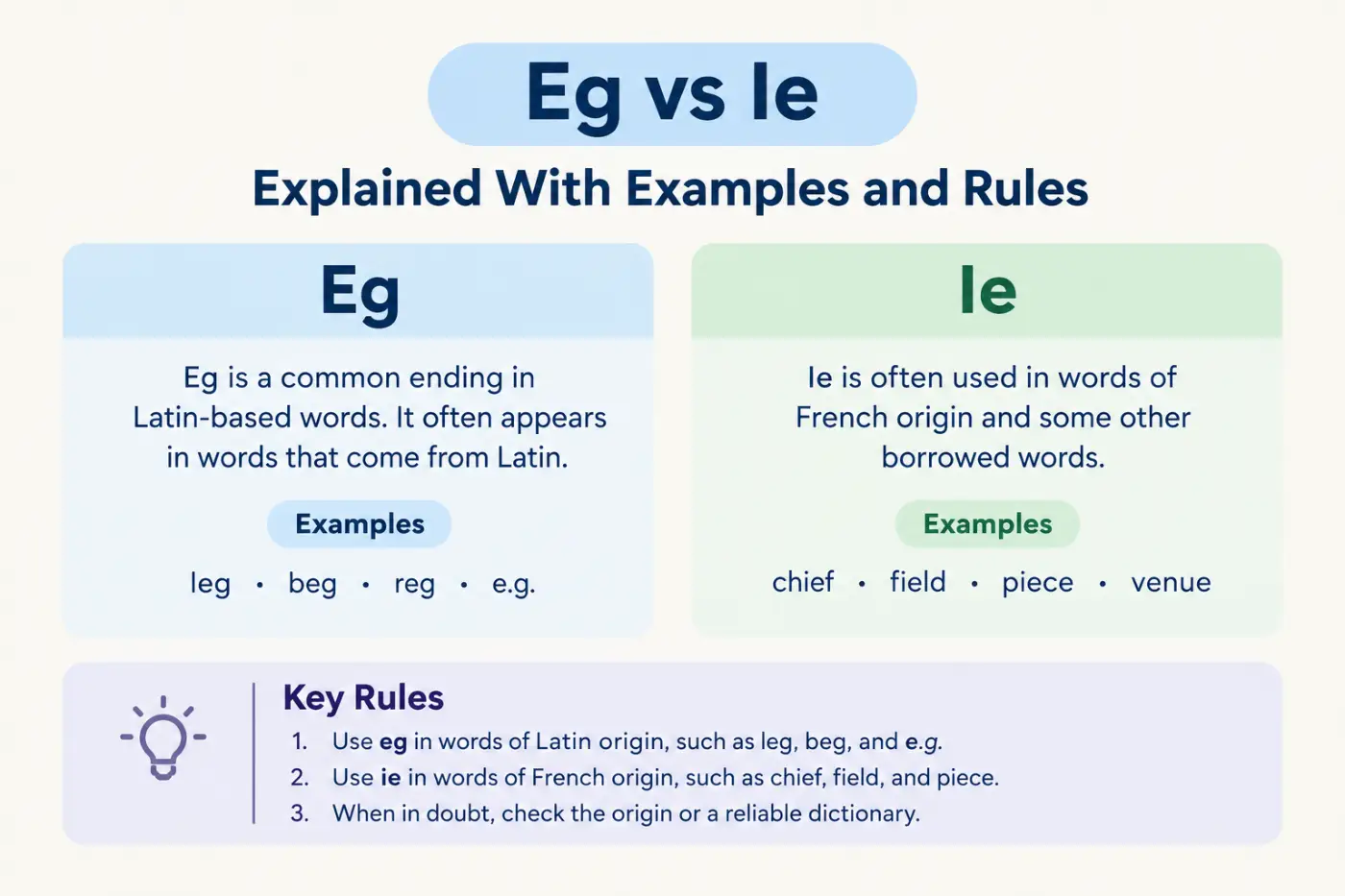
Writers often mix up e.g. and i.e. because both abbreviations come from Latin and appear in the middle of sentences. They look similar, and both can introduce information inside parentheses or after a comma. However, they serve different purposes. One introduces examples, while the other explains exactly what something means.
The easiest way to remember the distinction is to think of e.g. as a way to say for example and i.e. as a way to say that is. If you write that you enjoy outdoor activities, e.g., hiking and camping, you are naming a few possibilities. If you explain that you work remotely, i.e., you work outside your employer’s office, you are clarifying what remote work means in that sentence.
These abbreviations are common in emails, reports, academic papers, instructions, and everyday professional writing. Knowing how to use them correctly helps you express ideas clearly and avoid confusing readers. You will also learn how to punctuate them, pronounce them, decide when to replace them with plain English, and recognize the mistakes that often appear in formal writing.
You may also want to read check in vs check-in Correct Spelling Meaning and Usage.
Quick Answer
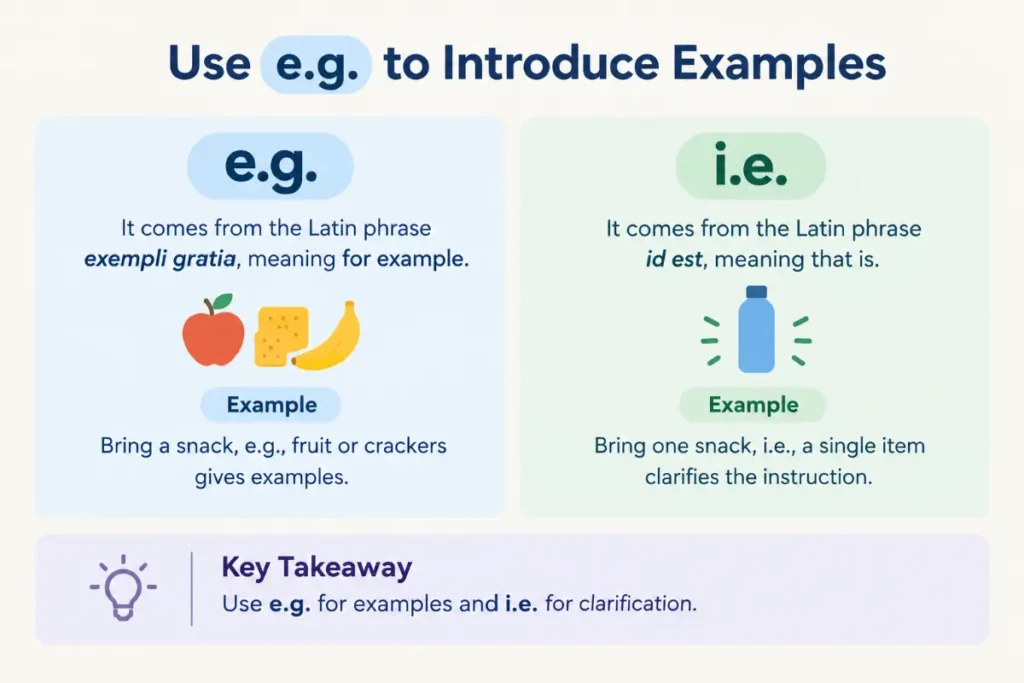
Use e.g. to introduce examples. It comes from the Latin phrase exempli gratia, meaning for example. Use i.e. to clarify or restate something more precisely. It comes from the Latin phrase id est, meaning that is. For instance, Bring a snack, e.g., fruit or crackers gives examples. Bring one snack, i.e., a single item clarifies the instruction.
Table of Contents
- The Meaning of E.g.
- The Meaning of I.e.
- The Main Difference Between the Two Abbreviations
- How to Use Each Abbreviation Correctly
- Punctuation Rules in American English
- Pronunciation Guide
- Ten Examples in Real Sentences
- Common Mistakes to Avoid
- Word Origins and History
- Regional and Professional Usage
- Related Terms and Alternatives
- Expert Editor Insight
- Frequently Asked Questions
- Key Takeaways
- Conclusion
The Meaning of E.g.
The abbreviation e.g. stands for the Latin phrase exempli gratia, which means for example. Use it when you want to name one or more examples of a larger group or category.
For example, imagine you enjoy several kinds of music. You might write, I enjoy classical music, e.g., jazz and opera. In this sentence, jazz and opera are examples of the broader category of music you enjoy. They don’t have to be the only types you like.
Here are three more examples.
- Please bring some office supplies, e.g., pens, paper, and sticky notes.
- Many fruits contain vitamin C, e.g., oranges, kiwis, and strawberries.
- You can learn a new skill, e.g., cooking, photography, or coding.
In each sentence, the abbreviation introduces examples that help readers understand the category.
When to Use E.g.
Use e.g. when your goal is to provide examples rather than a complete explanation. It works well when readers need a few specific items to understand a general idea.
For instance, a teacher might tell students to study literary devices, e.g., metaphors, similes, and personification. The three examples help students understand the broad category of literary devices.
You can also use it in professional writing.
- The report should include key performance measures, e.g., sales growth and customer retention.
- Employees can request workplace adjustments, e.g., an ergonomic chair or a different keyboard.
- The software supports several file formats, e.g., PDF, DOCX, and TXT.
Notice that the examples don’t necessarily cover every possible option. The software may support additional file formats, and the company may track other performance measures.
That is the key feature of e.g.. It introduces examples without claiming that the list is complete.
Does E.g. Mean Such As?
Yes. In many sentences, you can replace e.g. with such as or for example without changing the basic meaning.
Consider this sentence.
The store sells outdoor equipment, e.g., tents and sleeping bags.
You could rewrite it as follows.
The store sells outdoor equipment such as tents and sleeping bags.
Both sentences give examples of outdoor equipment. The second version may sound more natural in everyday writing.
However, e.g. can be useful when space matters, such as in a table, a technical note, or a compact parenthetical explanation.
The Meaning of I.e.
The abbreviation i.e. stands for the Latin phrase id est, which means that is. It introduces a clarification, restatement, or more precise explanation of something already mentioned.
For example, consider this sentence.
The meeting is virtual, i.e., everyone will attend online.
The second part clarifies what virtual means in this particular context. It doesn’t merely offer one possible example. It explains the intended arrangement.
Here are three additional examples.
- The deadline is tomorrow, i.e., Friday at 5 p.m.
- She is an only child, i.e., she has no siblings.
- We need a vegetarian meal, i.e., a meal without meat or fish.
In these sentences, the information after i.e. explains or narrows the meaning of the earlier statement.
When to Use I.e.
Use i.e. when you want to make a statement more specific. It is especially useful when a word or phrase might leave room for confusion.
Suppose a manager writes that employees must attend the final session, i.e., the meeting scheduled for Friday afternoon. The second part identifies the exact session. It doesn’t list several possible sessions.
You might also write the following.
- The event is invitation only, i.e., only people with invitations may attend.
- We need a bilingual editor, i.e., someone who can work fluently in two languages.
- The payment is recurring, i.e., it is charged at regular intervals.
Each explanation narrows the meaning of the first statement.
Does I.e. Mean In Other Words?
Usually, yes. In many contexts, i.e. can be replaced with in other words or that is.
For example.
The room is unoccupied, i.e., nobody is using it.
You could write this instead.
The room is unoccupied. In other words, nobody is using it.
Both versions clarify the meaning. The full phrase often sounds friendlier and more natural in everyday communication, while i.e. may suit technical or compact writing.
Remember that i.e. isn’t simply a shorter way to introduce more information. The added information should clarify or restate the intended meaning.
The Main Difference Between the Two Abbreviations
The essential distinction is the purpose of the information that follows each abbreviation.
E.g. gives examples. I.e. explains or specifies.
| Feature | E.g. | I.e. |
|---|---|---|
| Latin origin | Exempli gratia | Id est |
| English meaning | For example | That is |
| Main function | Introduces examples | Clarifies or restates an idea |
| Type of information | One or more possible instances | A more precise explanation |
| Does it require a complete list? | No | Not a list of examples |
| Common replacement | For example or such as | That is or in other words |
| Typical use | General categories | Definitions and specific explanations |
| Example | Pack snacks, e.g., nuts and fruit. | Pack one snack, i.e., one item of food. |
Compare the Meaning in Context
Consider these two sentences.
Example one: You can use a spreadsheet program, e.g., Excel or Google Sheets.
This sentence names two possible spreadsheet programs. The list is illustrative, so other programs may also qualify.
Example two: Use the spreadsheet program assigned by your manager, i.e., the approved application for your team.
This sentence clarifies which application the writer means. The explanation points to a specific requirement rather than offering a selection of examples.
The distinction can become clearer if you replace each abbreviation with its English equivalent. If for example fits, use e.g.. If that is or in other words fits better, use i.e..
Can Both Appear in the Same Paragraph?
Absolutely. They serve different purposes, so you can use them in the same paragraph when the context calls for both.
For example.
The course covers several writing skills, e.g., grammar, spelling, and punctuation. Students must also complete the final assessment, i.e., the test required to pass the course.
The first abbreviation introduces examples of writing skills. The second identifies the specific assessment students must complete.
There is no need to avoid one simply because you have already used the other. Just make sure each one performs its proper function.
How to Use Each Abbreviation Correctly
Correct usage depends on the relationship between the main statement and the information that follows.
Use E.g. for an Open List
An open list contains examples without claiming to include every possibility.
For example.
The store sells winter clothing, e.g., coats, gloves, and scarves.
The store may sell boots, hats, and other items too. The examples simply illustrate the category.
Another example is this sentence.
Several subjects interest me, e.g., history, biology, and literature.
The subjects listed are examples of the speaker’s interests. The sentence doesn’t claim that the list is complete.
Use I.e. for a Clarification
Use this abbreviation when the second part explains the first part more precisely.
For example.
The office is closed on the next business day, i.e., Monday.
This works if Monday is the specific day intended by the statement.
Another example.
She requested an extension, i.e., additional time to finish the assignment.
The explanation tells readers exactly what an extension means in this situation.
Check the Logic of Your Sentence
A sentence may contain the right abbreviation but still be unclear. The best test is to look at the relationship between the two parts.
Ask yourself these questions.
- Am I giving a few possible examples of a broader category? Use e.g.
- Am I explaining the meaning of a term or identifying one specific thing? Use i.e.
- Does the information after the abbreviation add examples instead of defining the earlier phrase? Use e.g.
- Does the information after the abbreviation restate the earlier idea more clearly? Use i.e.
This quick check is often enough to catch a mistake before you finish writing.
Punctuation Rules in American English
Both abbreviations traditionally include periods in American English. Write e.g. and i.e. in formal prose unless your organization’s style guide calls for another format.
Punctuation after these abbreviations depends on how they fit into the sentence. A comma often follows them in American English, but parentheses and sentence structure can change what punctuation you need.
Should You Put a Comma After E.g. and I.e.?
In American English, a comma commonly follows either abbreviation when it introduces an explanation or examples within a sentence.
For example.
- We offer several payment methods, e.g., credit cards and bank transfers.
- The office closes early, i.e., at 3 p.m.
- Bring basic supplies, e.g., a notebook and two pens.
- The event is postponed, i.e., it will happen on a later date.
The comma helps separate the introductory abbreviation from the information that follows it.
However, punctuation rules can vary by style guide. Some technical, scientific, or publishing styles handle commas after these abbreviations differently. Follow the style required for your document and apply it consistently.
How to Use Them Inside Parentheses
You can place either abbreviation inside parentheses when the examples or explanation are extra information rather than the main point.
For example.
- Several activities are available (e.g., swimming, cycling, and hiking).
- The form requires identification (i.e., a document that confirms your identity).
In the first sentence, the parentheses contain examples. In the second, they contain a clarification.
If the parenthetical material appears at the end of a sentence, the final period usually goes outside the closing parenthesis when the parentheses are part of the larger sentence. If the entire sentence appears inside parentheses, put the period inside the closing parenthesis.
For example.
The course covers several topics (e.g., grammar and punctuation).
(The course covers several topics, e.g., grammar and punctuation.)
The second sentence is fully enclosed in parentheses, so its period belongs inside them.
Should You Capitalize E.g. or I.e.?
In the middle of a sentence, lowercase letters are standard.
For example.
You can choose several activities, e.g., swimming or cycling.
At the beginning of a sentence, capitalization depends on the style guide. Some writers capitalize the first letter of the abbreviation, producing E.g. or I.e.. However, starting a sentence with either abbreviation can make the writing feel unnecessarily technical.
A clearer option is to spell out the meaning.
For example.
You can choose several activities. For example, you can go swimming or cycling.
The revised sentence is easier to read and works well for a broad audience.
Do These Abbreviations Need Periods?
In traditional American English, yes. The standard forms are e.g. and i.e..
Some technical publications, organizations, and style systems use forms without periods. Those forms aren’t automatically errors in every context, but they may conflict with the style expected by your school, employer, publisher, or instructor.
For general American English writing, the safest approach is to use periods consistently.
Should You Use a Semicolon After E.g. or I.e.?
A semicolon isn’t normally needed immediately after either abbreviation. The comma is the more common choice when the abbreviation introduces examples or a clarification within a sentence.
For example.
The course covers several subjects, e.g., math, science, and history.
A semicolon may be appropriate elsewhere in a sentence when separating two independent clauses, but it shouldn’t replace the comma simply because you used e.g. or i.e..
Pronunciation Guide
Although both abbreviations come from Latin, English speakers commonly pronounce them by saying their letter names.
| Abbreviation | Common spoken form | IPA |
|---|---|---|
| E.g. | Ee jee | /ˌiː ˈdʒiː/ |
| I.e. | Eye ee | /ˌaɪ ˈiː/ |
The pronunciation guide represents the usual way English speakers read the abbreviations aloud. Exact rhythm and stress can vary by speaker.
How to Pronounce E.g.
Say the names of the two letters. The first sounds like the letter E, and the second sounds like the letter G.
In ordinary speech, many people avoid saying the abbreviation aloud. They say for example instead because it sounds more natural.
For instance, rather than reading a sentence as The shop sells fruit, E.G., apples and pears, you can say The shop sells fruit, for example, apples and pears.
How to Pronounce I.e.
Say the letter I followed by the letter E. The first letter rhymes with eye, while the second sounds like the letter E.
In conversation, people usually say that is or in other words instead. This helps the listener understand the intended meaning without needing to recognize a Latin abbreviation.
Common Pronunciation Mistakes
A common problem is treating the abbreviations as if they were ordinary words. They aren’t usually pronounced as a single word with a new sound.
Another mistake is confusing their spoken forms because their written forms look alike. Remember that the letter names differ. E sounds like the beginning of eagle, while I sounds like the word eye.
You don’t need to memorize the Latin phrases to speak clearly. Learning the English meanings is much more useful for everyday communication.
For another common grammar confusion, see shoyu vs tonkotsu Which Ramen Should You Choose.
Ten Examples in Real Sentences
These examples show how the abbreviations work in different situations. Each sentence includes a short explanation of the meaning.
Examples Using E.g.
1. Everyday conversation: I enjoy outdoor activities, e.g., hiking and fishing.
Hiking and fishing are two examples of outdoor activities. The speaker may enjoy other activities too.
2. Text message: Bring something to drink, e.g., water or juice.
Water and juice are possible choices. The list doesn’t exclude other drinks.
3. Workplace communication: Please attach supporting documents, e.g., receipts and invoices.
The sentence gives examples of documents that may support a request.
4. School assignment: Choose a literary device, e.g., a metaphor or a simile.
A metaphor and a simile are two possible choices for the assignment.
5. Academic writing: Several factors affect plant growth, e.g., light, water, and temperature.
The listed factors illustrate the wider group of influences on plant growth.
Examples Using I.e.
6. Everyday conversation: I need a quiet place, i.e., somewhere without loud music.
The second part explains the kind of place the speaker wants.
7. Workplace communication: The report is confidential, i.e., only authorized people may read it.
The explanation clarifies the restriction on access.
8. School assignment: Submit the final draft, i.e., the version you want your teacher to grade.
The second part identifies the specific version required.
9. Formal writing: The payment is overdue, i.e., its due date has already passed.
The explanation restates the meaning of overdue in plain language.
10. Online communication: The account is inactive, i.e., it isn’t currently being used.
The second part clarifies the condition of the account.
How the Meaning Changes With One Abbreviation
Compare these two sentences.
The company offers flexible benefits, e.g., extra vacation days and wellness programs.
The company offers a fixed benefit, i.e., an additional five vacation days for every employee.
The first sentence provides examples of a broad category. The second specifies the exact benefit being discussed.
That distinction matters because readers may interpret an example as one of several choices, while a clarification can define the exact scope of a statement.
Common Mistakes to Avoid
Several errors occur because writers remember the abbreviations but forget their purpose.
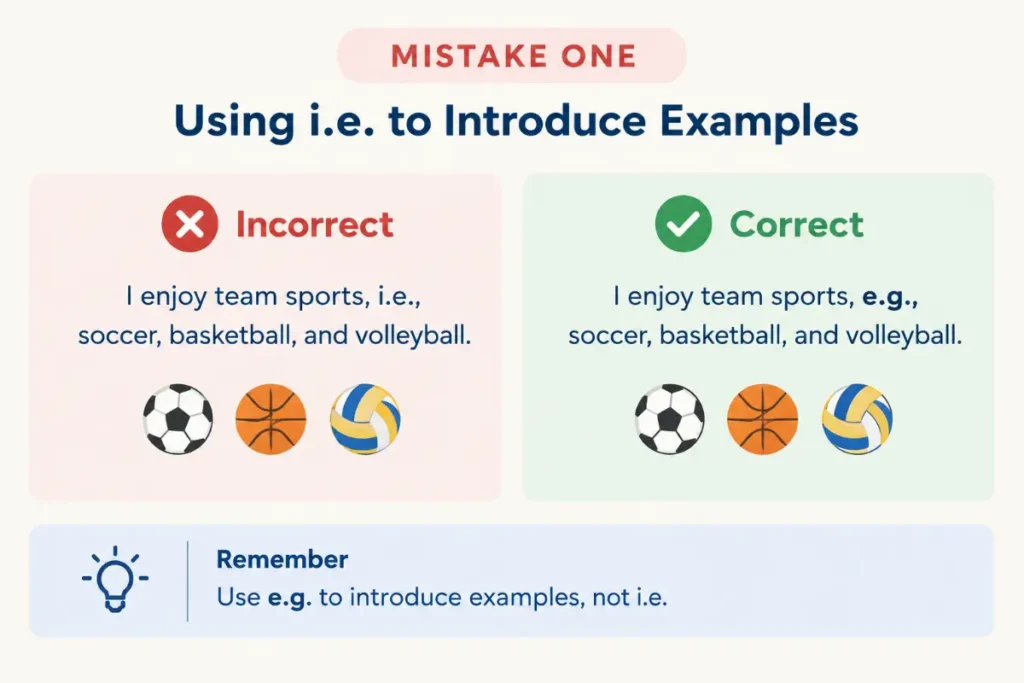
Mistake One Using I.e. to Introduce Examples
Incorrect: I enjoy team sports, i.e., soccer, basketball, and volleyball.
Correct: I enjoy team sports, e.g., soccer, basketball, and volleyball.
The sentence names examples of team sports. It doesn’t define the entire category, so e.g. is the appropriate choice.
Mistake Two Using E.g. to Give a Complete Definition
Incorrect: A triangle has three sides, e.g., a shape with three straight sides.
Better: A triangle has three sides, i.e., a shape with three straight sides.
The second part restates the definition rather than offering another example. In this context, i.e. fits better, although the sentence could also be written more simply without either abbreviation.
Mistake Three Forgetting the Periods
Less suitable for standard American prose: We sell several products, eg, notebooks and folders.
Preferred: We sell several products, e.g., notebooks and folders.
The traditional American forms include periods. Use the format required by your style guide when writing for a specific publication.
Mistake Four Using Both Abbreviations Together
Incorrect: Choose a fruit, e.g., i.e., an apple.
Correct: Choose a fruit, e.g., an apple or a pear.
The incorrect sentence combines two abbreviations that perform different jobs without a clear purpose. The corrected sentence gives examples of fruit.
Mistake Five Making the Explanation Too Vague
Unclear: The project needs special equipment, i.e., tools.
Clearer: The project needs special equipment, e.g., a laser level and a digital measuring tool.
The word tools is too broad to explain exactly what the project needs. Specific examples make the instruction more useful. If the intention is to define special equipment, provide a precise explanation after i.e..
Word Origins and History
Both abbreviations come from Latin, a language that has influenced English vocabulary, education, law, medicine, and scholarship for centuries.
The Origin of E.g.
The letters in e.g. stand for exempli gratia. The phrase means for the sake of an example or, in natural English, for example.
The expression became established in written English through the long tradition of using Latin in education and formal documents. Its abbreviated form remains useful when a writer wants to introduce examples without spelling out the full phrase.
The original Latin meaning also explains why the abbreviation introduces illustrative items rather than a definition.
The Origin of I.e.
The letters in i.e. stand for id est. This phrase means that is.
The expression entered English writing through the same broader tradition of Latin scholarship and formal written communication. It became a compact way to restate an idea or explain the exact meaning of a term.
Although Latin is no longer the normal language of everyday communication, these abbreviations remain familiar in English. Their meanings are stable enough that readers often recognize them immediately in formal writing.
Do You Need to Know Latin to Use Them?
No. You only need to remember their English meanings and the jobs they perform.
Memorizing the Latin phrases can help explain the abbreviations, but it isn’t necessary for correct usage. If you remember for example for e.g. and that is for i.e., you have the information you need for most writing tasks.
Regional and Professional Usage
The meanings of both abbreviations remain the same across major varieties of English. The main differences involve punctuation preferences, editorial style, and how often writers choose abbreviations instead of plain English.
American English
In the United States, e.g. and i.e. are standard forms in academic, professional, and technical writing. American style guides commonly retain the periods and often place a comma after each abbreviation when it introduces material within a sentence.
For example.
The team reviewed several options, e.g., a phone call, an email, or a video meeting.
The deadline is fixed, i.e., no extensions are available.
For general readers, writing out for example or that is can make a sentence easier to follow.
British English
British English uses the same abbreviations with the same meanings. Punctuation preferences may differ among publishers and style guides. Some British publications favor less punctuation in abbreviations, so follow the rules of the publication you are writing for.
The choice between e.g. and i.e. does not change in British English. One introduces examples, and the other clarifies an idea.
Canadian and Australian English
Canadian and Australian writers also use both abbreviations. The central distinction remains the same, and there is no major regional difference in meaning.
In either variety, the best choice depends on the sentence. Use e.g. to offer examples and i.e. to make a statement more precise. When writing for a specific organization or publication, check its preferred punctuation style.
Grammar Rules and Sentence Structure
Both abbreviations are used to connect a general statement with examples or an explanation. They don’t replace the main grammar of the sentence, so the surrounding words must still form a clear and correct sentence.
Can E.g. or I.e. Start a Sentence?
Yes, but it is usually better to avoid beginning a sentence with either abbreviation in general writing.
For example.
Less natural: E.g., you can save money by planning meals.
Better: For example, you can save money by planning meals.
The second version sounds more natural and is easier for readers who aren’t familiar with Latin abbreviations.
The same advice applies to i.e..
Less natural: I.e., the payment must arrive before Friday.
Better: In other words, the payment must arrive before Friday.
Starting with a full English phrase keeps the sentence accessible.
Can You Use Them in Academic Writing?
Yes. Both forms appear in academic and technical writing. They can be useful when introducing examples, explaining a technical term, or clarifying a point.
However, some academic style guides limit their use in the main text or prefer the full English expressions. Always follow the required style guide for your assignment, journal, or institution.
Should You Use Them in Emails?
You can use them in professional emails, particularly when the reader understands the abbreviations. Still, for everyday workplace communication, plain English often works better.
Compare these examples.
More technical: Please send the required files, e.g., the invoice and the signed form.
More conversational: Please send the required files, such as the invoice and the signed form.
The second sentence feels more natural in most everyday emails.
Can You Use Them in Formal Reports?
Yes. They are acceptable in many formal reports, especially in scientific, legal, and technical fields. The main concern is consistency and clarity.
If a report addresses a broad audience, spell out the meaning when the abbreviation could distract readers. If the intended audience regularly uses these forms, the abbreviations may be perfectly appropriate.
Related Terms and Useful Alternatives
Knowing the alternatives can help you choose language that fits the audience and the sentence.
1. For example. Use this phrase to introduce one or more illustrations of a general idea. It is the clearest everyday replacement for e.g.
2. Such as. Use this phrase before examples within a sentence. For instance, Many sports, such as tennis and soccer, require practice.
3. Including. Use this when naming items that belong to a larger group. The package includes several tools, including a screwdriver and a wrench.
4. That is. Use this phrase to explain or clarify a statement. It is the most direct everyday replacement for i.e.
5. In other words. Use this when restating an idea in a clearer or simpler way. It works well in explanations and conversations.
6. Specifically. Use this when identifying an exact detail. The team needs one additional editor, specifically someone with legal writing experience.
7. Namely. Use this when identifying the particular person or thing you mean. The winner was one student, namely the class president.
8. For instance. Use this phrase as an alternative to for example. It introduces an illustrative case and sounds natural in both conversation and writing.
These alternatives aren’t identical in every grammatical context. For example, such as usually fits before examples within a sentence, while in other words often introduces a full restatement. Choose the expression that fits the sentence rather than replacing abbreviations mechanically.
Expert Editor Insight
An experienced editor looks at meaning before punctuation. The most common problem is not a missing period but a mismatch between the abbreviation and the information that follows it. If the writer lists possible items, e.g. is the natural choice. If the writer defines a term or narrows a statement to a specific meaning, i.e. usually fits. Grammar checkers may catch punctuation issues, but they cannot always determine the intended relationship between two ideas. Reading the sentence with for example or that is substituted is a simple and reliable editing test.
Key Takeaways
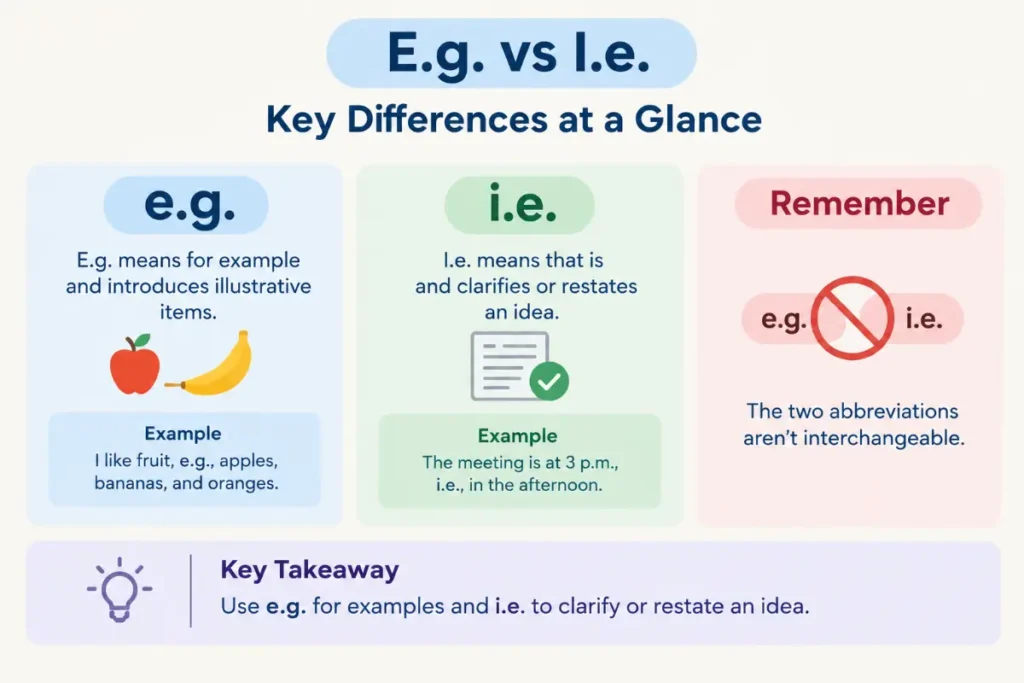
- E.g. means for example and introduces illustrative items.
- I.e. means that is and clarifies or restates an idea.
- The two abbreviations aren’t interchangeable.
- In standard American writing, both traditionally include periods.
- A comma commonly follows either abbreviation when it introduces material within a sentence.
- The meanings are the same in American, British, Canadian, and Australian English.
- Plain English often works better than Latin abbreviations in casual writing.
- The simplest test is to substitute for example or that is and check which one fits.
Learn the difference in Implicit vs Complicit Which Word Should You Use 2026.
Conclusion
The difference between eg vs ie comes down to one simple idea. Use e.g. to give examples and i.e. to explain exactly what you mean. Both are standard English abbreviations, but each serves a distinct purpose.
For everyday American writing, remember the English meanings rather than relying on the similar appearance of the letters. If you are listing possible items, choose e.g.. If you are clarifying a statement, choose i.e.. When the abbreviations make a sentence feel too technical, write for example or in other words instead. This small editing habit will make your emails, school assignments, reports, and articles clearer and easier to read.
Frequently Asked Questions
What is the difference between e.g. and i.e.?
E.g. means for example and introduces one or more illustrations of a broader category. I.e. means that is and introduces a clarification or restatement. If you are naming possible choices, use the first. If you are explaining exactly what you mean, use the second.
Is e.g. the same as for example?
Yes. E.g. is the standard abbreviation for the Latin phrase exempli gratia, which means for example. You can often replace it with for example or such as. The abbreviation is common in technical and formal writing, while the full phrase may sound more natural in everyday conversation.
Is i.e. the same as in other words?
In many contexts, yes. I.e. stands for id est, meaning that is. It introduces a clarification or restatement of the earlier idea. In other words is a natural alternative when you want to explain something in plain English, though the best replacement depends on the sentence.
Do you put a comma after e.g. and i.e.?
In standard American prose, a comma commonly follows either abbreviation when it introduces examples or a clarification within a sentence. For example, You can bring a snack, e.g., fruit or crackers. Some style guides use different punctuation rules, so follow your publisher’s or organization’s requirements.
How do you pronounce e.g. and i.e.?
English speakers commonly pronounce e.g. by saying the letter names E and G. They pronounce i.e. by saying I and E. In ordinary conversation, people often say for example, that is, or in other words instead of reading the abbreviations aloud.
Can you use these abbreviations in formal writing?
Yes. Both are accepted in many academic, technical, and professional contexts. However, some style guides prefer the full English expressions, especially in general audience writing. If you are writing for a school, employer, journal, or publisher, follow its style rules and use each abbreviation consistently.
Why do people confuse e.g. and i.e.?
Both abbreviations contain two letters and periods, and both introduce additional information. The difference is the relationship between that information and the original statement. One provides examples, while the other clarifies meaning. Replacing each abbreviation with its English equivalent is a quick way to check your choice.
Should I use e.g. or i.e. in everyday emails?
For most everyday emails, for example, such as, that is, and in other words sound natural and are easy to understand. Use the abbreviations when they suit the tone and your reader will understand them. In clear business communication, the full phrases are often the better choice.