
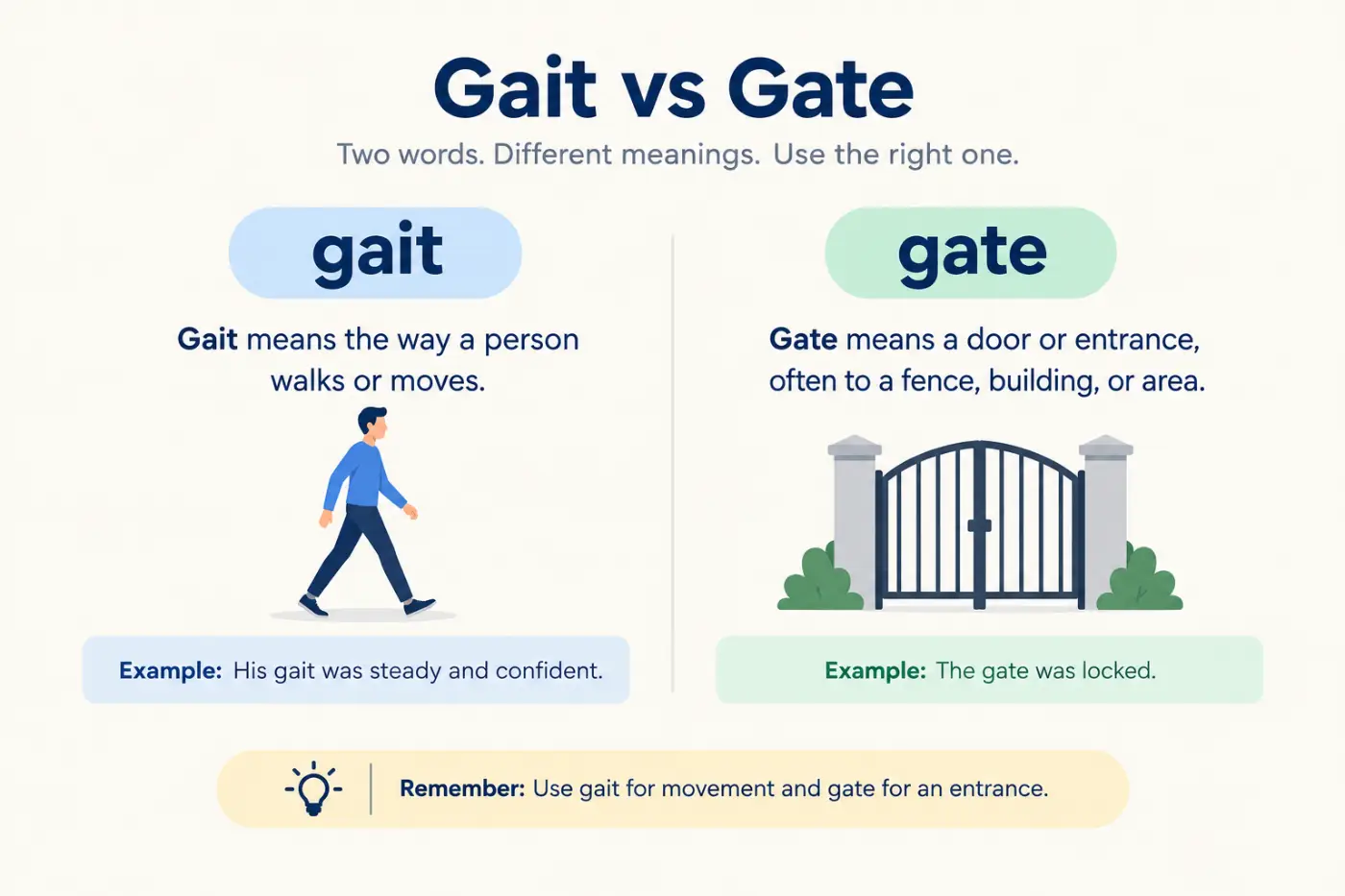
Gait vs gate causes confusion because the two words sound the same in standard American English. The spelling gives you an important clue. Gait relates to the way someone walks or moves, while gate refers to an entrance, barrier, or controlled opening.
You may see gait in medical writing, sports, horse riding, and descriptions of movement. Gate is much more common in everyday English. You might open a gate to enter a yard, wait at a gate at an airport, or close a gate to keep animals inside. Gait, by contrast, describes movement itself. A doctor may examine a patient’s gait, or a rider may notice a horse’s unusual gait.
The difference becomes easy once you connect each word with its meaning. Think of gait as a pattern of movement and gate as something you pass through or close. This guide explains the spelling, meanings, pronunciation, grammar, word origins, common mistakes, regional usage, and practical examples so you can choose the right word with confidence.
For another common grammar confusion, see Conex Or Connex Differences, Meaning and Correct Usage(2026).
Meaning of Gait
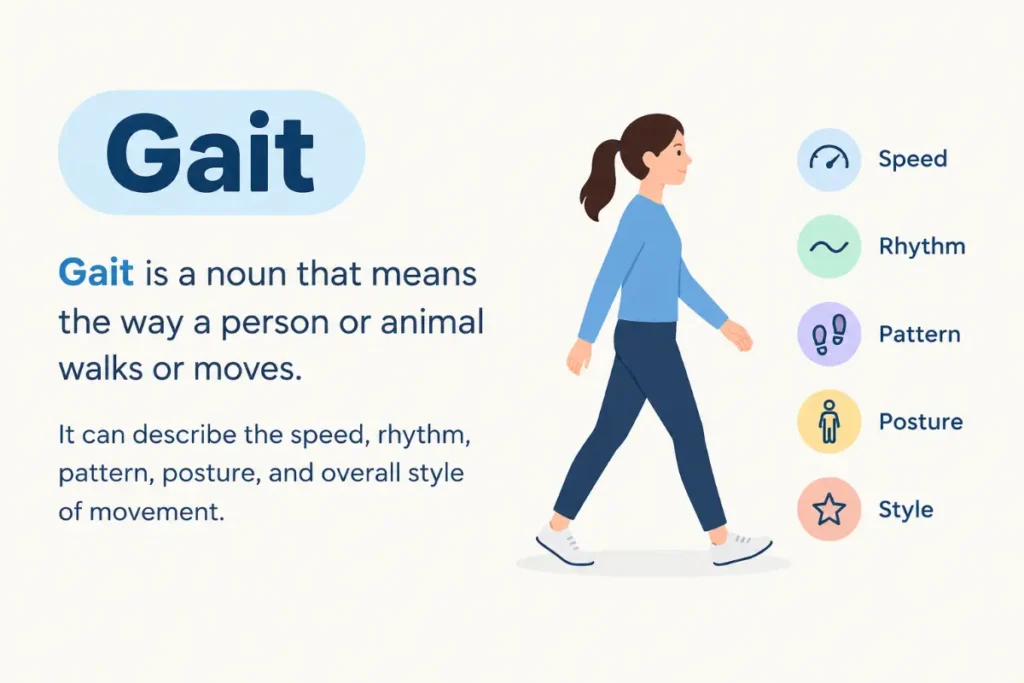
Gait is a noun that means the way a person or animal walks or moves. It can describe the speed, rhythm, pattern, posture, and overall style of movement.
For example, someone may have a slow gait after an injury. A doctor may notice that a patient has an uneven gait. A horse may have a smooth gait that makes it comfortable to ride.
The word is especially useful when the way a person or animal moves matters.
Consider these examples.
- The doctor noticed that the patient had an unusual gait.
- His relaxed gait made him look confident.
- The horse has a smooth and steady gait.
- The runner changed her gait during the final mile.
- The injury affected his gait.
In each sentence, gait refers to movement rather than an object.
The word can describe ordinary walking, but it can also appear in technical contexts. Doctors, physical therapists, sports professionals, trainers, and animal specialists may use it when discussing movement patterns.
Meaning of Gate
Gate is a noun that usually refers to a movable barrier used to control access through an opening. It can also mean the opening itself or a place where people enter or leave.
A gate can be part of a fence around a home. It can separate two areas on a farm. It can control access to a building or property.
For example.
- Please close the gate behind you.
- The children ran through the garden gate.
- We waited outside the gate.
- The horse escaped through an open gate.
- Security checked our tickets at the gate.
Gate has several common uses beyond physical fences.
At an airport, a gate is the designated area where passengers wait before boarding a flight.
At a stadium, a gate can refer to an entrance.
In technology and engineering, gate can have specialized meanings as well. A gate may be part of an electronic circuit or a control mechanism.
The central idea stays the same. Gate is connected with entry, exit, access, or control.
Gait vs Gate Comparison
| Word | Meaning | Part of Speech | Origin | Usage Frequency | Formality | Common Contexts | Example |
|---|---|---|---|---|---|---|---|
| Gait | The way a person or animal walks or moves | Noun | Old French and related Germanic history | Less common than gate | Neutral to formal | Medicine, sports, horses, movement | The therapist examined his gait. |
| Gate | A barrier, entrance, opening, or access point | Noun | Old English | Very common | Neutral | Homes, airports, farms, buildings, transportation | Please close the gate. |
The table shows the main distinction clearly. Gait describes movement. Gate refers to an entrance, barrier, or access point.
The Key Difference Explained
The spelling difference is only one letter, but the meanings are completely different.
- Gait relates to movement.
If you are describing how someone walks, use gait.
Example: The runner has a fast gait.
- Gate relates to access.
If you are describing an entrance or barrier, use gate.
Example: The gate is locked.
- Gait is usually used as a noun.
You can describe someone’s gait or an animal’s gait.
Example: Her gait changed after the injury.
- Gate is also usually used as a noun.
You can open, close, lock, enter through, or stand near a gate.
Example: The children waited near the gate.
- The words are homophones in standard American English.
They generally sound alike even though they have different spellings and meanings.
This is why context matters so much. When you hear the word rather than see it written, you have to use the surrounding sentence to determine the intended meaning.
Which Form Is Correct
Both gait and gate are correct English words. Neither is a misspelling of the other.
The correct choice depends entirely on what you mean.
Use gait when you mean a person’s or animal’s manner of walking or moving.
Use gate when you mean a barrier, entrance, opening, or access point.
For example.
The doctor studied his gait.
The doctor studied his gate.
These sentences do not express the same idea. The first concerns walking. The second suggests that the doctor studied an entrance or barrier.
A useful editor’s test is to replace the word with a simple description.
If you can say walking style, gait probably fits.
If you can say entrance or barrier, gate probably fits.
Why The Words Sound The Same
Gait and gate are homophones. Homophones are words that have the same pronunciation but different meanings and spellings.
Other familiar English homophones include pair and pear, right and write, and see and sea.
Gait and gate are particularly easy to confuse because their spellings are visually similar as well as sounding alike.
The pronunciation is not the main problem in speech. The real problem appears when you write the word.
For example, someone might say that a patient has a strange gait. A listener who has never seen the word may later spell it as gate because that is the spelling they already know.
The same problem can happen in reverse. Someone writing about a garden gate might accidentally write gait because the two forms sound identical.
Pronunciation Guide
In standard American English, gait and gate are pronounced the same.
Both contain the long a sound found in words such as day and name.
Gait is pronounced as one syllable.
Gate is also pronounced as one syllable.
The IPA pronunciation for both words is commonly represented as /ɡeɪt/.
The initial sound is the hard g sound found in go. The vowel is the long a sound. The final sound is t.
You can think of the sound pattern as one clean syllable.
The pronunciation gives you no reliable way to distinguish the words when you hear them alone. You need context.
For example, if someone says, The doctor examined his gait, the medical context tells you that the word refers to walking.
If someone says, Close the gate, the action tells you that the word refers to an entrance or barrier.
How Gait Works In A Sentence
Gait is a countable noun in many uses. You can talk about a gait, someone’s gait, a particular gait, or different gaits.
For example.
- The patient developed a different gait after the surgery.
- The trainer studied the horse’s gait.
- The runner has an efficient gait.
- Several gaits are common in different horse breeds.
The word often appears with possessive forms.
His gait was uneven.
Her gait became faster.
The horse’s gait was smooth.
You can also use adjectives to describe a gait.
A gait may be slow, fast, steady, uneven, awkward, smooth, natural, unusual, relaxed, or efficient.
These combinations are common because gait describes a pattern of movement.
How Gate Works In A Sentence
Gate is also a noun, but it refers to an object, opening, or access point.
You can use many verbs with it.
- Open the gate.
- Close the gate.
- Lock the gate.
- Unlock the gate.
- Enter through the gate.
- Walk toward the gate.
- Wait by the gate.
- Stand outside the gate.
Gate can also be modified by adjectives.
A gate may be wooden, metal, narrow, wide, locked, open, closed, automatic, private, public, or electronic.
For example.
The automatic gate opened when the car arrived.
The metal gate was locked.
We entered through the main gate.
These examples all involve access or movement through an opening.
Common Uses Of Gait
Gait appears in several fields where movement matters.
Medicine
Doctors and physical therapists may examine a person’s gait when assessing movement.
For example.
The therapist observed the patient’s gait during the examination.
A change in gait can be relevant to mobility and physical function.
Sports
Athletes and coaches may discuss gait when studying running or walking technique.
For example.
The coach analyzed the runner’s gait.
In this setting, the word can relate to stride, movement pattern, posture, and efficiency.
Horse Riding
Gait is especially common in discussions of horses.
A horse’s gait describes how it moves. Horse related writing may discuss different gaits and how they feel to a rider.
For example.
The horse has a comfortable gait.
The rider asked the horse to change its gait.
Everyday Description
You do not need to work in medicine or sports to use the word. It can simply describe how someone walks.
For example.
I recognized him by his distinctive gait.
That sentence means the person’s way of walking helped identify him.
Common Uses Of Gate
Gate is one of the more common words in everyday English.
Home And Property
People use gates at houses, gardens, farms, schools, and other properties.
For example.
Please shut the garden gate.
The dog ran through the gate.
Airports
Gate is an essential airport word.
For example.
Our flight leaves from Gate 12.
We need to get to the gate before boarding begins.
Stadiums And Event Venues
Large venues often have several gates.
For example.
The crowd entered through the main gate.
Security was checking bags at the gate.
Farms
Gates help control the movement of animals and people.
For example.
Always close the farm gate after entering.
Security
A gate can control access to a restricted location.
For example.
The security gate opens with an access card.
The word therefore has a broad range of everyday uses.
Ten Natural Sentence Examples
Here are ten examples that show how the two words work in real English.
- The physical therapist watched her gait as she walked across the room.
This sentence uses gait because the focus is on the person’s walking pattern.
- Please close the gate before the dog gets outside.
Gate refers to the barrier that controls access to the yard.
- The runner changed his gait after increasing his speed.
The sentence discusses a change in running movement.
- We waited at the airport gate for our boarding announcement.
Gate refers to the designated airport boarding area.
- The horse has a smooth gait that makes it comfortable to ride.
The word describes the horse’s manner of moving.
- The old wooden gate leads into the garden.
Gate refers to a physical entrance.
- The doctor noticed a change in the patient’s gait.
The sentence concerns the patient’s way of walking.
- Please use the main gate when you arrive at the school.
Gate refers to the school’s entrance.
- Her natural gait became more confident after months of training.
The sentence describes her movement pattern.
- The security guard locked the gate after everyone left.
Gate is the physical barrier being locked.
Common Mistakes And Misspellings
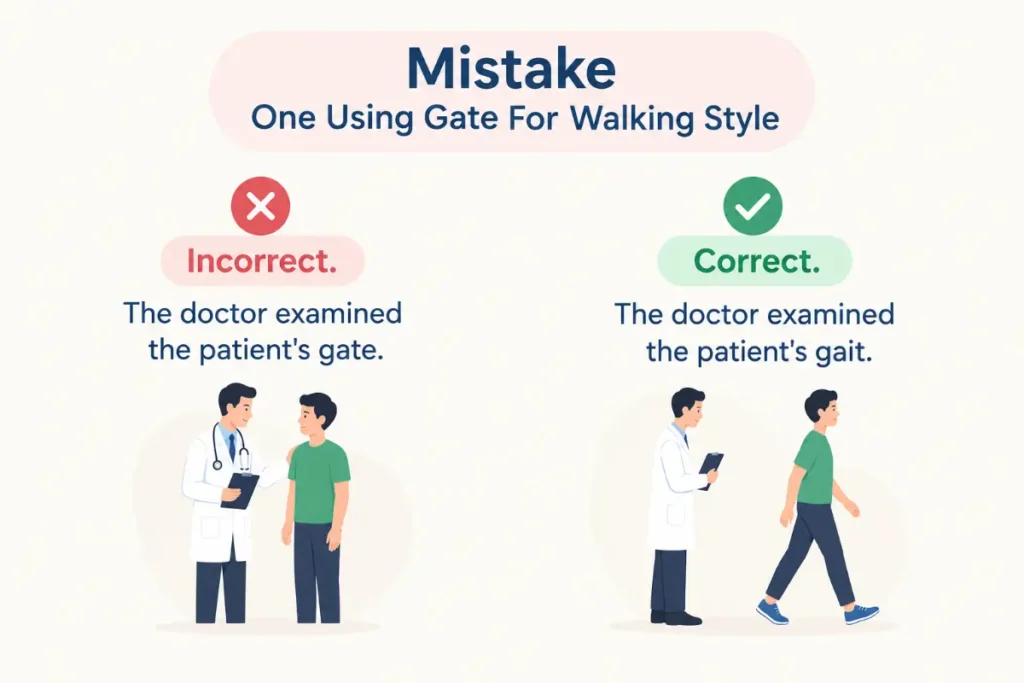
Mistake One Using Gate For Walking Style
Incorrect.
The doctor examined the patient’s gate.
Correct.
The doctor examined the patient’s gait.
The confusion happens because both words sound the same. In a medical or movement context, gait is the correct spelling.
Mistake Two Using Gait For An Entrance
Incorrect.
Please close the garden gait.
Correct.
Please close the garden gate.
A garden entrance or barrier is a gate.
Mistake Three Choosing The Word From Sound Alone
When you hear either word, you cannot depend on pronunciation to determine the spelling.
Instead, look at the meaning.
If the sentence concerns walking, running, or animal movement, think gait.
If it concerns an entrance, barrier, or access point, think gate.
Mistake Four Assuming Similar Spelling Means Similar Meaning
The words look almost identical, but that does not make them related in modern meaning.
English contains many words with similar spelling and unrelated meanings. Gait and gate happen to be homophones, which makes the confusion stronger.
Mistake Five Forgetting The Medical Use
Some writers know gate very well but rarely see gait. This can lead to errors in health, fitness, and sports writing.
If a sentence describes walking ability, movement patterns, stride, or physical examination, check the spelling carefully.
Memory Tips
The easiest way to remember the difference is to connect gait with walking.
Think of the phrase walking gait.
That pairing reinforces the meaning immediately.
For gate, think about something you can open or close.
You can open a gate.
You can close a gate.
Another useful memory trick is to associate the extra letter in gait with the idea of a person’s way of moving. The spelling is unusual enough that it deserves special attention.
You can also use a simple two word test.
Gait means movement.
Gate means entrance.
If you remember those two ideas, you will usually choose the correct spelling without hesitation.
Etymology And Word Origin
Gait has a long history in English and is connected with words relating to going and movement. The modern English form developed through Middle English from older Germanic forms, with influence from related Scandinavian vocabulary. Its history reflects the basic idea of a way of going or moving.
Gate has an older Germanic history. It comes from Old English forms related to an opening or passage. The word has close relatives in other Germanic languages.
The two words therefore have different historical paths even though their modern pronunciation is the same.
Their spelling and meaning developed separately. That is why you should not treat one as a variation of the other.
Need another quick comparison? Read shinny vs shiny Correct Spelling Meaning and Usage.
American English Usage
Both words are standard in American English.
Gait is used in medical, physical therapy, sports, fitness, horse related, and general descriptive contexts.
Gate is extremely common in everyday American English. It appears in discussions about homes, airports, schools, farms, stadiums, security, transportation, and access.
There is no American spelling rule that changes one word into the other.
The distinction remains semantic.
If you mean walking style, use gait.
If you mean an entrance or barrier, use gate.
British English Usage
British English also uses both words with the same basic meanings.
A person’s gait refers to the way that person walks.
A gate refers to an entrance, barrier, or access point.
The pronunciation is also very similar in standard British English.
There is no major British versus American spelling difference that changes this pair.
The same basic rule works across both varieties of English.
Canadian And Australian English
Australian and Canadian English also use gait and gate as standard words with the same core meanings.
Australian English commonly uses gate in everyday situations involving property, farms, entrances, and access.
Canadian English uses both words in the same broad ways found in American English.
Regional vocabulary can differ around particular objects or settings, but there is no major regional spelling distinction between these two words.
Grammar And Part Of Speech
Both words are nouns, but they refer to completely different things.
Gait is a noun for a manner or pattern of walking or moving.
Gate is a noun for a physical barrier, entrance, opening, or access point.
Neither word normally functions as a verb in ordinary modern English with the meanings discussed here.
You can use gait with possessives.
Her gait was unusual.
His gait changed after the injury.
You can also use gate with possessives.
The house gate was open.
The airport gate changed.
Both words can take modifiers.
A smooth gait.
An uneven gait.
A locked gate.
A wooden gate.
A large gate.
The grammar is straightforward once the meanings are separated.
Formal And Informal Usage
Gait is neutral and can appear in both everyday and professional writing. It is especially common in formal contexts involving medicine, physical therapy, sports science, and animal movement.
For example.
The patient’s gait was assessed during the examination.
That sentence sounds professional because the subject itself is clinical.
In casual conversation, someone might simply say.
He walks strangely.
The more precise word gait becomes useful when the exact pattern of movement matters.
Gate is neutral and extremely common. You can use it in casual conversation, workplace writing, academic writing, journalism, and formal documents.
For example.
Please close the gate.
The main gate will remain closed during construction.
Both are natural.
Real Life Usage In Daily Conversation
People often use gate in ordinary conversation because entrances and barriers appear in daily life.
- The kids left the gate open again.
- Can you meet me at the front gate?
Gait is less common in casual speech, but it still appears when someone needs to describe movement precisely.
- I noticed something different about his gait.
- Her gait looked normal again after the injury healed.
The difference in frequency does not change the meaning. It simply reflects how often people need to talk about entrances compared with walking patterns.
Real Life Usage In Workplace Communication
Gate can appear in workplace communication involving buildings, security, transportation, or access.
For example.
Please use the north gate when entering the facility.
Gait may appear in jobs connected with health, fitness, sports, rehabilitation, or animal care.
For example.
The therapist will evaluate the patient’s gait during the appointment.
In both cases, context makes the intended word clear.
Real Life Usage In Academic Writing
Academic writing often uses gait in research and technical discussions of movement.
For example.
The study examined changes in walking gait after exercise.
Gate can also appear in academic writing, especially in engineering, architecture, transportation, computer science, and social research.
For example.
The researchers measured traffic entering through the main gate.
The words are not restricted to everyday language. Their usefulness depends on the subject.
Real Life Usage In Journalism And Storytelling
Journalists may use gait when describing a person’s movement.
For example.
The witness described the man’s distinctive gait.
Writers may use gate to establish a physical setting.
For example.
She stopped at the old gate and looked across the field.
In storytelling, gate often carries a simple physical meaning, while gait can add detail to a character’s movement.
A writer might describe a character’s slow gait to suggest tiredness without directly stating that the person is exhausted.
Related And Confused Terms
Several words connect naturally with these two terms.
Walk
Walk is a common verb and noun for moving on foot.
Gait is more specific because it describes the manner or pattern of walking.
Stride
Stride refers to the length or manner of a person’s step.
It can be part of someone’s overall gait.
Pace
Pace refers to speed or the rate at which someone walks or moves.
It is related to movement but does not mean exactly the same thing as gait.
Step
Step can mean a single movement made by lifting and placing one foot.
A series of steps contributes to walking and can form part of a person’s gait.
Entrance
An entrance is a place or opening through which people enter.
A gate can serve as an entrance.
Door
A door is a movable structure that closes an opening in a building, vehicle, or other structure.
Like a gate, it can control access, but the two objects are not identical.
Barrier
A barrier is something that blocks or controls movement.
A gate can function as a barrier.
Homophone
A homophone is a word that has the same pronunciation as another word but differs in meaning or spelling.
Gait and gate are an example of this pattern in standard English.
How To Choose The Right Word Quickly
If you are writing quickly and hesitate between the two spellings, use this short decision process.
- Ask what the sentence is about.
If it concerns walking, running, posture, or animal movement, choose gait.
- Ask if you can open or close it.
Words such as patient, walking, stride, runner, horse, and movement point toward gait.
Words such as garden, airport, fence, entrance, security, and yard point toward gate.
- Read the complete sentence again.
The meaning should make the choice obvious.
For example.
The horse had a strange ___.
The answer is gait because the sentence describes movement.
Now consider this sentence.
The horse escaped through the ___.
The answer is gate because the horse passed through an entrance.
Expert Editor Insight
An experienced editor treats this pair as a context problem rather than a pronunciation problem. Since the words sound alike, spell checking software may not catch a mistake if the wrong word is still a valid English word. A grammar tool can sometimes miss the error for the same reason. The safest approach is to check the meaning of the sentence. If the word refers to movement, choose gait. If it refers to an entrance or barrier, choose gate.
A Simple Editing Exercise
Read each sentence and choose the correct word.
- The doctor noticed that his gait had changed.
- Please close the gate after entering the yard.
- The runner improved her gait through regular training.
- We arrived at the airport gate early.
- The horse has a graceful gait.
- The security gate opens automatically.
- His gait became uneven after the injury.
- The children ran toward the front gate.
The pattern should now be clear. Movement takes gait. Access takes gate.
Key Takeaways
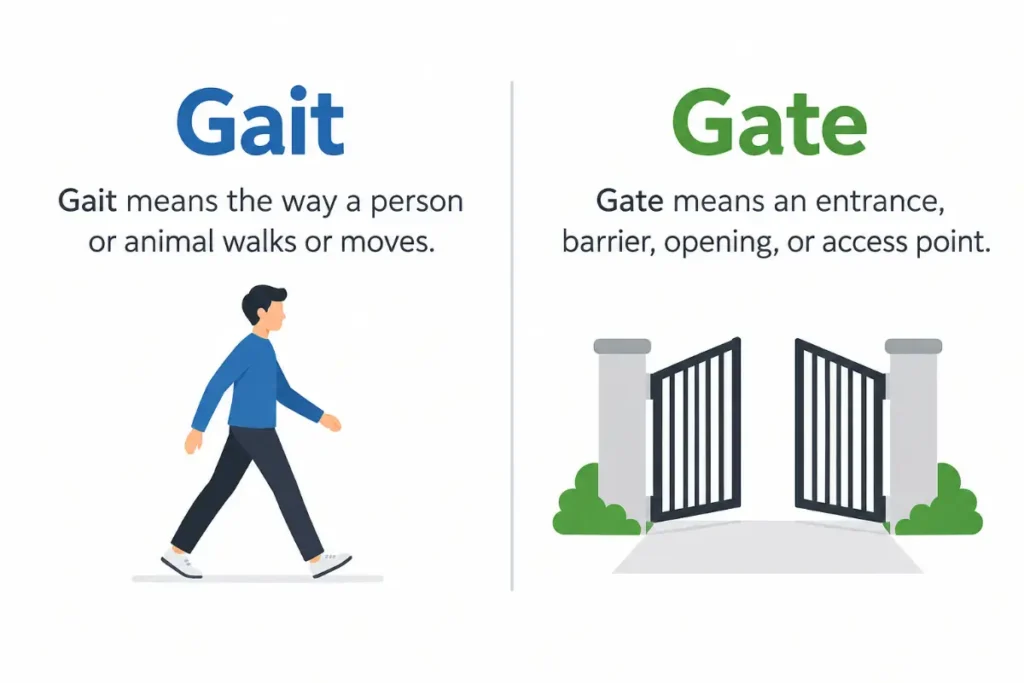
- Gait means the way a person or animal walks or moves.
- Gate means an entrance, barrier, opening, or access point.
- Both words are nouns.
- Gait and gate are homophones in standard American English.
- Both are pronounced /ɡeɪt/.
- Gait is common in medicine, physical therapy, sports, horse riding, and movement descriptions.
- Gate is common in everyday situations involving homes, airports, schools, farms, buildings, and security.
- Neither word is a misspelling of the other.
- Use context to choose the correct spelling because pronunciation cannot distinguish them.
- The easiest memory rule is simple: gait means movement and gate means entrance.
Need another quick comparison? Read Stellar vs Steller: Meaning, Spelling, and Usage.
Conclusion
Gait vs gate is a classic homophone problem, but the distinction is straightforward once you connect each word with its meaning. Gait refers to the way a person or animal walks or moves. Gate refers to an entrance, barrier, opening, or access point.
Use gait in sentences about walking patterns, running movement, medical assessment, sports, or animals. Use gate for gardens, yards, airports, schools, buildings, farms, and security entrances. The two words sound the same in standard American English, so pronunciation will not help you choose the spelling.
The best editing trick is to focus on meaning before spelling. If the sentence is about movement, choose gait. If it is about entry or a barrier, choose gate. Once you make that connection, this confusing word pair becomes easy to handle.
FAQs
Is gait or gate correct for the way someone walks?
Gait is correct when you mean the way a person or animal walks or moves. For example, a doctor may examine a patient’s gait. Gate is a different word that refers to an entrance, barrier, opening, or access point. The two words sound the same in standard American English but have different meanings and spellings.
Is gait a real English word?
Yes. Gait is a standard English noun. It refers to a person’s or animal’s manner of walking or moving. It is common in medical, physical therapy, sports, horse riding, and movement related contexts and It can also appear in ordinary descriptions, such as when someone recognizes another person by a distinctive way of walking.
What does gate mean?
Gate is a noun that usually refers to a movable barrier or an entrance through which people or animals pass. It can also refer to an access point at an airport or other location. Common examples include garden gate, front gate, airport gate, security gate, and main gate.
How do you pronounce gait and gate?
In standard American English, gait and gate are homophones. Both are pronounced as one syllable and are commonly represented in IPA as /ɡeɪt/. Their identical pronunciation is one reason writers sometimes confuse the spellings. Context is needed to determine which word belongs in a written sentence.
Why do people confuse gait and gate?
People confuse them mainly because they sound the same and look similar. Gate is also much more common in everyday writing, so some readers may know gate well while having less experience with gait. Medical, sports, and horse related writing can introduce gait more often.
Can gait refer to running?
Yes. Gait can describe a pattern of movement that includes walking and running. In sports and movement analysis, professionals may study how a person moves while walking or running. The exact meaning depends on context, but the central idea remains the person’s pattern or manner of movement.
Is gate appropriate in formal writing?
Yes. Gate is a standard word that works in formal and informal writing. It can describe physical entrances, barriers, airport access points, security controls, and other openings. For example, a formal report might state that the main gate remained closed during construction.
What is an easy way to remember the difference?
Connect gait with walking and gate with an entrance. If you can describe the person’s way of walking, use gait. If you can open, close, lock, or walk through the object, use gate. This simple meaning based test is more reliable than trying to remember the spelling from pronunciation.