
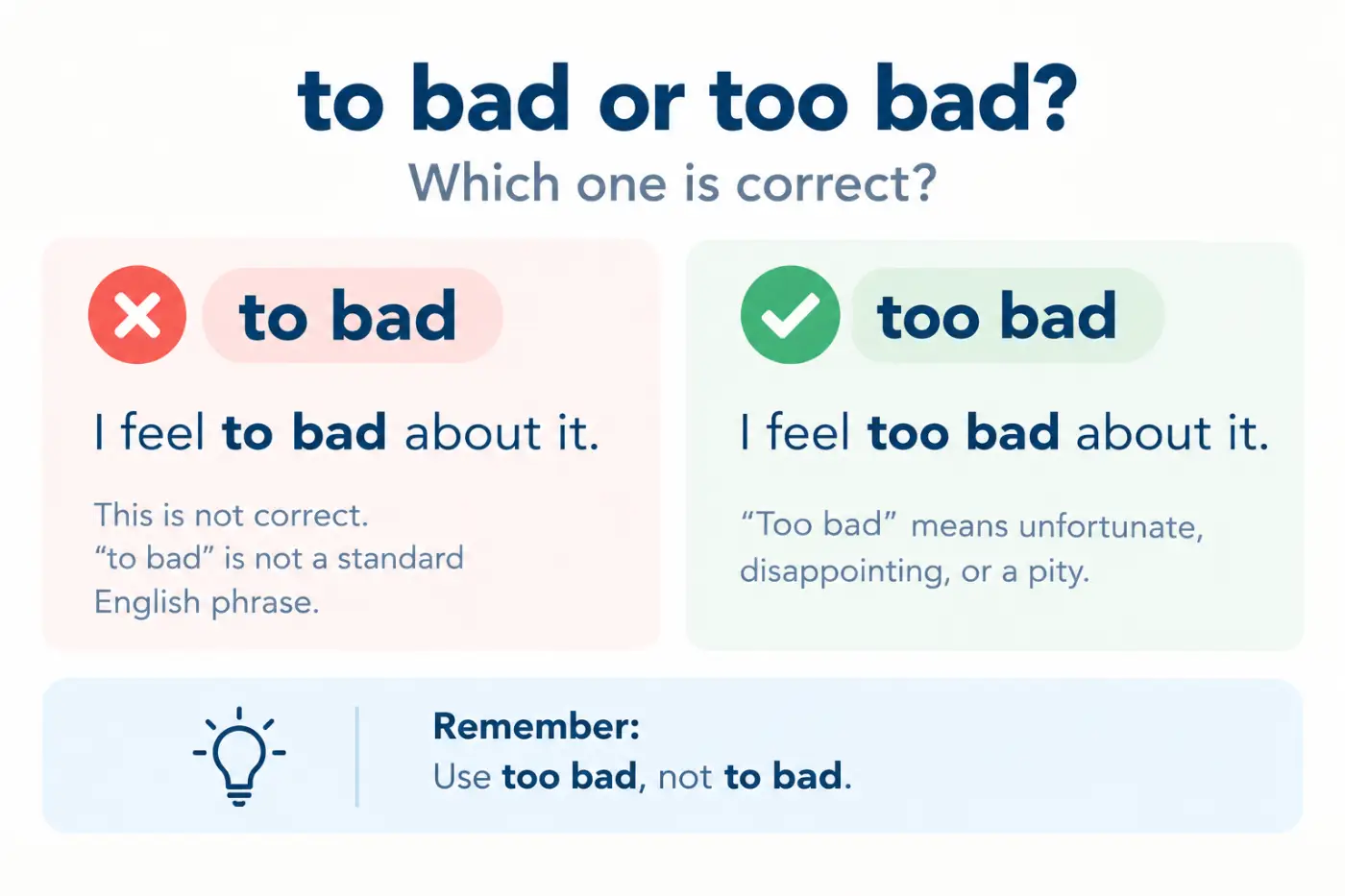
To bad or too bad is a common spelling confusion because both forms sound the same in many varieties of spoken English. The correct phrase is too bad when you want to say that something is unfortunate, disappointing, excessive, or regrettable.
The confusion usually comes from the fact that to and too are both extremely common English words. They have different grammatical jobs, but fast speech can make them sound almost identical. That makes it easy to type the wrong one, especially in texts, comments, emails, and other casual writing.
The good news is that the rule is easy once you understand what each word does. This guide explains the meaning of too bad, why to bad is normally incorrect, how the phrase works in sentences, how to pronounce it, and how to avoid similar mistakes with to, too, and two. You will also see examples from everyday conversation, school, work, and formal writing.
Still confused? Compare onsite vs on-site: Correct Usage Explained.
Quick Answer
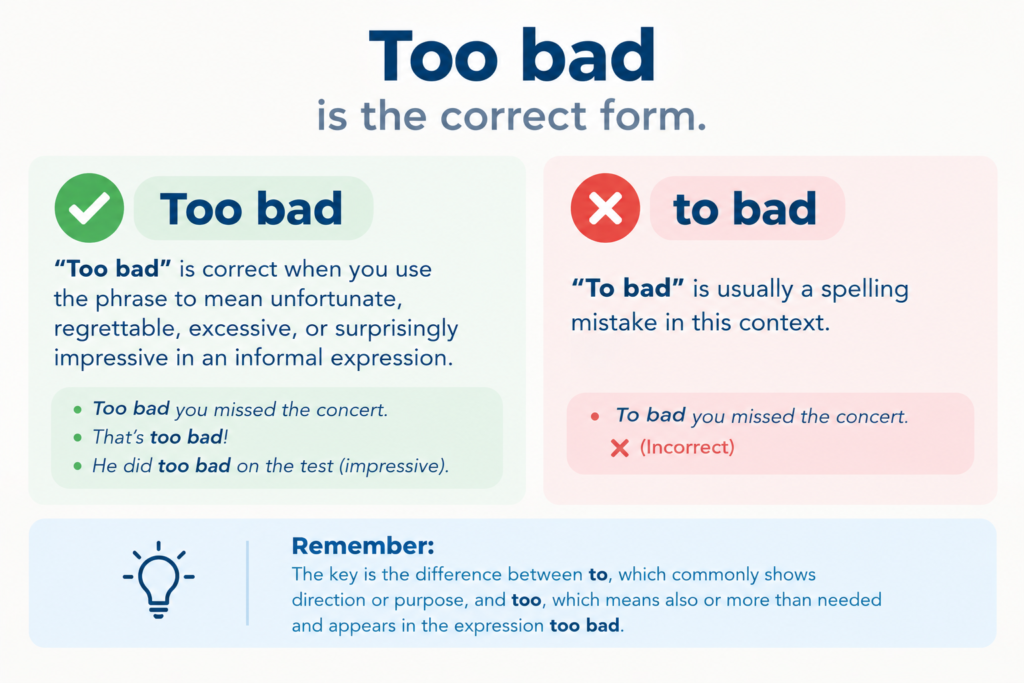
Too bad is the correct form when you use the phrase to mean unfortunate, regrettable, excessive, or surprisingly impressive in an informal expression. To bad is usually a spelling mistake in this context. The key is the difference between to, which commonly shows direction or purpose, and too, which means also or more than needed and appears in the expression too bad.
What Is The Correct Form
The standard phrase is too bad.
It contains the adverb too followed by the adjective bad. Together, the words can express several related ideas depending on the sentence and tone.
For example:
- It is too bad that you missed the meeting.
- That is too bad.
- The weather is too bad for a picnic.
- The movie was not too bad.
In the first two examples, too bad expresses regret or sympathy. In the third, too means excessively or to an undesirable degree and In the fourth, not too bad is a common expression meaning fairly good or better than expected.
By contrast, to bad does not normally work as the standard phrase in these sentences. If you write That is to bad, readers will usually see it as a spelling error.
Comparison Table
| Form | Meaning | Part of Speech | Origin | Usage Frequency | Formality | Common Contexts | Example |
|---|---|---|---|---|---|---|---|
| too bad | Unfortunate, regrettable, or excessively bad | Adverb plus adjective | Old English roots | Very common | Informal to neutral | Conversation, messages, everyday writing | It is too bad you could not come. |
| to bad | Usually not the intended expression | Preposition plus adjective | To has Old English roots | Uncommon in this intended meaning | Not standard for this expression | Usually a spelling mistake | That is to bad is normally incorrect. |
| too | Also or excessively | Adverb | Old English | Very common | All levels | Everyday and formal English | It is too expensive. |
| to | Direction, destination, relationship, purpose, or part of an infinitive | Preposition or infinitive marker | Old English | Very common | All levels | Almost every type of English writing | I want to go home. |
What Does Too Bad Mean
Too bad has more than one meaning. Context and tone determine the exact sense.
The most common meaning is unfortunate or regrettable.
For example:
It is too bad that Sarah could not attend.
Here, the speaker expresses disappointment or sympathy. The sentence does not necessarily mean that Sarah’s absence was excessively bad. It simply says that the situation is unfortunate.
The phrase can also describe something that is bad to an excessive degree.
The weather is too bad to play outside.
Here, too means more than is acceptable or manageable. The weather has reached a level that prevents the activity.
Another common use appears in not too bad.
How was your first day at work?
Not too bad.
This usually means fairly good, acceptable, or better than expected. It is a very natural expression in casual American English.
The phrase can also express resignation or a lack of sympathy, depending on tone.
You forgot your umbrella? Too bad.
In this sentence, the speaker may sound dismissive. The words themselves are simple, but the tone can make the expression sympathetic, neutral, sarcastic, or dismissive.
What Does To Bad Mean
To bad is not normally the correct form when you want to express regret or say that something is unfortunate.
For example:
It is to bad that you missed the flight.
This should be:
It is too bad that you missed the flight.
The mistake happens because to and too sound similar. Writers sometimes choose the shorter spelling automatically, especially when typing quickly.
There are situations where to appears directly before a word beginning with bad, but that does not create the phrase to bad.
For example:
I want to badly explain what happened.
That sentence has a different grammatical structure and actually contains another common issue involving the placement of badly. The important point is that to can appear before a verb in an infinitive, but bad is an adjective.
Compare these structures:
I want to leave.
It is too bad.
The first uses to as part of the infinitive to leave. The second uses too as an adverb modifying bad.
Why The Confusion Happens
The main reason is pronunciation.
In ordinary speech, to is often pronounced with a weak vowel, especially when it appears in an unstressed position. Too usually has a clearer long vowel sound. However, in fast conversation, the distinction can become less noticeable.
Spelling also creates confusion because to, too, and two are homophones or near homophones in standard English pronunciation. They sound alike or almost alike but have different meanings and grammatical functions.
Consider these three words:
- To can show direction or introduce an infinitive.
- Too can mean also or excessively.
- Two refers to the number 2.
The phrase too bad uses the second word.
A useful memory trick is simple: if you mean very or excessively, or you are saying something is unfortunate, think of too. The extra o can remind you that the word carries an additional idea beyond the basic function of to.
Which Form Is Correct
Too bad is the correct standard form for the expression.
The reason is grammatical rather than simply a matter of spelling preference. In this phrase, too functions as an adverb. It modifies the adjective bad.
For example:
The traffic is too bad to drive safely.
Here, too means excessively. The traffic has reached a level that makes safe driving difficult or impossible.
In:
It is too bad that you missed the event.
The phrase has developed into an idiomatic expression meaning unfortunate or regrettable.
The word to cannot perform that same grammatical function in these sentences. It normally works as a preposition or as the marker used with an infinitive.
That distinction is why replacing too with to changes the grammatical structure and usually creates an error.
Key Differences Between To And Too
The difference becomes much easier when you focus on the job each word performs.
- To often shows direction. We went to Chicago.
- To can introduce an infinitive. I want to learn Spanish.
- Too can mean also. I want to come too.
- Too can mean excessively. The coffee is too hot.
- Too appears in the expression too bad. It is too bad that you missed the show.
This is a grammar distinction rather than a regional preference. American, British, Canadian, and Australian English all use too bad as the standard form.
Grammar And Part Of Speech
Understanding the grammar behind the phrase makes the spelling easier to remember.
Too As An Adverb
In too bad, the word too is an adverb.
An adverb can modify an adjective, verb, another adverb, or an entire clause depending on its role.
In:
The food is too spicy.
Too modifies spicy.
In:
The situation is too bad to ignore.
Too modifies bad.
This use often carries the meaning of more than is desirable, acceptable, or manageable.
Too Bad As An Expression
Too bad can also work as a fixed conversational expression.
For example:
Too bad you cannot stay.
This is an informal way to express regret about a situation.
You can also say:
It is too bad that the store closed early.
This version is slightly more complete grammatically, but both forms are natural.
Too Bad At The End Of A Sentence
The expression can stand alone in conversation.
You missed the concert? Too bad.
The exact meaning depends heavily on tone. A warm tone can communicate sympathy. A flat or sarcastic tone can communicate indifference.
Too Bad With An Infinitive
Another useful pattern is:
too + adjective + to + verb
For example:
The box is too heavy to lift.
The water is too cold to swim in.
The noise was too loud to ignore.
In these sentences, notice that both too and to can appear in the same sentence.
That is one reason learners sometimes become confused.
The weather is too bad to go outside.
The first word is too because it expresses an excessive degree. The second is to because it introduces the verb go.
Pronunciation Guide
The phrase too bad is pronounced approximately:
IPA: /tuː bæd/
It has two syllables.
too: /tuː/
bad: /bæd/
The stress is fairly even in normal speech, although the speaker may emphasize either word depending on meaning.
An easy pronunciation guide is:
too BAD
The vowel in too is the long oo sound found in words such as food and blue.
The vowel in bad is the short a sound commonly heard in American English.
The spelling difference between to and too is much clearer in writing than it may seem in casual speech. That is one reason this mistake often appears in text rather than conversation.
Ten Natural Sentence Examples
Here are ten examples showing how the correct phrase works in different situations.
- It is too bad that you could not make it to the party.
- Too bad we missed the last train home.
- The weather was too bad for the outdoor event.
- It is too bad the restaurant closed before we arrived.
- That is too bad, but we can try again tomorrow.
- The road conditions were too bad to continue driving.
- My first interview did not go too badly, so I am feeling hopeful.
- Too bad you did not see the final scene of the movie.
- The signal was too bad for a clear phone call.
- The test was not too bad once I understood the instructions.
Notice that the phrase can carry different shades of meaning. In some examples, it expresses regret. In others, it means excessive severity and In not too bad, it can even express mild approval.
Need another quick comparison? Read gizmo vs gismo: Which Spelling Is Correct?.
Common Mistakes And Misspellings
Writing To Bad Instead Of Too Bad
This is the most direct mistake.
Incorrect:
It is to bad that you missed the game.
Correct:
It is too bad that you missed the game.
The writer has selected to, which does not perform the required grammatical function.
Confusing Too With To Before A Verb
The opposite mistake also happens.
Incorrect:
I want too go home.
Correct:
I want to go home.
Here, to introduces the verb go. The word too would be incorrect.
A simple test is to ask if the word means also or excessively. If it does not, too probably is not the right choice.
Confusing Too With Two
Some learners also confuse too with two.
Incorrect:
I bought too apples.
Correct:
I bought two apples.
Two refers to the number 2. Too does not.
Missing The Second O In Fast Typing
People often type to bad because to is much more common as a standalone word. The brain can produce the familiar spelling automatically even when the intended word is too.
Proofreading helps catch this mistake.
Assuming Similar Sound Means Similar Function
English contains many words that sound alike but behave differently in a sentence. To, too, and two are a classic example.
Pronunciation alone cannot tell you which spelling to use. Look at the grammatical role of the word.
How To Remember The Difference
A simple memory rule works well.
If you mean also, use too.
I want to come too.
If you mean more than necessary or desirable, use too.
The bag is too heavy.
If you mean unfortunate or regrettable in the expression too bad, use too.
Too bad you cannot stay.
If you are showing direction or introducing an infinitive, use to.
We went to school.
I need to study.
If you are talking about the number 2, use two.
I have two brothers.
This three word distinction solves most spelling problems involving these forms.
Real Life Usage
Daily Conversation
The phrase appears constantly in casual conversation.
Too bad you missed the sale.
That is too bad.
Too bad we did not know about the change earlier.
In spoken English, the expression can sound warm, neutral, sarcastic, or dismissive. Tone matters as much as vocabulary.
If someone says:
Oh, that is too bad.
They may be showing genuine sympathy.
If someone says:
You forgot your ticket? Too bad.
They may be expressing annoyance or indifference.
Text Messages
The phrase is also common in texts and online conversations.
Too bad you cannot come tonight.
That is too bad. Maybe next time.
In informal messaging, people may shorten sentences or omit subjects, but the spelling remains too bad.
Workplace Communication
The phrase can appear in workplace conversations, especially informal messages between colleagues.
It is too bad the meeting had to be canceled.
Too bad the client could not join us today.
For formal workplace writing, a more precise phrase may sometimes sound better.
Instead of:
Too bad the deadline was missed.
You could write:
It is unfortunate that the deadline was missed.
The original expression is not grammatically wrong, but unfortunate sounds more formal and professional.
Academic Writing
Academic writing usually favors precise language.
You might see:
It is unfortunate that the sample size was smaller than expected.
rather than:
It is too bad that the sample size was smaller than expected.
The latter is understandable, but it has a conversational tone.
This does not make too bad incorrect. It simply means that word choice should match the purpose and audience.
News And Journalism
Journalistic writing often prefers specific descriptions over conversational reactions.
A news report might say:
The storm caused extensive damage across the region.
A conversational speaker might say:
It is too bad that so many homes were damaged.
Both can communicate regret, but they serve different purposes.
Storytelling And Literature
In stories and dialogue, too bad can help reveal a character’s attitude.
For example:
You thought I would wait for you? Too bad.
The phrase can sound sharp or dismissive.
A different character might say:
It is too bad you had to leave so early.
The same phrase can sound caring and sincere.
Regional Usage
American English
Too bad is completely standard in American English.
It appears frequently in everyday speech, texting, informal writing, and conversation. The phrase can mean unfortunate, excessively bad, or acceptable when used in the negative expression not too bad.
There is no American English spelling that replaces too with to in the standard phrase.
British English
British English also uses too bad.
The basic grammar and spelling are the same. British speakers may use different expressions in some contexts, but too bad remains a normal English expression.
There is no meaningful British spelling rule that makes to bad correct.
Australian English
Australian English follows the same basic distinction.
Too bad is the standard spelling for the expression. The pronunciation and conversational tone can vary by speaker, but the written form remains the same.
Canadian English
Canadian English also uses too bad.
The distinction between to, too, and two follows the same basic grammar used in other major varieties of English.
Regional English does not provide a reason to replace too bad with to bad.
Etymology And Word Origin
The three words to, too, and two have different histories even though their modern pronunciations overlap.
To comes from Old English and developed as a preposition expressing ideas such as direction, movement, and relationship. It later became closely associated with the English infinitive, as in to run or to speak.
Too also has Old English roots. Its earlier meanings were connected with ideas such as also, in addition, and to an excessive degree. Modern English retains both major uses.
That gives us two familiar meanings:
I want some too.
Here, too means also.
The coffee is too hot.
Here, too means excessively.
Two has a separate history and refers to the number 2. Despite these different origins and meanings, changes in English pronunciation eventually brought the three words close together in sound.
That historical overlap helps explain why spelling errors involving these words remain so common.
Related And Confused Terms
Several words and expressions are closely connected to this grammar problem.
Too
Too is the word used in too bad. It can mean also or excessively.
She wants to come too.
The room is too small.
To
To commonly expresses direction or introduces an infinitive.
We drove to work.
I need to leave.
Two
Two is the number 2.
I have two tickets.
Bad
Bad is an adjective describing something undesirable, unpleasant, poor, harmful, or negative.
The weather is bad.
In too bad, the word bad is modified by too.
Very Bad
Very bad means extremely bad or highly unpleasant.
The service was very bad.
It does not always have the same meaning as too bad. Very describes degree, while too often suggests a degree beyond what is acceptable or appropriate.
Not Too Bad
Not too bad is a common expression meaning fairly good, acceptable, or better than expected.
How was the movie?
Not too bad.
Unfortunately
It can replace too bad in more formal contexts when you want to express regret.
Unfortunately, the event was canceled.
This sounds more formal than:
Too bad the event was canceled.
Regrettable
Regrettable means deserving regret or disappointment.
The decision was regrettable.
It is useful in formal writing where conversational expressions may not fit the tone.
When Too Bad Means Excessively Bad
One useful distinction deserves special attention.
Sometimes too bad is an idiomatic expression meaning unfortunate. At other times, it has a literal grammatical meaning of excessively bad.
Compare these two sentences:
It is too bad that you missed the flight.
This usually expresses regret.
The weather is too bad to fly.
This describes a degree of bad weather that prevents flying.
The structure can help you identify the meaning.
When too bad stands alone or appears in an expression of sympathy, it often means unfortunate.
When too bad appears in a structure such as too bad to, it often describes an excessive degree.
For example:
The road is too bad to drive on.
The road is so poor that driving on it is not practical.
This distinction matters because learners sometimes assume that too always means simply very. It does not. In many grammatical structures, it suggests more than is desirable or possible.
Is Too Bad Formal Or Informal
Too bad is grammatically correct, but its tone is usually conversational.
It works naturally in:
- Everyday conversation.
- Text messages.
- Informal emails.
- Dialogue.
- Casual online communication.
- Friendly workplace conversations.
For highly formal writing, alternatives such as unfortunate, regrettable, or unfortunately may sound more appropriate.
For example:
Too bad the proposal was rejected.
This sounds casual.
It is unfortunate that the proposal was rejected.
This sounds more formal.
Neither sentence has to be wrong. The difference is mainly one of tone, context, and audience.
Can Too Bad Start A Sentence
Yes.
Too bad we missed the bus.
This is natural informal English.
It is an abbreviated conversational structure. The fuller version could be:
It is too bad that we missed the bus.
Both communicate the same basic idea.
Starting with Too bad is especially common in conversation, texts, and dialogue. In formal writing, the complete version may be preferable if you want a more polished tone.
Can Too Bad Be Used In A Question
Yes, but the question normally depends on the larger sentence.
For example:
Is it too bad if I leave early?
Here, too bad can refer to an unacceptable or undesirable result.
You can also ask:
Was it too bad?
The meaning depends on context. It might refer to the severity of a situation.
For example:
Was the traffic too bad?
This asks if the traffic was excessively severe.
That differs from:
Is it too bad that I missed the meeting?
Here, the phrase is closer to asking how serious or unfortunate the situation is.
Expert Editor Insight
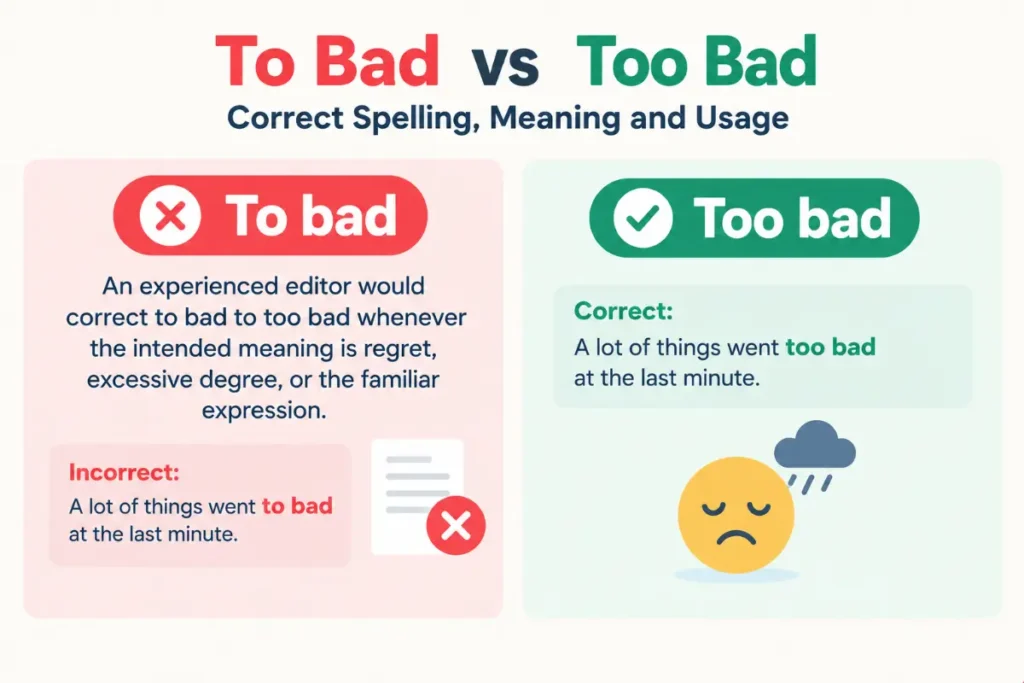
An experienced editor would correct to bad to too bad whenever the intended meaning is regret, excessive degree, or the familiar expression. The confusion is common because the words sound alike and to is far more frequent in ordinary writing. Good editing looks at the grammatical role of the word rather than relying only on sound. A useful proofreading trick is to replace too mentally with also or excessively. If one of those meanings fits, too is probably the right spelling.
Learn the difference in halfday or half-day: Correct Spelling and Usage.
Conclusion
To bad or too bad is a spelling question with a simple answer: too bad is the standard form when you mean unfortunate, regrettable, or excessively bad. The word too works as an adverb, while to has different grammatical functions such as showing direction or introducing an infinitive.
Remember the three word rule: to shows direction or introduces an infinitive, too means also or excessively, and two refers to the number 2. When proofreading, check the meaning rather than the sound. If you mean unfortunate in the familiar expression, write too bad.
FAQs
Is To Bad Ever Correct?
To bad can appear accidentally in writing, but it is normally not the correct spelling of the expression used to mean unfortunate or regrettable. In standard English, write too bad for that meaning. The word to has its own grammatical functions, but placing it before bad does not normally create the intended expression.
What Does Too Bad Mean?
Too bad commonly means unfortunate, regrettable, or disappointing. It can also mean excessively bad when too modifies bad in a literal grammatical structure. In casual speech, the expression can carry different tones, including sympathy, disappointment, sarcasm, or indifference. Context and the speaker’s tone help determine the intended meaning.
Which Is Correct To Bad Or Too Bad?
Too bad is correct when you mean that something is unfortunate or that something is bad to an excessive degree. To bad is normally a spelling mistake in this context. Remember that too can mean also or excessively, while to usually expresses direction or introduces an infinitive.
How Do You Pronounce Too Bad?
Too bad is pronounced /tuː bæd/ in standard American English. It has two syllables. The first word has the long oo sound found in food, while bad has the vowel sound commonly heard in American English words such as cat and sad. In natural speech, the two words usually flow together smoothly.
Can Too Bad Start A Sentence?
Yes. Too bad we missed the concert is a natural informal sentence. It is an abbreviated form of It is too bad that we missed the concert. This construction works well in conversation, texting, and dialogue. In formal writing, the complete version may sound more polished and precise.
Why Do People Confuse To And Too?
People confuse to and too mainly because they sound very similar in speech. Both are also extremely common English words, so writers can select the familiar spelling automatically while typing. The best solution is to focus on meaning and grammar. If the word means also or excessively, too is the correct choice.
Is Too Bad Appropriate In Formal Writing?
Too bad is grammatically correct, but it has a conversational tone. Formal writing often uses alternatives such as unfortunate, regrettable, or unfortunately. For example, It is unfortunate that the meeting was canceled sounds more formal than Too bad the meeting was canceled. Choose the expression that matches the audience and purpose.
What Is A Synonym For Too Bad?
The best synonym depends on the intended meaning. If too bad means unfortunate, alternatives include unfortunate, regrettable, and sadly. If it means excessively bad, phrases such as extremely poor or unacceptably bad may fit. In casual speech, that is unfortunate can replace that is too bad without changing the basic message.