
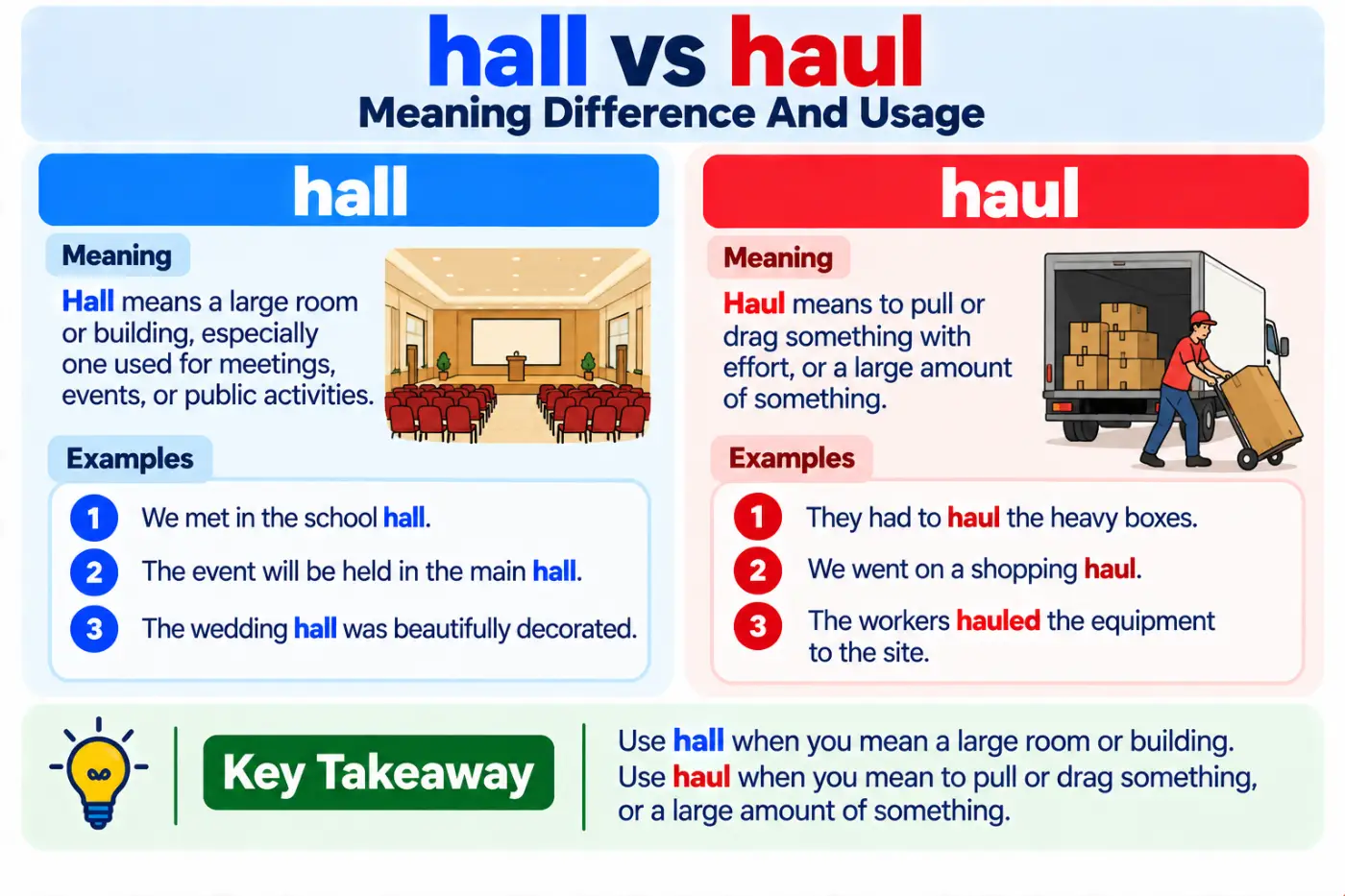
Hall vs haul can be confusing because both words are spelled differently but sound the same for many English speakers. They are both correct English words, so neither one is simply a misspelling of the other. The right choice depends entirely on what you mean.
Hall usually refers to a room, passage, building, or large public space. Haul usually means to pull or carry something, or it can refer to a large amount of something that has been collected, bought, or transported. The spelling changes because the meanings are different.
This distinction becomes easy once you connect each spelling with its meaning. In this guide, you’ll learn how to tell the words apart, how to pronounce them, when to use each one, why people confuse them, and how to avoid the mistake in everyday and formal writing.
Many readers also check Unenroll vs Disenroll Correct Usage and Meaning.
Quick Answer
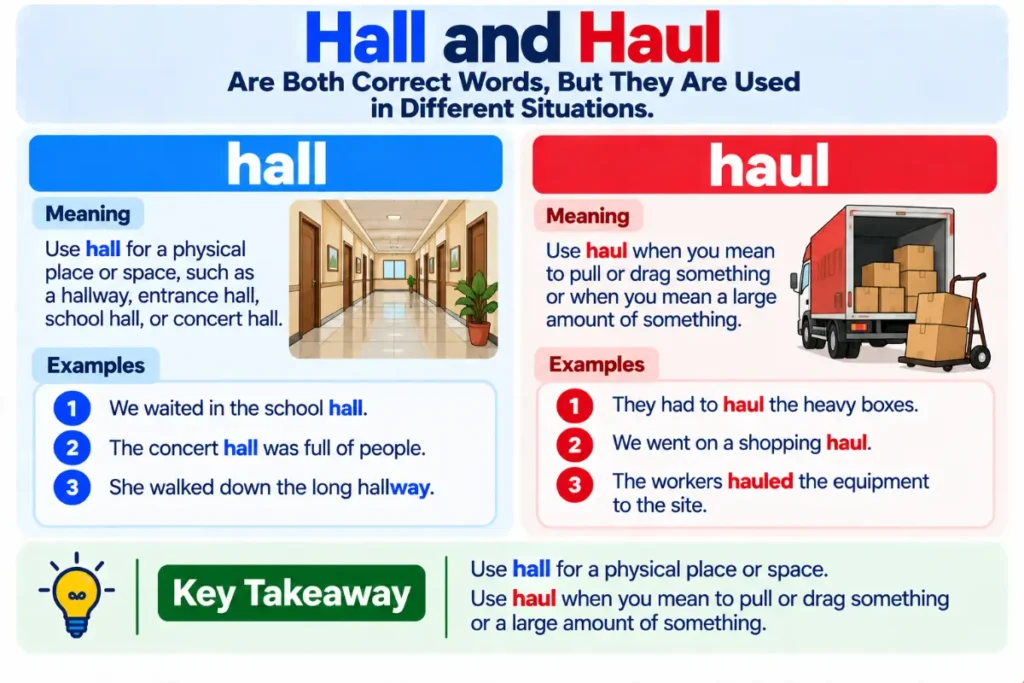
Hall and haul are both correct words, but they have different meanings. Hall usually means a room, passage, building, or large public space. Haul means to pull or carry something, or it can mean an amount of goods collected or transported. They often sound identical, so context determines the correct spelling.
Hall vs Haul Comparison
| Word | Meaning | Part of Speech | Typical Contexts | Example |
|---|---|---|---|---|
| hall | A room, passage, building, or large public space | Noun | Home, school, events, buildings, organizations | We met in the main hall. |
| haul | To pull, drag, or carry something with effort | Verb | Moving, transportation, work, physical tasks | They hauled the boxes upstairs. |
| haul | A quantity of items collected, bought, or transported | Noun | Shopping, fishing, travel, work, media | She shared her vacation haul online. |
The easiest way to remember the difference is to associate hall with a place and haul with moving or collecting things.
What Does Hall Mean?
Hall is a standard English noun with several related meanings. Its most common use refers to a passage or area inside a building. For example, you might walk down a hall to reach a bedroom, classroom, office, or meeting room.
The word can also refer to a large room used for meetings, performances, meals, ceremonies, or other public activities. A school might have an assembly hall, while a city might have a concert hall.
Hall can also describe a large building or an institution. In names such as City Hall, Town Hall, and Student Hall, the word refers to a building or organized public space.
Common uses include:
- A passage inside a building:
The bedrooms are at the end of the hall. - A large room:
The students gathered in the main hall. - A public building:
The meeting will take place at City Hall. - A residence or large historic building:
The family lived in an old country hall. - A place associated with an organization or group:
The university has a new residence hall.
The exact meaning depends on context, but the central idea is usually a place or space.
What Does Haul Mean?
Haul can function as both a verb and a noun.
As a verb, haul means to pull, drag, or transport something, often over a distance or with noticeable effort. The word can suggest that the object is heavy, difficult to move, or being transported as part of a job.
For example:
The workers hauled the equipment into the building.
Here, hauled means moved or carried the equipment.
As a noun, haul can mean a quantity of things that someone has collected, purchased, caught, or brought home.
For example:
We brought home a large haul of fish.
The word is also common in casual online language. Someone might post a shopping haul to show a group of items they recently bought.
Examples include:
- Physical movement:
They hauled the furniture upstairs. - Transportation:
The truck hauled the supplies across the state. - A large catch:
The fishermen returned with a good haul. - A collection of purchases:
She posted a makeup haul on social media. - A quantity collected:
The team came back with a valuable haul of equipment.
The key idea behind the verb is moving something, while the noun often refers to a quantity of things collected or transported.
The Key Difference Between the Two Words
The biggest difference is meaning, not pronunciation.
Hall refers to a place
Use hall when you mean a room, passage, building, or public space.
Please wait in the hallway.
The ceremony will be held in the main hall.
She walked down the hall.
The word often appears in compounds such as hallway, dining hall, concert hall, assembly hall, town hall, and residence hall.
Haul refers to moving or collecting
Use haul when you mean pulling, dragging, carrying, or transporting something.
They had to haul the heavy boxes outside.
It can also describe a collection of items.
My weekend shopping haul was bigger than I expected.
A useful mental shortcut is:
Hall = place.
Haul = pull, carry, or collection.
That simple association solves most spelling problems.
Spelling Difference
The words differ by one letter.
Hall contains all after the initial h.
Haul contains aul after the initial h.
This small spelling difference matters because the words have separate meanings.
The spelling of hall connects it with words such as:
- hallway
- hallways
- halls
- hallroom
The spelling of haul connects it with forms such as:
- hauls
- hauled
- hauling
Notice that the verb changes spelling in a regular way:
haul → hauled → hauling
The final l is doubled in hauled and hauling because of standard English spelling rules for this word.
Pronunciation Guide
In many varieties of English, hall and haul are pronounced the same or almost the same. That makes them homophones for many speakers.
The pronunciation is commonly represented approximately as:
hall: /hɔl/
haul: /hɔl/
The exact vowel can vary by accent. Some American speakers pronounce the vowel differently depending on their regional speech pattern, especially in varieties that distinguish or merge certain vowel sounds.
For a simple American English pronunciation guide, both can sound roughly like:
hall: hawl
haul: hawl
Both words have one syllable, with stress naturally falling on that single syllable.
Because the pronunciation often gives you no useful clue, you can’t always solve the spelling by saying the sentence aloud. You need to consider the meaning.
For example:
We waited in the hall.
The context clearly describes a place.
Compare that with:
We had to haul the boxes.
Here, the context clearly describes moving something.
This is one reason homophones create spelling errors. The listener hears one sound but has to select between different spellings when writing.
Why Do People Confuse Hall and Haul?
The main reason is pronunciation. If two words sound alike, a writer can’t rely on sound alone to select the spelling.
There is also a strong spelling pattern behind the confusion. English contains many words in which different spellings represent similar sounds. Learners may remember the sound first and then choose the spelling that seems familiar.
Several situations make the mistake more likely.
- Fast typing:
People often type based on sound and don’t reread the sentence. - Dictation:
Speech recognition software may need context to distinguish the words. - Early language learning:
Students may learn the spoken form before learning both written forms. - Limited reading exposure:
Someone who hears a word often but rarely sees it in print may have trouble recalling its spelling. - Similar sentence patterns:
Phrases such as “in the hall” and “haul the boxes” can sound very different in meaning but similar enough to cause errors when attention is low.
The solution isn’t to memorize a complicated rule. Connect each spelling with its meaning.
Which Form Is Correct?
Both hall and haul are correct standard English words.
The correct choice depends on the sentence.
Use hall for a place or space:
The students entered the hall.
Use haul for moving something:
The workers hauled the equipment inside.
Use haul as a noun for a collection or quantity:
The fishermen had an impressive haul.
So it would be inaccurate to call haul a misspelling of hall, or the other way around. They are separate words with separate meanings.
This distinction is especially important in formal writing. A spelling checker may identify one word as incorrect if the surrounding sentence makes the intended meaning unclear, but the software cannot always understand what you intended.
Grammar and Part of Speech
Hall is normally used as a noun in modern general English.
It can appear as the subject, object, or complement of a sentence.
The hall was crowded.
Here, hall is the subject.
We entered the hall.
Here, hall is the object of the verb entered.
The meeting room is beside the hall.
Here, hall is the object of the preposition beside.
The word also appears in compound nouns:
hallway
concert hall
dining hall
lecture hall
town hall
residence hall
Haul works as both a verb and a noun.
As a verb:
They haul supplies every week.
As a past tense verb:
They hauled the supplies yesterday.
As a present participle:
They are hauling the supplies now.
As a noun:
The fishermen made a large haul.
This grammatical difference gives you another useful clue. If the sentence needs an action involving moving or transporting something, haul may be the word you need.
Sentence Examples
Here are ten natural examples showing the words in different situations.
- The students gathered in the school hall before the ceremony.
- I left my jacket in the hall near the front door.
- The workers had to haul the heavy machine into the warehouse.
- We watched a concert in a large hall downtown.
- The truck will haul the equipment to the construction site.
- She shared a photo of her latest shopping haul online.
- Please wait in the hall until the meeting begins.
- The fishermen returned with an impressive haul.
- He walked down the hall and knocked on the office door.
- They spent the morning hauling boxes into the new apartment.
Each example gives enough context to make the intended word clear.
Many readers also check Clutz or Klutz Meaning, Usage and Correct Form 2026.
Common Mistakes and Misspellings
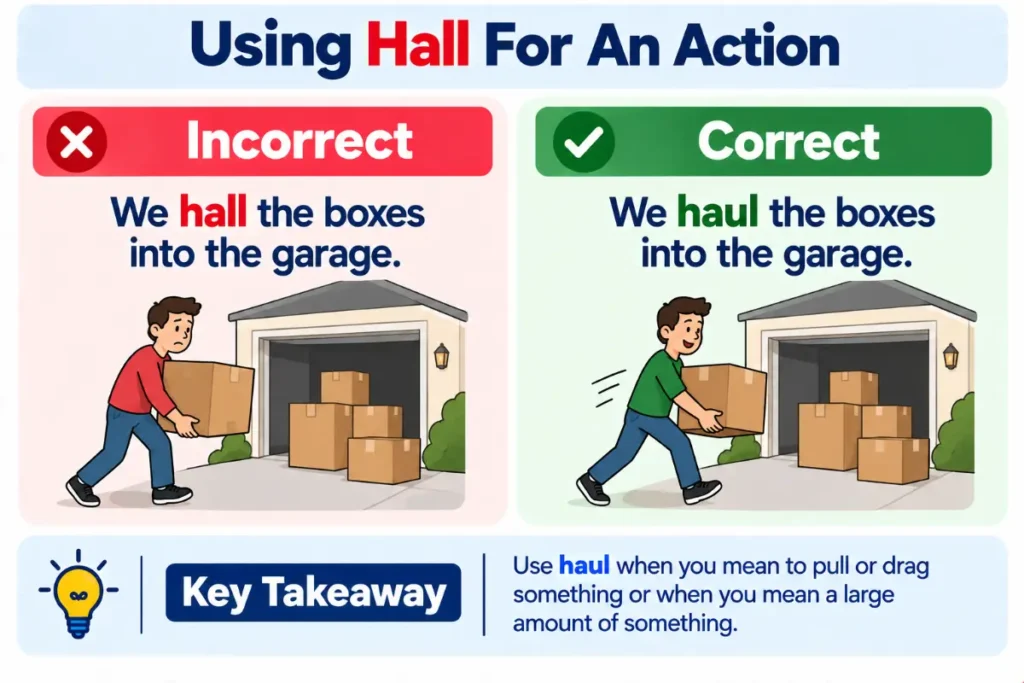
Using hall when you mean move something
Incorrect:
We need to hall these boxes upstairs.
Correct:
We need to haul these boxes upstairs.
The verb haul means to pull, carry, or transport something. Hall doesn’t have this standard meaning.
Using haul for a room
Incorrect:
The students are waiting in the main haul.
Correct:
The students are waiting in the main hall.
A room or large public space is a hall.
Confusing a shopping haul with a location
Incorrect:
I put my new clothes in the shopping hall.
Correct:
I shared my shopping haul online.
A shopping haul is a collection of things bought during shopping. It isn’t a type of room.
Choosing the spelling from sound alone
Incorrect:
We walked through the long haul.
Correct:
We walked through the long hall.
The phrase describes a passage inside a building, so hall is required.
Using hall as the past tense of haul
Incorrect:
They hall the furniture into the house yesterday.
Correct:
They hauled the furniture into the house yesterday.
The past tense of haul is hauled, not hall.
Five Incorrect Examples for Learning
These examples are intentionally incorrect so you can see the difference.
- Incorrect: We waited in the main haul.
Correct: We waited in the main hall. - Incorrect: They had to hall the boxes upstairs.
Correct: They had to haul the boxes upstairs. - Incorrect: The store displayed its weekend shopping hall.
Correct: The store displayed its weekend shopping haul. - Incorrect: The truck will hall the furniture across town.
Correct: The truck will haul the furniture across town. - Incorrect: She walked down the long haul.
Correct: She walked down the long hall.
The incorrect versions may sound fine when spoken, which is exactly why this pair causes trouble in writing.
Etymology and Word Origin
The two words have different histories.
Hall comes from an old Germanic word associated with a large room or covered space. It developed through Old English heall and related Germanic forms before becoming the modern English hall.
The historical sense was connected with a large covered room or central living space. Over time, its meaning expanded into several modern uses, including a passage, meeting room, public building, and large residence.
Haul has a different history. It developed through Middle English forms related to pulling or dragging and is connected with Scandinavian language influence, including Old Norse hala, meaning to pull or draw.
The modern meanings of haul still preserve this basic idea of pulling or transporting something. The noun meaning a quantity collected or transported developed naturally from the action of hauling.
So the words aren’t different spellings of one historical word. They have separate origins and meanings.
Regional Usage
There is no major American versus British spelling difference between these two words. Hall and haul are standard in both American and British English.
American English
Both words are common in the United States.
American speakers use hall for indoor spaces, public buildings, and institutions.
The students met in the lecture hall.
They use haul for pulling, transporting, or collecting things.
The truck hauls goods across the country.
The noun haul is also common in casual American speech, especially for a collection of purchased items.
British English
British English uses the same basic distinction.
We waited in the hall.
They had to haul the furniture upstairs.
The words can also sound the same for many British speakers, so pronunciation doesn’t always help with spelling.
Australian English
Australian English follows the same basic distinction. Hall refers to a place or space, while haul refers to pulling, transporting, or a collection of items.
Canadian English
Canadian English also uses the standard distinction. There isn’t a special Canadian spelling that changes the basic rule.
Accent can affect the exact pronunciation, but the meanings and spellings remain distinct.
Real Life Usage
Daily Conversation
In everyday speech, hall commonly appears when people talk about homes, schools, offices, and public buildings.
Your shoes are in the hall.
The kids are waiting in the school hall.
Haul is common when talking about moving something heavy or showing a collection of things.
Can you help me haul this table outside?
I bought a huge haul of books.
Workplace Communication
In workplace writing, hall can describe a building area or meeting space.
The training session will take place in the main hall.
Haul can describe transportation or physical work.
The company uses trucks to haul construction materials.
The distinction matters because using the wrong spelling can change the meaning of an otherwise clear sentence.
Academic Writing
Academic writing often uses hall when describing buildings, rooms, or historical structures.
The students gathered in the lecture hall.
The verb haul is less common in formal academic prose unless the subject involves transportation, physical labor, trade, or another context where the word is precise.
The workers hauled the materials to the excavation site.
News and Journalism
News writing may use hall when reporting on public meetings or events.
The candidates spoke at the town hall.
It may use haul when describing transportation, fishing, arrests involving seized goods, or collected materials.
The fishing crew returned with a large haul.
Literature and Storytelling
In stories, hall often helps establish a physical setting.
She heard footsteps echoing through the dark hall.
Haul can describe physical action.
The travelers hauled their bags up the narrow stairs.
Both words are useful in descriptive writing, but their meanings remain separate.
Related and Confused Terms
Several words and phrases are closely connected to these meanings.
Hallway
A hallway is a passage inside a building. It is strongly connected with hall.
The office is at the end of the hallway.
Corridor
A corridor is another word for a passage inside a building. It often has a more formal or architectural feel than hallway.
The rooms are located along the main corridor.
Room
A room is a general term for an enclosed space. A hall can be a type of large room, but the words aren’t always interchangeable.
Auditorium
An auditorium is a large room designed for audiences, performances, lectures, or public events. A concert hall may function as an auditorium.
Pull
Pull is one of the closest simple verbs to the action expressed by haul.
Pull the box toward you.
Haul often suggests more effort, distance, weight, or transportation.
Drag
Drag means to pull something along a surface, often with difficulty.
He dragged the suitcase across the floor.
Haul has a broader meaning and doesn’t always imply that the object touches the ground.
Transport
Transport means to move people or goods from one place to another. It is often more neutral and formal than haul.
The company transports goods across the country.
Cargo
Cargo refers to goods being carried by a ship, plane, truck, or other means of transportation. A haul can refer to the quantity of goods collected or transported.
The truck carried a large cargo.
The fishermen returned with a large haul.
A Simple Memory Trick
If you regularly mix these words up, use the first letter after h as your clue.
Hall has A L L. Think of a location.
Haul has A U L. Think of pulling.
You can also remember two short phrases:
hall = a place
haul = pull or carry
For example:
Meet me in the hall.
Help me haul this box.
The meanings make the spelling clear.
Another useful trick is to look at the words around the target word. If you see words such as room, building, school, office, or door, you probably need hall. If you see words such as box, truck, equipment, cargo, fish, or shopping, haul may be the right choice.
How Context Solves the Spelling Problem
Because the two words can sound identical, context is your strongest clue.
Consider this sentence:
The workers moved the furniture into the ___.
The word could initially sound like either form. But the meaning tells you what is needed. If the sentence describes a room, the answer is hall. If it says the workers had to pull or carry the furniture, the verb is haul.
Compare these sentences:
We met in the hall.
We had to haul the furniture.
The pronunciation may not help, but grammar and meaning do.
This is a useful general lesson for English spelling. When two words sound alike, don’t choose the spelling based only on pronunciation. Look at the word’s role in the sentence and ask what the sentence means.
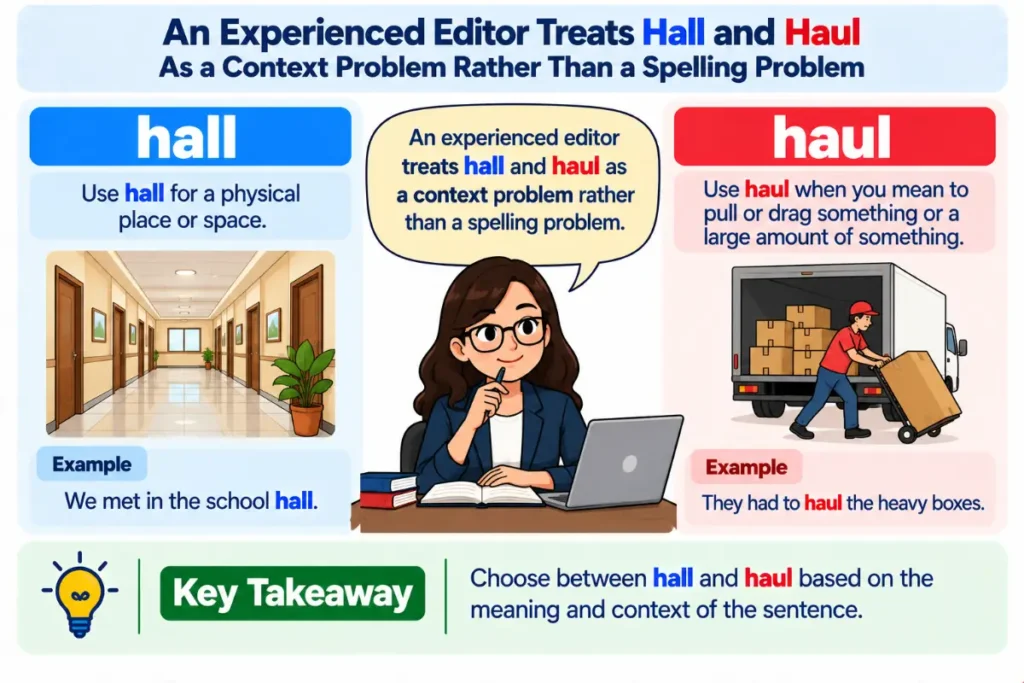
Expert Editor Insight
An experienced editor treats hall and haul as a context problem, not a simple spelling problem. Both are legitimate words, so a spell checker may not catch a substitution if the wrong word is spelled correctly. Professional editing therefore involves checking meaning as well as spelling. A quick reread should ask, “Am I describing a place, or am I describing moving or collecting something?” That question usually reveals the correct form immediately.
Key Takeaways
The main points are simple:
- Hall and haul are both correct English words.
- Hall usually refers to a room, passage, building, or large public space.
- Haul can mean to pull, carry, or transport something.
- Haul can also mean a quantity of things collected, caught, bought, or transported.
- The two words often sound the same, so pronunciation alone may not help.
- Hall is normally a noun, while haul can be both a noun and a verb.
- There is no major American, British, Canadian, or Australian spelling difference in this basic distinction.
- The easiest memory rule is hall = place and haul = pull, carry, or collection.
Need another quick comparison? Read Macaroon vs Macaron: Meaning and Culinary Differences 2026.
Conclusion
Hall vs haul is not a choice between a correct spelling and a misspelling. Both words are correct, but they have different meanings. Use hall for a room, passage, building, or public space. Use haul for pulling, carrying, transporting, or describing a collection of items.
The biggest reason people mix them up is pronunciation. In many accents, the words sound the same, so you need to use context instead of sound to choose the spelling. Look at the sentence and identify the meaning before you write the word.
A simple editing trick can make the distinction easy to remember: hall is a place, while haul involves moving or collecting something. If you connect each spelling with that meaning, you’ll rarely confuse them again.
FAQs
Is haul a real English word?
Yes. Haul is a standard English word used as both a verb and a noun. As a verb, it means to pull, carry, or transport something. As a noun, it can mean a quantity of things collected, caught, bought, or transported. It is common in everyday, workplace, transportation, shopping, and informal online contexts.
What does hall mean?
Hall is a noun that commonly refers to a passage, room, large public space, or building. You can find halls in homes, schools, universities, offices, and public institutions. Examples include hallway, lecture hall, concert hall, dining hall, and town hall. The exact meaning depends on the surrounding context.
Which spelling should I use for a room?
Use hall when you mean a room, passage, or large indoor space. For example, you can say, “The students gathered in the hall.” Use haul when you mean to pull, carry, or transport something. The two words may sound alike, so the meaning of the sentence determines the spelling.
How do you pronounce hall and haul?
For many English speakers, hall and haul are homophones and have the same or nearly the same pronunciation. They are commonly represented as /hɔl/. Regional accents can change the exact vowel sound, but the important point is that pronunciation often won’t distinguish the words. Context and meaning are therefore essential when choosing the spelling.
Can hall start a sentence?
Yes. Hall can easily start a sentence when it functions as a noun. For example, “Hall decorations were completed before the event.” You can also begin a sentence with a phrase containing the word, such as “The hall was already full when we arrived.” There is no grammar rule preventing it from appearing at the beginning.
What is a synonym for hall?
The best synonym depends on the meaning. For a passage inside a building, corridor or hallway may work. For a large public room, auditorium, meeting room, or venue may fit in certain contexts. These words aren’t always exact substitutes, so choose one based on the specific type of space you’re describing.
Why do people confuse these two words?
People often confuse them because they sound the same or nearly the same in many accents. Spoken English doesn’t show the spelling difference, so writers must rely on meaning and sentence context. Fast typing, dictation, limited reading exposure, and automatic spelling choices can also make the confusion more likely.
Is hall appropriate in formal writing?
Yes. Hall is a standard word and is completely appropriate in formal writing. It is commonly used in descriptions of buildings, institutions, meetings, universities, public events, and architecture. Haul is also appropriate in formal writing when its meaning is relevant, especially in discussions of transportation, physical work, fishing, shipping, or collected goods.