
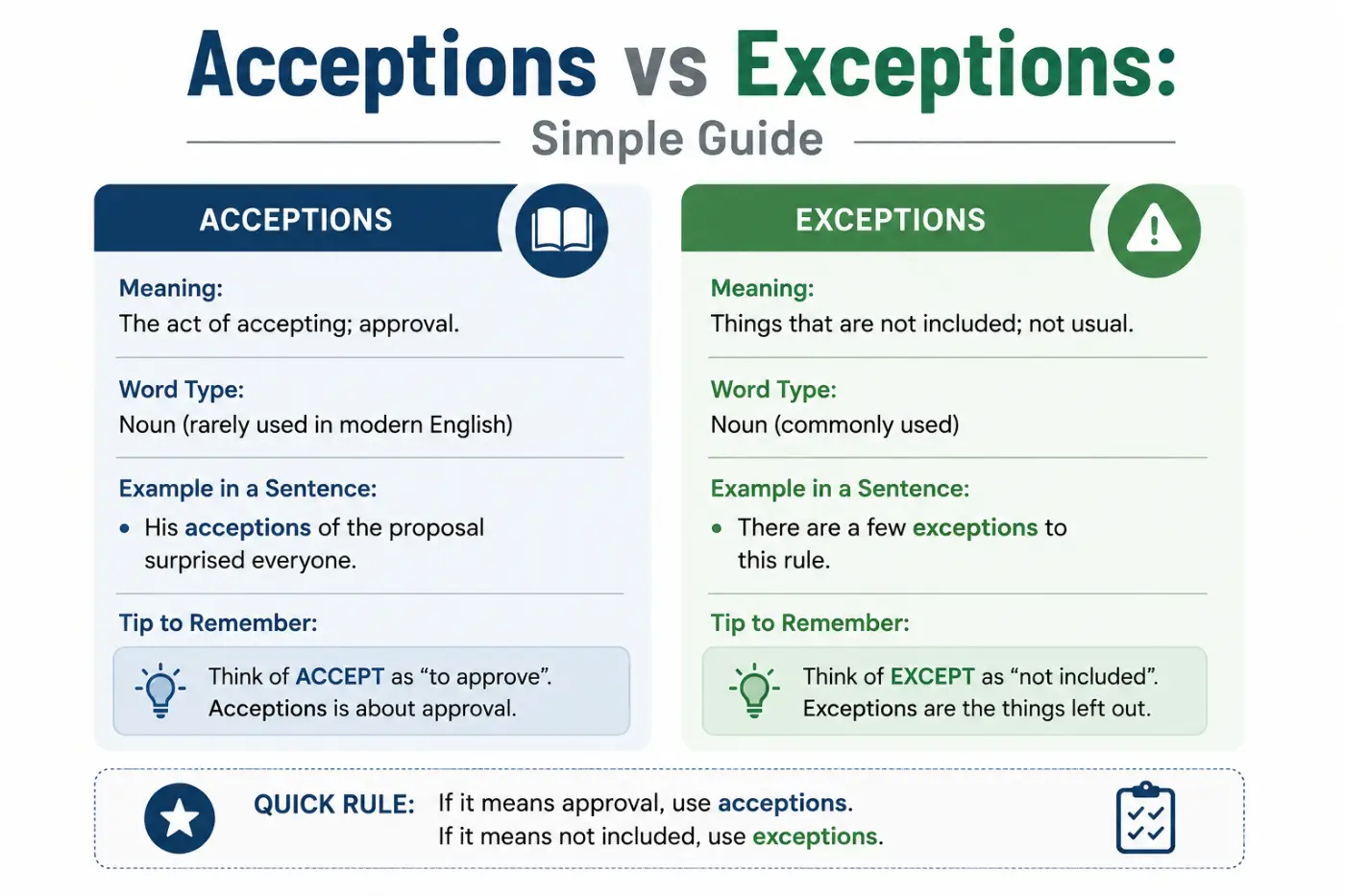
If you’ve searched for acceptions vs exceptions you may have noticed that the two words look similar but mean very different things. Both are legitimate English forms, but they belong to different word families and serve different purposes. Exceptions is the familiar everyday word, while acceptions is a much less common term with a specialized meaning.
The confusion makes sense because both words begin with accept and share several letters. However, their meanings move in different directions. Exceptions refers to things that don’t follow a rule or cases that are left out. Acceptions refers to particular meanings or interpretations of a word or expression. In ordinary American English, you’ll encounter exceptions far more often.
This distinction matters most in careful writing. If you’re writing an essay, editing an article, explaining a rule, or studying vocabulary, choosing the wrong form can change the meaning of your sentence. Once you see how the two words work, the difference becomes much easier to remember and apply.
You may also want to read Unenroll vs Disenroll Correct Usage and Meaning.
What is the difference between acception and exception?
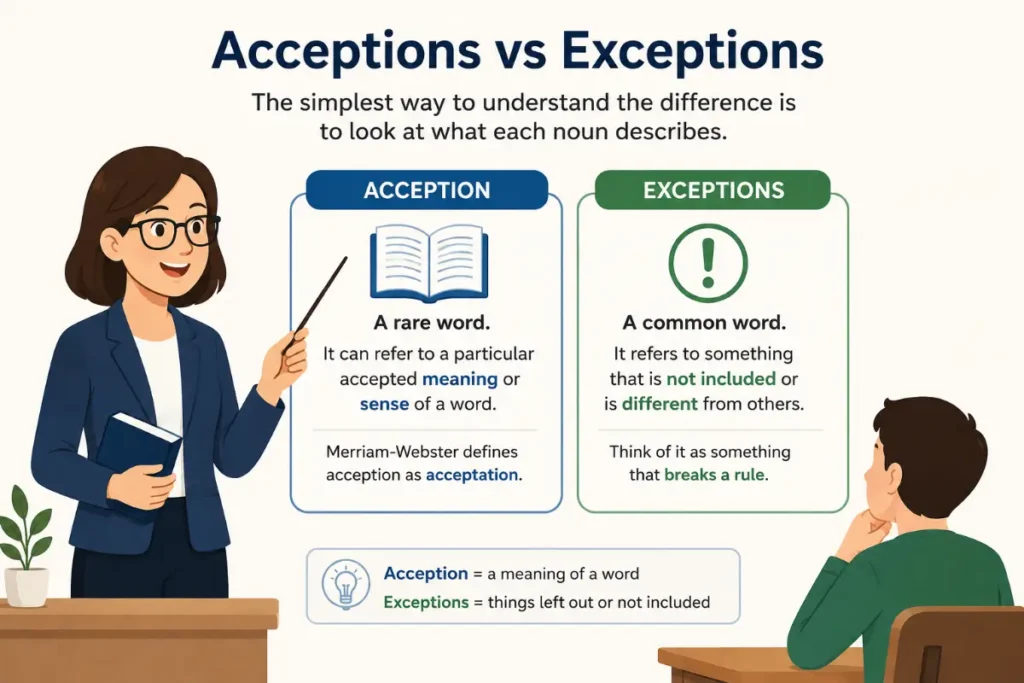
The simplest way to understand acceptions vs exceptions is to look at what each noun describes. Acception is a rare word. It can refer to a particular accepted meaning or sense of a word. Merriam Webster defines acception as acceptation, and historical usage connects it with a word’s accepted or received sense.
Featured Snippet Quick Definition
Acceptions and exceptions are different English words. Acceptions refers to particular meanings or interpretations of a word or expression, while exceptions refers to cases that do not follow a general rule. Exceptions is common in everyday English, while acceptions is uncommon and mainly appears in specialized discussions of language and meaning.
Quick Answer
Acceptions and exceptions are both valid words, but they do not mean the same thing. Acceptions relates to the different meanings or interpretations a word can have. Exceptions refers to people, things, or cases that do not follow a general rule.
For most everyday writing, exceptions is the word you’ll need. Acceptions appears mainly in linguistic, philosophical, historical, or specialized discussions about meaning and interpretation.
Comparison Table acceptions vs exceptions
| Form | Meaning | Part of Speech | Origin | Usage Frequency | Formality | Common Contexts | Example |
|---|---|---|---|---|---|---|---|
| Acceptions | Particular meanings or interpretations of a word or expression | Noun plural | Related to Latin roots connected with accepting or taking a meaning | Uncommon | Formal and specialized | Linguistics, historical language study, philosophy, textual interpretation | The word has several acceptions in older texts. |
| Exceptions | Cases that do not follow a rule or things left out of a general statement | Noun plural | From Latin roots connected with taking out or excluding | Very common | Neutral and formal | Everyday speech, school, work, law, rules, policies, writing | There are a few exceptions to this rule. |
Meaning and Definition
Meaning of Acceptions
Acceptions is the plural form of acception. It refers to particular meanings, senses, or interpretations associated with a word, phrase, expression, or statement.
The word is uncommon in modern everyday English. You’re much more likely to see terms such as meanings, senses, definitions, or interpretations. Still, acception has a legitimate place in specialized writing, especially when someone needs to distinguish between different senses of the same word.
Imagine a word that has several meanings depending on context. A linguist or historical writer might discuss its different acceptions. The focus is not on spelling or grammar. The focus is on how the word is understood.
For example:
The term had several acceptions in older English texts.
This sentence says that the term carried several different meanings or senses in historical usage.
Another example is:
The philosopher used the word in a specific acception.
Here, the writer means that the philosopher used the word with a particular meaning.
Because the term is specialized, many readers may find it unfamiliar. That doesn’t make it incorrect. It simply means the word has a narrower field of use.
Meaning of Exceptions
Exceptions is the plural form of exception. An exception is a person, thing, situation, or case that does not follow a general rule or statement.
For example:
There are three exceptions to this rule.
The general rule applies in most cases, but three cases do not follow it.
The word can also describe something deliberately excluded.
For example:
Everyone is invited, with a few exceptions.
Here, exceptions refers to people or situations that are not included.
You’ll see this word in almost every area of English. Teachers talk about exceptions to grammar rules. Employers describe exceptions to workplace policies. Doctors may discuss exceptions to general treatment guidelines. Lawyers use the word in legal contexts. Everyday speakers use it when explaining rules and unusual cases.
That broad usefulness makes exceptions a much more common word than acceptions.
The Core Difference Between The Two Words
The easiest way to understand the distinction is to focus on the idea behind each word.
- Acceptions are about meanings. They describe particular senses or interpretations of a word or expression.
- Exceptions are about rules. They describe cases that fall outside a general rule or are excluded from a group.
- Acceptions belong to specialized language discussions. You may encounter them in linguistic, philosophical, historical, or textual analysis.
- Exceptions belong to everyday English. People use them in conversations, instructions, policies, education, news, and professional writing.
- Acceptions are connected with interpretation. The question is often what a word means in a particular context.
- Exceptions are connected with exclusion. The question is often which case does not follow the general pattern.
A simple memory trick can help. Think of acceptions as senses and exceptions as cases outside the rule.
If you are talking about the meaning of a word, acception may be relevant. If you are talking about a rule that has unusual cases, exception is almost certainly the word you need.
Which Form Is Correct
Neither form is simply a misspelling of the other. Both exist in English, but their meanings are different.
If your sentence discusses cases that do not follow a rule, use exceptions.
There are several exceptions to the policy.
If your sentence discusses different meanings assigned to a word, acceptions may be appropriate.
The term has several acceptions in historical writing.
The key issue is context. A spellchecker can tell you that both forms are recognized words, but it cannot always determine which meaning you intend. That’s why understanding the words themselves matters more than relying only on automatic correction.
A useful editing question is this.
Am I talking about a meaning or a rule?
If the answer is meaning, consider acception. If the answer is a rule or general statement, consider exception.
In most everyday situations, exceptions will be the correct choice because discussions about rules and unusual cases are far more common than specialized discussions of word senses.
Spelling Differences
The visual similarity between the words causes much of the confusion.
Acceptions contains the sequence accept followed by ions. Exceptions contains except followed by ions.
That difference reflects their word families.
Acception is connected with the idea of accepting or taking a particular meaning. Exception is connected with the idea of taking something out or excluding it.
The words therefore look related but carry different semantic histories.
One practical spelling check is to look at the middle of the word.
Acceptions contains accept.
Exceptions contains except.
That single letter difference changes the meaning completely.
This is a useful example of why spelling deserves attention even when two words look nearly identical. A single letter can move a sentence from one meaning to another.
Grammar and Part of Speech
Both forms function as plural nouns.
Acception As A Noun
Acception is a countable noun when it refers to a particular meaning or sense of a word. Its plural form is acceptions.
For example:
The word has several acceptions in the manuscript.
The noun identifies different senses of the same expression.
Because the term is specialized, it usually appears in sentences that already discuss language, interpretation, meaning, or historical usage.
Exception As A Noun
Exception is also a countable noun. Its plural form is exceptions.
For example:
The teacher explained the exceptions to the grammar rule.
The noun identifies cases that do not follow the stated rule.
Exception also appears in several common patterns.
There are exceptions to the rule.
The policy allows no exceptions.
Everyone agreed with the decision, with one exception.
This case is an exception.
These structures are common and natural in American English.
Common Grammar Pattern
The phrase exception to is especially important.
You normally say:
This is an exception to the rule.
You don’t normally say:
This is an exception of the rule.
The preposition to connects the exception with the rule it differs from.
Acception has a different grammatical environment because it discusses meaning.
The writer used the word in a different acception.
The pattern is much less common in everyday speech.
Pronunciation Guide
The pronunciation of the two words is different enough to help you distinguish them when speaking.
Acceptions
A reasonable pronunciation guide is:
ak SEP shunz
The singular form acception can be represented approximately as:
ak SEP shun
The stress falls on the second syllable.
The plural ending sounds like shunz in natural speech.
Exceptions
Exceptions is commonly pronounced:
ik SEP shunz
The first vowel differs from the opening sound in acceptions. The word begins with the sound associated with except.
The stress also falls on the second syllable.
The pronunciation difference may seem small, especially in fast speech. That is another reason context matters.
If you’re unsure which word you heard, ask yourself what the speaker was discussing. A conversation about meanings may point toward acception. A conversation about rules or unusual cases almost certainly points toward exception.
Sentence Examples With Acceptions
Because the word is uncommon, the examples below use contexts where it genuinely makes sense.
- The historian identified several acceptions of the term in the manuscript.
- The word had different acceptions in medieval writing.
- The researcher examined the various acceptions of the expression.
- The author used the term in one of its older acceptions.
- Several acceptions of the word appear across the documents.
- The philosopher gave the term a specific acception in his argument.
- The study compares modern and historical acceptions of the phrase.
- Readers should consider the context before choosing among the word’s acceptions.
- The dictionary discussion focuses on several acceptions that developed over time.
- The translator considered the original word’s different acceptions before selecting an English equivalent.
These examples show why the word feels more technical than ordinary vocabulary. It appears when writers need to talk precisely about meaning.
A related grammar guide is Kinesthesiology vs Kinesiology Simple Rules Explained 2026.
Sentence Examples With Exceptions
Exceptions is much easier to encounter in ordinary writing.
- There are a few exceptions to this rule.
- The store is closed on holidays, with some exceptions.
- Most students completed the assignment without any problems, but there were two exceptions.
- This policy applies to everyone except in special cases.
- The teacher explained the exceptions before the test.
- The company allows no exceptions to its safety requirements.
- Every rule has some exceptions.
- The new schedule includes several exceptions for public holidays.
- There are exceptions to almost every general statement.
- The final paragraph explains the exceptions in detail.
Notice how each example involves a general condition and a case outside that condition. That is the central idea behind exception.
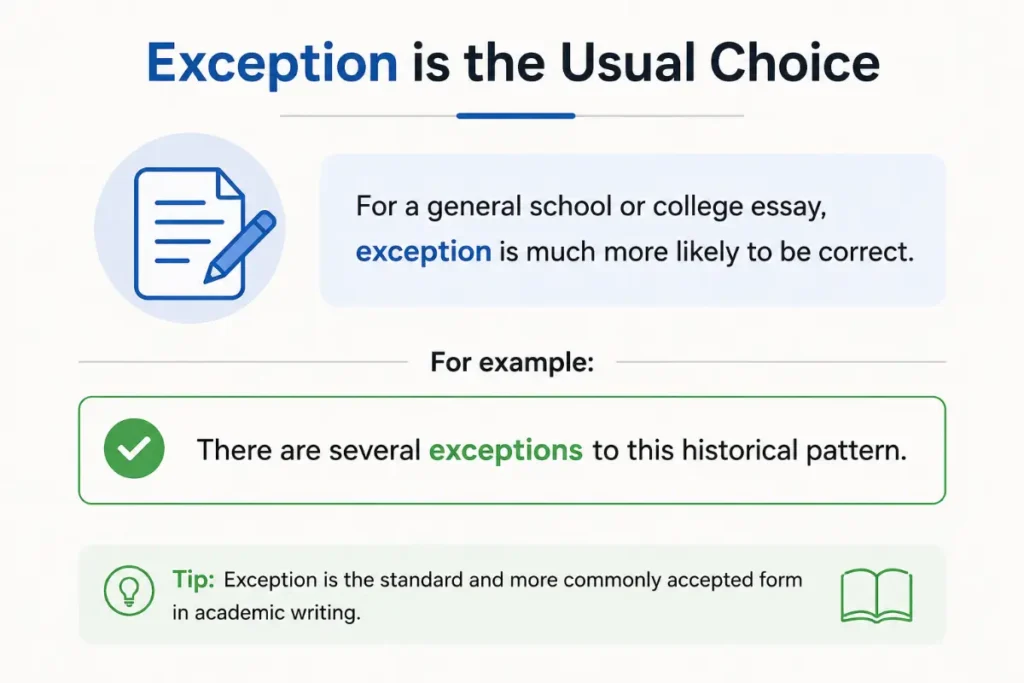
Which word is best for an essay?
For a general school or college essay, exception is much more likely to be correct.
For example:
There are several exceptions to this historical pattern.
Common Mistakes
Using Exceptions When You Mean Meanings
A writer discussing different meanings of a word may accidentally choose exceptions.
Incorrect for the intended meaning:
The word has several exceptions in this context.
Better:
The word has several acceptions in this context.
For most readers, however, meanings or senses would sound more natural than acceptions.
Using Acceptions In Everyday Rule Discussions
This is the reverse problem.
Incorrect:
There are several acceptions to this grammar rule.
Better:
There are several exceptions to this grammar rule.
The rule has cases that don’t follow it, so exceptions is the correct word.
Confusing Accept And Except
The singular forms are connected to the familiar words accept and except.
Accept generally means to receive, agree to, or take something.
Except generally means excluding or leaving something out.
That difference carries into acception and exception.
Assuming Similar Spelling Means Similar Meaning
English contains many word pairs that look similar but have different meanings. Similar letters don’t guarantee similar usage.
The safest approach is to examine the whole word family rather than guessing from appearance.
Choosing A Rare Word When A Common Word Is Clearer
Acception can be accurate in a specialized context, but it may sound unfamiliar to a general audience.
If you simply mean different meanings, words such as senses or meanings are usually clearer.
Good editing isn’t about choosing the most unusual word. It’s about choosing the clearest word that accurately expresses the idea.
Etymology and Word Origin
The histories of these words help explain why they look similar while expressing different ideas.
Acception is connected to Latin roots associated with accepting or taking. The historical family includes forms related to receiving or taking something in a particular sense. Over time, the word developed a specialized use connected with the meaning or sense assigned to a word or expression.
Exception has a different Latin background. It comes from a word family associated with taking out, excluding, or leaving something aside. The idea of exclusion remained central as the word developed through French and into English.
This shared historical connection with ideas of taking and receiving helps explain their visual similarity. Yet the paths diverged semantically.
The modern meanings make the difference clear. Acception concerns a particular sense or interpretation. Exception concerns something excluded from a general rule or statement.
You can think of their histories as two roads that began near each other and eventually led somewhere different.
Regional Usage
American English
American English uses exception and exceptions very commonly. The word appears in everyday conversation, education, business, journalism, law, science, and general writing.
Acception exists in English but is uncommon in ordinary American communication. A general reader will usually find meaning or sense more familiar.
British English
British English also uses exception in the same broad sense. There is no major spelling difference between American and British English for this word.
Acception is also possible in British English, especially in specialized or historical discussions of language. Its limited frequency remains the main point of distinction.
Australian English
Australian English uses exceptions in the standard way. The word appears in education, workplace writing, public information, and everyday conversation.
Acceptions may occur in specialized texts, but it is not a routine everyday term.
Canadian English
Canadian English follows the same basic distinction. Exceptions is a normal and widely understood plural noun. Acceptions remains uncommon and tends to belong to specialized discussions.
There is no major regional spelling difference that changes the distinction between these two forms.
Real Life Usage
Daily Conversation
You’ll hear exceptions regularly in ordinary speech.
There are a few exceptions to that rule.
Everyone can come except for a few exceptions.
The second sentence can sound repetitive because except and exceptions are closely related. A more natural version might be:
Everyone can come, but a few people can’t.
That example shows an important editing principle. Correct grammar doesn’t always produce the most natural sentence. Good writing also considers clarity and rhythm.
Acceptions is rare in daily conversation.
You might hear:
The word has several meanings.
You are much less likely to hear:
The word has several acceptions.
The latter is possible but sounds specialized.
Workplace Communication
Exceptions are common in workplace policies.
The standard schedule applies to all departments, with a few exceptions.
Managers must document any exceptions to the policy.
Acceptions would usually appear only if the workplace document deals with language, terminology, or interpretation.
The legal term has different acceptions in older documents.
Academic Writing
Both words can appear in academic writing, but they serve different purposes.
The study identifies several exceptions to the proposed pattern.
Here, the writer discusses cases that do not fit a general pattern.
The article examines different acceptions of the term.
Here, the writer discusses different meanings.
Academic writing often rewards precise vocabulary, so understanding this distinction can prevent subtle meaning errors.
News And Journalism
News writing commonly uses exceptions.
The new rule applies statewide, with a few exceptions.
Acceptions would be unusual unless the article were specifically about language or interpretation.
For general readers, journalists usually choose familiar words whenever they communicate the same idea clearly.
Literature And Storytelling
Exception can describe an unusual person or situation.
Everyone trusted him, but she was the one exception.
Acception may appear in historical or scholarly writing about a text.
The passage uses the term in an older acception.
That second use is much more specialized.
Related And Confused Terms
Acceptance
Acceptance means the act of accepting something or the state of being accepted. It is closely related in spelling to acception but has a different meaning.
Accept
Accept is a verb. It can mean to receive something, agree to something, or acknowledge something as true or valid.
She accepted the invitation.
Except
Except commonly works as a preposition, conjunction, or verb and expresses exclusion.
Everyone came except John.
Exception
Exception is a noun for a case that falls outside a general rule.
This case is an exception.
Exceptional
Exceptional is an adjective. It can describe something unusual or notably different from the normal pattern.
She showed exceptional skill.
Exclude
Exclude is a verb meaning to leave someone or something out.
The rule excludes certain cases.
Sense
Sense is a common word for one particular meaning of a word.
The word has several senses.
For general readers, sense is often clearer than acception.
Meaning
Meaning is the simplest everyday term for what a word or expression communicates.
The meaning changes depending on context.
These related terms help put the distinction into a larger language pattern. Accept, acceptance, acception, except, exception, exclude, and exceptional may look connected, but their grammatical roles and meanings differ.
Why The Confusion Happens
The confusion usually begins with spelling.
Acceptions and exceptions share most of their letters. Both contain the familiar ending ions, both have stress around the same general part of the word, and both can appear in formal writing.
The difference becomes clearer when you separate their roots.
Acceptions begins with accept.
Exceptions begins with except.
That single internal difference carries a major change in meaning.
There is also a frequency problem. Most English speakers know exceptions very well. Far fewer encounter acceptions regularly. When someone sees the less familiar form, they may assume it is a typo or confuse it with the familiar word.
The reverse can happen during editing. A writer who knows the word exception may accidentally use it in a sentence about meaning simply because it looks familiar.
Context solves much of the problem.
If the sentence talks about a rule, use exception.
If it talks about a meaning or sense, acception may be appropriate.
How To Choose The Right Word
Use this simple process when you’re unsure.
- Identify the topic. Are you talking about a rule or a meaning?
- Look for exclusion. If something falls outside a general rule, choose exception.
- Look for interpretation. If you are discussing a particular meaning of a word, acception may fit.
- Consider your audience. If you mean meanings or senses and you are writing for a general audience, meanings or senses will usually be clearer.
- Read the full sentence aloud. The surrounding context often makes the intended meaning obvious.
For example:
There are several ___ to this rule.
The answer is exceptions.
Now consider:
The word has several ___ in historical texts.
The answer can be acceptions, although meanings or senses may be more natural for a broad audience.
That small context test can save you from many word choice errors.
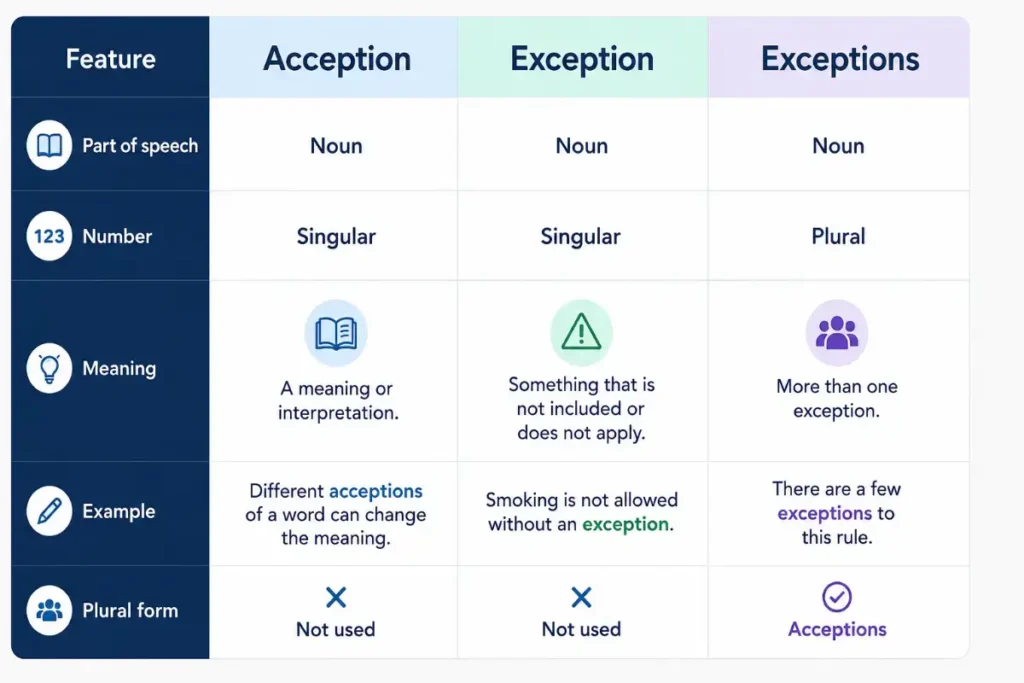
A quick comparison of acception and exception
| Feature | Acception | Exception |
|---|---|---|
| Part of speech | Noun | Noun |
| Plural | Acceptions | Exceptions |
| Main modern use | Rare and specialized | Common |
| Main idea | A particular meaning or accepted sense | A case outside a rule |
| Common in conversation | No | Yes |
| Common in academic writing | Specialized contexts | Yes |
| Common in business writing | Rare | Yes |
| Common in legal writing | Rare | Yes |
| Common in everyday emails | Rare | Yes |
| Related word | Acceptance or acceptation | Except |
| Best simple substitute | Meaning or sense | Special case |
| Pronunciation | ak SEP shun | ik SEP shun |
Expert Editor Insight
An experienced editor would not treat these words as competing spellings. They are different nouns with different meanings, and the surrounding sentence should determine the choice. The bigger issue is frequency. Exceptions is a normal everyday word, while acceptions is specialized and often replaceable with meanings or senses. Professional editing tools may recognize both forms as legitimate, so a grammar checker may not catch a wrong choice based on context. The best editing habit is to ask what idea the sentence needs to express before checking spelling.
A related grammar guide is Stellar vs Steller: Meaning, Spelling, and Usage.
Conclusion
The difference between acceptions vs exceptions comes down to meaning rather than simple spelling. Acceptions refers to particular meanings or senses of a word, while exceptions refers to cases that fall outside a general rule. Both forms are legitimate, but they belong to very different contexts.
For everyday American English, exceptions is the word you’ll encounter much more often. Acceptions is specialized and usually appears in discussions about language, interpretation, history, or textual meaning. If you’re writing for a general audience, meanings or senses may communicate the idea more naturally.
A useful editing trick is to remember accept means receive while except means leave out. That distinction gives you a reliable clue when choosing between these similar looking words.
FAQs
Is acception a real English word?
Yes. Acception is a legitimate but uncommon English noun. It refers to a particular meaning or sense assigned to a word or expression. The plural form is acceptions. The word appears mainly in specialized discussions of language, interpretation, philosophy, or historical texts. In everyday writing, meanings or senses will usually sound more natural and familiar.
What does exception mean?
An exception is a person, thing, or situation that does not follow a general rule or is left outside a general statement. For example, There are no exceptions to this rule means the rule applies in every relevant case. Exception is a common English noun used in conversation, education, business, law, journalism, and formal writing.
Which is correct for rules and policies?
Use exceptions when you are talking about rules, policies, standards, or general statements that have cases outside them. For example, The policy has several exceptions is correct. Acceptions does not carry this meaning. It refers to particular meanings or interpretations and belongs to a much narrower area of English usage.
What does acception mean in language?
In language discussions, acception refers to a particular sense or interpretation of a word or expression. A word can have more than one meaning, and each specific sense may be described as an acception. The term is relatively uncommon today. Most readers will understand meanings or senses more quickly in general purpose writing.
Are acceptions and exceptions pronounced the same?
No. The pronunciation differs at the beginning of each word. Acceptions begins with a sound closer to the opening of accept, while exceptions begins with the opening sound of except. Both words have stress on the second main syllable and share a similar ending. Context also helps listeners understand which word a speaker intends.
Why do people confuse these two words?
People confuse them because they look very similar and share most of their letters. The difference between accept and except is easy to overlook during fast reading or typing. Another reason is that exceptions is extremely familiar while acceptions is uncommon. Writers may therefore replace the unfamiliar form with the word they recognize more readily.
Is exceptions appropriate in formal writing?
Yes. Exceptions is completely appropriate in formal writing. You can use it in academic papers, workplace policies, reports, professional emails, legal writing, and other formal contexts. The word is standard and widely understood. The key is to use it when you mean cases that fall outside a general rule or statement.
Is acception better than meaning?
Not usually for a general audience. Acception has a specialized meaning and can be useful when a writer needs precise terminology in linguistic or historical discussion. However, meaning or sense is often clearer for ordinary readers. Choose acception when its technical distinction adds value. Don’t use it simply because it sounds more formal.