
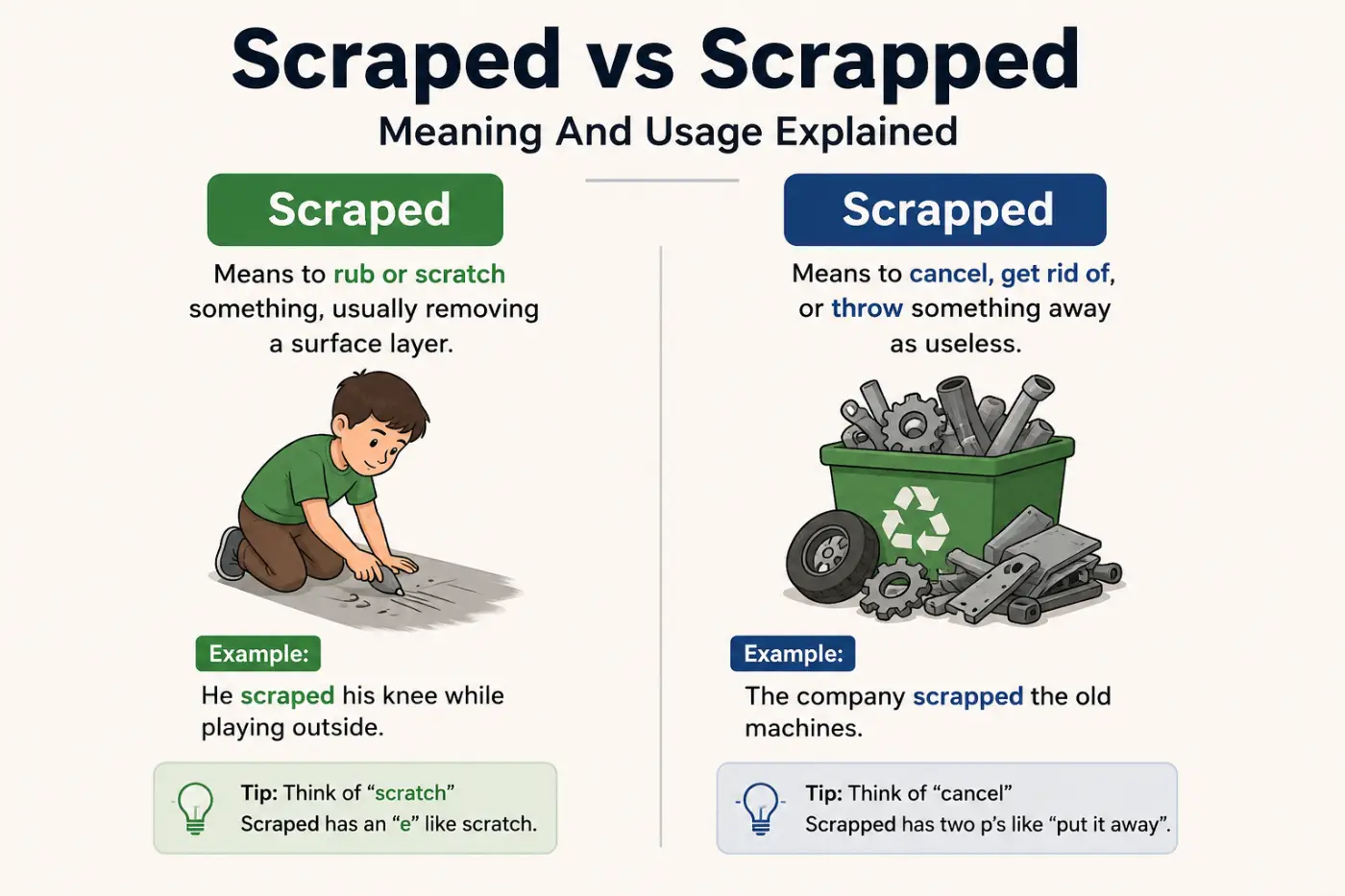
scraped vs scrapped can be confusing because both forms are spelled correctly but have completely different meanings. Scraped usually means rubbed against a surface, removed something from a surface, or collected something carefully. Scrapped usually means discarded, canceled, or removed from use. The extra p changes the meaning.
The confusion becomes stronger because the two words sound very similar in many varieties of English. They also come from the same base word family but follow different spelling patterns when the ending ed is added. A single extra consonant can therefore change the message from removing material to canceling a plan.
Once you understand the difference, the choice becomes much easier. This guide explains the meanings, grammar, pronunciation, spelling patterns, word origins, regional usage, common mistakes, and practical examples. You’ll also see how native speakers use both forms in conversation, workplace writing, academic contexts, journalism, and everyday communication.
For another common grammar confusion, see atleast or at least correct spelling meaning and usage.
Quick Definition
Scraped is the past tense and past participle of scrape. It usually means rubbed against a surface, removed something from a surface, or gathered something by scraping. Scrapped is the past tense and past participle of scrap. It usually means discarded, abandoned, canceled, or removed because it was no longer wanted or needed.
Short Answer
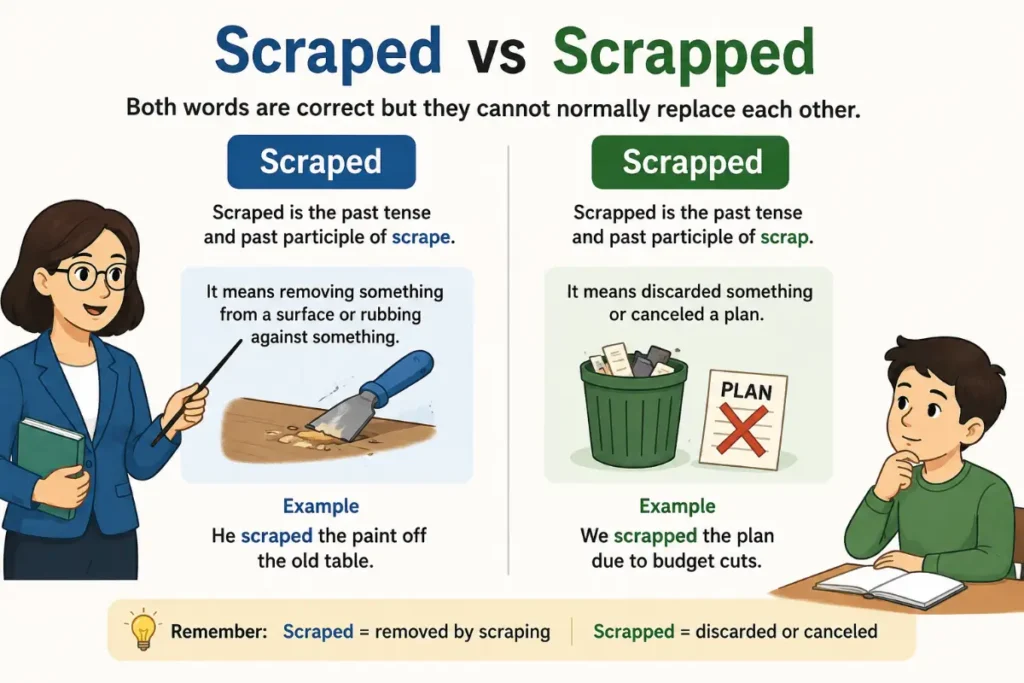
Scraped and scrapped are both correct words, but they have different meanings.
Use scraped when something is rubbed, removed from a surface, or collected by scraping. Use scrapped when something is thrown away, canceled, abandoned, or rejected.
For example, I scraped the ice from my windshield means I removed ice from the surface. The company scrapped the old plan means the company canceled or abandoned the plan.
Comparison Table
| Form | Meaning | Part of Speech | Origin | Usage Frequency | Formality | Common Contexts | Example |
|---|---|---|---|---|---|---|---|
| Scraped | Rubbed, removed by scraping, or gathered by scraping | Verb form and adjective in some contexts | From scrape | Very common | Neutral | Cleaning, injuries, surfaces, data collection, cooking | She scraped the paint from the wall. |
| Scrapped | Discarded, canceled, abandoned, or rejected | Verb form and adjective in some contexts | From scrap | Common | Neutral | Plans, projects, products, vehicles, policies, objects | The company scrapped the project. |
Meaning And Definition
Meaning Of Scraped
Scraped is the past tense and past participle of scrape.
The basic idea behind scrape is contact with a surface that removes something or causes friction. You can scrape paint from a wall, scrape ice from a windshield, scrape mud from your shoes, or scrape your knee against the ground.
For example:
I scraped my knee on the sidewalk.
The sentence tells us that the knee rubbed against a rough surface and suffered a minor injury.
Scraped can also describe collecting something from a surface.
She scraped the last bit of frosting from the bowl.
Here the action involves removing material by moving an object along a surface.
The word also appears in technology and data work. In that context, scraping means collecting information from websites or digital sources through software or another automated process.
The meaning remains connected to the basic idea of removing or gathering something from a surface or source.
Meaning Of Scrapped
Scrapped is the past tense and past participle of scrap.
As a verb, scrap means to get rid of something, abandon it, cancel it, or decide that it should no longer be used.
For example:
The company scrapped the old design.
This means the company decided not to use the design anymore.
Scrapped can also describe an object that has been discarded or sent for recycling.
The old car was scrapped after the accident.
Here the car was taken out of use and treated as scrap.
The word can also describe plans, ideas, projects, rules, or proposals.
The school scrapped the old schedule.
The team scrapped its original plan.
The government scrapped the proposed rule.
In each case, the meaning involves abandoning or removing something rather than physically rubbing a surface.
The Core Difference
The easiest way to separate these words is to focus on the action.
- Scraped involves scraping. Something is rubbed against a surface or removed from a surface.
- Scrapped involves scrap. Something is discarded, canceled, abandoned, or rejected.
- Scraped often involves physical contact. You can scrape your knee, scrape paint, or scrape ice.
- Scrapped often involves a decision. You can scrap a plan, project, design, proposal, or policy.
- Scraped has a collection meaning. You can scrape information from a website or scrape food from a bowl.
- Scrapped can describe disposal. An old vehicle can be scrapped after it is no longer useful.
Consider these two sentences.
I scraped the paint from the door.
I scrapped the plan for painting the door.
The first sentence describes physical removal. The second describes abandoning an idea.
That small spelling difference creates a major change in meaning.
Scrape And Scrap As Base Words
Understanding the base words makes the distinction much easier.
Scrape refers to an action involving rubbing or removing something from a surface.
Scrap refers to a small discarded piece of material or something that has been rejected or abandoned. As a verb, scrap means to discard or cancel something.
The past tense of scrape is scraped.
The past tense of scrap is scrapped.
The spelling difference comes from the different base words rather than from a random rule.
This is useful because learners sometimes look only at the endings. Instead, look at the word before the ending.
Scrape becomes scraped.
Scrap becomes scrapped.
The final e in scrape disappears before ed is added, while scrap doubles its final consonant.
Why Does Scrap Become Scrapped?
The spelling of scrapped follows a common English spelling pattern.
When a short one syllable verb ends in a consonant after a short vowel sound, English often doubles the final consonant before adding an ending that begins with a vowel.
For example:
- Stop becomes stopped.
- Plan becomes planned.
- Drop becomes dropped.
- Shop becomes shopped.
- Scrap becomes scrapped.
The same pattern explains why scrap becomes scrapped with two p letters.
Scrape works differently because the base word ends with silent e.
Scrape becomes scraped.
The final e is removed before the ed ending is added.
This gives you a useful visual contrast.
Scrape → scraped.
Scrap → scrapped.
That spelling pattern is one of the best ways to avoid confusion.
Which Form Should You Use?
Both forms are correct. The right choice depends on what you mean.
If you mean rubbed against a surface or removed something from a surface, use scraped.
If you mean canceled, abandoned, discarded, or rejected, use scrapped.
Ask yourself a simple question.
Am I describing physical removal or abandonment?
If you are describing physical removal, scraped is probably the word you need.
If you are describing a decision to abandon something, scrapped is probably correct.
For example:
The mechanic scraped the rust from the metal.
The mechanic scrapped the damaged part.
The first action removes material. The second involves getting rid of an object.
Grammar Rules And Part Of Speech
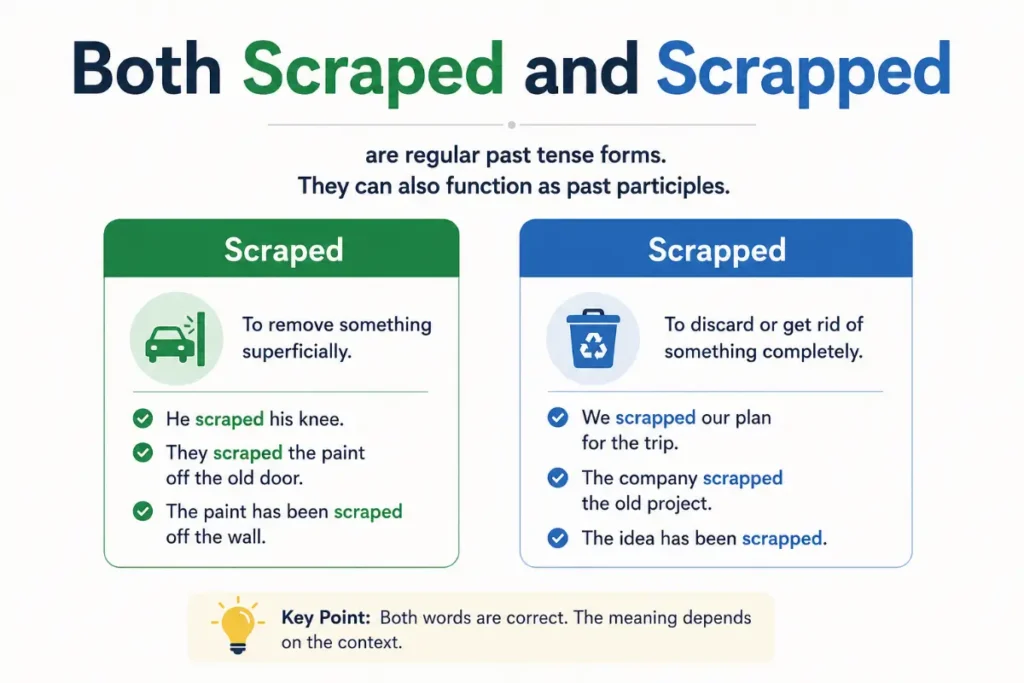
Both scraped and scrapped are verb forms.
They can function as the past tense of their base verbs.
She scraped the mud off her boots.
The company scrapped the project.
They can also function as past participles.
He has scraped the paint away.
They have scrapped the original proposal.
The two words can also appear as participial adjectives in some contexts.
She had a scraped knee.
The scrapped project will not return this year.
In the first example, scraped describes the condition of the knee. In the second, scrapped describes the project.
The grammar is not usually difficult. The bigger challenge is choosing the correct base word.
Common Patterns With Scraped
It often appears with expressions such as:
Scraped his knee.
Scraped the bowl clean.
These phrases usually involve removing or collecting something.
Common Patterns With Scrapped
It often appears with expressions such as:
Scrapped the plan.
Scrapped the project.
These phrases usually involve cancellation, abandonment, disposal, or rejection.
Sentence Examples With Scraped
Here are natural examples showing the different uses of scraped.
- I scraped the ice from my windshield before driving to work.
- She scraped the burnt food from the bottom of the pan.
- He scraped his elbow when he fell off his bike.
- The workers scraped old paint from the wooden door.
- I scraped the mud from my shoes before entering the house.
- The chef scraped the remaining sauce from the pan.
- The researcher scraped publicly available information for the study.
- She scraped the sticker from the glass but left some residue behind.
- The child scraped his knee while playing outside.
- We scraped the snow from the steps before opening the store.
Each sentence involves removal, friction, collection, or contact with a surface.
Sentence Examples With Scrapped
Now look at examples where the meaning involves cancellation or disposal.
- The company scrapped the project after funding problems emerged.
- We scrapped our original travel plans because of the storm.
- The team scrapped the old design and started again.
- The manufacturer scrapped the damaged vehicle.
- The school scrapped the outdated policy.
- They scrapped the proposal after reviewing the costs.
- The writer scrapped the first draft and began again.
- The city scrapped the planned construction project.
- She scrapped the idea after realizing it would take too much time.
- The factory scrapped several machines that were no longer safe to use.
These examples show why the extra p matters. The action is no longer about rubbing or removing material from a surface. It is about getting rid of something or abandoning it.
Common Mistakes
Writing Scraped When You Mean Canceled
A common mistake is using scraped for a plan or project.
Incorrect meaning:
The company scraped the project.
If the company abandoned the project, the correct word is scrapped.
Correct:
The company scrapped the project.
The verb needs the meaning of cancellation or abandonment.
Writing Scrapped For Physical Removal
Another mistake happens in sentences about cleaning.
For example:
I scrapped the ice from the windshield.
If you mean you removed ice by rubbing or using a tool, scraped is the correct form.
Correct:
I scraped the ice from the windshield.
The physical action points to scrape.
Confusing The Base Words
Some writers remember the sound but forget the base word.
Scraped comes from scrape.
Scrapped comes from scrap.
Checking the base word often solves the problem immediately.
Missing The Double P
Because scrape and scrap sound similar, writers may accidentally write scrapped with one p.
The correct past form of scrap is scrapped.
The doubled p follows the spelling pattern found in other short verbs such as stopped and planned.
Using The Wrong Word In Figurative Contexts
The difference can become less obvious when the sentence is figurative.
The company scraped the idea from the proposal sounds like removing something from a document.
The company scrapped the idea means the company abandoned it.
Both sentences can be grammatical, but they communicate different actions.
Pronunciation Guide
Scraped is commonly pronounced /skreɪpt/.
A simple pronunciation guide is skraypt.
The word has one syllable.
Scrapped is commonly pronounced /skræpt/.
A simple pronunciation guide is skrapt.
It also has one syllable.
The vowel sound creates an important difference.
Scraped uses the long a sound found in words such as day and late.
Scrapped uses the short a sound found in words such as cat and map.
The final ed ending does not create an extra syllable in either word. In both cases the ending sounds like a t.
This means the words can sound similar when spoken quickly, especially to learners who are still developing their English listening skills.
A useful pronunciation practice is to exaggerate the vowel difference.
Say:
scraped
Then:
scrapped
The first has the long a sound. The second has the short a sound.
Learn the difference in check in vs check-in Correct Spelling Meaning and Usage.
Etymology And Word Origin
Scrape has a long history in English and is related to words describing rubbing, scratching, or removing material from a surface. Its exact historical development includes older Germanic and Scandinavian influences.
The word scrap has a different history. As a noun, scrap came to refer to a small piece or fragment, especially a leftover piece of material. From that meaning, the verb developed the sense of throwing away or getting rid of something.
The modern meanings grew naturally from those older concepts.
To scrape something is to remove material by rubbing or dragging an object across a surface.
To scrap something is to treat it as unwanted material or abandon it.
The words therefore look similar because their modern spellings share several letters, but their meanings developed along different paths.
Regional Usage
American English
Both scraped and scrapped are standard American English forms.
American speakers use scraped for physical actions such as removing paint, ice, or dirt. They also use it in technical contexts such as data scraping.
Scrapped commonly appears when people talk about canceled plans, abandoned projects, discarded vehicles, and rejected ideas.
The distinction is the same in everyday American English and formal writing.
British English
British English uses both words with the same basic meanings.
A British writer can say that someone scraped paint from a wall or that a company scrapped a project.
There is no major British spelling variation that changes this distinction.
Australian English
Australian English follows the same basic usage.
Scraped describes the action of scraping. Scrapped describes disposal, cancellation, or abandonment.
The difference is semantic rather than regional.
Canadian English
Canadian English also maintains the same distinction.
Writers and speakers use scraped for actions involving scraping and scrapped for canceled or discarded things.
There is no major Canadian variation that changes the core rule.
Scraped In Technology And Data
One modern use deserves special attention because it can confuse readers who know only the physical meaning.
In technology, scraping can mean collecting information from digital sources. For example, a software tool may scrape publicly accessible web pages and collect specific pieces of information.
The past form is scraped.
The company scraped product information from publicly available pages.
This use still connects to the basic idea of removing or gathering information from a source.
The word does not become scrapped simply because the action happens online.
This distinction matters in technology writing.
A program scraped information.
A developer scrapped the project.
The first sentence describes data collection. The second describes abandoning a project.
Scrapped In Business And Project Management
Scrapped appears often in business because organizations regularly abandon plans, products, designs, or projects.
For example:
The company scrapped the original marketing campaign.
This means the campaign was abandoned.
The team scrapped the first design after testing it.
This means the design was rejected.
The board scrapped the proposal because the costs were too high.
This means the proposal was canceled or abandoned.
In these contexts, scrapped often signals a deliberate decision. Someone considered an option and then decided not to continue with it.
That is different from scraped, which normally describes an action involving removal or friction.
Scraped In Everyday Life
Scraped is especially common in everyday situations involving surfaces.
You might scrape your knee on rough pavement.
You might even scrape together enough money for something. In that expression, the meaning becomes figurative and refers to gathering small amounts from different sources.
For example:
We scraped together enough money for the trip.
This does not mean physical scraping. It means gathering resources from limited amounts.
The word still carries the idea of collecting something with effort.
Scrapped In Everyday Life
Scrapped also has several everyday uses.
You might scrap an old plan because it no longer works.
You might scrap an old schedule and create a new one.
The word can therefore describe both physical objects and abstract ideas.
That flexibility is one reason it appears often in business, journalism, transportation, manufacturing, and everyday speech.
Related And Confused Terms
Scrape
Scrape is the base verb behind scraped. It usually involves rubbing against a surface or removing something from it.
Scrap
Scrap is the base verb behind scrapped. It can mean discard, abandon, cancel, or reject.
Scratch
Scratch means to mark or damage a surface with something sharp or rough. Scrape and scratch can overlap but are not always interchangeable.
Rub
Rub means moving something repeatedly against a surface. It can describe friction without necessarily removing material.
Remove
Remove is a broad term for taking something away. Scrape is more specific because it often suggests contact with a surface.
Discard
Discard means to throw something away or decide not to use it. It is close in meaning to scrap.
Abandon
Abandon means to stop supporting or continuing something. It is often a useful synonym for scrap when discussing plans or projects.
Cancel
Cancel means to stop an event, arrangement, plan, or activity before it happens. It can overlap with scrap when discussing projects or proposals.
These related terms show why context matters. Scraped and scrapped do not differ only in spelling. They describe different kinds of actions.
Former And Similar Sounding Words
English contains many words that become confusing because they sound alike or nearly alike.
Scraped and scrapped are especially tricky because they differ in both vowel sound and spelling while sharing most of their consonants.
Another source of confusion is the final ed ending. In both words the ending sounds like t. That can make the written difference harder to notice during listening.
For learners, the best approach is to connect sound with meaning.
Scraped means something was scraped.
Scrapped means something was discarded or canceled.
Learning the words inside complete sentences is often more effective than memorizing the spelling alone.
How Spellcheck And Language Tools Handle The Difference
Spelling tools can often recognize both scraped and scrapped as valid words. That creates an interesting problem.
A basic spellchecker may not flag the wrong choice if the word itself is spelled correctly.
For example:
The company scraped the project.
The word scraped is spelled correctly. The problem is that the meaning may be wrong if the writer intended canceled.
This is a semantic error rather than a simple spelling error.
Natural language processing systems can use surrounding context to identify likely meaning. Still, automated tools do not replace careful editing. A sentence can contain a perfectly spelled word that does not fit its intended meaning.
That is why proofreading should include a meaning check, not just a spelling check.
Expert Editor Insight
An experienced editor would treat these words as a meaning problem first and a spelling problem second. Both forms are legitimate, so a standard spellchecker may accept either one even when the sentence uses the wrong meaning. The strongest editing habit is to identify the base verb before checking the past tense. If the intended action is scrape, use scraped. If the intended action is scrap, use scrapped. That quick test catches most errors.
A Practical Memory Trick
Think about the extra p.
Scrap becomes scrapped because the final consonant doubles.
You can connect this with other short verbs.
Stop becomes stopped.
Drop becomes dropped.
Plan becomes planned.
Scrap becomes scrapped.
Then remember the other form.
Scrape becomes scraped.
The final e changes the spelling pattern.
You can also connect the meanings.
Scraped means rubbed or removed.
Scrapped means rejected or discarded.
If you can identify the meaning first, the spelling usually follows naturally.
Real Life Usage Examples
Daily Conversation
I scraped the ice off the windshield before leaving.
We scrapped our dinner plans and stayed home.
The first sentence describes physical removal. The second describes abandoning a plan.
Workplace Communication
The team scraped information from several public sources for the analysis.
Management scrapped the old workflow after reviewing the results.
The technology example uses scraped for data collection. The business example uses scrapped for abandonment.
Academic Writing
The researchers scraped publicly available data for further analysis.
The authors scrapped the original hypothesis after reviewing new evidence.
These examples show that the distinction applies to technical and academic writing too.
News Writing
Workers scraped debris from the road after the storm.
Officials scrapped the proposed project after reviewing its expected costs.
News reports often use both forms because they describe physical events and policy decisions.
Literature And Storytelling
He scraped the mud from his boots before entering the house.
She scrapped her original plan and followed the narrow trail instead.
Storytelling often uses these words to describe both physical actions and changes in decisions.
Key Takeaways
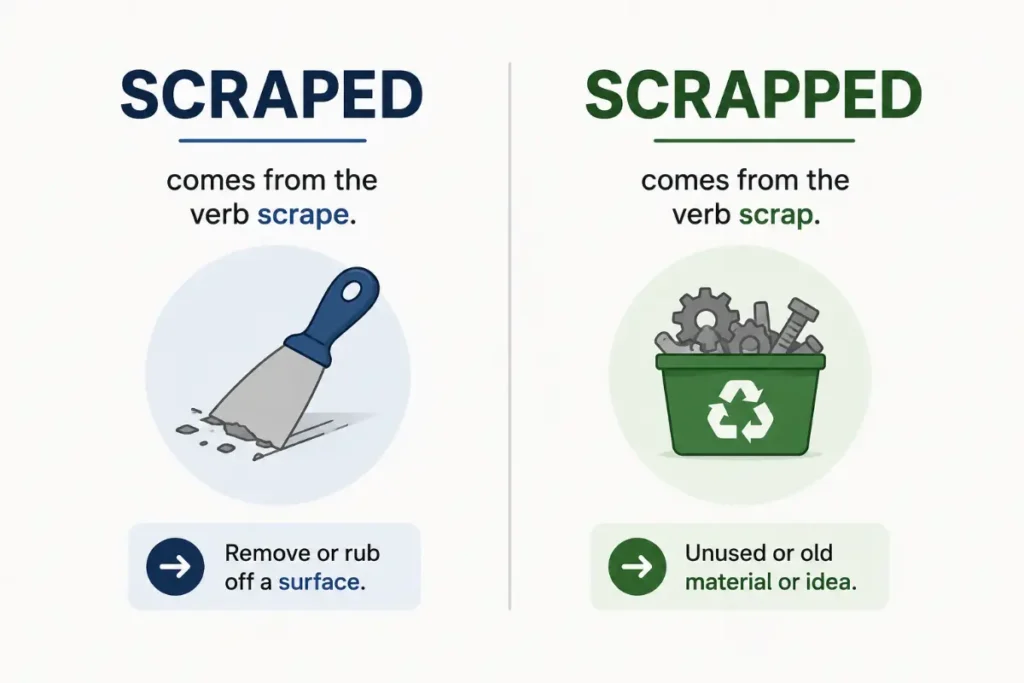
- Scraped comes from the verb scrape.
- Scrapped comes from the verb scrap.
- Scraped usually describes rubbing removing or physically damaging something.
- Scrapped usually means discarded canceled or abandoned.
- Scrape becomes scraped by adding d to the final e.
- Scrap becomes scrapped with a doubled final consonant.
- Both forms are standard in American and British English.
- Spellcheck alone may not catch a wrong choice because both words are valid.
- The best way to choose is to identify the intended meaning first.
- Remember scrape the paint and scrap the plan.
Learn the difference in The Ballot Or The Bullet Meaning And Why It Still Matters in 2026.
Conclusion
scraped vs scrapped becomes clear once you focus on meaning instead of appearance. Scraped comes from scrape and usually describes rubbing, removing material, or collecting something from a surface. Scrapped comes from scrap and usually means discarded, canceled, abandoned, or rejected. Both spellings are correct, but they cannot normally be swapped without changing the meaning.
The spelling gives you a useful clue. Scrape becomes scraped while scrap becomes scrapped. The extra p in the second form follows a common English spelling pattern for short verbs.
For an easy editing check, ask what action you mean. If something was rubbed or removed, choose scraped. If something was abandoned or thrown away, choose scrapped. That simple meaning first approach will help you choose the right word with confidence.
FAQs
What is the difference between scraped and scrapped?
Scraped is the past form of scrape and usually means rubbed against a surface, removed something from a surface, or gathered something by scraping. Scrapped is the past form of scrap and usually means discarded, canceled, abandoned, or rejected. The extra p in scrapped reflects the spelling pattern of the base word scrap.
Is scraped the same as scrapped?
No. The two words have different meanings. Scraped relates to scraping, rubbing, removing material, or collecting something from a surface. Scrapped relates to throwing something away, canceling it, or abandoning it. For example, you can scrape paint from a wall but scrap an old plan. Context determines which form you need.
Is scrapped grammatically correct?
Yes. Scrapped is the standard past tense and past participle of scrap. It can describe an object that was discarded or an idea or plan that was abandoned. For example, the company scrapped the project means the company decided not to continue with it. The doubled p is part of the standard spelling.
Why does scrap become scrapped?
Scrap becomes scrapped because English commonly doubles the final consonant of certain short verbs before adding an ending that begins with a vowel. Similar examples include stop and stopped or plan and planned. Scrape follows a different spelling pattern because its final silent e is removed before ed is added, producing scraped.
How do you pronounce scraped?
Scraped is commonly pronounced /skreɪpt/. It has one syllable and sounds roughly like skraypt. The vowel uses the long a sound found in words such as day. The final ed sounds like t rather than creating another syllable. This pronunciation is different from scrapped, which uses the short a sound.
How do you pronounce scrapped?
Scrapped is commonly pronounced /skræpt/. It has one syllable and sounds roughly like skrapt. The vowel uses the short a sound found in words such as cat. The final ed sounds like t. Listening for the difference between the long a in scraped and the short a in scrapped can help with pronunciation.
Can scraped refer to data?
Yes. Scraped can describe information collected from digital sources through a process called data scraping. For example, a researcher or software program may scrape publicly available information from web pages. This meaning is related to the broader idea of collecting or removing information from a source. The correct past form remains scraped, not scrapped.
Can scrapped refer to a plan?
Yes. Scrapped is commonly used for plans, projects, ideas, proposals, designs, and policies that have been abandoned or canceled. For example, the company scrapped its original plan means the company decided not to continue with it. This use is common in workplace communication, journalism, business writing, and everyday conversation.