
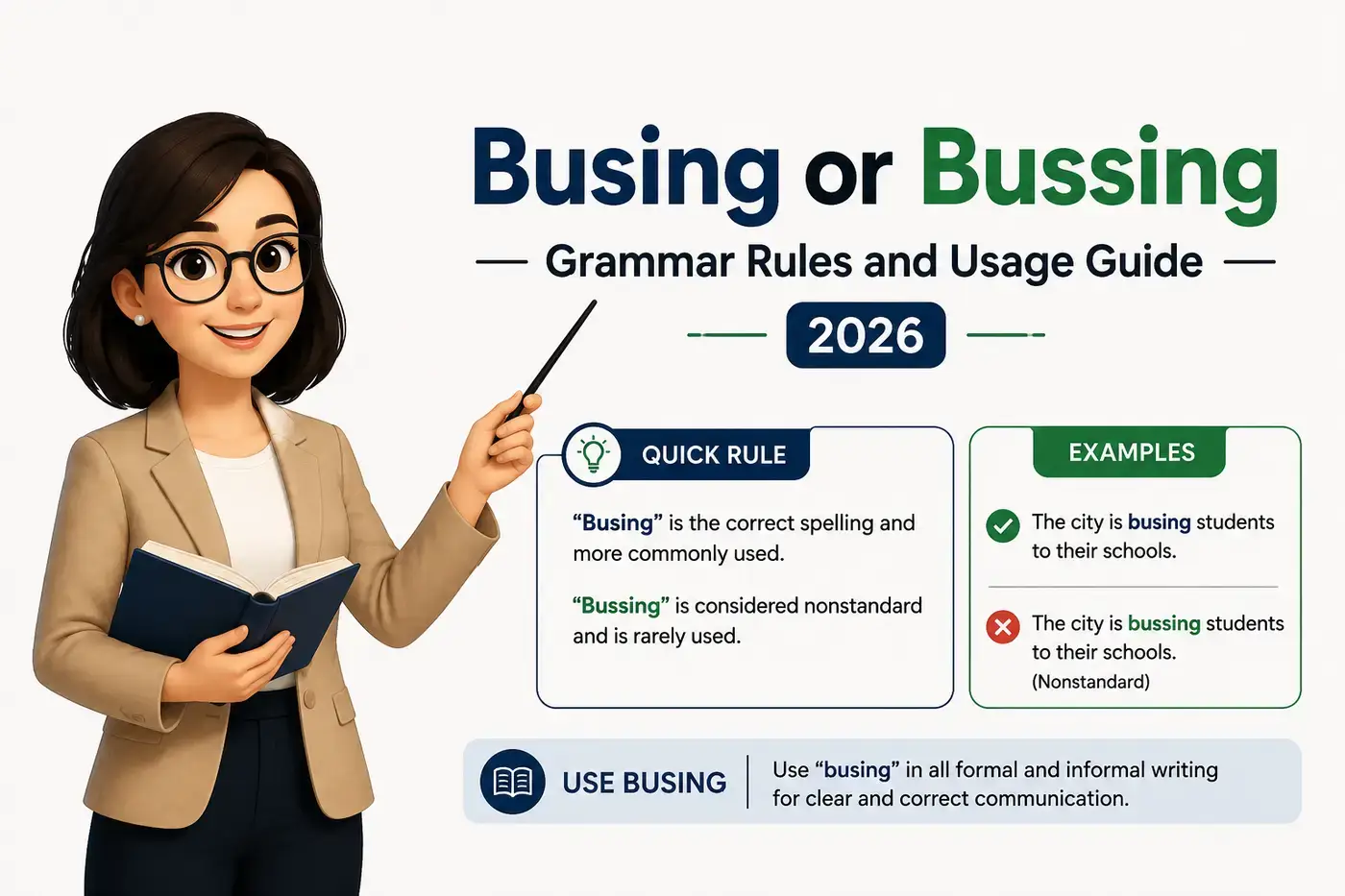
The debate over busing or bussing trips up many English writers. You might see one spelling in a newspaper article, another in a style guide, and a different version in everyday writing. That naturally raises a question: which spelling is actually correct? The short answer is that both busing and bussing are accepted spellings, but they aren’t always used in exactly the same way. Context matters, and regional preferences play a role as well.
Part of the confusion comes from the word bus itself. English spelling rules often require doubling a consonant before adding a suffix, yet some words develop accepted exceptions over time. As a result, both forms appear in dictionaries, publications, and professional writing. If you’ve searched for busing or bussing, you’re likely looking for the correct spelling, proper usage, grammar guidance, pronunciation help, and real examples. This guide covers all of that in clear, practical language.
By the end, you’ll understand the difference between the two spellings, know which one fits your audience, and avoid one of the most common spelling questions involving the word bus.
Learn the difference in Shiny Vs Shiney Meaning Usage And Examples2026.
Quick Definition
When comparing busing or bussing, both spellings are correct. Busing is more commonly used when referring to transportation by bus, especially in American English. Bussing often appears when referring to clearing tables in restaurants, though it can also be used as a variant spelling of busing. Context usually determines the preferred form.
Busing Or Bussing Quick Answer
If you’re talking about transportation by bus, busing is generally the preferred spelling in modern American English. If you’re talking about clearing dishes from restaurant tables, bussing is often preferred.
Examples:
- The district is busing students across town.
- She spent the summer bussing tables at a local café.
Both spellings are recognized, but usage patterns differ.
Busing Or Bussing Comparison Table
| Feature | Busing | Bussing |
|---|---|---|
| Correct Form | Yes | Yes |
| Primary Meaning | Transporting by bus | Clearing restaurant tables or transporting by bus |
| Part Of Speech | Verb | Verb |
| Root Word | Bus | Bus |
| Usage Frequency | More common for transportation | More common in restaurant contexts |
| Formality Level | Standard | Standard |
| Common Contexts | Schools, transit, transportation | Restaurants, hospitality, transportation |
| American English Preference | Strong | Context dependent |
| Example | The city is busing passengers downtown. | He spent the evening bussing tables. |
Meaning Of Busing Or Bussing
Meaning Of Busing
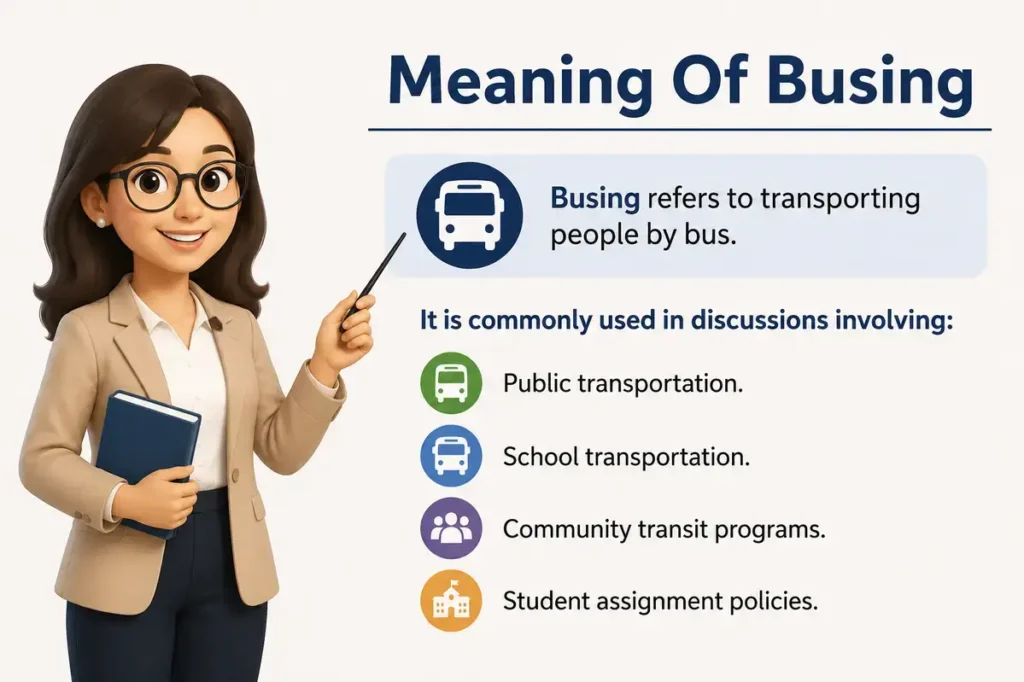
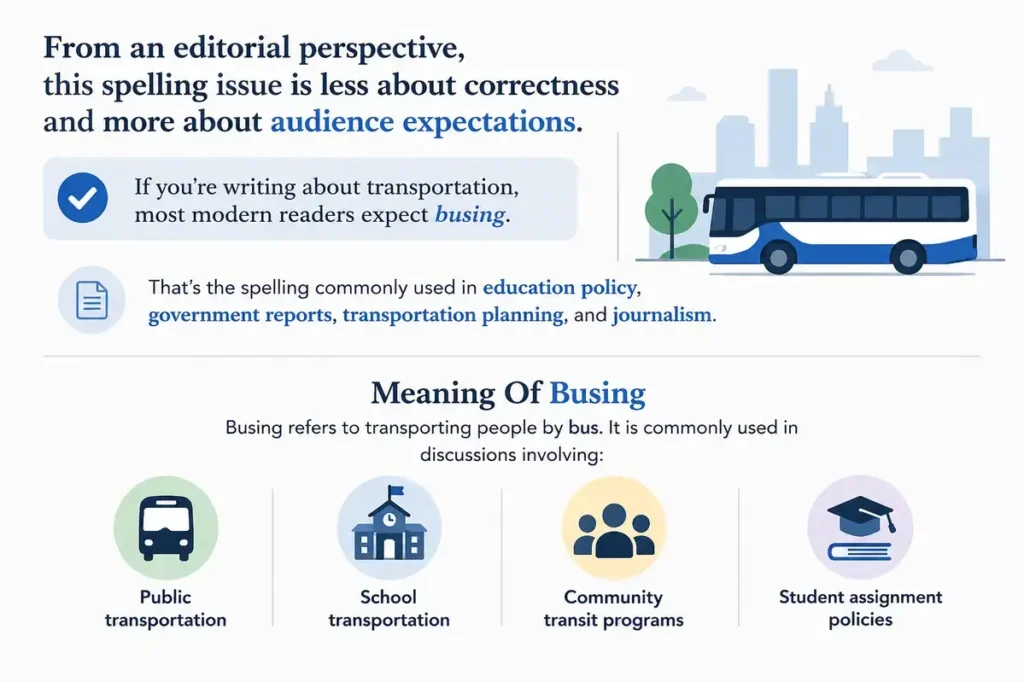
Busing refers to transporting people by bus. It is commonly used in discussions involving:
- Public transportation.
- School transportation.
- Community transit programs.
- Student assignment policies.
Examples:
- The district is busing students to neighboring schools.
- The company is busing employees to the work site.
- The city began busing commuters during the rail closure.
Meaning Of Bussing
Bussing can also mean transporting people by bus. However, many readers associate it more strongly with restaurant work. In hospitality settings, bussing means clearing tables after customers finish eating.
Examples:
- She was bussing tables after school.
- He started his career bussing tables at a small diner.
- The restaurant hired extra staff for bussing duties.
Busing Or Bussing Meaning Differences
Although dictionaries recognize overlap, real world usage shows noticeable differences.
Busing Usually Refers To Transportation
When readers encounter busing, they almost always think about buses and transportation.
Examples include:
- Busing students.
- Busing workers.
- Busing passengers.
Bussing Often Refers To Restaurant Work
When readers see bussing, many immediately think of restaurants.
Examples include:
- Bussing tables.
- Bussing dishes.
- Bussing stations.
This distinction helps reduce ambiguity.
Busing Or Bussing Key Differences
Meaning Differences
- Busing commonly relates to transportation.
- Bussing commonly relates to restaurant service.
Tone Differences
- Busing often appears in education, government, and transportation discussions.
- Bussing frequently appears in hospitality and service industry conversations.
Grammar Differences
- Both function as verb forms.
- Both can appear in present participle and gerund constructions.
Regional Differences
- American publications often favor busing for transportation.
- Some publications still use bussing in transportation contexts.
Context Differences
- Transportation discussions typically prefer busing.
- Restaurant discussions typically prefer bussing.
Which One Is Correct
Both words are correct. If your audience is American and you’re discussing transportation, busing is usually the safest choice. If you’re discussing restaurant work, bussing is often clearer because readers instantly understand the intended meaning. Many professional editors choose the spelling that creates the least confusion for readers.
Busing Or Bussing In Education
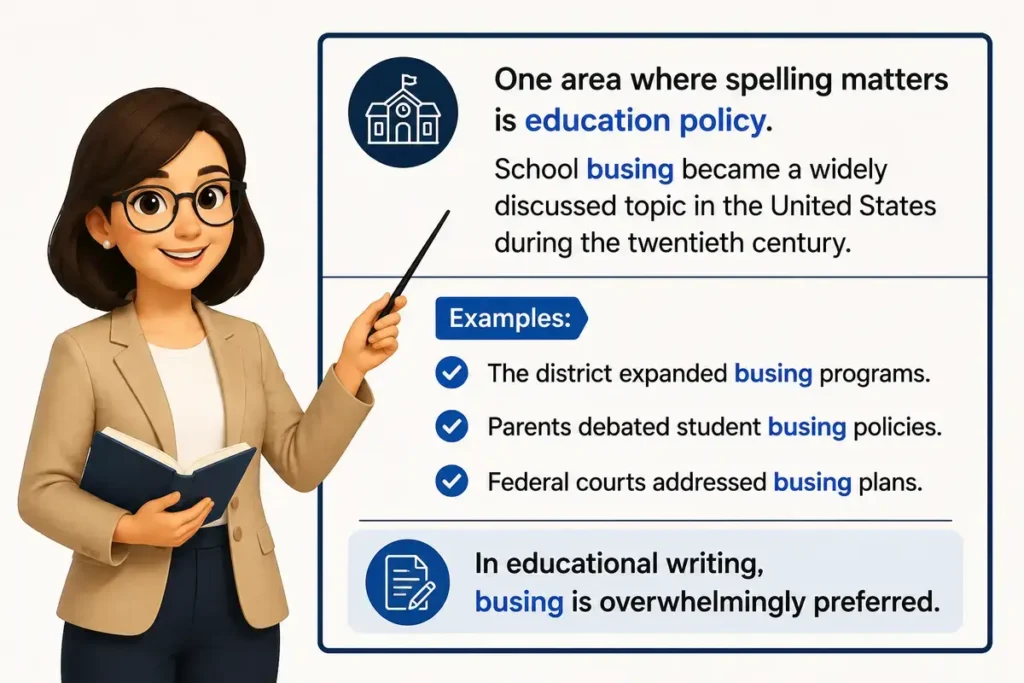
One area where spelling matters is education policy. School busing became a widely discussed topic in the United States during the twentieth century.
Examples:
- The district expanded busing programs.
- Parents debated student busing policies.
- Federal courts addressed busing plans.
In educational writing, busing is overwhelmingly preferred.
Busing Or Bussing In Transportation
Transportation professionals generally use busing.
Common examples include:
- Busing commuters.
- Busing passengers.
- Busing workers.
- Busing tourists.
The spelling looks cleaner to many readers and aligns with modern style guide preferences.
Busing Or Bussing In Hospitality
Restaurants often use bussing.
Common examples include:
- Bussing tables.
- Bussing trays.
- Bussing dishes.
- Bussing stations.
Many restaurant employees identify themselves as bussers, which reinforces the double s spelling.
Why Busing Or Bussing Causes Confusion
English spelling rules aren’t always consistent. Writers learn that many words double a final consonant before adding a suffix.
Examples include:
- Run becomes running.
- Sit becomes sitting.
- Stop becomes stopping.
Naturally, some people assume bus should become bussing. Others follow dictionary preferences that list busing as the primary transportation spelling. Both approaches have historical support, which explains the ongoing confusion.
Common Contexts For Busing
You’ll frequently see busing used in:
- School transportation.
- Public transit.
- Corporate transportation.
- Event transportation.
- Government reports.
- News articles.
- Transportation planning.
- Academic studies.
Examples:
- The company is busing employees from nearby towns.
- The city began busing visitors during the festival.
- The district expanded its busing network.
Still confused? Compare Puddy or Putty Which Spelling Is Correct in 2026.
Common Contexts For Bussing
You’ll frequently see bussing used in:
- Restaurants.
- Hotels.
- Cafés.
- Hospitality training.
- Food service industries.
Examples:
- He spent weekends bussing tables.
- She learned customer service while bussing at a busy restaurant.
- Bussing duties kept the dining area organized.
Busing Or Bussing Memory Trick
A simple trick can help.
Think about transportation.
- Bus plus ing equals busing.
Think about restaurants.
- Bussers often perform bussing duties.
This isn’t a grammar rule. It’s simply a practical memory aid many writers find useful.
Busing Or Bussing Examples In Sentences
Examples make the difference much easier to remember.
Busing Examples In Sentences
- The school district is busing students to a newly built campus.
- The company began busing workers from neighboring cities.
- Officials are busing residents to temporary shelters.
- The university is busing visitors between event locations.
- The city spent millions on busing programs.
- The district stopped busing students during the severe storm.
- They are busing employees to the construction site each morning.
- The transit authority is busing passengers during track repairs.
- Organizers are busing guests from the hotel to the venue.
- The government expanded busing services in rural communities.
Bussing Examples In Sentences
- He earned extra money bussing tables after school.
- She spent the summer bussing tables at a beach restaurant.
- Bussing duties kept the dining room clean during peak hours.
- The manager thanked the staff for bussing tables quickly.
- He learned teamwork while bussing at a busy café.
- She started bussing tables before becoming a server.
- The restaurant hired additional workers for bussing responsibilities.
- Bussing tables taught him how restaurants operate.
- They rotated bussing duties among employees.
- Her first hospitality job involved bussing dishes and resetting tables.
Common Mistakes With Busing Or Bussing
Many spelling errors happen because writers assume only one form is correct.
Mistake One Assuming Bussing Is Always Wrong
Incorrect belief:
- Bussing is never correct.
Reality:
- Bussing is a recognized spelling.
- It is especially common in restaurant settings.
Mistake Two Using Bussing In Formal Transportation Writing
While not technically wrong, some readers expect busing in transportation contexts.
Example:
- The district expanded busing programs.
This usually looks more natural in education and public policy writing.
Mistake Three Using Busing For Restaurant Work
Some readers may understand it, but bussing tables is generally clearer.
Example:
- She spent weekends bussing tables.
Mistake Four Following Sound Instead Of Context
Both words sound alike, so writers often choose a spelling based on habit instead of meaning. Context should always guide the choice.
Busing Or Bussing Pronunciation Guide
One reason this spelling question exists is that the pronunciations are identical.
Busing Pronunciation
IPA:
/ˈbʌsɪŋ/
Syllable Breakdown:
Bus • ing
Sounds Like:
BUS ing
Bussing Pronunciation
IPA:
/ˈbʌsɪŋ/
Syllable Breakdown:
Bus • sing
Sounds Like:
BUS ing
There is no pronunciation difference in standard English. Readers determine meaning from context rather than sound.
Common Pronunciation Mistakes
Most speakers pronounce both words correctly without realizing it. The challenge is spelling, not pronunciation.
Busing Or Bussing Etymology And Word Origin
The history of these spellings explains why both survive today.
Origin Of Bus
The word bus comes from omnibus. Omnibus entered English during the nineteenth century and referred to a vehicle carrying multiple passengers. Over time, speakers shortened omnibus to bus.
Development Of Busing
As transportation systems expanded, writers needed a verb form. The spelling busing emerged and became common in newspapers, government reports, and educational discussions.
Development Of Bussing
Some writers applied traditional English doubling patterns. Because many verbs double a final consonant before adding a suffix, bussing developed as an alternative spelling.
Examples of doubling include:
- Run becomes running.
- Sit becomes sitting.
- Stop becomes stopping.
As a result, both forms entered dictionaries.
Why Both Forms Remain
Language evolves through actual usage. Since large numbers of writers used both spellings, dictionaries eventually recognized both. Modern usage patterns now determine which form appears in different contexts.
Busing Or Bussing Regional Usage
English speaking countries generally recognize both spellings. Still, preferences vary slightly.
Busing Or Bussing American English
American English typically prefers busing for transportation.
Examples:
- School busing.
- Student busing.
- Employee busing.
Restaurant workers often use bussing.
Busing Or Bussing British English
British English uses both forms but encounters them less frequently because school transportation discussions often use different terminology. When the verb appears, usage is similar to American English.
Busing Or Bussing Canadian English
Canadian publications generally favor busing in transportation contexts. Hospitality industries commonly use bussing.
Busing Or Bussing Australian English
Australian English follows a similar pattern. Transportation discussions usually favor busing. Restaurant contexts frequently use bussing.
Is There A Universal Rule
No.
However, current usage strongly supports:
- Busing for transportation.
- Bussing for restaurant service.
Busing Or Bussing Grammar Rules
Understanding grammar helps prevent mistakes.
Parts Of Speech
Both words function as verb forms.
Examples:
- The district is busing students.
- She is bussing tables.
Present Participle Usage
Both words can function as present participles.
Examples:
- They are busing employees to the site.
- He is bussing tables tonight.
Gerund Usage
Both words can also function as gerunds.
Examples:
- Busing became a political issue.
- Bussing tables helped pay for college.
Past Tense Forms
The standard past tense form is:
- Bused.
- Bussed.
Both appear in dictionaries, though style guides may recommend one over the other depending on context.
Common Sentence Structures
Transportation:
- Subject plus is plus busing plus object.
Example:
- The city is busing passengers downtown.
Restaurant:
- Subject plus is plus bussing plus object.
Example:
- She is bussing tables during the lunch rush.
Busing Or Bussing In Real Life
Daily Conversation
Transportation:
- They’re busing students to the new school.
Restaurant:
- My son is bussing tables for extra cash.
Academic Writing
Transportation discussions often use busing because it aligns with common educational terminology.
Example:
- Researchers studied the effects of school busing policies.
Professional Communication
Companies frequently use busing when discussing transportation logistics.
Example:
- The organization is busing attendees between conference venues.
Hospitality Industry
Restaurant managers often use bussing.
Example:
- Bussing tables efficiently improves customer turnover.
Media And Journalism
News organizations usually favor busing when discussing transportation programs.
Example:
- Officials approved expanded busing services.
Related Words And Confused Terms
Several words create similar confusion.
Transportation Related Terms
- Bus.
- Omnibus.
- Transit.
- Transport.
- Shuttle.
- Commute.
- Passenger service.
- Public transportation.
Hospitality Related Terms
- Busser.
- Server.
- Waiter.
- Waitress.
- Host.
- Food runner.
- Table service.
- Restaurant staff.
Commonly Confused Words
- Busing and bussing.
- Bused and bussed.
- Bare and bear.
- Principal and principle.
- Stationary and stationery.
Busing Or Bussing Expert Language Insight
From an editorial perspective, this spelling issue is less about correctness and more about audience expectations. If you’re writing about transportation, most modern readers expect busing. That’s the spelling commonly used in education policy, government reports, transportation planning, and journalism. If you’re writing about restaurant work, bussing instantly signals hospitality related duties. Readers rarely pause to interpret the meaning. Experienced editors often choose the spelling that removes ambiguity.
That’s the real goal of effective writing. Language exists to communicate ideas clearly. When one spelling helps readers understand your meaning faster, that’s usually the best choice. For most writers, a practical rule works well:
- Use busing for transportation.
- Use bussing for restaurant service.
You’ll rarely run into problems by following that guideline.
Busing Or Bussing Frequently Asked Questions
Is Busing Or Bussing Correct?
Both spellings are correct. Busing is generally preferred for transportation related meanings, while bussing is commonly used for restaurant work such as clearing tables.
Which Spelling Is More Common In American English?
Busing is more common in transportation, education, and public policy discussions. Bussing remains popular in restaurant and hospitality settings.
Is Bussing Tables Correct Grammar?
Yes. Bussing tables is a standard expression in the restaurant industry. It refers to clearing dishes, cleaning tables, and preparing seating areas for new customers.
Why Do Dictionaries List Both Spellings?
Both spellings developed through actual usage. Over time, enough writers used each form that dictionaries recognized them as acceptable variants.
Is School Busing Or School Bussing Correct?
School busing is generally the preferred spelling in modern American English and appears most often in educational and government publications.
Do Busing And Bussing Sound Different?
No. Both words are pronounced the same way in standard English. The distinction appears only in spelling and usage.
What Is A Busser?
A busser is a restaurant employee responsible for clearing tables, removing dishes, and helping maintain the dining area.
Should I Use Busing Or Bussing In Professional Writing?
Use busing for transportation contexts. Use bussing when discussing restaurant duties. Matching the spelling to the context improves clarity and professionalism.
Learn the difference in Feeling Overwhelmed at Work How to Feel in Control Again.
Busing Or Bussing Conclusion
The answer to busing or bussing is simpler than it first appears. Both spellings are correct, but they serve different purposes in modern English. Use busing when discussing transportation, schools, public transit, employee travel, or passenger movement. This spelling is the preferred choice in most educational, governmental, journalistic, and professional contexts.
Use bussing when discussing restaurant work, especially clearing tables, removing dishes, and supporting dining room operations. The difference isn’t about right versus wrong. It’s about choosing the spelling that communicates your meaning most clearly. If you remember one rule, make it this: transportation usually calls for busing, while restaurant service usually calls for bussing. That simple distinction will help you write with confidence every time.
2 thoughts on “Busing or Bussing Grammar Rules and Usage Guide 2026”