
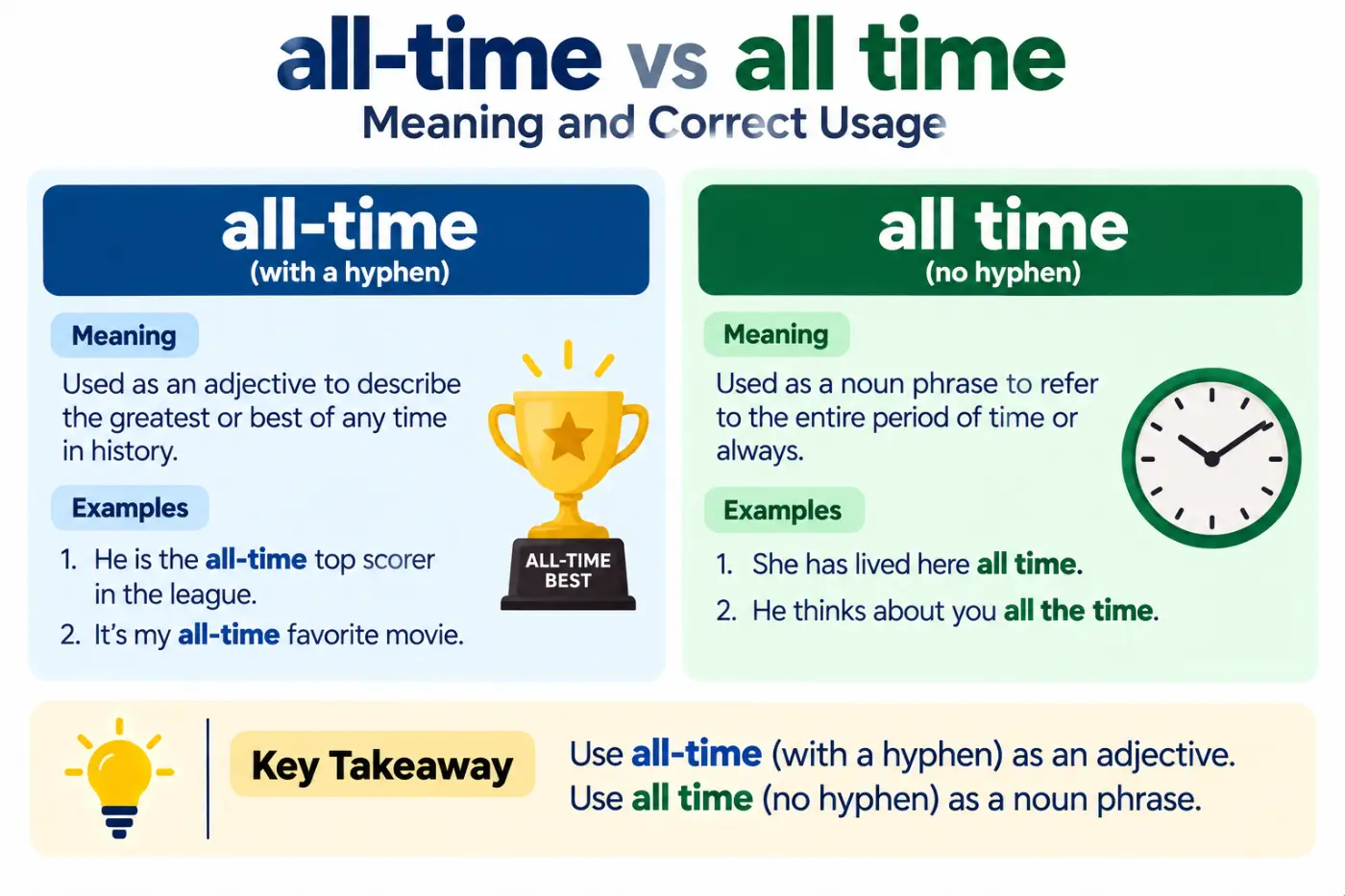
all-time vs all time can look like a simple spelling choice but the difference depends on how the phrase works in a sentence. Both forms are correct. The hyphenated form all-time usually works as a compound adjective before a noun while the open form all time usually works as a phrase that refers to the whole period or to something happening continuously.
For example you can say Serena Williams is one of the all-time great tennis players. Here all-time describes great tennis players. However you can say I have loved this song all time only in very limited or unusual contexts. In natural modern English you would normally say I have loved this song all along or I have loved this song for all time depending on the intended meaning. The phrase all time has several specific patterns and cannot simply replace every use of all-time.
This distinction matters because hyphens often show readers how words work together. They can turn two separate words into a single descriptive unit. In this guide you’ll learn the main grammar rule the difference in meaning pronunciation common sentence patterns regional usage and practical examples. You’ll also see when the open form needs another word such as for to sound natural.
Still confused? Compare well-known vs well known Which Form Is Correct.
Quick Definition
All-time is normally a compound adjective meaning among the greatest or highest ever recorded. All time is an open phrase referring to the entire period of time or to every point in a particular period. For example all-time favorite uses the hyphen while for all time means forever.
Quick Answer
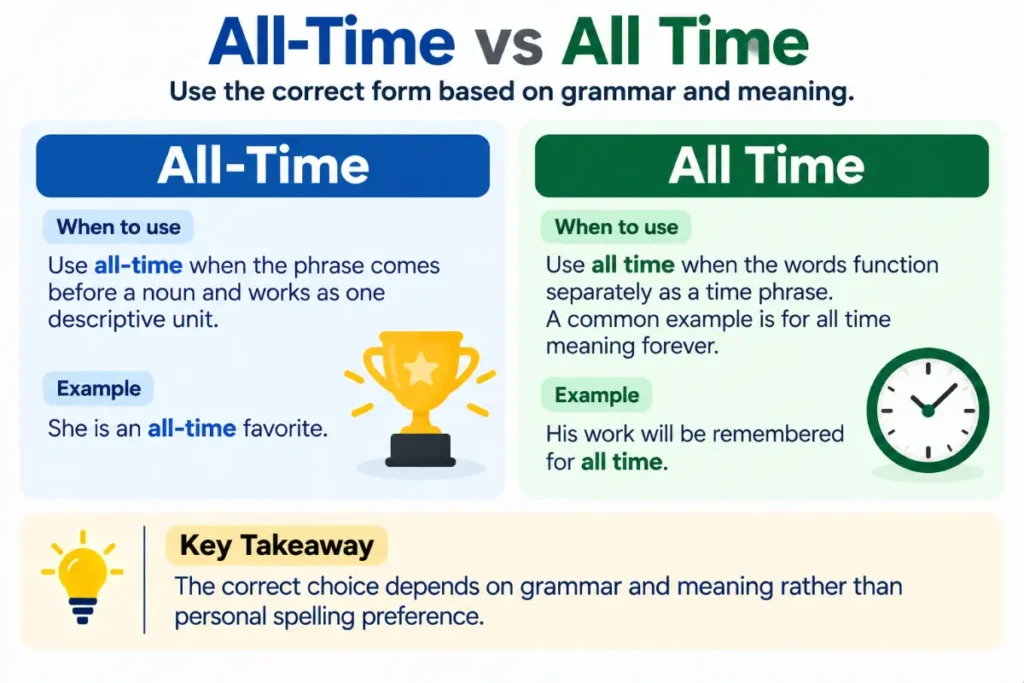
Use all-time when the phrase comes before a noun and works as one descriptive unit. For example she is an all-time favorite. Use all time when the words function separately as a time phrase. A common example is for all time meaning forever. The correct choice depends on grammar and meaning rather than personal spelling preference.
Comparison Table All Time Or All Time
| Form | Meaning | Part of Speech | Origin | Usage Frequency | Formality | Common Contexts | Example |
|---|---|---|---|---|---|---|---|
| All-time | Among the greatest or highest ever | Compound adjective | English combination of all and time | Very common | Neutral | Sports records favorites achievements rankings | She is an all-time great. |
| All time | The whole period of time or every point in a specified period | Noun phrase or time expression | English combination of all and time | Common in specific constructions | Neutral | For all time historical references duration | Their friendship lasted for all time. |
The table shows why treating the two forms as simple spelling alternatives can lead to mistakes. The hyphenated form normally creates a descriptive unit. The open form keeps the words grammatically separate.
Meaning And Definition
Meaning Of All Time
All time refers broadly to the complete span of time under discussion. Its exact meaning depends on the expression around it.
The clearest and most established pattern is for all time. This means forever or for the entire future.
The promise will remain for all time.
Here all time refers to an unlimited period.
You can also see the phrase in expressions that refer to the entire history of something.
The museum displays some of the greatest inventions of all time.
In this construction all time means across the entire history or period being considered. The phrase of all time means among everything that has existed or happened during the relevant period.
This is a very common structure.
Another example is:
That was one of the happiest days of my life of all time.
This particular sentence sounds awkward because of unnecessary repetition. A natural speaker would usually say:
That was one of the happiest days of my life.
Or:
That was one of the happiest days ever.
The lesson is simple. All time does not automatically belong in every sentence involving time. It needs a grammatical structure that supports its meaning.
Meaning Of All Time
The hyphenated form all-time normally acts as a compound adjective. It describes something as ranking among the highest or greatest ever.
Consider these examples.
He is an all-time great basketball player.
That was an all-time record.
She is one of my all-time favorite singers.
In each case all-time modifies a noun or noun phrase. The words work together to create a single descriptive idea.
The phrase can express more than greatness. It can refer to a record or high point that stands across the entire history of a particular activity.
For example:
The company reported an all-time high in sales.
Here all-time modifies high. It tells the reader that the sales level was the highest recorded up to that point.
Similarly:
The stock reached an all-time low.
The phrase tells us that the value reached its lowest recorded point within the relevant history.
This use is especially common in sports business finance entertainment and journalism.
The Key Difference
The main difference is grammatical rather than simply visual.
- All-time usually works as a compound adjective. It describes a noun and normally appears directly before that noun.
- All time works as an open phrase. It commonly appears in expressions such as for all time and of all time.
- The hyphen connects the words. It tells the reader that all and time work together as one modifier.
- The open form keeps the words separate. The phrase can refer to the entire period being discussed.
- Meaning depends on context. A hyphen can change the grammatical relationship even though the basic words remain the same.
Compare these sentences.
She is an all-time favorite.
She has supported the team for all time.
The first sentence describes the person or thing as a favorite across the whole history of the relevant subject. The second expresses duration and has a very different structure.
Another useful comparison is:
The athlete set an all-time record.
The record has stood for all time.
The first describes the record. The second describes how long something has lasted.
Why The Hyphen Matters
Hyphens can make English easier to read because they show which words belong together.
Consider:
He is an all time great player.
Most readers will understand the sentence. Still the standard compound adjective is written all-time before the noun.
He is an all-time great player.
The hyphen signals that all and time form a single modifier.
This pattern appears throughout English.
We see compound adjectives such as well-known author high-speed train and long-term plan. The same principle applies to all-time when the phrase works together before a noun.
Hyphenation can vary in some constructions because English style guides do not treat every compound in exactly the same way. However the general rule is stable. When all-time functions as a compound modifier before a noun the hyphen is normally appropriate.
When To Use All-Time
Use the hyphenated form when the phrase directly describes a noun as being among the greatest highest lowest or most significant ever.
Here are common patterns.
All-Time Favorite
This means a favorite that has remained especially important across a person’s or group’s experience.
That movie is one of my all-time favorites.
All-Time Great
This describes someone or something considered among the greatest in its field across history.
She is regarded as an all-time great athlete.
All-Time Record
This describes the highest or lowest recorded level.
The company reached an all-time sales record.
All-Time High
This means the highest recorded level.
The index reached an all-time high.
All-Time Low
This means the lowest recorded level.
The price fell to an all-time low.
All-Time Best
This means the best performance or result recorded during the relevant history.
The restaurant had its all-time best month.
The phrase appears often in sports business entertainment and everyday conversation because people frequently compare current achievements with historical records.
When To Use All Time
The open form appears in established phrases where time functions as a noun rather than as part of a compound adjective.
One of the most common patterns is for all time.
The agreement was designed to last for all time.
This means forever.
Another common structure is of all time.
He is one of the greatest musicians of all time.
Here of all time means across the entire history of music or across the complete period being considered.
The open form also appears when another word naturally controls the relationship.
They will be remembered for all time.
The story has remained popular throughout all time.
The second example is grammatically possible but sounds less natural than many alternatives. Native speakers would usually choose a more specific expression such as throughout history or for centuries depending on the intended meaning.
That point matters. Correct grammar does not automatically produce natural style. Good writing considers both.
Sentence Examples
Here are ten natural examples showing the main uses.
- She is one of the all-time best performers in the industry.
- That was an all-time great final.
- This is my all-time favorite book.
- The company reached an all-time high in revenue.
- The team recorded an all-time low number of errors.
- He is considered an all-time great quarterback.
- That song remains one of my all-time favorites.
- The athlete broke the all-time record for the event.
- The monument was built to stand for all time.
- They hope their work will be remembered for all time.
The first group uses the hyphenated form as a compound modifier. The final examples use the open form as part of the phrase for all time.
Common Mistakes
Writing All Time Favorite
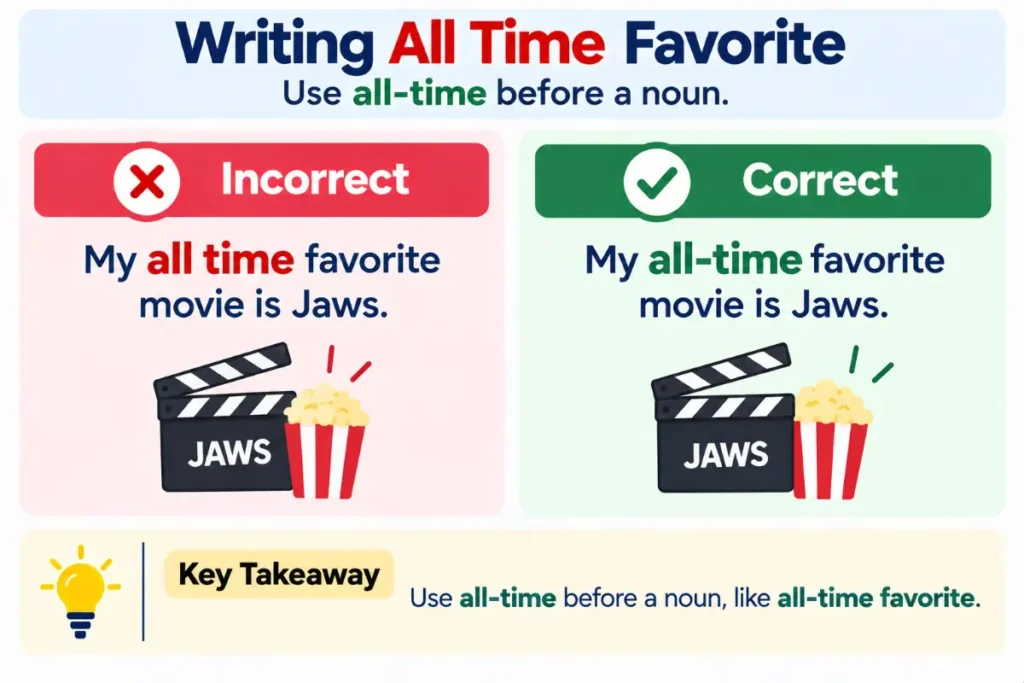
A common error is writing:
My all time favorite movie is Jaws.
The preferred standard form before the noun is:
My all-time favorite movie is Jaws.
The hyphen shows that all-time modifies favorite as part of a larger compound description.
Writing All-Time When The Phrase Means Forever
Another mistake is adding a hyphen to an open phrase.
Incorrect style:
They will be remembered for all-time.
Standard usage:
They will be remembered for all time.
Here for all time is a time phrase. The words are not acting as a compound adjective.
Treating Both Forms As Interchangeable
The two forms are related but they do not perform the same grammatical job.
She is an all-time favorite.
She stayed there for all time.
Replacing one form with the other can change the structure and sometimes the meaning.
Forgetting The Hyphen Before A Noun
Writers sometimes leave out the hyphen because the meaning still seems obvious.
He is an all time great.
A polished version is:
He is an all-time great.
This is especially useful in formal writing where compound modifiers should be easy to parse.
Adding A Hyphen To Every Use
Some writers learn the compound adjective rule and then apply it everywhere.
That produces sentences such as:
The tradition has lasted for all-time.
The standard form is:
The tradition has lasted for all time.
The hyphen belongs to the compound adjective use rather than every occurrence of the words.
A related grammar guide is gizmo vs gismo: Which Spelling Is Correct?.
Pronunciation Guide
The pronunciation of all-time and all time is generally the same in ordinary speech.
In American English the phrase can be represented approximately as:
all time
The word all is commonly pronounced /ɔːl/ while time is pronounced /taɪm/.
The phrase has two main spoken parts:
all TIME
The exact stress depends on the surrounding sentence. In a phrase such as all-time favorite the main sentence stress usually falls on the important noun or adjective rather than creating a special spoken difference between the hyphenated and open forms.
This is one reason the distinction can be confusing. You generally cannot hear the hyphen.
The difference appears in writing because the hyphen shows the grammatical relationship between the words.
That is a useful reminder for English learners. Not every written distinction produces a different sound. Sometimes punctuation tells you how the words function together.
Etymology And Word Origin
The expression combines two very old English words.
All comes from Old English and has long carried the idea of the entire amount or complete quantity.
Time also comes from Old English and is connected with the measurement or experience of duration.
The modern compound adjective developed naturally from the idea of considering something across the whole period of its relevant history. If a record is an all-time high then it is the highest point across all recorded time within the context being discussed.
The hyphenated form reflects a later grammatical development in English compound modifiers. The two words work together as a single descriptive unit.
The open phrase has a more literal relationship. In expressions such as for all time the words retain their separate roles within a prepositional phrase.
This is a good example of how English punctuation can reflect grammar rather than pronunciation.
Regional Usage
American English
American English uses both forms in standard writing. All-time is especially common in sports reporting business writing entertainment reviews and everyday descriptions such as all-time favorite.
All time appears naturally in phrases such as for all time and of all time.
American style generally favors the hyphen when the words function together as a compound modifier before a noun.
British English
British English also uses both forms with essentially the same distinction. An all-time favorite and an all-time record are standard constructions.
British writers also use for all time and of all time as open phrases.
There is no major regional difference in the basic grammar.
Australian English
Australian English follows the same general pattern. The hyphenated form commonly appears before a noun when all-time acts as a compound adjective.
The open form appears in phrases where the words function separately.
The distinction is grammatical rather than uniquely regional.
Canadian English
Canadian English also follows the same basic rule. Writers commonly use all-time before nouns and all time in established open phrases.
Differences in individual style guides may affect punctuation in some compound constructions. The core distinction remains stable.
Grammar Rules And Part Of Speech
The most useful grammar rule is to identify the role of the phrase in the sentence.
When all-time comes before a noun as a compound adjective it acts as one descriptive unit.
Examples include:
She is an all-time favorite.
That was an all-time record.
He is an all-time great.
In each sentence the compound describes a person thing or achievement.
The open form works differently.
For all time.
Of all time.
In these expressions time remains a noun and the words all and time do not form one compound adjective.
Hyphen Position
The hyphen normally appears between all and time when the phrase functions as a compound modifier.
An all-time record.
An all-time favorite.
An all-time high.
When the phrase follows the noun and does not act as a compound modifier the hyphen may not be appropriate.
For example:
The record is an all time high.
This sentence is less natural because all-time high is normally treated as a compound noun phrase. A polished version is:
The record is an all-time high.
The exact punctuation can depend on the structure of a particular sentence and the style guide being followed. The key question remains whether the words work together as a compound modifier or as a separate time phrase.
Real Life Usage Examples
Daily Conversation
That is my all-time favorite restaurant.
She is one of my all-time favorite actors.
These examples sound natural in casual speech even though the hyphen exists only in writing.
Email And Workplace Communication
The company reported an all-time high in monthly sales.
This quarter produced an all-time record for new customers.
The construction is common in business communication because organizations often compare current results with historical performance.
Academic Writing
The study examines one of the largest population changes of all time.
The research team recorded an all-time high participation rate during the final phase.
Academic writers should use the form that fits the grammatical structure rather than adding or removing a hyphen simply for appearance.
News And Journalism
The market reached an all-time high during morning trading.
The athlete broke an all-time record at the championship event.
Journalists use the phrase frequently when reporting records because it provides a quick comparison with historical performance.
Literature And Storytelling
He believed the promise would last for all time.
The old song became one of the town’s all-time favorites.
The first example emphasizes duration. The second describes status across the history of the subject.
Related And Confused Terms
Ever
Ever often replaces expressions involving the entire period of experience.
That was the best performance ever.
This can sound more natural than that was the best performance of all time in casual conversation.
Forever
Forever means for an unlimited period.
Their friendship lasted forever.
For all time can have a similar sense in formal or literary writing.
Throughout History
Throughout history refers to the whole span of recorded or known human history.
The invention has influenced people throughout history.
This phrase can be clearer than of all time when the historical scope matters.
All-Time Favorite
This is a common compound expression for a favorite that ranks especially highly across someone’s experience.
That is my all-time favorite song.
Record High
Record high means the highest level recorded within the relevant period.
The temperature reached a record high.
This can sometimes replace all-time high depending on the context.
Record Low
Record low means the lowest recorded level.
The region experienced a record low temperature.
Greatest Ever
Greatest ever is a conversational alternative to greatest of all time.
He may be the greatest ever.
This expression is especially common in sports discussions.
Historic
Historic means important or significant in history. It does not automatically mean the greatest ever.
The team won a historic championship.
That describes historical importance rather than necessarily claiming the highest achievement in the entire history of the sport.
How The Phrase Works In Sports
Sports writing is one of the places where the hyphenated form appears most often.
You’ll regularly see expressions such as all-time scoring record all-time great and all-time high.
For example:
She became the league’s all-time leading scorer.
He is widely regarded as an all-time great.
The team set an all-time attendance record.
These expressions compare current achievements with the full history of the relevant competition.
However all-time does not automatically mean the current record holder is the greatest person in every sense. An all-time scoring record is a measurable statistic. An all-time great is a broader judgment about achievement or reputation.
That distinction is useful in careful writing because measurable records and subjective evaluations are not the same thing.
How The Phrase Works In Business
Business writing often uses all-time high and all-time low to describe measurable results.
For example:
The company reached an all-time high in quarterly revenue.
Customer complaints fell to an all-time low.
These expressions are useful because they quickly communicate a comparison with historical performance.
The phrase can also appear in financial reporting.
The stock reached an all-time high during the session.
Here the writer means the highest recorded market price within the relevant history.
The context determines the exact period being compared. An all-time high for a company does not necessarily mean the highest price in an entire market. It means the highest recorded level for that particular subject.
How To Choose The Right Form
When you are unsure which form to use ask yourself one simple question.
Am I using the phrase to describe a noun as a record or as something exceptional across history?
If yes use the hyphenated form.
An all-time favorite.
An all-time record.
An all-time high.
If the phrase means an entire period and appears in a structure such as for all time use the open form.
For all time.
You can also check the words immediately around the phrase. If all-time sits directly before a noun and acts as one description the hyphen is usually appropriate.
If time is functioning as a regular noun inside a phrase the words usually remain open.
This quick test handles most everyday cases.
Expert Editor Insight
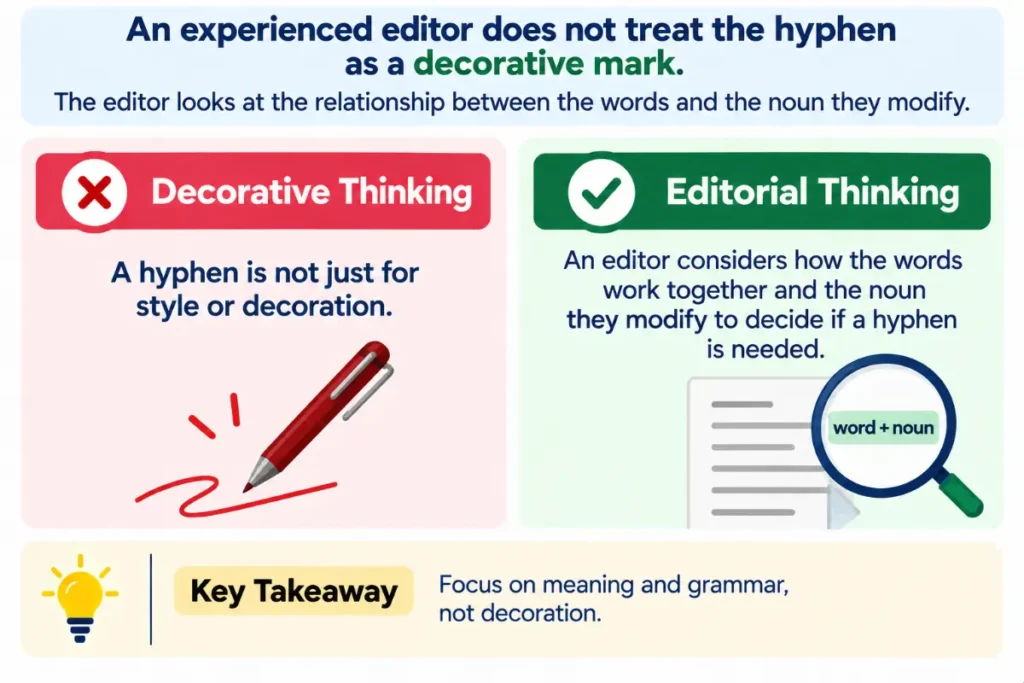
An experienced editor does not treat the hyphen as a decorative mark. The editor looks at the relationship between the words and the noun they modify. If all-time forms one descriptive unit before a noun such as all-time favorite or all-time high the hyphen improves clarity and follows standard compound adjective practice. If the phrase means an entire period in expressions such as for all time the words remain separate. Spellcheckers can catch some missing hyphens but they may not understand every stylistic context. Good proofreading still requires looking at how the phrase functions in the sentence.
Still confused? Compare emersion vs immersion: Correct Meaning and Usage.
Conclusion
all-time vs all time are both correct forms but they serve different grammatical purposes. The hyphenated form normally works as a compound adjective in expressions such as all-time favorite all-time great and all-time high. The open form commonly appears in phrases such as for all time and of all time where the words function as a separate time expression.
The easiest way to choose the right form is to look at what comes next. If the phrase works together to describe a noun use the hyphen. If you are talking about an entire period of time keep the words separate. This simple test covers most everyday uses.
For editing remember one practical rule. Think of the hyphen as a bridge that joins all and time when they act as one description. When they simply refer to time as a noun keep them apart. That approach will help you write naturally and avoid unnecessary punctuation mistakes.
FAQs
Is all-time always hyphenated?
No. The hyphen depends on grammar. Use all-time when the words work together as a compound modifier such as all-time favorite all-time great or all-time record. Use all time as separate words in phrases such as for all time and of all time. The sound stays similar but the written form reflects the different grammatical function.
Which is correct all-time or all time?
Both are correct. All-time normally works as a compound adjective that describes a noun. All time works as a separate phrase referring to an entire period. For example all-time favorite uses the hyphen while for all time does not. The correct form depends on the sentence rather than a simple spelling preference.
Is all-time favorite hyphenated?
Yes. The standard compound form is all-time favorite. The hyphen connects all and time because together they modify favorite as a single descriptive unit. You might write This is my all-time favorite movie. In that sentence the phrase describes the movie and indicates that it ranks as a favorite across the relevant span of the speaker’s experience.
Is it correct to say of all time?
Yes. Of all time is a standard phrase. It commonly means across the entire history of the subject being discussed. For example she is one of the greatest singers of all time means she is considered among the greatest singers throughout the history of music. The phrase remains open because it functions as a separate phrase rather than a compound modifier.
What does all-time high mean?
All-time high means the highest recorded level reached by something within the relevant history. The expression is common in business finance sports and news writing. For example the company reached an all-time high in sales means its sales reached their highest recorded level. The hyphen appears because all-time works as a compound modifier before high.
What does for all time mean?
For all time means forever or for the entire relevant future period. It often appears in formal literary or serious writing. For example the monument was created to stand for all time means the creators intended it to remain permanently. The words are written separately because they form a time phrase rather than a compound adjective.
Can I write all time favorite without a hyphen?
You may see all time favorite written without a hyphen especially in informal online writing. In careful standard writing the preferred form before the noun is all-time favorite. The hyphen makes the compound relationship clear. It shows that all and time work together to modify favorite rather than functioning as unrelated words.
Why is the hyphen used in all-time?
The hyphen is used to show that all and time form one compound modifier. In all-time favorite the two words work together to describe favorite. Without the hyphen the reader can still understand the sentence but the standard compound form is clearer. This follows the broader English practice of hyphenating many compound modifiers before nouns.