
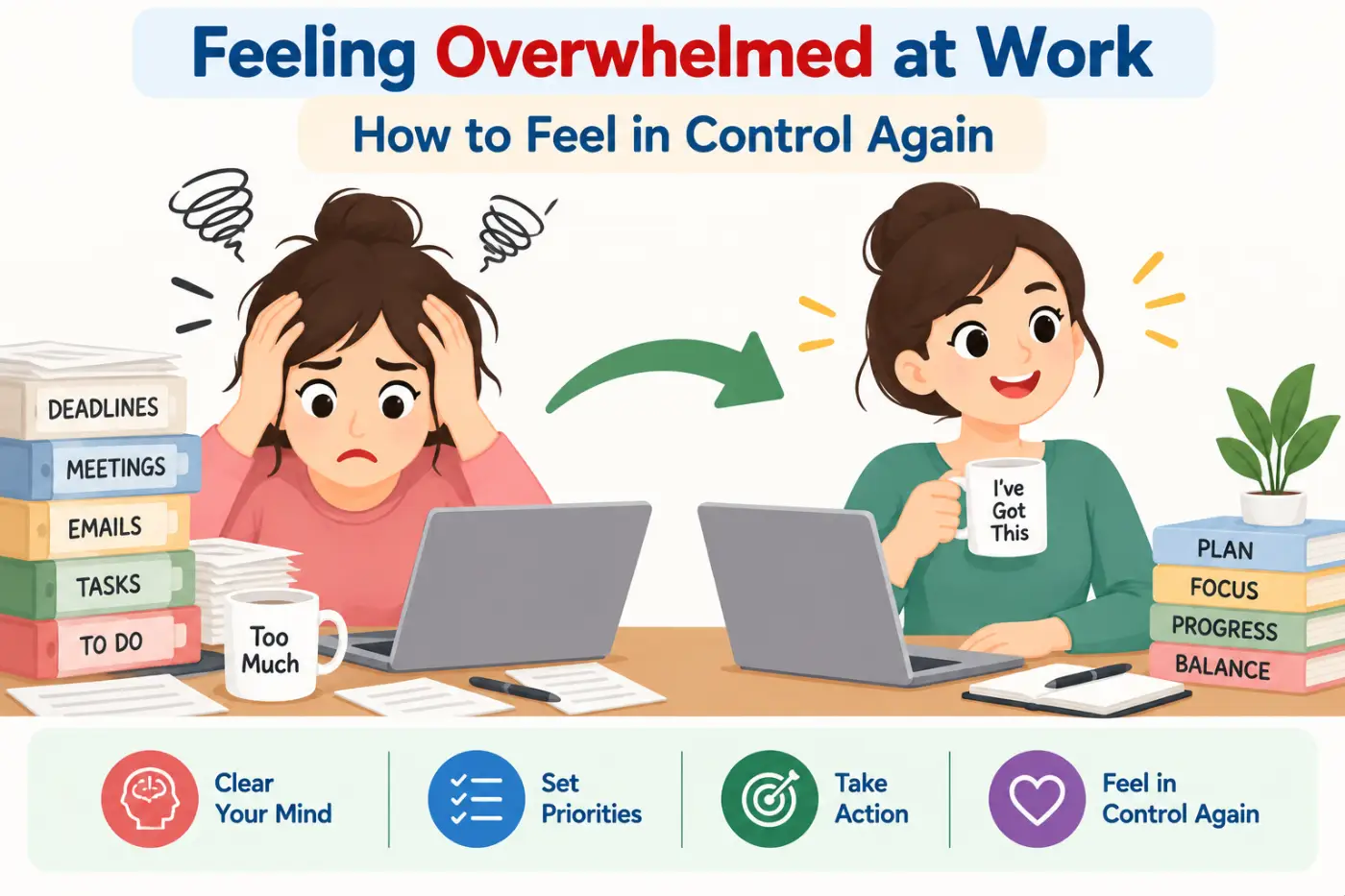
Feeling overwhelmed at work can make even a normal day feel like a mountain. Your inbox keeps growing, meetings interrupt your concentration, deadlines seem to arrive at the same time, and your mind keeps jumping from one unfinished task to another. If that sounds familiar, you’re not necessarily bad at managing your time. Your workload may simply be asking more from you than you can reasonably handle at once.
The first step is to stop treating every task as equally urgent. Feeling overwhelmed at work often comes from a combination of too many demands, unclear priorities, constant interruptions, limited control, or pressure that has continued for too long. Once you identify the real source, you can start making practical changes instead of simply pushing yourself harder.
This guide explains the common signs of workplace overload, why it happens, how to regain control of your day, how to speak with your manager, and how to build healthier work habits. You’ll also learn what to do when the usual productivity tricks aren’t enough.
Learn the difference in employer name meaning And How To Enter It Correctly.
Quick Definition
Feeling overwhelmed at work means experiencing more mental or emotional pressure from your job demands than you currently feel able to manage comfortably. It can involve stress, difficulty concentrating, constant worry about unfinished tasks, fatigue, irritability, or a sense that you can’t catch up. The solution usually starts with identifying and reducing the sources of overload.
Quick Answer
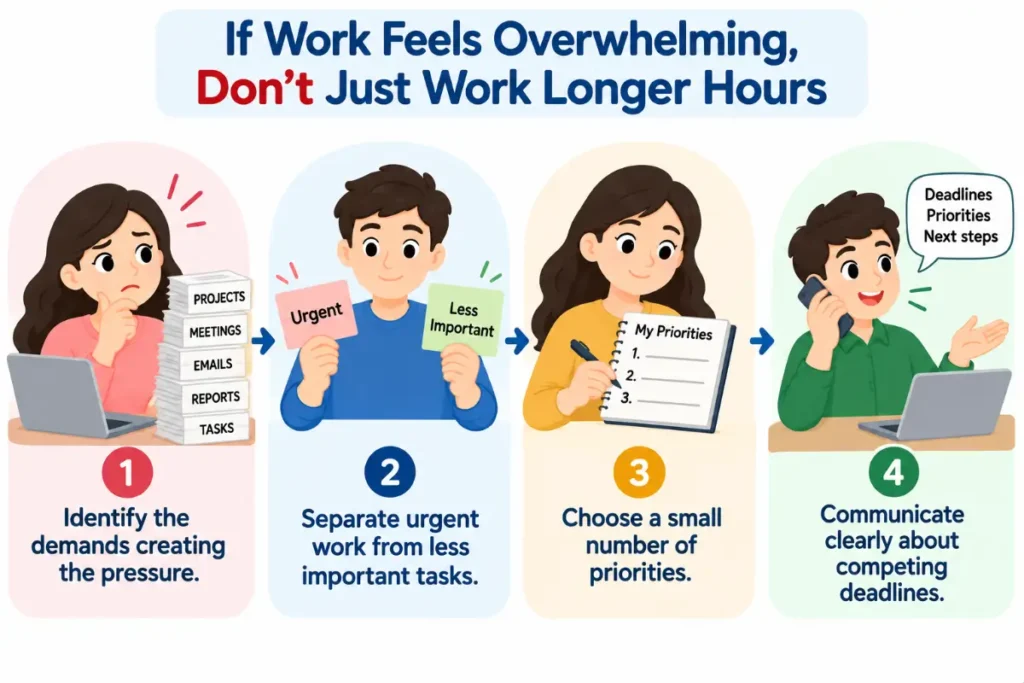
If work feels overwhelming, don’t respond by automatically working longer hours. First identify the demands creating the pressure, separate urgent work from less important tasks, choose a small number of priorities, and communicate clearly about competing deadlines.
If the problem continues despite reasonable changes, talk with your manager or another appropriate workplace support person. Persistent or severe distress can also be a reason to seek professional help.
What Workplace Overload Really Feels Like
Workplace overload isn’t always dramatic. Sometimes it looks like sitting at your desk for eight hours and still feeling as if you accomplished nothing.
You might open your laptop in the morning with a clear plan. Then an unexpected meeting appears. A coworker needs help. Three messages arrive. Your manager asks for an update. A deadline moves closer. By lunch, the original plan has disappeared.
The afternoon can become a game of mental whack a mole. You respond to whatever seems loudest instead of working on what matters most.
Over time, this pattern can affect more than productivity. You may find yourself thinking about work after hours, struggling to relax, feeling impatient with people, or waking up already worried about the day ahead.
The important point is that overwhelm is often a signal. It tells you that something about the current workload, environment, expectations, or working pattern needs attention.
That signal deserves more than another cup of coffee and a promise to work faster.
Signs You Have Too Much on Your Plate
Everyone has busy days. A busy day isn’t automatically a problem. The concern grows when pressure becomes persistent and starts affecting how you think, work, rest, or interact with others.
Common signs include:
- You struggle to decide what to do first. Every task feels urgent so choosing a priority becomes difficult.
- You keep switching between tasks. You start one assignment then jump to email before moving to another request.
- Small tasks feel unusually difficult. Something that normally takes ten minutes can suddenly feel like a major effort.
- You make more avoidable mistakes. Mental fatigue can make details harder to track.
- You constantly think about unfinished work. Your body may leave the office while your mind stays at your desk.
- You feel guilty when you take a break. Rest starts to feel like something you need to earn.
- You work longer but feel less productive. Extra hours don’t always solve a workload problem.
- You become more irritable. Patience can shrink when your mental resources are already stretched.
- You have trouble concentrating. Your attention keeps returning to everything you still need to do.
- You feel trapped by your workload. Instead of seeing individual tasks you see one enormous pile.
One or two signs during a demanding week don’t necessarily mean you have a serious problem. Look at the overall pattern and how long it has lasted.
Why Work Starts Feeling Unmanageable
There is rarely one single reason. Workplace pressure often builds from several small problems that eventually become too much.
Too Many Priorities
A long task list becomes especially stressful when everything is labeled urgent.
If your manager wants one report today, a customer needs an answer today, and your team needs another project completed today, the problem isn’t simply time management. You have competing demands.
You can’t give every priority first place.
Someone has to decide what comes first.
Unclear Expectations
Unclear work creates mental clutter.
If you don’t know what your manager considers most important, you may spend extra time trying to protect yourself from every possible outcome. You might overprepare, check your work repeatedly, or take on tasks that someone else could handle.
Clear expectations reduce that mental noise.
Constant Interruptions
Notifications can quietly destroy a workday.
A message takes thirty seconds to read. A quick question takes two minutes. A short meeting takes twenty minutes. None seems serious by itself.
The problem is the accumulation.
Every interruption forces your attention to change direction. Getting back into deep work can take much longer than the interruption itself.
Unrealistic Deadlines
A deadline can motivate you when it matches the amount of work available.
It becomes a source of chronic pressure when the required work consistently exceeds the time or resources provided.
If this happens repeatedly, working faster won’t solve the underlying problem.
The workload needs to change.
Lack of Control
People often cope better with demanding work when they have some control over how they complete it.
If every part of your day is controlled by urgent requests, meetings, last minute changes, or other people’s schedules, pressure can rise quickly.
Even small amounts of control can help. Choosing your task order, protecting focus time, or having a say in deadlines can make work feel more manageable.
Perfectionism
High standards can produce excellent work. Perfectionism can create unnecessary exhaustion.
If you spend an hour polishing something that needed twenty minutes of solid work, you’ve used time without necessarily creating much additional value.
Ask yourself what level of quality the task actually requires.
Not every email needs to sound like a legal document. Not every internal presentation needs to be flawless.
The Difference Between Busy and Overloaded
Being busy and being overloaded aren’t the same thing.
A busy period may involve many tasks but still feel manageable. You know what matters, you understand the deadlines, and you can see a path through the work.
Overload feels different.
You may have no clear starting point. New demands keep arriving faster than you can finish existing work. Even after working hard you still feel behind.
A useful question is:
Can I reasonably complete the important work with the time and resources available?
If the answer is no, you don’t have a motivation problem. You may have a capacity problem.
That distinction matters because the solutions are different.
A motivation problem may respond to better structure or fewer distractions.
A capacity problem may require renegotiating deadlines, reducing responsibilities, adding resources, delegating tasks, or changing the amount of work assigned.
How to Regain Control of Your Workday
You don’t need a perfect productivity system. In fact, building an elaborate system when you’re already stressed can make things worse.
Start small.
Put Everything in One Place
Get tasks out of your head.
Write down unfinished work, upcoming deadlines, messages you need to answer, meetings you need to prepare for, and personal reminders connected to your job.
The goal isn’t to create a beautiful task management system.
The goal is to stop your brain from acting like a storage cabinet.
Once everything is visible, you can make decisions.
Choose Your Top Three Priorities
Look at your full list and identify the three outcomes that matter most today.
These should be meaningful tasks rather than tiny chores.
For example:
- Finish the client proposal.
- Prepare the presentation for tomorrow.
- Resolve the issue blocking the development team.
Everything else can still matter. It simply doesn’t get equal attention at the same time.
Three clear priorities can feel much lighter than twenty vague obligations.
Separate Urgent From Important
Urgent work demands attention now.
Important work contributes to a meaningful outcome.
They can overlap but they aren’t identical.
An incoming message may feel urgent because it arrived five minutes ago. That doesn’t mean it deserves to interrupt a task with a deadline tomorrow.
Before reacting ask:
What happens if I don’t do this right now?
If the answer is nothing meaningful then you may have more flexibility than you thought.
Break Large Projects Into Visible Steps
Large projects create stress because the brain struggles with vague tasks.
Finish the project is vague.
Create the outline is clear.
Review the source material is clear.
Draft the introduction is clear.
Send the draft for review is clear.
Breaking work into smaller actions gives you a starting point. Once you begin moving the pieces forward the project often feels less intimidating.
Protect Focus Time
You don’t need an entire uninterrupted day.
Even a focused block of thirty to sixty minutes can help.
During that time close unnecessary tabs, silence nonessential notifications, and avoid checking messages unless the work genuinely requires it.
If your workplace makes uninterrupted time difficult, discuss a practical arrangement with your manager or team.
Focus is not a luxury for many jobs. It’s part of doing complex work properly.
Stop Treating Your Inbox as Your To Do List
Email is useful for communication. It’s a poor substitute for prioritization.
If you treat every new message as a command to stop what you’re doing, your priorities will constantly change.
Instead, review messages at sensible points during the day when your role allows it.
You can also create simple categories such as:
- Needs action today.
- Needs action later.
- Waiting for someone else.
- Information only.
This approach reduces the feeling that every message is demanding an immediate response.
A useful rule is to let your priorities drive your inbox rather than allowing your inbox to drive your priorities.
Learn to Say No Without Sounding Difficult
Many overwhelmed employees take on too much because they’re afraid that saying no will make them appear unhelpful.
You don’t always need to say a blunt no.
Instead, explain the tradeoff.
For example:
I can take this on today but I’ll need to move the report to tomorrow. Which one should come first?
That sentence does something valuable. It makes capacity visible.
Another option is:
I can handle this by Friday. If it needs to be done sooner I’ll need help with one of my current priorities.
You aren’t refusing to help.
You’re asking for a realistic decision about time and priorities.
That is a much healthier approach than silently accepting everything and hoping you can somehow squeeze it all into the day.
How to Talk With Your Manager
If the workload is consistently too high, your manager needs useful information rather than a vague statement that you’re stressed.
Prepare a short picture of the situation.
Explain:
- What you’re currently responsible for.
- Which deadlines are approaching.
- Which tasks are competing for your attention.
- What you can realistically complete.
- What support or prioritization you need.
A conversation might sound like this:
I’m currently handling the client report, the weekly analysis, and the new project request. I can finish the report and analysis by Friday. The new project will need to move to next week unless we shift one of those deadlines. Which priority would you like me to move?
This is much stronger than saying I have too much work.
It gives your manager something concrete to respond to.
What to Do When Everything Really Is Urgent
Sometimes the workload is genuinely intense.
A product launch may be approaching. A major client issue may have appeared. A deadline may be fixed by law or contract. Emergencies happen.
During these periods don’t aim for your normal productivity level.
Shift into triage mode.
First identify the consequences of delay.
Next determine what absolutely must happen.
Then identify what can wait.
After that find tasks that can be delegated or simplified.
Finally communicate the revised priorities to the people involved.
The goal during a high pressure period isn’t to maintain perfect balance. It’s to prevent temporary pressure from turning into unnecessary chaos.
For another common grammar confusion, see Loss or Lost Correct Usage Meaning and Examples.
Boundaries That Can Protect Your Energy
Work boundaries aren’t about refusing responsibility. They help define when and how responsibility is handled.
Useful boundaries might include:
- Having a clear stopping time when your role allows it.
- Avoiding routine work messages during personal time.
- Taking a real lunch break instead of eating while working.
- Blocking time for focused tasks.
- Turning off unnecessary notifications.
- Asking for reasonable notice for nonurgent requests.
- Taking vacation or personal leave when available.
- Keeping work conversations within appropriate channels.
A boundary only works if you communicate it clearly and apply it consistently.
You don’t need to build a fortress around your calendar. A few practical limits can make a surprisingly large difference.
When Productivity Advice Stops Helping
There comes a point where another productivity trick misses the real issue.
If you already organize your tasks, reduce distractions, prioritize carefully, and work efficiently but the workload remains impossible, you shouldn’t blame yourself.
You may need organizational change.
That could mean:
- A reduced workload.
- Additional staff.
- A different deadline.
- Better delegation.
- Clearer responsibilities.
- Fewer unnecessary meetings.
- Better project planning.
- A change in role or workload distribution.
Personal productivity has limits.
You can sharpen a pencil forever but it won’t make the pencil longer.
If the amount of work exceeds available capacity, the answer needs to involve the work itself.
How to Recover After a Difficult Workday
After a stressful day it can be tempting to keep thinking about everything you didn’t finish.
That usually doesn’t help tomorrow.
Create a short shutdown routine.
Write down the unfinished tasks you need to remember. Decide what you’ll tackle first tomorrow. Close your work applications if possible. Then give yourself permission to stop.
Your brain needs a clear signal that the workday has ended.
Something as simple as writing tomorrow’s first task before leaving can reduce the temptation to mentally rehearse your workload all evening.
Recovery isn’t wasted time.
It’s part of maintaining your ability to work well over the long term.
Small Habits That Make Work Feel Lighter
You don’t need to change your entire routine overnight.
A few small habits can reduce daily friction.
Start With One Clear Task
Instead of checking everything immediately ask what meaningful result would make today better.
Start there when possible.
Keep a Short Task List
A huge list can create pressure before you begin.
Keep your main working list manageable and store future tasks somewhere else.
Batch Similar Work
Answer several routine messages together. Handle administrative tasks in one block. Group meetings when practical.
Switching less often can protect your attention.
Take Short Breaks
Standing up stretching walking briefly or looking away from your screen can give your attention a reset.
A break doesn’t mean you’re falling behind.
Make Tomorrow Easier
Before finishing work write down the first important task for the next day.
Starting with a clear direction can make the next morning much calmer.
Sentence Examples for Talking About Work Stress
If you need to explain your situation to someone else, these phrases can help.
- I’m having trouble keeping up with the current workload.
- I have several competing deadlines and need help deciding which one should come first.
- I can complete these tasks but I can’t complete all of them by the same deadline.
- Could we review my current priorities?
- I’m spending more time on urgent requests than on the work we originally planned.
- I need a little protected time to finish this project.
- Could we discuss which tasks can be delegated?
- I’m concerned that the current timeline isn’t realistic with the resources available.
- I want to make sure I’m focusing on the work that has the greatest impact.
- Can we agree on the top priorities for this week?
These statements are direct without sounding dramatic or defensive.
Common Mistakes People Make Under Work Pressure
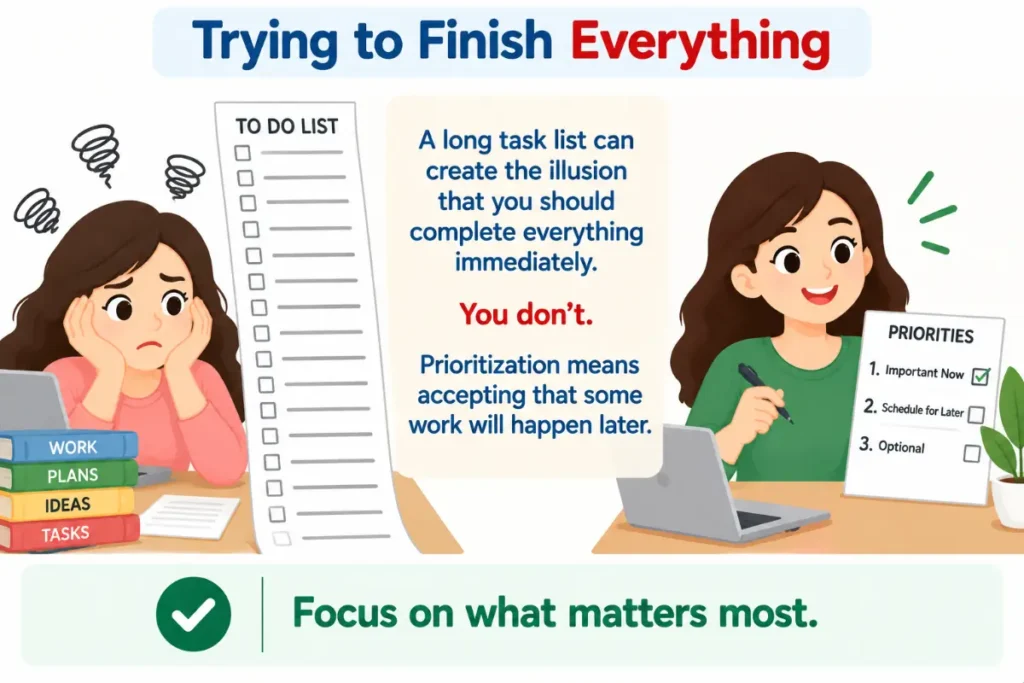
Trying to Finish Everything
A long task list can create the illusion that you should complete everything immediately.
You don’t.
Prioritization means accepting that some work will happen later.
Working Longer Instead of Working Differently
Extra hours can sometimes help during a temporary deadline. They aren’t a reliable answer to permanent overload.
If the same problem happens every week, the process needs attention.
Saying Yes Automatically
An automatic yes can feel polite in the moment.
Later it can become another deadline sitting on your shoulders.
Pause before accepting new work.
Avoiding Difficult Conversations
You may hope the workload will improve on its own.
Sometimes it does.
Often it doesn’t.
If competing demands are causing a genuine capacity problem, discussing priorities early is usually better than waiting until a deadline is missed.
Trying to Hide the Problem
Some employees believe a capable person should handle everything quietly.
That belief can create unnecessary pressure.
Good managers need enough information to make decisions about resources deadlines and priorities.
When You Should Take the Situation More Seriously
Work stress deserves attention when it becomes persistent or starts affecting your life outside work.
Pay attention if you regularly struggle to sleep, lose interest in things you normally enjoy, feel constantly tense, have significant changes in mood, or find it difficult to function normally.
You don’t need to wait until you reach a breaking point before asking for help.
Start with an appropriate support person at work if that feels safe and useful. Depending on your situation this might be your manager, human resources team, employee assistance program, or another trusted workplace resource.
You can also speak with a qualified mental health professional or healthcare professional if stress is affecting your wellbeing.
If you ever feel unable to stay safe or you’re thinking about harming yourself, seek immediate help from local emergency services or a crisis service in your area.
Work matters.
Your health matters more.
Regional Perspective
American English
In the United States people commonly describe workplace pressure with phrases such as overwhelmed, burned out, stressed out, overloaded, stretched thin, or swamped.
The exact phrase used often depends on the setting. Swamped sounds casual. Overloaded sounds more neutral. Burned out suggests a deeper and more persistent state of exhaustion and disengagement.
British English
British speakers also use overwhelmed, stressed, overloaded, and burned out. Some workplace vocabulary may differ slightly but the underlying idea remains familiar.
The phrase can appear in everyday conversation as well as professional discussions about workload and wellbeing.
Australian English
Australian English uses similar language for excessive workplace pressure. Terms such as stressed, overloaded, exhausted, and burned out are widely understandable.
Workplace discussions may use different informal expressions depending on the speaker and setting but there is no major difference in the underlying concept.
Canadian English
Canadian English also uses the same core expressions. Employees may describe themselves as overwhelmed, overloaded, stressed, or burned out when work demands become difficult to manage.
The meaning remains broadly consistent across these English varieties.
Related Terms You Should Know
Workload
Workload refers to the amount of work assigned to a person or team.
A heavy workload can contribute to stress but a large workload isn’t automatically unhealthy if sufficient time resources and control are available.
Work Related Stress
Work related stress describes stress connected to job demands conditions or workplace circumstances.
It can result from workload uncertainty conflict limited control or other factors.
Burnout
Burnout describes a more serious pattern of prolonged workplace stress involving exhaustion and other changes in how someone relates to work.
Feeling stressed for a few days isn’t automatically burnout.
Work Life Balance
Work life balance refers to how a person manages the demands of employment alongside personal life rest relationships and other responsibilities.
A healthy balance doesn’t require equal time for everything. It means work doesn’t consistently consume the resources needed for the rest of life.
Time Management
Time management involves deciding how to use available time effectively.
It can help with disorganization but it cannot completely solve a workload that exceeds available capacity.
Prioritization
Prioritization means deciding what deserves attention first.
It is one of the most useful skills for managing competing demands.
Mental Fatigue
Mental fatigue can make concentration decision making and sustained attention more difficult.
Long periods of demanding cognitive work can contribute to it.
Workplace Boundaries
Workplace boundaries define reasonable limits around availability communication responsibilities and personal time.
Clear boundaries can help prevent work from expanding into every part of the day.
Expert Editor Insight
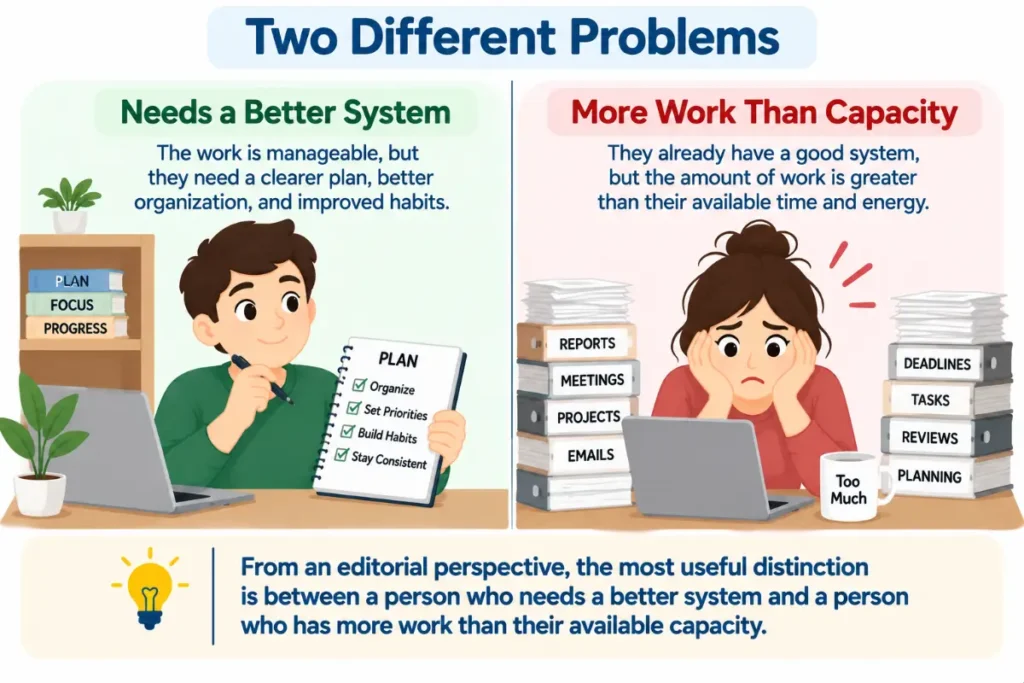
From an editorial perspective the most useful distinction is between a person who needs a better system and a person who has more work than their available capacity. Good advice should not automatically tell an overloaded employee to become more productive. First look at the workload itself. Then look at priorities interruptions deadlines and expectations. A practical editing tip applies here too: remove unnecessary complexity before adding another system. If one clear priority list and a short conversation with your manager solve the problem then you don’t need a complicated productivity method.
Need another quick comparison? Read ight meaning Explained With Examples and Usage.
Conclusion
Feeling overwhelmed at work doesn’t automatically mean you’re disorganized or unable to handle your job. Often the real issue is a mismatch between demands and available time attention or resources. Start by identifying what is creating the pressure then choose a small number of meaningful priorities instead of treating every task as urgent.
If the workload exceeds your actual capacity, better time management alone won’t fix it. You may need clearer priorities fewer competing deadlines more support or a realistic change in expectations. A direct conversation with your manager can help turn a vague sense of pressure into a practical plan.
One simple habit can make a big difference. Before ending your workday, write down tomorrow’s first priority and the next action you’ll take. Then step away. You’ve given your brain a place to put the unfinished work instead of carrying it into the evening.
FAQs
Why am I feeling overwhelmed at work?
Work can feel overwhelming when demands consistently compete for your limited time attention or energy. Common causes include excessive workload unclear priorities constant interruptions unrealistic deadlines limited control and pressure that continues without enough recovery. Start by identifying the biggest source rather than trying to fix everything at once. One clear priority conversation can sometimes remove a surprising amount of mental pressure.
How do I stop feeling overwhelmed at work?
Start by writing down everything currently demanding your attention. Then identify the few tasks that matter most and separate them from work that can wait. Protect focused time and reduce unnecessary interruptions. If there is simply too much work for the available time explain the competing deadlines to your manager and ask for clear prioritization rather than silently accepting every demand.
Is being overwhelmed at work a sign of burnout?
Not necessarily. Feeling overwhelmed can happen during a particularly busy period and may improve after the workload decreases. Burnout generally refers to a more persistent pattern associated with prolonged workplace stress and can involve exhaustion and changes in how you feel about work. If pressure continues despite reasonable attempts to recover or change the situation consider speaking with an appropriate professional.
Should I tell my manager that I feel overwhelmed?
If your workload is affecting your ability to complete important work it can be useful to tell your manager. Focus on specific facts rather than simply saying that everything feels like too much. Explain your current responsibilities competing deadlines and realistic capacity. Then ask which tasks should take priority. This gives your manager a clear decision to make and creates a more productive conversation.
How can I handle too many tasks at once?
Don’t try to work on everything simultaneously. Put the tasks in one visible list then rank them by urgency impact and deadline. Choose the most important task and give it focused attention. Identify tasks that can wait be delegated or simplified. If several high priority tasks genuinely conflict ask the relevant decision maker to help set the order.
Why does my work feel harder than it used to?
Work can feel harder when responsibilities increase without enough time resources or recovery. Constant interruptions can also make familiar tasks require more mental effort. Changes outside work may affect your available energy as well. Look for changes in workload expectations sleep recovery and concentration. If the difficulty persists or affects daily functioning consider discussing it with a qualified professional.
How do I set boundaries without looking unhelpful?
Frame boundaries around priorities and realistic delivery instead of simply refusing work. You can say that you’re happy to take on the request but need to know which existing task should move. You can also provide a realistic completion date. This approach shows that you want to contribute while making your current capacity visible.
When should I seek professional help for work stress?
Consider professional support if workplace stress becomes persistent or starts affecting sleep mood relationships concentration or your ability to function normally. You don’t have to wait until the situation becomes severe. A healthcare or mental health professional can help you understand what you’re experiencing and identify appropriate ways to cope. If you’re in immediate danger or may harm yourself seek emergency assistance right away.