
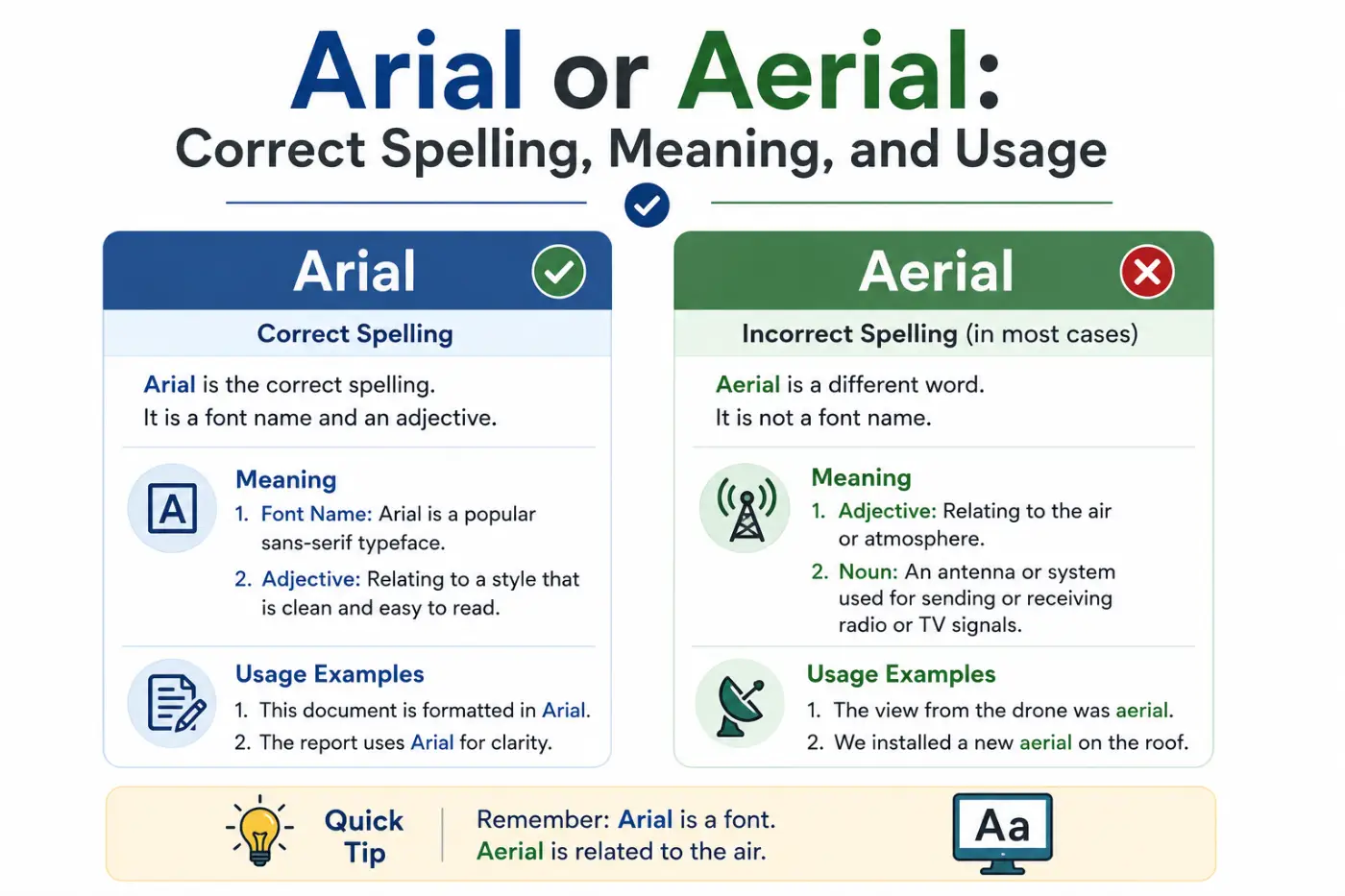
The confusion between arial vs aerial is easy to understand because the two forms look almost alike and can sound very similar in everyday speech. The key difference is simple. Arial is mainly a proper name used for a widely known typeface while aerial is a standard English word connected with the air or things above the ground.
That small spelling difference changes the meaning completely. If you’re talking about a font in a document you mean Arial. If you’re describing something related to the air or a view from above you need aerial. The words belong to different language categories even though their sounds can overlap for some speakers.
This distinction matters in school assignments workplace documents design discussions journalism and everyday writing. A sentence about font choice needs the typeface name while a sentence about photography from above needs the other word. Once you see the meaning behind each spelling the confusion becomes much easier to avoid.
You may also want to read Focussing or Focusing Which Spelling Is Correct 2026.
Quick Definition
Arial is the name of a sans serif typeface commonly used in digital documents and graphic design. Aerial is a standard English adjective meaning related to the air or above the ground. It can also function as a noun for an antenna in some varieties of English. The two forms have different meanings and uses.
Quick Answer
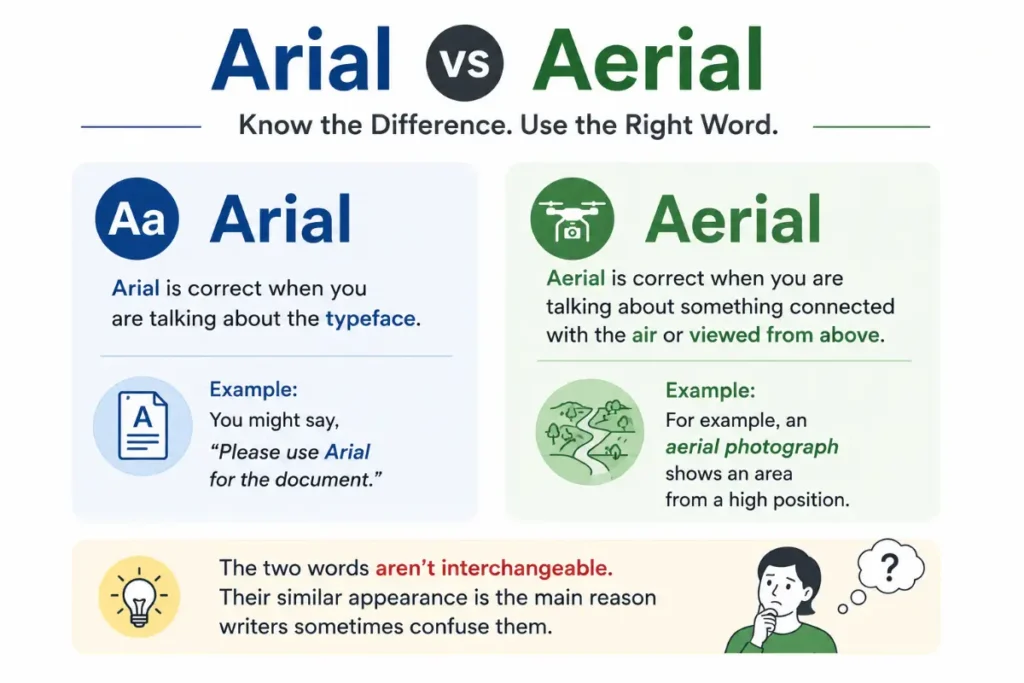
Arial and aerial are both legitimate forms but they are not interchangeable.
Arial refers primarily to a typeface. Aerial describes something related to the air or something located above the ground. For example you might write The report uses Arial but The photographer captured an aerial view of the city.
The easiest way to choose is to focus on meaning rather than sound. If you are discussing typography use Arial. If you are discussing air flight height or a view from above use aerial.
Comparison Table
| Form | Meaning | Part of Speech | Origin | Usage Frequency | Formality | Common Contexts | Example |
|---|---|---|---|---|---|---|---|
| Arial | Name of a typeface | Proper noun | Modern typeface name | Common in computing and design | Neutral | Documents typography publishing graphic design | The document uses Arial. |
| Aerial | Related to air or above the ground | Adjective | From Latin aer through French and English | Very common | Neutral and formal | Aviation photography views sports science weather | We ordered an aerial photograph. |
| Aerial | Antenna or radio receiver in some English usage | Noun | Same historical word family | Common in British usage | Neutral | Television radio communications | The technician repaired the aerial. |
Meaning and Definition
Meaning of Arial
Arial is a typeface name. It belongs to the world of typography rather than ordinary descriptive vocabulary.
You may recognize it from word processors websites presentations forms spreadsheets and other digital documents. It is a sans serif typeface with a clean and familiar appearance. The name is normally capitalized because it functions as the name of a specific typeface.
If someone says Please change the font to Arial they are talking about typography.
The word does not normally mean related to the air. It should not be used as a general adjective in that sense.
For example:
The designer selected Arial for the presentation.
Here the word identifies the typeface being used.
You might also see the name in discussions about font size style layout readability and document formatting. Those contexts make its meaning clear.
Because Arial is a proper name it is usually written with a capital A. This capitalization provides another useful clue when you’re proofreading.
Meaning of Aerial
Aerial is a regular English word with meanings connected to air and things above the ground.
As an adjective it can describe something that exists in the air or relates to the atmosphere.
The aircraft performed an aerial maneuver.
It can also describe something seen from above.
We took an aerial photograph of the coastline.
In that sentence aerial tells us that the photograph was taken from a high position rather than from ground level.
The word appears in many fields. Aviation uses it to describe activities performed in the air. Photography uses it for images taken from above. Geography uses aerial imagery to study land. Sports writers may describe aerial movements or aerial competition. Military writing can use aerial to describe operations involving aircraft.
Aerial can also be a noun in some varieties of English. In British English especially it can mean an antenna used for receiving radio or television signals.
For example:
The television aerial needs repair.
American English speakers are more likely to use antenna for this meaning.
This noun use is separate from the adjective meaning but comes from the same historical word family.
Key Differences Explained
Spelling
The forms differ by one important letter.
Arial contains the sequence Arial.
Aerial contains the sequence aerial.
The second form has an e after the initial a. That extra vowel is not optional. It marks a completely different word.
Meaning
Arial identifies a particular typeface.
Aerial relates to air height or something above the ground. It can also refer to an antenna in British usage.
Grammar
Arial normally functions as a proper noun because it names a typeface.
Aerial is most commonly an adjective. It can also function as a noun when referring to an antenna.
Pronunciation
The words can sound very close. For many speakers they may even sound nearly identical in quick conversation. Context therefore plays a major role.
Capitalization
Arial normally begins with a capital A because it is the name of a typeface.
Aerial is normally lowercase unless it begins a sentence or appears in a proper name.
Formality
Both forms can appear in formal and informal contexts. Their difference is not about formality. It is about meaning and grammatical function.
Context
Use Arial when discussing fonts typography documents or design.
Use aerial when discussing air aircraft altitude photography views from above or antennas in varieties of English that use the noun.
Regional usage
The adjective aerial is standard across major varieties of English. The noun aerial for an antenna is particularly associated with British English. Arial as a typeface name remains the same because it identifies a specific design rather than a regional spelling choice.
Which Form Is Correct?
Both forms are correct because they represent different words.
The right choice depends entirely on what you mean.
If you are talking about a font choose Arial.
If you are describing something connected with the air or above the ground choose aerial.
This is not a case where one spelling is correct and the other is a misspelling. That distinction matters. Calling Arial an incorrect version of aerial would be wrong because Arial is an established typeface name.
Likewise treating aerial as an alternative spelling of Arial would also be incorrect.
The capitalization offers a useful editing clue. Arial normally has a capital A when it refers to the typeface. Aerial is normally lowercase when it is used as an ordinary English adjective.
Compare these sentences:
The essay is written in Arial.
The essay includes an aerial photograph.
The first sentence concerns typography. The second concerns a photograph taken from above.
Dictionary conventions also support the distinction between proper names and ordinary vocabulary. A typeface name identifies a particular design while an adjective such as aerial describes a property or relationship.
Sentence Examples
Examples With Arial
- Please change the body text to Arial before you submit the report.
- The presentation looks cleaner in Arial.
- Our teacher asked us to use Arial for the assignment.
- I changed the font to Arial because the original typeface was difficult to read.
- The designer used Arial for the headings and captions.
- The form is formatted in Arial with a larger font size for the title.
- The company template uses Arial throughout the document.
- The website uses Arial for several parts of its interface.
- I opened the file and noticed that the font had been changed from Arial.
- The editor requested a consistent typeface across the entire report.
Examples With Aerial
- We watched an aerial display at the air show.
- The photographer captured an aerial view of the coastline.
- The researchers studied aerial images of the forest.
- The pilot performed a difficult aerial maneuver.
- The map was created from aerial photographs.
- The documentary includes stunning aerial footage of the mountains.
- The rescue team used aerial surveillance to locate the missing hikers.
- An aerial perspective revealed details that were hard to see from the ground.
- The aircraft carried equipment for aerial observation.
- The architect reviewed aerial images of the property before planning the project.
Examples Showing the Wrong Choice
These examples demonstrate how switching the words can change the meaning.
- The document uses aerial font.
This sounds incorrect if you mean the typeface. The intended word is Arial.
- We took an Arial photograph from the helicopter.
This is incorrect if you mean a photograph taken from above. The intended word is aerial.
- Please use aerial for the report font.
Use Arial if you are referring to the typeface.
- The designer selected an Arial view of the city.
Use aerial if you mean a view from above.
- The pilot performed an Arial maneuver.
Use aerial because the maneuver relates to activity in the air.
Common Mistakes and Misspellings
Using Aerial for a Font
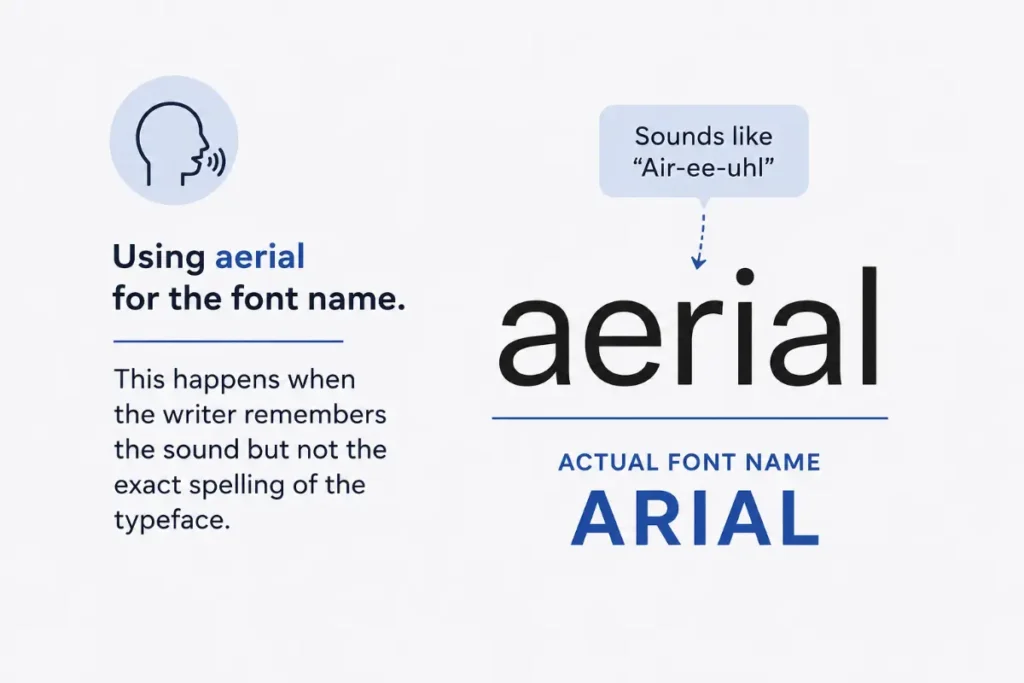
A common mistake is writing aerial when referring to the typeface.
Incorrect: Please use aerial for the report.
Correct: Please use Arial for the report.
The problem comes from the close visual and phonetic relationship between the two words.
Using Arial for Something Above the Ground
The reverse mistake happens too.
Incorrect: We ordered an Arial photograph.
Correct: We ordered an aerial photograph.
The photograph is aerial because it was taken from above.
Lowercasing Arial
Since Arial is a typeface name it is normally capitalized.
Less appropriate: Use arial font.
Preferred: Use Arial font.
The capitalization helps readers recognize that the word identifies a specific typeface.
Treating the Words as Spelling Variants
They are not two spellings of the same word. They represent different lexical items.
This is the most important point to remember. The difference is semantic as well as orthographic.
Relying Only on Sound
Pronunciation can cause trouble because the words may sound extremely similar. If you hear a sentence without seeing it written you may not know which form the speaker intends.
Context usually solves the problem.
If someone says Change the font to Arial the meaning is clear.
If someone says We captured an aerial image the surrounding vocabulary identifies the intended word.
Pronunciation Guide
Arial
Arial is commonly pronounced something close to AIR ee ul in American English.
The exact pronunciation can vary slightly among speakers. The word is usually heard as several light syllables rather than as a spelling based pronunciation.
Because Arial is a typeface name you may hear designers and office workers pronounce it quickly in conversation. The surrounding words usually make its meaning obvious.
Aerial
Aerial is commonly pronounced something close to AIR ee ul as well.
A common IPA representation is /ˈɛriəl/ in American English. Other pronunciation traditions may use slightly different vowel details.
The word normally has three syllables.
AIR ee ul.
The first syllable receives the main stress.
Why They Sound So Similar
This is where the confusion becomes interesting. The spelling difference is visually obvious once you slow down but the pronunciation difference can be very small.
English has many examples of words whose written forms provide more information than their spoken forms. That means listening alone may not tell you which word appears on the page.
When proofreading it is better to check meaning and context rather than trying to hear the spelling in your head.
A related grammar guide is Bellies vs Bellys Which Spelling Is Correct in 2026?.
Etymology and Word Origin
History of Aerial
Aerial has a long linguistic history connected with the word for air.
Its deeper origin traces to Latin aer meaning air. The word passed through French and related European language forms before becoming established in English.
The historical connection explains why aerial appears in vocabulary related to the atmosphere and things in the air.
English developed several related words from this same root. Air itself belongs to this broad historical family while aerial developed as an adjective associated with air.
Over time its meaning expanded naturally into ideas such as being above the ground or viewed from above. That is why expressions such as aerial photography and aerial view are now completely ordinary.
The noun use referring to an antenna developed in British English through the idea of something positioned above or exposed in the air.
History of Arial
Arial has a very different history because it is a modern typeface name rather than an old English adjective.
The typeface was developed for digital typography and became widely associated with computer documents and graphic interfaces. Its name therefore belongs to the history of modern type design rather than the older Latin and French word family behind aerial.
This distinction is useful because the similar appearance of the two forms is accidental from the perspective of ordinary English vocabulary.
One word describes a relationship with air. The other identifies a particular typeface.
Regional Usage
American English
American English uses aerial as a standard adjective for things related to air or positions above the ground.
Examples include aerial photography aerial view aerial survey aerial combat and aerial maneuver.
American English also uses antenna more commonly than aerial for the device used to receive radio or television signals.
Arial remains the same typeface name in American usage.
British English
British English uses aerial in the same adjective sense.
Aerial photography aerial view and aerial activity are all ordinary expressions.
One notable difference is the noun aerial. In British English an aerial can mean an antenna for receiving radio or television signals.
For example:
We need to replace the television aerial.
An American speaker would usually say television antenna instead.
Arial as a typeface name does not change.
Australian English
Australian English uses aerial as an adjective with the same broad meanings found in American and British English.
The word can describe aircraft activity photography images and things located above the ground.
The typeface name Arial remains unchanged.
Australian English may also use aerial in the antenna sense depending on context and speaker preference.
Canadian English
Canadian English generally follows the same distinction.
Aerial is used for concepts related to air and views from above while Arial identifies the typeface.
For an antenna Canadians may use antenna more commonly in contexts influenced by North American usage. The regional difference is minor compared with the central distinction between the two words.
Grammar Rules and Part of Speech
Arial as a Proper Name
Arial is normally a proper noun when it refers to the typeface.
You can use it after verbs that describe font selection.
The designer chose Arial.
You can also use it after words such as font and typeface.
The document uses the Arial font.
Arial is especially common in phrases connected with typography.
The capitalization is useful because it signals that the word names something specific.
Aerial as an Adjective
Aerial is most commonly an adjective.
It describes a noun associated with air height or an elevated viewpoint.
Examples include:
Aerial photography.
Aerial view.
Aerial survey.
Aerial footage.
Aerial vehicle.
Aerial movement.
Aerial activity.
The adjective normally comes before the noun it modifies.
The photographer captured an aerial image.
It can also appear after a linking verb.
The photograph was aerial.
That second structure is grammatically possible but less natural in ordinary conversation. Most speakers would simply say The photograph was taken from above.
Aerial as a Noun
In some English varieties aerial is also a noun meaning antenna.
The aerial on the roof was damaged.
This usage is particularly associated with British English.
In American English antenna is generally the more familiar term.
Punctuation
Neither word has a special punctuation rule.
The normal punctuation of the sentence applies.
For example:
The report uses Arial.
We reviewed the aerial photographs.
The difference comes from word choice rather than punctuation.
Formal Writing
Both words are suitable for formal writing when they express the intended meaning.
Arial can appear in instructions about document formatting.
Aerial is common in academic scientific technical journalistic and professional writing.
The key is precision. Using the wrong form can make a sentence confusing even when the grammar itself is correct.
Real Life Usage Examples
Daily Conversation
Typography often comes up in everyday office or school conversations.
Can you put this in Arial before you print it?
The aerial view from the plane was amazing.
The first sentence is about a typeface. The second describes a view from above.
Email and Workplace Communication
Please use Arial throughout the final report.
I’ve attached the aerial photographs for the property review.
Both forms fit naturally into workplace writing. The surrounding nouns make their meanings clear.
Academic Writing
The study examined aerial images to identify changes in vegetation.
The assignment instructions requested Arial for the main text.
Academic writing often uses aerial in scientific geographical environmental and research contexts. Arial may appear in formatting instructions or document preparation guidelines.
News and Journalism
The news report showed aerial footage of the flooded area.
Officials released aerial images of the damaged region.
Journalists frequently use aerial when discussing images or footage captured from aircraft drones or elevated positions.
Literature and Storytelling
From the hilltop they had an aerial view of the valley.
The designer chose Arial for the printed invitation.
The first example uses the word descriptively. The second uses the typeface name in a practical context.
Related and Confused Terms
Arial Font
Arial is a typeface. In everyday speech people often say Arial font although font and typeface have more specific meanings in typography.
Aerial View
An aerial view shows a place from above. It may come from an aircraft drone tall building mountain or other elevated position.
Aerial Photography
Aerial photography involves photographs taken from an elevated position. It is common in mapping surveying geography environmental studies and journalism.
Airborne
Airborne describes something carried or traveling through the air.
An airborne aircraft is physically in the air.
Aviation
Aviation refers broadly to aircraft and flying.
Aviation is therefore related to aerial but is not a direct synonym.
Atmospheric
Atmospheric usually refers to the atmosphere or conditions within it.
An atmospheric study may examine air pressure temperature gases or other properties of the atmosphere.
Antenna
Antenna is the common North American term for a device that receives or transmits radio signals. It overlaps with the British noun use of aerial.
Elevated
Elevated means raised above a normal level or position.
An elevated view may resemble an aerial view but doesn’t necessarily come from the air.
These terms belong to related semantic groups but they have different uses. Good writing depends on choosing the word that expresses the exact idea.
Why These Two Words Cause Confusion
The confusion comes mainly from three factors.
First the spellings differ by only one letter. A reader scanning quickly can miss the e in aerial or fail to notice the capital A in Arial.
Second the pronunciations can be very close. In natural conversation speakers don’t spell words aloud. If the context is unclear a listener may not know which form the speaker intends.
Third both words appear in modern professional settings. Arial is common in document formatting while aerial appears frequently in photography aviation mapping journalism and geography. People can therefore encounter both forms without fully noticing the difference.
This is a useful example of how context supports language understanding. Readers rarely process every word in isolation. They use nearby words to identify meaning.
For example:
Change the Arial size.
The word size strongly suggests typography.
Change the aerial survey area.
The word survey points toward photography mapping or observation from above.
Context acts like a road sign. It helps you choose the right word even when two forms look and sound similar.
A Simple Memory Trick
You don’t need a complicated rule to remember these words.
Think about the letter e in aerial.
Aerial contains air at the beginning.
That connection is useful because aerial describes something related to air.
Air plus ial gives you aerial.
For Arial think about the font.
If you’re opening a document choosing a typeface changing text size or discussing typography you want Arial.
You can also remember the capitalization.
Arial equals a named typeface.
Aerial equals air or above.
This simple meaning based approach works better than memorizing isolated spelling patterns.
How Context Changes the Meaning
Consider the sentence:
I changed the font.
You need a typeface name to complete the idea.
I changed the font to Arial.
Now the meaning is clear.
Consider another sentence:
We examined the photographs.
If the photographs were taken from above you can say:
We examined the aerial photographs.
The adjective tells the reader how the photographs were produced or positioned.
Now compare:
We watched an aerial display.
This refers to activity in the air rather than photography.
The surrounding noun determines how the adjective works. This is why vocabulary should be learned through sentences rather than isolated spelling lists.
Expert Editor Insight
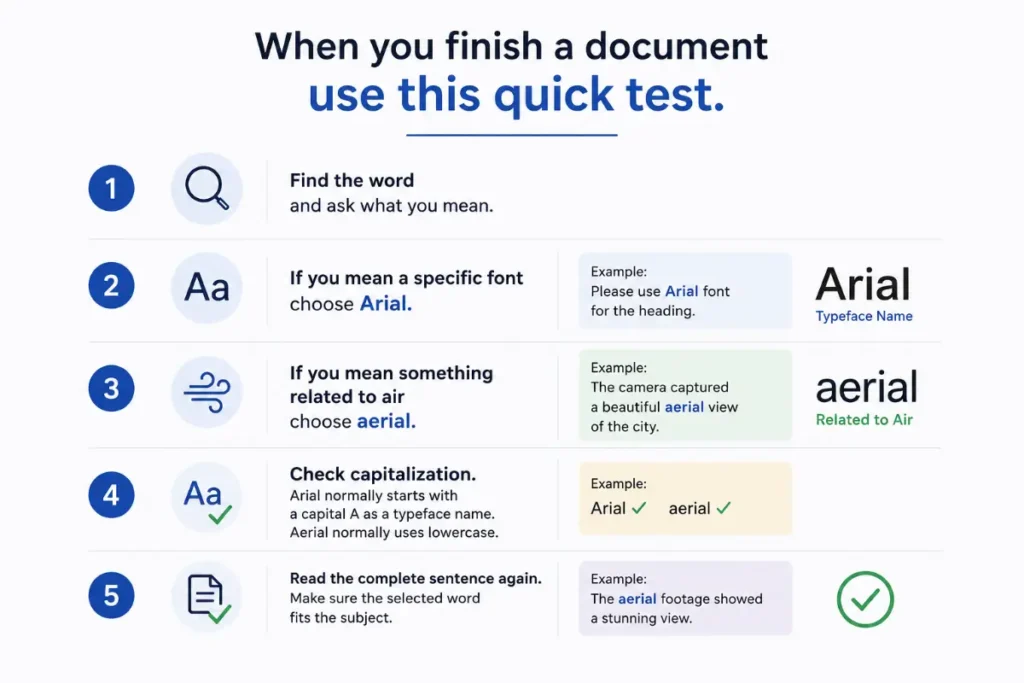
A professional editor would not treat these forms as competing spellings of one word. They are separate words with different meanings and one of them is also a proper typeface name. The quickest editorial check is context. If the sentence concerns fonts documents or typography use Arial with a capital A. If it concerns air aircraft height photography or something above the ground use aerial. Spellcheck tools may not always catch the mistake because both forms are legitimate. That is why meaning based proofreading is more reliable than depending entirely on automated correction.
A related grammar guide is Miss vs Missed Meaning Grammar and Usage 2026.
Conclusion
The difference between arial vs aerial becomes clear once you focus on meaning instead of sound. Arial is the name of a typeface while aerial is a standard English word that describes something related to air or something seen from above. Both forms are legitimate but they belong to different language categories.
Use Arial when you’re talking about fonts documents typography or design. Use aerial for phrases such as aerial view aerial photography and aerial activity. In British English the word can also mean an antenna while North American speakers usually use antenna for that meaning.
The best proofreading trick is to connect Arial with typography and aerial with air. If the sentence is about a font choose the capitalized typeface name. If it describes the air or something above the ground choose the word with the extra e.
FAQs
Is Arial the same as aerial?
No. Arial is primarily the name of a typeface while aerial is an ordinary English word related to air or something above the ground. The two forms look and sound similar but they have different meanings. Arial normally appears with a capital A because it identifies a specific typeface. Aerial is usually lowercase when used as an adjective.
What does Arial mean in writing?
Arial refers to a specific sans serif typeface commonly used in digital documents and other forms of typography. If someone asks you to write a document in Arial they are giving you a formatting instruction. The word is normally capitalized because it functions as the name of a particular typeface rather than as a general English adjective.
What does aerial mean?
Aerial usually means related to the air or located above the ground. It can describe photography taken from above as well as aircraft activity and elevated views. For example an aerial photograph is an image taken from a position above the ground. In British English aerial can also be used as a noun meaning an antenna.
Which word should I use for a font?
Use Arial when you are referring to the typeface. The capital A helps distinguish the typeface name from the ordinary word aerial. For example you can write Please use Arial for the report. If you are describing something related to air or a view from above then aerial is the correct choice instead.
How do you pronounce Arial and aerial?
Arial and aerial can have very similar pronunciations in American English. Both are commonly heard as something close to AIR ee ul. A common IPA representation for aerial is /ˈɛriəl/. The small pronunciation difference can vary among speakers. Because the spoken forms overlap so closely context is often more useful than pronunciation for identifying which word someone means.
Can aerial be a noun?
Yes. In British English aerial can function as a noun meaning an antenna used for receiving radio or television signals. For example someone might say The television aerial needs replacing. American English speakers generally use antenna for this meaning. Aerial is much more widely used as an adjective across English varieties when describing things related to air or positions above ground.
Why are these words easy to confuse?
They are easy to confuse because their spellings are nearly identical and their pronunciations can be very close. The difference is also easy to overlook when reading quickly. Context usually resolves the problem. A sentence about a font points to Arial while a sentence about aircraft photography or something above the ground points to aerial.
Is Arial appropriate in formal writing?
Yes. Arial is appropriate in formal writing when you are referring to the typeface itself. It can appear in formatting instructions professional documents design specifications and academic submission guidelines. The choice of typeface can depend on the requirements of a particular organization or institution. When naming the typeface write Arial with a capital A to reflect its status as a specific name.