
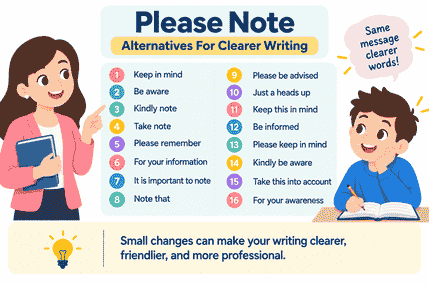
Please note alternatives can make your writing sound more natural and less repetitive. The phrase please note is grammatically correct and widely used in emails notices instructions and professional documents. Still, using the same expression again and again can make your writing feel stiff or formulaic. A small change in wording can make the same message clearer and more suited to your audience.
The right replacement depends on what you want the reader to do. Sometimes you simply want to draw attention to an important fact. In other cases you want someone to remember a deadline follow an instruction or understand a change. Phrases such as please be aware keep in mind please remember and note that can express these ideas with slightly different tones.
This guide explains the best alternatives and shows you how native American English speakers use them. You’ll learn which options work in emails academic writing workplace communication notices customer messages and everyday conversation. You’ll also see which expressions sound formal friendly direct or conversational so you can choose the right phrase without making your writing sound forced.
Still confused? Compare it means a lot alternatives for Natural English.
Short Answer
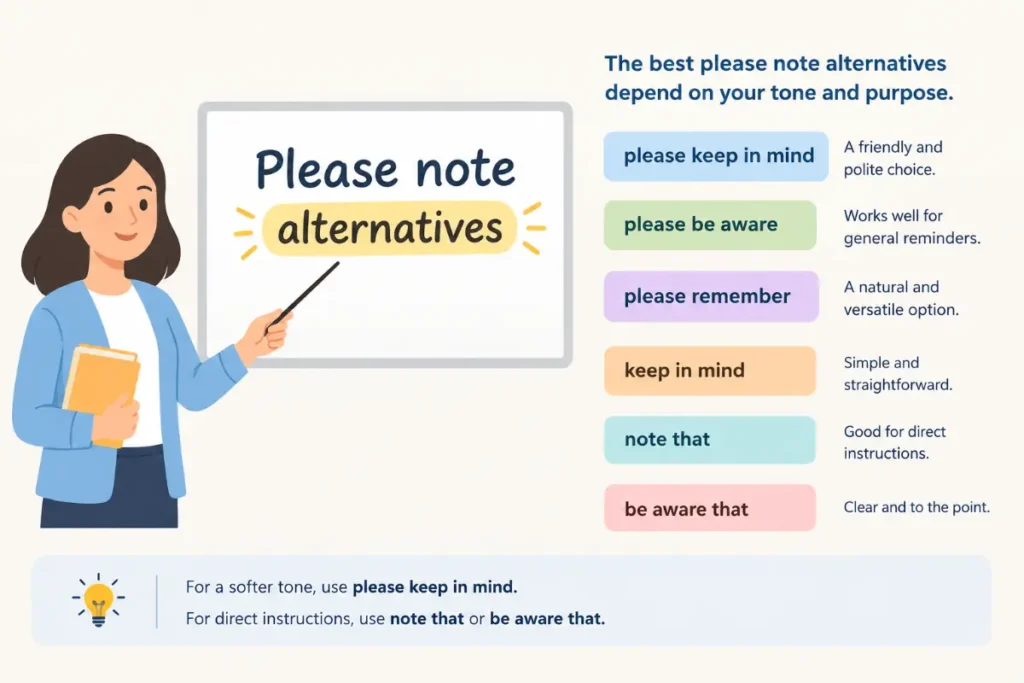
The best please note alternatives depend on your tone and purpose. For most professional writing you can use phrases such as please keep in mind, please be aware, please remember, keep in mind, or note that. For a softer tone use please keep in mind. For direct instructions use note that or be aware that.
Table of Contents
- What please note means.
- Why writers look for alternatives.
- Best alternatives for professional writing.
- Alternatives for polite emails.
- Alternatives for formal notices.
- Alternatives for casual communication.
- Alternatives for academic writing.
- Tone differences between common options.
- How to choose the right expression.
- Common mistakes.
- Examples in real situations.
- Memory tips.
- Related usage notes.
- Frequently asked questions.
- Key takeaways.
- Conclusion.
What Please Note Means
Please note is a polite expression used to direct attention toward information that the reader should notice. It often appears before a fact instruction reminder warning change or important detail.
For example:
Please note that the office will close at 3 p.m.
The sentence tells the reader to pay attention to the information that follows.
The phrase contains the verb note. Here note means to notice or pay attention to something. The word please makes the instruction more polite.
Please note is common in professional communication because it is short and clear. You’ll often see it in emails policies forms announcements websites instructions and customer service messages.
It can sometimes sound formal or slightly stiff. That isn’t a grammar problem. It’s mainly a matter of tone.
Consider these two sentences:
Please note that your appointment has been moved.
Please keep in mind that your appointment has been moved.
Both are correct. The first sounds more official. The second feels a little warmer and more conversational.
Best Alternatives For Professional Writing
The strongest please note alternatives are not identical in tone. Each one carries a slightly different message.
Please keep in mind
Please keep in mind is one of the most useful choices for everyday professional writing. It sounds polite without feeling overly formal.
Example:
Please keep in mind that processing may take three business days.
This works well in emails customer communication instructions and workplace messages.
Please be aware
Please be aware tells the reader that a particular fact deserves attention.
Example:
Please be aware that the building will close at 6 p.m.
This expression sounds professional and direct. It can also sound more serious than please keep in mind.
Please remember
Please remember works best when the reader needs to retain information or complete an action.
Example:
Please remember to bring your identification.
The expression feels personal and direct. It works well in messages to students customers employees and clients.
Note that
Note that is shorter and more direct.
Example:
Note that prices may change without notice.
This option is common in instructions technical writing policies and formal documents. It sounds less conversational because it removes please.
Keep in mind
Keep in mind is useful when you want to highlight something the reader should consider.
Example:
Keep in mind that delivery times can vary.
It sounds natural and works especially well when you’re giving advice or explaining a situation.
Be aware
Be aware is direct and sometimes carries a warning.
Example:
Be aware that the road may become slippery after dark.
This phrase is stronger than some softer alternatives. Use it when the information genuinely deserves attention.
Remember that
Remember that works well when the information needs to stay in the reader’s thoughts.
Example:
Remember that all applications must be submitted before Friday.
It sounds more direct than please remember but remains perfectly natural.
Take note
Take note is useful when you want someone to pay close attention.
Example:
Take note of the revised submission date.
It can sound formal and instructional. It fits notices presentations training materials and workplace instructions.
Alternatives For Polite Emails
Professional emails don’t always need formal wording. In many cases a natural sentence sounds better than a standard notice style.
The phrase please note can feel distant when you’re writing to someone you know. A warmer alternative can make the message easier to read.
Compare these examples:
Please note that the meeting starts at 9 a.m.
Just a reminder that the meeting starts at 9 a.m.
The second sentence feels friendlier. It gives the same information without sounding like an official announcement.
Here are useful options for email writing.
Just a reminder
Use just a reminder when you want to mention something the reader probably already knows.
Example:
Just a reminder that the report is due Friday.
This works especially well with coworkers students clients and regular contacts.
I wanted to let you know
This phrase works when you’re introducing new information.
Example:
I wanted to let you know that the schedule has changed.
It feels personal and conversational.
Please keep in mind
This remains one of the safest choices when you want polite professional language.
Example:
Please keep in mind that the updated policy applies starting Monday.
I’d like to point out
Use this expression when you want to direct attention toward a particular detail.
Example:
I’d like to point out that the final section still needs revision.
It can sound slightly formal but remains natural in workplace communication.
Just so you know
Just so you know is much more casual.
Example:
Just so you know the store will close early tomorrow.
It works well in friendly messages but may sound too relaxed for highly formal communication.
Alternatives For Formal Notices
Formal notices often need concise language. The reader should understand the key information quickly.
In this setting note that can be effective.
Example:
Note that applications received after the deadline will not be considered.
You can also use please be advised.
Example:
Please be advised that the parking area will be closed Saturday.
Please be advised has a distinctly formal tone. It appears often in official notices customer service messages and administrative communication.
Another option is users should be aware.
Example:
Users should be aware that some features require an active account.
This structure works well when the information applies to a broad group.
For policies you can also write:
The following information applies to all employees.
This avoids a direct instruction altogether. Instead of telling readers to notice something you simply state the relevant information.
That approach often produces cleaner professional writing.
Alternatives For Casual Communication
Casual writing gives you more freedom. You don’t need formal phrases simply because the information matters.
You might say:
Just a heads up that the store closes early today.
Keep in mind that traffic gets heavy after five.
Remember that we’re meeting at Sarah’s house.
One quick reminder. The appointment starts at ten.
Just so you know the package arrived.
These expressions sound more like natural conversation.
The phrase just a heads up is especially common in American English. It introduces information that may help someone prepare. It works well in texts emails workplace chats and friendly messages.
Still consider your audience. A phrase that sounds perfectly normal in a message to a coworker may feel too casual in a legal notice or formal report.
Alternatives For Academic Writing
Academic writing usually favors precise and neutral language. Please note is acceptable but you often don’t need a direct attention marker at all.
Instead of:
Please note that the sample size was limited.
You could write:
The sample size was limited.
The second version is stronger because it states the fact directly.
This is a useful editing principle. Don’t add an attention phrase when the sentence can communicate the point clearly on its own.
You can also use:
It should be noted that the sample size was limited.
However this structure can sound unnecessarily passive. A direct sentence is often better.
Consider:
The study included only 50 participants.
That sentence gives the reader the important information without telling them to notice it.
Good academic writing often lets the evidence carry the weight.
Many readers also check First Come First Serve Alternatives For Clear Writing.
Tone Differences Between Common Options
The best please note alternatives become easier to choose once you understand their tone.
| Expression | Tone | Best Use | Example |
|---|---|---|---|
| Please keep in mind | Polite and conversational | Emails and workplace writing | Please keep in mind that the deadline is Friday. |
| Please be aware | Professional and direct | Notices and warnings | Please be aware that parking is limited. |
| Please remember | Friendly and direct | Reminders | Please remember to submit the form. |
| Note that | Formal and concise | Instructions and policies | Note that fees may apply. |
| Keep in mind | Conversational | Advice and explanations | Keep in mind that prices may vary. |
| Be aware | Direct and serious | Warnings | Be aware that conditions may change. |
| Just a reminder | Friendly | Emails and messages | Just a reminder that the meeting starts at nine. |
| Just so you know | Casual | Personal communication | Just so you know the package arrived. |
| Take note | Formal and instructional | Training and notices | Take note of the revised schedule. |
| Please be advised | Very formal | Official communication | Please be advised that the office is closed. |
How To Choose The Right Expression
Choosing among please note alternatives becomes simple when you focus on your purpose instead of searching for a perfect synonym.
Use please keep in mind for a warm professional tone
This phrase works when you want to sound respectful and approachable.
Example:
Please keep in mind that response times may be longer during the holiday period.
Use please be aware for important information
Choose this when the reader needs to understand a condition or possible problem.
Example:
Please be aware that construction may cause delays.
Use please remember for reminders
Choose this when you want someone to remember an action.
Example:
Please remember to sign the form.
Use note that for concise instructions
This works when you need to state an important detail without extra wording.
Example:
Note that the final price includes taxes.
Use just a reminder for friendly emails
This is ideal when the reader already knows about the matter.
Example:
Just a reminder that our call is scheduled for Thursday.
Use just so you know for casual messages
This works for relaxed communication.
Example:
Just so you know I left the documents on your desk.
Use please be advised for official notices
Reserve this phrase for situations that genuinely call for formal language.
Example:
Please be advised that the building will remain closed until Monday.
Common Mistakes
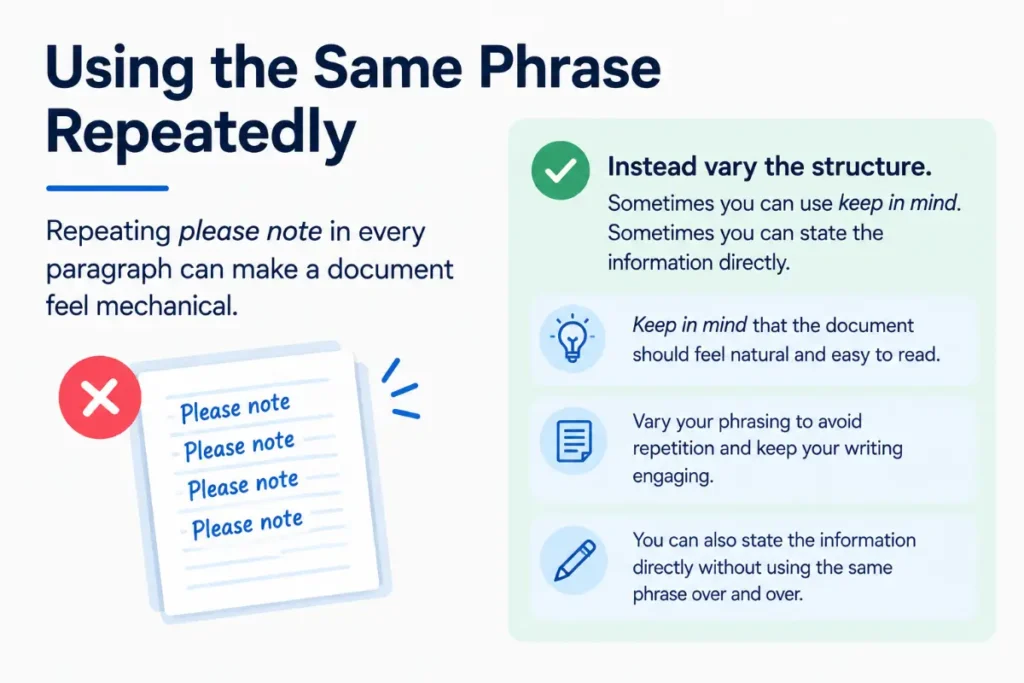
Using the same phrase repeatedly
Repeating please note in every paragraph can make a document feel mechanical.
Instead vary the structure. Sometimes you can use keep in mind. Sometimes you can state the information directly.
Using formal language in casual messages
A sentence such as please be advised that your pizza has arrived sounds comically formal.
A simple your order is here works better.
Adding unnecessary attention phrases
You don’t always need to tell readers to notice information.
Instead of:
Please note that the meeting starts at 9 a.m.
You could write:
The meeting starts at 9 a.m.
The second sentence is cleaner when no special emphasis is needed.
Choosing be aware for harmless information
Be aware can sound like a warning.
For example:
Be aware that the cafeteria closes at four.
This can sound more serious than necessary.
A softer version is:
Please keep in mind that the cafeteria closes at four.
Using take note in everyday conversation
Take note is grammatically correct but can sound formal in casual speech.
For a friend you might say:
Remember that the store closes early.
That sounds more natural.
Real Life Examples
Workplace Email
Please keep in mind that the deadline has moved to Friday.
This sounds polite and professional without sounding cold.
Customer Service
Please be aware that delivery times may vary during severe weather.
The phrase fits because the customer needs to know about a possible delay.
School Message
Please remember to bring your permission form tomorrow.
This works well because the reader needs to complete an action.
Company Notice
Note that the building will close at 5 p.m.
The concise structure fits a formal notice.
Friendly Email
Just a reminder that we’re meeting at noon.
This sounds natural between people who already know about the meeting.
Text Message
Just so you know I picked up your package.
The casual expression suits personal communication.
Academic Paper
The results should be interpreted with caution because the sample was small.
This is stronger than beginning with please note because it states the relevant idea directly.
Instruction Manual
Note that the device must remain connected to power during installation.
The reader needs a clear instruction so the direct form works well.
Policy Document
Employees should be aware that access may be restricted during maintenance.
This makes the affected group clear and keeps the tone professional.
Public Notice
Please be advised that the parking lot will be closed on Saturday.
The formal expression suits an official announcement.
Memory Tips
A simple way to remember the main choices is to connect each phrase with its purpose.
- Keep in mind means remember this information.
- Be aware means pay attention because this matters.
- Please remember means don’t forget an action or fact.
- Note that means pay attention to the information that follows.
- Just a reminder means you already know this but I’m reminding you.
- Just so you know means I’m giving you useful information in a casual way.
- Please be advised means the message has an official tone.
- Take note means pay close attention.
Think of these phrases as different voices saying the same basic message. Some speak softly. Some sound official. Some are direct.
Related Usage Notes
The phrase note that deserves special attention because note can serve different grammatical roles.
In note that the verb note introduces a clause.
Example:
Note that the office closes early.
Here note means notice or pay attention to.
The word note can also function as a noun.
Example:
I left a note on your desk.
It can also refer to a musical sound.
Example:
She sang a high note.
Context determines the meaning.
Another useful distinction involves please remember and remember to.
Please remember to call your doctor.
Here remember to introduces an action that needs to happen.
Please remember that the meeting starts at ten.
Here remember that introduces information that should stay in the reader’s mind.
The structures look similar but they serve different purposes.
You should also distinguish please note from please notice. Notice is possible but it often sounds more literal.
Please notice the difference.
This sentence asks someone to observe a visible or specific detail.
Please note the difference.
This sounds more formal and focuses attention on information.
Professional Editing Advice
Strong business writing doesn’t need a formal phrase every time you introduce important information. Often the best edit removes the attention phrase and puts the information first.
Original:
Please note that all employees must complete the form by Friday.
Cleaner:
All employees must complete the form by Friday.
The second sentence gets to the point faster.
That doesn’t mean you should remove every instance of please note. The phrase has a legitimate purpose when you need to highlight a detail that readers could easily miss.
A good editor asks one simple question. Does the attention phrase add meaning or only announce that information is coming.
When it adds meaning keep it. When it doesn’t remove it.
This approach makes professional writing feel more confident.
Key Takeaways
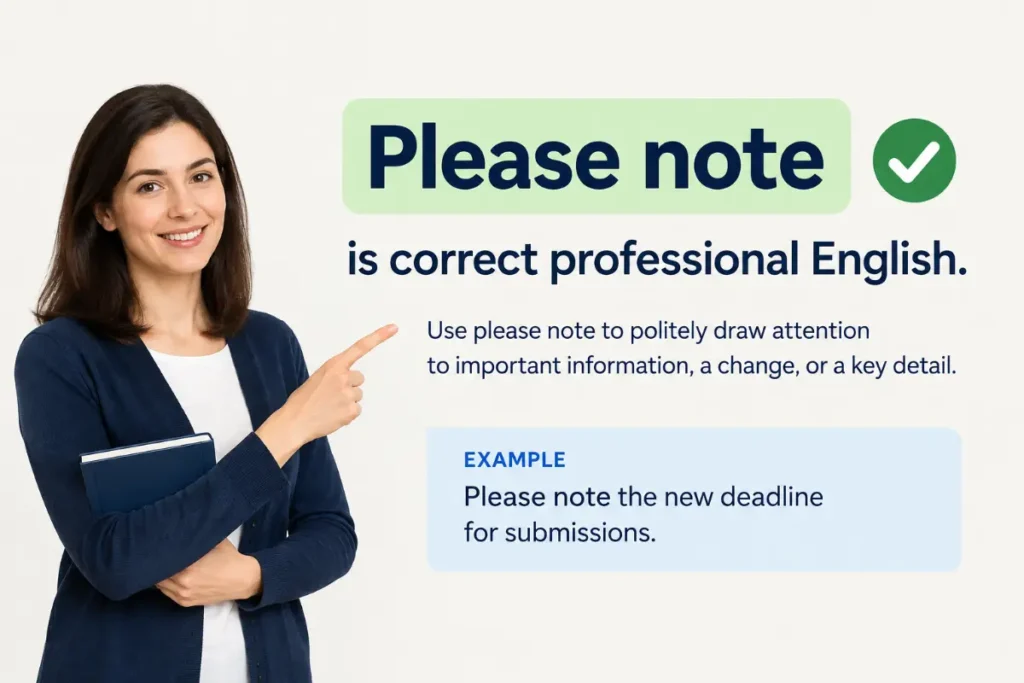
- Please note is correct professional English.
- Please keep in mind is a strong warm alternative.
- Please be aware works well for important conditions and warnings.
- Please remember is useful for reminders and actions.
- Note that gives instructions a concise formal tone.
- Just a reminder works well in friendly professional emails.
- Just so you know fits casual communication.
- Please be advised sounds highly official.
- You don’t always need an attention phrase.
- Direct statements often make professional writing clearer.
Still confused? Compare Are You Free Alternatives for Natural English used in 2026.
Conclusion
The best please note alternatives depend on the message you’re writing and the tone you want to create. Please be aware works for information that deserves special attention. Note that works well in concise formal instructions. Just a reminder sounds friendly and natural in emails.
Please note itself isn’t wrong or outdated. It remains a useful expression when you genuinely need to direct attention toward important information. The problem comes from using it automatically in every notice email or paragraph.
The practical tip is simple. Read the sentence without the phrase first. If the message becomes clearer and stronger then remove it. If readers genuinely need help noticing the information choose the alternative that matches your tone. Good writing doesn’t just deliver information. It makes the reader understand exactly what deserves attention.
Frequently Asked Questions
What are the best alternatives to please note?
The best choices include please keep in mind please be aware please remember note that keep in mind just a reminder and please be advised. Your choice should match the tone and purpose of the message. Please keep in mind sounds warm and professional. Note that sounds concise and formal. Just a reminder works well for friendly emails and routine workplace messages.
Is please note professional?
Yes. Please note is professional and grammatically correct. It appears frequently in workplace emails instructions notices policies and formal communication. The phrase can sound somewhat formal when used repeatedly. For a warmer style you can use please keep in mind or just a reminder. For a more direct style you can state the information without an introductory attention phrase.
What is a polite alternative to please note?
Please keep in mind is one of the most natural polite alternatives. It draws attention to information without sounding overly formal. For example you can write Please keep in mind that the office closes at four. Please be aware is another polite option but it can sound more serious because it often introduces information that requires special attention.
What is a formal alternative to please note?
Note that and please be advised are strong formal options. Note that is concise and works well in policies instructions reports and technical documents. Please be advised has a more official tone and often appears in notices or administrative messages. Choose the simpler option when you want formal writing to remain clear and easy to read.
Can I use please note in an email?
Yes. Please note works perfectly well in emails. It can introduce a deadline change instruction reminder or important detail. Still you don’t need it in every message. For friendly workplace emails try just a reminder or please keep in mind. For a direct message you can often skip the phrase and state the information immediately.
Is please be aware better than please note?
Neither phrase is automatically better. Please note simply directs attention to information. Please be aware can sound more serious and often suggests that the reader should consider a condition risk or limitation. Use please note for neutral emphasis. Use please be aware when the information deserves stronger attention.
How can I avoid repeating please note?
Change the sentence structure rather than replacing the phrase with a different expression every time. You can use keep in mind please remember just a reminder note that or simply state the information. For example instead of Please note that the deadline changed you can write The deadline has changed. Direct writing often sounds cleaner than repeated attention phrases.
Is please note too formal?
Please note isn’t excessively formal but it can sound formal in casual conversation. The expression fits professional emails notices policies and instructions. In a message to a friend you would usually say remember keep in mind or just so you know. The setting matters more than the phrase itself. Match your wording to the relationship and purpose.
What is the difference between please note and please remember?
Please note mainly tells the reader to pay attention to information. Please remember tells the reader not to forget something. For example Please note that the office closes early directs attention to a fact. Please remember to lock the door asks someone to remember an action. The two expressions overlap but their main purposes differ.
Can I use note that without please?
Yes. Note that is grammatically correct and widely used. It sounds more direct than please note. You’ll often see it in instructions policies technical material and formal documents. For example Note that the application cannot be edited after submission. In a friendly email please keep in mind may sound more natural.