
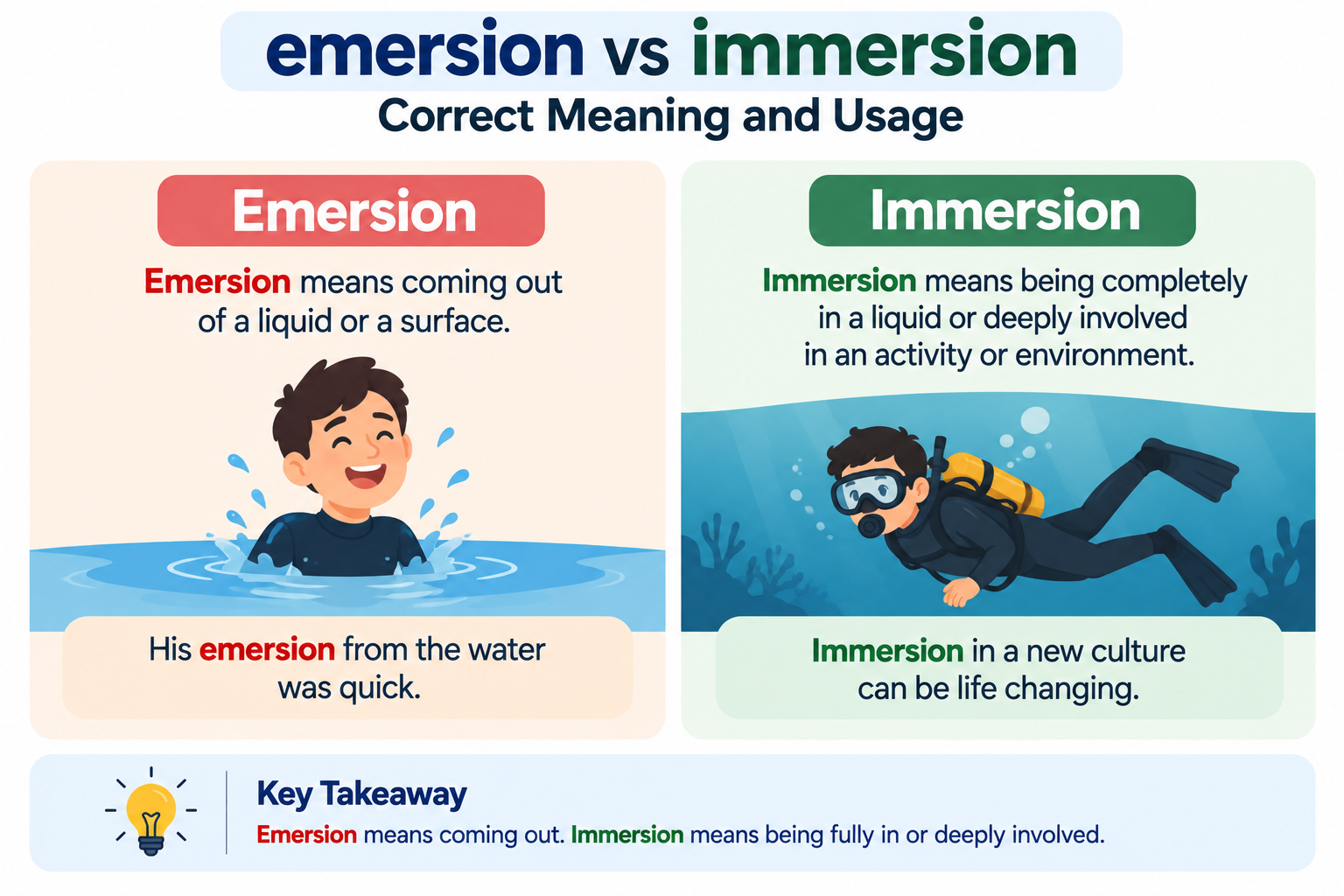
If you’ve ever typed emersion vs immersion into a search box because the two words look almost identical you’re not alone. The spelling differs by only one letter yet the meanings point in opposite directions. Immersion describes going into something or becoming deeply involved in it. Emersion describes coming out or emerging from something.
That small difference matters. You might talk about immersion in water when something goes beneath the surface. You might use emersion when that same object comes back above the surface. In everyday American English immersion is far more common because it has broad uses in education work entertainment culture and ordinary conversation. Emersion is a legitimate word but it appears mainly in specialized or formal contexts.
Once you see the direction behind each word the confusion becomes much easier to handle. This guide explains the meanings pronunciation grammar spelling history regional use and practical examples so you can choose the right word with confidence.
For another common grammar confusion, see Headed vs Heading Meaning and Usage.
Quick Answer
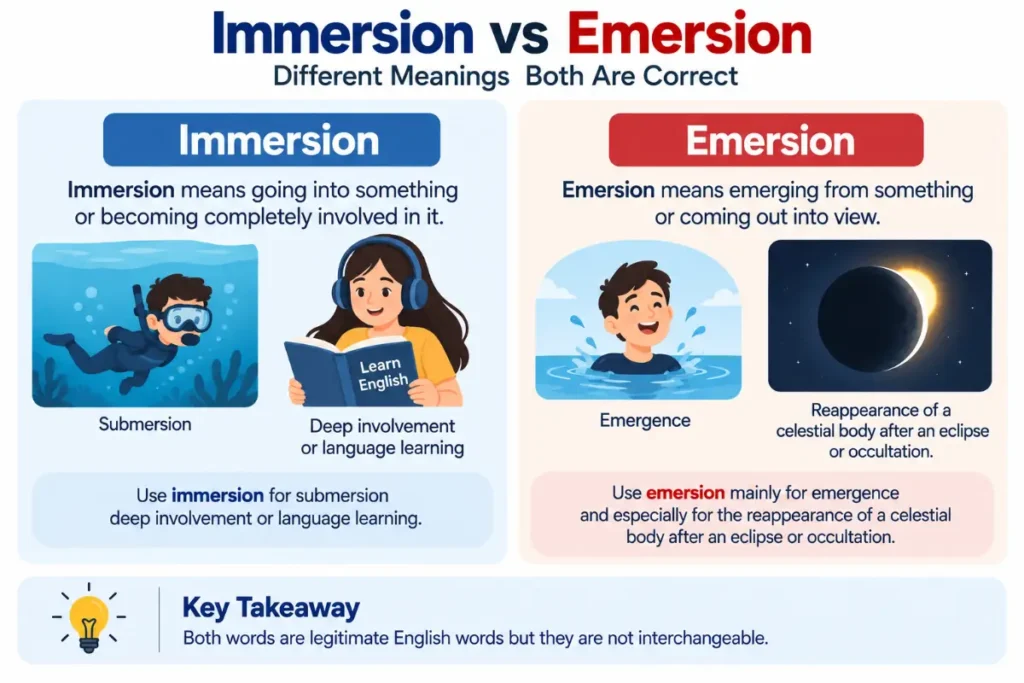
Immersion means going into something or becoming completely involved in it. Emersion means emerging from something or coming out into view. Both are legitimate English words but they aren’t interchangeable. Use immersion for submersion deep involvement or language learning. Use emersion mainly for emergence and especially for the reappearance of a celestial body after an eclipse or occultation.
The Core Difference
The easiest way to remember these words is to think about direction.
Immersion moves inward. Something enters a surrounding substance or situation. A person can immerse themselves in water. A student can become immersed in Spanish. A reader can become immersed in a novel.
Emersion moves outward. Something that was hidden or submerged appears again. A swimmer’s head can emerge from the water. In astronomy a celestial body can undergo emersion when it becomes visible again after being hidden by an eclipse or occultation.
The words look like close relatives because they are built from related Latin roots. Their prefixes point in different directions. The root behind immersion carries the idea of going into or plunging into something. The root behind emersion carries the idea of coming out or rising from something.
That gives you a useful memory trick.
Immersion means in.
Emersion means exit.
The first two letters can help you remember the difference. The im in immersion can remind you of going in. The e in emersion can remind you of emerging.
This isn’t a formal grammar rule. It’s simply a practical memory aid. Still it works well because it matches the historical meaning of the words.
Comparison Table
| Form | Meaning | Part of Speech | Origin | Usage Frequency | Formality | Common Contexts | Example |
|---|---|---|---|---|---|---|---|
| Immersion | The act of putting something into a surrounding substance or becoming deeply involved | Noun | Latin through Middle English | Common | Neutral to formal | Water language learning culture work entertainment | The course uses full immersion in Spanish. |
| Emersion | The act of emerging or coming into view after being hidden or submerged | Noun | Latin | Uncommon | Formal or specialized | Astronomy emergence scientific writing | The emersion of the moon was visible after the eclipse. |
The frequency difference is important. Immersion has many everyday meanings. Dictionaries recognize physical immersion as well as deeper involvement and language instruction. Emersion has a much narrower range of use and is often associated with emergence or astronomy.
What Immersion Means
Immersion is a noun that describes the act or state of being immersed.
In its physical sense it means putting something completely under a liquid or another surrounding substance. You might place fabric into dye and describe the process as immersion. A person can experience immersion in water. Baptism by complete submersion is also described as immersion.
The word also has a figurative meaning. Someone can become deeply involved in an activity experience culture subject or environment. A person who spends several months studying a new culture may describe the experience as cultural immersion. Someone who spends hours focused on a novel may become completely immersed in the story.
Language learning provides another common use. An immersion program exposes learners to a language extensively so they learn through sustained contact with it. The goal is not simply to memorize vocabulary from a list. The learner spends substantial time hearing reading speaking or using the target language.
This broad meaning explains why immersion appears so often in modern English.
You can have:
- Water immersion.
- Language immersion.
- Cultural immersion.
- Academic immersion.
- Immersion in a book.
- Immersion in a video game.
- Immersion in a project.
- Immersion in a new environment.
The central idea stays the same. Something or someone becomes surrounded by or deeply involved in something.
What Emersion Means
Emersion is also a real noun. It isn’t simply a misspelling of immersion.
Merriam Webster defines emersion as an act of emerging. Dictionary sources also recognize the word in astronomy for the reappearance of a celestial body after an eclipse or occultation.
That distinction is easy to miss because emersion is much less common in ordinary conversation.
Imagine a person standing underwater. If the person goes beneath the surface the movement can be described as immersion. When the person comes back up the movement can be described as emersion.
The same basic idea works in other contexts. Something hidden can become visible again. A celestial body can disappear from view during an astronomical event and later reappear. That reappearance can be called emersion.
The word has a long history in English. Merriam Webster records its first known use in the seventeenth century and traces it to Latin emersus which is related to emergere meaning to rise or come out.
So if you have seen emersion and assumed it was simply a typing error for immersion you may have been looking at a genuine word. The real question is context.
Is Emersion a Correct Word
Yes. Emersion is a correct English word.
Calling it a misspelling every time you see it would be inaccurate. Major dictionaries recognize it as a noun meaning emergence or the act of emerging. It also has a specific astronomical use.
At the same time you shouldn’t replace immersion with emersion simply because the two spellings look similar.
If you write that a student learned French through emersion you have changed the meaning. The standard expression is learning through immersion.
Likewise if you write about the emersion of someone into a project you probably mean immersion. A person becomes immersed in a project because they become deeply involved in it.
The distinction comes down to direction and meaning.
Immersion means going in.
Emersion means coming out.
Which Form Should You Use
For most everyday writing the answer will be immersion.
Use immersion when you mean:
- Putting something into liquid.
- Going beneath a surface.
- Becoming deeply involved in an activity.
- Becoming deeply involved in a culture.
- Learning through extensive exposure.
- Becoming absorbed in a book movie game or project.
Use emersion when you specifically mean emergence or reappearance from concealment or submersion. It is especially useful in technical and astronomical contexts.
Consider these two sentences.
The swimmer experienced complete immersion in the pool.
The swimmer went into the water.
The swimmer’s emersion from the pool marked the end of the dive.
The swimmer came out of the water.
The words describe opposite movements. That is why substituting one for the other can create a genuine meaning error rather than a simple spelling mistake.
Sentence Examples
Here are ten natural examples that show how immersion works in different settings.
- The children enjoyed complete immersion in the summer camp activities.
- She became so immersed in the novel that she forgot about the time.
- The school offers an immersion program for students learning Spanish.
- The training gave new employees an immersive introduction to the company’s daily work.
- He spent several months in Japan to experience cultural immersion.
- The fabric needs complete immersion in the dye before it develops the right color.
- The game creates a strong sense of immersion through sound and storytelling.
- The research team studied the effects of long term immersion in cold water.
- Her immersion in the subject helped her understand ideas that once seemed difficult.
- The class uses language immersion to give students more practice with everyday Spanish.
Now consider examples with emersion.
The emersion of the moon became visible after the eclipse.
The diver’s emersion from the water ended the demonstration.
The telescope recorded the emersion of the star after the occultation.
These examples show why context matters. Emersion is not wrong. It simply serves a much narrower purpose.
Common Mistakes
The biggest errors happen when writers remember the sound of a word but not its direction.
Using Emersion for Deep Involvement
Incorrect idea:
The employee showed complete emersion in the project.
Preferred:
The employee showed complete immersion in the project.
The intended meaning is deep involvement. That meaning belongs to immersion. Dictionaries list absorption and involvement among the figurative meanings of immersion.
Using Immersion for Reappearance
Incorrect idea:
The emersion of the moon from the eclipse was observed.
Preferred:
The emersion of the moon from the eclipse was observed.
Here emersion is actually the correct word because the sentence describes reappearance.
The mistake isn’t always choosing emersion. Sometimes the mistake is assuming immersion must be correct simply because it is much more familiar.
Treating Emersion as a Typo
Incorrect assumption:
Emersion isn’t a real English word.
Correct understanding:
Emersion is a legitimate noun with established meanings.
The word appears in major dictionaries and has documented historical use.
Confusing Emergence With Emersion
Emergence is much more common than emersion.
Emergence means the process of becoming known visible or present. Emersion has the more specific idea of emerging from something and has a notable technical use in astronomy.
The words overlap in meaning but they aren’t always interchangeable.
Adding an Extra Letter
A common spelling problem is writing forms such as immerssion or emerrsion. The correct nouns are immersion and emersion.
The safest approach is to connect each spelling to its base verb.
Immerse becomes immersion.
Emerge becomes emersion.
The spelling becomes much easier once you recognize the underlying word.
Learn the difference in Indulgent Vs Sober Understanding The Real Difference 2026.
Pronunciation Guide
Both words can sound very similar in American English. That similarity is one reason people confuse them in speech and writing.
Immersion is commonly pronounced:
ih MUR zhun
IPA:
/ɪˈmɝːʒən/
The stress falls on the second syllable. Merriam Webster gives the same general American pronunciation pattern.
Break it into three parts:
ih
MUR
zhun
The middle syllable receives the strongest stress.
Emersion is commonly pronounced:
ih MUR zhun
IPA:
/ɪˈmɜrʒən/
Dictionary sources also record a pronunciation ending with a sound closer to shun in some forms.
Because the pronunciation is so close the spelling carries much of the burden. If you only hear the word you may not know which one the speaker intends. Context usually provides the answer.
Etymology and Word Origin
The history of these words explains their difference better than memorizing isolated spellings.
Immersion comes from Latin immergere meaning to plunge into or dip into. Merriam Webster traces immerse through Middle English to Latin and identifies the Latin components as in meaning into and mergere meaning to plunge or dip.
The noun immersion developed from this idea of being plunged into something. Over time English expanded the word beyond physical water. The figurative sense of deep involvement became established as well. Etymological sources date the figurative meaning of absorption in an interest or situation to the seventeenth century.
Emersion follows the opposite path. It comes from Latin emergere which carries the idea of rising out or coming forth. Merriam Webster traces emersion to Latin emersus.
That gives us a useful conceptual pair.
Immerse means plunge in.
Emerge means rise out.
Immersion describes the movement in.
Emersion describes the movement out.
The similarity isn’t accidental. Both words are historically connected to the Latin root associated with plunging or emerging. Their prefixes help distinguish the direction.
Regional Usage
American English
In American English immersion is a standard and widely used word. It appears in ordinary speech as well as education business culture entertainment and technical writing. It can refer to physical submersion or deep involvement.
Emersion is also a recognized American English word but it is much less common. Dictionary sources identify it as a noun meaning an act of emerging and give astronomy as an important specialized use.
For everyday American writing immersion will usually be the word you need.
British English
British English also recognizes both words. The core distinction remains the same.
Immersion refers to being put into something or becoming deeply involved. Emersion refers to emerging or becoming visible again. Cambridge lists immersion for involvement and for putting something completely under the surface of a liquid.
There is no major British American spelling difference that changes this distinction.
Australian English
The same basic semantic distinction applies in Australian English. Immersion is the familiar term for deep involvement or submersion. Emersion remains a much more specialized word.
Canadian English
Canadian English follows the same general pattern. Immersion is widely useful in everyday and educational contexts while emersion is comparatively specialized.
The important point is that this isn’t a regional spelling dispute. The two words have different meanings across standard varieties of English.
Grammar Rules and Part of Speech
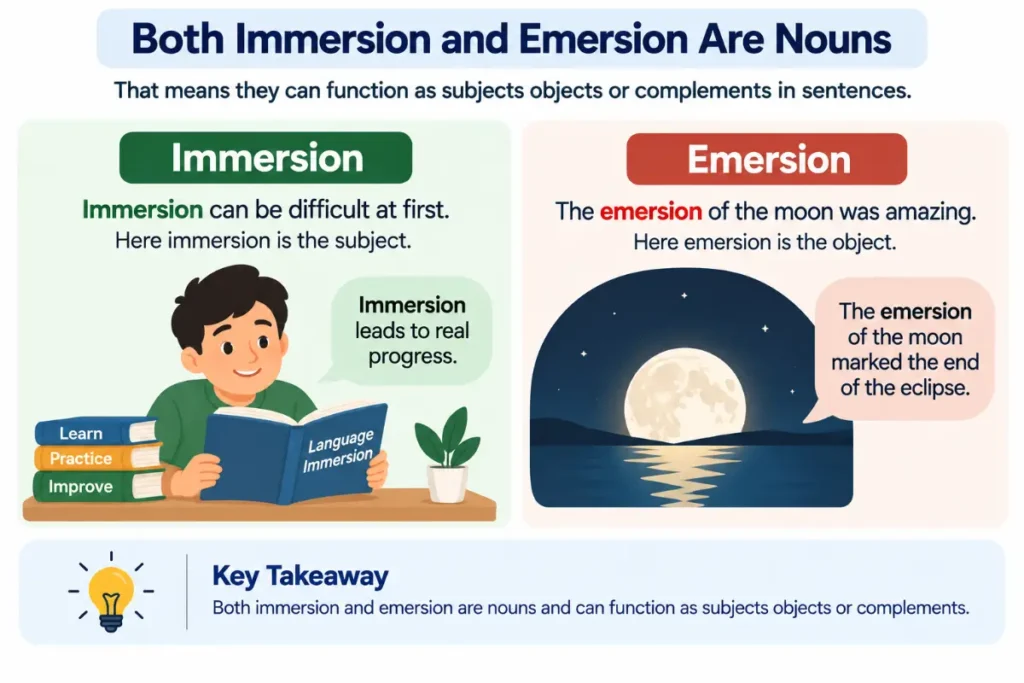
Both immersion and emersion are nouns.
That means they can function as subjects objects or complements in sentences.
Immersion can be difficult at first.
Here immersion is the subject.
The program encourages immersion in Spanish.
Here immersion functions as the object of encourages.
The goal is complete immersion.
Here immersion functions as a subject complement after is.
Emersion works in the same grammatical way.
The emersion was recorded by the telescope.
Scientists observed the emersion of the planet.
The emersion marked the end of the event.
One useful grammar pattern is immersion in.
You can say:
immersion in a subject
immersion in a project
You can also use immersion into in some contexts when emphasizing movement into a situation. However immersion in is often the more natural choice when describing a state of deep involvement.
The verb form is different.
Immerse is the verb.
Immersed is the past tense and past participle.
Immersing is the present participle.
Immersion is the noun.
For example:
She immersed herself in the course.
She was immersed in the course.
Her immersion in the course improved her skills.
This relationship gives you a reliable spelling check. If your sentence describes the act or state of becoming deeply involved then immersion is probably the noun you need.
Real Life Usage
Daily Conversation
Immersion appears naturally in casual speech when people talk about hobbies media travel or learning.
I really got immersed in that show.
The trip gave us a lot of cultural immersion.
These uses sound normal because immersion has become part of everyday vocabulary.
Emersion is much less likely to appear in casual conversation. A person talking about coming out of a swimming pool would normally say coming out of the water or emerging from the water rather than choosing the specialized noun emersion.
Workplace Communication
Immersion can work well in professional communication when describing intensive training or deep involvement.
The new hires spend their first week in an immersion program.
The project gave her a deep immersion in customer research.
The word sounds natural in these settings because the meaning is clear and established.
Emersion would rarely be needed in ordinary workplace writing unless the subject itself involves a technical process connected to emergence.
Academic Writing
Both words can appear in academic writing but they serve different purposes.
The study examines language immersion among adult learners.
The researchers recorded the emersion of the celestial object after the occultation.
The first sentence discusses education. The second uses specialized astronomical terminology.
This is a good example of why formal writing requires precision. A sophisticated sounding word isn’t automatically the right word. Meaning comes first.
News And Journalism
News writing commonly uses immersion in stories about education culture entertainment and personal experience.
A report might discuss students in a language immersion program or audiences experiencing complete immersion in a virtual environment.
Emersion is more likely to appear in science or astronomy reporting where precise terminology matters.
Literature And Storytelling
Writers often use immersion in a figurative sense.
She became lost in the quiet immersion of the forest.
His immersion in the old diary pulled him deeper into the mystery.
Emersion can create a more specialized literary effect when describing something rising into view.
The emersion of the figure from the mist startled everyone.
In ordinary storytelling however emergence would often sound more natural than emersion.
Related And Confused Terms
Several words sit close to these two terms but carry their own meanings.
Immersive
Immersive is an adjective. It describes something that creates or involves deep absorption.
The museum offers an immersive experience.
Merriam Webster defines immersive as involving or providing deep absorption or immersion.
Immerse
Immerse is the verb behind immersion.
She immersed herself in the language.
It can describe physical submersion or deep involvement.
Emergence
Emergence means becoming visible known or present. It is broader and more common than emersion.
The emergence of a new trend surprised researchers.
Emerge
Emerge is the verb associated with coming out or becoming visible.
The swimmer emerged from the water.
The moon emerged from the shadow.
Submersion
Submersion refers to being completely covered or placed under a liquid or other substance.
It is closely related to physical immersion but emphasizes being beneath the surface.
Absorption
Absorption can mean deep mental involvement or concentration.
She was absorbed in the book.
It overlaps with the figurative sense of immersion.
Involvement
Involvement is a broader everyday word for taking part in something.
His involvement in the project lasted six months.
Immersion suggests a deeper level of participation.
Exposure
Exposure describes contact with something or experience of it.
Regular exposure to spoken Spanish can help learners improve.
Immersion generally suggests more sustained and comprehensive involvement than simple exposure.
A Simple Memory Trick
If these words still seem slippery remember the direction.
Immersion goes in.
Emersion comes out.
Picture a person stepping into a swimming pool. The person moves into the water. That is immersion.
Now picture the same person climbing out. The person emerges from the water. That is emersion.
You can also connect the words to their related verbs.
Immerse → immersion
Emerge → emersion
This method is more reliable than trying to remember which spelling simply looks right.
Another useful test is to replace the noun with a verb.
If your sentence could use immerse or immerse yourself then immersion may be appropriate.
If your sentence could use emerge then emersion may be appropriate.
For example:
She immersed herself in French.
becomes:
Her immersion in French was intense.
Likewise:
The moon emerged after the eclipse.
can become:
The emersion of the moon was observed.
That simple substitution test can save you from many spelling mistakes.
Why People Confuse These Words
The confusion comes from several sources.
First the words are visually almost identical. Both contain mersion and differ mainly in their prefixes.
Second they sound very similar in American English. A listener may not immediately know which spelling belongs on the page.
Third both words relate to movement involving something that surrounds or hides another thing. Immersion involves going into or being covered. Emersion involves coming out or becoming visible.
Fourth immersion is much more common. Because people encounter it frequently they may assume emersion is simply an error. That assumption isn’t correct. Emersion is legitimate but specialized.
Finally the related verbs can cause trouble. Immerse and emerge look different enough in their basic forms but their noun forms become surprisingly similar.
The solution is to focus on meaning rather than appearance.

Expert Editor Insight
An experienced editor would first look at the intended meaning rather than the spelling. If the writer means deep involvement submersion or intensive language learning then immersion is the natural choice. If the sentence describes something emerging or becoming visible again then emersion may be correct. Editors also watch for the common mistake of treating emersion as a typo because it is unfamiliar. Spelling tools may flag rare words depending on their dictionaries but a warning does not automatically mean the word is wrong.
You may also want to read Wether or Whether Which Spelling Is Correct.
Final Takeaway
The difference between emersion vs immersion becomes simple once you focus on direction. Immersion means going into something becoming surrounded by it or becoming deeply involved in it. Emersion means coming out emerging or becoming visible again. Both words are legitimate but they don’t serve the same purpose.
For most everyday writing you will need immersion. Use it for language learning cultural involvement deep concentration and physical submersion. Reserve emersion for contexts involving emergence especially specialized astronomical writing.
A quick editing trick can help. Connect immersion with immerse and emersion with emerge. If the idea moves in think immersion. If it moves out think emersion. That one distinction will keep these two easily confused words from getting tangled again
Frequently Asked Questions
Is emersion a real word?
Yes. Emersion is a legitimate English noun. It means the act of emerging or coming out. It also has a specialized astronomical meaning involving the reappearance of a celestial body after an eclipse or occultation. Major dictionaries recognize the word so it shouldn’t automatically be treated as a spelling error.
What does immersion mean?
Immersion means the act of putting something into a surrounding substance or the state of being deeply involved in something. It can describe physical submersion in water as well as figurative involvement in a subject culture activity or experience. Language immersion refers to learning through extensive exposure to the language being studied.
Which word is correct for language learning?
Immersion is correct for language learning. You can say language immersion or an immersion program. The term describes learning through extensive contact with the target language. Emersion doesn’t carry this meaning. Using it in this context would change the meaning and would be considered incorrect for standard usage.
How do you pronounce immersion?
In American English immersion is commonly pronounced ih MUR zhun with the strongest stress on the middle syllable. Its IPA pronunciation is /ɪˈmɝːʒən/. The final sound is similar to the sound in words such as vision. The pronunciation can vary slightly across English varieties but the stressed middle syllable remains easy to recognize.
How do you pronounce emersion?
Emersion is commonly pronounced close to ih MUR zhun in American English. Dictionary sources also record a pronunciation ending with a sound closer to shun. Because emersion and immersion sound very similar the surrounding context often tells listeners which word is intended. In writing you should rely on meaning and spelling rather than sound alone.
Can immersion start a sentence?
Yes. Immersion can start a sentence because it is a noun. For example Immersion in another language can change how quickly a learner develops practical communication skills. Starting with the noun doesn’t create any special punctuation rule. The word simply functions as the subject of the sentence.
Is immersion appropriate in formal writing?
Yes. Immersion is fully appropriate in formal writing when it accurately expresses the intended meaning. It is common in education academic discussion professional training and technical contexts. The word can describe physical submersion or deep involvement. Its broad established use makes it suitable for both everyday and formal communication.
Why do people confuse emersion and immersion?
People confuse them because they look and sound very similar while their meanings move in opposite directions. Immersion relates to going into something or becoming deeply involved. Emersion relates to coming out or becoming visible again. The best way to avoid confusion is to connect immersion with immerse and emersion with emerge.