
If you’ve typed envolve vs involve and stopped because something looked wrong you’re not alone. The two spellings look close enough to cause a quick second guess. However only one is the standard English word used in modern writing.
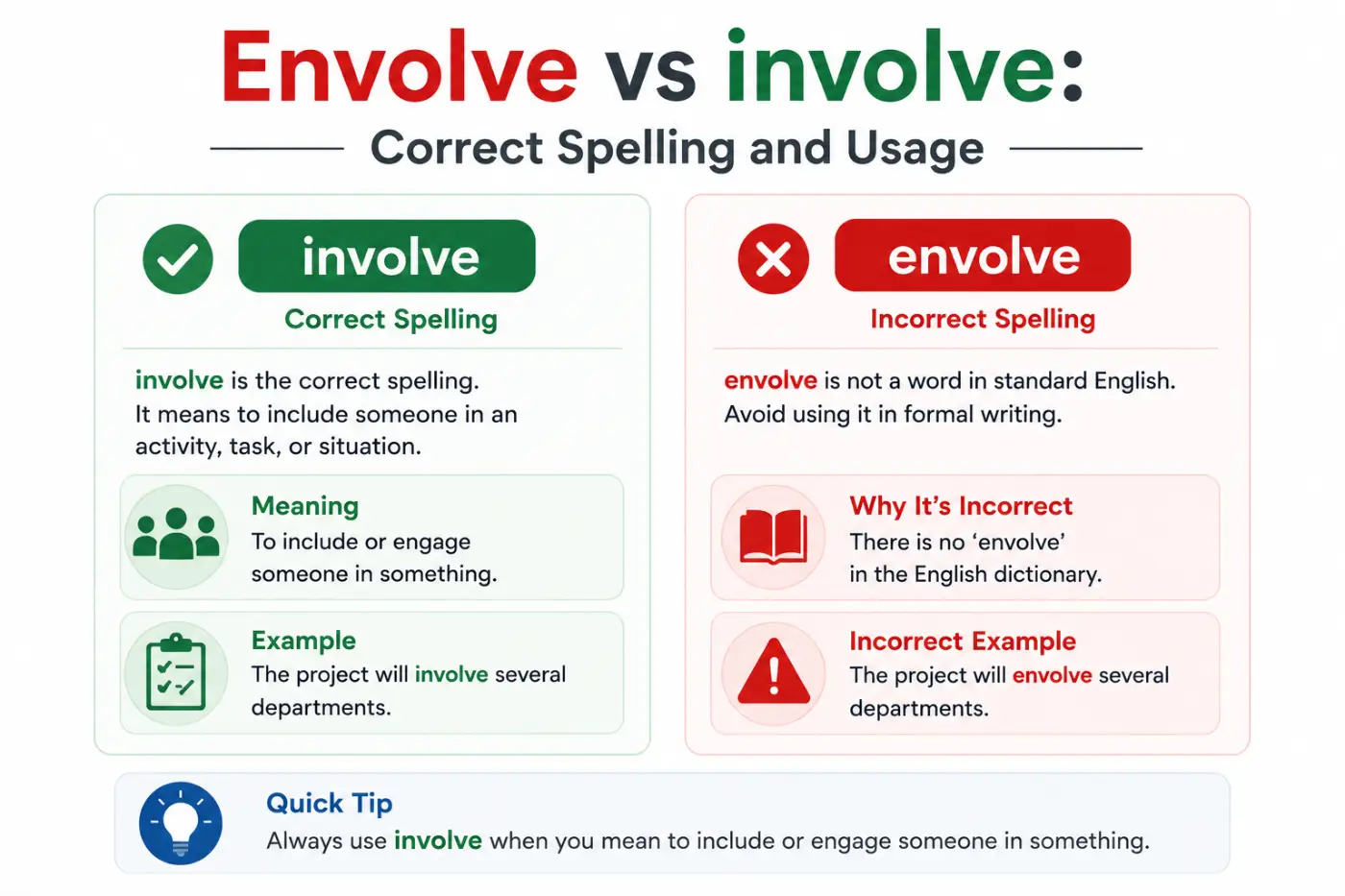
Involve is correct. It means to include someone or something in an activity or situation or to make something part of a process. Envolve is generally an incorrect spelling of involve. It can appear because the sound of the word makes the first vowel easy to misremember.
The good news is that this is an easy mistake to fix once you understand the spelling pattern. This guide explains the meaning grammar pronunciation origin and everyday use of involve. You’ll also see natural examples and practical ways to remember the correct spelling.
A related grammar guide is good luck in future endeavors Meaning and Usage.
Quick Answer
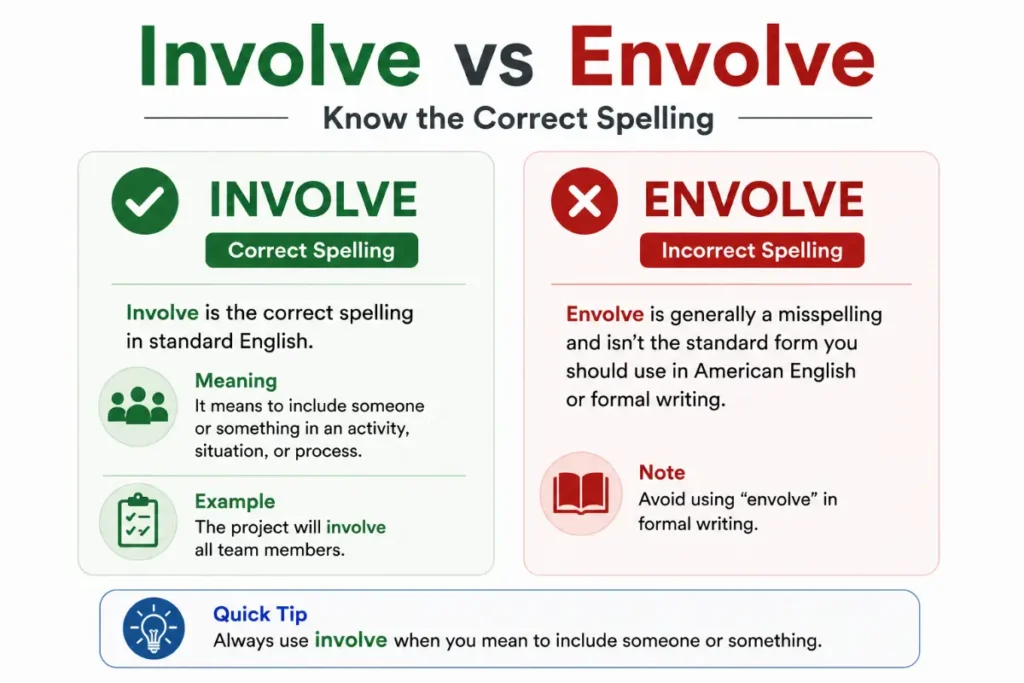
Involve is the correct spelling in standard English. It means to include someone or something in an activity situation or process. Envolve is generally a misspelling and isn’t the standard form you should use in American English or formal writing.
Quick Answer
The correct form is involve.
Use involve when you mean to include someone or something in an activity or situation or when something has a connection to a particular process.
For example:
The project will involve several departments.
The spelling envolve is normally an error. If you’re writing an email essay report application or other standard English text use involve.
Comparison Table
| Form | Meaning | Part of Speech | Origin | Usage Frequency | Formality | Common Contexts | Example |
|---|---|---|---|---|---|---|---|
| Involve | Include or make part of something | Verb | From Latin roots through French and Middle English | Very common | Standard | Work school relationships processes and everyday speech | The plan will involve everyone. |
| Envolve | Usually a misspelling of involve | Not a standard English verb in this sense | Not applicable as the standard form | Very uncommon | Nonstandard | Typing errors and spelling mistakes | Use involve instead. |
The table shows the key point without much fuss. Involve has an established meaning grammatical role and history in English. Envolve doesn’t serve as the standard spelling for that meaning.
Meaning of Involve
Involve is a verb. Its central idea is bringing someone or something into an activity situation process or relationship.
You can involve a person in a discussion. You can involve a team in a project and You can also say that a task involves several steps.
Consider these examples:
The teacher involved the students in the discussion.
The repair will involve replacing two parts.
In the first sentence the students become active participants. In the second sentence the replacement of two parts forms part of the repair process.
The word can also describe something that has a particular effect or requirement.
Buying a house involves careful planning.
Here the meaning isn’t simply that someone is physically included. The idea is that careful planning is an essential part of the process.
That broader use is one reason involve appears so often in everyday and professional English.
Involve As A Verb
As a verb involve can describe an action performed by a person or a condition connected to an event.
For example:
She involved her brother in the decision.
The job involves working with customers.
The investigation involved several interviews.
The grammatical form changes depending on the tense and sentence structure.
involve
involves
involved
involving
These forms all come from the same verb.
Common Meanings Of Involve
Involve has several closely related uses.
- To include someone in an activity.We involved the whole team in the planning.
- To make something part of a process.The procedure involves three steps.
- To require something as part of an activity.The position involves frequent travel.
- To connect someone with an event or situation.Several people were involved in the project.
- To engage someone emotionally or personally.She became deeply involved in the community.
These meanings share one central idea. Something or someone becomes connected to another activity situation or process.
Meaning Of Envolve
In standard modern English envolve is generally not the correct spelling for the verb meaning include or make part of something.
Most appearances of envolve in ordinary writing are simply spelling errors. Someone may remember the pronunciation but choose the wrong vowel when typing the word.
For example:
Incorrect: The project will envolve five departments.
Correct: The project will involve five departments.
The correction is straightforward. Replace envolve with involve.
It’s useful to avoid treating every unfamiliar word as automatically wrong. English contains many unusual words and specialized forms. In this particular spelling comparison however the form readers normally need is involve.
Why The Two Spellings Get Confused
The confusion comes mainly from pronunciation and visual similarity.
When people say involve quickly the first syllable can sound less distinct than it looks on the page. That can make the opening vowel easier to forget.
There’s also a spelling pattern at work. English contains many words beginning with en. Words such as encourage engage enlarge and enable are familiar. That pattern can make envolve look believable at first glance.
But spelling isn’t always predictable from familiar patterns. A word can look as if it should follow one pattern while its established spelling follows another.
That’s exactly what happens here.
A useful mental trick is to connect involve with related forms such as involved and involvement. Once you picture those words together the correct spelling becomes easier to recognize.
Key Differences Explained
The difference between the two forms is much simpler than it may first appear.
- SpellingThe standard spelling is involve. The opening letters are in followed by volve.
- MeaningInvolve has established meanings connected with inclusion participation connection and required parts of a process. Envolve doesn’t normally function as the standard word for these meanings.
- GrammarInvolve is a verb. You can change it into forms such as involves involved and involving.
- PronunciationInvolve is commonly pronounced with the stress on the second syllable.
- FormalityInvolve works naturally in casual conversation as well as formal writing.
- Regional usageAmerican English uses involve as the standard form. British Canadian and Australian English also use involve.
- Standard usageIn standard English writing you should use involve. The alternative spelling can make your writing look careless or unfinished.
Which Form Is Correct?
Involve is correct.
The word has a long established history in English and functions as a standard verb. It appears naturally in everyday speech academic writing workplace communication journalism and formal documents.
The spelling follows the established form involve rather than envolve.
If a spelling checker marks envolve as an error that’s consistent with standard English usage. The software isn’t simply choosing a preferred style. It’s recognizing that the expected word in this context is involve.
A good editor would make the same correction unless the unusual form appeared as a proper name or some highly specific specialized usage.
For ordinary writing the decision is easy.
Use involve.
Sentence Examples
The best way to make a spelling distinction stick is to see the correct word working naturally in different settings.
- Everyday conversationDoes this job involve a lot of travel?
- Text messageWill the meeting involve the whole team?
- Workplace communicationThe new policy will involve changes to our current process.
- SchoolThe science project will involve collecting data from several experiments.
- Academic writingThe study involved participants from several age groups.
- Formal writingThe agreement involves both parties in the final review process.
- Social situationsI don’t want to involve everyone in a private disagreement.
- Online communicationThe update will involve a few changes to the user interface.
- Business discussionExpanding the company will involve additional training and planning.
- Personal decision
Moving to another city would involve some major changes.
Notice how flexible the word is. It can describe participation. It can describe requirements and It can also describe connections between people and events. That flexibility makes it a common and useful verb.
Common Mistakes And Misspellings
Several mistakes can appear around this word because writers rely on sound instead of remembering the established spelling.
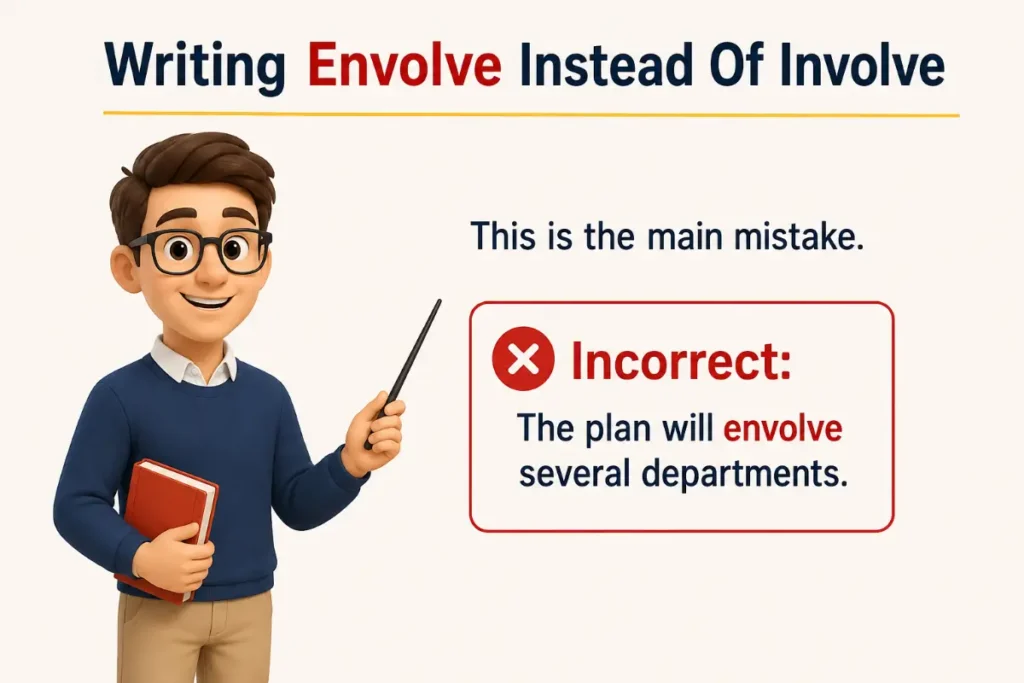
Writing Envolve Instead Of Involve
This is the main mistake.
Incorrect: The plan will envolve several departments.
Correct: The plan will involve several departments.
The error usually comes from choosing en at the beginning instead of in.
Adding An Extra Letter
Some writers may produce unusual forms such as envolvve or involvve while typing quickly. These errors are simple keyboard mistakes.
Correct: The work will involve careful testing.
The base form contains one v before the final e.
Confusing Involve With Involved
Involve and involved are related but they serve different grammatical roles.
The project will involve three teams.
Three teams are involved in the project.
The first sentence uses the base verb after will. The second uses the past participle after are.
Confusing Involve With Involving
The form involving commonly appears after prepositions or as part of a progressive structure.
The case involves several witnesses.
The case is involving several witnesses.
The second sentence sounds unnatural in many contexts because involve often works better as a simple verb when describing a general fact.
Forgetting The Preposition In
A common grammar problem isn’t spelling at all. It’s the phrase that follows the verb.
You can say:
The project involves several students.
You can also say:
The project involves students in the research.
The first structure means the students are part of the project. The second specifically describes bringing the students into the research activity.
That small difference matters.
Many readers also check powerfull vs powerful Correct Spelling and Usage.
Pronunciation Guide
The standard pronunciation of involve is commonly represented in American English as /ɪnˈvɑlv/.
You can think of it as:
in VOLVE
The second syllable carries the main stress.
The first part sounds like the short i in words such as sit. The second part begins with a clear v sound and ends with the familiar sound found in words such as solve.
A simple pronunciation guide is:
in VAHLV
The exact vowel quality can vary slightly among speakers and accents. That’s normal. The spelling remains the same across standard varieties of English.
Common Pronunciation Problem
Some speakers may reduce the first syllable during fast speech. That can make the beginning of the word less noticeable.
This may contribute to the spelling mistake because people sometimes spell words according to how they remember hearing them.
A useful rule is simple. Learn the visual pattern together with the sound.
Involve. Involved. Involvement.
Seeing the word family helps reinforce the spelling.
Etymology And Word Origin
Involve has an old history.
The English verb comes through French from Latin involvere. The Latin word was built from elements associated with movement into something and rolling or turning. Its older literal sense was connected with wrapping or rolling something in.
Over time the meaning developed beyond a physical idea.
English eventually used involve for the idea of including something in a situation or connecting something with a process. That modern sense is now much more common than the original physical imagery.
The related noun involvement developed from the same word family. The adjective involved also carries the central idea of being connected with or included in something.
This history helps explain why the modern word can describe several kinds of connection. A person can be involved in an activity. A process can involve several stages. A decision can involve difficult choices.
The underlying idea remains connection and inclusion.
Regional Usage
There’s no major regional spelling difference here. English speakers across major standard varieties use involve.
American English
In American English involve is the standard spelling and a very common verb.
You’ll find it in casual speech as well as workplace documents academic writing news writing and everyday messages.
The position involves working with customers.
This sentence sounds completely natural in American English.
British English
British English also uses involve as the standard form.
There’s no normal British spelling that replaces the initial in with en.
Australian English
Australian English uses involve in standard writing and speech.
The spelling does not normally change based on Australian usage.
Canadian English
Canadian English also uses involve.
As with American British and Australian English the alternative spelling isn’t a standard regional variation.
So there’s no need to memorize different spellings for different English speaking countries. Involve works across these varieties.
Grammar Rules And Part Of Speech
Involve is a verb.
It can be used in several grammatical patterns. Understanding those patterns makes the word easier to use correctly.
Involve Plus Object
One common structure is:
involve + person or thing
The project involves several teachers.
Here several teachers are part of the project.
Another example is:
The investigation involved three departments.
The departments were connected with the investigation.
Involve Someone In Something
Another important pattern is:
involve + someone + in + activity or situation
The manager involved the staff in the decision.
This structure emphasizes active participation.
Compare these two sentences:
The project involves the staff.
The manager involved the staff in the project.
The first says the staff are part of the project. The second highlights the action of bringing them into it.
Involve With
The expression involved with can describe a connection with a person activity group or situation.
She became involved with the local community.
The phrase can work in both neutral and negative contexts.
He became involved with the organization.
The exact meaning depends on the surrounding sentence.
Involved In
The phrase involved in is extremely common.
She is involved in the project.
They were involved in the discussion.
Here involved is the past participle of involve and often works as an adjective describing participation or connection.
Involving
The ing form can describe something that includes a particular person or process.
We discussed a case involving several employees.
Here involving introduces information about the case.
This form is especially common in formal and professional writing.
Real Life Usage Examples
The word feels most natural when you see how native speakers use it in different situations.
Daily Conversation
People often use involve when talking about plans responsibilities and participation.
The trip will involve a lot of walking.
I don’t want to involve my parents in the argument.
The word works well because it quickly communicates the idea of participation or consequence.
Email And Workplace Communication
Professional writing uses involve frequently because many tasks require people departments or steps to work together.
The transition will involve training for all new employees.
Please involve the design team before making the final change.
The verb is clear and professional without sounding overly formal.
Academic Writing
Academic writers use involve to explain processes methods participants and conditions.
The experiment involved observing changes over several days.
The research involved interviews with college students.
It’s useful because it can describe complicated processes in a compact way.
News And Journalism
News writing often uses involve when describing people events investigations or incidents.
The investigation involved several government agencies.
The case involved multiple witnesses.
The word helps writers describe connections without unnecessary explanation.
Literature And Storytelling
In storytelling involve can describe emotional relationships or personal situations.
She didn’t want her family involved in the conflict.
He became deeply involved in the life of the small town.
This use can carry a stronger emotional meaning than the basic idea of participation.
Related And Confused Terms
Several words connect closely with involve. They aren’t all interchangeable.
Include
Include means to contain or make someone or something part of a group or activity.
The price includes breakfast.
Include is often more direct than involve.
Engage
Engage can mean to attract attention or actively participate in something.
The teacher engaged the students in discussion.
Engage often suggests active participation.
Participate
Participate means to take part in an activity.
Everyone participated in the meeting.
Unlike involve participate normally focuses on the person who takes part.
Contain
Contain means to have something inside or as a component.
The box contains several documents.
It can overlap with include but doesn’t normally carry the same idea of personal participation.
Connect
Connect means to link people things or ideas.
The two events are connected.
Connect focuses on the relationship rather than the act of including someone.
Concern
Concern can mean to relate to or affect someone.
The decision concerns everyone in the department.
This can overlap with involve when something affects people.
Require
Require means that something is necessary.
The task requires careful planning.
Involve can sometimes suggest a requirement but it doesn’t always mean something is strictly necessary.
Implicate
Implicate means to show that someone is connected to something especially a harmful or questionable event.
The evidence implicated several people.
Implicate is much more specific and can carry a negative meaning. It shouldn’t be used as a general replacement for involve.
Involve In Common Expressions
Learning common phrases can make the word easier to recognize.
Involve Someone In Something
This means to bring someone into an activity or situation.
The coach involved the players in the planning.
Be Involved In
This means to participate in or be connected with something.
She is involved in several community projects.
Get Involved
This means to begin participating.
You should get involved in the discussion.
Become Involved
This means to start becoming connected with an activity situation or group.
He became involved in local volunteer work.
Involve A Lot Of Work
This phrase describes something that requires significant effort.
Moving to a new office will involve a lot of work.
These expressions are common enough that recognizing them can reinforce the correct spelling naturally.
How To Remember The Correct Spelling
The easiest memory trick is to focus on the beginning.
Think:
IN + VOLVE = INVOLVE
Then connect it with related forms.
Involve
Involved
Involvement
Seeing the shared beginning makes the correct spelling easier to recall.
Another useful trick is to remember a short sentence:
The project will involve everyone.
If you can remember that sentence you can often reconstruct the spelling when you need it.
You can also picture the word as a family rather than as an isolated spelling. When involve appears beside involved and involvement the correct in beginning becomes much harder to forget.
Why Spelling Tools May Flag Envolve
Modern spelling tools compare typed words against recognized dictionaries and language patterns. When you enter envolve in ordinary English writing a spelling checker may suggest involve.
That correction makes sense because involve is the established standard word for the intended meaning.
Still you shouldn’t blindly accept every automated suggestion. Spell checkers work from patterns and dictionaries and can sometimes flag proper names technical terms or specialized vocabulary.
The best approach is to understand the word first and then use software as a second check.
For this particular spelling the correction is usually straightforward.
A Simple Difference To Remember
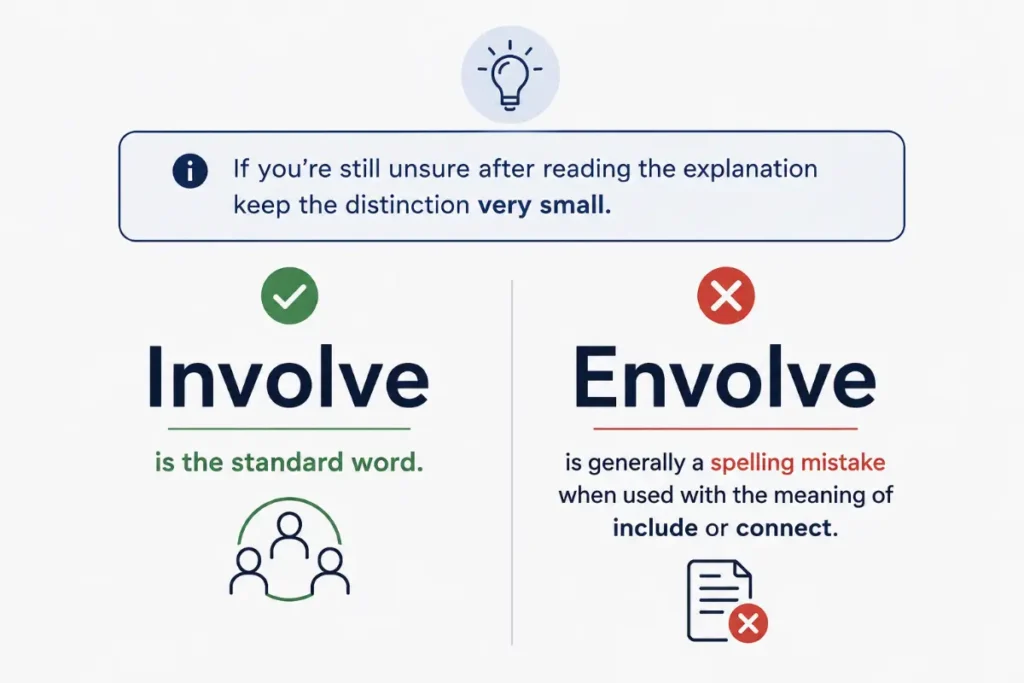
If you’re still unsure after reading the explanation keep the distinction very small.
Involve is the standard word.
Envolve is generally a spelling mistake when used with the meaning of include or connect.
You don’t need a complicated grammar rule to remember it. The word simply has an established spelling that begins with in.
Think about these three forms together:
involve
involved
involvement
That pattern gives you a strong visual reminder.
You may also want to read emaculate vs immaculate Correct Spelling Meaning and Usage.
Final Takeaway
Envolve vs involve has a clear answer. Involve is the standard English spelling and the correct choice when you mean to include someone or something or make it part of a process. Envolve is generally a misspelling and should be avoided in standard writing.
The word involve works comfortably in casual conversation academic writing workplace communication and formal documents. It can describe participation requirements connections and processes. If you’re unsure about the spelling remember the word family involve involved involvement. That simple pattern can keep the correct form firmly in place the next time you write it.
FAQs
Is Envolve A Real Word?
In ordinary modern English envolve isn’t the standard spelling of the verb that means to include or connect. Most uses of it are spelling errors for involve. If you’re writing standard American English you should use involve. An unusual word can exist in a specialized context without making it the correct choice for ordinary writing.
What Does Involve Mean?
Involve means to include someone or something in an activity situation or process. It can also describe something that forms a necessary part of an activity. For example you can involve someone in a discussion or say that a job involves travel. The exact meaning depends on the sentence.
Which Spelling Should I Use In Formal Writing?
Use involve in formal writing. It is the standard English spelling and works naturally in academic papers business documents reports applications and professional correspondence. The spelling envolve can distract readers because it appears to be an error. There’s no normal formal writing context that requires the alternative spelling for this meaning.
How Do You Pronounce Involve?
Involve is commonly pronounced /ɪnˈvɑlv/ in American English. It has two syllables and the main stress falls on the second syllable. You can think of the pronunciation as in VAHLV. The exact vowel sound may vary slightly among speakers but the standard spelling remains involve.
Can Involve Start A Sentence?
Yes. Involve can start a sentence when the sentence structure calls for the verb. For example you could write Involve the entire team before making the decision. This is an imperative sentence. Starting with involve is completely grammatical when the context supports that structure.
What Is A Synonym For Involve?
Useful synonyms include include engage connect concern and require. The best choice depends on the meaning. Include works when something becomes part of a group. Engage often suggests active participation. Connect focuses on a relationship. Require emphasizes necessity. No single synonym works perfectly in every sentence.
Why Do People Misspell Involve?
People may misspell involve because the first syllable can sound less clear during natural speech. The spelling envolve also looks believable because many English words begin with en. When someone relies on sound or a familiar spelling pattern the wrong initial vowel can slip in. Repeated exposure to the correct word helps prevent the mistake.
Is Involve Appropriate In Formal Writing?
Yes. Involve is completely appropriate in formal writing. It appears naturally in academic work professional reports business communication and other serious forms of writing. It doesn’t sound overly casual or overly technical. In fact its flexibility makes it useful when you need to describe participation connection or a process that contains several parts.