
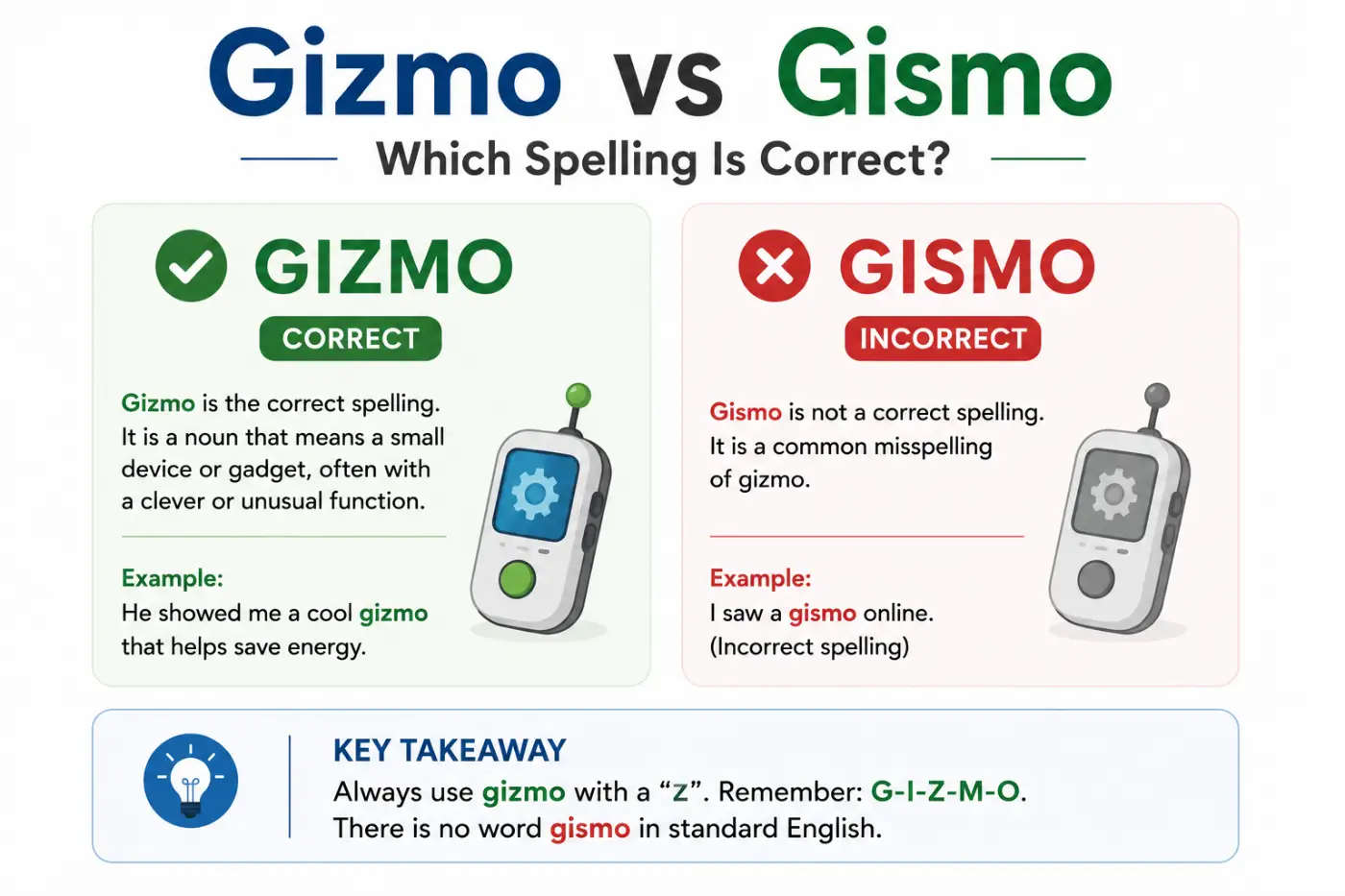
If you’re wondering about gizmo vs gismo you’re not alone. The two forms look almost identical and sound the same when spoken. The good news is that you don’t have to treat one as a simple spelling mistake.
Gizmo is the standard and more common spelling. Gismo is also an accepted spelling variant with the same meaning. Both forms refer to a small device or gadget.
The word usually describes a small device or object when you don’t want to give its exact name. You might call a strange kitchen tool a gizmo or refer to a new electronic gadget as a gizmo. The word is informal and often has a friendly or slightly playful tone.
This guide explains the difference between the two spellings. You’ll also learn how to pronounce the word how it functions in a sentence where it came from and how to choose the best form for everyday and formal writing.
Learn the difference in Brought vs Bought Correct Spelling Meaning and Usage.
Quick Answer
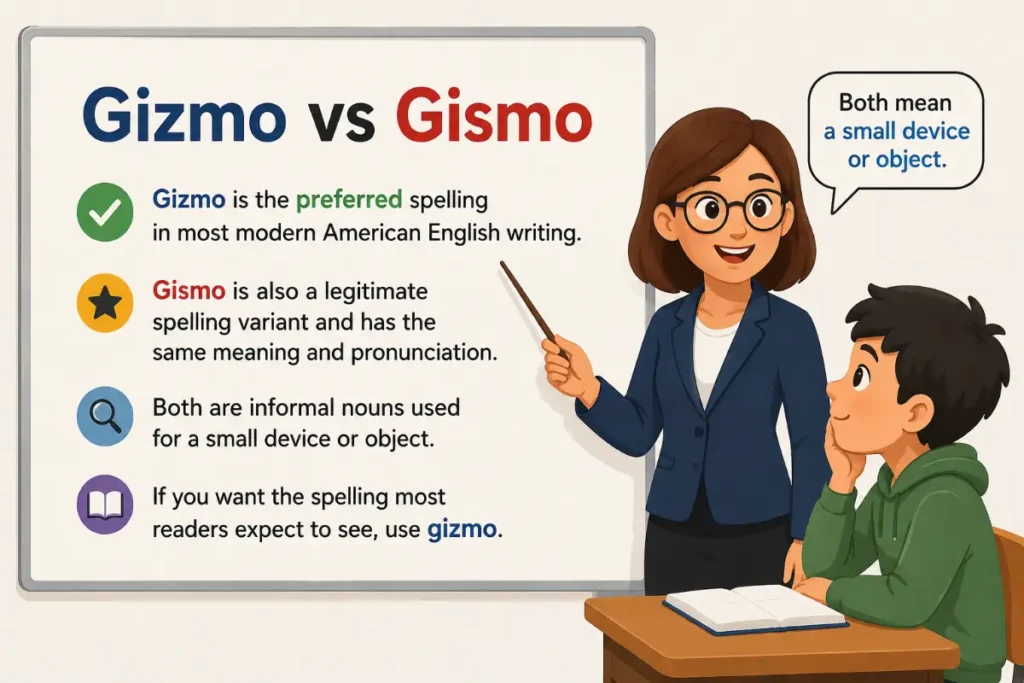
Gizmo is the preferred spelling in most modern American English writing. Gismo is also a legitimate spelling variant and has the same meaning and pronunciation. Both are informal nouns used for a small device or object. If you want the spelling most readers expect to see use gizmo.
Gizmo And Gismo At A Glance
The biggest difference is simply the spelling.
| Form | Meaning | Part of Speech | Origin | Usage | Formality | Common Contexts | Example |
|---|---|---|---|---|---|---|---|
| Gizmo | A small device or gadget | Noun | Modern English with uncertain origin | More common | Informal | Technology gadgets tools and everyday objects | I bought a new gizmo for the kitchen. |
| Gismo | A small device or gadget | Noun | Variant spelling of gizmo | Less common | Informal | General and informal writing | I couldn’t figure out how the gismo worked. |
The important point is that gismo isn’t simply an error. It is a recognized variant spelling of gizmo.
That distinction matters because spelling questions often have a simple right or wrong answer. This one doesn’t fit neatly into that box. One form clearly dominates modern usage but the other remains an accepted spelling.
What Does Gizmo Mean?
Gizmo is an informal noun for a small device or object whose exact name may be unknown unnecessary or simply not worth mentioning.
For example you might see a complicated tool on someone’s desk and say:
I have no idea what this gizmo does.
The speaker doesn’t necessarily mean the object is useless. The word simply avoids naming the object precisely.
Gizmo works especially well in casual conversation because it has a light and flexible feel. You can use it for electronics tools kitchen equipment mechanical parts and many other small objects.
Consider these examples.
- My brother bought a strange gizmo for his car.
- What does this little gizmo do?
- The new gizmo makes cooking much easier.
- I found an old gizmo in the garage.
- She showed me a clever gizmo that tracks the temperature.
In each sentence the speaker could use a more precise noun such as device or tool. The word gizmo works because the exact name isn’t important.
What Does Gismo Mean?
Gismo has the same basic meaning as gizmo. It refers to a small device gadget or object.
The key difference isn’t meaning. It’s spelling.
So if someone writes:
This gismo controls the lights.
The spelling isn’t automatically a mistake. It is a recognized variant.
That said gizmo is the safer choice for most modern American writing because it is much more familiar to readers. If you’re writing an article email school assignment or general business communication and you simply want the form that looks most natural choose gizmo.
Is Gismo A Misspelling?
No. Gismo is not simply a misspelling of gizmo.
It is a legitimate variant spelling. That doesn’t mean both forms are equally common. English has many words with accepted variants where one form has become much more widespread.
This is a useful distinction for editors and learners.
A misspelling is normally a nonstandard form created by mistake. A variant spelling is an alternative form that has established usage.
Gismo belongs in the second category.
If your spell checker flags gismo in a particular application that doesn’t prove the word is wrong. Software dictionaries don’t always contain every legitimate variant. At the same time a spell checker accepting a word doesn’t automatically make it the best choice for every context.
That is why good editing requires more than trusting a red underline.
Why Gizmo Is Usually The Better Choice
If both spellings are accepted you may wonder why you should favor one.
The answer is familiarity.
Gizmo is the spelling most readers are likely to recognize immediately. It is also the form most commonly presented as the main spelling in modern dictionaries while gismo appears as a variant.
This creates a practical writing rule.
Use gizmo when you have no special reason to choose the alternative.
That choice keeps your writing familiar and avoids making readers pause over an uncommon spelling. You aren’t gaining anything by choosing the less common form in ordinary American prose.
For example:
The new gizmo connects to your phone.
This feels natural.
You could write:
The new gismo connects to your phone.
The sentence still works. The meaning hasn’t changed. The spelling simply looks less familiar to many readers.
Pronunciation Of Gizmo And Gismo
Both spellings have the same pronunciation.
Gizmo: /ˈɡɪz.moʊ/
Gismo: /ˈɡɪz.moʊ/
You can think of it as:
GIZ moh
The first syllable receives the main stress.
The first part sounds like giz. The second part sounds like moh.
The spelling difference doesn’t create a pronunciation difference. The z sound remains the same even when the word is written with s.
That makes the pair especially easy to confuse in writing. When you hear the word you can’t tell which spelling the speaker has in mind.
This is a good example of why pronunciation alone doesn’t always tell you how to spell an English word.
Grammar And Part Of Speech
Both forms function primarily as nouns.
They usually refer to a small device object or gadget.
You can use the singular form when discussing one object.
This gizmo isn’t working.
You can use the plural when talking about more than one.
The store sells all kinds of gizmos.
The plural of gizmo is gizmos.
The plural of gismo is gismos.
Both forms can appear after determiners such as a the this that these and those.
For example:
I bought a gizmo yesterday.
That gizmo looks useful.
These gizmos are surprisingly expensive.
Because the word is informal it usually appears in casual descriptions rather than highly technical writing. If you know the precise name of a device and that name matters you should normally use it.
How Gizmo Works In A Sentence
The word is easy to use because it behaves like an ordinary countable noun.
You can say a gizmo when you mean one object.
She found a gizmo under the sink.
You can say the gizmo when the listener already knows which object you’re talking about.
Put the gizmo back on the shelf.
You can also use gizmos for several objects.
His desk is covered with electronic gizmos.
The word can also work as part of a noun phrase.
a useful kitchen gizmo
a strange electronic gizmo
a tiny mechanical gizmo
the latest tech gizmo
The phrase usually sounds casual because the word itself is casual.
Ten Natural Examples With Gizmo
- I bought a little gizmo that helps me open tight jars.
- Do you know what this gizmo is supposed to do?
- My dad keeps every useful gizmo he finds in the garage.
- The technician installed a new gizmo inside the machine.
- She showed me a clever gizmo that measures the water level.
- That electronic gizmo costs more than I expected.
- I couldn’t remember the name of the tool so I called it a gizmo.
- The kids were fascinated by all the gizmos on the workbench.
- This kitchen gizmo saves me several minutes every morning.
- He bought another gizmo for his home office even though he already had three similar devices.
These examples show why the word remains useful. It fills a small but practical gap in everyday speech. Sometimes you know what an object does but don’t know its technical name. Sometimes the exact name simply doesn’t matter.
When To Use Device Instead
Device is a broader and more neutral word.
A device refers to an object or machine designed for a particular purpose. It is suitable for casual writing and professional contexts.
Compare these sentences.
The technician tested the device.
The technician tested the gizmo.
The first sentence sounds neutral and professional. The second sounds more casual and less precise.
If you’re writing a technical report you will usually want device or the specific name of the equipment.
If you’re talking with a friend about a strange little tool you might naturally say gizmo.
The choice depends on tone as much as meaning.
Gizmo Compared With Gadget
Gadget is one of the closest everyday alternatives.
A gadget generally refers to a small device or machine designed for a particular purpose.
Still the two words can create slightly different impressions.
Gadget often suggests something useful clever or interesting. It frequently appears when people talk about consumer products and technology.
Gizmo is more flexible. It can describe an object even when the speaker doesn’t know or doesn’t care about its exact name.
For example:
I bought a new kitchen gadget.
This suggests you know the object is a useful tool.
What’s this gizmo for?
This suggests you’re looking at something unfamiliar.
The difference is subtle but useful.
Gizmo Compared With Widget
Widget can also mean a small device whose name you don’t know or have forgotten.
But widget has developed additional meanings.
In business and software contexts a widget can refer to a hypothetical manufactured product or a small software component on a webpage.
That means context matters.
If someone says:
I need a widget for this page.
They may be talking about software rather than a physical object.
Gizmo doesn’t normally carry that same technical software meaning in ordinary English.
Gizmo Compared With Contraption
Contraption usually describes a machine or device that looks complicated unusual or awkward.
For example:
What is that strange contraption in your garage?
The word can carry a slightly humorous tone.
Gizmo is usually more neutral and often suggests something small.
You could call a complicated machine a contraption. You’d be less likely to call a large industrial machine a gizmo unless you’re being deliberately casual.
Gizmo Compared With Thingamajig
Thingamajig is an informal word used when you don’t know or can’t remember the exact name of something.
It has a stronger sense of placeholder language.
For example:
Hand me that thingamajig on the table.
Gizmo can work in a similar way but often sounds more connected to a device or gadget.
Both words are useful in casual conversation. Neither belongs in formal technical writing when a precise term is available.
Common Spelling Mistakes
The two forms create several predictable mistakes.
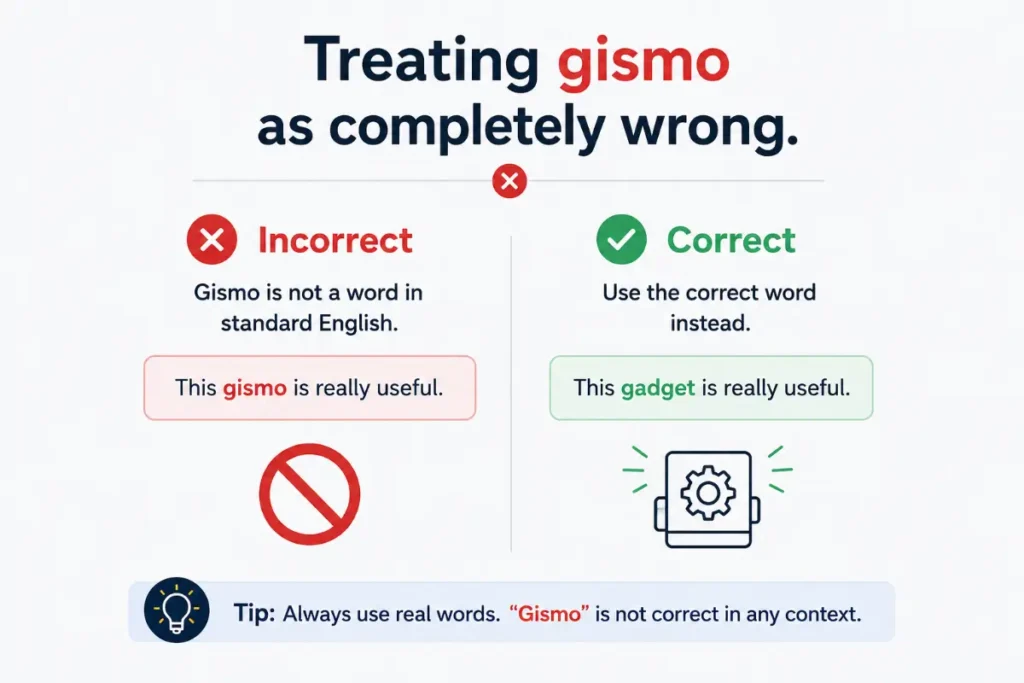
- Treating gismo as completely wrong.
Some writers assume the spelling with s is always incorrect. That’s not accurate. Gismo is an established spelling variant.
- Treating both forms as equally common.
The fact that both forms are accepted doesn’t mean they’re equally familiar. Gizmo is the stronger default for most modern American writing.
- Using gizmo as a technical term.
Gizmo is informal. It doesn’t name a specific class of machine. It works as a general word for a device whose exact name is unknown or unimportant.
- Using gizmo when precision matters.
A technical report should identify the exact equipment when that information matters. Calling a specialized instrument a gizmo can make the writing sound vague.
- Writing the plural incorrectly.
The plural is gizmos. You don’t need an apostrophe to make the word plural.
Need another quick comparison? Read well-known vs well known Which Form Is Correct.
Why People Confuse The Spelling
The confusion is easy to understand.
English spelling doesn’t always provide a direct map from sound to letters. The sound in the middle of the word can lead writers to expect an s because English uses s in many words that contain similar sounds.
There’s also a simple visual factor. Gizmo and gismo differ by only one letter.
If you’ve mostly heard the word in conversation you have no visual information to tell you which form a writer prefers. You may have seen one form only rarely and then assume it was a typo.
This is also why people often ask spelling questions using a comparison format. The speaker knows the sound but wants confirmation of the written form.
Etymology And Word Origin
The history of gizmo is less certain than its modern meaning.
The word appeared in American English during the twentieth century. Its exact origin remains uncertain.
Historical evidence connects early uses with military slang for an unnamed object. Some explanations suggest that it may have developed as an invented placeholder word rather than coming directly from an older foreign word.
Because the origin isn’t completely settled it’s better to avoid presenting one theory as proven fact.
What we can say with confidence is that the word developed as a handy informal label for an object whose exact name was unknown or unimportant.
That history fits the word’s modern role remarkably well. English speakers have long created playful placeholder terms for unnamed objects. Thingamajig is another familiar example. Gizmo belongs to the same broad family of informal naming strategies.
American English Usage
In American English gizmo is the spelling most readers will recognize first.
It works naturally in casual conversation online communication product discussions and informal descriptions.
You might hear:
Where did you get that gizmo?
Or:
This little gizmo makes the job much easier.
The word is especially comfortable around technology because people often encounter new devices before they know the official name for them.
Still gizmo isn’t limited to electronics. A kitchen tool a mechanical part or an unusual household object can also receive the label.
British English Usage
British English also recognizes gizmo and gismo.
The pronunciation differs slightly from the typical American pronunciation because of the final vowel sound in many British accents.
The basic meaning remains the same.
There isn’t a major British versus American meaning distinction that requires you to learn separate rules. The main practical point is still that gizmo is the familiar spelling while gismo functions as a recognized alternative.
Australian And Canadian English
There is no major spelling distinction that requires a separate rule for Australian or Canadian English.
Both varieties share the broader English vocabulary that includes gizmo and gismo. The exact frequency of each form can vary across speakers and publications but the basic meaning remains unchanged.
For general international writing gizmo is the clearest choice because it is widely recognizable.
Is Gizmo Appropriate In Formal Writing?
Usually gizmo is too informal when the exact technical term is known and important.
For example a scientific report shouldn’t identify specialized equipment simply as a gizmo when a precise name is available.
A clearer sentence would be:
The pressure sensor was tested before installation.
This is more precise than:
The gizmo was tested before installation.
However informal words can appear in formal writing when they’re part of a quotation or when an author intentionally uses conversational language.
The key is context.
Don’t treat gizmo as grammatically wrong. Treat it as an informal word that may not suit a formal purpose.
That distinction is important. Informal doesn’t mean incorrect.
Can Gizmo Start A Sentence?
Yes. Gizmo can appear at the beginning of a sentence just like any other noun.
For example:
Gizmo makes the process much easier.
Here gizmo is simply the subject of the sentence.
You can also begin a sentence with the plural form.
Gizmos can make simple tasks easier.
The word’s position doesn’t make it more or less correct. The main consideration is still tone and precision.
Related Words And Expressions
Several words sit close to gizmo in meaning.
- Gadget refers to a small useful device or machine.
- Device is a broader and more neutral term for an object designed for a particular purpose.
- Widget can mean a small device but also has business and software meanings.
- Contraption often describes an unusual or complicated machine.
- Thingamajig is an informal placeholder for something whose name is unknown or forgotten.
- Thingamabob works in much the same playful way as thingamajig.
- Doohickey is another informal term for an unnamed object or device.
- Appliance usually refers to a machine designed for a particular household or practical function.
These words overlap but they aren’t perfect substitutes in every sentence. Device sounds neutral. Gadget often sounds useful or clever. Contraption can suggest complexity. Gizmo sits comfortably in the middle as a casual name for a small device.
Real Life Usage In Conversation
In daily conversation the word often appears when the speaker can’t remember an object’s name.
Can you pass me that gizmo?
This works because the listener can identify the object from the situation.
Another common use is playful description.
My new phone has all kinds of fancy gizmos.
Here the speaker isn’t claiming that the phone contains unnamed objects. The word simply creates a casual tone around its features.
That flexibility makes the word useful in ordinary speech.
Real Life Usage At Work
At work the word depends heavily on the setting.
In a casual conversation with a coworker you might say:
Do you know how this gizmo works?
That’s perfectly natural if everyone understands which object you mean.
In a formal report you should normally replace it with the specific name.
For example:
The pressure sensor was tested before installation.
is clearer than:
The gizmo was tested before installation.
Professional writing benefits from precision. Casual workplace conversation doesn’t always need it.
Real Life Usage In Academic Writing
Academic writing generally favors precise nouns.
A researcher shouldn’t call specialized equipment a gizmo when the technical name is available and relevant.
Still the word can appear in academic writing when the writer is discussing informal language itself or quoting someone.
For example:
Participants commonly referred to the device as a gizmo.
Here the word is useful because the informal term is part of the subject being discussed.
That is a good example of context controlling word choice.
Real Life Usage In Journalism
Journalists sometimes use informal nouns to make a story sound accessible.
A technology article might call a small new product a gizmo when the exact technical name isn’t important to the story.
The word can make a description feel lighter and more conversational.
However a journalist covering a technical subject still needs precision. Calling a medical instrument a gizmo without explanation could make the reporting sound careless.
Good editing balances accessibility with accuracy.
Real Life Usage In Storytelling
Gizmo works naturally in storytelling because it can reveal a character’s personality.
Marcus pulled a strange gizmo from his backpack and placed it on the table.
The reader doesn’t need to know exactly what the object is yet. The vague noun creates curiosity.
That makes the word useful beyond ordinary conversation. It can serve a narrative purpose when the writer wants to delay a precise description.
Expert Editor Insight
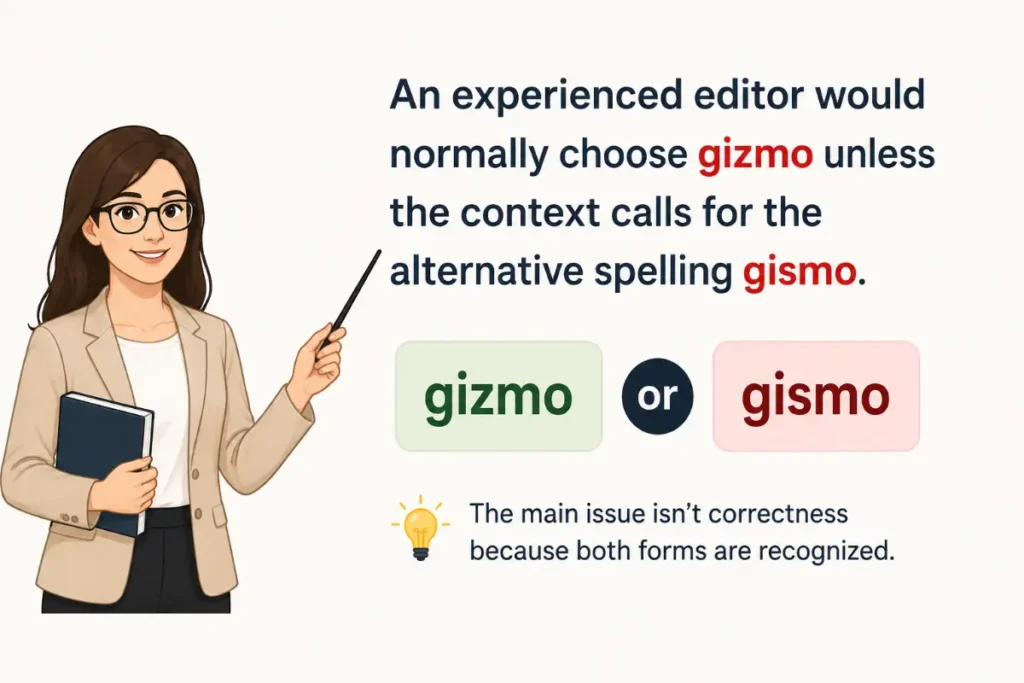
An experienced editor would normally choose gizmo unless the context calls for the alternative spelling gismo. The main issue isn’t correctness because both forms are recognized. The real question is familiarity and tone. If a manuscript uses gismo throughout without a clear reason an editor may suggest gizmo for consistency and reader familiarity. A good editor also checks the surrounding sentence to see if a more precise word such as device gadget or the object’s actual name would communicate the idea better.
A Simple Memory Trick
If you often hesitate between the two spellings use this simple rule: Gizmo with Z is the default choice. Think of the Z as the form that stands out. you don’t need a complicated spelling rule because the issue isn’t a grammar distinction. The two forms carry the same basic meaning. If you see gismo in a dictionary or published text don’t assume the writer made an error. It is an accepted variant. For everyday American English though gizmo is the form worth remembering first.
Learn the difference in Brite vs Bright Which Spelling Should You Use in 2026.
Conclusion
The answer to gizmo vs gismo becomes simple once you separate spelling from correctness. Gizmo is the preferred and more familiar spelling in general American English while gismo is a legitimate alternative spelling with the same meaning and pronunciation.
Use gizmo as your default choice in everyday writing. Choose a more precise term such as device or gadget when the object’s function or type matters. If you see gismo in published writing don’t automatically assume it’s an error because the form is recognized.
The easiest editing tip is to remember gizmo with Z as your first choice. Then consider the tone of your sentence and the level of precision your reader needs. That approach keeps your writing natural clear and accurate.
FAQs
Is Gismo A Real Word?
Yes. Gismo is a real English word and a recognized spelling variant of gizmo. It refers to the same kind of small device or gadget and has the same basic pronunciation. It isn’t simply an accidental misspelling. Still gizmo is the more familiar form and is generally the better choice for ordinary American English writing.
Which Is Correct Gizmo Or Gismo?
Both spellings are accepted. Gizmo is the more common and preferred spelling for general use while gismo is an established variant. If you’re writing for a broad American audience and have no special reason to use the alternative choose gizmo. That choice gives readers the spelling they’re most likely to recognize immediately.
What Does Gizmo Mean?
Gizmo means a small device object or gadget. It is often used when the exact name of an object is unknown forgotten or unimportant. The word is informal so it fits casual conversation especially when talking about tools electronics machines or unusual objects. It doesn’t describe one specific type of device.
How Do You Pronounce Gizmo?
Gizmo is pronounced /ˈɡɪz.moʊ/ in American English. A simple pronunciation guide is GIZ moh. The first syllable receives the main stress. Gismo has the same pronunciation. The spelling difference doesn’t normally create a difference in how speakers say the word.
Can Gizmo Start A Sentence?
Yes. Gizmo can appear at the beginning of a sentence just like any other countable noun. For example you can write Gizmo makes the job easier. You can also use the plural form at the beginning of a sentence such as Gizmos can be useful in small workshops. Grammar doesn’t restrict the word to a particular sentence position.
Is Gizmo Formal Or Informal?
Gizmo is informal. It works well in conversation casual emails friendly articles product discussions and storytelling. In formal technical academic or professional writing you should usually use the object’s exact name or a neutral word such as device when precision matters. Informal doesn’t mean incorrect. It simply describes the tone of the word.
Why Do People Confuse Gizmo And Gismo?
People confuse the spellings because they sound exactly the same and differ by only one letter. English also allows several ways to represent similar sounds so pronunciation doesn’t always reveal the correct spelling. Since both forms are recognized the confusion becomes even more understandable. The easiest default is to remember gizmo with a z.
What Is A Synonym For Gizmo?
Common alternatives include gadget device widget contraption and doohickey. The best choice depends on context. Device is the most neutral option. Gadget often suggests a useful small product. Contraption can suggest something complicated or unusual. Doohickey and thingamajig are highly informal and often appear when the exact name is unknown.