
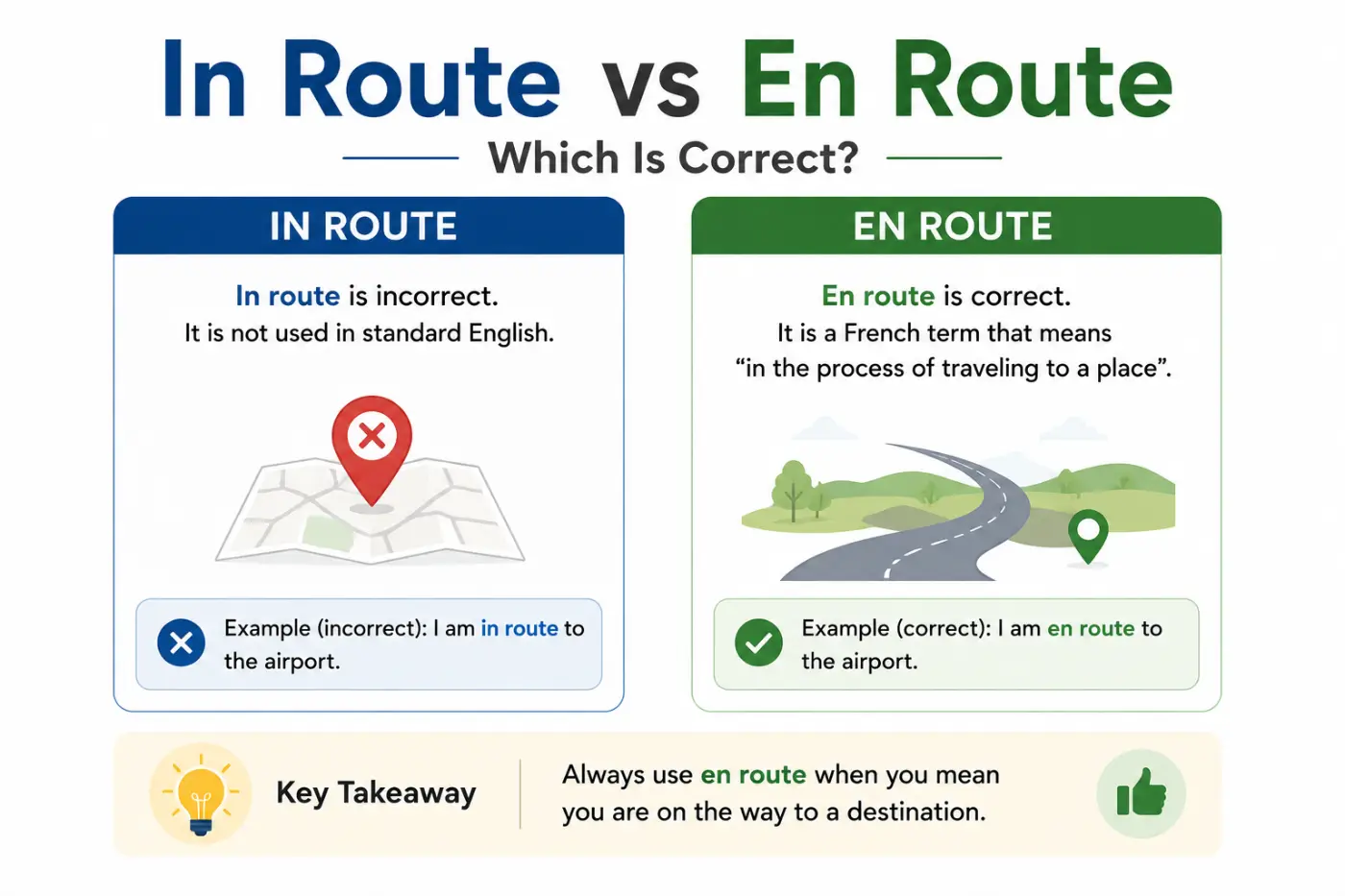
If you are wondering about in route vs en route you are not alone. The two forms look close enough to cause confusion. However there is a clear answer for standard English. En route is the established expression used to mean on the way or during a journey.
The confusion often comes from the meaning of the individual words. English speakers already use the phrase in route in their minds because in can mean inside or during and route refers to a path or journey. That combination feels logical. Still standard English uses the French expression en route for this meaning.
This guide explains the difference in plain English. You will learn what en route means how to pronounce it where it comes from how to use it in sentences and why in route usually needs a different grammatical context. You will also see practical examples that show how native speakers use the expression in everyday and formal writing.
You may also want to read Hopeing or Hoping: Correct Spelling and Usage Guide 2026.
Quick Answer
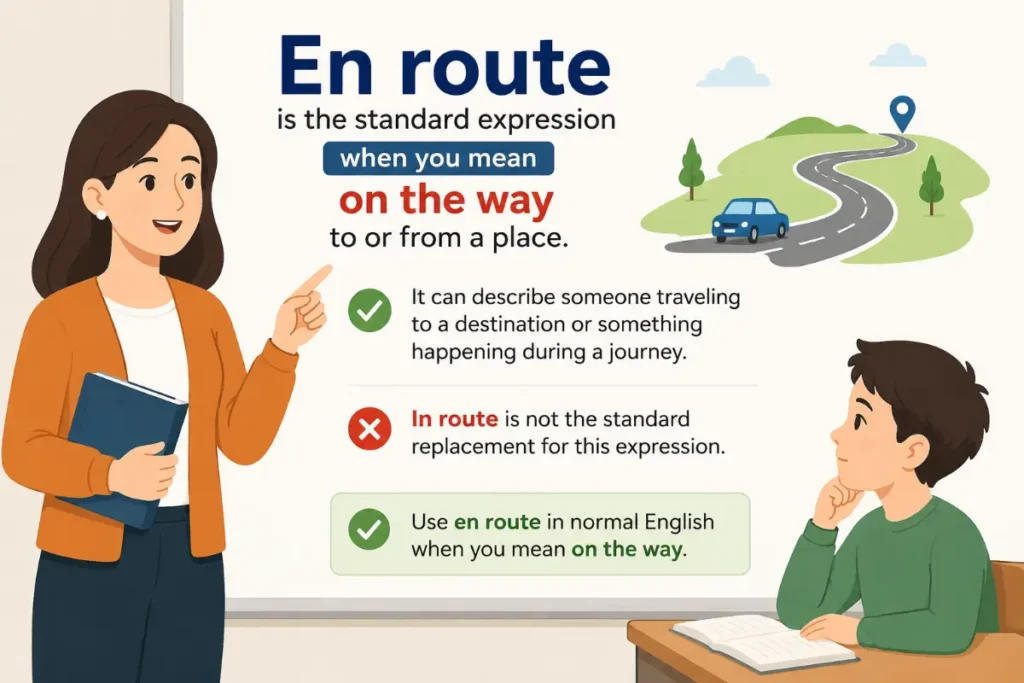
En route is the standard expression when you mean on the way to or from a place. It can describe someone traveling to a destination or something happening during a journey. In route is not the standard replacement for this expression. Use en route in normal English when you mean on the way.
In Route Or En Route At A Glance
The easiest way to remember the difference is to separate the expression from ordinary uses of the words in and route.
- En route is the established expression meaning on the way or during a journey.
- In route is not normally used as a substitute for en route in standard English.
- Route is a regular English noun meaning a path or way from one place to another.
- En route comes from French and entered English as a travel expression.
- You can use en route in everyday conversation as well as professional and formal writing.
- You can often replace en route with on the way without changing the basic meaning.
Oxford defines en route as an adverb meaning on the way or while traveling from or to a particular place. Cambridge gives the same central meaning and also recognizes en route as an adjective in American English in contexts such as en route aircraft.
What Does En Route Mean
En route means on the way to a destination or on the way from one place to another. It can also describe something that happens during a journey.
For example:
The package is en route to your home.
The family stopped for lunch en route to the beach.
The plane experienced turbulence en route from Chicago to Denver.
In simple terms you can usually understand en route as on the way.
The expression works especially well when the journey itself matters. A person can be en route to work. A plane can be en route to another city. A delivery can be en route to a customer. Someone can even be en route to an event or appointment.
Cambridge gives patterns such as en route to and en route from one place to another. Oxford also shows the phrase used with a destination and with a journey between two locations.
Is In Route Correct English
In route is not the standard form to use when you simply mean on the way.
For example this sentence sounds unnatural in standard American English:
The driver is in route to the office.
The natural version is:
The driver is en route to the office.
This distinction matters because in and en do not work as interchangeable words here. En route functions as an established expression. Treating it as a simple combination of an English preposition and the noun route creates the common mistake.
That does not mean the words in and route can never appear next to each other in a sentence. They can appear together when they perform their normal grammatical roles.
For example:
The workers stayed in Route 9 traffic for nearly an hour.
The phrase in Route 9 refers to a specific route name. It is not an alternative spelling of en route.
The key point is context. If your intended meaning is on the way then en route is the form you want.
Why The Confusion Happens
The confusion makes sense from a word formation perspective. English speakers often build phrases from familiar pieces. In is a common preposition. Route is a common noun. So in route may seem like a logical way to express movement along a route.
There is another reason the mistake appears often. The expression is pronounced as a connected phrase. People who hear it before they see it in writing may not immediately know that the spelling contains the French word en.
The phrase also has several pronunciation patterns in English. Cambridge lists American pronunciations beginning with sounds represented by either on or a nasal French influenced form. Oxford likewise gives more than one pronunciation for English varieties. This is a classic example of how English spelling cannot always be predicted from sound alone.
The Key Difference Explained
The main difference is simple.
- En route is an established expression meaning on the way.
- In route does not normally carry that meaning in standard English.
- Route by itself is a noun for a road path or method of reaching something.
- In is a normal English preposition but it does not replace en in this established expression.
- En route can describe physical travel and can also appear in more abstract contexts that describe progress toward a goal.
The difference is therefore not about two competing spellings of the same English phrase. It is mainly about using an established expression correctly.
Grammar And Part Of Speech
En route is commonly used as an adverbial expression. It tells the reader where someone is in relation to a journey or what is happening during travel. Oxford classifies it as an adverb. Cambridge also lists an adverb use and notes an adjective use in American English.
Consider these examples:
We stopped en route.
The driver called us en route to the office.
The plane developed a problem en route from Miami to Dallas.
In each sentence the expression adds information about the journey.
The most common patterns include en route to a destination and en route from one place to another. You can also use the expression by itself if the destination is already clear from the context.
For example:
I am en route.
That sentence means I am on the way.
In casual American conversation many speakers may simply say I am on the way. That version is completely natural and often sounds more relaxed.
En Route In Formal And Informal Writing
En route works in many styles of English.
In casual conversation you might say:
I am en route now.
In a work message you might write:
The technician is en route to the customer site.
In a news report you might read:
The aircraft encountered severe weather en route to the airport.
In formal writing you might see:
The samples were damaged en route to the laboratory.
The expression is therefore not restricted to formal English. It has a slightly polished feel in some everyday situations because it comes from French. Still it is widely understood and standard in English.
If your goal is the simplest possible wording you can often use on the way instead.
For example:
The driver is en route to the office.
The driver is on the way to the office.
Both communicate the same basic idea.
Sentence Examples
Here are ten natural examples that show how the expression works.
- The ambulance is en route to the hospital.
- We stopped for coffee en route to the airport.
- The package is already en route to your address.
- I will call you while I am en route to the meeting.
- The travelers found a small restaurant en route to the coast.
- The flight was delayed because of bad weather en route to Denver.
- She picked up some groceries en route home.
- The repair team is en route and should arrive soon.
- We took several photos en route to the mountain town.
- The documents were lost en route from the office to the courthouse.
Notice how naturally the expression connects with a destination. It can also appear without a destination when the context makes the journey obvious.
Common Mistakes And Misspellings
Several mistakes tend to appear around this expression.
- In route
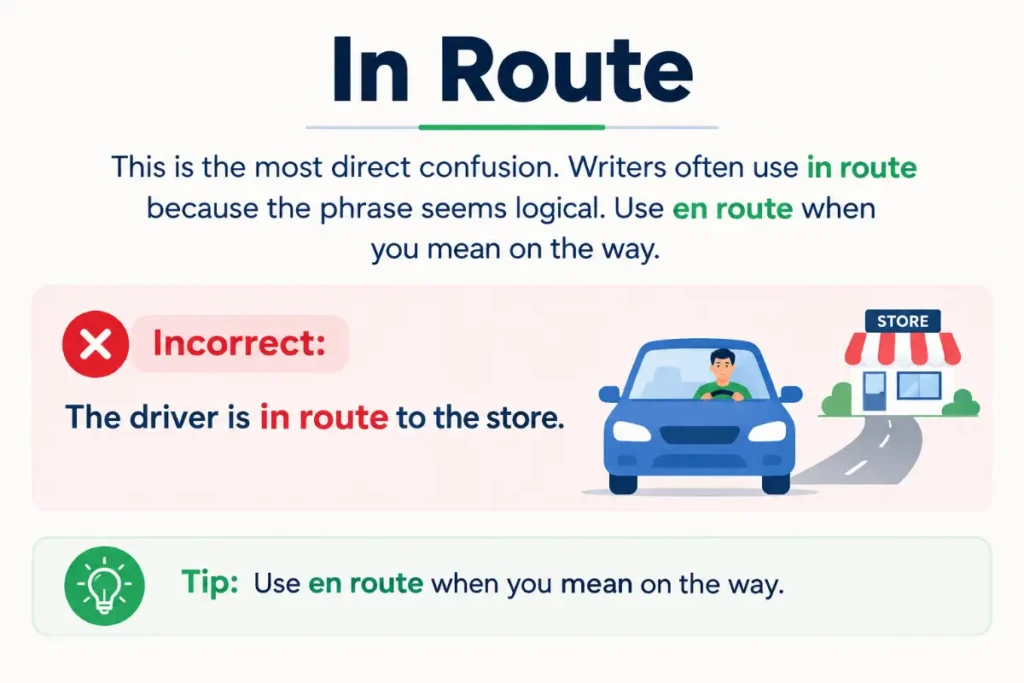
This is the most direct confusion. Writers often use in route because the phrase seems logical. Use en route when you mean on the way.
Incorrect: The driver is in route to the store.
Correct: The driver is en route to the store.
- Enroute
Enroute appears in informal or specialized usage and some dictionaries note it as a form used in American English adjective contexts. However the standard adverbial expression is written as two words: en route.
For general writing use en route.
- En rout
This form drops the final e from route. It is simply a spelling error.
Correct: The plane is en route to Boston.
- In rout
This version replaces en with in and also removes the final e. It does not represent the standard expression.
- Enroute to
Writers sometimes combine the words and then add to. The safest standard form is en route to.
Correct: She is en route to school.
How Do You Pronounce En Route
English has more than one accepted pronunciation for en route.
Cambridge gives American pronunciations represented as approximately on root and a French influenced nasal form. It also gives British pronunciations with similar variation.
A simple American friendly pronunciation guide is:
ahn ROOT
The second part receives the strongest stress.
The IPA listed by Cambridge for American English includes /ɑːn ˈruːt/ and a French influenced variant /ɑ̃ː ˈruːt/. Oxford also lists /ˌɑn ˈrut/ and /ˌɛn ˈrut/ for American English.
You do not need to imitate a French accent to use the phrase correctly. English speakers use several accepted pronunciations.
A common mistake is trying to pronounce route in a completely French way in ordinary American English. Clear natural English pronunciation matters more than forcing a foreign accent.
The Origin Of En Route
En route is a French expression that entered English in the late eighteenth century. Oxford traces it to French and notes that route comes from Old French rute meaning road.
The history becomes easier to understand once you look at the two parts.
En is a French preposition that can express ideas connected with location or movement. Route refers to a road or path. Together the expression developed the sense of being on the way.
English has borrowed many words and expressions from French over the centuries. En route is one of the expressions that remained close to its original form instead of becoming completely anglicized.
That history also explains why English speakers sometimes find the spelling less intuitive. The phrase does not follow the same pattern as a simple English expression built from familiar words.
American English
En route is standard in American English when it means on the way or during travel. Oxford’s American dictionary gives the expression as an adverb and provides examples involving travel from one place to another.
American speakers also use the expression as an adjective in some contexts. Cambridge gives examples involving en route aircraft and weather related en route delays.
In everyday American speech on the way may sound more casual.
For example:
I am on the way to work.
I am en route to work.
The first sounds especially natural in casual conversation. The second is also correct but can sound a little more polished or formal depending on the setting.
British English
British English also uses en route with the meaning on the way. Oxford gives British pronunciation forms and examples involving travel between locations.
There is no major spelling difference between American and British English for the standard expression.
That matters because some English words have different regional spellings. En route is not one of the major examples of that pattern. The standard form remains en route across major English varieties.
British English may also use en route for a destination with patterns that differ slightly from common American phrasing. Oxford notes the British pattern en route for Heathrow.
Australian And Canadian English
Australian and Canadian English generally follow the same standard spelling for this expression.
There is no major regional spelling change that turns en route into a different standard form. The main variation you may notice involves pronunciation and style rather than spelling.
For international writing the safest choice remains en route.
If you want maximum simplicity you can also choose on the way. That phrase is familiar to English speakers across regions and avoids the French expression entirely.
Many readers also check Investor vs Investee Which Is the Difference? 2026.
En Route Compared With On The Way
En route and on the way are close in meaning but they do not always feel identical.
On the way is more conversational.
En route can sound more polished or descriptive.
Compare these sentences:
I am on the way to the store.
I am en route to the store.
The meaning is almost the same. The first sounds like normal everyday speech. The second may sound more formal or deliberate.
That difference in tone can help you choose the right expression. If you are texting a friend you will probably use on the way. If you are writing a workplace update you may use en route.
Neither choice changes the basic idea.
En Route Compared With In Transit
In transit is another related expression.
It usually emphasizes movement from one place to another rather than simply being on the way.
For example:
The package is in transit.
The package is en route to Chicago.
The two sentences overlap. However in transit often describes the general state of an item or person during transportation. En route commonly focuses on movement toward a particular destination.
This distinction becomes useful in shipping and logistics.
En Route Compared With Onward
Onward means continuing forward.
En route means on the way.
For example:
We continued onward after lunch.
We stopped en route to the hotel.
The words can appear in the same story but they perform different jobs.
Onward focuses on continuation. En route focuses on the journey or position during travel.
En Route Compared With Along The Way
Along the way refers to something that happens during a journey or process.
For example:
We found a small café along the way.
We stopped en route to the hotel.
Both sentences describe something happening during travel.
The expression along the way often sounds more conversational. En route is shorter and can fit neatly into formal or professional writing.
Related Terms You Should Know
Several expressions are closely connected to this topic.
- On the way means traveling toward a destination or currently moving toward it.
- In transit means being transported or moving from one location to another.
- Along the way refers to something that happens during a journey or process.
- Onward means continuing forward.
- Route means a path or way used to reach a destination.
- Destination means the place someone or something is traveling toward.
- Journey means the act of traveling from one place to another.
- Detour means a different route taken instead of the usual or direct route.
Understanding these related terms helps you see why en route has a specific role. It does not simply mean route. It describes the state of being on a journey or the action of traveling toward or from a place.
How To Use En Route In A Sentence
The easiest pattern to remember is:
en route to + destination
Examples include:
She is en route to the office.
The plane is en route to New York.
The package is en route to the customer.
Another useful pattern is:
en route from + starting point + to + destination
Examples include:
The train broke down en route from Boston to New York.
The shipment was damaged en route from the warehouse to the store.
The travelers stopped en route from Dallas to Austin.
You can also use the expression alone.
For example:
He is en route.
The team is en route.
The technician is en route.
The meaning is clear if the destination has already been discussed.
Can En Route Start A Sentence
Yes. En route can appear at the beginning of a sentence.
For example:
En route to the airport we stopped for breakfast.
En route from Boston to New York the travelers encountered heavy rain.
Starting with the expression is grammatically acceptable. However punctuation can help the reader understand the opening phrase.
A more polished version is:
En route to the airport we stopped for breakfast.
You can also write:
We stopped for breakfast en route to the airport.
The second version may feel more natural in ordinary prose because the main subject appears first.
Can You Use En Route In Formal Writing
Yes. En route is appropriate in formal writing.
You may see it in business communication transportation reports news writing travel descriptions and academic prose. Cambridge and Oxford both treat it as a standard English expression.
Still you should not use it simply to make your writing sound sophisticated.
Good editing is often about choosing the clearest word rather than the fanciest one.
If on the way is clearer for your audience use on the way.
If en route fits the tone and keeps the sentence concise use en route.
For example:
The samples were damaged on the way to the laboratory.
The samples were damaged en route to the laboratory.
Both are clear. The second has a slightly more formal tone.
Real Life Usage In Daily Conversation
People often use the expression in short travel updates.
For example:
I am en route now.
We are en route to the restaurant.
She is en route home.
The delivery driver is en route.
Still many speakers choose on the way in casual conversation.
For example:
I am on the way now.
We are on the way to the restaurant.
She is on the way home.
This difference is mostly about tone. En route is not wrong in conversation. It simply has a more polished sound for many speakers.
Real Life Usage At Work
The expression can be useful in workplace communication because it gives a quick update about movement.
For example:
The technician is en route to the site.
The replacement equipment is en route.
The client is en route to the office.
The shipment is en route from the warehouse.
These sentences are short and clear. They work well in status updates because the reader can quickly understand that movement is already underway.
Real Life Usage In Academic Writing
Academic writers can use en route when describing movement or development.
For example:
The researchers collected additional samples en route to the field station.
The team recorded several observations en route from the study site.
The phrase can also appear in a more abstract sense.
For example:
The theory changed en route to its modern form.
Here the expression describes development rather than literal physical travel. The idea is that something moved through stages before reaching a later point.
Real Life Usage In News Writing
News writing often values concise expressions.
For example:
The aircraft reported a technical problem en route to Chicago.
Emergency crews responded after the vehicle crashed en route to the city.
The phrase works well because it communicates the timing and direction of travel without adding unnecessary words.
It can also appear in reports about shipments transportation and public services.
Real Life Usage In Storytelling
Writers can use en route to describe events that happen during a journey.
For example:
En route to the village they discovered an old bridge.
The travelers stopped en route and watched the sunset.
The expression can create a compact sense of movement. It tells the reader that the event happened during the journey rather than before it began or after it ended.
For a more relaxed storytelling voice you could simply say on the way.
An Easy Memory Trick
Think of en route as a travel sign that says you are already moving.
If someone is sitting at home planning a trip they are not en route.
If someone has started the journey they can be en route.
That simple distinction makes the expression easier to remember.
You can also connect en route with the phrase on the way.
Whenever you mean on the way to a place or on the way from one place to another use en route.
For example:
On the way to work.
En route to work.
Same basic idea.
The spelling is different because en route is an established expression borrowed from French.
Expert Editor Insight
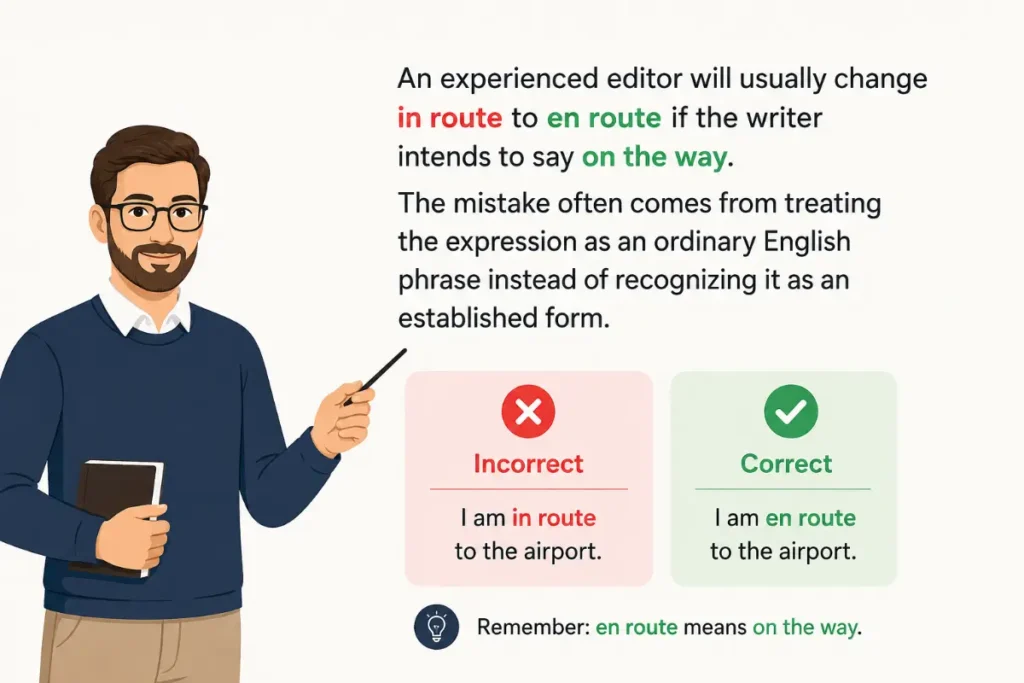
An experienced editor will usually change in route to en route if the writer intends to say on the way. The mistake often comes from treating the expression as an ordinary English phrase instead of recognizing it as an established form. Editors also look at context because in route can appear naturally when in and route have separate grammatical roles. The best editing choice is not simply to correct a spelling pattern. It is to identify the intended meaning first and then choose the form that communicates that meaning clearly.
Many readers also check Elfs or Elves Correct Spelling Meaning and Usage Guide.
Conclusion
If you are choosing in route vs en route the correct standard expression for meaning on the way is en route. Use it for people vehicles packages and other things traveling toward or from a destination. It can also describe something that happens during a journey.
The phrase is standard in American and British English and comes from French. You can use it in casual conversation as well as professional formal and academic writing. If you want a simpler everyday alternative you can usually use on the way.
A useful editing trick is to replace the phrase with on the way. If that gives you the meaning you intend then en route is probably the form you need. Remember the spelling as two words and you will avoid one of the most common mistakes connected with this expression.
Frequently Asked Questions
Is In Route A Correct Replacement For En Route?
No. In route is not the standard replacement for en route when you mean on the way. Use en route for that meaning. For example the natural sentence is The driver is en route to the office. The phrase in route may appear when in and route have separate functions in a sentence but it should not be used as a substitute for the established expression.
What Does En Route Mean?
En route means on the way to or from a place. It can describe someone traveling toward a destination or something happening during a journey. You can say The package is en route to Chicago or We stopped en route to the beach. Oxford and Cambridge both give this central meaning.
Is En Route One Word?
The standard expression is written as two words: en route. Some dictionaries recognize enroute in specific American English adjective usage but the normal adverbial expression is en route. For general writing especially school work business writing and formal prose it is safest to use the two word form.
How Do You Pronounce En Route?
In American English en route is commonly pronounced approximately like ahn ROOT. Cambridge lists more than one accepted pronunciation including a French influenced version. The main stress falls on route. You do not need to use a French accent to pronounce the expression correctly in English.
Can En Route Start A Sentence?
Yes. En route can begin a sentence when it introduces information about a journey. For example En route to the airport we stopped for breakfast. You can also place the expression later in the sentence. For example We stopped for breakfast en route to the airport. Both structures are grammatical.
Is En Route Formal English?
En route is standard English and works in formal writing. It can appear in workplace messages academic writing news reports and travel descriptions. In casual speech many Americans may prefer on the way because it sounds more relaxed. The choice depends mainly on tone and clarity rather than correctness.
What Is A Simple Synonym For En Route?
The simplest synonym is on the way. Other related expressions include in transit and along the way. The best choice depends on context. On the way is usually the most natural everyday alternative. In transit often emphasizes transportation. Along the way focuses on something that happens during a journey.
Why Do People Confuse In Route And En Route?
People confuse the forms because in and route are both familiar English words and the combination can seem logical. En route is different because it is an established expression that came into English from French. The sound can also contribute to confusion because speakers may learn the phrase by hearing it before seeing its spelling.