
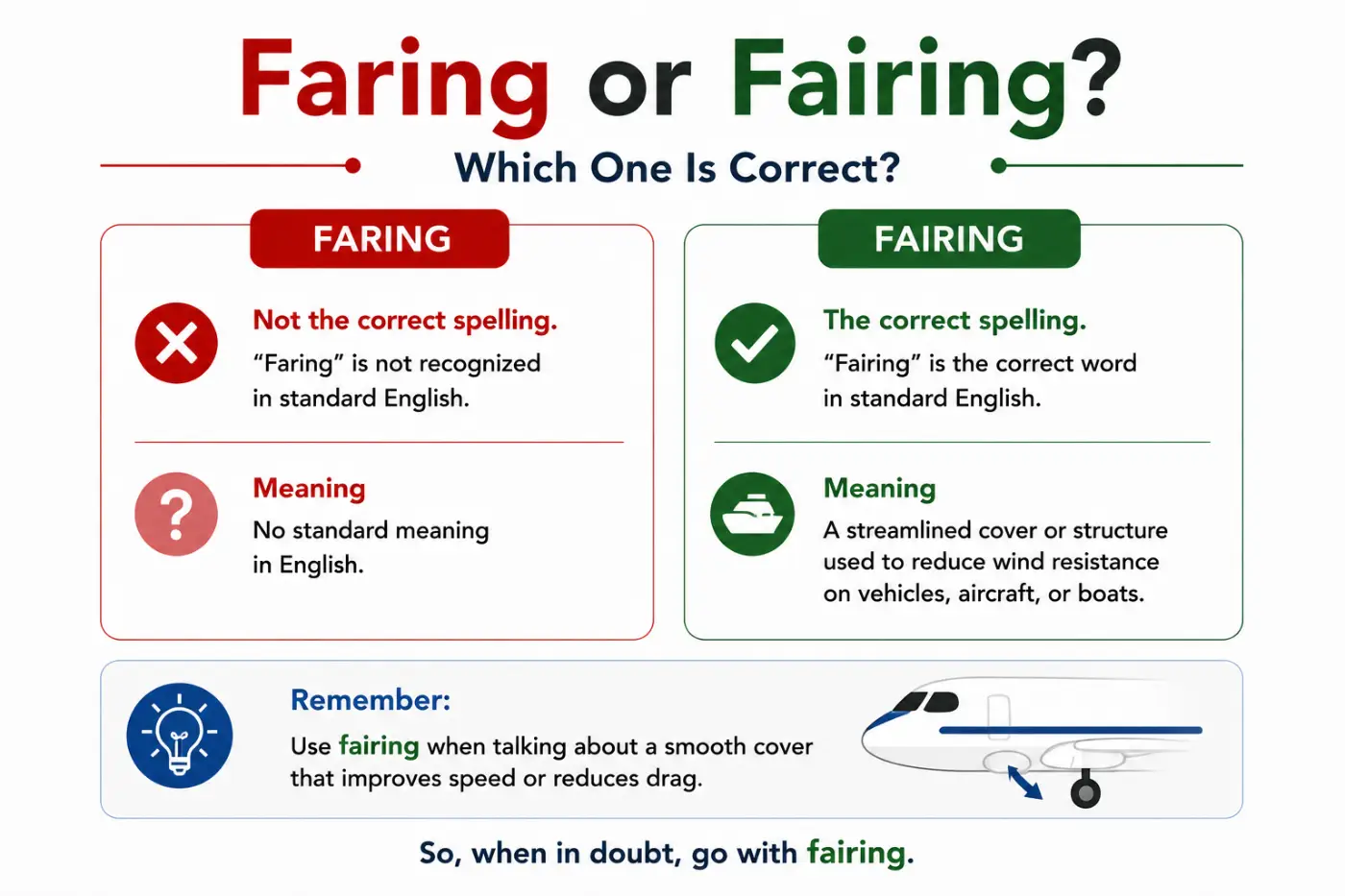
Faring or fairing can be confusing because the two words sound alike in everyday American English. The spelling differs by only one letter, yet the meanings are completely different. If you mean how someone is doing or how something is progressing, faring is the correct form. If you mean a protective or aerodynamic covering on an aircraft, boat, motorcycle, or similar vehicle, fairing is the correct word.
The confusion is understandable because both words belong to different English word families that happen to produce nearly identical sounds. Faring comes from the verb fare and describes progress or experience. Fairing is usually a noun connected with a physical covering or structure. Once you connect each spelling with its meaning, the difference becomes much easier to remember.
This guide explains how each word works in real English. You’ll learn their meanings, grammar, pronunciation, origins, common mistakes, regional usage, sentence examples, and a simple editing trick that can help you choose the right spelling quickly.
Need another quick comparison? Read Lacs Or Lakhs Which Is Correct in 2026?.
Quick Answer
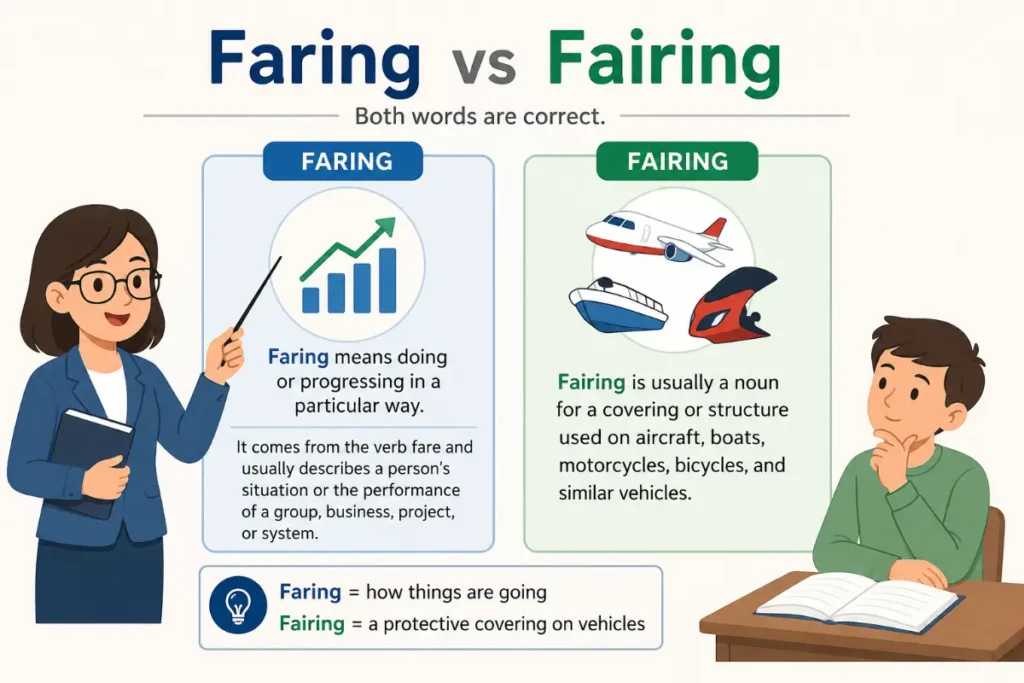
Faring means doing or progressing in a particular way. It comes from the verb fare and usually describes a person’s situation or the performance of a group, business, project, or system. Fairing is usually a noun for a covering or structure used on aircraft, boats, motorcycles, bicycles, and similar vehicles. Both words are correct.
Meaning And Definition
The easiest way to understand these words is to separate their word families.
Meaning Of Faring
Faring is the present participle of fare.
The verb fare means to get along, perform, or experience a particular result. It often describes someone’s progress in a situation.
Consider these examples.
How are you faring in your new position?
The students are faring well in their final exams.
The company is faring better than expected.
How is the project faring after the latest changes?
In every example, the word refers to progress or performance.
Faring doesn’t name a physical object. It describes how someone or something is doing.
The word can describe people, organizations, businesses, projects, teams, plans, and other things that can experience success or difficulty.
Meaning Of Fairing
Fairing is most commonly a noun.
In engineering and transportation, it refers to a structure or covering placed around part of a vehicle or machine. Its purpose can include reducing air resistance, improving airflow, protecting components, or creating a smoother exterior shape.
You might encounter the word in discussions about:
- Aircraft.
- Rockets.
- Motorcycles.
- Boats.
- Bicycles.
- Cars.
For example:
The aircraft fairing was damaged during maintenance.
The motorcycle needs a replacement fairing.
The engineer redesigned the fairing to improve airflow.
The word can also have older meanings. In some British usage, fairing can refer to a gift bought at a fair. Some dictionaries also record a British meaning connected with a type of biscuit. These meanings are much less common in modern American English.
The Key Difference
The biggest difference is meaning.
Faring connects to fare.
Fairing usually refers to a physical covering or structure.
A useful memory trick is to think about progress versus machinery.
If you’re describing how someone or something is doing, think fare and choose faring.
If you’re describing a physical covering around part of a vehicle, think fairing.
That simple distinction handles most situations.
Faring Talks About Progress
Faring often appears with words such as well, badly, better, worse, and poorly.
For example:
The new restaurant is faring well.
Small businesses are faring better this year.
The team is faring poorly under the new system.
These combinations make the meaning easy to recognize.
You’re not describing an object. You’re describing performance or experience.
Fairing Talks About Structure
Fairing often appears with words connected to engineering and transportation.
Common combinations include:
- Aircraft fairing.
- Motorcycle fairing.
- Rocket fairing.
- Wing fairing.
- Engine fairing.
- Body fairing.
Here the word identifies a physical component.
That gives you another useful clue. If the sentence contains words about machinery, airflow, vehicles, or construction, fairing may be the form you need.
Which Form Is Correct
Both forms are correct.
The important point is that they aren’t alternative spellings of the same word.
Use faring when you mean doing or progressing.
Use fairing when you mean a covering or structure.
Compare these sentences.
How is your new business faring?
This asks about the business’s performance.
The engineer inspected the aircraft fairing.
This refers to a physical component.
The spelling isn’t based on American English versus British English in these core meanings. Both major varieties recognize the two forms. The meaning determines the correct choice.
Sentence Examples
Here are ten natural examples that show how the words work in real sentences.
- How are you faring in your new job?
This asks how well someone is doing at work.
- The students are faring well in mathematics this semester.
Here faring describes academic progress.
- The small business is faring better than expected.
The word describes business performance.
- How is your garden faring during the dry weather?
The sentence asks about the condition and progress of the garden.
- The team is faring poorly after several key players were injured.
Faring describes the team’s current performance.
- The mechanic removed the damaged fairing from the motorcycle.
Here fairing is a physical motorcycle component.
- The aircraft fairing was inspected before the flight.
The word refers to an aircraft structure.
- The engineer designed a lighter fairing for the new aircraft.
The context is technical design.
- The rocket fairing protects its payload during launch.
The noun describes a protective structure.
- The boat’s fairing was repaired before it returned to service.
Again, fairing refers to a physical structure.
Notice the pattern. The first five examples describe progress or performance. The last five describe a physical object.
Common Mistakes And Misspellings
These words create several predictable mistakes.
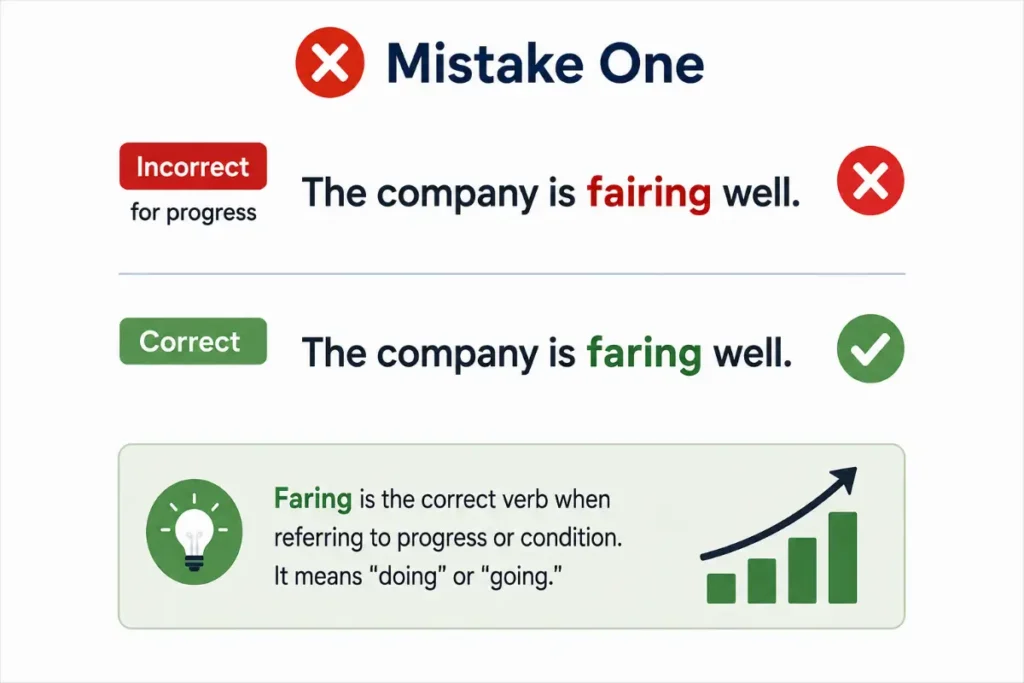
Mistake One
Incorrect for progress: The company is fairing well.
Correct: The company is faring well.
The problem comes from hearing the two forms as the same sound. Since the sentence describes business performance, the verb fare is the correct source.
Mistake Two
Incorrect for a motorcycle component: The mechanic replaced the faring.
Correct: The mechanic replaced the fairing.
Here the sentence describes a physical part of a motorcycle. The technical noun needs the spelling fairing.
Mistake Three
Incorrect: How is your project fairing?
Correct: How is your project faring?
A project can fare well or fare badly. It doesn’t normally have a fairing simply because you’re discussing its progress.
Mistake Four
Incorrect: The damaged faring was removed from the aircraft.
Correct: The damaged fairing was removed from the aircraft.
An aircraft component is a fairing.
Mistake Five
Incorrect: The students are fairing well in class.
Correct: The students are faring well in class.
The phrase faring well comes from fare. The word fairing doesn’t perform that grammatical job.
The most common cause of these mistakes is sound based spelling. People often hear a word first and then choose the spelling that looks familiar. That approach can fail when two different words share the same pronunciation.
Pronunciation Guide
In American English, faring and fairing are commonly pronounced alike or very similarly.
Faring can be represented as /ˈferɪŋ/.
A simple pronunciation guide is:
FAIR ing
The first syllable receives the main stress.
Fairing has the same basic pronunciation:
FAIR ing
This creates a classic homophone problem. Homophones are words that sound the same or nearly the same but have different meanings and spellings.
The pronunciation won’t reliably tell you which spelling to use. Context does that job.
If someone says:
How are you faring?
You can’t hear the spelling. You understand the intended word because the sentence clearly asks about someone’s progress.
If someone says:
The motorcycle needs a new fairing.
The surrounding words point toward a physical component.
This is why professional editing relies on meaning rather than sound when dealing with these words.
Etymology And Word Origin
The two words come from different historical paths.
Faring comes from fare. The older verb developed from an Old English word connected with going, traveling, or making one’s way. Over time, fare also developed the sense of being in a particular condition or experiencing a particular result.
The modern expression fare well preserves this connection between movement and experience.
Faring is simply the present participle form of that verb.
The history of fairing is different. The technical noun developed from fair in a shipbuilding context. The idea involved making a surface smooth, regular, or properly shaped. Over time, the noun came to describe structures added to improve the shape and airflow of vehicles.
That history explains the modern engineering meaning. A fairing helps create a smoother shape.
There is also an older meaning connected with fairs. In British usage, fairing could refer to a gift or present bought at a fair. Some dictionaries also record a British sense referring to a type of biscuit.
These older meanings don’t usually cause confusion in modern American writing. The main distinction for most readers remains fare for progress and fairing for a physical covering.
Many readers also check Instalments or Installments Which Spelling Is Correct 2026.
Regional Usage
The core distinction remains stable across major varieties of English.
American English
American English uses faring as the present participle of fare.
How is your company faring?
The team is faring well.
American English also uses fairing as a technical noun.
The motorcycle fairing is cracked.
The aircraft fairing needs repair.
The technical meaning is especially common in writing about transportation, engineering, and vehicle design.
British English
British English also recognizes faring as the form connected with fare.
Fairing has technical uses in British English as well. British English also preserves some less common historical meanings connected with fairs and traditional food.
These extra meanings don’t change the main spelling rule.
Australian English
Australian English follows the same basic distinction in standard usage. Faring belongs to fare when describing progress. Fairing refers to a physical structure in technical contexts.
Canadian English
Canadian English also follows the same broad pattern. Context determines the correct spelling.
So this isn’t a case where American writers should use one spelling and British writers should use the other. Both words have their own meanings in standard English.
Grammar Rules And Part Of Speech
Grammar gives you another reliable way to tell the words apart.
Faring is a verb form.
Fairing is most commonly a noun in the technical sense.
That difference is extremely useful.
How Faring Works
Faring is the present participle of fare.
It can appear with forms of be to create progressive constructions.
She is faring well.
They are faring badly.
The company is faring better this quarter.
The project is faring worse than expected.
It can also appear in clauses and phrases where the participle describes an ongoing situation.
The students faring best in the class received additional opportunities.
In ordinary conversation, the expression How are you faring? is grammatically correct, although many Americans may more naturally say How are you doing?
How Fairing Works
Technical fairing is a noun.
It can appear after articles.
The fairing was damaged.
A new fairing was installed.
It can also appear after possessive nouns.
The motorcycle’s fairing needs repair.
The aircraft’s fairing was inspected.
It can take modifiers.
The front fairing was cracked.
The lightweight fairing reduced drag.
The grammatical roles are completely different. One describes action or experience. The other names a thing.
Real Life Usage Examples
These words appear in very different parts of everyday English.
Daily Conversation
Faring can appear in polite questions about someone’s progress.
How are you faring after the move?
How is your brother faring at college?
In casual American conversation, doing is often more common than faring. Still, faring is perfectly understandable and grammatically sound.
Fairing is less common in casual conversation unless someone is discussing motorcycles, aviation, boating, cycling, or another technical subject.
The bike looks great after you replaced the fairing.
Workplace Communication
Faring works well in professional discussions about results.
The department is faring better than it did last year.
The new product is faring well with customers.
The word can sound slightly more formal than doing or performing, but it remains natural.
Fairing appears in technical workplace writing.
The engineering team inspected the fairing before testing.
The damaged fairing must be replaced before the vehicle is returned to service.
Academic Writing
Faring can appear in academic discussions of groups, policies, systems, or outcomes.
Students from the revised program were faring better in several subjects.
Fairing can appear in technical research involving aerospace, transportation, mechanical engineering, or fluid dynamics.
The redesigned fairing reduced air resistance during testing.
News And Journalism
Journalists often use faring when describing economic performance or public outcomes.
Small businesses are faring better as consumer demand increases.
How local schools are faring remains a major concern.
Fairing appears more often in specialized reporting.
The spacecraft’s fairing separated successfully during the mission.
The context makes the intended meaning clear.
Literature And Storytelling
Faring can give prose a slightly formal or old fashioned tone.
The travelers were faring well despite the difficult road.
He wondered how his old friend was faring.
Fairing in its technical sense appears mainly when a story includes machinery or transportation.
The rider noticed a crack in the fairing before leaving the garage.
Related And Confused Terms
Several words sit close to these terms in meaning or sound.
Fare
Fare is the base verb behind faring. It can mean to do or progress in a particular way.
How did you fare on the test?
Fared
Fared is the past tense and past participle of fare.
The team fared well last season.
Farewell
Farewell developed historically from fare and expresses a wish for someone’s safe journey or departure.
They said farewell before leaving.
Fair
Fair has many meanings. It can describe something just or reasonable. It can also refer to an event where people gather for entertainment or trade.
Fairly
Fairly is an adverb formed from fair.
The test was fairly easy.
It can also mean in a just or reasonable way depending on context.
Fairness
Fairness refers to the quality of being fair.
The manager valued fairness in the workplace.
Fairground
A fairground is a place where a fair takes place.
The children spent the afternoon at the fairground.
Fairing
Fairing is connected with fair in its technical noun sense.
The engineer replaced the damaged fairing.
These related words show why spelling by sound can lead you astray. English contains many families where pronunciation alone doesn’t provide enough information.
How To Remember The Difference
A simple memory trick can save you from most mistakes.
Think about fare when the sentence asks how someone or something is doing.
How is the company faring?
Think about fairing when you can point to a physical part.
The motorcycle fairing is damaged.
You can also use the substitution test.
Replace the word with doing.
If the sentence still makes sense, you probably need faring.
How is your business faring?
Becomes:
How is your business doing?
The meaning stays intact.
Now try a physical object.
The motorcycle faring is damaged.
Replacing it with doing makes no sense.
The motorcycle doing is damaged.
That tells you the sentence needs the noun fairing.
This is a practical editing test because it focuses on meaning rather than spelling.
Why The Confusion Happens
The biggest reason is pronunciation.
When two words sound the same, your brain has less information to work with. English spelling doesn’t always map neatly onto pronunciation. A listener may understand the meaning from context while a writer still has to choose the correct letters.
Another reason is the familiarity of fair.
Fair is an extremely common English word. People know phrases such as fair treatment, fair price, fair weather, and county fair. That familiarity can make fairing feel like the obvious spelling even when the intended word comes from fare.
The opposite mistake happens in technical writing. Someone may write faring when they mean the protective structure on a motorcycle or aircraft because they remember the sound but not the technical spelling.
The solution isn’t to memorize a long rule.
Learn the two word families.
Fare leads to faring.
Fair leads to fairing.
Once that connection becomes familiar, the difference becomes much easier to spot.

Expert Editor Insight
An experienced editor doesn’t usually solve this problem by asking how the word sounds. The editor looks at the sentence and identifies the word’s job. If the sentence describes progress, performance, or experience, the editor traces the word back to fare and chooses faring. If the sentence names a physical structure, especially around a vehicle or aircraft, the editor chooses fairing. This approach works because it checks meaning and grammar at the same time. Spelling tools can catch obvious errors, but they may not catch a correctly spelled word used in the wrong context.
You may also want to read fulfilment or fulfillment Correct Spelling and Usage.
Conclusion
Faring or fairing isn’t a choice between a correct spelling and a misspelling. Both are real English words with different meanings. Use faring when you mean doing or progressing because it comes from the verb fare. Use fairing when you mean a physical covering or structure, especially in transportation and engineering.
The easiest memory trick is simple. Fare means progress, so faring follows fare. Fairing usually names a physical structure. If you’re proofreading your own writing, replace the word with doing as a quick test. If the sentence still makes sense, faring is probably the word you need and If you’re talking about a motorcycle, aircraft, boat, or similar structure, fairing is the safer choice.
Once you connect each word to its meaning, the confusion largely disappears. Don’t rely on pronunciation alone because both forms can sound the same. Look at the role of the word in the sentence. Progress points to faring. A physical covering points to fairing. That small distinction is enough to make the correct choice with confidence.
FAQs
Is Faring A Real Word?
Yes. Faring is a standard English word. It is the present participle of the verb fare. It describes how someone or something is doing or progressing. For example, The students are faring well this year uses the word correctly. It isn’t a typo and doesn’t need to be replaced simply because fairing is another legitimate word.
Is Fairing A Real Word?
Yes. Fairing is also a legitimate English word. In modern technical English, it commonly refers to a covering or structure around part of an aircraft, boat, motorcycle, bicycle, or other vehicle. It can help create a smoother shape or reduce air resistance. Some dictionaries also record older British meanings connected with fairs.
Which Is Correct For Saying How Someone Is Doing?
Use faring. The verb fare means to do or progress in a particular way. You can say How are you faring? or She is faring well in her new role. The word fairing doesn’t work in this context because it isn’t the verb form of fare.
Which Is Correct For A Motorcycle Part?
Use fairing. A motorcycle fairing is a structure fitted around part of the motorcycle. It can help protect components and manage airflow. You might write The mechanic replaced the damaged fairing or The motorcycle has a new front fairing. Faring would be incorrect in this technical context.
Are Faring And Fairing Pronounced The Same?
They are commonly pronounced the same or almost the same in American English. Both can sound like FAIR ing. That shared pronunciation explains much of the spelling confusion. Since sound doesn’t reliably distinguish them, writers should use context and meaning to choose the spelling.
Why Do People Confuse These Words?
People confuse them mainly because they sound alike and differ by only one letter. English has many words with this kind of spelling challenge. Familiarity with the common word fair can also make fairing feel natural even when the intended word comes from fare. Learning the word families makes the distinction easier.
Can Faring Be Used In Formal Writing?
Yes. Faring is grammatically correct in formal writing. It can describe the progress of a person, organization, policy, project, or system. For example, The revised program is faring better than the previous model is suitable for professional or academic prose. In very casual conversation, Americans may simply prefer doing.
Is Fairing Used Only For Aircraft?
No. Fairing has several technical uses. It can describe structures on aircraft, boats, motorcycles, bicycles, cars, and other machines. The exact design varies by application, but the general idea involves shaping or covering a part to improve its form, protect components, or manage airflow. The word can also have less common historical meanings.