
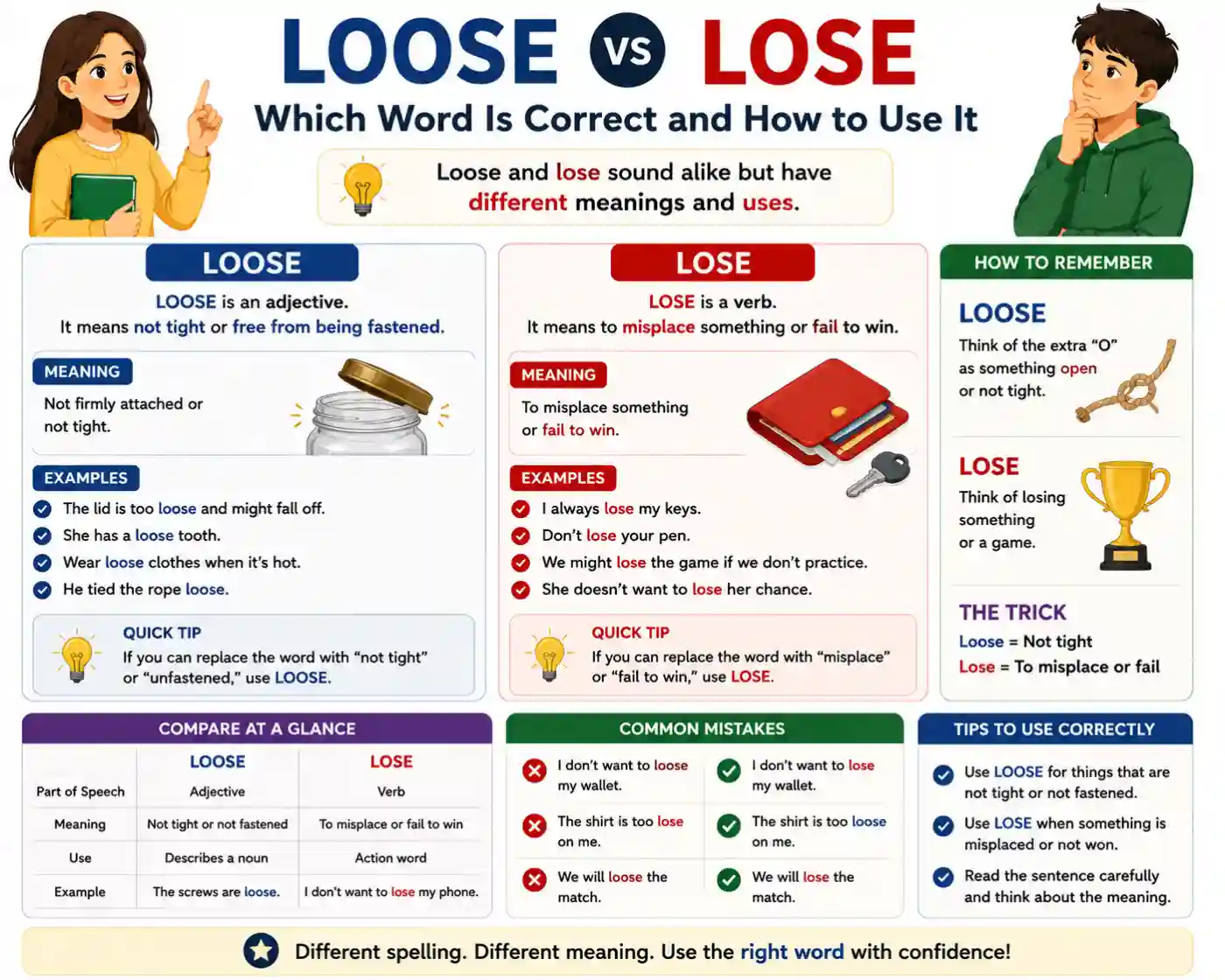
If you’ve ever paused while writing a sentence and wondered if you need loose or lose you’re not alone. These two words look almost identical and they sound close enough to cause trouble. The difference is small on the page but significant in meaning.
The correct choice depends on what you want to say. Loose usually describes something that isn’t tight secure or firmly attached. Lose is a verb that means to no longer have something to fail to win or to stop keeping something. So you can lose your keys but you can’t loose them when you mean misplace them. You can wear a loose shirt but you can’t wear a lose shirt.
The confusion happens because both words begin with the same letters and contain the same long vowel sound. Their final sounds are different though. Loose ends with an s sound while lose ends with a z sound.
This guide explains the difference in plain English. You’ll learn the meanings grammar rules pronunciation patterns common mistakes regional usage and easy memory tricks that make the distinction much easier to remember.
A related grammar guide is Propose vs Purpose Which One Should You Use 2026.
Quick Definition
Loose usually means not tight not firmly attached or not closely controlled. Lose is a verb meaning to misplace something stop having something fail to win or become unable to keep something. The words are pronounced differently at the end. Loose has an s sound while lose has a z sound.
Quick Answer
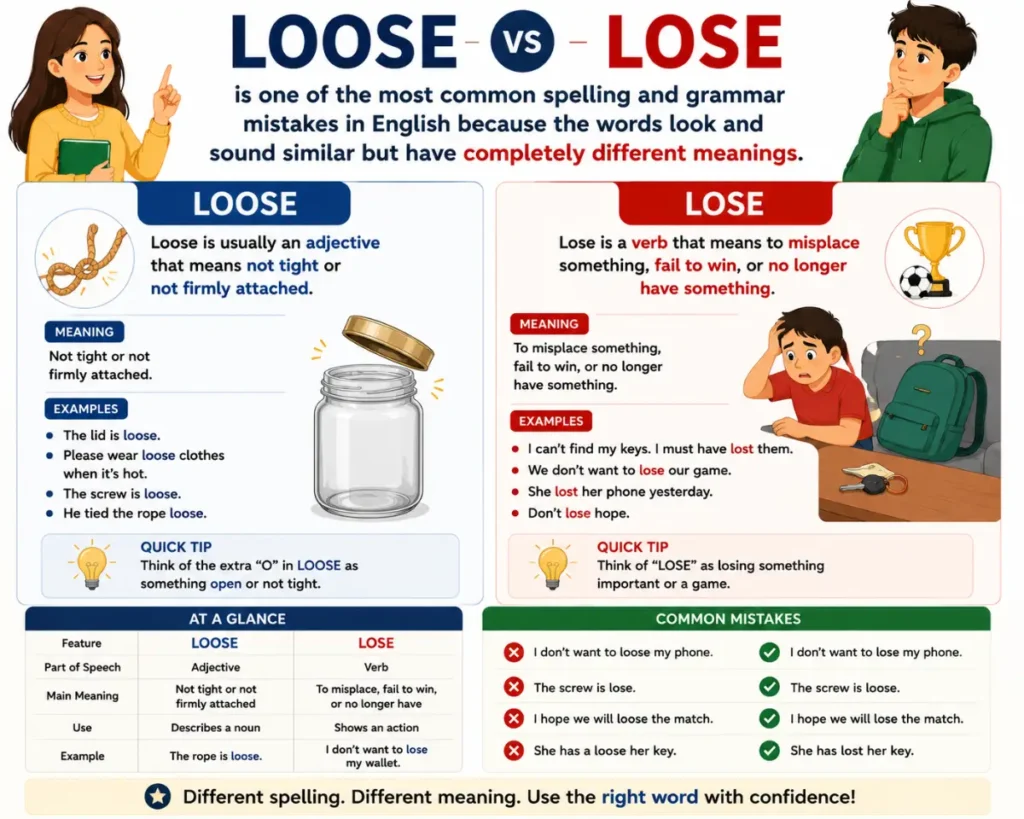
Use loose when you mean not tight not firmly attached or not closely controlled. Use lose when you mean misplace something no longer have something or fail to win.
A simple example makes the difference clear. Your shoelaces can be loose but you might lose your shoes. The first word describes a condition. The second describes an action or change.
Comparison Table For Loose And Lose
| Correct Form | Meaning | Part of Speech | Origin | Usage Frequency | Formality | Common Contexts | Example |
|---|---|---|---|---|---|---|---|
| Loose | Not tight or firmly attached | Adjective and verb | Old English and related Germanic roots | Very common | Standard | Clothing knots objects rules animals | My shirt feels loose. |
| Lose | Stop having something or fail to win | Verb | Old English and Germanic roots | Very common | Standard | Games possessions money time opportunities | I don’t want to lose my keys. |
Meaning And Definition
Meaning Of Loose
Loose is mainly an adjective. It describes something that isn’t tight firmly attached or closely controlled.
You might say a screw is loose. A button can be loose. A shirt can be loose. A dog can be loose if it isn’t tied up or contained.
The word also has broader meanings. A loose translation doesn’t follow the original wording exactly. A loose connection means the relationship isn’t strong or precise.
Loose can also work as a verb although this use appears less often in everyday American English. As a verb it can mean to release something or make something less tight. For example a writer might say that someone loosed an arrow. In ordinary conversation though most people use loosen for the idea of making something less tight. Cambridge lists both the adjective and verb uses.
Meaning Of Lose
Lose is a verb. It describes the act or experience of no longer having something or failing to keep it.
You can lose your phone.
You can lose money.
The word covers several related ideas.
If you can’t find your wallet you’ve lost it.
If another team scores more points you lose the game.
Cambridge defines lose with meanings connected to no longer having something failing to succeed becoming unable to maintain something and having less of something.
That broad range explains why lose appears in so many everyday expressions.
You can lose track of time.
You can lose touch with someone.
Key Differences Explained
Spelling
The first difference is the spelling.
Loose contains two o’s followed by s and e.
Lose contains one o followed by s and e.
That extra o doesn’t just change the appearance. It belongs to a completely different word with a different meaning.
Grammar Role
Loose most often works as an adjective.
The loose rope fell from the wall.
Lose is a verb.
I don’t want to lose the rope.
The distinction becomes much easier when you identify the job the word performs in the sentence.
Meaning
Loose describes a state or quality. It often tells you that something isn’t tight secure or firmly controlled.
Lose describes an action or result. It often means something is no longer in your possession or control.
Tone
Neither word is informal or slang. Both are standard English words that belong in professional academic and everyday writing.
The problem isn’t formality. The problem is choosing the word that matches your meaning.
Context
Think about the situation before you think about the spelling.
If you’re talking about clothing knots screws wires or control you may need loose.
If you’re talking about possessions games money time opportunities or confidence you probably need lose.
That context based approach works better than trying to memorize the letters alone.
Which Spelling Is Correct
Both loose and lose are correct spellings. They aren’t interchangeable.
If you write I don’t want to loose my phone when you mean you might misplace it you’ve chosen the wrong word. The correct sentence is I don’t want to lose my phone.
If you write My shoes are lose when you mean they aren’t tight the sentence is also incorrect. You need loose.
This isn’t simply a matter of style. Major English dictionaries treat loose and lose as separate words with separate meanings and pronunciations. Cambridge gives loose the pronunciation /luːs/ and lose the pronunciation /luːz/.
A useful editor’s rule is simple. Ask yourself if you’re describing something that isn’t tight. If yes use loose. If you’re talking about misplacing something failing to win or no longer having something use lose.
Sentence Examples
Examples With Loose
- The handle on this drawer is loose.
- She prefers loose clothing during the summer.
- One of the wires is loose and needs attention.
- The dog got loose from the yard.
- His shoelaces were loose after the long walk.
- The knot became loose after several minutes.
- The window frame feels loose.
- The company has a loose set of guidelines rather than strict rules.
- Her hair was loose around her shoulders.
- The translation is a loose version of the original text.
Examples With Lose
- I don’t want to lose my phone again.
- Our team can’t afford to lose this game.
- She doesn’t want to lose her chance.
- Try not to lose your receipt.
- You can lose valuable time by waiting too long.
- He hopes to lose a few pounds through regular exercise.
- I always lose track of time when I read.
- The company could lose money if sales fall.
- Don’t lose confidence after one mistake.
- We might lose contact after they move.
6 Examples Showing The Common Misspelling Finaly
The form finaly is a common spelling mistake involving finally. It isn’t the correct standard spelling.
- Incorrect: I finaly finished the report.
- Correct: I finally finished the report.
- Incorrect: She finaly understood the lesson.
- Correct: She finally understood the lesson.
- Incorrect: We finaly reached the station.
- Correct: We finally reached the station.
These examples involve a different spelling issue from the loose and lose distinction. They’re included here because the same kind of visual pattern can cause writers to drop a letter when typing quickly.
Common Mistakes And Misspellings
Mistake One
Writing loose when the sentence needs lose is probably the most common error.
I don’t want to loose my job is incorrect.
I don’t want to lose my job is correct.
The meaning provides the answer. A job can be lost. It can’t normally be loose.
Mistake Two
Writing lose when you mean something isn’t tight creates the opposite problem.
My shoes are lose is incorrect.
My shoes are loose is correct.
Shoes can become loose because they aren’t fitting tightly.
Mistake Three
Confusing lose with loss is another common problem.
Lose is a verb.
I might lose money.
Loss is a noun.
The company suffered a major loss.
The ending changes because the grammatical role changes.
Mistake Four
Adding an extra o to lose can happen because English has many words where repeated vowels appear in similar spelling patterns. Writers may also connect loose visually with words describing physical looseness.
That visual association can overpower the actual meaning for a moment.
Mistake Five
Pronunciation can contribute to the confusion. Loose ends with the voiceless s sound. Lose ends with the voiced z sound. The difference is subtle but useful. Cambridge records loose as /luːs/ and lose as /luːz/.
From an NLP perspective the confusion comes from strong orthographic similarity. The words share several letters and nearly the entire spoken form. The final consonant distinguishes them while the surrounding context usually determines which word belongs in the sentence.
Pronunciation Guide
Loose is pronounced /luːs/.
Think of it as:
loose
The final sound is like the s in bus.
Lose is pronounced /luːz/.
Think of it as:
looz The final sound is like the z in zoo. Both words begin with the long oo sound found in words such as blue and food. The key difference comes at the end. Loose sounds like looss. Lose sounds like looz. You don’t need to exaggerate the final sound in normal conversation. Native speakers usually produce the distinction naturally. Still hearing the difference can help you catch the correct word when proofreading. A useful speaking trick is to say the pair slowly. Loose. Lose. The second word should have a gentle buzzing sound at the end. That voiced z sound can act as a small mental signal that you’re dealing with the verb.
Etymology And Word Origin
Loose and lose have long histories in English and their similar appearance isn’t accidental. Loose developed from Old English and related Germanic forms associated with ideas such as being free or not bound tightly. Over time the word developed several connected meanings. The modern senses of something not fastened something not tight and something released all fit that central idea of freedom from restraint.
Lose also has Germanic roots. Its historical development is connected with ideas of separation deprivation and failing to keep possession. Modern English expanded that basic idea into many meanings including misplacing something failing to win wasting time and no longer having a quality. The historical connection between a word and its modern meaning can sometimes make spelling easier to remember. Loose carries the sense of freedom from tightness or restraint. Lose carries the sense of no longer having or keeping something. You don’t need to memorize Old English forms to use the words correctly. The history simply shows why these are distinct words rather than two spelling options for the same idea.
Regional Usage In The US
American English uses both loose and lose in the same standard ways found across major English dictionaries. Americans write loose clothing and loose change. They also write lose money lose weight lose a game and lose interest. There’s no standard American spelling variant that replaces one word with the other. The difference comes from meaning rather than geography.
Many readers also check faring or fairing Which One Is Correct.
Regional Usage In The UK
British English also uses loose and lose as separate words. The spellings remain the same in standard British writing. The pronunciation is also distinguished by the final consonant sound. British speakers may use some expressions more often than American speakers but that doesn’t change the core spelling rule.
Regional Usage In Australia
Australian English follows the same basic distinction. Loose describes something that isn’t tight or securely attached. Lose functions as the verb for misplacing something failing to win or no longer having something. Australian dictionaries and educational materials generally preserve this distinction because it belongs to standard English grammar rather than a regional preference.
Regional Usage In Canada
Canadian English also keeps loose and lose separate. Canadian writers can use both words in formal and casual settings. The correct choice depends on meaning rather than Canadian spelling conventions. This is one of those cases where American British Canadian and Australian English largely agree.
Grammar Rules And Part Of Speech
Loose most often functions as an adjective. An adjective describes a noun. The loose button fell off. The word loose tells us about the button. Lose functions as a verb. A verb describes an action state or event. I could lose the button. The verb tells us what could happen to the button. This distinction gives you one of the fastest ways to choose the correct word. If you can replace the word with not tight or not firmly attached you probably need loose. If you can replace it with misplace no longer have or fail to win you probably need lose. Placement also differs because the words perform different grammatical jobs.
You might write:
The rope is loose.
She wears loose clothes.
He could lose the rope.
They might lose the match.
The first two sentences describe a condition. The second pair describes an action or outcome.
Lose also changes form depending on tense.
Present: lose.
Third person present: loses.
Present participle: losing.
Past: lost.
Past participle: lost.
Loose can also form related words such as loosely and loosen.
Loosely is an adverb.
The papers were loosely arranged.
Loosen is a verb.
Please loosen the knot.
These related forms are useful because they reinforce the central meaning of loose.
Real Life Usage Examples
Daily Talk
- My shoelaces are loose. I need to tie them again.
- Don’t lose your wallet while you’re traveling.
These sentences sound ordinary because they reflect two very common meanings. One describes something that isn’t tight. The other describes something that could disappear from your possession.
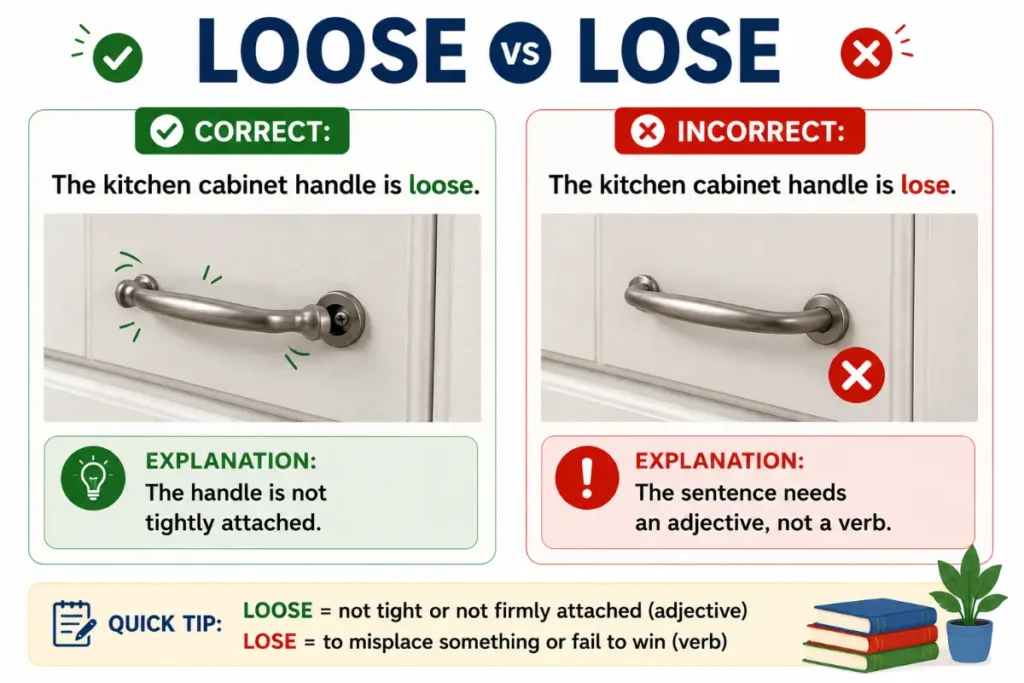
- The handle on the cabinet is loose and needs to be repaired.
- I don’t want to lose the information in this file.
In professional email the same grammar applies. You don’t need a special formal version of either word.
Academic Writing
- The study uses a loose definition of the term.
- Researchers may lose valuable data when records aren’t preserved correctly.
Academic writing often uses loose in the sense of approximate or not exact. Lose can describe lost data lost opportunities or a decline in something measurable.
News Writing
- Police reported that a dangerous animal was loose in the area.
- The team could lose its lead if it fails to score.
News writing often relies on precise word choice because a single word can change the meaning of a sentence.
Literature
- Her loose hair moved in the wind.
- He feared he might lose everything.
Literary writing uses both words naturally because they express clear physical and emotional ideas. Loose can suggest freedom or lack of restraint. Lose can suggest separation deprivation or failure.
Related And Confused Terms
Several words and phrases overlap with the meaning of lose but they don’t always work in the same sentence.
- At last means something has happened after a long wait or delay. It often carries a sense of relief.
- Eventually means something happens after some time. It focuses on the final outcome rather than the emotional reaction.
- Ultimately means in the final result or after considering the larger situation.
- At the end usually points to the final point in a period event story or process.
- Conclusively means in a way that settles an issue with strong or final evidence.
- In the end often introduces the final result of a situation.
- Lastly usually introduces the final item in a sequence.
- Finally can mean after a long wait at the end of a sequence or as the last point in a discussion.
These words overlap in some contexts but they aren’t perfect substitutes. Good writing depends on the exact shade of meaning you want.
A Simple Memory Trick
Think about the extra o in loose as creating extra space.
Loose clothing has extra room. A loose knot has extra freedom. A loose screw has extra movement. Lose has only one o because something has gone away. You lose your keys. You lose money. This isn’t a formal grammar rule. It’s a memory device. And sometimes a simple trick is more useful than a page of theory. Another method is to ask yourself one question. Am I describing something that isn’t tight or am I talking about something that might disappear or no longer belong to me? If you’re describing a condition use loose. If you’re describing losing possession control success time or an opportunity use lose.
Why The Confusion Is So Common
English spelling often creates pairs that look almost identical but behave differently. Loose and lose are a classic example.
They share l o s e. The only visual difference is the extra o.
That makes the brain rely heavily on context. The pronunciation adds another layer. Both words begin with the same /luː/ sound. Only the final consonant separates them clearly. Loose uses /s/. Lose uses /z/. Fast typing can make the problem worse. When people write quickly they often type based on the sound they hear internally instead of checking the exact spelling. Since the sounds are so close the wrong form can slip through. Autocorrect doesn’t always save the sentence either. Both words are legitimate English words. A spell checker may accept either one because it can’t always understand your intended meaning. That’s why context is your best defense.
Expert Editor Insight
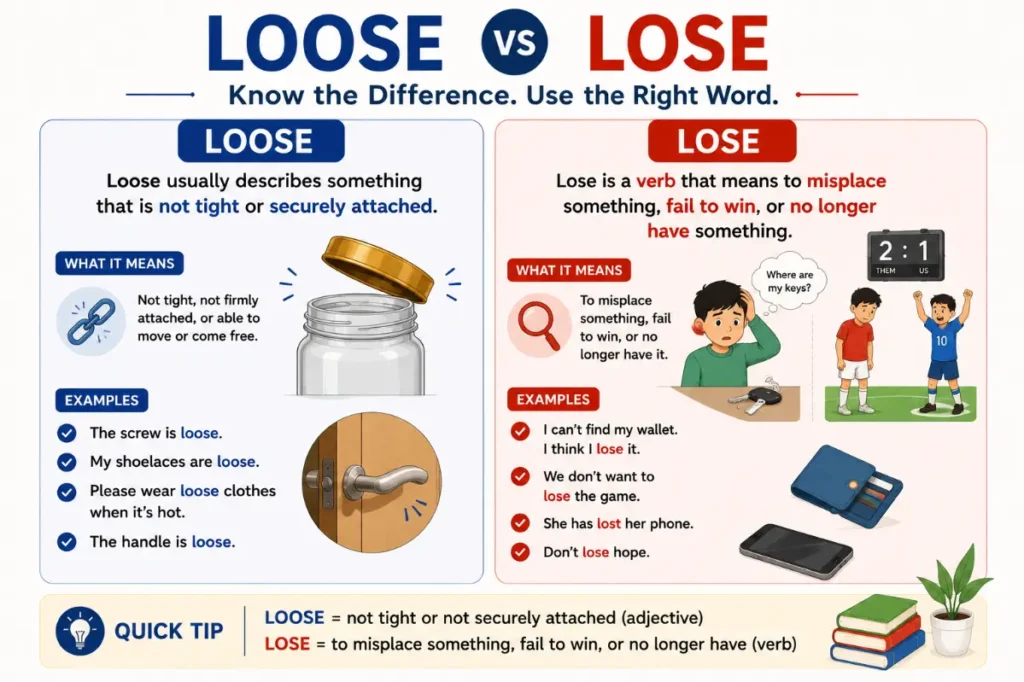
As an editor I’d treat this as a meaning problem rather than a spelling problem. If you only memorize that one form has two o’s you may still hesitate later. Instead connect the spelling to the idea. Loose describes freedom from tightness or firm attachment. Lose describes the disappearance or failure to keep something. Native speakers make the distinction automatically because context guides the choice. Grammar checkers can catch some mistakes but they may miss a correctly spelled word used in the wrong sentence. A human proofreader still has the advantage when meaning matters.
Expert Tip
When proofreading don’t look at the spelling first. Read the whole sentence and ask what the word is doing. If the sentence says something is not tight use loose. If the sentence says something is missing no longer available or not won use lose. This works especially well in phrases such as lose weight lose time lose money lose interest and lose control. In each case the word describes something becoming less available or no longer being maintained. For loose look for phrases involving physical space attachment or control. Loose clothing loose wires loose screws loose hair and loose rules all point toward the same central idea.
Learn the difference in Tear vs Tare: What is the Difference? (2026).
Final Takeaway
The key difference between loose or lose comes down to meaning. Use loose when something isn’t tight firmly attached or closely controlled. Use lose when you mean to misplace something stop having something fail to win or no longer maintain something. That distinction works across American English and other major varieties of standard English.
A quick memory trick can save you from the most common mistake. Think of the extra o in loose as extra space. Loose clothes have extra room. A loose knot isn’t tight. Lose has one o because something is gone or no longer kept. You lose your keys. You lose a game.
When you’re unsure remember this simple question. Are you describing something that isn’t tight or are you talking about something you no longer have? That one check will usually give you the right answer.
FAQs
Is loose or lose correct?
Both words are correct but they have different meanings. Loose describes something that isn’t tight secure or firmly attached. Lose is a verb that means to misplace something fail to win or stop having something. For example you can wear loose clothes but you can lose your jacket. The correct choice depends on the meaning of your sentence.
What is the difference between loose and lose?
Loose usually describes a condition. It means not tight or not firmly fixed. Lose describes an action or result. It can mean misplacing something failing to win or no longer having something. For example The screw is loose describes the screw. I might lose the screw describes what could happen to it.
Is loose a verb or an adjective?
Loose is most commonly an adjective. It describes something that isn’t tight or firmly attached. For example The rope is loose. Loose can also function as a verb in some contexts meaning to release something. However everyday American English usually uses loosen when talking about making something less tight.
Is lose a verb or an adjective?
Lose is a verb. It describes an action or situation involving something that is no longer kept found or won. For example You can lose your keys. You can also lose a game lose money or lose confidence. The related noun is loss while the past tense and past participle are lost.
How do you pronounce loose and lose?
Loose is pronounced /luːs/ and ends with an s sound. Lose is pronounced /luːz/ and ends with a z sound. Both words begin with the same long oo sound. A simple way to hear the difference is to say loose slowly and then lose. The second word has a gentle buzzing sound at the end.
Is loose the opposite of tight?
Yes. Loose is commonly used as the opposite of tight. A loose shirt has plenty of room while a tight shirt fits closely against the body. The same idea applies to objects. A loose screw isn’t firmly secured. In some contexts loose can also mean free or not under strict control.
How can I remember loose and lose?
Think of the extra o in loose as extra space. Loose clothes have extra room. A loose knot has extra movement. Lose has one o and refers to something going away or no longer being kept. You can lose your keys lose a game or lose money. This simple association makes the difference easier to remember.
Which is correct loose weight or lose weight?
Lose weight is correct. Weight is something you can gain or lose. Loose weight is incorrect when you mean reducing your body weight. Loose is an adjective that describes something that isn’t tight. For example you might wear loose clothing after losing weight. Remember the phrase as lose weight because lose describes the change in your weight.