
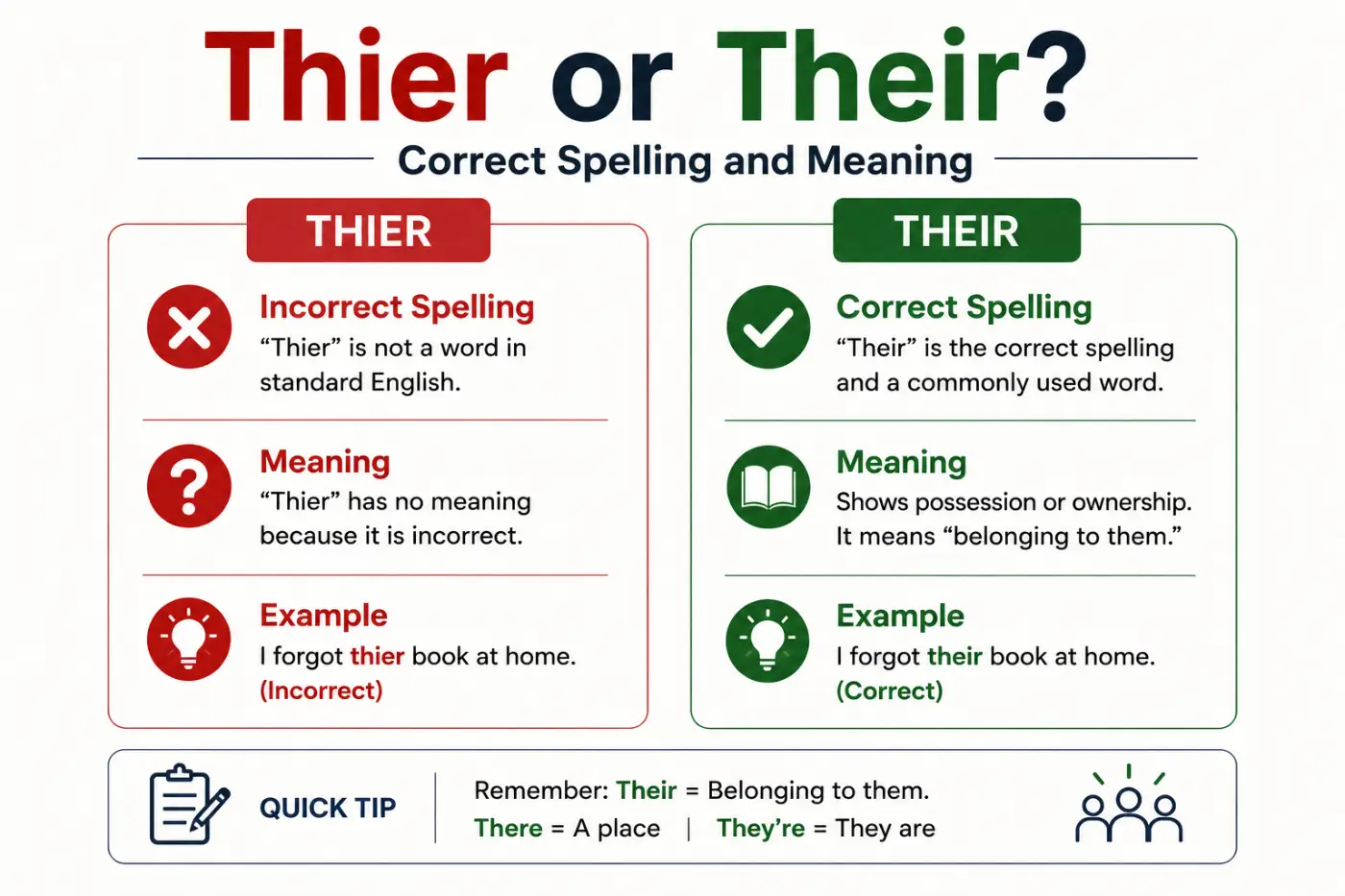
Few spelling mistakes are as easy to make as this one. You type quickly and suddenly you see thier on the screen. It looks close enough to the correct spelling that you may stop and wonder if both forms are accepted. The answer is simple. Their is the correct standard English spelling.
Thier is a misspelling and should be corrected in formal and informal writing.
The confusion makes sense because their is pronounced as one short sound and the letters can be arranged incorrectly when you type from memory. The word also sits close to other easily confused forms such as there and they’re.
That creates a small spelling trap that catches students, professionals, and native English speakers alike. In this guide, you’ll learn the difference between thier or their, what their means, how to pronounce it, where it belongs in a sentence, and why the incorrect form appears so often. You’ll also see natural examples that make the correct spelling easier to remember.
Need another quick comparison? Read neighbour or neighbor Correct Spelling and Usage.
Quick Definition
Their is the correct standard English spelling. It is a possessive determiner used to show that something belongs to or is connected with people, animals, groups, or sometimes one person. Thier is not a standard English word. It is a common spelling mistake caused mainly by letter order confusion.
Quick Answer
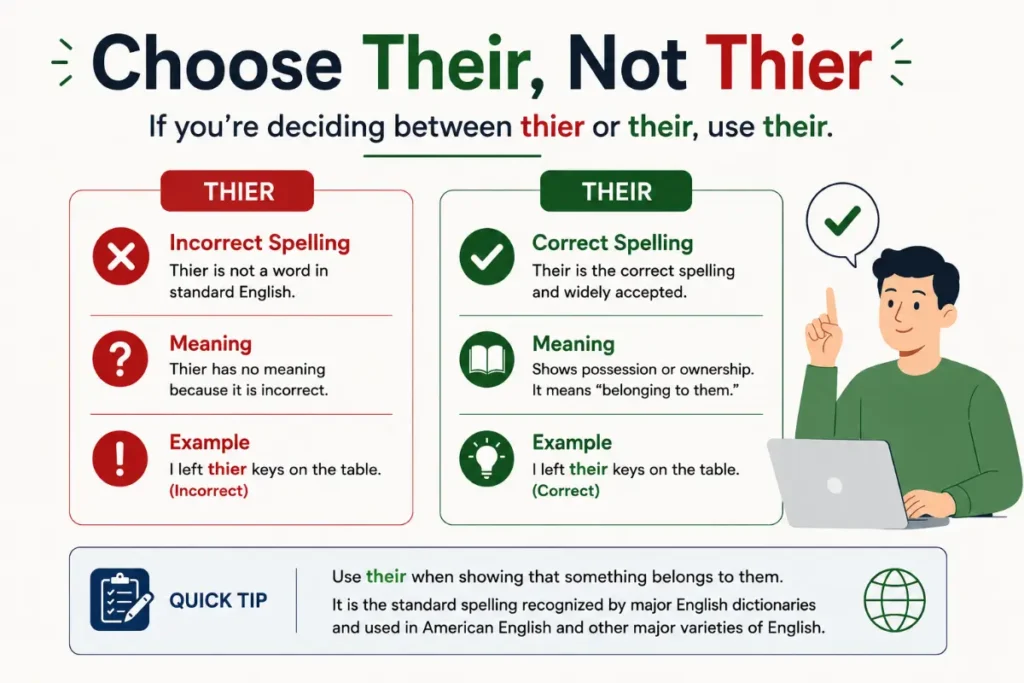
If you’re deciding between thier or their, use their. It is the standard spelling recognized by major English dictionaries and used in American English and other major varieties of English.
For example, you can write The students finished their homework. You should not write The students finished thier homework.
Comparison Table
| Correct Form | Meaning | Part of Speech | Origin | Usage Frequency | Formality | Common Contexts | Example |
|---|---|---|---|---|---|---|---|
| their | Belonging to them or connected with them | Possessive determiner | Developed from the history of they and related Germanic forms | Very high | Standard | Everyday speech, school, business, academic writing, news | They brought their books. |
| thier | No standard English meaning | None in standard English | Spelling error rather than an established English form | Common as a typo | Nonstandard | Typing errors, informal mistakes, spelling exercises | Thier books were on the desk. |
Meaning and Definition
Meaning of thier
Thier does not have a standard dictionary meaning in modern English. In ordinary writing, it is treated as a misspelling of their rather than as a separate word with its own grammatical function.
You may occasionally see unusual forms like this used as a name, username, business name, or creative label. That does not make the spelling a standard English word. Names and invented labels can follow their own spelling choices.
If you are writing an essay, email, report, application, article, school assignment, or professional document, thier should be changed to their.
The safest approach is simple. If you mean belonging to them or connected with them, write their.
Meaning of their
Their expresses possession, connection, or association. It usually appears before a noun.
Consider this sentence.
The employees returned to their offices.
Their tells us that the offices are connected with or belong to the employees.
Cambridge Dictionary classifies their as a determiner and explains that it refers to something belonging to or connected with them. It also recognizes its use for one person when the writer or speaker does not want to specify gender or does not know the person’s gender.
The word can refer to people, animals, groups, organizations, and other entities.
The dogs returned to their owner.
The company updated their policy.
The children packed their bags.
In modern English, singular they has also made their extremely useful.
Someone left their phone on the table.
In this sentence, their refers to one person whose identity or gender is not specified. Major dictionaries recognize this use.
Key Differences Explained
- Spelling. Their is the correct spelling. Thier reverses the position of the i and e.
- Grammar role. Their functions as a possessive determiner. Thier has no standard grammatical role.
- Meaning. Their shows possession or association. Thier has no established meaning in standard English.
- Tone. Their works in casual conversation, academic writing, business communication, and formal documents. Thier signals a spelling mistake.
- Context. Their appears before a noun such as their car, their home, or their decision. Thier should be corrected in every standard writing context.
Which Spelling Is Correct?
Their is correct. The spelling is supported by standard English dictionaries and established grammar usage. Cambridge Dictionary lists their as a possessive determiner and gives examples showing how it works before nouns.
The linguistic reason behind the mistake is mostly visual rather than grammatical. English contains many words where i and e appear in different patterns. When you write quickly, your brain may remember the general sound and shape of the word without retrieving every letter in the right order.
That makes thier a classic transposition error. The writer knows the word but switches two letters during typing. A useful memory trick is to connect their with they. Both words begin with the same three letters.
They have a new car.
They brought their new car.
Think of their as the possessive form connected to they. That mental link can help keep the letters in the right order.
Sentence Examples
Here are natural examples using the correct spelling.
- The students finished their project before Friday.
- The children put their shoes beside the door.
- The employees discussed their plans during the meeting.
- The neighbors painted their house last summer.
- The players celebrated their victory after the game.
- The company changed their website design.
- The parents packed their children’s lunches.
- The dogs chased their ball across the yard.
- Everyone should bring their own notebook.
- The visitors left their coats at the front desk.
Here are examples that show the common spelling mistake.
- Incorrect: The students finished thier project.
- Incorrect: The children left thier shoes outside.
- Incorrect: The company changed thier policy.
- Incorrect: Everyone should bring thier own notebook.
- Incorrect: The players celebrated thier victory.
In each sentence, replace thier with their.
Need another quick comparison? Read Specialty Or Speciality Which Spelling Is Correct 2026.
Common Mistakes and Misspellings
- Thier. This is the most direct spelling error. The i and e appear in the wrong order.
- Their. This is correct when you need a possessive determiner.
- There. There commonly refers to a place or introduces the existence of something. There is a book on the desk.
- They’re. They’re is a contraction of they are. They’re coming later means they are coming later.
- Theirs. Theirs is a possessive pronoun and normally appears without a noun immediately after it. The blue car is theirs.
From an NLP perspective, these errors can be understood as confusion among words that share similar sounds, visual patterns, or grammatical associations. Their, there, and they’re are especially troublesome because they are homophones in many varieties of English.
The mistake can also come from letter transposition. Your brain may retrieve the correct word quickly while your fingers produce the letters in a different order. That is why someone can spell a word correctly hundreds of times and still type the wrong version during a rushed message.
Pronunciation Guide
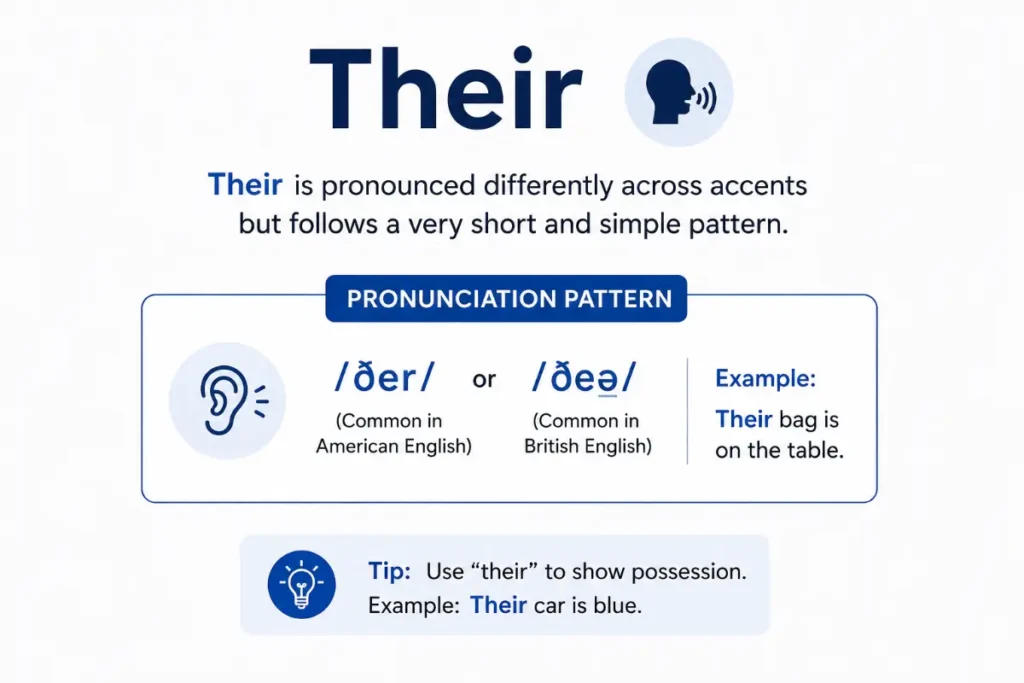
Their is pronounced differently across accents but follows a very short and simple pattern.
The Cambridge Dictionary gives the US pronunciation as /ðer/ and the UK pronunciation as /ðeər/.
For American English, you can think of the sound as something close to thair.
The word has one syllable.
IPA: /ðer/
Syllable breakdown: one syllable.
Audio style: thair.
The opening sound is the voiced th sound found in this and those. It is not the unvoiced th sound found in think.
The spelling mistake does not normally change pronunciation. That creates another reason the error survives. When you say the word aloud, there is no obvious sound that tells you which letters belong in the middle.
If you’re unsure while proofreading, look at the word rather than relying on how it sounds. The correct written form is their.
Etymology and Word Origin
Their has a long history connected with the development of English pronouns. The modern form did not appear from nowhere. It developed through changes in English and through influence from related Germanic language forms.
Old English originally used other forms for the possessive relationship connected with they. Over time, English experienced major changes in its pronoun system. The form their became established as the standard possessive form associated with they.
The history of the word also reflects a broader pattern in English. Common grammatical words often change considerably across centuries because speakers naturally reshape frequently used forms.
This history explains why their may not look as simple as a word such as my or your. English pronouns carry traces of older stages of the language.
The important point for modern writers is practical rather than historical. Contemporary standard English uses their. Thier does not represent an alternative historical spelling that you can freely use today.
Regional Usage
US English
American English uses their as the standard spelling. It appears throughout everyday communication, education, journalism, business writing, and academic work. American dictionaries and style guides treat their as the established form.
American English also commonly uses singular they and their when referring to one person whose gender is unknown or when a writer chooses gender neutral language. Cambridge’s American Dictionary entry recognizes this use.
UK English
British English also uses their as the standard spelling. The same possessive function applies in British writing and speech. The pronunciation can differ from American pronunciation, but the spelling remains their.
Australian English
Australian English follows the same standard spelling. Their is used in schools, workplaces, newspapers, books, and everyday communication. Thier is considered a spelling error rather than an Australian variant.
Canadian English
Canadian English also uses their.
Grammar Rules and Part of Speech
Their is generally classified as a possessive determiner. It comes before a noun and tells the reader who or what the noun belongs to or relates to.
Their house is large.
Their children attend the same school.
In each sentence, their comes before a noun.
Their can also refer to one person.
Someone forgot their wallet.
This use is now widely accepted in standard English. Cambridge specifically records singular use when the writer does not know the person’s gender or chooses not to use his or her. (Cambridge Dictionary)
Do not confuse their with theirs.
Their usually needs a noun after it.
That is their car.
Theirs can stand alone.
That car is theirs.
Also remember the difference between their and they’re.
Their means belonging to them.
They’re means they are.
Their house is nearby.
They’re walking home.
There usually refers to a place or introduces an existence statement.
The keys are over there.
There is a problem.
These three forms sound alike in many accents, so context and grammar matter more than pronunciation.
Real Life Usage Examples
Daily Talk
- Their kids are playing outside.
- I like their new restaurant.
These sentences show ordinary possession and association. The word fits naturally into everyday conversation.
- Please ask the clients for their updated information.
- The team will share their final decision tomorrow.
Professional emails use their constantly because writers often need to refer to people, teams, customers, or organizations.
Academic Writing
- Students should explain their reasoning clearly.
- Researchers must identify their sources carefully.
Academic writing frequently uses their when discussing people or groups without repeating specific names.
News
- Officials said the residents could return to their homes.
- The players thanked their supporters after the match.
News writing needs concise possessive language. Their does the job without adding unnecessary words.
Literature
- The travelers carried their belongings through the forest.
- The villagers returned to their homes before sunset.
Literary writing uses the same grammatical rules as ordinary English. Style may change, but the spelling does not.
Expert Editor Insight
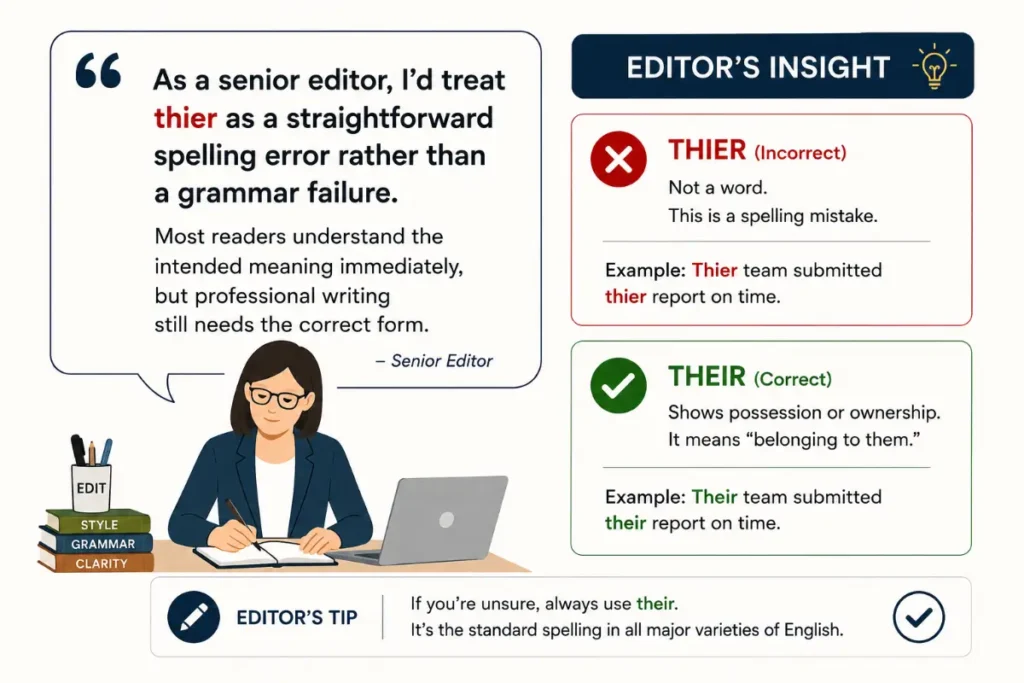
As a senior editor, I’d treat thier as a straightforward spelling error rather than a grammar failure. Most readers understand the intended meaning immediately, but professional writing still needs the correct form. Native speakers often produce this mistake while typing quickly because the word is common and familiar. Spell checkers and grammar tools usually flag the misspelling because standard dictionaries do not recognize it as the possessive form. The best fix is simple: connect their with they in your memory and check the spelling whenever you’re proofreading quickly.
For another common grammar confusion, see whiny vs whiney: Avoid This Common Spelling Mistake in 2026.
Conclusion
Thier or their has a simple answer. Their is the correct standard English spelling. It functions as a possessive determiner and shows that something belongs to or is connected with people, groups, animals, or sometimes one person. Thier is a common spelling mistake and should not be used as the standard form.
The confusion comes mainly from fast typing, letter order, and the fact that their sounds like there and they’re in many English accents. That means pronunciation cannot always help you choose the right spelling. Grammar and context do the heavy lifting.
Here’s a practical tip you can remember. Connect their with they. If the sentence refers to something connected with they, their is usually the form you need. Once that connection becomes automatic, this small spelling trap becomes much easier to avoid.
FAQs
Is thier a real word?
Thier is not a standard English word used as the possessive form of they. In ordinary writing, it is a misspelling of their. You may see thier used as a personal name, username, brand label, or invented form, but those special uses do not make it standard English. For normal writing, use their.
What does their mean?
Their is a possessive determiner that shows something belongs to or is connected with a group of people, animals, or things. It can also refer to one person when the person’s gender is unknown or when gender neutral language is preferred. For example, The students brought their books uses their to show that the books belong to the students.
thier or their which is correct?
Their is correct. Thier is a common spelling error caused by reversing the i and e. The correct word appears before a noun in phrases such as their house, their family, their work, and their ideas. If you see thier in standard writing, replace it with their.
How to pronounce their?
In American English, their is commonly pronounced /ðer/. You can think of the sound as thair. It has one syllable. British pronunciation is commonly represented as /ðeər/. The spelling stays the same across these major varieties of English even though pronunciation can vary slightly by accent.
Can their start a sentence?
Their can appear at the beginning of a sentence when it directly modifies a noun phrase. For example, Their decision surprised everyone is grammatically correct. The important point is not the position of their but its function. It should clearly identify something belonging to or connected with the people or person being discussed.
What is the synonym of their?
Their does not have a simple synonym that works in every sentence because it is a grammatical possessive form. Depending on the sentence, you might replace it with a phrase such as belonging to them or connected with them. However, those phrases often sound less natural. Their is usually the clearest and most efficient choice.
Why do people misspell their?
People often misspell their because the word contains a letter sequence that is easy to reverse during fast typing. Pronunciation does not help much because the incorrect spelling normally sounds exactly the same. Confusion with there and they’re can add to the problem. Repeated exposure and a simple memory link between they and their can reduce the mistake.
Is their acceptable in formal writing?
Yes. Their is completely standard in formal English. You can use it in academic papers, business reports, professional emails, applications, journalism, and official documents. It is also common in everyday conversation. The word itself is not informal. The only issue is choosing it for the correct grammatical purpose and spelling it correctly.