
If you’ve ever typed a word that looks right and then stared at it for a few seconds wondering if you spelled it correctly you’re not alone. definately or definitely is one of those spelling questions that catches people off guard because the wrong form looks surprisingly natural.
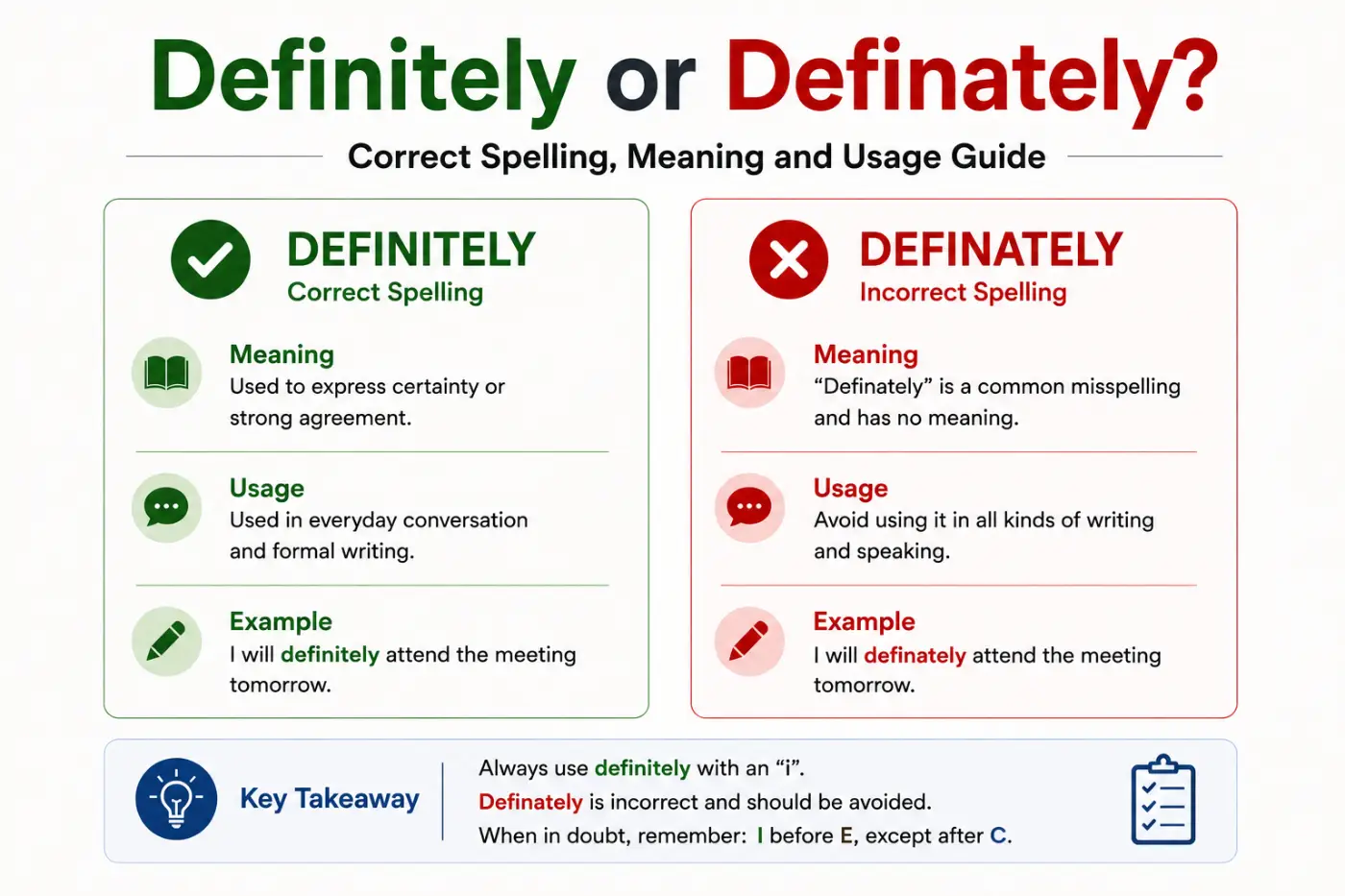
The correct spelling is definitely. The spelling definately is incorrect in standard English. If you’re writing an email a school assignment a report a resume or a professional message use definitely.
The confusion usually comes from pronunciation. When people say the word quickly the middle vowel can sound weak. That makes it easy to remember the word as something closer to definite plus ly without noticing the exact letters. The connection with the adjective definite also helps explain the correct spelling.
Need another quick comparison? Read Sapphire or Saphire Which Spelling Is Correct 2026.
Quick Definition
Definitely is the correct spelling. It is an adverb that means without doubt certainly or in a way that shows strong certainty. Definately is a common spelling mistake and isn’t accepted as the standard spelling in English. The correct form comes from definite plus the adverb ending ly.
Quick Answer
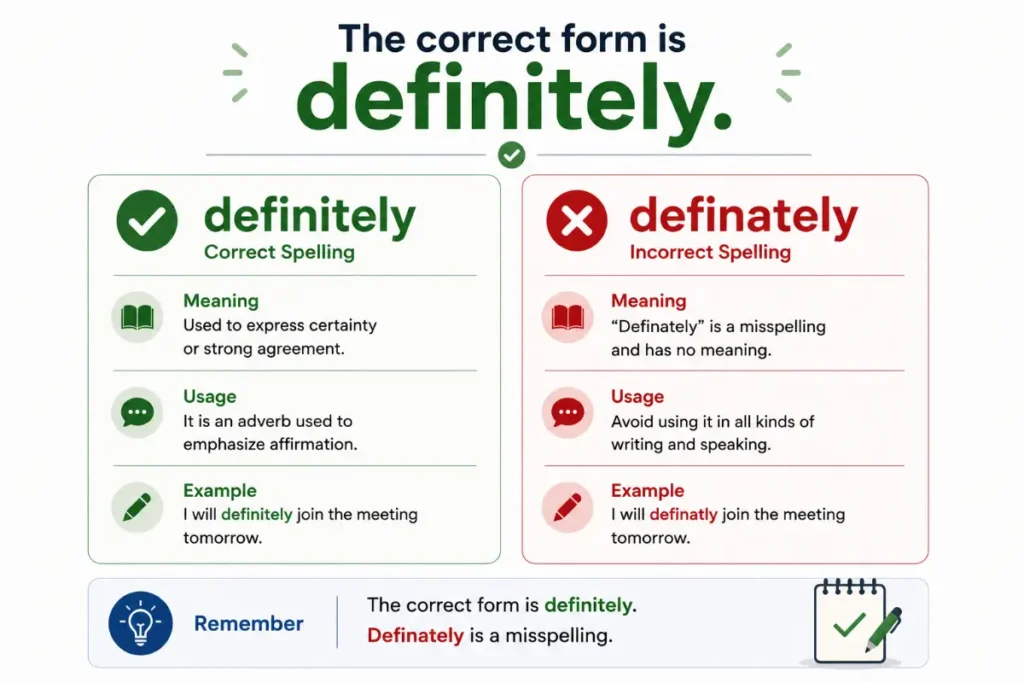
The correct form is definitely.
Definately is a misspelling. The easiest way to remember the correct spelling is to connect it with the word definite. Write definite first and then add ly to get definitely.
Comparison Table
| Correct Form | Meaning | Part of Speech | Origin | Usage Frequency | Formality | Common Contexts | Example |
|---|---|---|---|---|---|---|---|
| Definitely | Without doubt or certainly | Adverb | From definite with roots reaching through Latin and Old French | Very common | Neutral and suitable for formal writing | Conversation emails essays reports and general writing | I definitely want to visit again. |
| Definately | No standard meaning because it is a misspelling | Not a standard English word | Spelling error influenced by pronunciation and visual memory | Common as a mistake | Not appropriate in edited writing | Informal typing drafts and spelling errors | I will definitely finish the report today. |
Meaning and Definition
Meaning of Definately
Definately does not function as a standard English word with its own established meaning. In normal English writing it is treated as a misspelling of definitely.
You may see it in text messages social media posts online comments drafts or other informal writing. Its appearance doesn’t mean the spelling has become an accepted alternative. People simply make the same spelling mistake often enough that it becomes familiar.
This is a useful distinction. A word can appear thousands of times online and still be incorrect in standard edited English. Search results user generated content and casual messages can preserve spelling errors for years.
So if a spelling checker flags definately you should change it to definitely.
Meaning of Definitely
Definitely means without doubt certainly or in a way that shows certainty.
It is an adverb. It can describe the speaker’s confidence in a statement or emphasize that something is firmly decided or clearly true.
For example:
I definitely remember meeting her.
That sentence tells the reader that the speaker has strong confidence in the memory.
You can also use it as a short answer.
Are you coming with us?
Definitely.
The word can also appear with negative expressions.
I definitely don’t want to miss the meeting.
She definitely isn’t ready.
In these sentences the adverb strengthens the speaker’s certainty.
Key Differences Explained
- Spelling.
The correct spelling is definitely. The incorrect form definately replaces the second i with a. - Grammar role.
Definitely is an adverb. It modifies a verb phrase an adjective or sometimes an entire statement. - Meaning.
Definitely expresses certainty. Definately has no separate meaning because it is simply a spelling error. - Tone.
The correct word works in casual conversation as well as formal writing. It can sound especially emphatic in speech. - Context.
Use definitely in school work professional communication academic writing articles reports and everyday messages.
There’s no special American spelling that changes this rule. The same standard spelling applies across major varieties of English.
Which Spelling Is Correct?
Definitely is the correct spelling.
The most useful linguistic clue is the base word definite. The adjective definite means clear certain or fixed. When English forms the related adverb it adds ly, producing definitely.
Think of the word as:
definite + ly = definitely
That small connection can save you from relying on memory alone.
From an editing perspective the rule is straightforward. If your sentence requires the word meaning certainly then definitely is the form you want.
Sentence Examples
Here are natural examples that show how the word works in real writing.
- I definitely want to see that movie.
- She definitely knows the answer.
- We’ll definitely need more time to finish the project.
- He definitely called me yesterday.
- This is definitely the best option for our team.
- You should definitely try the new restaurant.
- I’m definitely going to apply for the position.
- The weather will definitely affect our plans.
- She definitely deserves the award.
- I definitely remember locking the door.
The word can appear before a main verb.
I definitely understand your point.
It can also appear after a form of be.
She is definitely ready.
It can strengthen a negative statement.
I definitely don’t agree with that decision.
It can also stand alone in conversation.
Will you come back tomorrow?
Definitely.
Now consider examples of the common misspelling. These forms should be corrected.
- Incorrect: I definately want to go.
- Incorrect: She definately knows the answer.
- Incorrect: We will definately call you.
- Incorrect: He is definately ready.
- Incorrect: I definately remember that day.
The corrected versions all use definitely.
Common Mistakes and Misspellings
The spelling error happens for several understandable reasons.
- Sound based spelling.
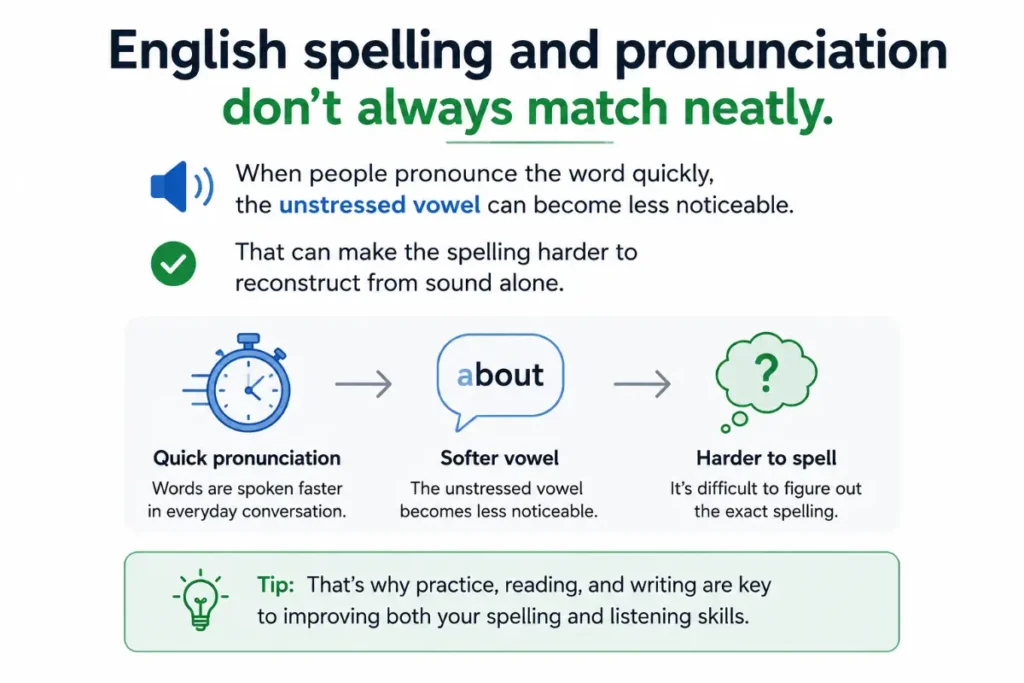
English spelling and pronunciation don’t always match neatly. When people pronounce the word quickly the unstressed vowel can become less noticeable. That can make the spelling harder to reconstruct from sound alone. - Visual memory.
A person may have seen the misspelling many times online. Repeated exposure can make an incorrect form look familiar. Familiarity isn’t the same as correctness. - Connection with definite.
Some writers know the word definite but lose the second i when they add the adverb ending. The correct connection is definite followed by ly. - NLP confusion.
From an NLP perspective this is a useful example of orthographic confusion. The brain processes familiar letter patterns quickly and often predicts the next letters before conscious attention checks every character. A common error can therefore feel visually acceptable. - Fast typing.
When people type quickly they often rely on phonetic memory and motor patterns rather than consciously spelling every word. That makes frequent words vulnerable to small letter substitutions.
Other common forms you may encounter include definatly, definetely, definitly, and definitley. None is the standard spelling. The best correction strategy is simple. Stop trying to memorize every letter as an isolated sequence. Connect the word to definite.
Pronunciation Guide
The pronunciation can actually help explain the spelling problem.
A practical syllable breakdown is:
def i nite ly
In natural American speech it can sound roughly like:
DEF uh nit lee
The middle vowel is weak in ordinary speech. That weak sound is one reason some writers remember an a in the spelling.
Try saying the word slowly:
definite
Then say:
definitely
The spelling becomes easier to remember when you hear the relationship between the two words.
A common pronunciation mistake is to pronounce every written vowel with equal strength. Native speakers generally reduce the unstressed vowel sounds. That can make the spoken word feel quite different from its written form.
Pronunciation alone isn’t a reliable spelling guide in English. The safest approach is to connect pronunciation with the base word definite.
Etymology and Word Origin
The history of definitely begins with definite.
The English adjective ultimately traces back through French to Latin roots associated with defining setting limits or bringing something to a clear end. The Latin verb definire carried the idea of limiting or defining. English later developed definite with the sense of being clear fixed or certain.
The adverb developed from the adjective through the familiar English ending ly.
That gives us the basic structure:
definite + ly = definitely
This history matters because it gives you a memory hook. Instead of treating the spelling as a random collection of letters you can see it as a natural extension of another English word you already know.
The related family includes words such as define, definition, definite, definitive, and definitely. These words share a historical connection and help explain why the spelling contains i rather than a.
The form definately doesn’t represent a separate historical development. It is an orthographic error.
Regional Usage
United States
American English uses definitely as the standard spelling. It appears frequently in everyday speech and writing. Americans may use it as a strong response as in Definitely when answering a question.
United Kingdom
British English also uses definitely. The standard spelling does not change simply because the variety of English changes. The pronunciation can differ slightly from American pronunciation but the written form remains the same.
Australia
Australian English follows the same standard spelling. Writers use definitely in casual communication academic work journalism business writing and general prose. Definately remains a spelling mistake rather than an Australian variant.
Canada
Canadian English also uses definitely. Canadian writers may follow conventions influenced by both American and British English but this particular spelling does not normally vary. The standard form remains definitely.
You may also want to read Mentioned Vs Mentionned Which Spelling Is Correct (2026).
Grammar Rules and Part of Speech
Definitely is an adverb.
Its main job is to express certainty or strengthen a statement. Its position can change depending on the sentence.
One common position is before the main verb.
I definitely agree.
She definitely understands.
Another position is after a form of be.
He is definitely right.
They are definitely prepared.
It can also appear before a negative verb phrase.
I definitely don’t want that.
She definitely isn’t coming.
It can modify an adjective or another expression of certainty.
That was definitely strange.
This is definitely worth considering.
The word can also introduce a sentence when the writer wants to emphasize certainty.
Definitely, we need a better plan.
That use is grammatically possible but it can sound more emphatic than simply placing the adverb inside the sentence.
Punctuation depends on the structure. If definitely begins a sentence as an introductory adverb it can be followed by a comma in many contexts. If it sits naturally inside the sentence no special punctuation is required.
For example:
Definitely, we should leave early.
We should definitely leave early.
Both sentences are correct. The second sounds more natural in many everyday situations.
Real Life Usage Examples
Daily Talk
- I’ll definitely call you tonight.
- Definitely. I’d love to come with you.
In conversation the word often works as a confident response.
- I’ll definitely send the updated file this afternoon.
- We should definitely discuss the schedule before Friday.
In professional email the word is perfectly acceptable. Still the strength of the word matters. If you’re making a promise use it only when you can confidently stand behind the statement.
Academic Writing
- The results definitely support the main argument.
- The evidence does not definitely establish the cause.
Academic writing often prefers precise language. Definitely can be useful when the evidence truly supports strong certainty. If the evidence is limited then a more cautious expression may be better.
News Writing
- The decision will definitely affect the local economy.
- The team has definitely improved since last season.
News writers can use the word but strong claims require strong evidence. Good editing isn’t only about spelling. It’s also about making sure the level of certainty matches the facts.
Literature
- She definitely knew something was wrong.
- He definitely wasn’t ready to leave.
In fiction the word can reveal a character’s confidence or reinforce the narrator’s certainty. Its conversational quality can also make dialogue sound natural.
Expert Editor Insight
As a practical editing rule I recommend remembering the base word rather than the entire spelling. Think definite first and then add ly. That gives you definitely. Spell checkers can catch many instances of definately because the incorrect form is not the standard dictionary entry. But spell check should be your safety net rather than your only editing method. A good editor checks spelling while also checking meaning tone certainty and sentence structure. Native speakers may use definitely casually in conversation but still expect the standard spelling in polished writing.
A Simple Memory Trick
There’s a reliable way to keep the spelling straight.
Think of the adjective:
definite
Now add the adverb ending:
definite + ly
That gives:
definitely
The key is the second i.
You can also remember the phrase:
A definite answer is definitely clear.
The two words belong to the same word family. Once that connection becomes automatic the spelling becomes much easier.
Another useful technique is to pause before typing the word in an important document. Ask yourself which base word sits inside it. If you can see definite you’re already most of the way there.
Why The Error Feels So Convincing
Some spelling mistakes look obviously wrong. This one doesn’t. That’s because definately follows a spelling pattern that feels familiar. The pronunciation also doesn’t strongly highlight the exact vowel sequence. When your brain recognizes a familiar word during fast reading it often processes the overall shape rather than checking every letter individually.
This is why you might read a misspelled word several times without noticing it. The same principle affects typing. If your fingers have learned an incorrect motor pattern you can reproduce the same mistake without consciously deciding to spell the word incorrectly.
That’s also why simple repetition isn’t always enough. You need a useful mental connection.
For this word the best connection is:
definite → definitely
Once you remember that relationship the extra i stops looking random.
When To Use Definitely
Use definitely when you want to communicate strong confidence.
You might use it to confirm a decision.
I’m definitely going to apply.
You might use it to confirm a fact.
She definitely lives nearby.
You might use it to emphasize an opinion.
That was definitely the best part.
You might use it as a direct response.
Are you interested?
Definitely.
You can also combine it with negative forms.
I definitely don’t agree.
They definitely aren’t ready.
The word is flexible because it focuses on certainty rather than a particular type of action.
When Another Word May Be Better
Correct spelling doesn’t automatically make a word the best choice.
If you’re talking about time you may need eventually.
We eventually found the missing file.
If you’re talking about the final result you may need ultimately.
Ultimately the decision belongs to the board.
If you’re introducing the final point in a list you may need lastly.
Lastly we need to review the budget.
If you’re emphasizing certainty definitely is a strong choice.
She definitely understands the problem.
This distinction matters in polished writing because good word choice is about meaning rather than simply choosing a word that sounds impressive.
The Difference Between Definitely And Definitively
These two words look similar and are sometimes confused.
Definitely means certainly or without doubt.
Definitively usually means in a final or conclusive way.
Compare these sentences:
She definitely knows the answer.
The issue has not been definitively resolved.
The first sentence expresses certainty about someone’s knowledge.
The second says the issue has been settled conclusively.
That small difference can matter in academic professional and legal writing.
The Difference Between Definite And Definitely
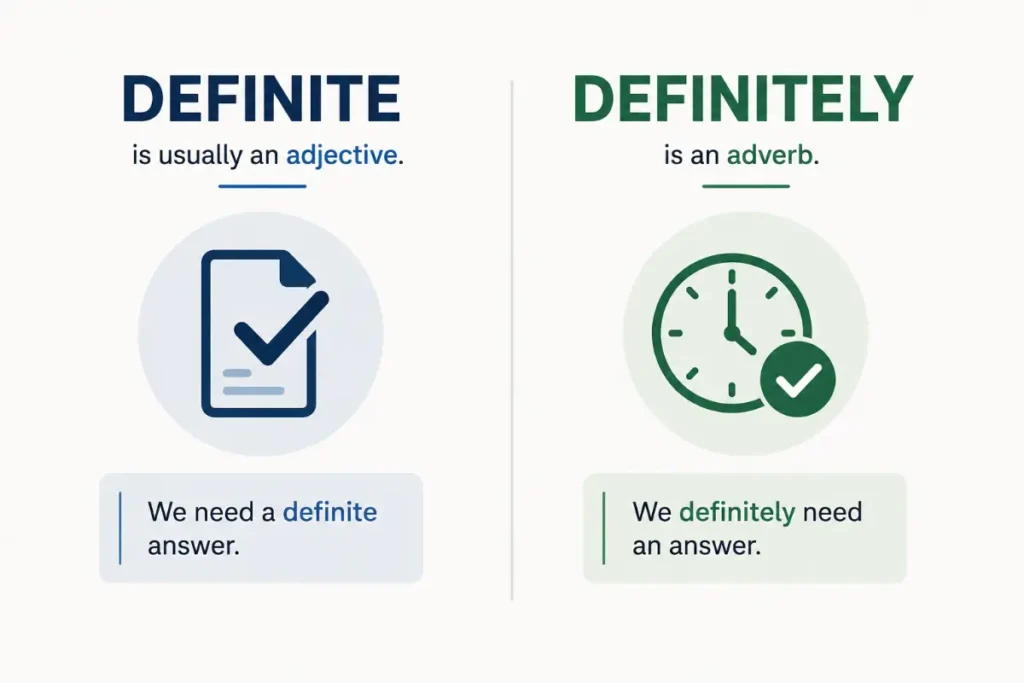
Definite is usually an adjective.
We need a definite answer.
Definitely is an adverb.
We definitely need an answer.
A quick grammar test can help.
If the word describes a noun use definite.
If it modifies an action or statement and expresses certainty use definitely.
Examples:
She gave a definite answer.
She definitely gave an answer.
The first describes the answer.
The second emphasizes the certainty of the action.
Practical Editing Tip
If you’re unsure about the spelling while writing don’t stare at the word and hope it suddenly looks right.
Use the base word.
Definite.
Then add ly.
Definitely.
This takes less than a second and gives you a reliable spelling pattern.
For important writing you can also use a dictionary or spelling checker as a final verification step. Dictionary tools are especially useful when you’re dealing with words that sound different from the way they look.
The goal isn’t to memorize every difficult spelling in English. It’s to build small connections that make common words easier to retrieve accurately.
You may also want to read According to Alternatives for Clearer Writing.
Conclusion
definately or definitely has a simple answer. Definitely is the correct spelling and definately is a common misspelling. The correct word is an adverb that expresses certainty and means something like certainly or without doubt. Major dictionaries including Cambridge and Oxford list definitely as the standard form.
The spelling becomes much easier when you connect it to definite. Think definite + ly = definitely. That small memory trick works because it links the word to its existing English word family instead of forcing you to memorize a string of letters.
One practical tip can save you from the mistake every time. When you hesitate remember definite first. Add ly and you’ll get definitely.
Frequently Asked Questions
Is Definately A Real Word?
Definately is not the standard spelling of an English word. It is a common misspelling of definitely. You may find it in informal online writing messages comments and unedited text because many people make the same mistake. Its frequent appearance doesn’t make it an accepted spelling. In formal writing school work professional communication and edited content use definitely.
What Does Definitely Mean?
Definitely means without doubt certainly or with a strong sense of certainty. It is an adverb. You can use it to emphasize that you believe something is true or that you have made a firm decision. For example you might say I definitely want to go when you want to make your strong intention clear.
Definately Or Definitely Which Is Correct?
Definitely is correct. Definately is a misspelling. A simple way to remember the correct form is to start with definite and add ly. The spelling therefore becomes definitely. This memory trick works better than trying to memorize every letter separately because it connects the adverb to a familiar English word.
Can Definitely Start A Sentence?
Yes. Definitely can start a sentence when you want to emphasize certainty. For example Definitely, we need to leave early is grammatically acceptable. In everyday writing the word often sounds more natural inside the sentence as in We definitely need to leave early. Both structures can work. The best choice depends on the rhythm and emphasis you want.
What Is The Synonym Of Definitely?
Common synonyms include certainly, surely, undoubtedly, and decidedly. Certainly is often the closest everyday substitute. The exact choice depends on tone and context. Undoubtedly can sound more formal. Surely can sometimes express expectation or surprise rather than absolute certainty. Good word choice depends on the meaning you want to emphasize.
Why Do People Misspell Definitely?
People often misspell the word because pronunciation doesn’t clearly reveal every letter. The unstressed middle vowel can be weak in natural speech. Another reason is the relationship between sound and memory. Writers may also confuse the spelling with familiar patterns such as definite and definitive. Fast typing and repeated exposure to online misspellings can reinforce the error.
Is Definitely Suitable For Formal Writing?
Yes. Definitely is standard English and is appropriate for formal writing when the meaning fits. You can use it in reports essays business communication and academic prose. The bigger issue is certainty. If your evidence is limited then a cautious phrase may be more accurate. Use definitely when the statement genuinely supports a strong level of confidence.