
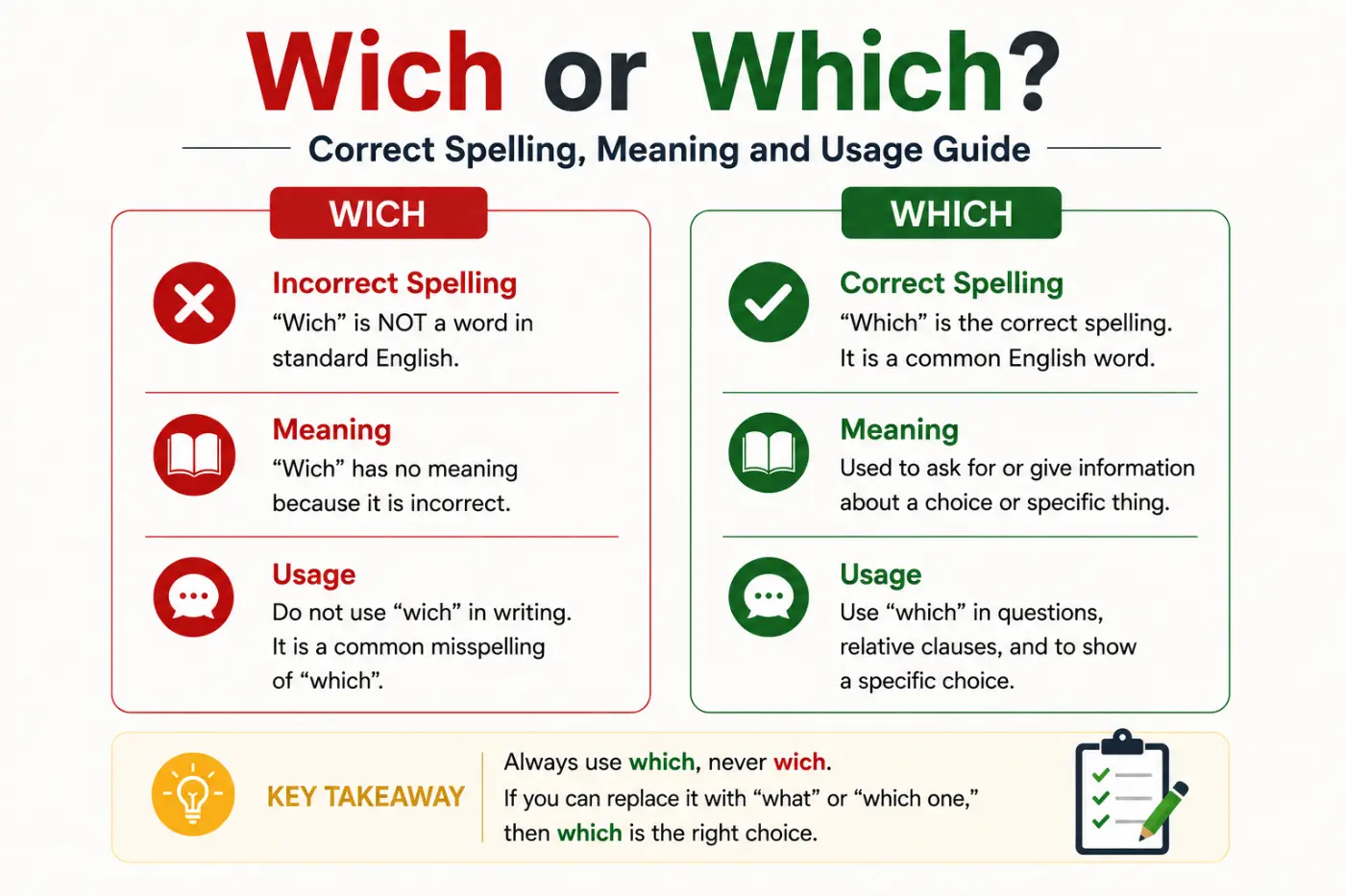
Making a spelling mistake with a common word can be surprisingly easy. You type quickly. Your brain knows the word. Your fingers simply leave out one letter. That’s exactly what happens with wich or which. The correct spelling is which. Wich is not the standard spelling of the English question word or relative pronoun. If you’re asking a question such as Which book do you want? or connecting information in a sentence such as The car which I bought is blue. you need which.
The confusion often comes from pronunciation. In normal speech the h in this word isn’t strongly emphasized. That can make the spelling feel less obvious when you write it. Fast typing also makes the missing letter easy to overlook.
This guide explains the difference between the two forms. You’ll learn what which means. You’ll also learn its pronunciation grammar rules common mistakes regional usage and practical examples that show how native English speakers use it.
Many readers also check success or sucess Correct Spelling Meaning And Usage.
Quick Definition
Which is the standard English spelling. It can work as a pronoun determiner or relative pronoun. It usually asks someone to choose from a known group or introduces information about a noun. Wich is normally a spelling mistake when someone intends to write which.
Quick Answer
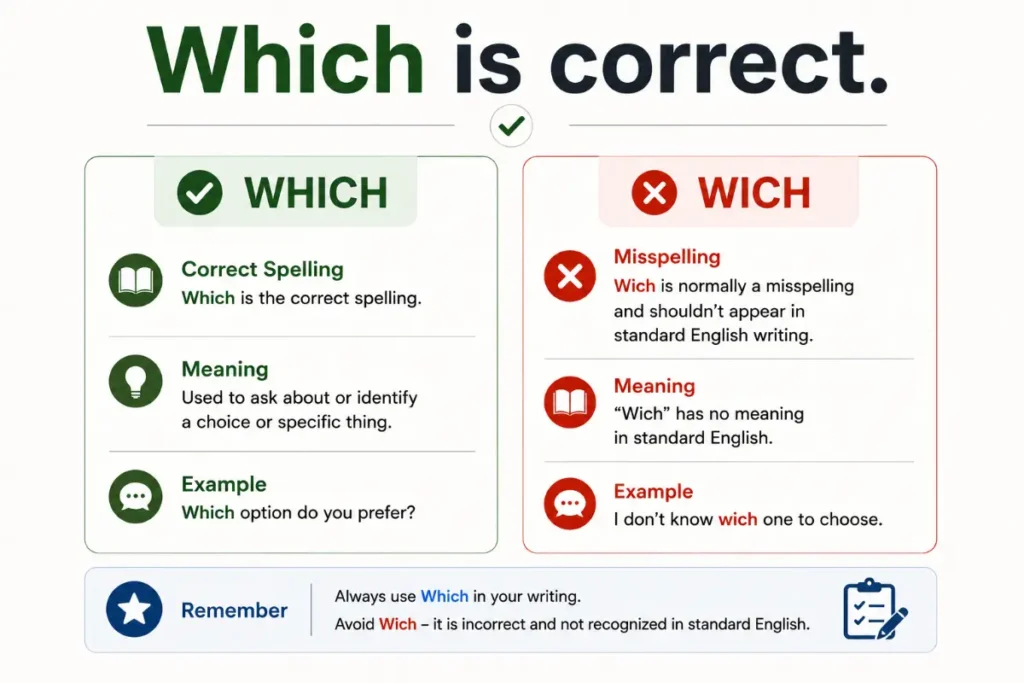
Which is correct. Wich is normally a misspelling and shouldn’t appear in standard English writing. Use which when asking someone to identify or choose something or when introducing a relative clause. For example: Which movie do you want to watch? and The laptop which I bought works well.
Comparison Table
| Correct Form | Meaning | Part of Speech | Origin | Usage Frequency | Formality | Common Contexts | Example |
|---|---|---|---|---|---|---|---|
| Which | Identifies or selects one or more things from a group | Pronoun or determiner | Old English and Germanic roots | Extremely common | Neutral and formal | Questions relative clauses writing speech | Which color do you prefer? |
| Wich | No standard meaning as the intended spelling of which | Usually a misspelling | Not an accepted spelling of the standard word | Very uncommon | Not standard | Typing errors spelling mistakes | Wich book should I read? |
Meaning and Definition
Meaning of Wich
In ordinary modern English wich is not the standard spelling of the word people mean when they write which. If you type Wich book should I buy? you have made a spelling mistake. The sentence should read Which book should I buy?
That said Wich can appear in proper names or historical place names. English place names sometimes preserve old spellings that don’t follow modern spelling patterns. A famous example is the element wich found in some English place names and connected historically with salt production or settlements.
That special use doesn’t make wich an alternative spelling of which. This distinction matters because a word can exist somewhere in English without being the correct replacement for another word. If you’re writing a question or relative clause in standard English you should use which.
Meaning of Which
Which is a very common English word with several related grammatical functions.
First it can act as a determiner before a noun.
Which shirt do you want?
Which answer is correct?
Here the word helps identify one item from a group.
Second it can act as a pronoun.
Which do you prefer?
Which should I choose?
In these examples the noun doesn’t need to appear after the word because the meaning is already clear from context.
Third which can introduce a relative clause.
I bought a new phone which has a better camera.
She chose the restaurant which her friend recommended.
In this use which connects additional information to a noun.
The word comes from an old Germanic family of words. Its history reaches back to Old English hwilc and related forms in other Germanic languages. Over centuries English spelling changed and eventually developed the modern form which.
Key Differences Explained
- Spelling.
The standard spelling is which. It contains the letters w h i c h. The form wich leaves out the second letter and is normally incorrect when you mean the common English word.
- Grammar role.
Which can function as a determiner pronoun or relative pronoun. Wich doesn’t perform these standard grammatical roles.
- Meaning.
Which commonly asks someone to identify something from a group. It can also introduce additional information about a noun.
- Tone.
Which works in casual conversation formal writing academic work journalism and professional communication. The misspelled form can make writing look careless.
- Context.
You’ll see which in questions such as Which one should I buy? You’ll also see it in sentences such as The report which you sent was helpful.
Which Spelling Is Correct
The correct spelling is which.
The reason is simple. Standard English dictionaries recognize which as the established spelling for this pronoun and determiner. The spelling has developed through the history of English rather than from a modern attempt to represent its pronunciation letter by letter.
That’s one reason English spelling can feel tricky. Pronunciation and spelling don’t always line up perfectly.
The h in which can be easy to overlook when you write quickly. Yet the letter belongs to the standard written form.
A useful editor’s test is to look at the role of the word.
If you’re asking Which one? or connecting a clause such as the book which I bought then you need which.
If you’ve written wich in one of those situations correct it to which.
Sentence Examples
Here are natural examples that show how the correct form works.
- Which restaurant should we try tonight?
- Which jacket looks better on me?
- I don’t know which answer is right.
- Which train goes to downtown?
- Which book did you enjoy the most?
- She asked which route would be faster.
- The house which sits near the lake belongs to my uncle.
- I found the document which you were looking for.
- He chose the computer which had the larger screen.
- We need to decide which option makes the most sense.
Now compare those examples with the common spelling mistake.
- Wich restaurant should we try tonight?
The standard form is Which restaurant should we try tonight?
- I don’t know wich answer is right.
The standard form is I don’t know which answer is right.
These mistakes don’t change the intended meaning. They change the spelling. In professional writing that distinction matters because readers expect common words to appear in their standard forms.
Need another quick comparison? Read Different or Diffrent Which Spelling Is Correct 2026.
Common Mistakes and Misspellings
Several patterns can make this error more likely.
- Leaving out the h.
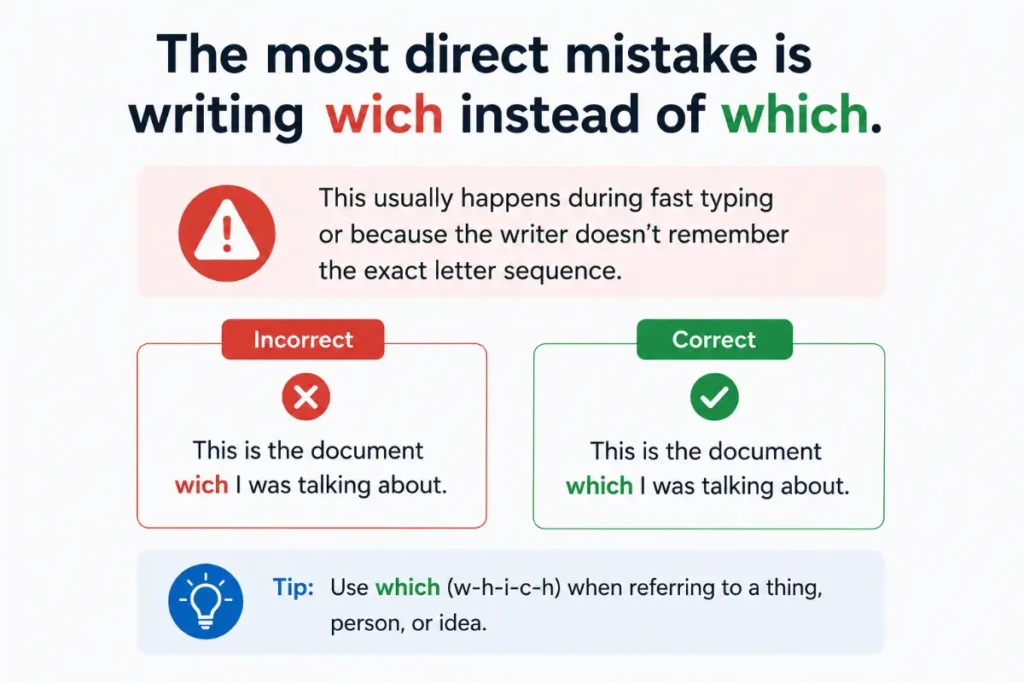
The most direct mistake is writing wich instead of which. This usually happens during fast typing or because the writer doesn’t remember the exact letter sequence.
- Relying on pronunciation.
The spoken word doesn’t always make every letter obvious. If you try to spell the word only from its sound you may leave out the h.
- Typing by sound.
Some writers use a sound based spelling strategy. They hear a word and immediately choose the letters that seem to match. This works for some words but fails with many English spellings.
- Visual pattern confusion.
English contains many words beginning with wh such as what where when who and why. A writer who has internalized some patterns may still accidentally shorten one of them during fast writing.
- NLP and typing confusion.
From an NLP perspective wich can be treated as a noisy or misspelled form of the intended word which. Spellcheckers and language models often use context to recognize that relationship. If a sentence says Wich movie do you want? the surrounding words strongly suggest that which was intended.
The important point is that context helps identify the mistake but it doesn’t make the incorrect spelling acceptable in standard writing.
Pronunciation Guide
The pronunciation of which can vary slightly across English varieties.
In General American English it is commonly pronounced close to wich in casual speech. A common IPA representation is /wɪtʃ/.
The word has one syllable.
You can think of the sound as roughly:
which = w + itch
The beginning sounds like the w in win. The vowel resembles the short i in sit. The ending sounds like the ch in chair.
In some accents you may hear a small distinction between which and witch. In much of modern American English the two words can sound identical. Some speakers maintain a traditional distinction in which which begins with a slightly breathier wh sound.
That pronunciation variation doesn’t change the spelling.
A useful memory trick is to connect the spelling with other common wh words.
What.
When.
Where.
Who.
Why.
Which.
The spelling pattern gives you a visual anchor. If you’re writing the question word that belongs with this family then which is the form you want.
Etymology and Word Origin
The history of which reaches deep into the development of English. Old English used forms such as hwilc. This word was related to older Germanic forms used to identify or distinguish one thing from another. Over time the spelling changed as English itself changed.
Middle English brought several spelling variations. Medieval writers didn’t have one fixed spelling system like the standardized forms used in modern dictionaries. Spelling could vary from one writer or region to another.
Eventually English settled on which as the modern standard form.
The word also has relatives across Germanic languages. Its history connects it to an old family of interrogative and relative words used to identify a particular person or thing.
This historical background helps explain why the spelling contains wh. The letters aren’t random. They reflect an older spelling tradition that survived into modern English. English has many words like this. Their modern spelling often preserves pieces of their history even when modern pronunciation has changed.
Regional Usage
United States
In American English which is the standard spelling. It appears constantly in everyday questions professional writing academic work journalism and conversation. American speakers may pronounce it the same as witch. Some speakers preserve a small difference in pronunciation.
United Kingdom
British English also uses which as the standard spelling. The word works in the same basic grammatical roles as it does in American English. British speakers may use it frequently in both formal and informal writing.
Australia
Australian English follows the standard spelling which. You’ll find it in ordinary conversation school writing workplace communication newspapers and other forms of published English. Wich isn’t a standard Australian alternative.
Canada
Canadian English also uses which. Canadian spelling practices include influences from both American and British English but this particular word remains straightforward. The accepted spelling is which.
No major English variety uses wich as the standard spelling for the common word.
Grammar Rules and Part of Speech
Which has more than one grammatical function. Understanding these functions makes the word easier to use correctly.
Which as a Determiner
A determiner comes before a noun and helps identify it.
Which movie are you watching?
Which students finished the assignment?
Here which works with the noun that follows it.
Which as a Pronoun
A pronoun can stand in place of a noun.
Which is yours?
Which should we choose?
The noun is understood from context.
Which in Relative Clauses
Which can introduce a relative clause that adds information about something already mentioned.
I bought a new laptop which has a larger screen.
The book which you recommended was excellent.
The clause beginning with which provides information about the noun.
In American English many writers use which in nonrestrictive clauses after a comma.
My car which I bought last year has already needed repairs.
This sentence can be interpreted as adding extra information about the car.
A restrictive clause works differently.
The car which has the broken window is mine.
Here the clause helps identify the particular car.
Modern American editorial style often prefers that for many restrictive clauses involving things.
The car that has the broken window is mine.
Both patterns can appear in real English. The best choice depends on the sentence structure and the style guide being followed.
Placement in Questions
Which usually appears near the beginning of a direct question.
Which class are you taking?
It can also appear inside an indirect question.
I don’t know which one you want.
She asked which class I was taking.
Punctuation
When which begins a direct question the sentence normally ends with a question mark.
Which option should we choose?
When which introduces information inside a statement punctuation depends on the clause structure.
The report which you sent yesterday was useful.
When a nonessential clause interrupts or adds information a comma may be appropriate.
The report which you sent yesterday was useful.
Many style guides prefer a structure such as:
The report which you sent yesterday was useful.
or:
The report which you sent yesterday was useful.
The punctuation decision depends on the intended meaning and the type of relative clause. The spelling of which stays the same.
Real Life Usage Examples
Daily Talk
- Which coffee do you want?
- Do you remember which store we visited?
These sentences sound completely natural in everyday conversation.
- Could you tell me which file you need?
- I’ve attached the document which contains the updated figures.
Professional email doesn’t require complicated wording. Which fits naturally into clear workplace communication.
Academic Writing
- The study examined which factors affected student performance.
- The researchers identified several variables which influenced the results.
Academic writing often uses relative clauses to connect ideas without creating unnecessary short sentences.
News
- Officials announced which areas would receive assistance.
- The report examined the policy which affected thousands of residents.
News writing frequently uses which to connect facts and provide context.
Literature
- She remembered the house which stood at the end of the road.
- He wondered which path would lead him home.
Literary writing can use which for both questions and descriptive clauses.
Expert Editor Insight
As a senior editor I’d treat wich as a straightforward spelling error in normal English prose. Native speakers rarely pause to think about the spelling of which because they’ve seen it thousands of times. The mistake usually appears during fast typing or because the writer spells from sound. Modern spellcheckers often catch it because wich doesn’t fit the expected dictionary entry. Context aware writing tools can also infer the intended word. My practical tip is simple: remember which as part of the familiar wh family of words. That visual pattern is more reliable than trying to spell the word from its pronunciation.
Many readers also check Touchbase or Touch base: A Complete Usage Guide in 2026.
Conclusion
Wich or which has a simple answer. Which is the correct standard spelling for the common English question word and relative pronoun. Wich is normally a spelling mistake when you mean that word. The confusion usually comes from pronunciation and fast typing because the written h isn’t strongly noticeable when the word is spoken.
Use which when you’re identifying something from a group or asking someone to choose. You’ll also use it to introduce information about a noun in a relative clause. It works naturally in everyday conversation as well as formal academic and professional writing.
One practical tip can make the spelling easier to remember. Think of which as part of the familiar wh family alongside what when where who and why. That small visual connection can save you from dropping the h when you type.
Frequently Asked Questions
Is Wich a Real Word?
Wich can appear in historical terms and proper place names but it isn’t the standard spelling of the common English word which. If you’re asking a question or introducing a relative clause you should use which. Writing wich in those situations will normally be treated as a spelling mistake. Always consider the context before assuming an unusual word form is an accepted alternative.
What Does Which Mean?
Which is used to identify or select something from a group. For example you can ask Which shirt do you want? It can also introduce information about a noun such as The book which you recommended was helpful. Depending on the sentence which can function as a determiner pronoun or relative pronoun.
Wich or Which Which Is Correct?
Which is correct for the standard English question word and relative pronoun. Wich is normally a misspelling caused by leaving out the h. Use which in sentences such as Which movie should we watch? and I found the book which you recommended. The pronunciation may make the missing letter easy to overlook.
How to Pronounce Which?
In General American English which is commonly pronounced /wɪtʃ/. It has one syllable and sounds similar to the word witch for many speakers. Some English speakers maintain a subtle difference between the initial sounds of which and witch. The pronunciation can vary by region but the standard spelling remains which.
Can Which Start a Sentence?
Yes. Which can easily begin a sentence when it forms part of a question. For example Which option should we choose? It can also begin a sentence as part of a relative construction in some writing styles. Starting with which isn’t a grammar error. The important point is to make sure the sentence has a clear grammatical structure.
What Is a Synonym of Which?
There isn’t one universal synonym for which because its meaning changes with its grammatical role. In a choice question phrases such as what one or which one may sometimes overlap. In a relative clause words such as that may work in certain structures. The right replacement depends on the sentence and the exact meaning you want.
Why Do People Misspell Which?
People often misspell which because its pronunciation doesn’t clearly highlight every letter. During fast typing the h can disappear. Some writers also spell words according to sound instead of established spelling patterns. Since which is pronounced with one syllable the written form can feel less obvious than its spoken form.
Is Which Used in Formal Writing?
Yes. Which is completely appropriate in formal writing. You’ll find it in academic papers professional reports legal documents journalism and edited books. The key is using it correctly within the sentence. Formal writing doesn’t require avoiding common words. In fact clear professional writing often depends on familiar words used accurately and naturally.