
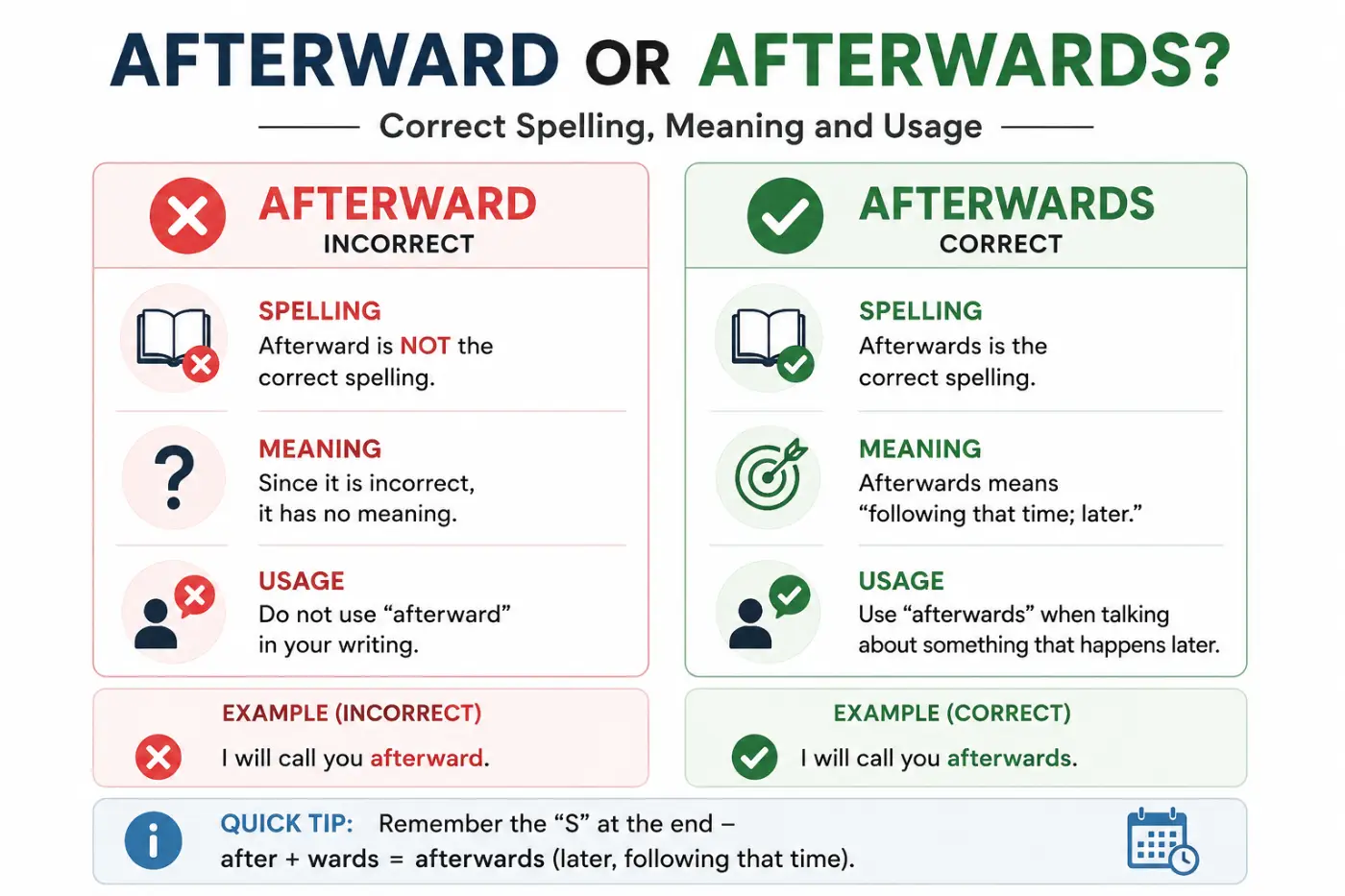
Afterward or afterwards often make writers pause because the two forms look almost identical. The extra s can make you wonder if one spelling is wrong or if the two words have different meanings. Both forms are correct. In American English the preferred form is afterward. In British English afterwards is especially common. The meaning stays the same in both forms. They refer to a later time or to something that happens after an earlier event.
The confusion usually comes from regional English rather than grammar. American dictionaries recognize afterwards as a variant while British and other varieties of English commonly use the form ending in s. That means you can see both spellings in reliable English writing.
This guide explains afterward or afterwards in plain English. You’ll learn which form to choose for American writing how the word works as an adverb where it came from how to pronounce it and how native speakers use it naturally. You’ll also see examples that make the distinction easy to remember.
You may also want to read Copys or Copies Which Spelling Is Correct in 2026.
Quick Definition
Afterward and afterwards are adverbs that mean at a later time or after something has happened. Both spellings are correct and have the same basic meaning. American English usually favors afterward while British English commonly uses afterwards. Neither form changes the meaning of the sentence.
Quick Answer
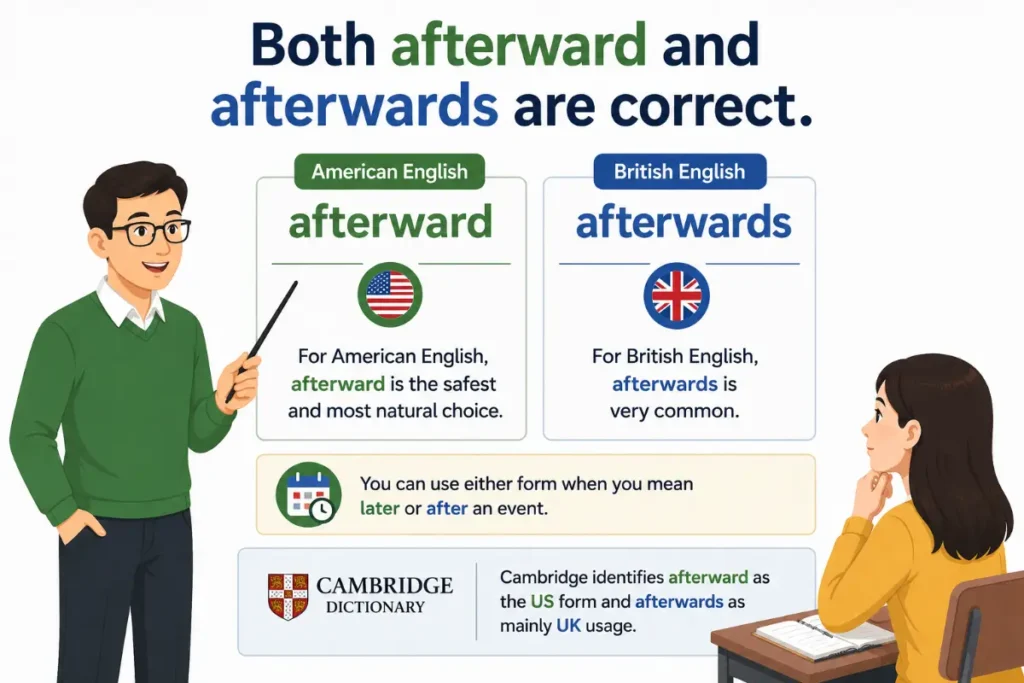
Afterward is the preferred form in American English. Afterwards is also correct and is especially common in British English. If you write for a US audience use afterward for the most natural American style. If you’re writing in British English afterwards is a perfectly normal choice.
Comparison Table for Afterward or Afterwards
| Correct Form | Meaning | Part of Speech | Origin | Usage Frequency | Formality | Common Contexts | Example |
|---|---|---|---|---|---|---|---|
| afterward | At a later time | Adverb | Old English and Middle English roots | Very common in American English | Neutral | US writing speech email academic writing news | We went home afterward. |
| afterwards | At a later time | Adverb | Old English and Middle English roots | Very common in British English | Neutral | UK writing speech email academic writing news | We went home afterwards. |
Both forms have the same grammatical role and meaning. The main distinction is regional preference rather than meaning. Merriam Webster lists afterwards as a variant of afterward while Cambridge identifies afterward as the usual US form and afterwards as mainly UK.
Meaning and Definition
Meaning of Afterward
Afterward is a standard English adverb meaning at a later time or after something has happened.
Consider this sentence.
We had dinner and went for a walk afterward.
The word tells the reader that the walk happened later than dinner. It doesn’t describe exactly how much time passed. The gap could be five minutes or several hours depending on the context.
Afterward can appear at the beginning or end of a sentence. It can also appear after a verb or clause when the meaning remains clear.
Afterward, we talked about the decision.
We talked about the decision afterward.
The two sentences communicate essentially the same idea.
Afterward isn’t slang or an informal shortcut. It’s a standard dictionary word. Merriam Webster defines it as a later or succeeding time and lists afterwards as a variant. Cambridge also identifies afterward as the usual American form.
Meaning of Afterwards
Afterwards has the same meaning as afterward.
She apologized afterwards.
This means she apologized at a later time following an earlier event.
The additional s doesn’t create a new meaning. It also doesn’t make the word plural. That point matters because some learners see the final s and assume it must have a grammatical function. It doesn’t work that way here.
Cambridge labels afterwards as mainly British and says American English usually uses afterward. Oxford gives the same general regional distinction by identifying afterwards as especially British and afterward as the usual North American form.
Why Both Forms Exist
English has several adverbs that appear with and without a final s. Words such as toward and towards and forward and forwards show a similar pattern.
Regional English developed different preferences over time. That doesn’t automatically make one form correct and the other incorrect.
For American readers the simplest choice is afterward. For British readers afterwards often sounds more natural.
Key Differences Explained
- SpellingAfterward has no final s. Afterwards has a final s. Both spellings appear in reputable dictionaries.
- Grammar roleBoth words function as adverbs. They describe when something happens in relation to another event.
- MeaningThe meaning is essentially identical. Both refer to a later time.
- ToneNeither form is inherently more formal. The choice mainly reflects regional English.
- ContextAmerican English generally prefers afterward. British English frequently uses afterwards. Canadian and Australian English can use both forms although local style preferences can vary.
- PronunciationThe extra s produces a small difference in pronunciation. Afterward ends with a d sound while afterwards ends with a z sound.
- Writing choiceIf your audience is American choose afterward as your default. If your publication follows British style afterwards may be the better choice.
Which Spelling Is Correct
Both spellings are correct.
That answer is worth remembering because many word comparison questions assume that one version must be wrong. This one doesn’t work that way.
Merriam Webster lists afterward as the main entry and identifies afterwards as a variant. Cambridge describes afterward as the US form and afterwards as mainly UK. Oxford likewise identifies afterwards as especially British and says North American English usually uses afterward.
For American English the strongest practical recommendation is afterward.
For British English afterwards is completely standard.
This is a regional spelling preference rather than a difference in correctness.
An experienced editor would also consider consistency. If you’re writing an American article and use afterward throughout the piece then suddenly switch to afterwards there’s no grammatical disaster. Still the change can look inconsistent. Choose one style and stick with it.
Sentence Examples
Here are natural examples using afterward.
- We went out for coffee afterward.
- She called me afterward to explain what happened.
- I felt much better afterward.
- The students stayed behind afterward to ask questions.
- We can discuss the details afterward.
- He apologized afterward and admitted that he had overreacted.
- Afterward, everyone agreed that the meeting had been useful.
- She moved to another city shortly afterward.
- I didn’t realize how serious the problem was until afterward.
- They celebrated afterward with a quiet dinner.
Here are examples showing finaly as a common misspelling of another English word. The correct spelling in each case is finally.
- I finally finished the report.
- She finally understood the instructions.
- We finally reached the station.
- He finally decided to accept the offer.
- They finally found the missing file.
The spelling finaly is not an accepted standard spelling of finally. The mistake happens because English spelling does not always make repeated consonants easy to predict. The correct form is finally with two l letters.
Common Mistakes and Misspellings
Several errors appear when writers use afterward and afterwards.
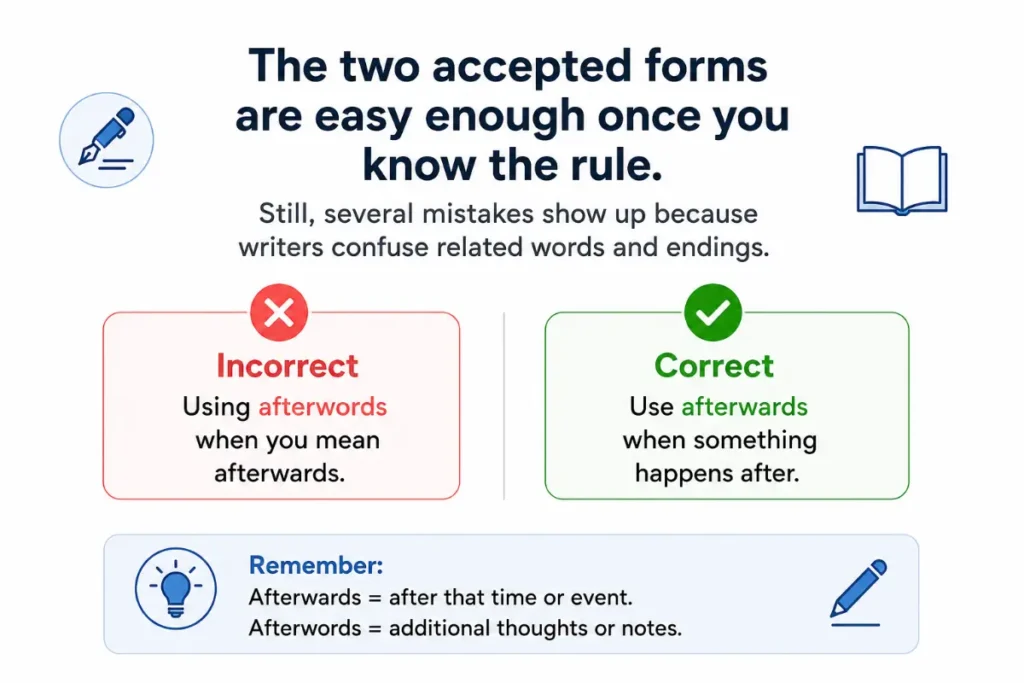
- Treating afterwards as incorrectThis mistake usually comes from American style. Afterwards is a valid English word and is especially common in British English. It isn’t a spelling error.
- Assuming the extra s changes the meaningIt doesn’t. Afterward and afterwards refer to the same basic idea of a later time.
- Mixing regional styles without a reasonA writer may use afterward in one paragraph and afterwards in another. That isn’t grammatically wrong but consistent regional style usually reads better.
- Confusing afterward with afterAfter can perform several grammatical roles. It can work as a preposition conjunction or adverb. Afterward is specifically an adverb meaning later.
- Writing finaly instead of finallyThis is a separate spelling issue that often appears in searches containing similar terms. Finally has two l letters. Finaly with one l is a common misspelling rather than a standard English word.
Why People Type Finaly
The spelling finaly is easy to produce because the pronunciation doesn’t clearly signal the doubled l. English spelling also contains many words where a consonant doubles before a suffix.
There is another NLP related reason. When people type quickly they often rely on familiar visual patterns instead of checking every letter. The brain can recognize the overall shape of a familiar word even when one letter is missing. That makes errors such as finaly especially easy to overlook during casual typing.
Search engines and spell checkers often recognize the intended word from surrounding context. That can make the mistake less noticeable to the writer.
Pronunciation Guide
Afterward is commonly pronounced:
IPA: /ˈæftərwərd/
A simple pronunciation guide is:
AF ter werd
The first part sounds like after. The second part sounds roughly like werd in American English.
Afterwards is commonly pronounced:
IPA: /ˈæftərwərdz/
A simple pronunciation guide is:
AF ter werdz
The final sound is different because afterwards ends with a voiced z sound.
Cambridge gives the American pronunciation of afterward as /ˈæf.tɚ.wɚd/ and lists the pronunciation of afterwards with the additional final sound. Oxford also provides pronunciation guidance for both forms.
A common pronunciation mistake is to pronounce every written letter too strongly. In natural American speech the middle syllables can become softer. Native speakers often say the word quickly as part of a larger sentence.
Try saying:
We’ll talk afterward.
Then say:
We’ll talk afterwards.
The difference is small and mainly appears at the end.
Many readers also check success or sucess Correct Spelling Meaning And Usage.
Etymology and Word Origin
The history of afterward reaches back much further than modern American and British spelling preferences.
Merriam Webster traces afterward to Middle English and ultimately to Old English æfterweard. The older form carried meanings connected with being behind or following. Over time the idea developed into the temporal meaning of something occurring later. Merriam Webster records the first known use of afterward in the 13th century.
Oxford traces afterwards to Old English roots and connects the word with forms involving æftewearde and the element related to ward. The modern form was influenced by after.
This history helps explain why the word has a transparent structure. After points to something later in time. The ending developed from an older directional or positional element.
English has changed these forms over centuries. Modern speakers don’t normally think about the historical pieces when they use the word. Still the history shows that afterward isn’t a modern invention or a casual shortened form.
The final s in afterwards also has a long history. Merriam Webster records Middle English forms such as afterwardes and efterwardes.
Regional Usage in the US
American English strongly favors afterward.
You’ll commonly see it in American newspapers academic writing business communication books and everyday speech. Cambridge identifies afterward as the usual American form while Merriam Webster uses afterward as its main dictionary entry.
If you’re writing for a US audience this is the form I’d recommend. It sounds natural and fits standard American editorial style.
For example:
We went home afterward.
That sentence sounds completely ordinary to an American reader.
Regional Usage in the UK
British English commonly uses afterwards.
Cambridge describes afterwards as mainly UK while Oxford identifies it as especially British English.
A British writer might naturally say:
We went home afterwards.
The sentence is just as correct as the American version. The difference is regional preference rather than grammar.
Regional Usage in Australia
Australian English can use both forms. The choice can depend on the publication style and the writer’s habits.
Because Australian English shares many features with British English it is common to encounter afterwards. However afterward also appears in modern English usage.
For an Australian publication consistency matters more than trying to force one universal rule. Follow the publication’s established spelling guide if one exists.
Regional Usage in Canada
Canadian English can also show both forms.
Canadian writing often reflects influences from both American and British English. As a result you may encounter afterward as well as afterwards.
If you’re writing for a Canadian audience there’s no need to treat one version as grammatically superior. Choose the form that matches the style guide or editorial voice of the publication.
Grammar Rules and Part of Speech
Afterward and afterwards are adverbs.
An adverb can modify a verb or provide information about time. In this case the word tells us that one event happens after another.
Consider:
We ate dinner afterward.
The adverb afterward tells us when the eating happened in relation to something already understood from the context.
The word can also appear at the beginning of a sentence.
Afterward, we went home.
A comma often follows an introductory adverb when it helps separate the opening element from the main sentence. The comma is a punctuation choice based on sentence structure and readability. It isn’t part of the word itself.
The word can also appear after a longer clause.
After we finished the meeting, we talked about it afterward.
This sentence is grammatically possible but stylistically repetitive because both after and afterward communicate the time relationship. A cleaner version would be:
After we finished the meeting, we talked about it.
Good editing isn’t only about finding grammatical errors. It’s also about removing unnecessary repetition.
Where to Place the Adverb
Afterward can appear in several positions.
At the beginning:
Afterward, we went for lunch.
At the end:
We went for lunch afterward.
After a clause:
She spoke to the manager and left afterward.
The final position is especially natural in everyday American English.
Afterward With Soon and Shortly
Afterward commonly appears with words such as soon and shortly.
We left shortly afterward.
She called soon afterward.
These combinations are useful because they show that the second event happened not long after the first. Cambridge and Oxford both provide examples using shortly afterward or shortly afterwards.
Real Life Usage Examples
Daily Talk
- I’ll call you afterward.
- Do you want to grab coffee afterward?
These sound natural in everyday American conversation. The word works well when the earlier event is already understood.
- I’ll send the documents afterward.
- We can discuss the remaining questions afterward.
In professional email writing afterward has a neutral tone. It doesn’t sound overly formal or overly casual.
Academic Writing
- The researchers collected the samples and analyzed them afterward.
- Participants completed a short survey afterward.
Academic writers use the word to establish a clear sequence of events. When precision matters you can also use subsequently if the context calls for a more formal term.
News Writing
- The officials spoke to reporters afterward.
- The team issued a statement shortly afterward.
News writing often favors concise time markers. Afterward works well because readers immediately understand the sequence.
Literature
- She remembered the conversation afterward with surprising clarity.
- He understood the significance only afterward.
Literary writing can use afterward to create a sense of reflection. The word is particularly effective when a character realizes something after an event has already passed.
Related and Confused Terms
Several expressions overlap with afterward but don’t always mean exactly the same thing.
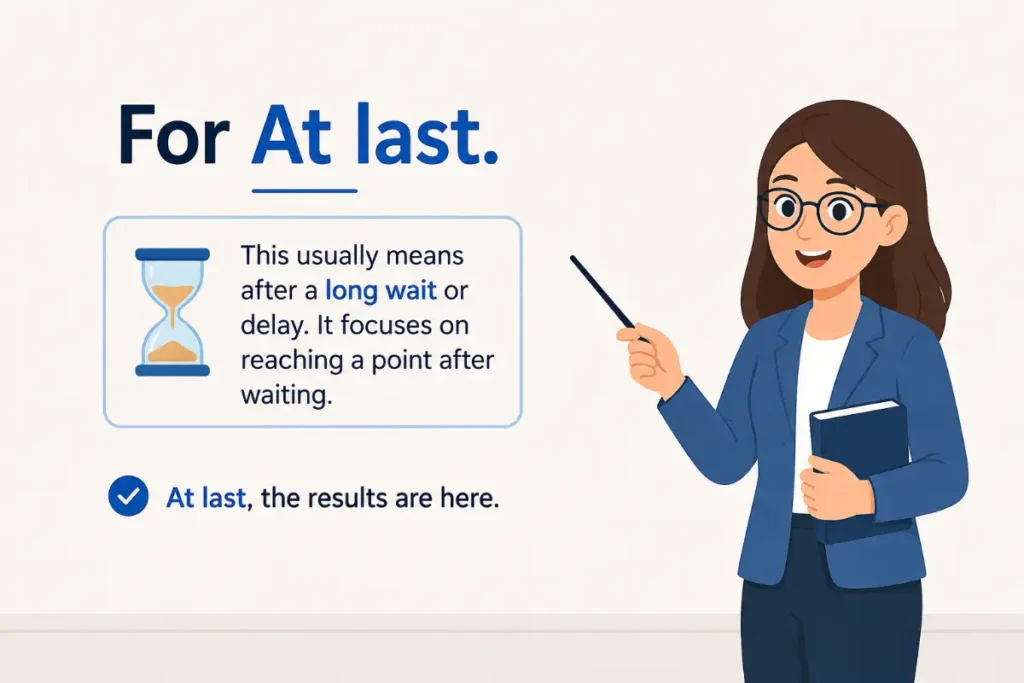
- At lastAt last usually emphasizes that something happened after a long wait. It often carries a feeling of relief or completion.
- EventuallyEventually means at some point after a period of time. It can suggest a longer process.
- UltimatelyUltimately often refers to the final result or conclusion of a situation rather than simply the next event.
- At the endAt the end identifies a position or final point. It often needs additional context such as at the end of the meeting.
- ConclusivelyConclusively means in a way that settles an issue. It isn’t a direct synonym for afterward.
- In the endIn the end usually introduces the final outcome of a situation. It can carry a sense of resolution.
- LastlyLastly usually introduces the final item in a sequence or list.
- SubsequentlySubsequently means at a later time and often sounds more formal than afterward. Merriam Webster lists subsequently among related synonyms.
These words overlap around the general idea of time and sequence but they aren’t interchangeable in every sentence.
For example:
We ate afterward.
This simply tells us that eating happened later.
We ate eventually.
This suggests that eating happened after some delay.
We ate in the end.
This suggests that eating became the final outcome.
The small differences matter because good word choice depends on meaning not just dictionary similarity.
Expert Editor Insight
As a senior editor I’d recommend choosing the form that matches your audience and then using it consistently. For American content afterward is the safest default because major dictionaries identify it as the usual US form. For British content afterwards is a natural choice. Spell checkers can also flag finaly because the standard spelling of finally contains two l letters. Language tools may suggest afterward or afterwards based on regional settings. The best editorial decision still comes from understanding the audience rather than blindly accepting every automated suggestion.
Expert Tip
If you’re writing specifically for Americans use afterward unless a quotation or source requires the British form. If your audience is international and the regional distinction isn’t important you can use either form. Just keep your choice consistent throughout the piece.
For another common grammar confusion, see Encorporate vs Incorporate Meaning and Usage 2026.
Conclusion
Afterward and afterwards are both correct English words. They have the same basic meaning and perform the same grammatical job as adverbs that refer to a later time. The main difference is regional preference. American English generally favors afterward while British English commonly uses afterwards.
If you’re writing for a US audience choose afterward as your default. If you’re following British English afterwards is perfectly natural. Don’t treat the extra s as a sign of incorrect spelling.
One practical tip can save you from most confusion. Think about your audience first and then stay consistent. Also remember that finaly is a separate spelling mistake. The correct form is finally with two l letters.
Frequently Asked Questions
Is finaly a real word?
Finaly is not the standard spelling of the English adverb finally. It is generally treated as a misspelling. The correct spelling contains two l letters. Finally can mean at last or after a long process. It can also introduce the last point in a sequence. For example you can say I finally finished the project. The spelling finaly should be corrected in standard English writing.
What does finally mean?
Finally is an adverb that commonly means at last or after a period of waiting. It can also introduce the last item in a sequence. For example you might say She finally arrived after several hours. You could also write Finally we need to review the budget. The word has a different meaning and spelling from afterward and afterwards even though all three can relate to time.
Afterward or afterwards which is correct?
Both forms are correct. American English usually prefers afterward while British English commonly uses afterwards. The difference is mainly regional. Neither spelling changes the basic meaning. Both words function as adverbs meaning at a later time. If you’re writing for a US audience afterward is the natural default. If you’re following British English afterwards is entirely standard.
How do you pronounce finally?
Finally is commonly pronounced /ˈfaɪnəli/. A simple guide is FYE nuh lee. The first syllable sounds like fine. The word has three syllables in ordinary pronunciation. Avoid adding an extra sound between the syllables. The spelling contains two l letters but that doesn’t mean you pronounce two separate l sounds. The important point is to keep the word smooth and natural.
Can finally start a sentence?
Yes. Finally can start a sentence when it introduces the last point or indicates that something happened after a long wait. For example you can write Finally we reached the station. When finally introduces a sentence as a transition it can be followed by a comma for clarity. It can also appear later in a sentence depending on the intended emphasis.
What is a synonym of finally?
Common synonyms for finally include at last eventually ultimately and in the end. The best choice depends on the meaning. At last often suggests relief after waiting. Eventually focuses on something happening after time passes. Ultimately often emphasizes the final result. Finally can also mean lastly when it introduces the last item in a sequence. These words overlap but aren’t identical.
Why do people misspell finally?
People often misspell finally because the pronunciation doesn’t clearly reveal the doubled l. Fast typing can also cause writers to omit a repeated letter. Another reason is visual familiarity. Your brain can recognize a familiar word from its overall shape and may overlook a missing letter. That’s why finaly can look acceptable at first glance even though standard English requires finally.
Is finally suitable for formal writing?
Yes. Finally is completely acceptable in formal writing. You can use it in academic essays professional reports business communication and formal explanations. The word can describe something that happened after a period of time or introduce the final point in an argument. Just make sure the meaning is clear. In highly technical writing subsequently or ultimately may sometimes provide a more precise alternative.