
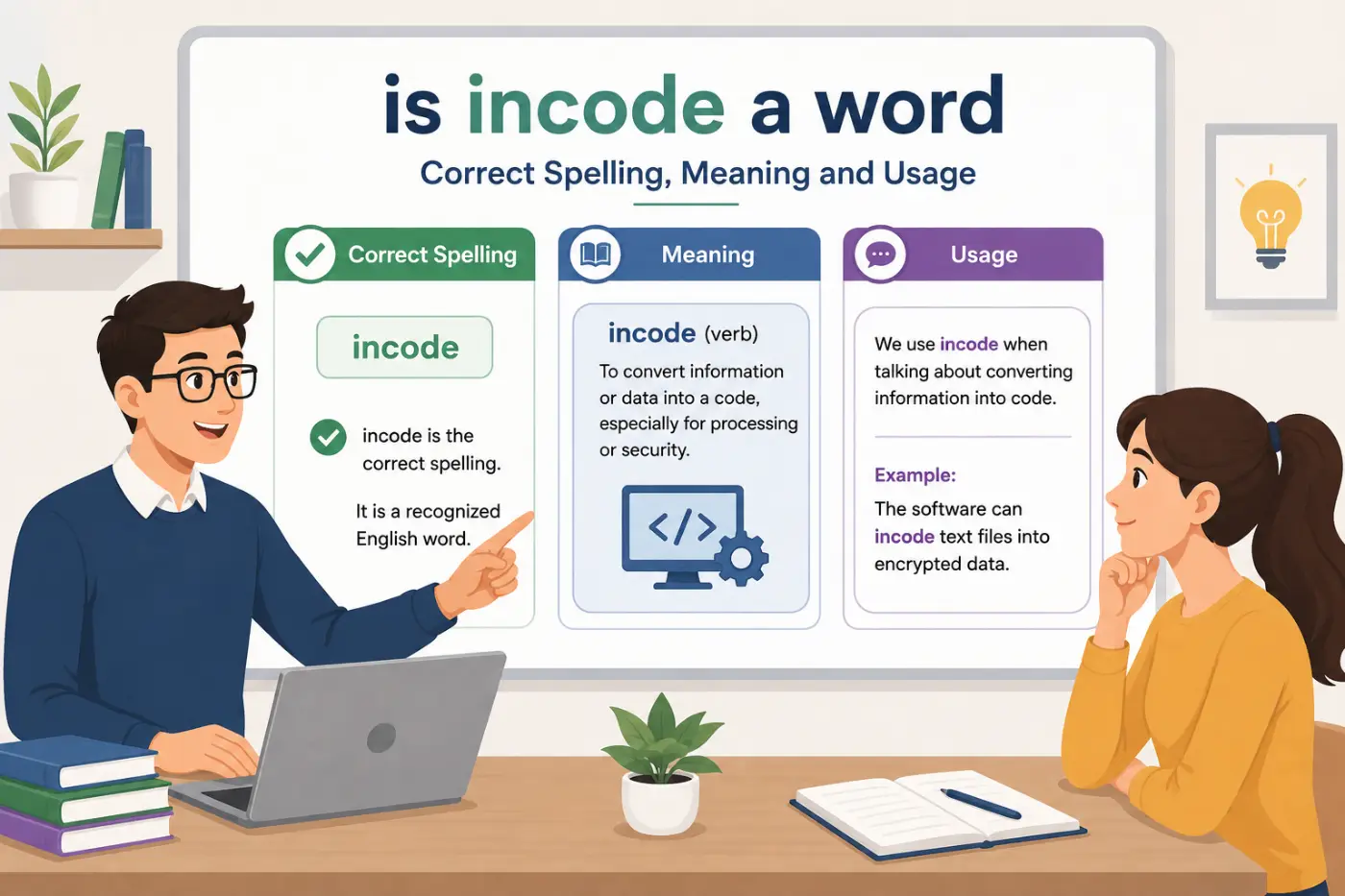
If you’ve typed incode and paused to ask yourself is incode a word you’re not alone. The spelling can seem natural because English has many words that begin with in. The confusion becomes even easier to understand when you hear encode aloud because its first sound can resemble the word in.
The direct answer is that incode isn’t the standard spelling of the verb encode. If you mean to convert information into code or another form of representation then encode is the correct word. There’s also a separate phrase in code written as two words. In specialized British postal terminology incode can appear as a noun referring to the inward part of a postcode.
This guide explains is incode a word in simple terms. You’ll learn what incode means in its limited specialist use what encode means how the words are pronounced and why people often confuse them. You’ll also see practical examples from everyday English technology academic writing business communication and formal contexts.
You may also want to read Analyzing or Analysing: Which Is Correct? 2026.
Quick Definition
Incode is not the standard English verb for putting information into code. The normal verb is encode. The two word phrase in code is also correct when something is written or communicated using a code. In specialized British postal language incode has a separate noun meaning.
Quick Answer
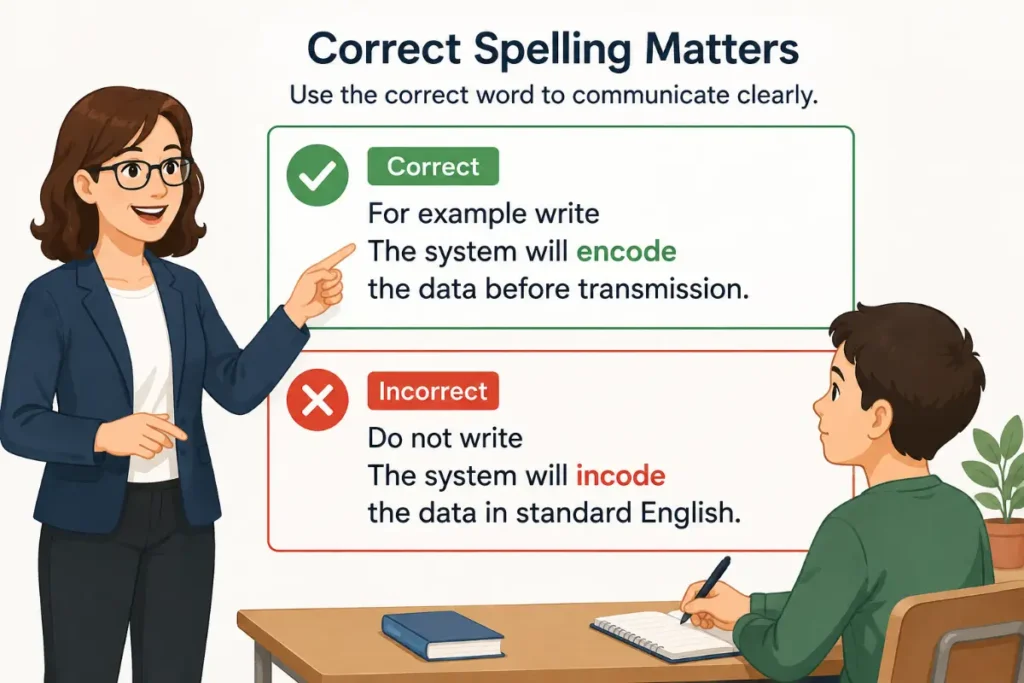
For example write The system will encode the data before transmission. Do not write The system will incode the data in standard English.
If you mean something written using a secret or special code use in code as two separate words. Cambridge and Oxford both recognize the phrase in code while major dictionaries list encode as the standard verb.
Comparison Table
| Correct Form | Meaning | Part of Speech | Origin | Usage Frequency | Formality | Common Contexts | Example |
|---|---|---|---|---|---|---|---|
| encode | Convert information into code or another representation | Verb | en plus code | Very common | Standard | Technology genetics communication data | The software will encode the file |
| incode | A specialized term for the inward part of a UK postcode | Noun | Short for inward code | Rare | Specialized | UK postal terminology | The incode identifies the inward part of the postcode |
| in code | Using a code or coded form | Phrase | in plus code | Common | Standard | Secret messages communication descriptions | The message was written in code |
| encoded | Converted into a coded form | Verb form or adjective | Past form of encode | Very common | Standard | Computing data genetics communication | The information was encoded securely |
| encoding | The process of converting information into a coded form | Noun or present participle | From encode | Very common | Standard | Computing linguistics communication | Encoding protects the data format |
Meaning and Definition
Meaning of Incode
The answer to is incode a word needs a little nuance.
In ordinary modern English incode is not the standard verb used as an alternative to encode. If you are writing about computers data messages genetics signals files or information then encode is the established word.
Major learner and general dictionaries support this distinction. Merriam Webster defines encode as a verb meaning to convert something from one system of communication into another and specifically includes converting a message into code. Cambridge also lists encode among the vocabulary associated with code. Oxford provides code and the phrase in code as standard English usage.
There is however a small wrinkle.
Incode does appear as a specialized noun in British postal terminology. Wiktionary records it as the second part of a United Kingdom postcode after the space and gives its origin as a shortening of inward code.
That specialized use doesn’t make incode a general replacement for encode.
Think of it like a word that has a tiny key on a large map. It has a legitimate place in one narrow context but doesn’t belong everywhere you might be tempted to use it.
Meaning of Encode
Encode is a standard English verb.
It means to convert information into a particular code system or form. The information might be a written message a digital file a signal a biological instruction or another kind of representation.
Merriam Webster defines encode as converting something from one system of communication into another. It also gives the meaning of converting a message into code and notes its use in genetics. The dictionary records its first known use around 1919.
For example you might encode a file before storing it. A computer can encode information using a particular format. A genetic sequence can encode information about proteins. A message can also be encoded so that another person needs the correct method to interpret it.
The word has become especially common in computing. Modern writing regularly uses forms such as encode data, encoded information, encoding process, character encoding, and video encoding.
Meaning of In Code
In code is different from both encode and the specialized noun incode.
It is a two word phrase.
When something is in code it is expressed using a system of symbols words numbers or other representations that aren’t presented in ordinary language.
For example:
The message was written in code.
The spies communicated in code.
The instructions were hidden in code.
Cambridge specifically gives in code as a standard phrase and provides examples involving coded messages. Oxford also lists in code in its entry for code.
This distinction is worth remembering because it solves several spelling problems at once.
If you mean the action of converting something into code use encode.
If you mean something is expressed using a code use in code.
If you’re discussing a specialized British postcode term use incode.
Key Differences Explained
Spelling
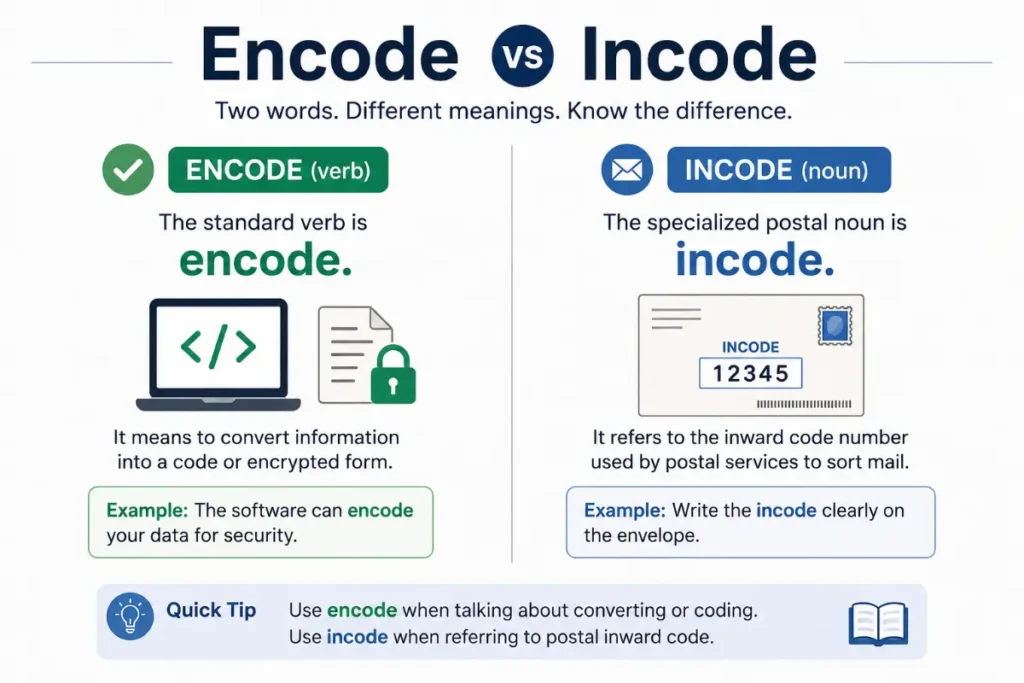
The standard verb is encode.
The specialized postal noun is incode.
The ordinary phrase describing something expressed using a code is in code.
The missing space in incode can change the grammatical identity of the expression. English spelling isn’t always predictable from sound alone. In this case the visual similarity between encode and incode makes the mistake particularly easy.
Grammar Role
Encode is a verb.
Incode in its specialized postal sense is a noun.
In code is a prepositional phrase.
That grammatical difference matters. You can’t simply swap the three forms because they don’t perform the same job in a sentence.
Meaning
Encode means to convert information into a coded or represented form.
Incode has a narrow British postal meaning.
In code means using a code to communicate or represent information.
Tone
Encode works comfortably in casual professional academic scientific and technical writing.
In code also works naturally across everyday and formal contexts.
Incode sounds unusual outside its specialist postal meaning. A reader may assume it’s a typo for encode.
Context
Technology almost always calls for encode when discussing the conversion of data.
Secret messages may be described as being in code.
British postcode terminology can use incode as a specialized noun.
Which Spelling Is Correct
For normal English writing encode is the correct spelling when you mean convert information into code. That conclusion isn’t based only on how the word looks or on personal preference. It follows dictionary evidence and the established grammatical role of the word.
Merriam Webster lists encode as a transitive verb. Cambridge also lists encode among standard terms related to code. Oxford’s dictionary material recognizes in code as a phrase rather than treating incode as the ordinary verb meaning to encode information.
There is one useful exception. Incode exists as a specialized noun connected with the inward part of a United Kingdom postcode. Wiktionary identifies it as a shortening of inward code.
So a careful editor would not say that the sequence of letters incode can never appear in English. That would be too broad. The better rule is simple.
Use encode for the standard verb.
Use in code for the phrase.
Use incode only when the specialized postal meaning is actually intended.
Sentence Examples
Natural Examples With Encode
- The software will encode the video before uploading it.
- Your browser can encode the information into a format the server understands.
- The system automatically encodes sensitive data before storage.
- Scientists study how genes encode instructions for making proteins.
- The application needs to encode the file before it can send it.
- The device can encode audio in several different formats.
- The developer used a new method to encode the data efficiently.
- Some systems encode information using binary patterns.
- The program will encode the message before transmission.
- The camera can encode high quality video in real time.
Examples Showing The Common Misspelling
- Incorrect: The program will incode the data before sending it.
- Correct: The program will encode the data before sending it.
- Incorrect: The application incodes the message automatically.
- Correct: The application encodes the message automatically.
- Incorrect: We need to incode the file first.
- Correct: We need to encode the file first.
The incorrect examples show why incode can look convincing. The surrounding grammar is perfectly normal. Only the verb spelling causes the problem.
Common Mistakes and Misspellings
Writing Incode Instead of Encode
This is the most common confusion. People often know the meaning but attach the wrong letters to the beginning of the word. The correction is straightforward.
Write encode.
Confusing Encode With In Code
This mistake goes in the other direction. Someone may write encode when they actually mean the phrase in code.
Compare these sentences.
The software will encode the file.
The message was written in code.
The first sentence describes an action. The second describes the form in which a message appears.
Using Incode As A Verb
In standard professional English avoid treating incode as a verb meaning to encode.
A sentence such as The system will incode the information should be changed to The system will encode the information.
Confusing Encode With Encrypt
These words are related but aren’t identical.
Encode is a broad term for converting information into another representation.
Encrypt normally means transforming information so unauthorized people can’t understand it without the appropriate key or method.
A file can be encoded without being encrypted.
This distinction matters in technical writing because using the wrong term can make a sentence less precise.
Confusing Encode With Decode
These words describe opposite directions.
To encode is to put information into a particular coded or represented form.
To decode is to convert coded information back into an understandable form.
Merriam Webster describes decode as converting something from code into intelligible form and identifies encode as its opposite in this sense.
A related grammar guide is In house KPIs Explained With Examples and Best Practices.
Why People Type Incode
The confusion isn’t random.
English speakers often rely on sound when spelling unfamiliar words. Encode is pronounced with an initial sound that can easily be interpreted as the familiar prefix in. That makes incode look like a reasonable spelling even though the standard written form uses en.
There is also a genuine linguistic reason for the confusion.
The prefix en has a meaning related to putting something into a particular state or form. The word encode can therefore be understood historically as putting something into code.
The Online Etymology Dictionary traces encode to en plus code and dates the word to the early twentieth century. It also notes that its computing sense developed later.
English contains many pairs where similar sounds don’t lead to identical spellings. Once you recognize that pattern you become less likely to trust pronunciation alone when spelling a new word.
This is a useful NLP point too. A language model or spelling system can identify incode as a plausible character sequence because it resembles familiar English patterns. Human writers make a similar prediction when they spell by sound. Context then determines which form belongs in the sentence.
Pronunciation Guide
Encode
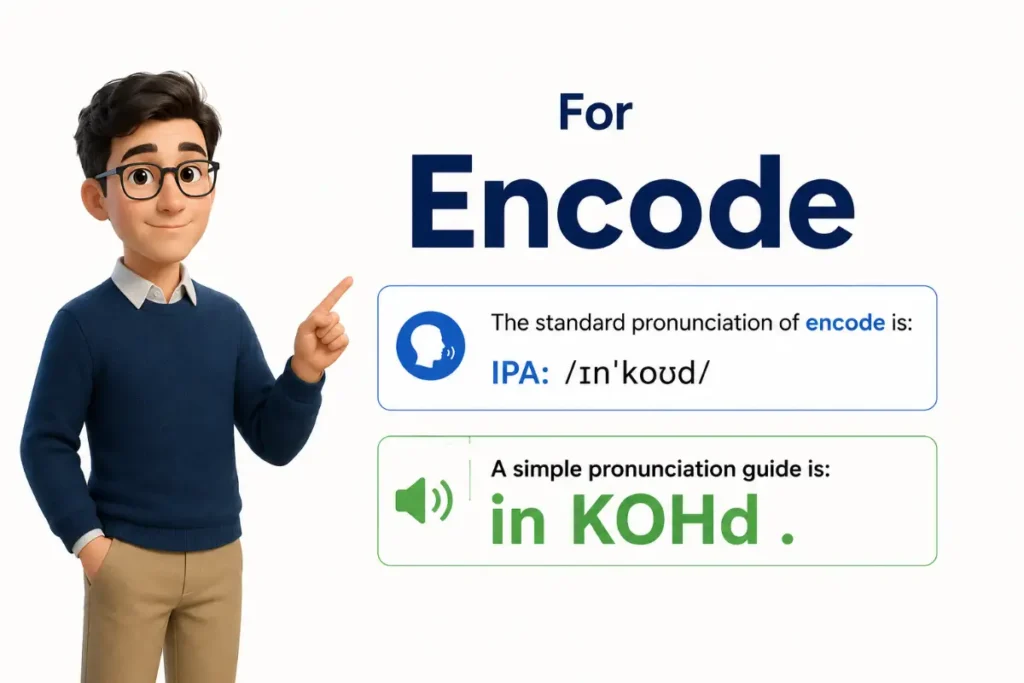
The standard pronunciation of encode is:
IPA: /ɪnˈkoʊd/
A simple pronunciation guide is:
in KOHd
The stress falls on the second syllable.
Say it naturally as two syllables:
en code
The first part sounds like in in many varieties of American English. That sound is one reason people sometimes spell the word incorrectly as incode.
Incode
In its specialized postal noun use incode is generally pronounced like:
IN code
The stress falls on the first part because the term functions as a noun built from inward code. Wiktionary records the postal sense and its derivation from inward code.
The pronunciation difference can help you distinguish the terms in careful speech.
In Code
The phrase in code is pronounced as two words:
in KOHd
The grammatical context usually makes the meaning clear.
For example:
The message was written in code.
Here in code describes how the message was written.
Etymology and Word Origin
The history of encode explains why the spelling begins with en.
The Online Etymology Dictionary traces the word to en meaning roughly put in or into plus code. It dates the verb to around 1917 and records a computing sense from the mid twentieth century.
The history of code itself goes much further back.
Merriam Webster traces code through Middle French to Latin codex and earlier caudex. The original Latin connection involved a book or collection of written material. The meaning later developed into ideas involving systems of laws symbols signals and coded communication.
This gives encode a fairly transparent structure.
En carries the idea of putting into.
Code supplies the system or representation.
Together they form a verb describing the act of putting information into a coded form.
The postal noun incode has a different history. Wiktionary identifies it as a shortened form of inward code. In that specialized British context the word developed as a practical postal term rather than as an alternative spelling of the verb encode.
That distinction is important. Two words can look almost identical while having different histories.
Regional Usage
US English
In American English encode is the standard verb for converting information into code or another representation.
In code is also standard when describing a coded message or communication. Cambridge lists this phrase in its English dictionary.
American readers will usually interpret incode used as a verb as a spelling mistake.
UK English
British English also uses encode as the standard verb.
The interesting exception is the specialized noun incode in postcode terminology. The term refers to the inward part of a United Kingdom postcode and is associated with the concept of an inward code.
This narrow use shouldn’t be confused with the ordinary verb encode.
Australian English
Australian English follows the broader international pattern for standard computing and communication terminology.
Use encode when describing the conversion of information into a coded form.
Use in code when describing a message or other information expressed through a code.
There is no general reason for an Australian writer to replace encode with incode.
Canadian English
Canadian English also follows the standard spelling encode.
In professional technical academic and general writing incode should not be used as a substitute for encode.
The phrase in code remains two words when that meaning is intended.
Grammar Rules and Part of Speech
Encode is a verb.
It can take a direct object because the action is normally performed on something.
For example:
The program encodes the file.
The system encoded the message.
The application is encoding the data.
The researchers encoded the information.
The basic forms are:
Base form: encode.
Third person singular: encodes.
Past tense: encoded.
Present participle: encoding.
The verb can appear in several common grammatical structures.
Encode something.
The program will encode the file.
Encode something into something.
The system encoded the information into a digital format.
Encode something as something.
The application encoded the image as a compressed file.
These structures are useful because they show how the verb behaves naturally in professional writing.
Sentence Placement
Because encode is a verb it normally appears after the subject or after an auxiliary verb.
The software encodes the data.
The software will encode the data.
The software has encoded the data.
The software is encoding the data.
You can also use the passive form.
The data was encoded before transmission.
The message was encoded securely.
Punctuation
The word encode doesn’t require special punctuation.
If you use it in a normal sentence simply follow standard English punctuation rules.
For example:
The program will encode the file before transmission.
You don’t need quotation marks or italics merely because the word is technical.
Real Life Usage Examples
Daily Talk
- You might hear someone say that a device can encode a video before sharing it.
- Someone explaining a secret message might say that the message was written in code.
These uses are natural because encode describes an action while in code describes a form of communication.
- The IT team will encode the files before sending them to the client.
- Please confirm that the system has encoded the information correctly.
Professional email favors the standard spelling because readers need to understand technical instructions quickly.
Academic Writing
- Researchers can encode observations into numerical categories for analysis.
- The study examines how biological systems encode information.
Academic writing benefits from precise terminology. Using encode makes the intended technical meaning immediately clear.
News Writing
- The device can encode large amounts of information in a compact format.
- Scientists are studying how organisms encode complex biological instructions.
News writing generally favors familiar standard vocabulary over unusual variants.
Literature
- The author may encode a political idea through symbolism.
- The poem contains images that encode several layers of meaning.
The verb isn’t limited to computers. It can describe symbolic communication in literature and cultural analysis as well.
Related and Confused Terms
At Last
At last usually means something happens after a long wait.
Example:
At last the train arrived.
It often carries an emotional sense of relief or impatience.
Eventually
Eventually means something happens after some time or after a sequence of events.
Example:
She eventually found the missing document.
It focuses on the final outcome rather than the act of converting information into a code.
Ultimately
Ultimately refers to the final result or conclusion.
Example:
The decision ultimately depended on cost.
It can overlap with eventually but often emphasizes the final conclusion or most important result.
At The End
At the end refers to the final point of something.
Example:
At the end of the chapter the mystery is explained.
It is usually more literal and specific than ultimately.
Conclusively
Conclusively means in a way that settles an issue with strong evidence or certainty.
Example:
The evidence did not conclusively prove the claim.
This word is especially common in formal analytical writing.
In The End
In the end means finally or after everything has happened.
Example:
In the end they chose the simpler option.
It often summarizes the final outcome of a situation.
Lastly
Lastly introduces the final item in a sequence.
Example:
Lastly we reviewed the financial figures.
It works differently from encode because it functions as an adverb used to organize information.
Code
Code can refer to a system of symbols rules or instructions.
For example:
The message was written in code.
The developer wrote the code for the application.
Understanding code makes the difference between encode and in code easier to remember.
Expert Editor Insight
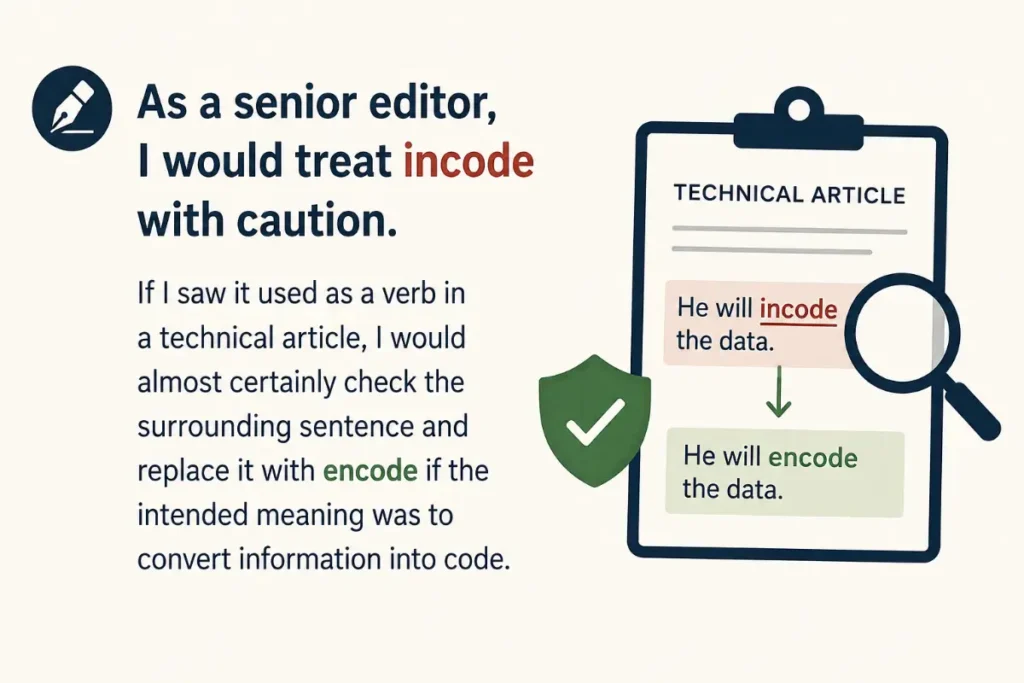
As a senior editor I would treat incode with caution. If I saw it used as a verb in a technical article I would almost certainly check the surrounding sentence and replace it with encode if the intended meaning was to convert information into code. Dictionary evidence supports encode as the established verb while in code is a standard phrase. The specialized noun incode deserves attention only when the text is discussing the inward portion of a UK postcode.
A useful editing habit is to test the word by asking what job it performs.
If it describes an action use encode.
If it describes a message or information expressed through a coding system use in code.
If it names the inward portion of a British postcode incode may be appropriate.
That three way test is faster and more reliable than trying to memorize isolated spellings.
Expert Tip
When you aren’t sure about incode or encode replace the questionable form mentally with convert into code. If the sentence still makes sense you almost certainly need encode.
For example:
The program will convert the data into code.
That naturally becomes:
The program will encode the data.
This simple substitution trick works because it tests meaning instead of relying only on pronunciation.
You may also want to read Journies Or Journeys 2026 Grammar Rules and Examples.
Conclusion
The answer to is incode a word depends on the context. In standard English incode isn’t the normal spelling of the verb meaning to convert information into code. The correct verb is encode. The phrase in code is also correct when something is expressed through a code. A specialized British postal noun incode does exist for the inward part of a postcode.
For everyday writing keep the distinction simple. Use encode for the action. Use in code for the description. Reserve incode for its narrow postal meaning. When in doubt replace the word with convert into code. If that meaning fits your sentence then encode is almost certainly the form you need.
FAQs
Is Incode A Real Word?
Yes but only in a limited specialist sense. Incode is recorded as a noun referring to the second part of a United Kingdom postcode after the space. Wiktionary traces it to the phrase inward code. It isn’t the standard general English verb meaning to convert information into code. For that meaning use encode.
What Does Encode Mean?
Encode means to convert information from one system of communication or representation into another. It can describe digital data written messages signals or genetic information. Merriam Webster lists it as a verb and includes the meaning of converting a message into code. The word is common in computing science communication genetics and many other technical fields.
Incode Or Encode Which Is Correct?
Encode is correct when you mean to convert information into code. Incode should not be used as a general alternative to that verb. The separate phrase in code is correct when something is expressed using a code. The specialized noun incode has a narrow British postal meaning connected with the inward part of a postcode.
How To Pronounce Encode?
Encode is pronounced /ɪnˈkoʊd/ in standard American English. You can think of it as in KOHd with the main stress on the second syllable. The first sound can make the spelling confusing because it sounds similar to the beginning of in. The written form is still encode with en rather than in.
Can Encode Start A Sentence?
Yes. Encode can begin a sentence when it is used as an instruction or an imperative verb. For example: Encode the file before sending it. It can also begin a sentence in other grammatical constructions. There is nothing grammatically unusual about starting a sentence with encode when the sentence structure supports it.
What Is A Synonym Of Encode?
Useful synonyms depend on the context. Convert works when information is changed from one format to another. Code can work in some technical contexts. Cipher or encipher can fit messages that are converted into cipher. Represent may work when information is expressed through symbols. Don’t treat these words as perfect substitutes because each carries a slightly different meaning.
Why Do People Misspell Encode As Incode?
The spelling confusion mainly comes from pronunciation and English word patterns. The beginning of encode sounds close to the word in in ordinary speech. English also contains many familiar words that begin with in. A writer who spells by sound may therefore create incode even though the established spelling of the verb is encode.
Is Encode Suitable For Formal Writing?
Yes. Encode is completely suitable for formal academic professional scientific and technical writing. It is an established dictionary word with a clear grammatical role. In formal writing precision matters more than using complicated vocabulary. If you mean converting information into a coded or represented form then encode is the clean and professional choice.