
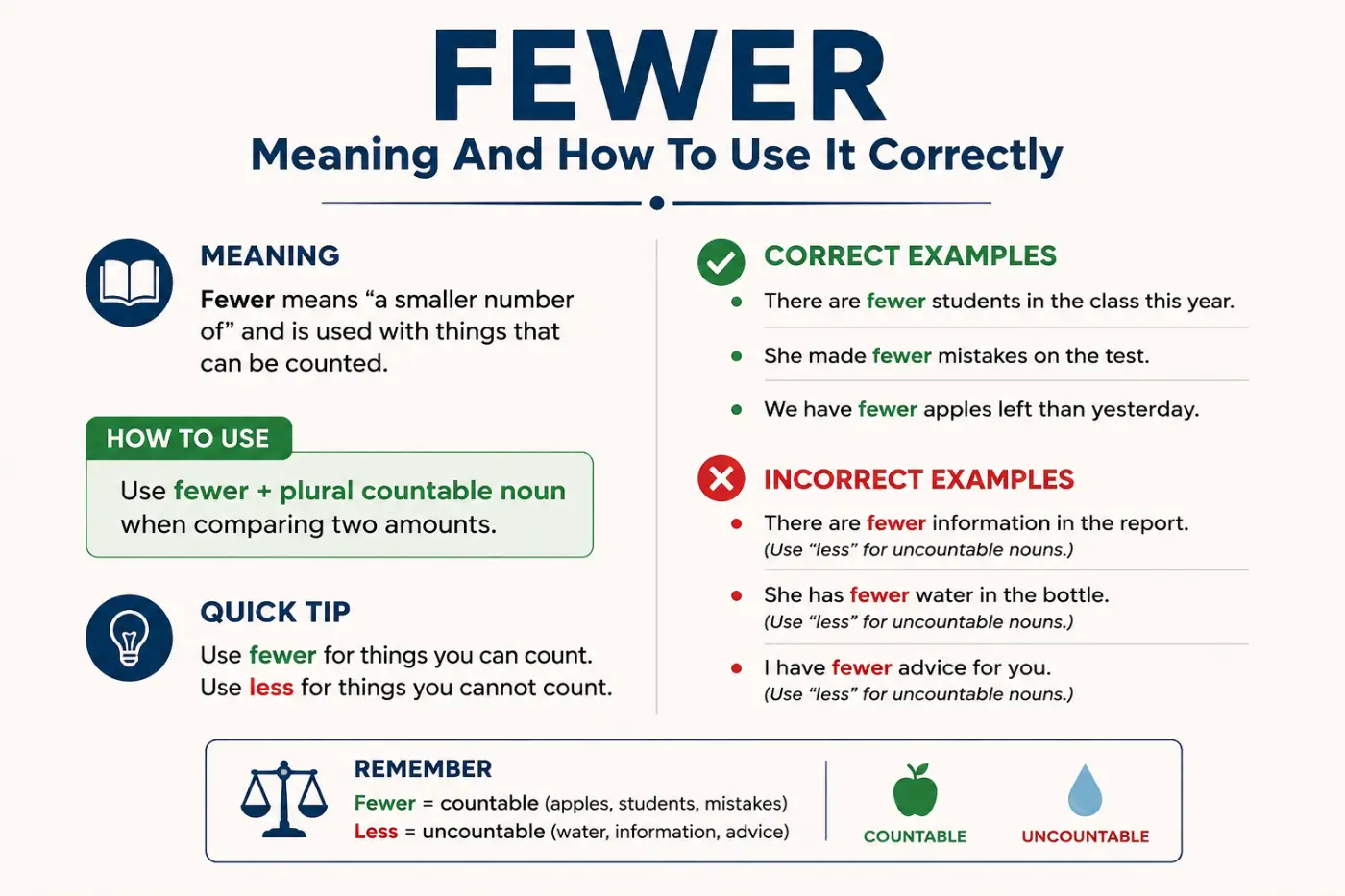
Understanding fewer meaning gives you more than a dictionary definition. It helps you choose the right word when you compare quantities. It also helps you avoid one of the most noticeable grammar mistakes in formal writing.If you’ve ever wondered if you should write fewer people or less people you’re dealing with one of the most common quantity questions in English. The basic rule is simple.
Fewer means a smaller number of people or things that you can count. It normally goes with plural countable nouns such as books cars questions and mistakes. The word can look easy but its grammar becomes tricky when everyday speech doesn’t always follow traditional rules. You may hear native speakers say less people or less problems in casual conversation. Standard edited English generally prefers fewer people and fewer problems.
This guide explains what fewer means how it works as a determiner and pronoun how it differs from less how to pronounce it and how native speakers use it in real situations. You’ll also find practical examples and answers to common questions.
You may also want to read alter vs altar The Complete Difference Guide 2026.
Quick Definition
Fewer means a smaller number of people or things. It is the comparative form of few and normally comes before plural countable nouns. You can say fewer students, fewer books, and fewer mistakes because each item can be counted separately. Cambridge Dictionary identifies fewer as the comparative form used with plural countable nouns.
Quick Answer
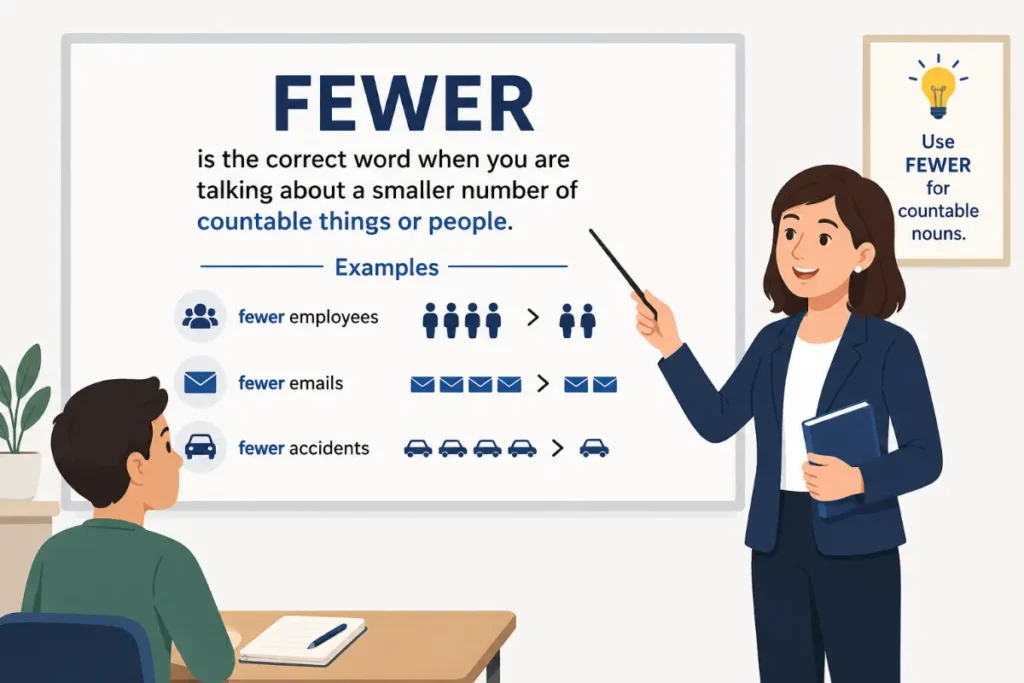
Fewer is the correct word when you are talking about a smaller number of countable things or people. You can say fewer employees, fewer emails, and fewer accidents.
For uncountable amounts you normally use less instead. That gives you the basic contrast: fewer cars but less traffic. Cambridge Grammar explains this traditional distinction clearly.
Comparison Table For Fewer Meaning
| Correct Form | Meaning | Part of Speech | Origin | Usage Frequency | Formality | Common Contexts | Example |
|---|---|---|---|---|---|---|---|
| fewer | a smaller number | Determiner or pronoun | Comparative form of few | Very common | Standard | People objects questions mistakes | Fewer students attended the class. |
| few | a small number | Determiner pronoun noun or adjective | Old English roots | Very common | Standard | Small quantities | Few students missed the test. |
| less | a smaller amount | Determiner pronoun adverb or preposition | Comparative form of little | Very common | Standard | Uncountable amounts degree | We need less water. |
| fewest | the smallest number | Determiner or pronoun | Superlative form of few | Common | Standard | Comparing three or more groups | This class has the fewest students. |
| fewer than | a number below a stated amount | Determiner phrase | Comparative construction | Very common | Standard | Statistics quantities limits | Fewer than fifty people applied. |
Meaning And Definition
Meaning Of Fewer
Fewer means not as many or a smaller number of. It compares one number with another.
For example:
There are fewer students in this class.
The sentence tells us that the class has a smaller number of students than another class or than it had before.
The noun students is plural and countable. You can count one student two students three students and so on. That makes fewer the traditional standard choice.
The word is not normally used to describe an uncountable substance or general amount. You wouldn’t normally say fewer water because water isn’t counted as separate water units in that context. You would say less water.
Cambridge Dictionary describes fewer as the comparative form connected with few and gives examples involving people complaints and other plural countable nouns.
Meaning Of Few
Understanding few makes the meaning of fewer much easier.
Few refers to a small number. Fewer compares that number with another number.
Consider these examples.
Few people attended.
This means that only a small number of people attended.
Fewer people attended this year.
This means the number of people who attended this year was smaller than the number in another period.
That small change from few to fewer changes the grammatical relationship. The first describes a limited number. The second compares quantities.
Fewer As A Comparative Word
English uses fewer to show a decrease in number.
We received fewer complaints this month.
The sentence suggests a comparison with another month.
She made fewer mistakes after practicing.
The comparison is between her performance before and after practice.
The new system requires fewer steps.
The writer compares the number of steps required by the new system with an earlier system or another process.
This comparative meaning is the heart of the word.
Key Differences Explained
- Spelling. The correct spelling is fewer. It has the letters f e w e r. It should not be written as fewerer or confused with fewest.
- Grammar role. Fewer usually works as a determiner before a plural countable noun. It can also work as a pronoun when the noun is understood.
- Meaning. Fewer means a smaller number. It focuses on things that can normally be counted as individual units.
- Tone. Fewer is completely neutral. It works in casual conversation academic writing professional communication journalism and formal documents.
- Context. Use fewer with plural countable nouns in standard English. Use less with singular uncountable nouns and amounts.
- Comparison. Fewer normally implies a comparison even when the second quantity is not directly stated.
The difference becomes especially clear in pairs such as fewer books and less paper. Books are individual objects that you can count. Paper is normally treated as an amount rather than a collection of separate units.
Which Spelling Is Correct
The correct form is fewer.
There is no accepted standard spelling fewar or fewerr for this word. The spelling follows the established comparative form of few.
Dictionary and grammar references support this use. Cambridge lists few as a determiner and pronoun and gives fewer as the comparative form used for a smaller number. Its grammar guidance states that fewer normally appears with plural nouns while less normally appears with uncountable nouns.
From an editing perspective the safest rule is straightforward. Look at the noun after the quantity word.
If you can count the individual items use fewer.
fewer chairs
fewer customers
fewer questions
If you are describing an amount or degree use less.
less water
less time
less money
This simple test works in most everyday writing situations.
Fewer Versus Less
The most important comparison is between fewer and less.
Use fewer with plural countable nouns.
fewer apples
fewer employees
fewer accidents
fewer pages
Use less with singular uncountable nouns.
less sugar
less traffic
less information
less noise
Cambridge Grammar gives the same traditional distinction and notes that many people now use less with plural countable nouns in informal speech. Standard edited English still generally favors fewer with plural countable nouns.
Consider this pair.
The city has fewer buses.
The city has less traffic.
Buses are individual objects. Traffic is an overall amount or flow. The nouns determine the choice.
There are also situations where the choice depends on meaning.
We have fewer than ten employees.
We have less than ten minutes.
Employees are countable. Minutes are also countable when you mean individual units of time. Yet English traditionally treats expressions involving time money distance and measurement as amounts in many contexts.
For example:
The trip took less than ten minutes.
That sounds completely natural because the speaker is treating the ten minutes as an amount of time.
This is one reason the simple rule is useful but not absolute. Good grammar requires attention to how the noun is being used in the sentence.
Sentence Examples
Here are natural examples showing how native speakers commonly use fewer.
- Fewer people came to the meeting than we expected.
- I made fewer mistakes after reviewing the instructions.
- The new car uses fewer parts than the older model.
- We received fewer applications this year.
- There are fewer restaurants in this neighborhood than downtown.
- The teacher asked fewer questions during the final lesson.
- Fewer students needed extra help after the review session.
- The company has fewer employees than it had five years ago.
- Try to make fewer changes when you edit the final draft.
- The updated process takes fewer steps to complete.
These examples share the same basic structure. Fewer comes before a plural noun that represents countable units.
Common Misspelling Examples
People sometimes type the word incorrectly because the spelling does not perfectly match its pronunciation.
Here are five incorrect examples.
- The store has fewar customers today.
- We received fewerer complaints this month.
- There are feweer people waiting outside.
- The report contains feewer errors than the first version.
- The team had fewe r problems after the update.
These forms are not standard English spellings. The correct word is fewer. A useful memory trick is to connect few with fewer. The base word stays visible and the comparative ending er is added.
few → fewer
fast → faster
small → smaller
The pattern helps your brain recognize the correct spelling.
Common Mistakes And Misspellings
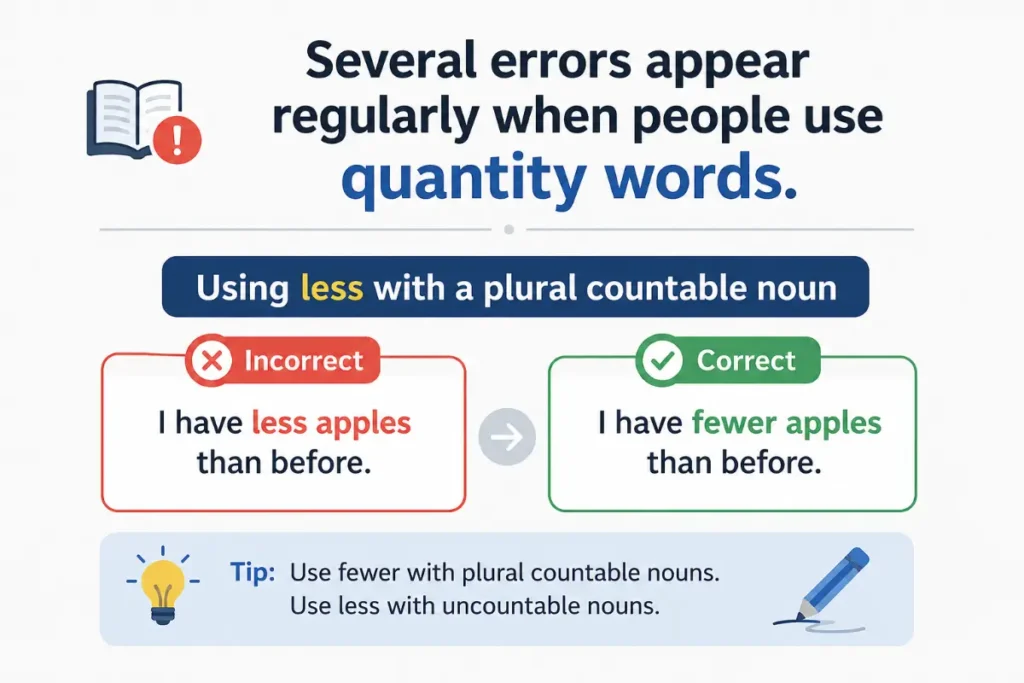
Several errors appear regularly when people use quantity words.
- Using less with a plural countable noun.
The traditional standard form is fewer cars rather than less cars. Casual speech often uses the second version but formal edited writing generally prefers the first.
- Writing fewerer.
Fewer already contains the comparative ending. Adding another comparative ending creates an incorrect form.
- Confusing fewer with fewest.
Use fewer for a comparative relationship. Use fewest when identifying the smallest number among a group of three or more.
This class has fewer students than that class.
This class has the fewest students in the school.
- Using fewer with an uncountable amount.
You should normally say less water rather than fewer water.
- Assuming every measurement needs fewer.
English treats many measurements as amounts.
less than five miles
less than three hours
less than ten dollars
The noun and the meaning both matter.
Why People Make These Errors
Language learners often build a mental shortcut around the idea of quantity. If less means a smaller amount and fewer also signals reduction then choosing between them can feel arbitrary.
There is also an NLP related issue involving sound and visual similarity. When people process language quickly they often rely on familiar patterns rather than analyzing every grammatical feature. Words such as few fewer fewest less and least form a related semantic group. Their meanings overlap enough to create confusion while their grammatical roles differ.
Typing adds another layer. People often type according to how a word sounds. Since fewer is pronounced with two syllables many learners may mentally reconstruct its spelling incorrectly.
Reading the word regularly is one of the best ways to build strong visual memory.
Pronunciation Guide
The standard pronunciation of fewer is:
IPA: /ˈfjuːər/ in many American English pronunciation systems.
You can think of it as:
FYOO er
It has two syllables.
few er
The first syllable sounds like few. The second is a light unstressed sound similar to er.
Avoid pronouncing it as one heavy syllable. Also avoid changing the first vowel into the sound found in flower or fear.
The pronunciation is close to few + er which makes the spelling easier to remember.
Fewer In American English
In American English the word commonly sounds like FYOO er. The first syllable receives the main stress.
FEW er
The second syllable is much weaker.
When spoken quickly the two syllables can blend together. That can make the spelling harder to recognize if you mainly learn English through conversation.
A good practice method is to say the base word first.
few
Then extend it.
fewer
Then place it inside a sentence.
There are fewer people here.
This connects pronunciation grammar and meaning at the same time.
Etymology And Word Origin
The history of fewer goes back to the older English word few.
The word few has deep Germanic roots and is related to similar words found in other Germanic languages. English developed its comparative form by adding the familiar comparative ending er.
That gives the basic historical pattern:
few → fewer
The form has remained remarkably stable even as English pronunciation and vocabulary have changed.
This is useful because it shows that fewer is not an arbitrary modern construction. It belongs to a long established English pattern.
Modern English uses er in many comparative forms.
short → shorter
small → smaller
few → fewer
The meaning developed around comparison of number. When you say fewer, you are measuring one number against another.
You may also want to read Carrer or Career Which Spelling Is Correct? 2026.
Regional Usage In The US
American English follows the traditional distinction between fewer and less in careful edited writing. Fewer people fewer cars and fewer mistakes are standard forms.
In everyday American speech you may hear less before plural countable nouns. Phrases such as less people can appear in casual conversation. Many speakers understand them without difficulty.
For professional writing academic work journalism and polished business communication fewer remains the safer choice with plural countable nouns.
Regional Usage In The UK
British English also maintains the traditional distinction between fewer and less. Cambridge Grammar specifically describes fewer with plural nouns and less with uncountable nouns.
British speakers also use less with some plural countable nouns in informal contexts. This does not erase the traditional grammar rule. It shows that spoken English can be more flexible than formal edited English.
Regional Usage In Australia
Australian English generally follows the same broad grammatical pattern found in other major English varieties.
You’ll normally see fewer people fewer cars and fewer problems in edited writing. Less remains the usual choice for uncountable amounts such as time money water and information.
Everyday speech can be more relaxed. Still fewer is the strong choice when you want polished standard English.
Regional Usage In Canada
Canadian English also follows the conventional distinction between fewer and less.
Formal Canadian writing commonly uses fewer with plural countable nouns. Informal speech can show variation just as it does in American and British English.
There is no major regional Canadian spelling of fewer that replaces the standard form.
Grammar Rules And Part Of Speech
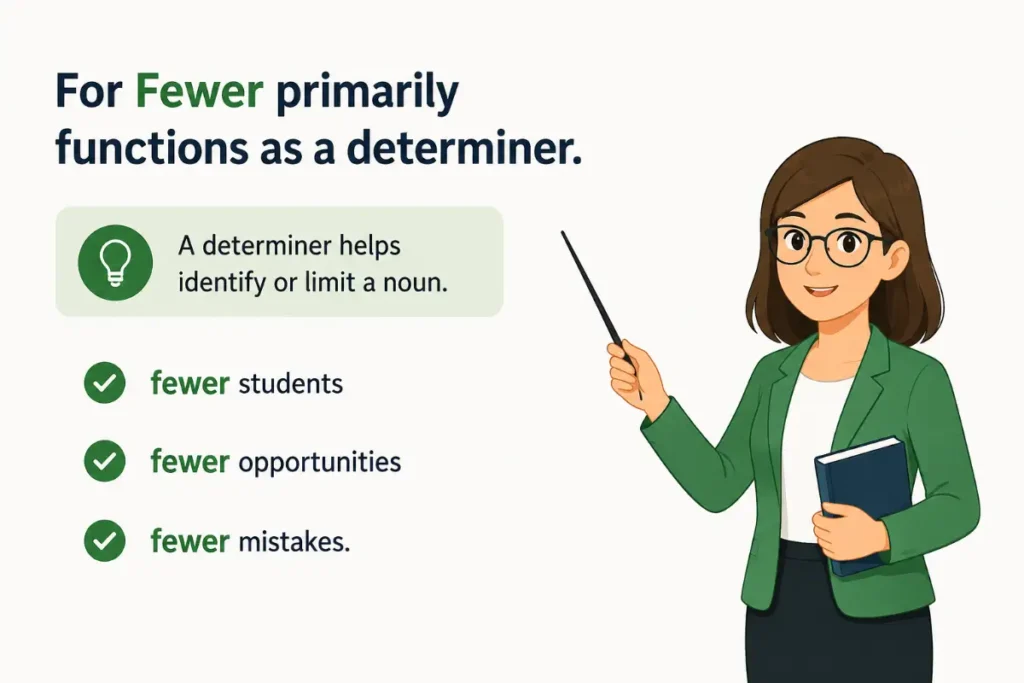
Fewer primarily functions as a determiner.
A determiner helps identify or limit a noun.
fewer students
fewer opportunities
fewer mistakes
It can also function as a pronoun when the noun is understood.
Some students passed and fewer failed.
Here the word students is understood after fewer.
Fewer With Countable Nouns
Use fewer with plural countable nouns.
fewer books
fewer houses
fewer emails
fewer questions
These nouns represent things that can be counted individually.
Fewer Than
The expression fewer than is extremely common.
Fewer than twenty people attended.
The job takes fewer than five hours.
Fewer than one hundred tickets remain.
It means a number below a stated amount.
Fewer Of
Use fewer of when a determiner or pronoun follows.
fewer of them
fewer of these problems
fewer of the students
Cambridge Grammar explains that fewer takes of before pronouns and certain noun phrases.
Sentence Position
Fewer usually appears immediately before the noun it modifies.
fewer questions
fewer opportunities
fewer complaints
When it works as a pronoun it can stand alone.
We expected more applications but received fewer.
Punctuation
The word itself does not require special punctuation.
Fewer students attended the lecture.
If fewer appears at the beginning of a sentence you do not add punctuation simply because of the word.
Fewer people are buying printed newspapers.
The punctuation depends on the complete sentence rather than the quantity word.
Real Life Usage Examples
Daily Talk
We have fewer eggs than we need for breakfast.
I’m seeing fewer friends this week because I’m busy.
These sentences sound natural in ordinary conversation.
We received fewer responses than expected.
Please send fewer attachments in future emails.
The word works well in professional communication because it is neutral and precise.
Academic Writing
The second group reported fewer errors than the first group.
Students who practiced regularly made fewer grammatical mistakes.
Academic writing benefits from the clear distinction between countable numbers and uncountable amounts.
News Writing
Fewer residents attended the public meeting this year.
The latest report recorded fewer accidents on the highway.
News writing often relies on quantity comparisons. Fewer provides a concise way to describe numerical changes.
Literature
Fewer voices could be heard as the evening grew darker.
He returned with fewer hopes but greater determination.
Literary writing can use fewer literally or figuratively. The grammatical principle remains the same when the noun is countable.
Related And Confused Terms
Several words and phrases belong to the same semantic field as fewer. They do not all mean exactly the same thing.
- At last means after a long wait or delay.
- Eventually means at some point after a period of time.
- Ultimately means finally or in the final result.
- At the end identifies the final point of something.
- Conclusively means in a way that settles an issue or proves something.
- In the end refers to the final outcome or result.
- Lastly usually introduces the final item in a sequence.
- Fewest means the smallest number among three or more groups or quantities.
These words are semantically related to comparison completion or quantity in different ways. They should not be treated as direct substitutes for fewer.
For example fewer students describes quantity. Eventually describes time. Ultimately describes a final result. Fewest students identifies the smallest number within a larger comparison.
Fewer And Fewest
The difference between fewer and fewest is worth learning.
Fewer is comparative.
This school has fewer students than ours.
Fewest is superlative.
This school has the fewest students in the district.
Use fewer when comparing two quantities.
Use fewest when identifying the lowest quantity among three or more possibilities.
This follows the same pattern found in other English comparisons.
few → fewer → fewest
That pattern is easy to remember and highly useful.
Fewer And A Few
Another useful distinction involves few and a few.
Few people attended.
This usually suggests that the number was surprisingly or disappointingly small.
A few people attended.
This simply means some people attended.
Cambridge Dictionary explains that a few means some or a small number while few can emphasize that the number is small.
Now add the comparative form.
Fewer people attended this year.
The focus shifts from simply describing a small number to comparing one number with another.
These tiny words can change the emotional tone of a sentence. Few can sound negative or limited. A few often sounds more neutral or positive. Fewer simply makes a comparison.
Expert Editor Insight
As a senior editor I’d use one practical test before changing less to fewer. Look at the noun and ask if you can naturally count its individual members. If the answer is yes then fewer is usually the standard choice. If you’re talking about an amount or degree then less is normally better. Grammar checkers often flag less before plural countable nouns because formal style guides and dictionary based grammar rules favor fewer in those contexts. At the same time a good editor should recognize that real spoken English is flexible. Not every sentence containing less and a plural noun is a sign that the writer lacks command of English. Context and register matter. Cambridge also acknowledges variation in informal speech.
Expert Tip
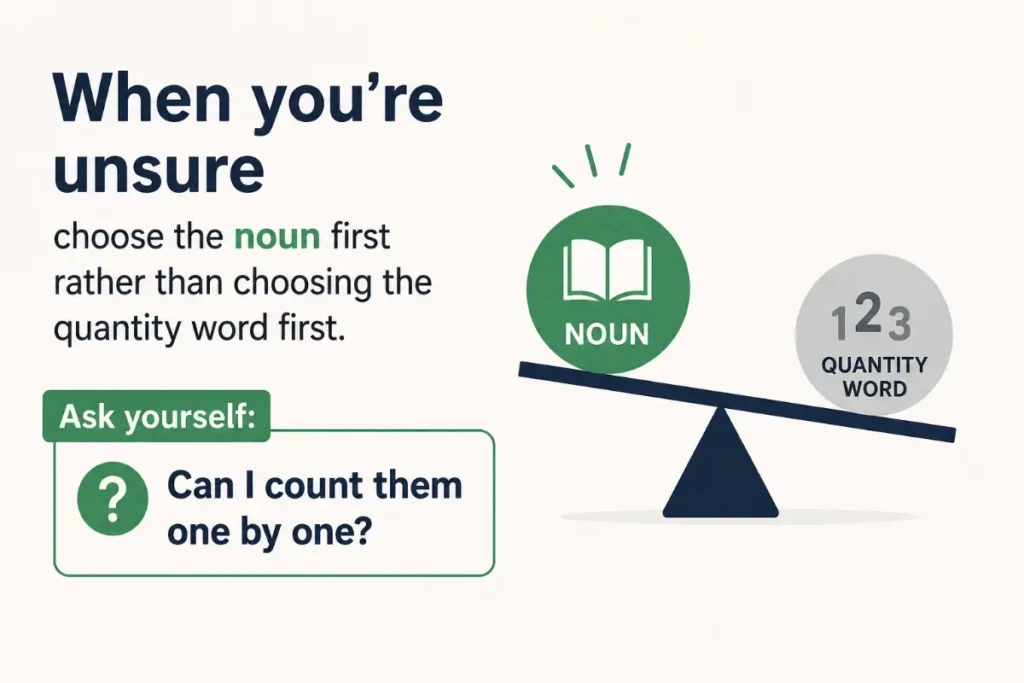
When you’re unsure choose the noun first rather than choosing the quantity word first.
Ask yourself:
Can I count them one by one?
If yes use fewer in standard English.
fewer books
fewer workers
fewer questions
If you’re talking about an amount use less.
less water
less time
less money
This method is more reliable than trying to memorize dozens of isolated examples.
Still confused? Compare gizmo vs gismo: Which Spelling Is Correct?.
Conclusion
Understanding fewer meaning comes down to one central idea. Fewer means a smaller number and normally goes with plural countable nouns. You can write fewer students fewer questions and fewer mistakes because each item can be counted.
The most useful comparison is fewer versus less. Use fewer for numbers of countable things and use less for amounts or degrees. Everyday speech sometimes bends this rule but formal edited English generally keeps the distinction clear.
A practical tip can make the choice much easier. Look at the noun first. If you can count the items individually then fewer is usually your best choice. That small habit will prevent a surprisingly large number of grammar mistakes.
FAQs
Is Fewer A Real Word?
Yes. Fewer is a standard English word and the comparative form of few. It means a smaller number and normally appears with plural countable nouns. Examples include fewer students fewer books and fewer mistakes. Major dictionary and grammar references recognize it as a standard part of English grammar.
What Does Fewer Mean?
Fewer means a smaller number or not as many. It is used when comparing quantities of countable people or things. For example fewer cars means a smaller number of cars. The word often appears with than as in fewer than fifty people. It is the comparative form related to few.
Fewer Or Less Which Is Correct?
Both words are correct but they normally serve different grammatical purposes. Use fewer with plural countable nouns such as fewer books or fewer employees. Use less with uncountable amounts such as less water or less money. This traditional distinction remains the safest choice for formal and edited English.
How Do You Pronounce Fewer?
Fewer is commonly pronounced FYOO er with two syllables. The IPA pronunciation is approximately /ˈfjuːər/ in American English. The first syllable carries the main stress and sounds like few. Saying the word as few plus er can help you remember both its pronunciation and its spelling.
Can Fewer Start A Sentence?
Yes. There is no grammar rule that prevents fewer from beginning a sentence. For example Fewer people attended the event this year is completely correct. The word simply functions as a determiner before the plural countable noun people. Sentence position does not change its basic meaning or grammatical role.
What Is A Synonym Of Fewer?
Common alternatives depend on the sentence. Not as many is often the closest natural phrase. You can also use a smaller number in more formal explanations. These expressions do not always fit every sentence because fewer is a grammatical quantity word rather than a simple descriptive adjective. The best substitute depends on context and sentence structure.
Why Do People Misspell Fewer?
People can struggle with the spelling because English pronunciation does not always show every letter clearly. The word has two syllables and the second syllable is weak in normal speech. Learners may also confuse few fewer and fewest because they belong to the same grammatical family. Regular reading helps build strong visual recognition of the correct spelling.
Fewer In Formal Writing?
Yes. Fewer is completely appropriate in formal writing and is often preferred when you are describing a smaller number of plural countable nouns. Academic papers business reports news articles and professional documents commonly use forms such as fewer participants and fewer errors. For polished writing it is usually best to follow the traditional distinction between fewer and less.