
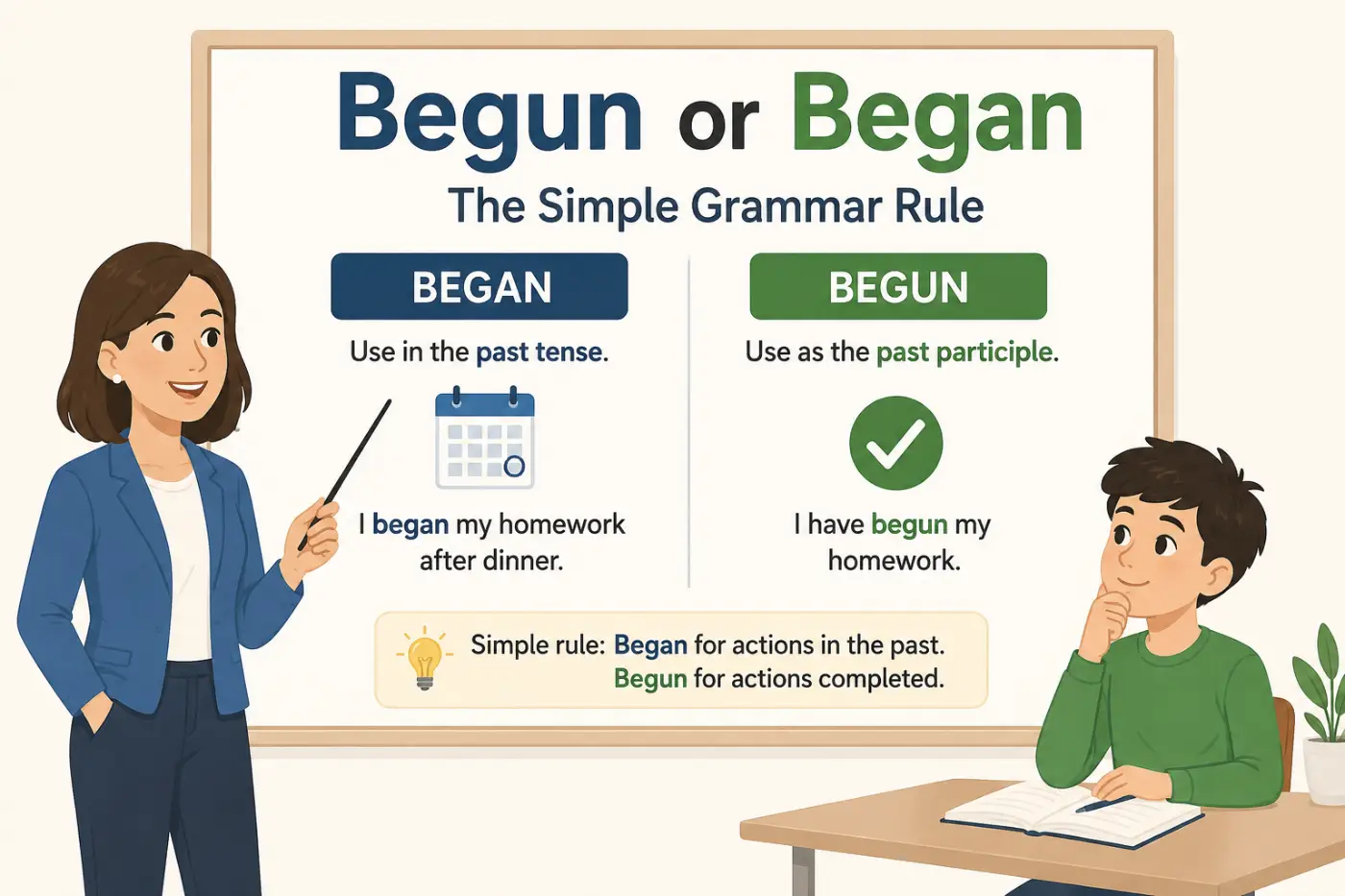
Confusing begun or began is easy because both words come from the same verb: begin. They also describe the same basic idea of starting something. The difference appears when you put them into a sentence.
The simplest rule is this: began is the simple past tense of begin, while begun is the past participle. You can use began by itself as the main verb in a past tense sentence. Begun normally needs a helping verb such as has, have, or had.
For example, you can say, “The meeting began at nine.” You can also say, “The meeting has begun.” You can’t normally replace one with the other without changing the grammar. This small distinction causes a surprising number of mistakes in emails, school assignments, articles, business writing, and everyday messages. The confusion gets worse because the two forms sound similar and both refer to an action that started.
For another common grammar confusion, see hall vs haul: Correct Spelling, Meaning and Usage.
Quick Definition
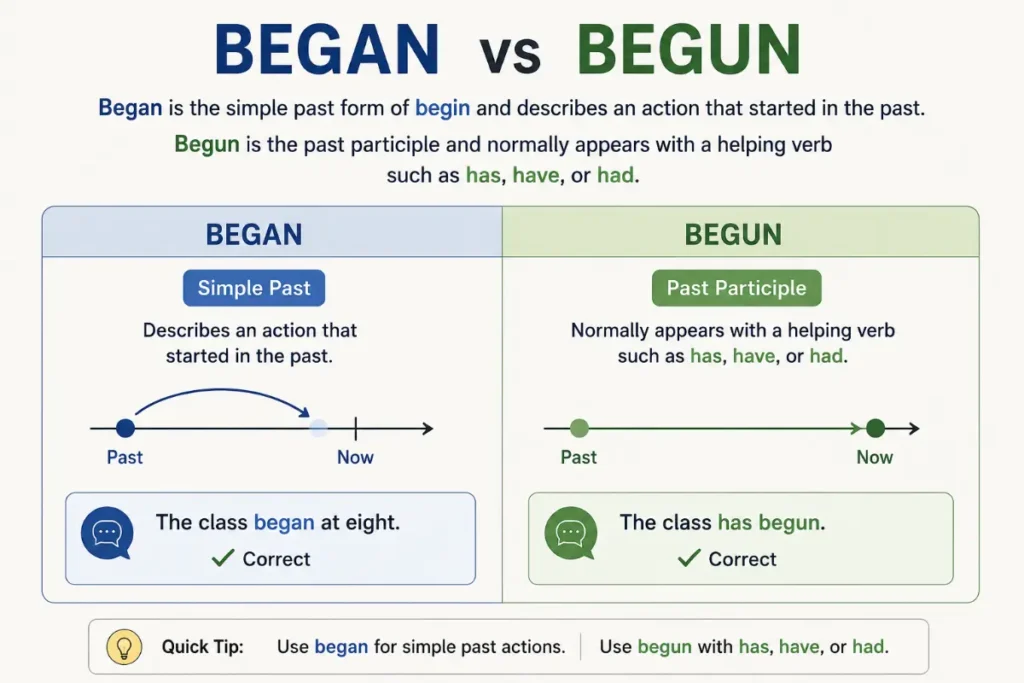
Began is the simple past form of begin and describes an action that started in the past. Begun is the past participle and normally appears with a helping verb such as has, have, or had. For example, “The class began at eight” is correct, while “The class has begun” is also correct.
Quick Answer For Begun Or Began
Both began and begun are correct words. They simply perform different grammatical jobs.
Use began when you need the simple past tense.
- The movie began at seven.
- She began her new job last Monday.
- The rain began suddenly.
Use begun when you need the past participle. In most everyday sentences, that means putting has, have, or had before it.
- The movie has begun.
- She has begun her new job.
- The rain had begun before we left.
A useful memory trick is simple: began can stand on its own as a past tense verb. Begun usually needs a helping verb.
That distinction is the key to the entire topic.
Comparison Of Begun Or Began
| Feature | Began | Begun |
|---|---|---|
| Correct form | Yes | Yes |
| Base verb | Begin | Begin |
| Part of speech | Verb | Verb |
| Verb form | Simple past | Past participle |
| Basic meaning | Started in the past | Started as part of a perfect or passive construction |
| Helping verb required | No | Usually yes |
| Common helpers | None required | Has, have, had, is, was, were |
| Common tense | Simple past | Present perfect or past perfect |
| Can stand alone as the main past verb | Yes | No |
| Formality | Neutral | Neutral |
| Everyday use | Very common | Very common in perfect constructions |
| Common context | Completed past events | Events viewed in relation to another time |
| Example | The show began at eight. | The show has begun. |
| Common error | Using began after has or have | Using begun by itself |
The important point is that began and begun aren’t competing spellings for the same grammatical position. They’re different forms of the same irregular verb.
That makes this less of a spelling question and more of a grammar question.
Meaning Of Began
Began means started in the simple past.
It is the past tense form of begin. You use it to describe something that started at a past time.
For example:
- The concert began at eight.
- We began the meeting after lunch.
- The storm began during the night.
- He began his career as a teacher.
- The students began their exams on Monday.
In each sentence, began tells us that the starting point belongs to the past.
Notice something important. Began doesn’t need another verb in front of it.
You can say:
The class began at nine.
You don’t need has, have, or had.
This is one of the easiest ways to identify the correct form. If you’re simply describing something that started in the past, began is usually the form you want.
Began In Simple Past Tense
The simple past is often used for an event that happened at a definite or understood time in the past.
Consider these examples:
- The game began at noon.
- Sarah began studying after dinner.
- The company began operations in 2005.
- The speaker began with a short introduction.
- The discussion began after everyone arrived.
The action of starting belongs to the past. The sentence doesn’t need to connect that starting point to the present through a perfect tense.
This is why began fits naturally.
Began With Time Expressions
You’ll often see began with expressions that clearly place an event in the past.
Common examples include:
- yesterday
- last night
- last year
- two hours ago
- in 2019
- when I was a child
- at eight o’clock
- after lunch
For example:
The meeting began at 10 a.m.
She began learning Spanish last year.
The storm began two hours ago.
These sentences use the simple past because the writer is presenting the starting event as a past event.
Meaning Of Begun
Begun is the past participle of begin.
This is where many learners get stuck. A past participle isn’t simply another word for past tense. It has a different grammatical function.
In ordinary active sentences, begun commonly appears with forms of have:
- has begun
- have begun
- had begun
For example:
The meeting has begun.
The students have begun their work.
The storm had begun before we arrived.
You wouldn’t normally write:
The meeting begun at nine.
That sentence needs began, not begun.
The difference becomes clear when you compare the structures:
The meeting began at nine.
The meeting has begun.
The first sentence uses the simple past.
The second uses the present perfect.
The verb form changes because the grammatical construction changes.
Begun Or Began In Perfect Tenses
The word begun becomes especially important in perfect tenses.
The present perfect uses has or have + past participle.
So:
She has begun her assignment.
They have begun the project.
The past perfect uses had + past participle.
So:
She had begun her assignment before dinner.
They had begun the project before the funding arrived.
This is one of the most reliable grammar patterns to remember.
If the sentence uses has, have, or had as the auxiliary verb, the past participle form is normally required.
That gives you:
has begun
have begun
had begun
Not:
has began
have began
had began
Those combinations are grammatically incorrect in standard English.
Key Differences
The biggest difference between the two forms isn’t meaning. Both connect to the idea of starting. The real difference is grammatical function.
Began Is Simple Past
Use began when the verb itself carries the past tense.
The class began at eight.
The word began tells us that the starting happened in the past.
Begun Is A Past Participle
Use begun when the grammar requires a past participle.
The class has begun.
Here, has carries the present tense while begun completes the perfect verb construction.
This distinction matters because English doesn’t use the past participle in the same way as the simple past.
The same pattern appears with many irregular verbs:
go → went → gone
see → saw → seen
write → wrote → written
sing → sang → sung
And:
begin → began → begun
English learners often recognize this pattern without realizing it. You already know that “I have went” is incorrect and “I have gone” is correct. The same principle applies to began and begun.
Which One Is Correct
The answer depends on the sentence.
Began is correct when you need the simple past form.
The movie began at six.
Begun is correct when you need the past participle.
The movie has begun.
So asking which word is correct by itself isn’t quite enough. Both are standard English forms. The sentence structure determines the right choice.
A good editor doesn’t simply look at the word. The editor looks at the verb phrase around it.
Compare these:
I began my work.
I have begun my work.
Both sentences are correct.
Now compare:
I begun my work.
That sentence is incorrect in standard English because begun has been used as a simple past verb.
This is why replacing one form with the other based only on sound can create a grammar error.
Examples With Began
Here are ten natural examples of began in everyday English.
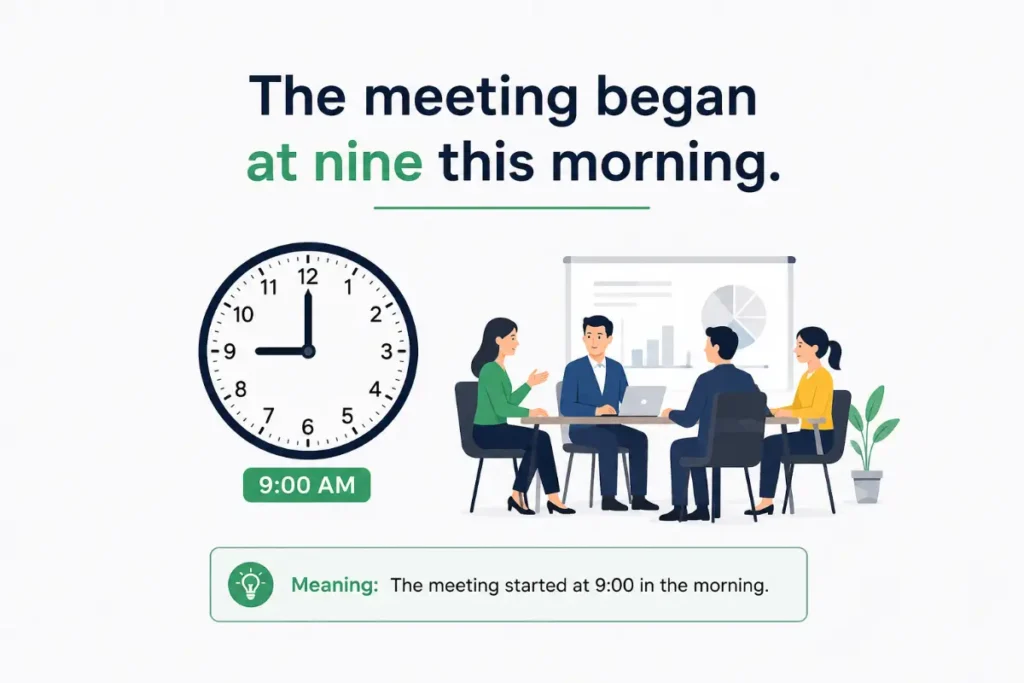
- The meeting began at nine this morning.
- She began writing her report after lunch.
- The children began playing outside when the rain stopped.
- His interest in photography began during college.
- The movie began before we found our seats.
- The teacher began the lesson with a simple question.
- The temperature began to drop after sunset.
- We began our trip early to avoid traffic.
- The argument began over a small misunderstanding.
- Construction began in the spring.
Notice the variety. Began works in conversations, news writing, academic sentences, professional documents, and storytelling.
It can describe a physical event, an activity, a career, a process, a relationship, or an abstract change.
Her interest began in college.
The conversation began after dinner.
The problem began with one small mistake.
The word itself stays the same. The surrounding sentence gives it its meaning.
Examples With Begun
Now look at ten natural examples of begun.
- The meeting has begun.
- We have begun preparing for the event.
- She has begun studying for her final exams.
- The company has begun hiring new employees.
- The rain has begun to fall.
- The team had begun practicing before the coach arrived.
- Construction had begun by the time we reached the site.
- The children have begun cleaning their rooms.
- The discussion has begun to move in a different direction.
- The process had begun long before the new manager arrived.
Again, notice the structure.
Begun doesn’t simply appear as the main past tense verb. It works as part of a larger verb phrase.
has begun
have begun
had begun
This is the pattern that separates it from began.
Common Mistakes
Most mistakes happen because writers remember that both words mean something like “started” but forget that they belong to different verb forms.
Using Begun Without A Helping Verb
Incorrect:
The meeting begun at ten.
Correct:
The meeting began at ten.
Why?
Because the sentence uses the simple past. It doesn’t have a helping verb that requires the past participle.
Using Began After Has
Incorrect:
The meeting has began.
Correct:
The meeting has begun.
The word has signals a perfect construction. The next verb must use its past participle form.
Using Began After Have
Incorrect:
They have began the project.
Correct:
They have begun the project.
Again, have requires the past participle.
Using Began After Had
Incorrect:
She had began working before I arrived.
Correct:
She had begun working before I arrived.
The word had creates the past perfect construction. The correct participle is begun.
Confusing Sound With Grammar
In fast speech, the difference between began and begun may not feel as obvious as it looks in writing. That’s one reason people sometimes choose the wrong form.
Good writing requires more than listening for what sounds familiar. You also need to recognize the grammatical structure.
A Simple Memory Trick
If you need a quick way to remember the difference, use this:
Began stands alone. Begun needs help.
That isn’t a complete description of every possible construction, but it’s an excellent practical rule for everyday writing.
Compare:
The show began.
The show had begun.
The first uses began by itself.
The other two use begun after a helping verb.
You can also memorize the three main forms together:
begin → began → begun
Think of them as three positions in the same verb family.
Begin is the base form.
Began is the simple past.
Begun is the past participle.
Once that sequence becomes familiar, the confusion becomes much easier to avoid.
Why English Has Began And Begun
English contains many irregular verbs that change internally instead of simply adding ed to form the past.
For a regular verb, you might have:
walk → walked
talk → talked
start → started
But begin doesn’t follow that pattern.
It developed as an irregular verb with different forms:
begin → began → begun
This type of verb is sometimes called a strong verb because older English verb patterns changed the vowel inside the word to mark different grammatical forms.
You don’t need to study historical grammar to use the words correctly. Still, understanding the pattern explains why began and begun look so different even though they come from the same verb.
Etymology
Both forms ultimately come from the same historical verb. The modern English begin developed from Old English beginnan, a verb meaning to start or undertake. Over centuries, English changed its sound system and verb patterns, but the relationship among the forms remained.
The modern sequence is:
begin
began
begun
This is similar to other old irregular patterns such as:
drink → drank → drunk
sing → sang → sung
ring → rang → rung
These forms may look unusual from a modern perspective, but they’re traces of older English grammar.
That history also explains why trying to form the past of begin as beginned doesn’t work in standard English. English inherited the irregular pattern rather than replacing it with the regular ed pattern.
Pronunciation Of Began
Began is pronounced:
/bɪˈɡæn/
It has two syllables:
be GANN
The stress falls on the second syllable.
The first vowel sounds like the vowel in bit.
The second vowel is the short a sound heard in words such as cat and hand in many varieties of American English.
A common pronunciation mistake is putting too much stress on the first syllable. Native speakers normally stress the second syllable.
Pronunciation Of Begun
Begun is pronounced:
/bɪˈɡʌn/
It also has two syllables:
be GUN
Again, the stress falls on the second syllable.
The major sound difference from began occurs in the final stressed vowel.
Began has /æ/.
Begun has /ʌ/.
For American English speakers, the vowel in begun is similar to the vowel in sun, fun, and run.
The two forms can sound close to learners because the beginning of the words is identical. Listening carefully to the stressed vowel helps distinguish them.
You may also want to read shinny vs shiny Correct Spelling Meaning and Usage.
Begun Or Began In American English
American English follows the same standard grammatical distinction.
Americans use began as the simple past form:
The game began at noon.
They use begun as the past participle:
The game has begun.
There isn’t a separate American spelling for these forms.
The same spellings and core grammar apply in standard British, Australian, and Canadian English. Regional accents can change pronunciation, but they don’t change the basic tense distinction.
That means an American reader doesn’t need one rule while a British reader needs another. The grammar is essentially the same.
Begun Or Began In British English
British English also uses began as the simple past and begun as the past participle.
For example:
The ceremony began at six.
The ceremony has begun.
The distinction is standard across British English.
You may notice differences in vocabulary, pronunciation, or preferred sentence style between British and American writers, but began and begun don’t have a major regional grammar split.
The same applies to Australian and Canadian English.
Begun Or Began In Australian And Canadian English
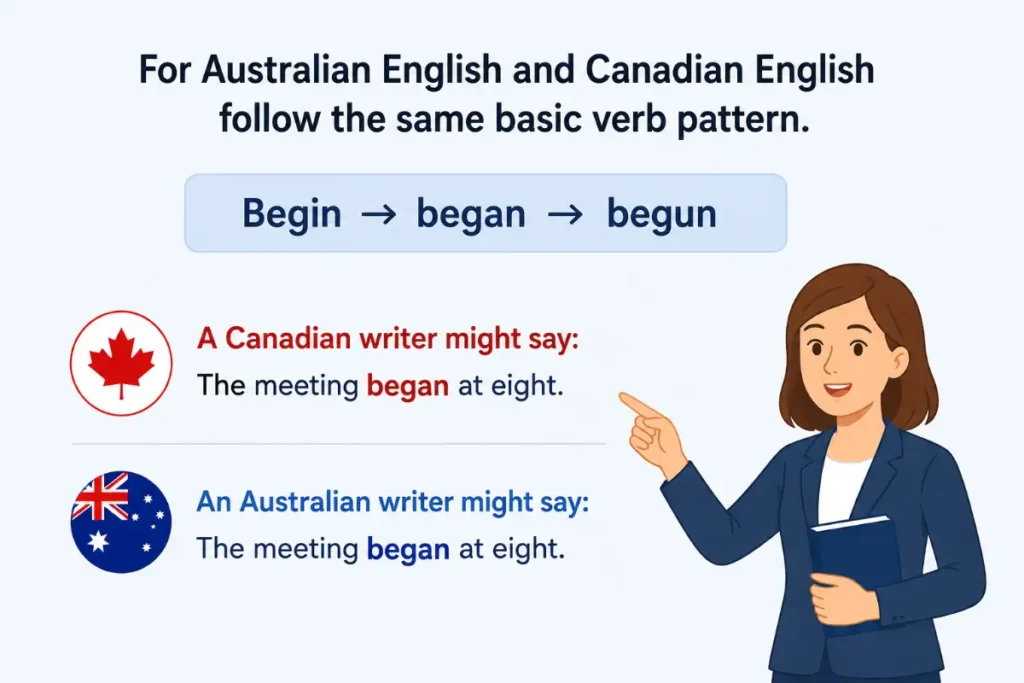
Australian English and Canadian English follow the same basic verb pattern.
Begin → began → begun
A Canadian writer might say:
The meeting began at eight.
An Australian writer might say:
The meeting has begun.
Both follow the same grammatical rule used in American and British English.
Regional pronunciation may differ, but the choice between began and begun depends on tense and verb structure rather than geography.
That makes this a useful grammar rule to learn once and apply across the major varieties of standard English.
The Grammar Behind Began And Begun
To understand the difference properly, it’s worth looking at the three forms of begin together.
| Verb form | Function | Example |
|---|---|---|
| Begin | Base form | I begin work at eight. |
| Began | Simple past | I began work at eight. |
| Begun | Past participle | I have begun work. |
The base form appears in the present tense and in structures such as infinitives.
The simple past form describes a past event.
The past participle works with auxiliary verbs in perfect constructions and can also appear in passive structures.
This is why calling begun simply “the past tense” creates confusion. It isn’t the simple past form. Began holds that role.
Begun In Passive Constructions
There is one useful point that often gets overlooked.
Begun can appear in passive constructions.
For example:
The project was begun last year.
The work was begun before the new team arrived.
These sentences are grammatically possible because begun is a past participle.
However, in ordinary modern English, writers often choose a more direct active construction:
The team began the project last year.
This version is usually clearer and more natural.
That doesn’t make the passive version wrong. It simply shows why understanding grammar and understanding style aren’t always the same thing.
A sentence can be grammatically correct and still have a less natural rhythm.
Real Life Usage Of Began
In everyday conversation, began is common when someone tells a story or reports a past event.
You might hear:
The movie began before we got there.
It began raining around midnight.
She began working here five years ago.
In professional writing, began is equally useful:
The company began operations in 2018.
The research began after the initial review.
In academic writing:
The study began with a review of previous research.
In journalism:
The investigation began after several complaints were filed.
The word doesn’t sound unusually formal. It’s a normal part of standard English.
Real Life Usage Of Begun
Begun appears frequently in conversation and writing whenever speakers use perfect tenses.
You might say:
The meeting has begun.
School has begun again.
I’ve begun working on it.
Professional writing uses the form just as naturally:
The company has begun expanding into new markets.
Academic writing may use it like this:
Researchers have begun examining the long term effects of the policy.
News writing often uses it when describing a process that has started and is relevant to the current situation:
The cleanup effort has begun.
The important point is that begun doesn’t automatically sound more formal. Its grammar determines its use.
The Most Useful Rule To Remember
When you’re unsure between the two, look at the words around the verb.
If you have a simple past sentence:
Use began.
If you have has, have, or had followed by the verb:
Use begun.
Compare:
The class began.
The class had begun.
That three sentence comparison captures most of the practical difference.
Once you stop treating began and begun as interchangeable words and start seeing them as different forms of the same irregular verb, the choice becomes much easier.
Advanced Grammar With Begun vs Began
The basic rule is easy to remember, but experienced writers often need a little more than a simple shortcut. The real value comes from understanding how began and begun behave inside longer verb phrases.
The verb begin is an irregular verb with three principal forms:
begin → began → begun
Merriam Webster identifies began as the simple past form and begun as the past participle.
That distinction becomes especially important when a sentence contains auxiliary verbs.
Consider these examples:
- I begin work at eight every morning.
- I began work at eight yesterday.
- I have begun work on the new project.
- I had begun work before the manager arrived.
- I will have begun work by eight tomorrow.
The verb changes because the grammatical construction changes.
Present Perfect With Begun
The present perfect combines has or have with a past participle.
That gives us:
has begun
have begun
For example:
The meeting has begun.
The students have begun their exam.
We have begun planning the event.
The present perfect often connects a past action with the present situation. The exact meaning depends on context.
If someone says:
The meeting has begun.
The important point is that the meeting started before now and is relevant now.
That’s different from:
The meeting began at nine.
This sentence simply reports the past starting point.
Merriam Webster gives the same basic distinction, describing began as the simple past and begun as the past participle used after have.
Past Perfect With Begun
The past perfect uses had + past participle.
So the correct form is:
had begun
Not:
had began
For example:
The movie had begun before we arrived.
The sentence contains two past events. The movie started first. We arrived later.
The past perfect helps establish that sequence.
Compare:
The movie began before we arrived.
The movie had begun before we arrived.
Both can be grammatically correct. The second version puts stronger emphasis on the fact that the beginning happened before another past event.
This is one reason begun appears so often in narrative writing.
Future Perfect With Begun
The same pattern continues in the future perfect.
Use:
will have begun
For example:
The construction will have begun by next spring.
By the time you arrive, the ceremony will have begun.
The new program will have begun by the start of the semester.
The word begun doesn’t change because the sentence is talking about the future. The auxiliary phrase will have carries the future perfect structure, so the main verb remains in its past participle form.
This is a useful reminder that begun isn’t a tense by itself. It’s a verb form.
Modal Verbs With Begun
Modal verbs can also be followed by have + past participle.
For example:
The work may have begun already.
The meeting could have begun without us.
The project might have begun earlier.
The investigation must have begun weeks ago.
Notice the pattern:
modal + have + begun
Not:
modal + began
This is a common point of confusion for learners because the sentence refers to a past event. The fact that something happened in the past doesn’t automatically mean you should use began. The grammatical structure determines the form.
Infinitives With Begin
The base form begin also appears after to.
For example:
She wants to begin the project today.
They decided to begin after lunch.
We need to begin now.
You wouldn’t use began or begun after to in standard English.
Incorrect:
She wants to began the project.
Correct:
She wants to begin the project.
Incorrect:
They decided to begun the meeting.
Correct:
They decided to begin the meeting.
This gives you another useful pattern:
to begin
began
has begun
Three different structures. Three different forms.
Began With To And Begun With To
Both forms can appear near to, but they don’t behave in the same way.
With began, you can use an infinitive after it:
She began to cry.
He began to speak.
The baby began to walk.
Here, began is the main verb and to cry, to speak, or to walk completes the construction.
With begun, you normally need an auxiliary verb:
She has begun to cry.
He had begun to speak.
The baby has begun to walk.
This gives us another useful comparison:
She began to laugh.
She has begun to laugh.
The first sentence uses simple past.
The second uses present perfect.
Began And Begun With Gerunds
The verb begin can also be followed by an ing form.
For example:
She began studying.
They began working.
We began discussing the problem.
The same structure can work with begun when an auxiliary verb comes before it:
She has begun studying.
They had begun working.
We have begun discussing the problem.
Both begin to do and begin doing are common patterns.
For many sentences, the choice between the two doesn’t create a major difference in meaning.
He began to laugh.
He began laughing.
Both naturally communicate that the laughing started.
The important issue for this article remains the form of begin itself. If the sentence is simple past, use began. If the grammar calls for the past participle, use begun.
Began Or Begun In Professional Writing
The same principle applies to business emails, reports, proposals, and workplace communication.
Correct:
The meeting began at 2 p.m.
Correct:
The meeting has begun.
Correct:
The company began hiring in January.
Correct:
The company has begun hiring for several new positions.
The difference can even affect the time perspective.
The company began hiring in January.
This reports a past starting point.
The company has begun hiring.
This emphasizes a current situation resulting from a recent start.
That distinction can make business writing more precise.
Beginning
Beginning is the present participle or gerund form.
Examples:
The show is beginning.
Beginning the project was difficult.
The beginning of the story was slow.
Notice that beginning can also function as a noun.
The beginning was exciting.
Began
Began is the simple past.
The show began at eight.
Begun
Begun is the past participle.
The show has begun.
These four forms are worth learning together:
begin
began
begun
beginning
Once they’re grouped together in your mind, individual grammar decisions become much easier.
Expert Language Insight
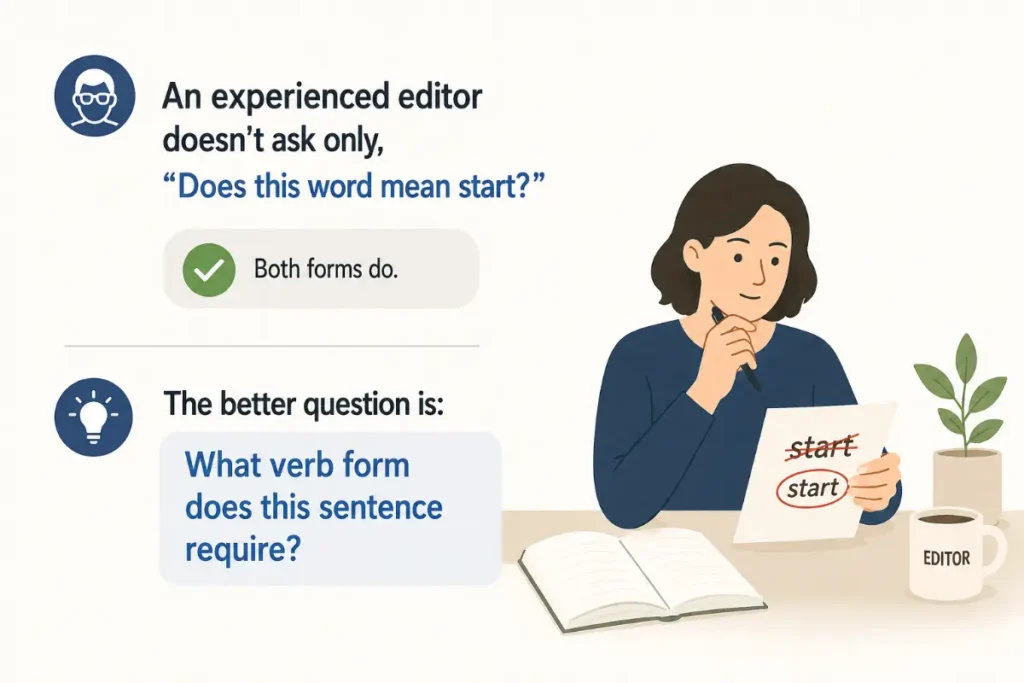
An experienced editor doesn’t ask only, “Does this word mean start?”
Both forms do.
The better question is:
What verb form does this sentence require?
That’s the decision that matters.
If you’re reporting a past event, began will often be right.
If you’re writing a sentence with an auxiliary such as has, have, or had, pause for a second and check the verb form.
How Native Speakers Think About Began Or Begun
Native speakers usually don’t consciously recite grammar rules when choosing between these forms.
They’ve heard patterns such as:
has begun
have begun
had begun
since childhood.
The combinations feel natural because they’re deeply familiar.
This is why reading good English can improve your instinct for verb forms. When you repeatedly encounter correct structures, patterns become easier to recognize.
A Practical Editing Test
When editing your own sentence, use these steps.
- Find the verb that comes from begin.
- Decide if the sentence describes a simple past event.
- If it does, use began.
- If the sentence uses a perfect construction, use begun.
- Check for has, have, or had.
- Check the entire verb phrase instead of judging the target word by itself.
- Read the sentence aloud once to make sure the final structure sounds natural.
For example:
The project has began.
Find the auxiliary:
has
That tells you a perfect construction is being used.
Replace began with the past participle:
The project has begun.
Now the sentence is correct.
Another example:
The project begun last year.
There is no auxiliary.
The sentence simply reports a past event.
Use the simple past:
The project began last year.
This method is quick enough to use while proofreading an email or school assignment.
Still confused? Compare Tear vs Tare: What is the Difference? (2026).
Final Verdict On Begun Or Began
The choice between began and begun comes down to grammar. Both forms come from begin and express the idea of starting something. The difference lies in how each form works in a sentence. Began is the simple past form, while begun is the past participle.
Use began when you’re describing something that started in the past. For example, you can say, The meeting began at nine. Use begun when the sentence requires a past participle, such as The meeting has begun, The meeting had begun, or The meeting will have begun.
Keep the three forms together in your mind: begin, began, begun. Once you understand how these forms work, choosing the right one becomes much easier. When you’re unsure, don’t rely only on how the word sounds. Check the tense and the structure of the sentence first. That simple habit will help you avoid one of the most common mistakes involving this irregular verb
Eight Frequently Asked Questions
Is Began Or Begun Correct?
Both began and begun are correct forms of begin. Began is the simple past form, while begun is the past participle. Use began in sentences such as “The class began at nine.” Use begun in sentences such as “The class has begun.”
Should I Say I Began Or I Begun?
Say I began when you’re using the simple past. For example, “I began working at nine.” Say I have begun when you’re using the present perfect. “I begun” by itself is not standard English. The key is to identify the complete verb structure rather than choosing the word based only on how it sounds.
Is It Have Began Or Have Begun?
The correct form is have begun. The verb have creates a perfect construction and must be followed by the past participle of begin. Since begun is the past participle, you should write “They have begun the project,” not “They have began the project.”
Is It Had Began Or Had Begun?
The correct form is had begun. Had is the auxiliary used to form the past perfect, so the main verb must appear as a past participle. For example, “The meeting had begun before we arrived” is correct. “The meeting had began” is not standard English.
Can Begun Be Used Without Have?
Yes, but the context must support a past participle construction. For example, “The work was begun last year” uses begun in a passive construction. You can also see it in reduced constructions such as “Once begun, the process was difficult to stop.” In ordinary active sentences, begun most commonly appears with forms of have.
What Is The Difference Between Begin Began And Begun?
Begin is the base form, began is the simple past, and begun is the past participle. For example, “I begin work at eight,” “I began work yesterday,” and “I have begun work” are all correct. Learning these three forms together is the easiest way to remember their grammatical roles.
Which Is More Formal Began Or Begun?
Neither is inherently more formal. Began and begun are different verb forms rather than different levels of formality. The correct choice depends on sentence structure. “The meeting began at nine” and “The meeting has begun” are both standard and professional. Don’t choose begun simply because it looks or sounds more formal.
How Do You Remember Began And Begun?
A useful shortcut is began stands alone while begun usually needs an auxiliary. Think of the complete sequence: begin, began, begun. If you’re describing a simple past event, choose began. If you’re using has, have, or had, choose begun. This simple pattern handles most everyday writing situations.