
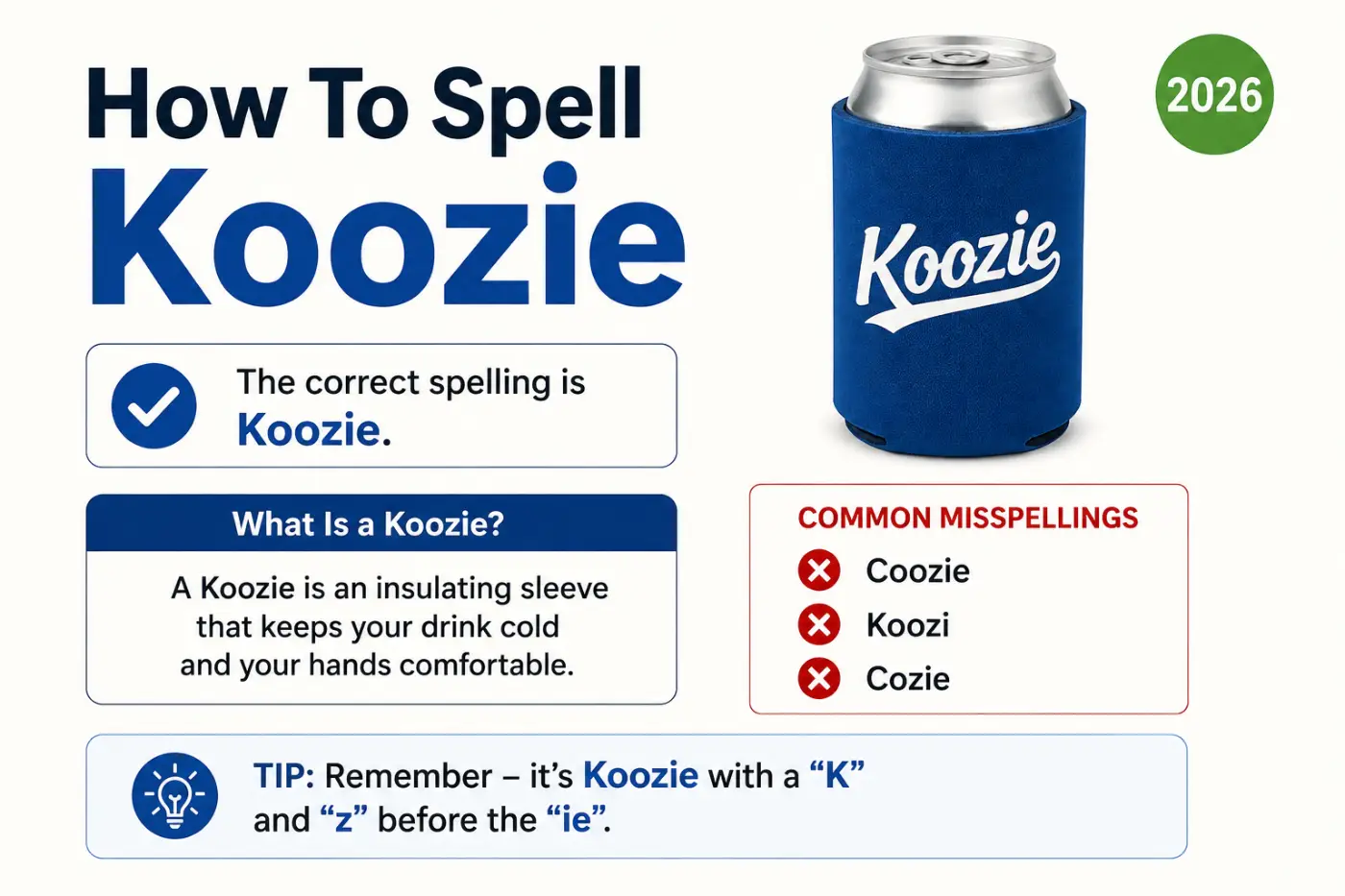
Have you ever typed the word for that little insulated drink sleeve and stopped because the spelling suddenly looked wrong? You might have seen koozie on a promotional product. Then you may have noticed coozie, cozy, or coozy somewhere else and wondered which form you should actually use.
The most useful answer is simple. Koozie is the established spelling of the trademarked brand name. Coozie is also recognized as an alternative form for the same type of drink sleeve. In everyday American English people also use general terms such as can cooler, drink sleeve, beer cozy, and bottle sleeve.
The confusion comes from the way this word developed. It sounds like a familiar English word while having a spelling associated with a specific brand. Over time people started using different spellings for the same object. Cambridge Dictionary lists Koozie as a US trademark and also recognizes coozie.
If you need one spelling for ordinary American writing the safest choice is koozie. If you want to avoid trademark language entirely you can use can cooler or drink sleeve. This guide explains the spelling history pronunciation grammar regional usage and the practical differences between the forms so you can choose the right word with confidence.
Still confused? Compare jersies or jerseys Correct Spelling And Usage.
Quick Definition
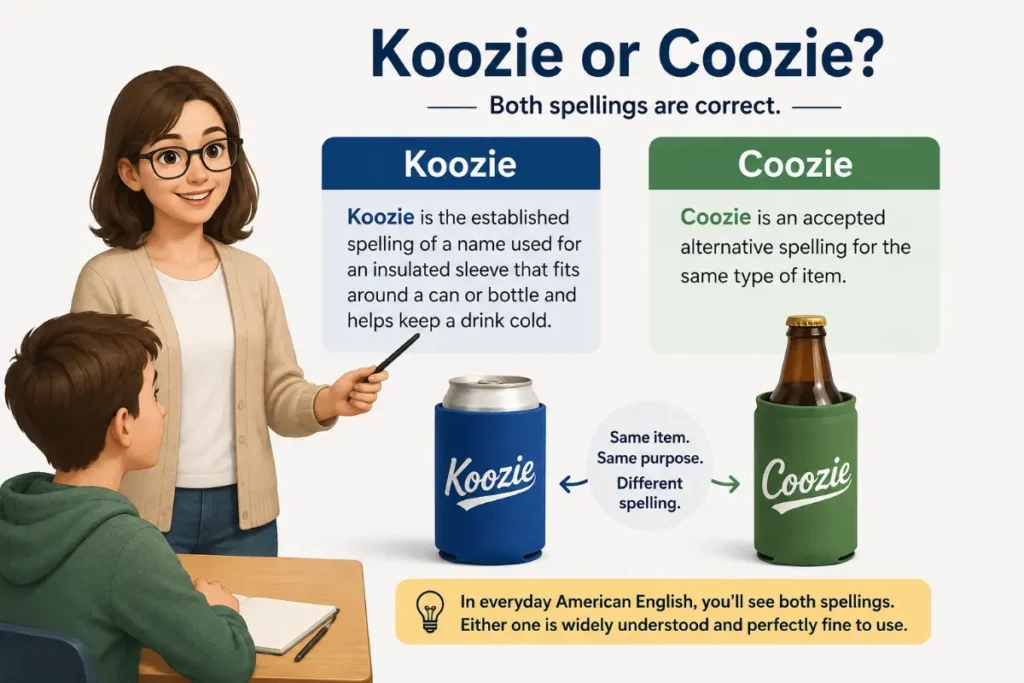
Koozie is the established spelling of a name used for an insulated sleeve that fits around a can or bottle and helps keep a drink cold. The word is also used generically in everyday American English. Coozie is an accepted alternative spelling for the same type of item.
Quick Answer
If you are asking how to spell koozie the standard spelling is koozie. The word normally refers to an insulated sleeve that surrounds a beverage can or bottle. It helps reduce heat transfer and condensation while making a cold drink easier to hold. Koozie is also a trademarked brand name. Cambridge Dictionary identifies it as a US trademark and lists coozie as another form.
For general writing you can use koozie when that is the term people around you normally use. If you want a completely generic expression use can cooler, drink cooler, drink sleeve, or insulated beverage sleeve. The spelling koozie has two important features that make it easy to remember. It begins with k and contains oo.
Think of it as:
KOOZIE
The pronunciation is KOO zee. Cambridge gives the pronunciation as /ˈkuː.zi/ in both British and American English.
Comparison Table
| Feature | Koozie | Coozie |
|---|---|---|
| Correct form | Yes | Yes as an alternative form |
| Meaning | An insulated drink sleeve | An insulated drink sleeve |
| Part of speech | Noun | Noun |
| Origin | Brand name that became widely used | Alternative spelling |
| Usage frequency | Very common in American English | Less common than koozie |
| Formality level | Informal everyday noun and trademarked brand term | Informal |
| Common contexts | Parties outdoor events sports promotional products and casual conversation | Casual conversation and informal writing |
| Example | I put my soda in a koozie. | I need a coozie for this bottle. |
| Pronunciation | /ˈkuː.zi/ | Usually /ˈkuː.zi/ |
| Generic alternatives | Can cooler drink sleeve beverage sleeve | Can cooler drink sleeve beverage sleeve |
The key point is that koozie and coozie can refer to the same kind of object. The distinction is mainly about spelling and trademark history rather than meaning. Cambridge specifically lists Koozie as a US trademark and identifies coozie as another form.
Meaning Of Koozie
A koozie is an insulated sleeve designed to fit around a drink container.
Most people associate the word with cans of soda beer energy drinks or other cold beverages. The sleeve creates a layer of insulation between the drink and the surrounding air. It can also reduce the amount of condensation that reaches your hand or the surface beneath the drink.
Cambridge defines Koozie as a brand name for a sleeve that covers a drink bottle or can and keeps it cold.
The object can come in several forms. Traditional versions often use foam or flexible fabric. Modern versions may use neoprene polyester leather stainless steel or other insulating materials. Food and Wine has reviewed koozies made from materials ranging from soft sleeves to more substantial insulated containers.
In everyday American conversation the word has become much broader than a simple brand reference.
Someone might say:
I left my koozie in the car.
That sentence usually means the person left the insulated drink holder in the car. The speaker isn’t necessarily making a formal statement about the trademark.
This is common with brand names that become strongly associated with an entire product category. People often use a familiar brand term as a convenient name for a type of product.
Meaning Of Coozie
Coozie refers to the same general type of insulated drink sleeve.
The spelling changes the first letter from k to c but the meaning normally stays the same. Cambridge Dictionary explicitly includes coozie as an alternative form of Koozie.
For example:
I bought a coozie for my water bottle.
The sentence tells the reader that the speaker bought an insulated sleeve for the bottle.
The form coozie appears in informal American usage and in product descriptions. It is especially useful to understand because you may encounter it while shopping or reading casual online conversations.
That doesn’t mean you need to choose it as your default spelling.
If you’re writing an article or editing professional content for a broad American audience koozie is generally the more recognizable form. If the context calls for generic language can cooler or drink sleeve may be even clearer.
How To Spell Koozie Correctly
The easiest way to remember the spelling is to focus on the opening sound and the double o.
The correct spelling is:
Koozie
Not:
Koozy
Not:
Cousy
Not:
Coozy
Not:
Cousy
Some of these forms appear online because people spell the word based on sound. That is completely understandable. English has plenty of words whose spelling cannot be predicted perfectly from pronunciation.
The spelling koozie is unusual because the oo creates the long vowel sound heard in words such as moon and food.
You can remember it as:
Koo plus zie
That simple pattern can help when you’re typing quickly.
Key Differences
The differences between koozie and coozie are smaller than many people expect.
Meaning Differences
There is normally no meaningful difference in the object being described. Both forms can refer to an insulated sleeve used with a can or bottle.
If someone says:
Put the can in the koozie.
And another person says:
Put the can in the coozie.
The practical meaning is the same.
Tone Differences
Both forms sound informal. You would normally hear these words at a barbecue a picnic a sporting event a party or another casual gathering. They aren’t typical choices for highly formal technical writing.
For formal product documentation insulated beverage sleeve may sound more precise. For ordinary conversation koozie sounds natural.
Grammar Differences
There is no important grammatical difference between the two spellings. Both function primarily as nouns.
For example:
The koozie is on the table.
The coozie is on the table.
You can also make either form plural.
koozie becomes koozies.
coozie becomes coozies.
The spelling changes from y to ies only in words that actually end in y. Since koozie already ends in ie the plural simply adds s.
So:
One koozie.
Two koozies.
One coozie.
Two coozies.
Regional Differences
The vocabulary used for this object changes considerably across English speaking regions. American speakers commonly use koozie or coozie. Australian English commonly uses stubby holder for a similar product. British English may use terms such as beer cooler or drink sleeve depending on the context.
Cambridge includes stubby holder among related terms for Koozie. In Australia the phrase stubby holder is particularly familiar. Australian speakers also use other local expressions for beverage holders.
This is a good reminder that vocabulary doesn’t always follow a single worldwide rule. The object stays almost the same while the everyday name changes.
Context Differences
Use koozie when you are writing for an American audience and want the familiar everyday term. Choose can cooler when clarity matters more than regional vocabulary. Use drink sleeve when the item may hold a can bottle or cup and you want a broad description.
Which One Is Correct
Koozie is the safest spelling to use as the primary form. However coozie is not simply a spelling mistake. Cambridge recognizes it as another form of the word. This distinction matters because many online articles oversimplify the issue by declaring one form correct and every other form wrong.
Real English usage is more complicated.
The original Koozie name has a significant brand history. Recent reporting from the San Antonio Express News traces the product’s history to the late 1970s and credits entrepreneur Bob Autrey with coining the term. The brand later became closely associated with insulated beverage holders across the United States.
The trademark also remains important. Trademark records show registered KOOZIE marks associated with Scribe Opco and related entities. At the same time the word has become deeply embedded in casual speech. People commonly use lowercase koozie to describe an insulated drink holder even when they aren’t referring to a particular branded product.
So the best editorial advice is simple.
If you’re asking for the spelling people will most readily recognize in American English use koozie. If you’re writing generic product copy and want to avoid brand language use can cooler, drink cooler, or insulated beverage sleeve.
Examples With Koozie
Here are natural examples that show how American speakers commonly use koozie.
- I put my soda in a koozie before we headed outside.
- She grabbed a koozie from the kitchen drawer.
- Everyone at the picnic received a free koozie.
- My old koozie still has the logo from my college days.
- Keep the bottle in the koozie so it stays colder.
- He ordered custom koozies for the family reunion.
- I forgot my koozie at the campsite.
- The team handed out koozies before the game.
- She slipped the cold can into a blue koozie.
- We have a drawer full of koozies from different events.
Notice how naturally the noun works in each sentence. The word doesn’t need special grammar treatment simply because it has a brand history.
Examples With Coozie
The alternative spelling coozie can appear in casual writing and product language.
- I need a coozie for this can.
- She bought a new coozie for the beach.
- His favorite coozie has a funny design.
- We found a handmade coozie at the local market.
- Put the bottle in the coozie before you leave.
- The shop sells custom coozies for parties.
- I keep a spare coozie in my camping bag.
- He gave everyone a coozie at the barbecue.
- That coozie fits the bottle perfectly.
- She washed the coozie after the picnic.
The important lesson is that the alternate spelling doesn’t normally create a different object. Context tells you what the speaker means.
Common Mistakes
The spelling creates several predictable mistakes.
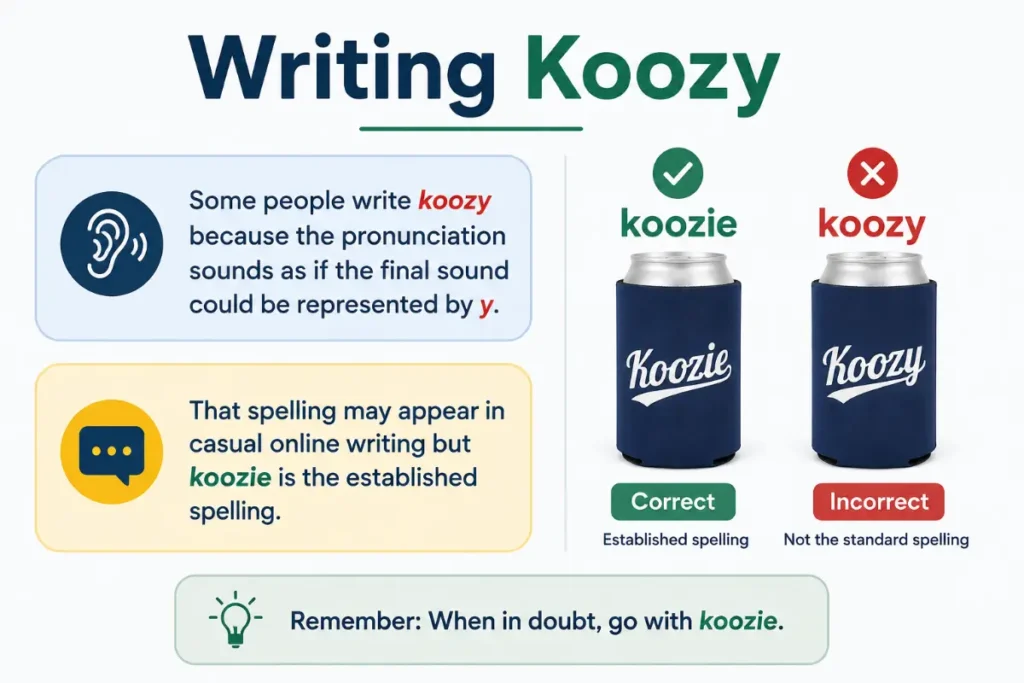
Writing Koozy
Some people write koozy because the pronunciation sounds as if the final sound could be represented by y. That spelling may appear in casual online writing but koozie is the established spelling.
Writing Coozy
Coozy looks logical because English already contains the word cozy. Still it isn’t the spelling you should choose when you want the established form koozie.
Writing Cozy
This mistake creates a more interesting problem. Cozy is already a normal English word. It means comfortable warm pleasant or snug.
For example:
The room feels cozy.
That sentence has nothing to do with an insulated drink sleeve. The two words can sound similar in some casual speech but they aren’t interchangeable in standard written English.
Confusing Koozie With Cozy
This is one of the biggest sources of confusion. A koozie is a drink sleeve. A cozy is something comfortable warm or snug. The noun cosy can also refer to a covering designed to keep something warm such as a tea cosy.
The connection between the words is interesting because the history of beverage sleeve terminology overlaps with older covering terms. Some etymological references describe koozie as an altered form connected with cozy or cosy. Still you should not replace koozie with cozy in a sentence about a can holder.
Writing Kousie
Kousie is not the standard spelling. It may appear as an attempt to represent the sound phonetically but it isn’t the form recommended for ordinary American English writing.
Writing Koozie As A Verb
A common grammar mistake is treating koozie as a verb without context. In ordinary English koozie functions as a noun.
You can say:
I bought a koozie.
You normally wouldn’t say:
I koozied my drink.
Creative speakers might invent such a verb in playful conversation. That doesn’t make it standard usage.
Pronunciation Guide
The pronunciation of koozie is straightforward.
Cambridge gives the pronunciation as:
/ˈkuː.zi/
The first syllable receives the main stress.
A simple pronunciation guide is:
KOO zee
The first part sounds like coo.
The second part sounds like zee in American English.
So the word has two syllables:
KOO
zee
The pronunciation doesn’t normally change simply because the word is written with c in coozie. The two forms are generally pronounced alike.
Common Pronunciation Mistakes
Some speakers may pronounce the first vowel too quickly and produce something closer to KUZ ee. That isn’t the pronunciation given by Cambridge. The long vowel sound should remain clear:
KOO zee
Another mistake comes from reading the word as if it were related to cousin or couch because of the first letter in the alternate spelling.
The easiest approach is to remember the sound rather than overthink the spelling.
Think:
cool
Then:
zee
Put them together naturally.
KOO zee
Why The Spelling Feels So Confusing
The word creates a perfect storm for spelling confusion. First the pronunciation is familiar but the spelling isn’t predictable. Second the word has a trademark history. Third people use several generic names for the same object. Fourth informal speech spreads alternative spellings quickly. Fifth the word resembles cozy and cosy which already have established meanings. That combination makes people hesitate. You aren’t dealing with a simple case like a word with one obvious spelling and one obvious pronunciation. You’re dealing with a product name that entered everyday language and developed multiple forms. That is why searches such as how to spell koozie, how do you spell koozie, is it koozie or coozie, koozie spelling, correct spelling of koozie, and what is a koozie called all make sense. They reflect slightly different versions of the same language question.
Expert Language Insight
From an editorial perspective the most important point is this. Correct spelling depends partly on what you are trying to communicate. If your reader is an American English speaker looking for the familiar name of an insulated drink holder then koozie is the clearest choice.
Etymology And Word Origin
The story behind koozie is more interesting than the spelling suggests. It isn’t an old English word that has been passed down unchanged for centuries. Instead it is closely connected with a modern product name that became so familiar that people began using it as a general noun.
Cambridge Dictionary identifies Koozie as a US trademark and defines it as a brand name for a sleeve that covers a drink bottle or can and keeps it cold. The same entry also gives coozie as another form.
That trademark history helps explain why the spelling looks unusual.
The Brand Connection
The capitalized form Koozie began as a brand name rather than as an ordinary English noun. Over time Americans started using the word in everyday conversation to describe similar insulated drink holders. This process is common in English. A brand name can become strongly associated with a product category and eventually appear in casual speech as a general term.
You can see the same language pattern with words such as thermos and escalator. Their histories show how commercial names can influence everyday vocabulary. The important editorial point is that Koozie still has trademark significance even though lowercase koozie is widely used informally. koozie immediately.
Is Koozie Related To Cozy
This is where the history becomes less certain. The spelling and meaning naturally remind people of cozy because both words have a similar sound and both can involve the idea of a covering or something comfortable.
However you shouldn’t state as an established fact that koozie simply comes from cozy.
Merriam Webster traces the much older English word cozy to a possible Scandinavian source and gives its first known English use around 1665. As a noun cozy can refer to a padded covering for a teapot.
The History Of Cozy
Understanding cozy also helps explain some of the spelling confusion around koozie. Merriam Webster gives cozy as an adjective meaning comfortable or snug. It also lists a noun meaning a padded covering especially one used for a teapot. The dictionary dates the adjective to around 1665 and the noun sense to 1863.
That means English already had a word that looked and sounded somewhat similar long before the modern drink sleeve became popular. American English normally spells the adjective cozy. British English commonly uses cosy.
Those forms are related to the same English word. Neither one should replace koozie when you’re talking about an insulated can or bottle sleeve.
How The Word Developed In American English
American English has a strong habit of turning familiar product names into everyday nouns. That habit is especially noticeable in casual speech. People often choose the shortest familiar term instead of a technical description.
The full phrase insulated beverage sleeve is accurate but long.
Koozie is short.
That difference matters in conversation.
Regional Usage
The word koozie is strongly associated with American English but similar products have different names in other English speaking regions. This is one of the most useful things to know if you’re writing for an international audience. A reader in the United States may immediately picture a foam sleeve when they see koozie.
American English
Koozie is well established in American informal usage. Cambridge labels the term as a US trademark and gives coozie as an alternative form. American speakers may use the word for foam sleeves fabric sleeves and other insulated holders.
Common American expressions include:
- I need a koozie for this can.
- Grab a couple of koozies from the drawer.
- We ordered custom koozies for the party.
- Put your drink in a koozie.
In American promotional products the word also appears frequently because customized drink sleeves are popular event items.
British English
British English doesn’t have the same level of everyday attachment to koozie. A British reader can understand the word from American media or online shopping but may prefer a more descriptive expression. Possible alternatives include drink sleeve, can cooler, bottle cooler, or insulated sleeve. The term tea cosy is also important in British English because it describes a covering used to keep a teapot and its contents warm. This creates an interesting vocabulary contrast.
American English:
koozie
British English:
tea cosy for a teapot covering
Generic English:
drink sleeve or can cooler
The words describe related ideas but not necessarily the same object.
Australian English
Australian English has one particularly distinctive term. Stubby holder is the familiar Australian expression for an insulated sleeve used around a drink bottle or can. Cambridge labels stubby holder as Australian English and defines it as a sleeve for a drinks bottle or can that keeps it cold.
The word stubby itself has an Australian noun sense referring to a small beer bottle. Cambridge identifies that sense as Australian English. So the phrase stubby holder makes sense within Australian vocabulary.
For an American audience you would normally use koozie or can cooler instead. For an Australian audience stubby holder may sound more natural. This is exactly why regional language matters in SEO writing. A page targeting American readers shouldn’t automatically treat an Australian term as the dominant answer.
Canadian English
Canadian English sits in an interesting position because Canadian speakers encounter both American and British vocabulary. Koozie can be understood in Canada because of strong exposure to American media commerce and product terminology.
Still can cooler, drink sleeve, and bottle sleeve can provide clearer generic descriptions. There isn’t a simple rule saying that every Canadian speaker uses one particular term. Local habits vary. For broad Canadian content an editor should favor the term that matches the surrounding context and audience.
If the article discusses an American brand then Koozie makes sense. If it describes the object generically then drink sleeve or can cooler may be more neutral.
Koozie And Stubby Holder
These two terms often create confusion because they can describe essentially the same type of product. The difference is mainly regional vocabulary.
Koozie is strongly associated with American English.
Stubby holder is specifically identified by Cambridge as Australian English.
For example an American might say:
I bought a new koozie for my soda.
An Australian might say:
I bought a new stubby holder.
Both speakers are talking about a sleeve designed to help keep a drink cold. This is a good example of how language can divide along regional lines without creating any real difference in the underlying object.
Grammar Rules
Grammar becomes much easier once you recognize koozie as a noun. It normally names an object. That means you can use it as the subject or object of a sentence.
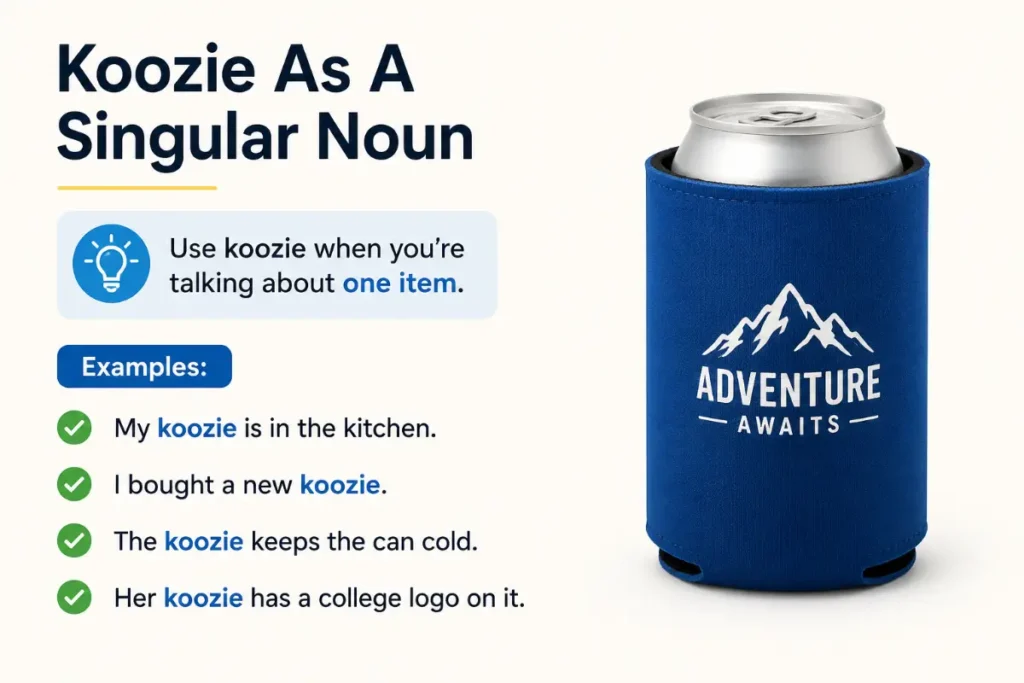
Koozie As A Singular Noun
Use koozie when you’re talking about one item.
Examples:
- My koozie is in the kitchen.
- I bought a new koozie.
- The koozie keeps the can cold.
- Her koozie has a college logo on it.
The word behaves like other ordinary count nouns.
You can use articles such as a and the.
Koozie As A Plural Noun
The plural form is koozies.
Add s.
Examples:
- We bought five koozies.
- The store sells custom koozies.
- I keep several koozies in the cabinet.
- Everyone received koozies at the event.
The same pattern applies to coozie.
One coozie.
Two coozies.
The plural does not become coozys.
Koozie With Articles
Because the word begins with a consonant sound you use a rather than an.
Correct:
a koozie
Incorrect:
an koozie
For example:
I need a koozie for this bottle.
The pronunciation begins with the sound represented by k so the article follows the sound rather than the letters alone.
Koozie With Adjectives
You can describe a koozie with ordinary adjectives.
Examples include:
- a blue koozie
- a foam koozie
- a custom koozie
- a reusable koozie
- an insulated koozie
- a personalized koozie
- a neoprene koozie
- a promotional koozie
This flexibility is one reason the word works naturally in everyday American English.
Koozie In Different Tenses
Because koozie is normally a noun it doesn’t have tense by itself. The verb in the sentence carries the tense.
Compare these examples:
- I bought a koozie yesterday.
- I am using a koozie today.
- I will bring a koozie tomorrow.
- She has ordered three koozies.
- They were carrying koozies at the game.
The noun stays the same.
The verbs change.
This sounds obvious but it matters because informal internet language sometimes encourages people to turn nouns into verbs. That can work creatively but it isn’t necessary here.
Koozie In Professional Writing
Professional writing requires a little more judgment.
Imagine you’re writing a product specification.
You might write:
Insulated beverage sleeve designed to reduce heat transfer and condensation.
That sounds precise.
If you’re writing an event announcement you might write:
Every guest will receive a custom koozie.
That sounds natural.
If you’re writing a marketing headline you could use:
Custom Koozies For Your Next Event.
The best choice depends on the audience and purpose.
This is where good editing differs from mechanical grammar checking. A grammar checker can tell you if a sentence is structurally correct. An experienced editor also considers register audience clarity and context.
Koozie In Academic Writing
Academic writing rarely needs the word koozie unless the subject specifically involves consumer culture language product naming branding or everyday American vocabulary.
If you are writing about beverage insulation for an engineering audience you might use:
insulated beverage container sleeve
If you’re studying brand language you might discuss:
Koozie as a trademarked product name and its broader informal use.
If you’re analyzing American speech you could examine koozie as an example of lexical change.
That last use is particularly interesting because the word demonstrates how commercial language can move into everyday vocabulary.
Koozie In Media And Popular Culture
You may encounter koozie in American lifestyle writing sports coverage party guides outdoor articles and promotional content.
The word fits naturally into casual subjects because the object itself belongs to relaxed settings.
You might see it associated with:
- Backyard gatherings.
- Tailgating.
- Camping.
- Picnics.
- Beach trips.
- Sporting events.
- Weddings.
- Company events.
- College gatherings.
- Promotional campaigns.
The word carries a casual tone. It feels more at home beside words such as barbecue, tailgate, cooler, and picnic than beside highly technical vocabulary.
Generic Alternatives To Koozie
Sometimes koozie isn’t the best choice. If your audience might not recognize the term you can use a more descriptive phrase.
Can Cooler
Can cooler is one of the clearest alternatives. It tells the reader exactly what the product does and what it holds.
Example:
The company gave every guest a branded can cooler.
Drink Sleeve
Drink sleeve is broader.
It can describe a sleeve for cans bottles or some other drink containers.
Example:
The insulated drink sleeve prevented condensation from covering the table.
Beverage Sleeve
Beverage sleeve sounds more formal.
It works well in product descriptions technical material and professional communication.
Example:
The reusable beverage sleeve fits standard cans.
Bottle Sleeve
Use bottle sleeve when the product specifically covers a bottle.
Example:
She placed the bottle inside the insulated bottle sleeve.
Insulated Drink Holder
This phrase emphasizes function.
Example:
The insulated drink holder kept the cold bottle comfortable to hold.
These alternatives can be useful for SEO too. Search engines understand related concepts through semantic relationships rather than relying only on one exact phrase.
A well written article can naturally connect koozie with can cooler, drink sleeve, insulated beverage sleeve, bottle holder, drink holder, and stubby holder without forcing them into every paragraph.
Related Words And Confused Terms
Understanding related vocabulary can make the spelling easier to remember.
Cozy
Cozy usually means comfortable warm or snug.
Example:
The cabin was cozy and quiet.
It isn’t the normal spelling for an insulated drink sleeve.
Cosy
Cosy is the common British spelling of cozy.
Example:
We found a cosy little café.
Again it isn’t the standard spelling for the drink sleeve.
Cozie
Cozie is an older variant associated with cozy rather than the modern spelling of the drink sleeve. Merriam Webster identifies cozey and cozie as archaic variants of cozy. That makes the spelling particularly confusing because cozie looks close to koozie.
Coozy
Coozy appears as a related form in dictionary vocabulary surrounding Koozie. Cambridge includes it among related terms. Still koozie remains the most useful spelling for American readers.
Stubby Holder
Stubby holder is an Australian term for a sleeve that keeps a bottle or can cold. It is a regional equivalent rather than a completely different product.
Can Cooler
Can cooler is a generic American friendly term. It avoids the brand issue and tells readers exactly what the product is.
Drink Sleeve
Drink sleeve is another broad generic term. It can cover more product types than can cooler.
Semantic Relationships Around Koozie
From an NLP perspective koozie belongs to a useful semantic field centered on beverage containers insulation and cooling.
Related concepts include:
- Can cooler.
- Bottle sleeve.
- Drink sleeve.
- Beverage holder.
- Insulated sleeve.
- Drink cooler.
- Beverage cooler.
- Stubby holder.
- Foam sleeve.
- Neoprene sleeve.
- Reusable drink holder.
- Can holder.
These terms help establish meaning because they describe the same product category from different angles. A reader searching how to spell koozie may also search how do you spell koozie, is koozie spelled with a K, koozie or coozie, what is a koozie, what is a can cooler called, or how do you pronounce koozie.
A useful article should answer those related questions naturally instead of making the reader search again.
A related grammar guide is Thank You For The Information Correct Usage And Meaning.
How Native Speakers Actually Use Koozie
Native speakers usually don’t stop to think about the trademark history during casual conversation. They use the word because it is familiar.
Consider this exchange:
Do you have a koozie?
Yeah. There’s one in the drawer.
That sounds completely ordinary in American English.
Nobody needs to explain what the word means.
Now imagine the same conversation in a formal manufacturing meeting.
The engineer might say:
We need an insulated sleeve that fits standard twelve ounce cans.
The vocabulary changes because the purpose changes.
This is an important lesson for writers.
Natural language depends on context.
A word isn’t automatically good or bad because it sounds informal. You simply need to use it in the right setting.
Editorial Guidance For Writers
If I were editing an American English article that used this word I would follow a few simple principles.
- Use koozie when the audience expects the familiar everyday American term.
- Use Koozie when the specific trademark or brand is relevant.
- Use coozie when quoting or preserving an established alternative form.
- Use can cooler when you want generic and immediately clear wording.
- Use drink sleeve when the product could cover different types of containers.
- Use stubby holder when writing specifically for an Australian audience.
- Use cozy only when you mean comfortable or snug or a traditional covering such as a tea cozy.
This approach keeps the writing accurate without turning a simple spelling question into a rigid right or wrong rule.
Why Koozie Is Usually The Best Choice
For an American audience koozie has several practical advantages.
It is recognizable.
It matches the established brand spelling.
Major dictionaries list it as the trademarked form.
Most importantly it answers the reader’s spelling question directly.
If someone asks:
How do you spell koozie?
The response shouldn’t make them work for the answer.
Write:
Koozie.
Then explain the alternatives and trademark background if they need more detail.
That is good language guidance. Give the reader the answer first and the interesting history second.
When To Use Koozie
The best way to use koozie is to match the word to your audience and context.
For casual American English the word works naturally. You can use it in conversations emails social posts product descriptions event materials and lifestyle content when the audience understands the term.
For example:
- I left my koozie on the patio.
- We ordered custom koozies for the wedding.
- Grab a koozie before you head outside.
- The company gave us free koozies at the event.
These sentences sound natural because the word describes a familiar object in a familiar setting.
You don’t need to replace koozie with a complicated technical expression just to sound professional. Clear writing isn’t about choosing the longest word. It is about choosing the word that communicates the idea efficiently.
When To Use Can Cooler
Can cooler is a strong alternative when clarity matters most.
The advantage is obvious. Almost anyone can understand the phrase without knowing the history of koozie.
For example:
The store sells insulated can coolers.
That sentence works especially well in product descriptions because it immediately tells the reader what the item does.
A can cooler can also be a better choice when you’re writing for an international audience. The word koozie has a stronger American flavor while can cooler is more transparent.
When To Use Drink Sleeve
Drink sleeve is useful when the product can fit different types of containers.
A koozie often refers to a sleeve for a can or bottle. A drink sleeve can describe a wider range of products.
For example:
The reusable drink sleeve fits cans bottles and small cups.
This wording gives the reader more information without requiring any explanation of brand terminology.
It also works well in professional product copy.
When To Use Insulated Beverage Sleeve
Insulated beverage sleeve is the most technical expression among these choices.
You might see it in product specifications manufacturing descriptions packaging documents and formal commercial writing.
For example:
The insulated beverage sleeve reduces heat transfer between the container and the surrounding air.
That sentence sounds precise because it focuses on the function rather than the familiar nickname.
You wouldn’t normally use this phrase at a backyard barbecue. Context matters.
Koozie In Promotional Writing
Promotional products are one area where koozie appears frequently.
Businesses often print logos slogans event names or artwork on drink sleeves. These products can become useful promotional items because people may keep using them long after an event ends.
A promotional company might write:
Custom koozies are a practical giveaway for outdoor events.
That sentence sounds natural for an American audience.
If the company wants to avoid trademark concerns it could instead say:
Custom can coolers are practical giveaways for outdoor events.
Both versions communicate the idea. The second one uses a generic product description.
This is an important distinction for editors and marketers. Familiar consumer vocabulary can make copy sound more natural but generic terminology can provide greater precision.
Koozie In Everyday Conversation
Everyday speech is where koozie feels most comfortable.
People use the word casually because it names something they can see and hold.
Here are natural conversational examples:
- Where’s my koozie?
- Can you grab me a koozie?
- This koozie doesn’t fit the bottle.
- I need a bigger koozie.
- Put the can in a koozie.
- I left three koozies in the cooler.
- That koozie has our team logo on it.
- Do you have an extra koozie?
Notice the sentence patterns. The noun behaves like any ordinary count noun.
There is nothing unusual about its grammar.
Koozie In Digital Communication
You may see koozie frequently in social media posts online stores event pages and casual messages.
Online communication encourages short familiar words. That makes koozie a natural choice.
A social post might say:
Don’t forget your koozie for Saturday’s tailgate.
A product listing might say:
Personalized koozies make fun gifts for summer parties.
An event announcement might say:
Custom koozies will be available at the entrance.
These examples demonstrate another useful point about spelling. Informal online language can produce many alternative forms because people often write words according to sound.
That doesn’t mean every version deserves equal status.
If you want the established American spelling use koozie.
Koozie In Search Queries
People don’t always search using dictionary style questions.
They may type:
- how to spell koozie.
- how do you spell koozie.
- is it koozie or coozie.
- koozie spelling.
- correct spelling of koozie.
- how to pronounce koozie.
- what is a koozie.
- what do you call a drink sleeve.
- is koozie a real word.
- how do you spell coozie.
These searches point to the same underlying problem. The reader wants certainty.
A strong answer should therefore begin with the spelling instead of making the reader search through several paragraphs.
The direct answer is:
Koozie is the established spelling most commonly used in American English.
Coozie is also recognized as an alternative form.
That distinction gives the reader both the quick answer and the useful context.
Is Koozie A Real Word
Yes.
Koozie appears in major dictionary resources and is identified by Cambridge Dictionary as a US trademark for a sleeve used to cover a drink container and keep it cold. Cambridge also lists coozie as another form.
The word has therefore moved beyond being something you might see only on a product label.
People use it in ordinary American conversation.
This is an important difference between an invented spelling that appears occasionally online and a word with established lexical recognition.
The history of koozie also shows how dictionaries document living language. English doesn’t remain frozen in old vocabulary. New words enter the language through products culture technology media and everyday speech.
Is Koozie A Trademark
Yes.
Koozie has trademark history and is associated with a registered brand.
Cambridge Dictionary identifies Koozie as a US trademark. Trademark records also show KOOZIE registrations associated with Scribe Opco and related entities.
That doesn’t prevent people from using koozie in ordinary language.
However writers working on commercial packaging advertising legal documents or brand specific material should pay closer attention to capitalization and trademark context.
If the goal is to describe the product category rather than a particular brand the phrase can cooler is often a safer generic choice.
Is Coozie A Misspelling
No. Coozie is recognized as an alternative form of Koozie by Cambridge Dictionary. That doesn’t mean the two spellings have identical popularity. Koozie is the more recognizable form for many American readers. So if you’re writing a general American English article and you want the spelling most readers will expect choose koozie. If you encounter coozie in a casual message you don’t need to assume the writer doesn’t know English. They may simply be using an accepted alternative spelling.
Is Koozie The Same As Cozy
No. The words may sound similar but they have different meanings. Koozie refers to an insulated drink sleeve. Cozy normally means comfortable warm or snug.
For example:
The cabin is cozy.
This sentence describes the cabin as comfortable.
Now compare:
The soda is inside a koozie.
This sentence describes an insulated sleeve around a drink. The words belong to different semantic categories even though their sounds can lead to confusion.
There is also a traditional noun sense of cozy involving a covering for a teapot. That meaning creates an interesting connection between the general concept of a container covering and the modern drink sleeve. Merriam Webster documents this noun sense of cozy.
Still don’t treat cozy as the standard spelling of the modern beverage sleeve.
Koozie Or Cozie
Koozie is the better choice for the modern drink sleeve. Cozie belongs to the historical spelling family associated with cozy and appears as an older variant. Merriam Webster lists cozie among archaic variants of cozy.
That distinction explains why cozie can look plausible while still being the wrong choice for most modern writing about beverage sleeves.
If your sentence is about comfort use cozy.
If it is about a drink sleeve use koozie.
Koozie Or Coozy
For the modern American drink sleeve use koozie.
Coozy can appear as a related spelling but it isn’t the form you should normally choose when writing for a broad American audience.
The safest editorial rule is simple.
Use koozie as the default.
choose cozy for comfort or snugness.
Use can cooler when you want a generic term.
That four way distinction eliminates most of the confusion.
How To Remember The Spelling
A simple memory trick can make the spelling stick.
Think:
Koozie has K plus oo plus zie.
The first part sounds like coo.
The middle contains oo.
The final part is zie.
So:
K O O Z I E
Another useful trick is to connect the word with its most familiar American context. Picture a cold can inside a foam sleeve.
Then picture the spelling:
Koozie.
Visual memory can be more reliable than trying to memorize an isolated sequence of letters.
The Plural Of Koozie
The plural is koozies.
This is one of the most common grammar questions associated with the word.
Singular:
I bought a koozie.
Plural:
I bought three koozies.
The word already ends in ie so you simply add s.
The same pattern applies to coozie.
Singular:
I found a coozie.
Plural:
I found several coozies.
Avoid koozys and coozys.
Those spellings don’t follow the standard plural pattern.
Can Koozie Be Capitalized
It depends on the context. When referring specifically to the trademarked brand the capitalization Koozie may be appropriate. When using the word generically in ordinary writing you’ll often see lowercase koozie. This is similar to many words whose commercial origins became part of general vocabulary. An editor should look at the intended meaning rather than apply capitalization mechanically. If a sentence clearly refers to the brand then preserve the brand styling. If the sentence simply describes an insulated drink sleeve in casual American English then lowercase koozie is common.
Koozie And Trademark Writing
Trademark questions require more care than ordinary spelling questions. If you’re writing for a company that owns or licenses the Koozie brand you should follow its official brand guidelines. If you’re writing independent editorial content you can explain that Koozie is a trademark while also acknowledging its widespread informal use. Avoid making a legal claim stronger than the evidence supports.
For example don’t casually write that the word can never be used generically. Language usage and trademark law involve different questions. A trademark identifies a source of goods or services. Everyday speakers may use a brand name more broadly.
Those two facts can exist at the same time. For high stakes legal or commercial copy consult current trademark records and applicable legal guidance rather than relying on a general language article.
Koozie And The Meaning Of Insulation
The word koozie names the product but the object itself works through insulation. A cold drink naturally gains heat from its surroundings. An insulating sleeve slows that process.
The sleeve can also reduce condensation on the outside of a cold container. That makes the drink more comfortable to hold and can help keep a wet ring from forming on a surface.
This explains why people associate the word with cold drinks. A koozie isn’t simply decorative. Its basic purpose is functional. Modern versions may use foam neoprene fabric or other materials. Their designs vary but the basic concept remains the same.
Real Life Examples By Context
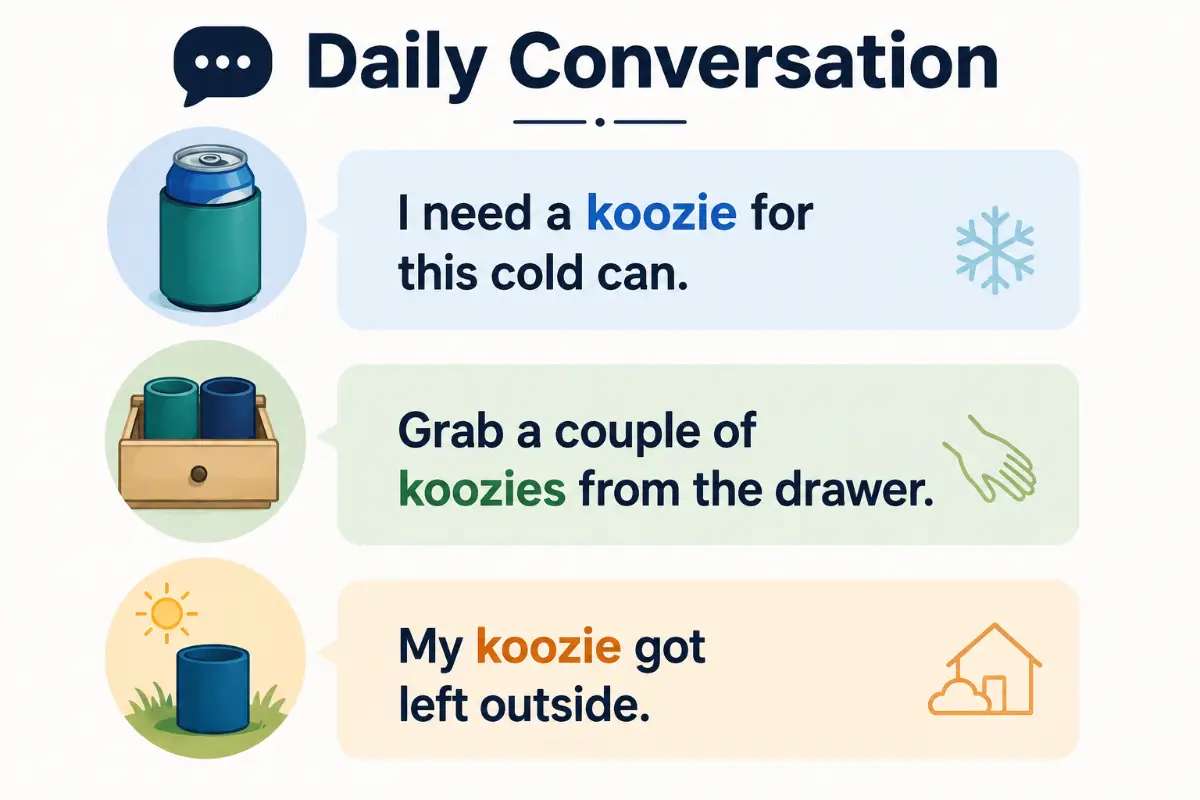
Daily Conversation
- I need a koozie for this cold can.
- Grab a couple of koozies from the drawer.
- My koozie got left outside.
Family Events
- We ordered personalized koozies for the reunion.
- Everyone got a koozie with the family name on it.
- The kids picked their favorite koozies from the box.
Outdoor Activities
- Put your bottle in the koozie before the hike.
- I always keep a spare koozie in my camping bag.
- The koozie helped keep the bottle comfortable to hold.
Sports Events
- The team handed out koozies before the game.
- I bought a koozie with the team logo.
- Everyone had a drink in a koozie during the tailgate.
Professional Events
- The company ordered custom koozies for the conference.
- Guests received branded koozies at the product launch.
- The event organizer included reusable koozies in the gift bags.
These examples show that the word works across many everyday situations. The tone remains casual even when the event itself is professional.
What Native American English Speakers Usually Mean
When an American speaker says koozie they generally mean an insulated holder or sleeve for a beverage container. The listener doesn’t normally interpret it as a word for comfort.
They don’t hear it as cozy.
They understand it as the familiar object used to keep a drink cold and make the container easier to hold. Context strengthens the meaning.
If someone says:
Pass me a koozie.
while standing beside a cooler the meaning is obvious.
If someone says:
This room feels cozy.
the listener immediately understands that the speaker means comfortable or snug. Strong context often resolves vocabulary confusion before anyone consciously thinks about spelling.
What Should Writers Choose
For most American English content the recommendation is straightforward.
Use koozie.
It is recognizable.
It directly answers the search query how to spell koozie.
Use coozie when you need the alternative spelling.
Choose can cooler when you want a generic product term.
Use drink sleeve when you want a broader description.
Use insulated beverage sleeve when precision and technical clarity matter.
Chose stubby holder for Australian contexts where that regional term fits.
This approach gives readers the word they expect without pretending that English vocabulary always has only one possible form.
A related grammar guide is Figoro Or Masingo Meaning Differences and Grammar Guide 2026.
Final Answer To How To Spell Koozie
The correct answer is koozie. If you’re writing for an American audience and need the familiar spelling for an insulated drink sleeve koozie is the form to choose. Coozie is also an accepted alternative form. Don’t confuse koozie with cozy. A cozy place is comfortable or snug. A koozie is a sleeve that surrounds a drink container.
The word also has an interesting trademark history. Koozie originated as a brand name and later became widely used in everyday American English. That history explains why you may see capitalization in brand contexts and lowercase spelling in general conversation. Cambridge Dictionary recognizes the trademark and lists coozie as another form.
For a generic term you can use can cooler or drink sleeve. For British readers a descriptive phrase such as drink sleeve or can cooler can provide clearer meaning.
Frequently Asked Questions
How do you spell koozie?
The most established spelling is koozie. It refers to an insulated sleeve used around a drink can or bottle. Coozie is also recognized as an alternative form. For general American English writing koozie is the safest and most recognizable choice.
Is koozie or coozie correct?
Both forms can be used for an insulated drink sleeve. Cambridge Dictionary identifies Koozie as a US trademark and lists coozie as another form. For American readers koozie is generally the better default because it is the familiar established spelling.
What does koozie mean?
A koozie is an insulated sleeve that fits around a drink can or bottle. It helps slow heat transfer and can reduce condensation on the outside of the container. The word is especially common in casual American English and is also associated with the Koozie brand.
How do you pronounce koozie?
Koozie is normally pronounced KOO zee. Cambridge gives the pronunciation as /ˈkuː.zi/. The word has two syllables and the first syllable receives the main stress. The opening sound is similar to the sound in moon and the final syllable sounds like zee in American English.
Is koozie a real word?
Yes. Koozie appears in dictionary resources and Cambridge identifies it as a US trademark for a drink sleeve. The word is also widely used informally in American English as a general term for an insulated beverage sleeve. Coozie is recognized as an alternative form.
What is another word for koozie?
Common alternatives include can cooler, drink sleeve, beverage sleeve, bottle sleeve, drink cooler, and insulated drink holder. In Australian English stubby holder is a familiar regional term. The best alternative depends on the container and the audience.
Is koozie the same as cozy?
No. Koozie refers to an insulated drink sleeve. Cozy normally means comfortable warm or snug. For example a cozy room feels comfortable while a koozie surrounds a cold drink. The words may sound similar but they have different meanings and spelling.
What is the plural of koozie?
The plural of koozie is koozies. You add s to the singular form. For example you can say I bought one koozie and I bought four koozies. The same plural pattern applies to coozie which becomes coozies.