
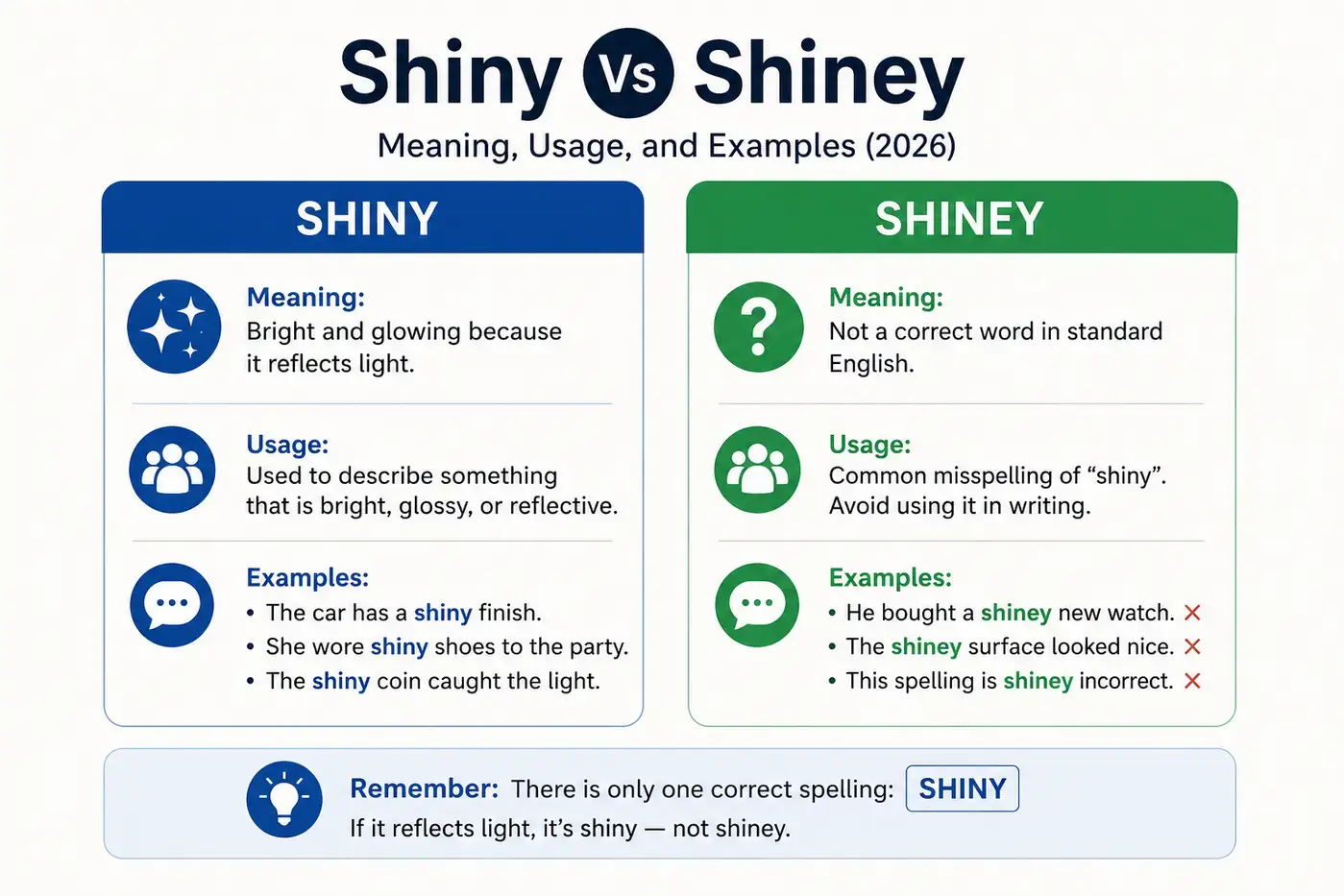
The debate around shiny vs shiney confuses many English learners and native speakers alike. At first glance, both words seem reasonable. Since the adjective comes from the noun shine, many people naturally assume that adding a y should create shiney.English spelling doesn’t always work that way.
In standard English, shiny is the correct spelling. The form shiney is considered a misspelling and should generally be avoided in academic writing, professional communication, published content, and everyday writing.The confusion exists because English contains many words that keep the final e when suffixes are added, while other words drop it. Without knowing the spelling rule, it’s easy to assume shiney is acceptable.
If you’ve ever wondered which version belongs in your writing, you’re not alone. This guide explains the difference between shiny and shiney, the grammar behind the correct spelling, pronunciation, examples, common mistakes, historical origins, regional usage, and expert editing advice.
Need another quick comparison? Read Plural of quiz Is It Quizzes or Quizzez.
Shiny Vs Shiney Quick Definition
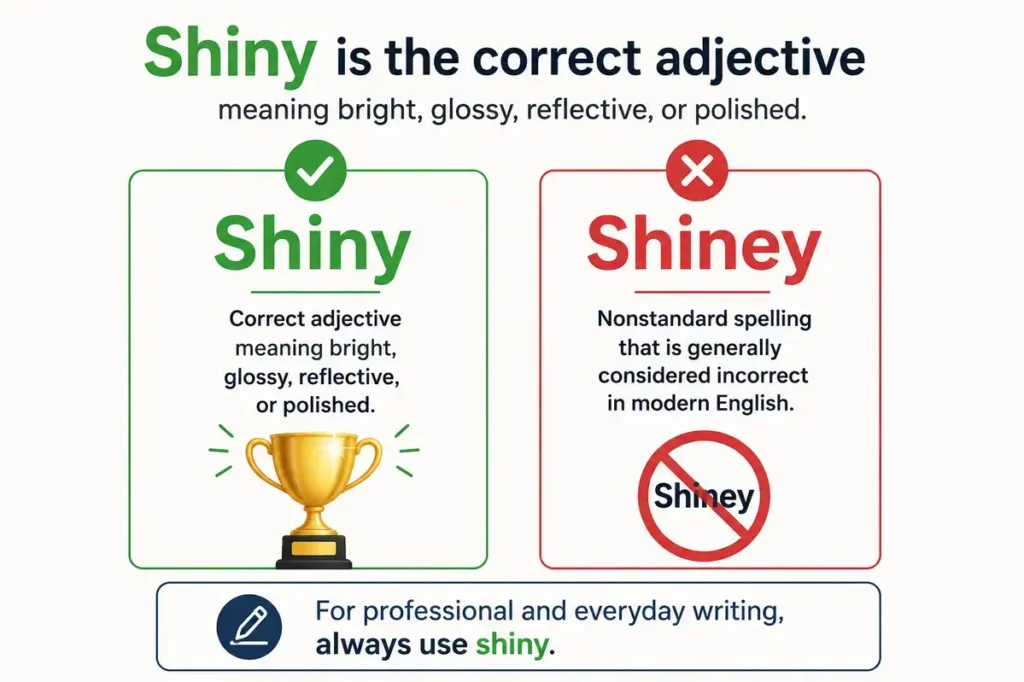
Shiny is the correct adjective meaning bright, glossy, reflective, or polished. Shiney is a nonstandard spelling that is generally considered incorrect in modern English. For professional and everyday writing, always use shiny.
Shiny Vs Shiney Quick Answer
The answer is straightforward.
Use shiny.
Avoid shiney.
Correct examples:
- The car looked shiny after the wash.
- She wore shiny black shoes.
- The floor was shiny and clean.
Incorrect examples:
- The car looked shiney after the wash.
- She wore shiney black shoes.
- The floor was shiney and clean.
In standard English, shiny is always the preferred spelling.
Shiny Vs Shiney Comparison Table
| Feature | Shiny | Shiney |
|---|---|---|
| Correct Spelling | Yes | No |
| Dictionary Recognition | Yes | No |
| Meaning | Bright or reflective | Misspelling of shiny |
| Part Of Speech | Adjective | Nonstandard form |
| Professional Usage | Accepted | Not accepted |
| Academic Usage | Accepted | Incorrect |
| Common In Publishing | Yes | No |
| Formal Writing | Correct | Incorrect |
| Example | A shiny coin | A shiney coin |
Meaning Of Shiny Vs Shiney
What Does Shiny Mean?
Shiny is an adjective used to describe something that reflects light or appears bright, polished, smooth, or glossy.
Examples:
- A shiny silver necklace.
- A shiny new bicycle.
- A shiny marble floor.
- A shiny red apple.
- A shiny sports car.
The word often suggests cleanliness, attractiveness, freshness, or high quality.
What Does Shiney Mean?
Shiney is generally considered a spelling mistake. Writers often create this version because the base word shine ends with the letter e. However, standard English spelling rules require the final e to be dropped before adding the suffix y.
As a result:
- Shine + y = shiny.
- Not shiney.
Most dictionaries, editors, publishers, and teachers treat shiney as incorrect.
Key Differences Between Shiny Vs Shiney
This comparison is much simpler than many word pairs because only one spelling is standard.
Spelling Difference
- Shiny is correct.
- Shiney is incorrect.
Dictionary Difference
- Shiny appears in major dictionaries.
- Shiney generally does not appear as a standard entry.
Professional Writing Difference
- Shiny is suitable for all writing situations.
- Shiney should be avoided.
Educational Difference
- Teachers and editors accept shiny.
- Shiney is usually marked as an error.
Usage Difference
- Native speakers regularly write shiny.
- Shiney appears mostly as a spelling mistake.
Why People Confuse Shiny Vs Shiney
The confusion comes from how English spelling behaves. Many writers see the word shine and assume the adjective should remain shiney. That assumption feels logical. However, English often drops the final e before adding certain suffixes.
Examples:
- Shine becomes shiny.
- Ice becomes icy.
- Bone becomes bony.
- Stone becomes stony.
- Noise becomes noisy.
Because this pattern isn’t always obvious, many people mistakenly write shiney.
Shiny Vs Shiney In Everyday Writing
You’ll encounter shiny constantly in daily life.
Examples:
- The dog had a shiny coat.
- The lake looked shiny in the sunlight.
- She bought a shiny new laptop.
- The polished table appeared shiny.
- The trophy remained shiny for years.
Using shiney in these situations would be considered a spelling error.
Shiny Vs Shiney In Professional Writing
Professional communication requires correct spelling.
Examples:
- The product has a shiny finish.
- The vehicle features shiny chrome accents.
- Customers preferred the shiny surface.
- The polished material remained shiny after cleaning.
- The brochure highlighted the shiny exterior design.
Incorrect spelling can weaken credibility, especially in business, academic, and published content.
Which Spelling Appears More Often?
The difference is enormous.
Shiny appears in:
- Books.
- Newspapers.
- Academic publications.
- Marketing materials.
- Professional websites.
- Dictionaries.
Shiney appears mainly in:
- Typing mistakes.
- Informal online posts.
- User generated content.
- Discussions about spelling errors.
The overwhelming preference for shiny confirms its status as the standard spelling.
Memory Trick For Shiny Vs Shiney
A simple trick can help.
Think about similar words:
- Ice becomes icy.
- Noise becomes noisy.
- Bone becomes bony.
- Shine becomes shiny.
The final e disappears before adding y. If you remember noisy and icy, remembering shiny becomes much easier.
Shiny Vs Shiney And English Spelling Rules
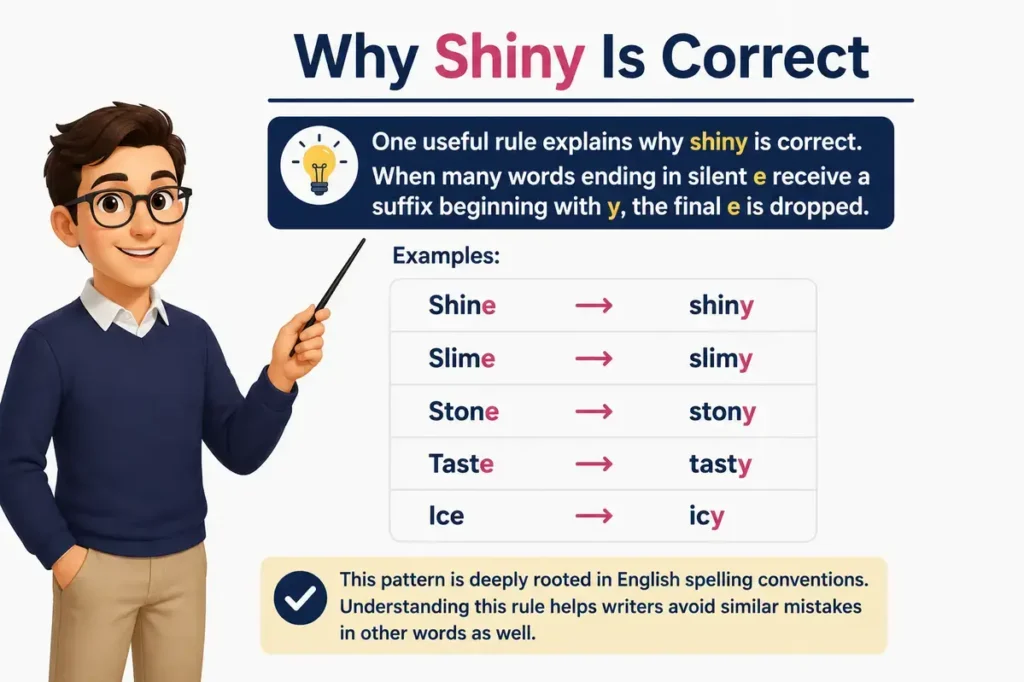
One useful rule explains why shiny is correct. When many words ending in silent e receive a suffix beginning with y, the final e is dropped.
Examples:
- Shine becomes shiny.
- Slime becomes slimy.
- Stone becomes stony.
- Taste becomes tasty.
- Ice becomes icy.
This pattern is deeply rooted in English spelling conventions. Understanding this rule helps writers avoid similar mistakes in other words as well.
Learn the difference in grisly vs grizzly: Correct Spelling, Meaning and Usage.
Which Form Should You Use?
The answer is simple.
Always choose shiny.
Use it in:
- School assignments.
- Blog articles.
- Business documents.
- Academic writing.
- Emails.
- Social media posts.
- Professional publications.
Avoid shiney unless you’re intentionally discussing the misspelling itself. That single choice will keep your writing accurate and professional.
Which One Is Correct In Shiny Vs Shiney?
The correct spelling is shiny. The spelling shiney is considered nonstandard and incorrect in modern English. If you’re writing for school, work, publishing, business, or everyday communication, you should always choose shiny.
Correct examples:
- The shiny floor reflected the light.
- She wore a shiny gold bracelet.
- The shiny paint made the car stand out.
- The child picked up a shiny coin.
- The lake looked shiny in the morning sun.
Incorrect examples:
- The shiney floor reflected the light.
- She wore a shiney gold bracelet.
- The shiney paint made the car stand out.
- The child picked up a shiney coin.
- The lake looked shiney in the morning sun.
Professional editors, teachers, dictionaries, and style guides all recognize shiny as the accepted spelling.
Why Is Shiny Correct?
The answer comes from English word formation rules. The adjective shiny comes from the noun and verb shine. When the suffix y is added, the silent e is removed.
Pattern:
- Shine → Shiny.
- Slime → Slimy.
- Ice → Icy.
- Bone → Bony.
- Stone → Stony.
This spelling pattern explains why shiny became the standard form.
Shiny Vs Shiney Examples In Sentences
Examples help reinforce correct usage.
Correct Examples Using Shiny
- The shiny mirror reflected the entire room.
- He bought a shiny new motorcycle.
- The shiny trophy sat proudly on the shelf.
- The puppy had a shiny coat.
- The polished floor looked shiny after cleaning.
- She admired the shiny gemstones.
- The shiny wrapping paper caught everyone’s attention.
- The apple looked shiny and fresh.
- The shiny silver watch matched his suit.
- The shiny metal surface reflected sunlight.
Incorrect Examples Using Shiney
The following examples contain the common spelling mistake.
- The shiney mirror reflected the room.
- He bought a shiney new motorcycle.
- The shiney trophy sat on the shelf.
- The puppy had a shiney coat.
- The shiney floor looked clean.
- She admired the shiney gemstones.
- The shiney wrapping paper stood out.
- The apple looked shiney and fresh.
- The shiney watch matched his outfit.
- The shiney metal reflected sunlight.
Every sentence above should use shiny instead.
Common Mistakes In Shiny Vs Shiney
Many spelling mistakes occur because writers apply logic rather than established spelling rules.
Keeping The Final E
This is the most common mistake. People see the base word shine and assume the e remains.
Examples:
- Shine → Shiney.
- Shine → Shiny.
Only the second form is correct.
Assuming Pronunciation Determines Spelling
Both shiny and shiney would be pronounced the same way. Because pronunciation doesn’t change, many people assume either spelling works. English spelling often depends on historical rules rather than pronunciation alone.
Following Incorrect Online Usage
The internet contains millions of user generated posts. Some include spelling mistakes. Seeing shiney online does not make it correct.
Confusing It With Other Words
Writers sometimes compare shiny with words that keep the e before a suffix. English spelling rules vary depending on the suffix being added. That variation creates confusion.
Using Shiney In Professional Content
A misspelling in a business document, academic paper, blog article, or website can reduce trust. Professional proofreading should always catch shiney and replace it with shiny.
Shiny Vs Shiney Pronunciation Guide
Interestingly, pronunciation does not help distinguish the two spellings. Both would be spoken exactly the same way.
Shiny Pronunciation
IPA:
/ˈʃaɪ.ni/
Syllable Breakdown:
Shi • ny
Pronounced as:
SHY nee
Examples:
- A shiny coin.
- A shiny surface.
- A shiny necklace.
Shiney Pronunciation
IPA:
/ˈʃaɪ.ni/
The pronunciation remains identical. The issue is spelling rather than sound.
Common Pronunciation Mistakes
- Overstressing the second syllable.
- Pronouncing it as three syllables.
- Assuming the spelling change affects pronunciation.
Native speakers pronounce shiny naturally as two syllables.
Etymology And Word Origin Of Shiny Vs Shiney
Understanding the word’s history helps explain why shiny became the accepted form.
Origins Of Shine
The word shine traces back to Old English. It originally referred to emitting light, glowing, or reflecting brightness. The concept has remained remarkably stable for centuries.
Development Of Shiny
As English evolved, speakers needed an adjective describing things that shine. The suffix y was added to create shiny. This followed common English word building patterns. The adjective eventually became standard across English speaking regions.
Historical Usage
Writers have used shiny in literature, newspapers, books, and correspondence for generations. Over time, dictionaries codified the spelling. Because shiny became firmly established, alternative forms never gained widespread acceptance.
Why Shiney Appears Logical
The spelling shiney seems logical because it preserves the original word shine. Many people naturally assume the base spelling should remain visible. English spelling, however, favors dropping the silent e before adding y. That convention produced shiny.
Shiny Vs Shiney Regional Usage
One interesting aspect of this topic is the lack of regional disagreement. Unlike words such as theater and theatre or color and colour, the spelling remains remarkably consistent.
American English
American English uses shiny.
Examples:
- A shiny sports car.
- A shiny new phone.
British English
British English also uses shiny.
Examples:
- A shiny silver spoon.
- A shiny wooden floor.
Australian English
Australian English follows the same spelling.
Examples:
- A shiny helmet.
- A shiny coin.
Canadian English
Canadian English also prefers shiny.
Examples:
- A shiny bicycle.
- A shiny lake surface.
Global English
Across major English speaking countries:
- Shiny is standard.
- Shiney is generally viewed as a spelling error.
This consistency makes the rule easy to apply internationally.
Shiny Vs Shiney Grammar Rules
Understanding the grammatical role of shiny helps writers use it correctly.
Part Of Speech
Shiny functions primarily as an adjective.
It describes nouns.
Examples:
- A shiny car.
- A shiny floor.
- A shiny ring.
Predicate Adjective Usage
Shiny can appear after linking verbs.
Examples:
- The car looks shiny.
- The floor seems shiny.
- The necklace appears shiny.
Comparative Form
The comparative form is shinier.
Examples:
- This car is shinier than mine.
- The new floor looks shinier.
Superlative Form
The superlative form is shiniest.
Examples:
- That is the shiniest trophy.
- This is the shiniest surface in the room.
Common Sentence Structures
Adjective + Noun
Examples:
- A shiny coin.
- A shiny table.
- A shiny window.
Linking Verb + Adjective
Examples:
- The floor looks shiny.
- The apple appears shiny.
- The metal remains shiny.
Editor’s Grammar Observation
As an editor, I’ve noticed that shiny is one of those words writers rarely question until spellcheck flags shiney. The mistake often happens because people trust visual intuition instead of spelling conventions. Fortunately, once you learn the e dropping rule, the correct spelling becomes much easier to remember. Think of shiny as part of the same family as icy, noisy, slimy, and stony. That connection helps eliminate the error permanently.

Shiny Vs Shiney In Real Life Usage
Learning grammar rules is helpful, but seeing how native speakers actually use words makes the lesson stick. In everyday English, you’ll find shiny everywhere. From product descriptions and novels to advertisements and conversations, it is the standard spelling people expect to see.
Shiny Vs Shiney In Daily Conversation
People frequently use shiny to describe objects that reflect light or appear polished.
Examples:
- Your car looks shiny after that wash.
- She bought a shiny new laptop.
- The floor is so shiny that I can see my reflection.
- He picked the shiny apple from the basket.
- Those shoes still look shiny after years of use.
In natural conversation, native speakers use shiny without thinking twice about the spelling.
Shiny Vs Shiney In Academic Writing
Academic writing values precision and standard language.
Examples:
- Researchers observed a shiny surface on the mineral sample.
- The specimen displayed a shiny metallic appearance.
- The report described the object as shiny and reflective.
- Students compared shiny and matte finishes.
- The article analyzed shiny coatings used in manufacturing.
Using shiney in academic work would almost certainly be marked as a spelling error.
Shiny Vs Shiney In Professional Communication
Businesses often use shiny in product descriptions and marketing materials.
Examples:
- The vehicle features shiny chrome trim.
- Our new packaging has a shiny finish.
- Customers preferred the shiny exterior design.
- The brochure highlighted the shiny metal accents.
- The furniture maintained its shiny appearance for years.
Professional editors would replace shiney with shiny immediately.
Shiny Vs Shiney In Literature
Writers frequently use shiny to create vivid imagery.
Examples:
- The knight carried a shiny sword.
- Moonlight danced across the shiny river.
- She admired the shiny jewels.
- The child chased a shiny balloon.
- A shiny coin glimmered in the dust.
The adjective helps readers visualize brightness and reflection.
Shiny Vs Shiney In Media
News outlets, magazines, and websites consistently use shiny.
Examples:
- The company unveiled a shiny new headquarters.
- The athlete arrived in a shiny black vehicle.
- The product featured a shiny finish.
- The award ceremony showcased shiny gold trophies.
- The magazine highlighted shiny interior design trends.
Reputable publications overwhelmingly favor shiny.
Related Words And Confused Terms
Writers searching for shiny vs shiney often encounter several related words that create additional uncertainty.
Shine
Shine is the base verb.
Examples:
- The stars shine brightly.
- Please shine the flashlight here.
Shining
Shining is the present participle and adjective form.
Examples:
- The sun is shining today.
- She wore shining jewelry.
Shinier
This is the comparative form of shiny.
Examples:
- This ring is shinier than that one.
- The new floor looks shinier.
Shiniest
This is the superlative form.
Examples:
- That is the shiniest car in the showroom.
- She owns the shiniest trophy.
Glossy
Glossy is a close synonym.
Examples:
- The magazine had glossy pages.
- The paint created a glossy finish.
Polished
Polished often overlaps with shiny.
Examples:
- The silver looked polished.
- The marble floor appeared polished and bright.
Reflective
Reflective describes something that bounces light back.
Examples:
- The reflective surface sparkled.
- Reflective materials improve visibility.
Lustrous
Lustrous is a more formal synonym.
Examples:
- The pearls had a lustrous appearance.
- The fabric looked lustrous under the lights.
Understanding these related words expands vocabulary and improves writing variety.
Expert Language Insight On Shiny Vs Shiney
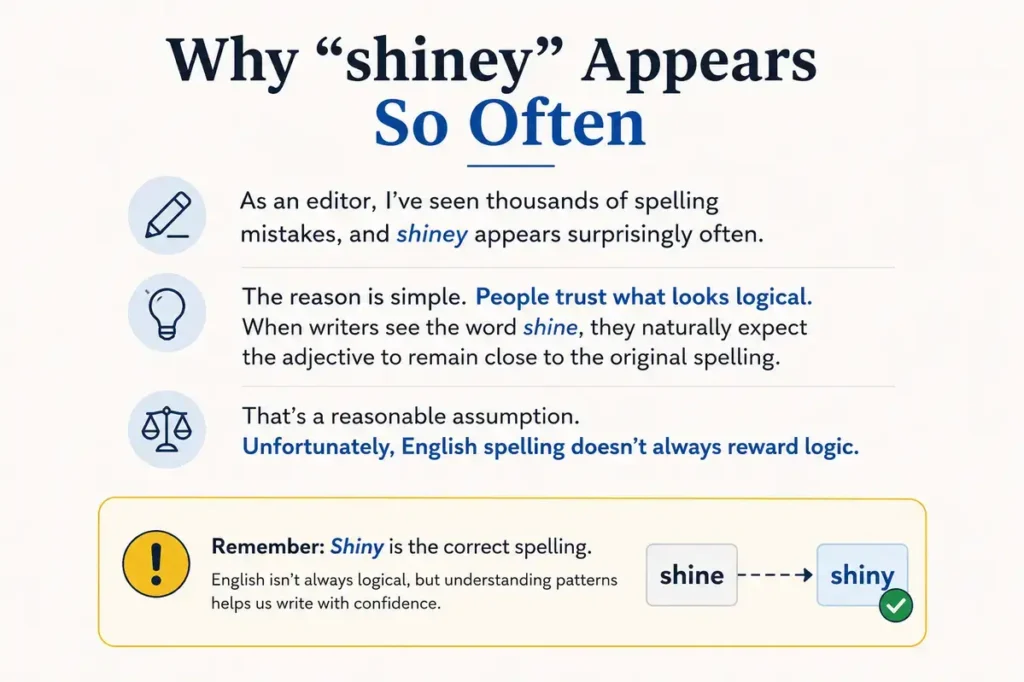
As an editor, I’ve seen thousands of spelling mistakes, and shiney appears surprisingly often. The reason is simple. People trust what looks logical. When writers see the word shine, they naturally expect the adjective to remain close to the original spelling. That’s a reasonable assumption. Unfortunately, English spelling doesn’t always reward logic.
The language developed over centuries through influences from Germanic languages, French, Latin, and countless regional variations. As a result, spelling patterns can feel inconsistent. Native speakers almost always write shiny. Most don’t consciously remember the spelling rule. They simply recognize the word because they’ve seen it repeatedly in books, advertisements, websites, and everyday communication.
Another interesting observation is that readers notice shiney immediately. Even if the rest of the content is excellent, the misspelling stands out because shiny is such a familiar word. For professional writers, bloggers, students, and business owners, using shiny helps maintain credibility. Correct spelling signals attention to detail, and attention to detail builds trust. If you’re ever unsure, remember this simple pattern:
- Ice becomes icy.
- Stone becomes stony.
- Noise becomes noisy.
- Shine becomes shiny.
That rule solves the problem instantly.
Frequently Asked Questions About Shiny Vs Shiney
Is shiny or shiney correct?
Shiny is the correct spelling in standard English. Shiney is considered a misspelling and should generally be avoided in professional, academic, and everyday writing.
Why is shiny spelled without the letter e?
English spelling rules often drop a silent e before adding the suffix y. That’s why shine becomes shiny rather than shiney.
Is shiney a real word?
Shiney occasionally appears online, but it is not recognized as the standard spelling in modern English. Most dictionaries, editors, and teachers consider it incorrect.
How do you pronounce shiny?
Shiny is pronounced /ˈʃaɪ.ni/. It has two syllables and sounds like SHY nee.
Is shiny used in American and British English?
Yes. Both American English and British English use shiny as the accepted spelling. The spelling remains consistent across major English speaking countries.
What part of speech is shiny?
Shiny is an adjective. It describes nouns by indicating that something is bright, glossy, reflective, or polished.
What is the comparative form of shiny?
The comparative form is shinier.
Example:
- This car is shinier than the old one.
What is the superlative form of shiny?
The superlative form is shiniest.
Example:
- That is the shiniest trophy in the collection.
Many readers also check Natzi or Nazi Meaning, Usage, and Correct Form 2026.
Conclusion
The answer to shiny vs shiney is clear. Shiny is the correct spelling. Shiney is a common misspelling that results from misunderstanding English spelling rules. The adjective shiny describes something bright, polished, glossy, reflective, or attractive. It appears in everyday conversation, literature, academic writing, business communication, and professional publishing.
A simple spelling rule explains why shiny is correct. English often drops a silent e before adding the suffix y. The same pattern appears in words such as icy, noisy, slimy, and stony. If you want writing that looks polished and professional, choose shiny every time. That’s the spelling native speakers expect, dictionaries recognize, and editors recommend.
1 thought on “Shiny Vs Shiney Meaning Usage And Examples2026”