
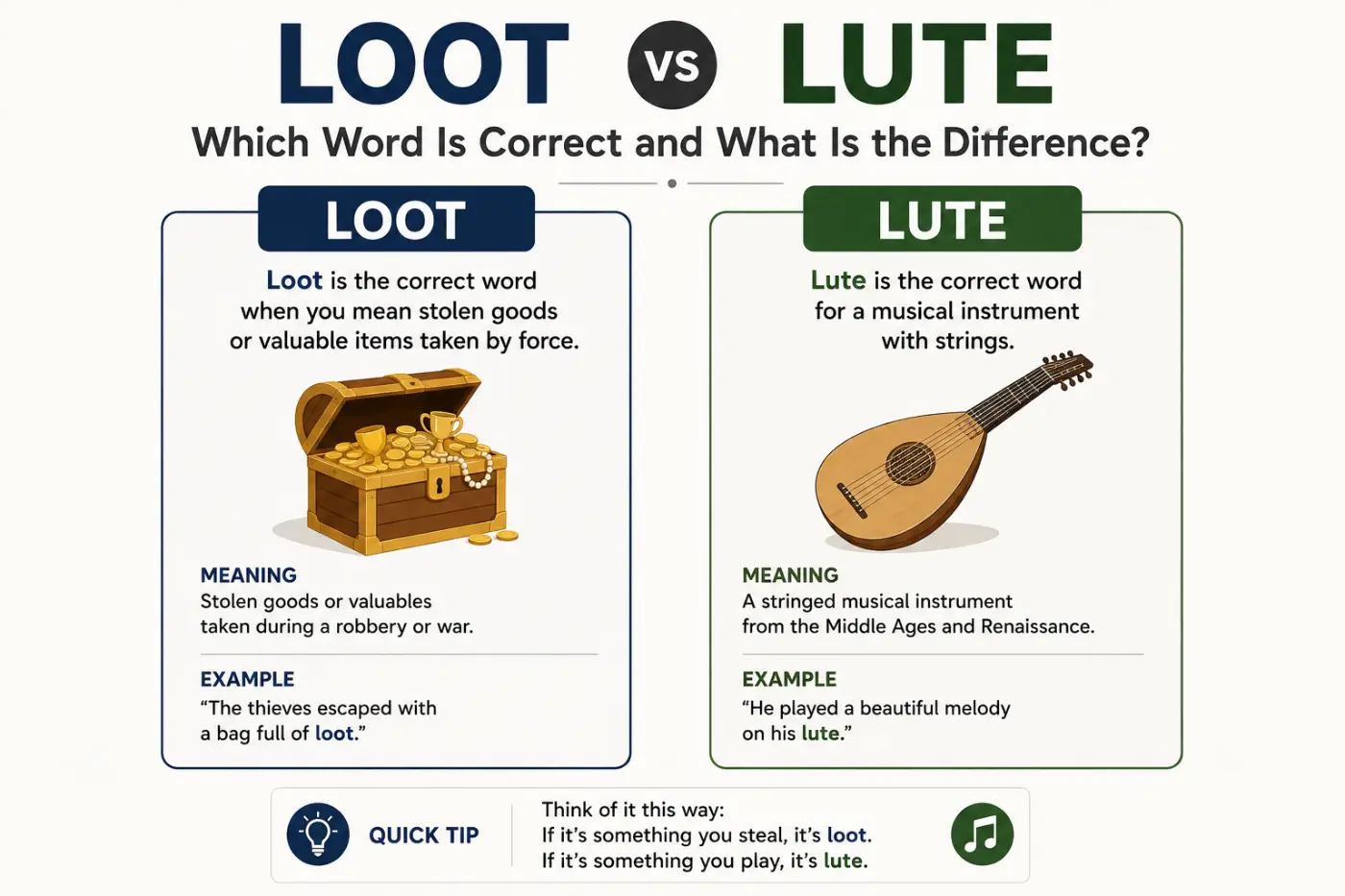
If you’ve searched for loot vs lute, you’re probably wondering if these words are different spellings of the same term or if they have completely different meanings. The short answer is that both words are correct, but they refer to entirely different things. Loot usually means stolen property or valuables taken by force, while lute is a stringed musical instrument with a long history in European and Middle Eastern music.
The confusion often comes from their similar spelling and pronunciation. They differ by only one letter, and in fast speech they can sound somewhat alike to learners of English.
However, using the wrong word can completely change the meaning of a sentence. Saying someone played a loot instead of a lute creates an obvious mistake, just as describing stolen treasure as a lute would confuse readers.
Need another quick comparison? Read Bony Vs Boney Which Spelling Is Correct 2026.
Featured Snippet
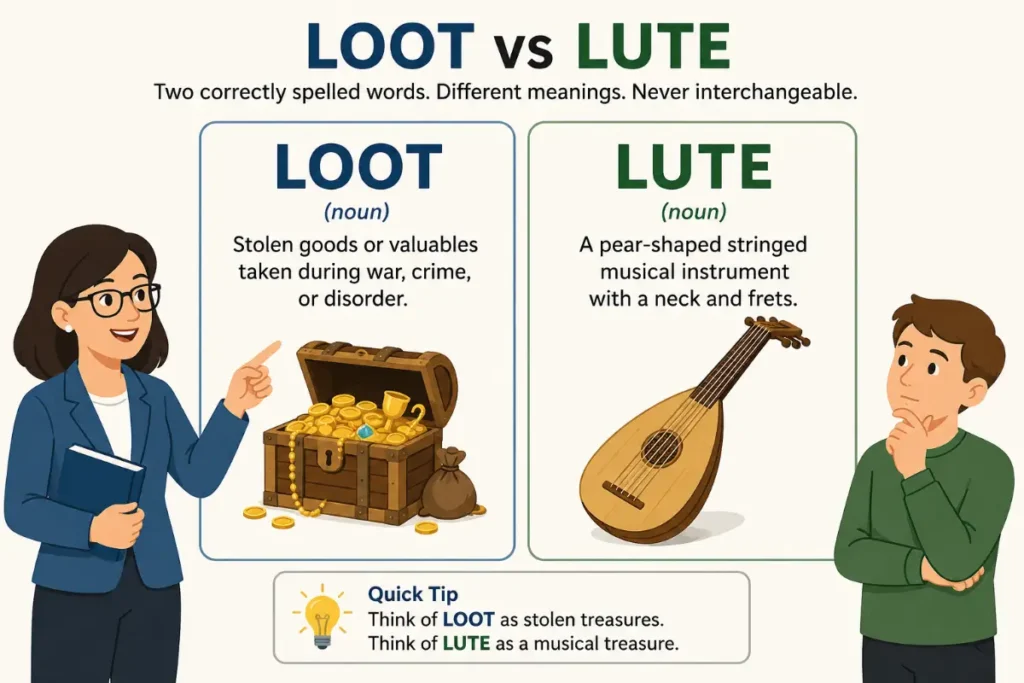
Loot vs lute is a comparison between two correctly spelled English words with unrelated meanings. Loot refers to stolen goods, valuables taken during war, crime, or disorder, while lute is a pear-shaped stringed musical instrument. Although they look and sound somewhat similar, they belong to different parts of speech and are never interchangeable.
Quick Answer
Both loot and lute are correct English words.
- Loot means stolen property, valuables taken by force, or goods acquired through robbery or war. It can also be used as a verb meaning to steal or plunder.
- Lute is a noun referring to a historical stringed musical instrument with a rounded back and a fretted neck.
The correct choice depends entirely on the meaning you intend.
Loot vs Lute Comparison Table
| Feature | Loot | Lute |
|---|---|---|
| Correct spelling | Yes | Yes |
| Meaning | Stolen property or valuables | A stringed musical instrument |
| Part of speech | Noun and verb | Noun |
| Primary use | Crime, war, history, gaming | Music, history, education |
| Origin | Hindi lūṭ, from Sanskrit roots | Arabic al-ʿūd through Old French |
| Usage frequency | Common | Less common |
| Formality | Neutral | Neutral |
| Common contexts | Theft, riots, treasure, games | Classical music, Renaissance music, orchestras |
| Example | The thieves escaped with the loot. | She learned to play the lute. |
Meaning of Both Terms
What Does Loot Mean
Loot refers to money, valuables, goods, or property taken illegally during theft, war, riots, or other acts of plunder. It can describe anything stolen from a person, business, or community. As a verb, loot means to steal or plunder property. Examples include criminals stealing jewelry, soldiers taking valuables during historical conflicts, or mobs breaking into stores during civil unrest. Modern English also uses loot in a more casual way. For example, gamers often say they found rare loot after defeating an enemy. In everyday conversation, people may jokingly call gifts or shopping purchases their “loot.”
Definition
A collection of stolen goods or valuables taken illegally.
Part of Speech
- Noun.
- Verb.
Common Contexts
- Crime reports.
- Military history.
- Archaeology.
- Video games.
- Informal conversation.
What Does Lute Mean
A lute is a traditional stringed instrument known for its rounded body, short neck, and multiple strings. It became one of Europe’s most important musical instruments during the Renaissance and Baroque periods. Musicians played the lute for solo performances, chamber music, and accompaniment. Today, it remains popular among performers specializing in historical music. Unlike a guitar, the lute has a bowl-shaped back and is tuned differently.
Definition
A pear-shaped stringed musical instrument played by plucking its strings.
Part of Speech
- Noun.
Common Contexts
- Classical music.
- Music education.
- Renaissance history.
- Museums.
- Historical performances.
Loot vs Lute Key Differences
Although these words differ by only one letter, they have almost nothing else in common.
Meaning
- Loot relates to stealing, valuables, crime, or treasure.
- Lute relates to music and musical instruments.
Grammar
- Loot functions as both a noun and a verb.
- Lute functions only as a noun.
Context
- Loot appears in news articles, history books, legal writing, and video games.
- Lute appears in music books, orchestras, museums, and discussions of historical instruments.
Tone
- Loot often carries a negative meaning because it involves theft.
- Lute has a neutral and artistic meaning.
Usage Frequency
- Loot appears much more frequently in modern English.
- Lute is relatively uncommon outside music and historical contexts.
Which One Is Correct
The answer depends on what you want to say. Choose loot when referring to stolen property, treasure, rewards collected in games, or the act of stealing valuables. Choose lute when referring to the musical instrument. Neither spelling replaces the other because they represent entirely different words.
Correct examples:
- The robbers hid the loot.
- The museum displayed a beautifully restored lute.
- Players searched the castle for valuable loot.
- The musician performed on a Renaissance lute.
Incorrect examples:
- The thieves escaped with the lute. ✗
- She practiced the loot every afternoon. ✗
Loot Examples in Sentences
- The police recovered most of the stolen loot.
- Pirates buried their loot on a remote island.
- The robbers divided the loot before fleeing.
- Soldiers were forbidden to loot villages.
- The thieves left behind some of the loot.
- Detectives traced the missing loot to another city.
- The video game rewards players with rare loot.
- Protesters were arrested after several stores were looted.
- Archaeologists discovered treasure once believed to be lost loot.
- The gang argued over how to split the loot.
Lute Examples in Sentences
- She learned to play the lute in college.
- The performer carried an antique lute.
- Renaissance composers wrote beautiful music for the lute.
- The museum displayed a sixteenth-century lute.
- He carefully tuned the lute before the concert.
- The music teacher explained the history of the lute.
- Artists often painted musicians holding a lute.
- The old lute required careful restoration.
- Her favorite instrument was the lute.
- The orchestra included a skilled lute player.
Common Mistakes
Many learners confuse these words because of their similar spelling.
Common errors include:
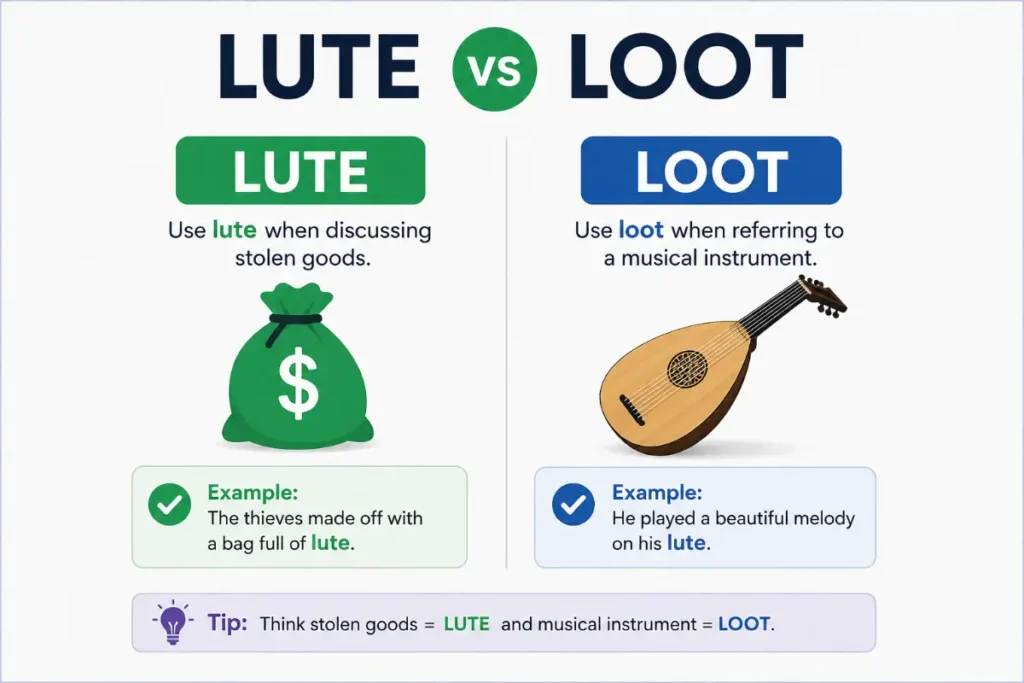
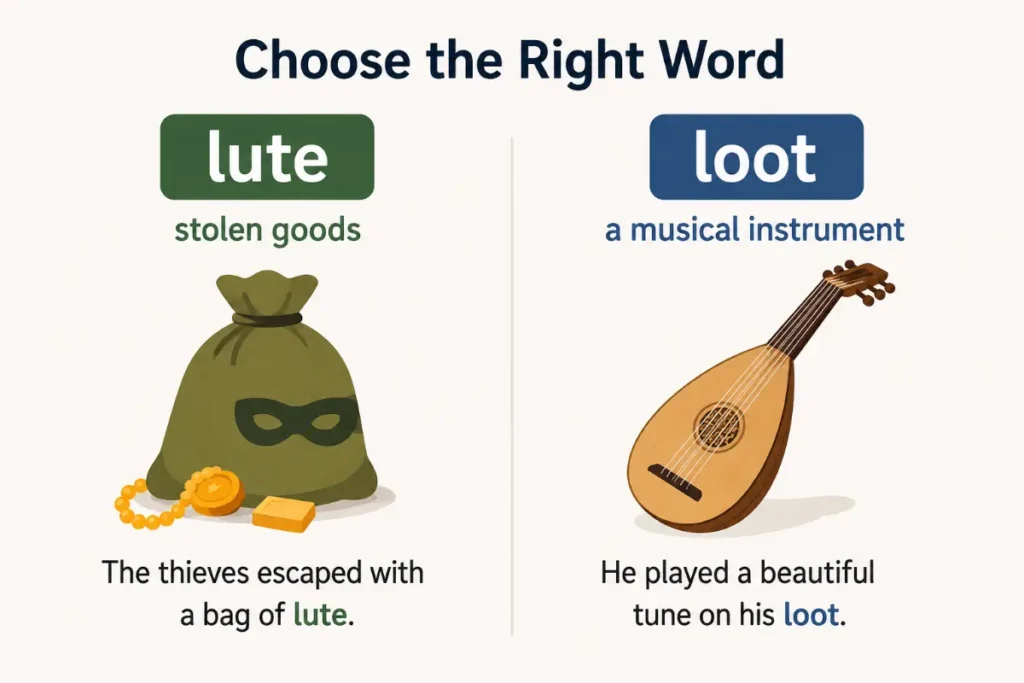
- Writing lute when discussing stolen goods.
- Writing loot when referring to a musical instrument.
- Assuming one spelling is simply British English and the other American English.
- Believing they are alternative spellings of the same word.
None of those assumptions is correct. These are two separate English words with different histories and meanings.
Pronunciation Guide
Loot
IPA: /luːt/
Syllables: loot
Rhymes with:
- boot.
- root.
- suit.
Lute
IPA: /luːt/
Syllables: lute
Rhymes with:
- mute.
- flute.
- dispute.
Although both words share the same standard pronunciation, their meanings make the intended word clear in context.
Learn the difference in pent vs pants Meaning and Usage Explained.
Etymology and Word Origin
Although loot and lute look similar, they come from entirely different language families. Their resemblance is purely accidental.
The Origin of Loot
The English word loot entered the language during the British colonial period in India in the late eighteenth century. It comes from the Hindi word lūṭ, meaning “plunder” or “stolen goods,” which in turn traces back to the Sanskrit root luṇṭ, meaning “to rob” or “to seize by force.” British soldiers and administrators frequently encountered the word and gradually adopted it into English. By the early nineteenth century, loot had become a standard English word used in military reports, newspapers, and literature. Over time, its meaning expanded beyond war.
Today, loot commonly refers to:
- Property stolen during crimes.
- Valuables taken during riots.
- Treasure found by fictional adventurers.
- Rewards collected in video games.
- Informal references to shopping purchases or gifts.
Despite these newer uses, the core idea remains the same. Loot refers to valuables that are acquired or collected, often through force, theft, or reward.
The Origin of Lute
The history of lute stretches back much further. The word ultimately comes from the Arabic al-ʿūd, which means “the wood.” Through trade and cultural exchange, the instrument spread into Europe during the Middle Ages. The word passed through Old French as lut before becoming lute in Middle English. The instrument flourished between the fifteenth and seventeenth centuries. During the Renaissance, the lute became one of Europe’s most respected musical instruments. Many composers wrote specifically for it, and educated musicians were expected to know how to play it. Although the guitar eventually became more popular, the lute remains important in early music performances and historical studies.
Why the Words Look Similar
English contains many words that resemble one another despite having unrelated origins. That is exactly what happened here. Loot developed from South Asian languages. Lute developed through Arabic and French. Their spellings simply converged over time.
Loot vs Lute Regional Usage
Unlike many confusing word pairs, loot and lute do not change meaning across major English-speaking countries.
American English
Americans use loot frequently in:
- Crime reporting.
- News coverage.
- Police investigations.
- Video game discussions.
- Informal speech.
Examples:
- Police recovered the stolen loot.
- The game offers legendary loot.
Lute mainly appears in:
- Music education.
- Museums.
- Classical performances.
- Historical writing.
British English
British English uses both words in the same way.The only noticeable difference is that British publications may discuss the lute more often when covering Renaissance music and European history.
Examples:
- The museum displayed a beautifully restored lute.
- Officers recovered the loot after the robbery.
Canadian English
Canadian English follows the same conventions as American English. Both meanings remain identical.
Australian English
Australian English also follows the same pattern. You will hear loot in crime reports, sports commentary, gaming communities, and casual conversation. Lute continues to refer exclusively to the musical instrument.
Is There a Regional Preference
No. There is no American spelling versus British spelling distinction. Both words are standard English worldwide.
Loot vs Lute Grammar Rules
Understanding how each word functions grammatically makes choosing the correct one much easier.
Loot as a Noun
When used as a noun, loot refers to stolen property or collected valuables.
Examples:
- The loot was hidden underground.
- Police recovered the missing loot.
- The pirates protected their loot.
Loot as a Verb
As a verb, loot means to steal or plunder.
Examples:
- Criminals looted several stores.
- The army refused to loot villages.
- Rioters looted nearby businesses.
Verb forms include:
| Base Form | Past Tense | Past Participle | Present Participle |
|---|---|---|---|
| loot | looted | looted | looting |
Lute as a Noun
Lute functions only as a noun.
Examples:
- The lute sounded beautiful.
- She purchased an antique lute.
- The musician restored the old lute.
Plural Form
The plural is lutes.
Examples:
- The museum displayed several Renaissance lutes.
- The collection includes rare lutes from Italy.
Can Lute Be Used as a Verb
In modern English, almost never.
Most dictionaries recognize lute primarily as a noun. In highly specialized historical or technical contexts, you may occasionally encounter unrelated verb senses, but everyday English treats lute as the name of the instrument.
Real Life Usage Examples
Seeing these words in realistic situations helps reinforce the difference.
Daily Conversation
- Someone broke into the store and stole thousands of dollars in loot.
- My grandfather owns an old lute from Europe.
- The children joked about pirate loot during the birthday party.
- The music student practices the lute every weekend.
Academic Writing
History textbooks often discuss loot collected after battles. Music textbooks explain how the lute influenced the development of modern string instruments.
Professional Communication
News reporters frequently write about stolen loot recovered by investigators. Museum curators describe valuable collections of historical lutes.
Literature
Adventure novels often feature hidden loot buried on mysterious islands. Historical novels may describe traveling musicians carrying lutes through medieval towns.
Media and Entertainment
Modern video games frequently reward players with loot after completing missions. Historical documentaries regularly feature experts demonstrating authentic Renaissance lutes.
Related Words and Confused Terms
Many readers who search for loot vs lute also explore similar words.
Words Related to Loot
- Plunder.
- Booty.
- Spoils.
- Treasure.
- Stolen property.
- Valuables.
- Riches.
- Haul.
- Prize.
- Reward.
Words Related to Lute
- Guitar.
- Mandolin.
- Oud.
- Harp.
- Lyre.
- Banjo.
- Violin.
- Cittern.
- String instrument.
- Renaissance instrument.
Commonly Confused Word Pairs
- Loot vs Booty.
- Lute vs Lyre.
- Lute vs Oud.
- Steal vs Rob.
- Instrument vs Equipment.
- Prize vs Reward.
- Treasure vs Loot.
- Guitar vs Lute.
Knowing these related terms helps you choose more precise vocabulary in both speaking and writing.
Loot vs Lute in Popular Culture
Both words appear regularly in modern media, but in very different settings.
Loot in Entertainment
The word loot has become especially common in gaming culture. Players often talk about:
- Rare loot.
- Epic loot.
- Legendary loot.
- Loot drops.
- Loot boxes.
- Bonus loot.
Outside gaming, movies about pirates, treasure hunters, and crime frequently use the word.
Examples include stories involving:
- Hidden pirate loot.
- Bank robbery loot.
- Smuggled loot.
- Buried treasure.
Lute in Music and History
The lute appears most often in:
- Renaissance music.
- Medieval festivals.
- Historical dramas.
- Classical concerts.
- Museum exhibitions.
- Educational documentaries.
Films set in medieval Europe often feature traveling musicians carrying lutes, helping create an authentic historical atmosphere.
Expert Language Insight
Professional editors rarely confuse loot and lute because the surrounding context immediately reveals the intended meaning. For writers, the real challenge is proofreading. Since the words differ by only one letter and share the same pronunciation, a simple typing mistake can easily slip past spellcheck if it creates another valid English word. Experienced editors recommend checking the surrounding nouns and verbs rather than focusing only on the word itself.
Memory Tricks to Remember Loot vs Lute
Small spelling differences are easy to miss, especially when two words sound the same. These memory tricks can help you choose the correct word every time.
Remember Loot
Think of a pirate opening a treasure chest filled with gold coins and jewels. Loot is connected with:
- Treasure.
- Stolen goods.
- Rewards.
- Robbery.
- Plunder.
The double o in loot can remind you of two gold coins inside a treasure chest.
Remember Lute
Imagine a musician sitting in a castle, gently playing a beautiful wooden instrument. Lute is connected with:
- Music.
- Instruments.
- Renaissance performers.
- Concerts.
- Classical history.
The letter e at the end of lute can remind you of entertainment, which music provides.
Quick Practice Quiz
Choose the correct word to complete each sentence.
- The pirates buried their ______ on the island.
- She learned to play the ______ during music school.
- Police recovered most of the stolen ______.
- The museum displayed an antique ______ from the sixteenth century.
- Players searched the dungeon for rare ______.
- The musician carefully tuned the ______ before the concert.
- Rioters tried to ______ several businesses.
- The orchestra included a skilled ______ player.
Answers
- loot.
- lute.
- loot.
- lute.
- loot.
- lute.
- loot.
- lute.
If you answered all eight correctly, you have mastered the difference.
Common Questions People Ask About Loot vs Lute
Many online searches reveal the same points of confusion. Here are the clearest answers.
Is loot another spelling of lute
No. They are completely different English words. Loot refers to stolen goods or valuables, while lute is a musical instrument.
Why do loot and lute sound the same
English contains many homophones, which are words that share the same pronunciation but have different spellings and meanings. Loot and lute are examples of this pattern.
Can loot be used positively
Sometimes. In news reports and legal writing, loot almost always has a negative meaning because it refers to stolen property. In these contexts, it usually carries a positive meaning.
Is the lute still played today
Yes. Although it is no longer a mainstream instrument, professional musicians, music historians, and early music ensembles continue to perform on the lute. It is especially popular in Renaissance and Baroque music.
You may also want to read Tapping Vs Taping Which Word Should You Use in 2026?.
Final Verdict on Loot vs Lute
The comparison between loot vs lute is straightforward once you know what each word means. Both spellings are correct, but they belong to completely different parts of the English vocabulary.
Choose loot when writing about stolen goods, treasure, plunder, valuables, or rewards collected in games. It functions as both a noun and a verb and appears frequently in news reports, historical writing, and everyday conversation.
Choose lute when referring to the traditional stringed musical instrument associated with Renaissance and Baroque music. It is always used as a noun in modern English and appears mainly in musical, historical, and educational contexts.
Frequently Asked Questions
Is loot or lute the correct spelling?
Both are correct spellings. Loot means stolen property or valuables taken by force and can also be used as a verb meaning to steal. Lute is the name of a traditional stringed musical instrument. The correct choice depends entirely on the meaning of your sentence.
What is the difference between loot and lute?
The difference is their meaning. Loot relates to theft, treasure, plunder, or game rewards. Lute refers to a historical musical instrument with a rounded body and strings. Despite their similar pronunciation, they are unrelated words and cannot replace one another.
Are loot and lute pronounced the same?
Yes. In standard English, both words are commonly pronounced /luːt/. Because they are homophones, listeners rely on context to determine which word is intended.
Can loot be used as a verb?
Yes. As a verb, loot means to steal or plunder property, especially during war, riots, or civil disorder. Example: The criminals looted several shops before police arrived.
Is lute only a noun?
Yes, in modern everyday English, lute is almost exclusively used as a noun. It refers to the musical instrument and is not commonly used as a verb in contemporary writing or speech.
Is loot common in video games?
Yes. Modern video games frequently use loot to describe weapons, armor, coins, equipment, and other rewards that players collect after completing quests, defeating enemies, or opening treasure chests.
Are loot and lute used differently in British and American English?
No. Both British English and American English use loot and lute with the same meanings. There is no regional spelling difference between the two words.
How can I remember the difference between loot and lute?
Think of loot as treasure hidden inside a pirate’s chest and lute as a musical instrument played by a Renaissance musician. Associating each word with a vivid image makes it much easier to remember the correct spelling.