
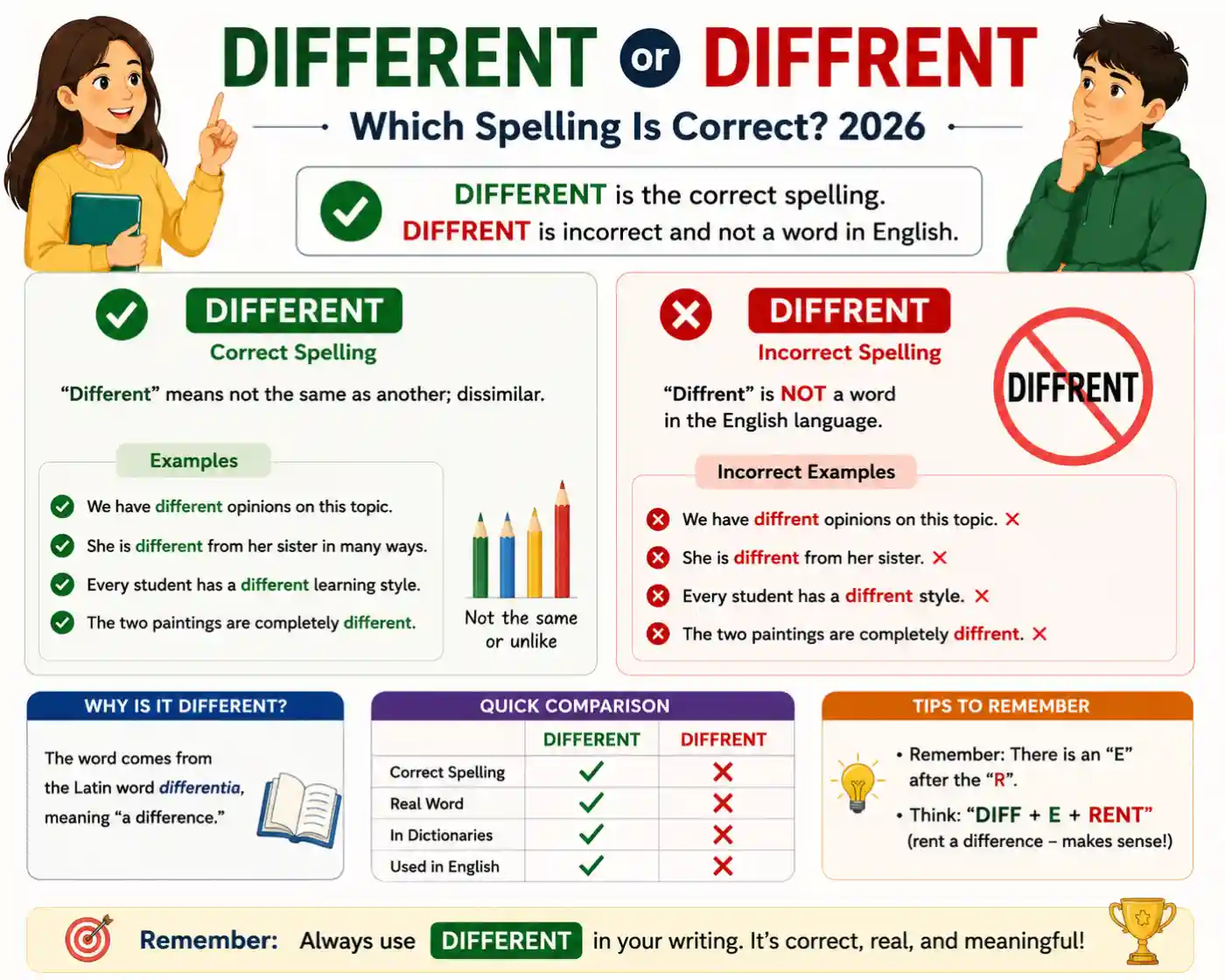
If you’ve ever typed different or diffrent into a search engine, you’re not alone. Thousands of English learners, students, professionals, and native speakers accidentally misspell this common adjective. The mistake usually happens because the word contains two e’s, two f’s, and one r, making it easy to drop a vowel while typing quickly. Spell check often catches the error, but understanding why the correct spelling works helps you avoid repeating the mistake.
The short answer is simple. Different is the correct spelling in all forms of English. Diffrent is a misspelling and is not recognized as a standard English word in dictionaries or formal writing.
In this guide, you’ll learn the correct spelling, pronunciation, meaning, grammar, word origin, sentence examples, common mistakes, and practical tips to remember the spelling forever. You’ll also see how native speakers naturally use different in everyday conversations, academic writing, business communication, and professional editing.
You may also want to read Suprise or Surprise Correct Spelling Meaning and Usage Guide.
Quick Definition
Different is the correct English spelling. It means not the same as another person, thing, idea, or situation. Diffrent is an incorrect spelling caused by accidentally omitting the first e after diff. Always use different in formal and informal writing.
Quick Answer
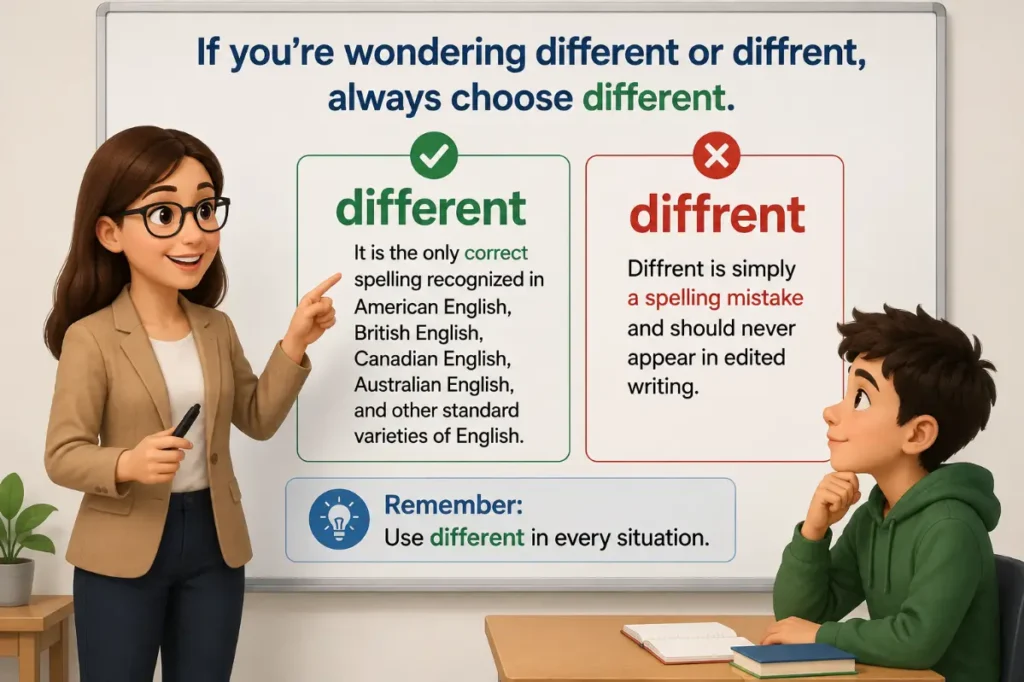
If you’re wondering different or diffrent, always choose different. It is the only correct spelling recognized in American English, British English, Canadian English, Australian English, and other standard varieties of English. Diffrent is simply a spelling mistake and should never appear in edited writing.
Different or Diffrent Comparison Table
| Feature | Different | Diffrent |
|---|---|---|
| Correct spelling | Yes | No |
| Dictionary word | Yes | No |
| Part of speech | Adjective | Not a word |
| Meaning | Not the same | None |
| Origin | Middle English from Latin | Misspelling of different |
| Usage frequency | Extremely common | Typographical error |
| Formal writing | Correct | Incorrect |
| Academic writing | Correct | Incorrect |
| Professional communication | Correct | Incorrect |
| Everyday conversation | Correct | Incorrect |
| Accepted worldwide | Yes | No |
| Example | Our opinions are different. | Incorrect |
Meaning of Different
Different is an adjective used to describe people, objects, ideas, places, or situations that are not the same. It highlights distinction, variation, or contrast between two or more things.
Examples include:
- The two paintings look different.
- My schedule is different this week.
- Every student has a different learning style.
- We reached different conclusions.
- The climate here is completely different.
The word is one of the most frequently used descriptive adjectives in English because comparison is a natural part of everyday communication.
Definition
Different means:
- Not the same.
- Distinct from another.
- Unlike something else.
- Separate in nature or quality.
- Unique in some respect.
How Editors Use Different
Professional editors use different to make comparisons precise and easy to understand.
For example:
Incorrect:
The two reports are same.
Correct:
The two reports are different.
The adjective immediately tells readers that the reports are not identical.
Meaning of Diffrent
Diffrent has no meaning because it is not a recognized English word. It appears only because of:
- Fast typing.
- Missing the first e.
- Keyboard slips.
- Poor proofreading.
- Spelling uncertainty.
Modern dictionaries do not list diffrent as a standard word. Whenever you write diffrent, readers immediately recognize it as a spelling error.
Different or Diffrent Which One Is Correct
The correct spelling is different. The incorrect spelling is diffrent. The easiest way to remember this is that the word contains two e’s.
Correct spelling:
Different
Incorrect spelling:
Diffrent
Think of the pattern:
dif + fer + ent
Notice that fer contains the missing e.
Dropping that vowel creates an incorrect spelling. Professional editors automatically correct diffrent because it never appears in standard English.
Why People Misspell Different
Although different is a common word, many people accidentally write diffrent. Several factors contribute to the mistake.
1. Fast Typing
When typing quickly, writers often skip vowels without noticing.
For example:
different
becomes
diffrent
2. Pronunciation
In everyday speech, the middle vowel is pronounced very lightly.
Many speakers hear:
dif-frent
instead of
dif-fer-ent
Because the unstressed vowel sounds weak, people sometimes leave it out when spelling.
3. Double Letters
The word contains:
- Two f’s.
- Two e’s.
Words with repeated letters naturally cause more spelling mistakes.
4. Memory Errors
People often remember only the beginning and ending of long words. Instead of recalling every letter, they rely on memory patterns, increasing the chance of missing one vowel.
5. Typographical Errors
Even experienced writers occasionally type diffrent by accident. Fortunately, proofreading usually catches the mistake before publication.
Key Differences Between Different and Diffrent
Although these spellings look similar, they are fundamentally different.
| Feature | Different | Diffrent |
|---|---|---|
| English word | Yes | No |
| Correct spelling | Yes | No |
| Used by native speakers | Yes | Only accidentally |
| Appears in dictionaries | Yes | No |
| Accepted in exams | Yes | No |
| Used in books | Yes | No |
| Suitable for professional writing | Yes | No |
The comparison is straightforward because only one form belongs to standard English.
Pronunciation Guide
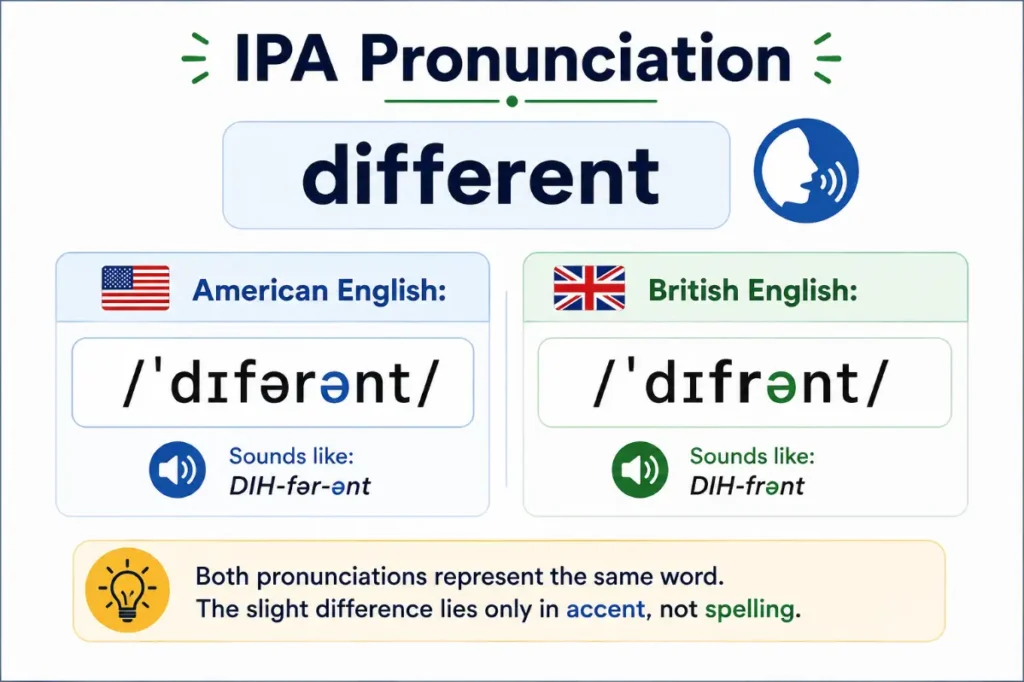
IPA Pronunciation
American English:
/ˈdɪfərənt/
British English:
/ˈdɪfrənt/
Both pronunciations represent the same word. The slight difference lies only in accent, not spelling.
Syllable Breakdown
Different has three syllables:
dif fer ent
Stress falls on the first syllable.
Say it slowly:
DIF fer ent
Common Pronunciation Mistakes
Some learners pronounce every vowel equally. Native speakers usually reduce the middle vowel, making it sound softer. This reduced vowel explains why many people accidentally write diffrent, even though the spelling remains different.
Different or Diffrent Grammar Rules
Since different is an adjective, it follows normal adjective grammar rules.
Rule 1. Describe Nouns
Correct:
- A different answer.
- A different city.
- A different approach.
Rule 2. Follow Linking Verbs
Correct:
- The results are different.
- My opinion is different.
- Their methods seem different.
Rule 3. Compare Two Things
Correct:
- This phone is different from mine.
- Her writing style is different from yours.
- Our experiences were different.
In formal American English, different from is the safest and most widely accepted construction. Some regional dialects also use different than or different to, but usage varies by region and style guide.
Parts of Speech
The word different functions primarily as an adjective.
Examples:
- Different ideas.
- Different opinions.
- Different colors.
- Different cultures.
- Different solutions.
It does not function as a verb or noun.
Still confused? Compare Fare Better Or Fair Better Correct Usage Guide.
Common Word Forms
| Form | Example |
|---|---|
| Different | We have different opinions. |
| Difference | I noticed the difference. |
| Differ | Our views differ greatly. |
| Differently | She thinks differently. |
| Differences | We discussed our differences. |
These related forms all share the same root but serve different grammatical functions.
Examples of Different in Sentences
Here are ten natural examples showing how native speakers use different.
- Every child learns at a different pace.
- This recipe tastes different from the original.
- We chose a different route to avoid traffic.
- My priorities are different now.
- They have different personalities.
- The second proposal looks much different.
- Life was completely different ten years ago.
- She offered a different perspective.
- Each season brings different challenges.
- Our teacher explained the concept in a different way.
These examples reflect everyday English and demonstrate the flexibility of the word across many contexts.
Examples of Diffrent in Sentences
Because diffrent is not a correct English word, it should not appear in properly written sentences. The following examples show common mistakes alongside the corrected versions.
| Incorrect | Correct |
|---|---|
| We have diffrent opinions. | We have different opinions. |
| The answer looks diffrent. | The answer looks different. |
| Try a diffrent method. | Try a different method. |
| Everyone has diffrent goals. | Everyone has different goals. |
| This feels diffrent today. | This feels different today. |
| They reached diffrent conclusions. | They reached different conclusions. |
| She chose a diffrent color. | She chose a different color. |
| Our schools are diffrent. | Our schools are different. |
| The two books are diffrent. | The two books are different. |
| I expected a diffrent outcome. | I expected a different outcome. |
Reviewing incorrect and corrected versions side by side makes the proper spelling easier to remember.
Common Mistakes With Different
Although different is one of the most common words in English, it also appears among the most frequently misspelled words in school assignments, emails, social media posts, and online searches. Most mistakes happen because writers type quickly, rely on pronunciation instead of spelling, or confuse similar grammar patterns. Learning these common errors can help you write with greater confidence.
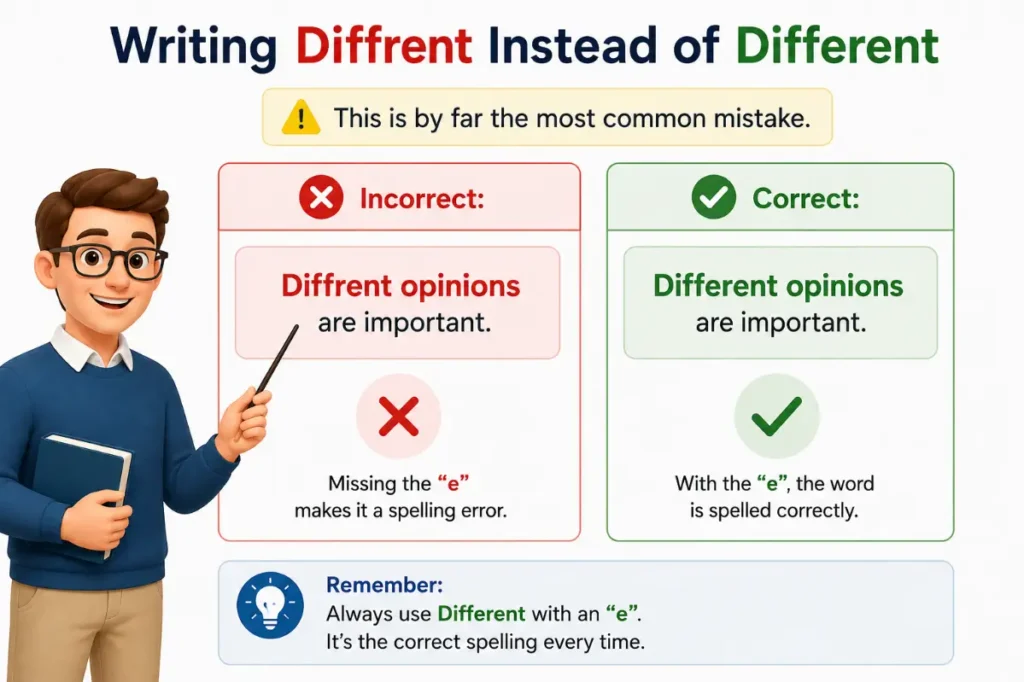
1. Writing Diffrent Instead of Different
This is by far the most common mistake.
Incorrect:
Different opinions are important.
Correct:
Different opinions are important.
The missing e changes the word into a spelling error.
2. Confusing Different With Difference
These two words share the same root but serve different grammatical purposes.
Different is an adjective.
Difference is a noun.
Correct:
- There is a difference between the two plans.
- The plans are different.
Incorrect:
- There is a different between the two plans.
- The plans are difference.
3. Using the Wrong Preposition
Many learners wonder which preposition should follow different. The most widely accepted choice is different from.
Correct:
- Your answer is different from mine.
- This design is different from the original.
Although different than appears in American English and different to is common in British English, different from remains the safest choice in formal writing.
4. Forgetting Proofreading
Even experienced writers occasionally type diffrent without noticing. A quick proofreading pass usually catches the mistake before publication.
5. Trusting Pronunciation Too Much
Native speakers often pronounce different quickly. The middle vowel becomes less noticeable, making the word sound similar to “diffrent.” Remember that spelling follows the standard written form, not casual pronunciation.
Etymology and Word Origin
Understanding a word’s history often makes it easier to remember. The word different has a long history that stretches back through several languages.
Latin Roots
The ultimate source is the Latin verb differre, meaning:
- To carry apart.
- To be unlike.
- To differ.
From this developed the Latin adjective differentem, meaning “distinct” or “unlike.”
Middle English
The word entered English through Old French before becoming part of Middle English. Over time, the spelling settled into the modern form:
different
Despite changes in pronunciation over the centuries, the spelling has remained remarkably stable.
Modern English
Today, different is one of the most frequently used descriptive adjectives in English.
It appears in:
- Literature.
- Newspapers.
- Academic journals.
- Business documents.
- Government publications.
- Everyday conversations.
Meanwhile, diffrent has never been accepted as a standard spelling.
Regional Usage
One advantage of learning different is that its spelling never changes across major English varieties.
American English
Americans always spell the word:
different
Common examples:
- Different ideas.
- Different opinions.
- Different results.
American writers sometimes use different than, especially before a clause.
Example:
This project is different than I expected.
Even so, many editors still prefer different from in formal writing.
British English
British English also uses:
different
Many British writers naturally choose:
different from
or
different to
Examples:
- Your experience is different from mine.
- His approach is different to ours.
Both forms are widely understood in the United Kingdom.
Australian English
Australian English follows the same spelling: different Australian style guides commonly accept different from, while different to also appears in everyday speech.
Canadian English
Canadian English generally follows North American spelling conventions. The standard spelling remains: different Professional editors usually recommend different from because it is accepted worldwide.
Does the Spelling Ever Change?
No.
Unlike words such as color and colour or center and centre, the spelling different stays exactly the same in:
- American English.
- British English.
- Canadian English.
- Australian English.
- New Zealand English.
- International English.
That makes it one of the easier words to standardize once you remember the correct spelling.
Different in Real Life
Understanding grammar is helpful, but seeing how native speakers use different every day makes the word easier to remember.
Daily Conversation
People use different constantly in casual speech.
Examples:
- Let’s try something different tonight.
- You look different with your new haircut.
- I expected a different answer.
- This coffee tastes different.
- We have different hobbies.
Academic Writing
Teachers and researchers frequently compare ideas using different.
Examples:
- The study examined different teaching methods.
- Students developed different solutions.
- The researchers reached different conclusions.
- Different theories explain the results.
- Scientists tested different materials.
Professional Communication
Businesses use different when discussing choices, comparisons, and alternatives.
Examples:
- We considered three different proposals.
- Each department has different responsibilities.
- Customers have different expectations.
- We need a different strategy.
- Different markets require different approaches.
Literature
Authors use different to create contrast between characters, settings, or ideas.
Example:
The twins looked alike, but their personalities were completely different.
News and Media
Journalists frequently compare events, opinions, and statistics.
Examples:
- Experts offered different perspectives.
- The candidates presented different policies.
- Different communities responded in different ways.
- Analysts reached different conclusions.
- Viewers expressed different opinions online.
These examples show why different ranks among the most useful descriptive words in English.
Related Words and Commonly Confused Terms
Many words share a similar meaning with different, while others belong to the same word family. Knowing these relationships expands your vocabulary and helps you choose the most precise word.
Related Words
- Different.
- Difference.
- Differ.
- Differently.
- Differences.
Close Synonyms
Each synonym has a slightly different shade of meaning.
| Word | Meaning |
|---|---|
| Distinct | Clearly separate |
| Separate | Not joined together |
| Unlike | Not similar |
| Diverse | Showing variety |
| Varied | Containing many kinds |
| Unique | One of a kind |
| Alternative | Another option |
| Contrasting | Showing clear differences |
| Diverse | Made up of different types |
| Individual | Separate or personal |
Opposites
Common antonyms include:
- Same.
- Similar.
- Identical.
- Equal.
- Alike.
- Matching.
- Uniform.
Commonly Confused Words
Different and Difference
Different is an adjective. Difference is a noun.
Correct:
The twins are different.
I noticed the difference.
Different and Distinct
Both describe something separate. However, distinct usually emphasizes clarity.
Example:
The two voices are distinct.
The two opinions are different.
Different and Diverse
Different often compares two or more items.
Diverse emphasizes variety within a larger group.
Example:
The classroom includes students from diverse backgrounds.
Each student has different interests.
Different and Unique
Unique means one of a kind. Different simply means not the same. Everything unique is different, but not everything different is unique.
Expert Language Insight
Professional editors rarely think about the spelling of different because years of reading and writing make it automatic. Still, they often see diffrent appear in first drafts, student essays, emails, and online comments. One reason is that English spelling does not always match pronunciation. In everyday speech, the middle vowel in different becomes weak. Writers sometimes spell the word exactly as they hear it, accidentally dropping the e. Experienced editors recommend learning the word as a complete visual pattern rather than sounding it out letter by letter. Notice this sequence:
d i f f e r e n t
The middle section fer is the part people most often forget. Another useful strategy is to connect the spelling with related words you already know.
- Difference.
- Differ.
- Different.
- Differently.
Since every member of the word family contains fer, remembering one helps reinforce the others. Professional proofreaders also recommend slowing down when reviewing frequently used words. Common words often receive less attention because our brains recognize them so quickly that we stop examining individual letters. That is exactly why simple spelling mistakes can survive several rounds of editing if proofreading is rushed.
Memory Tricks to Spell Different Correctly
Many learners remember difficult spellings more easily with simple patterns. Here are several techniques that work well.
Trick 1. Think of Difference
Both words contain the same middle letters. Difference Different If you can spell difference, you are already close to spelling different correctly.
Trick 2. Remember FER
Visualize the word in three parts.
dif + fer + ent
Never remove the e from fer.
Trick 3. Read It Slowly
Instead of rushing, pronounce each section.
Dif.
Fer.
Ent.
This reinforces the written form.
Trick 4. Write It Repeatedly
Writing the correct spelling several times helps build muscle memory. Practice sentences such as:
- Every person is different.
- Our opinions are different.
- We chose a different solution.
Repeated exposure makes the correct spelling feel natural.
Practical Tips for Using Different Correctly
Learning the correct spelling is only the first step. Using different naturally in your writing will make your communication clearer and more professional. Here are a few habits that experienced writers and editors recommend.
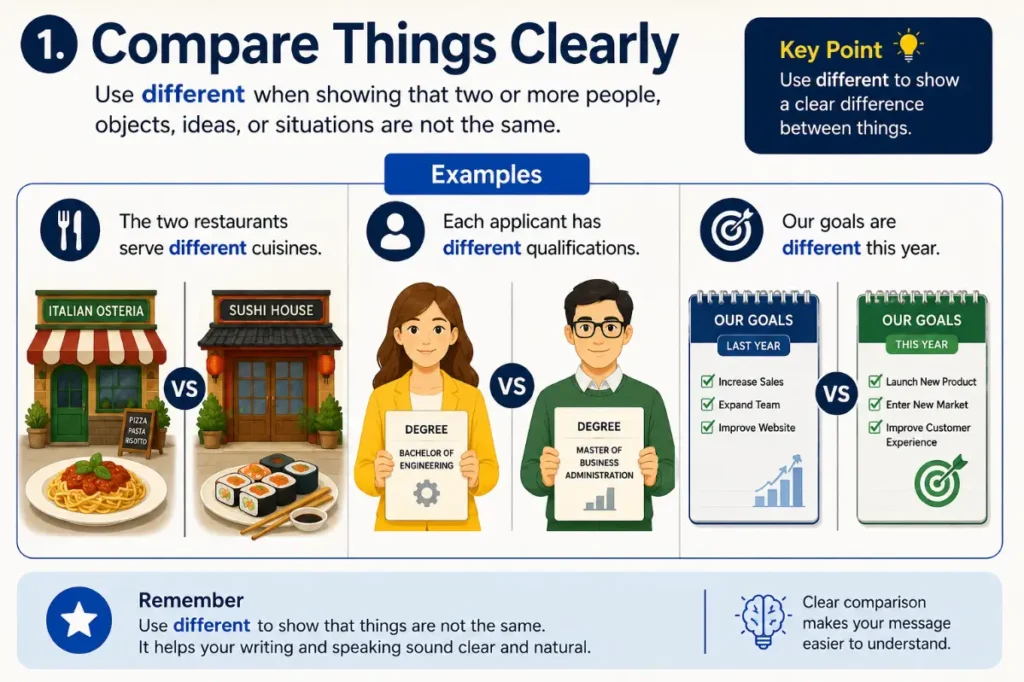
1. Compare Things Clearly
Use different when showing that two or more people, objects, ideas, or situations are not the same.
Examples:
- The two restaurants serve different cuisines.
- Each applicant has different qualifications.
- Our goals are different this year.
2. Prefer Different From in Formal Writing
Although different than and different to appear in some regional varieties of English, different from is the safest choice for academic, business, and professional writing.
Examples:
- My opinion is different from yours.
- Today’s weather is different from yesterday’s.
- This version is different from the original.
3. Proofread Common Words
Writers often focus on unusual vocabulary and overlook familiar words. Before sending an email or publishing an article, quickly check frequently used words like different, because, necessary, and separate, as they are among the most commonly misspelled words in English.
4. Build the Entire Word Family
Learning related words strengthens your spelling memory.
- Differ.
- Different.
- Difference.
- Differently.
- Differences.
Recognizing the shared differ root makes it much easier to spell each form correctly.
Need another quick comparison? Read Missle or Missile Correct Spelling and Meaning.
Conclusion
If you’ve been wondering about different or diffrent, the answer is clear. Different is the only correct spelling in standard English, while diffrent is simply a misspelling. Although the error is common because of fast typing and the way the word is pronounced, it should always be corrected in school assignments, business documents, emails, articles, and everyday writing.
A helpful way to remember the spelling is to think of the word in three parts: dif + fer + ent. The middle e is easy to overlook, but once you recognize the pattern, the correct spelling becomes much easier to remember. You can also reinforce it by learning related words such as difference, differ, and differently, all of which share the same root.
When writing professionally, use different with confidence and, in most formal contexts, pair it with from to create clear and natural comparisons. Developing the habit of proofreading common words will also help eliminate simple spelling mistakes before they reach your readers.
Frequently Asked Questions
Is different or diffrent correct?
Different is the only correct spelling. It is recognized by dictionaries and used in every standard variety of English. Diffrent is a misspelling caused by omitting the first e in the middle of the word.
Why do people spell different as diffrent?
The mistake usually happens because the middle vowel is lightly pronounced in natural speech. When people rely on pronunciation instead of the standard spelling, they sometimes leave out the e and write diffrent by accident.
Is diffrent a real English word?
No. Diffrent does not appear as a standard entry in reputable English dictionaries. It has no accepted meaning and should never be used in formal or informal writing.
How do you pronounce different?
In American English, different is commonly pronounced /ˈdɪfərənt/. In British English, it is often pronounced /ˈdɪfrənt/. Despite the slight difference in pronunciation, the spelling remains exactly the same.
What part of speech is different?
Different is an adjective. It describes nouns by showing that they are not the same.
Example:
The two proposals are different.
Is the spelling different the same in British and American English?
Yes. Unlike many words that have regional spelling variations, different is spelled exactly the same in American English, British English, Canadian English, Australian English, and other standard forms of English.
Should I write different from or different than?
For formal writing, different from is the safest and most widely accepted choice. Different than is common in American English, especially before clauses, while different to appears mainly in British English.
How can I remember the correct spelling of different?
A simple trick is to divide the word into three parts:
dif + fer + ent
The middle section fer contains the e that writers often forget. Remembering this pattern makes the correct spelling much easier to recall.