
If you’ve ever paused before writing unkept or unkempt, you’re not alone. The two words look similar, and both seem like they could describe something messy or neglected. That similarity causes many English learners and even native speakers to second-guess their spelling. A quick search online reveals countless questions asking which word is correct and if both are acceptable.
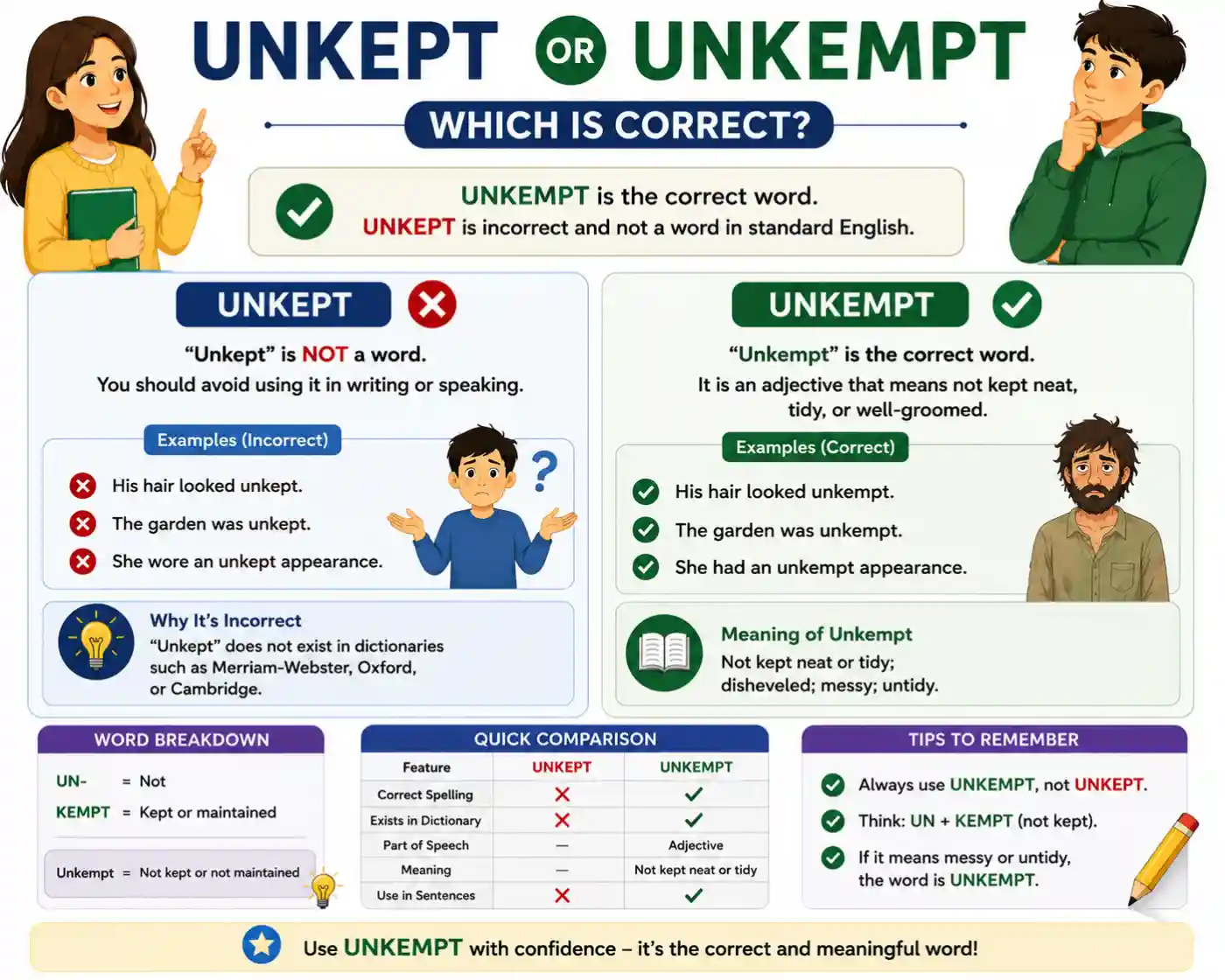
The short answer is simple. Unkempt is the standard and widely accepted English word. It describes someone or something that is untidy, disheveled, or poorly maintained. Unkept, on the other hand, is generally considered a nonstandard spelling in modern English. While it occasionally appears in older texts or informal writing, professional editors, dictionaries and style guides overwhelmingly recommend unkempt.
The confusion exists because many English adjectives begin with un followed by the past participle of a verb, such as unfinished, unopened, and unwritten. People naturally assume that kept becomes unkept. English, however, doesn’t always follow predictable patterns, and unkempt is one of those historical exceptions.
Many readers also check Channel Vs Chanel Which One Is Correct? (2026).
Quick Definition
Unkempt is the correct and standard English adjective meaning untidy, messy, disheveled, or poorly maintained. Unkept is generally regarded as a nonstandard spelling and should usually be avoided in formal, academic, and professional writing. If you want to sound natural and grammatically correct, choose unkempt.
Quick Answer
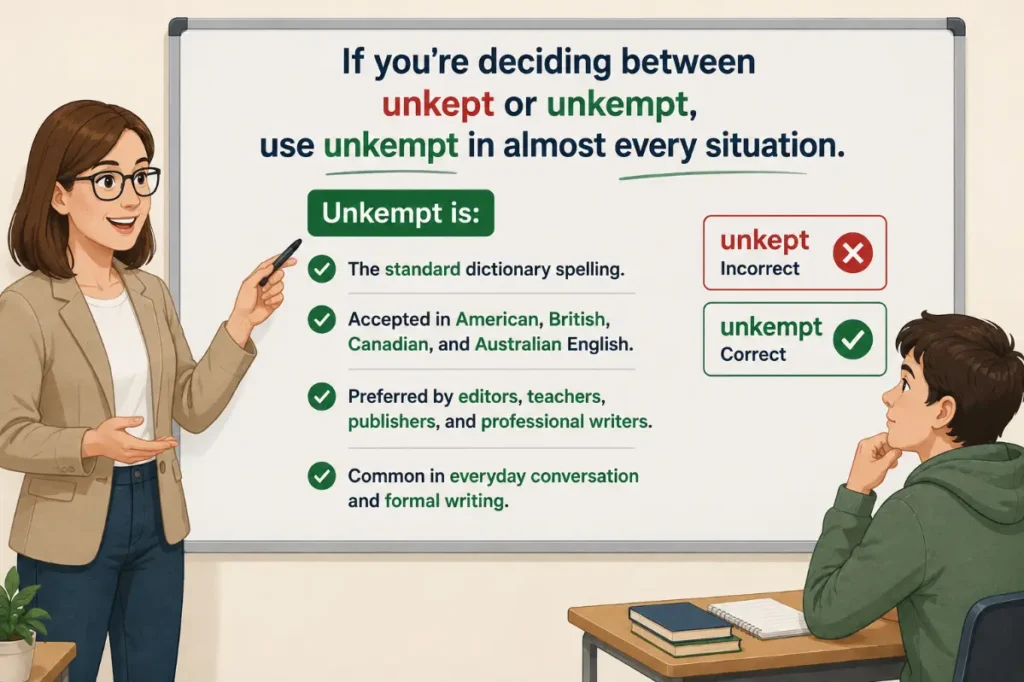
If you’re deciding between unkept or unkempt, use unkempt in almost every situation.
Unkempt is:
- The standard dictionary spelling.
- Accepted in American, British, Canadian, and Australian English.
- Preferred by editors, teachers, publishers, and professional writers.
- Common in everyday conversation and formal writing.
Unkept is:
- Rare.
- Generally considered nonstandard.
- Usually treated as a spelling mistake.
- Best avoided unless you’re intentionally quoting historical or dialectal writing.
Simply put, if you remember only one thing from this article, remember this:
Use unkempt, not unkept.
Unkept or Unkempt Comparison Table
| Feature | Unkept | Unkempt |
|---|---|---|
| Correct modern spelling | Generally no | Yes |
| Part of speech | Adjective (rare) | Adjective |
| Meaning | Intended to mean neglected or untidy | Untidy, messy, disheveled, neglected in appearance |
| Dictionary status | Usually marked nonstandard or uncommon | Standard English |
| Usage frequency | Very rare | Very common |
| Formal writing | Not recommended | Recommended |
| Academic writing | Avoid | Preferred |
| Business writing | Avoid | Preferred |
| Everyday conversation | Occasionally heard | Common |
| Newspapers and books | Rare | Frequently used |
| Professional editing | Usually corrected | Accepted |
| Example | The lawn looked unkept. | His unkempt beard made him look exhausted. |
Meaning of Unkept
Although many people assume unkept is simply the opposite of kept, modern English does not generally recognize it as the standard adjective for describing a messy appearance.
Some writers use unkept to mean:
- Not maintained.
- Not cared for.
- Neglected.
- Left unattended.
Examples include phrases like:
- An unkept garden.
- An unkept promise.
- An unkept house.
However, notice something important.
When talking about promises, English almost always uses broken promise rather than unkept promise. More commonly, people say a promise wasn’t kept instead of turning the verb into an adjective.
Likewise, instead of writing:
An unkept yard.
Most professional writers prefer:
- A neglected yard.
- An overgrown yard.
- A poorly maintained yard.
- An unkempt yard, if referring to its messy appearance.
Because unkept is uncommon, it often distracts readers and can make polished writing appear less professional.
Why People Think Unkept Is Correct
English teaches us many familiar patterns.
Consider these examples:
- Finished → Unfinished.
- Written → Unwritten.
- Opened → Unopened.
- Locked → Unlocked.
- Covered → Uncovered.
Naturally, many people expect:
Kept → Unkept.
That seems logical.
Unfortunately, English has inherited many words from earlier stages of the language that don’t always match today’s spelling patterns. Unkempt is one of those historical exceptions.
Meaning of Unkempt
Unkempt means untidy, messy, disheveled, or lacking proper care and grooming.
It most often describes:
- Hair.
- Beards.
- Clothing.
- Gardens.
- Rooms.
- Buildings.
- Lawns.
- Personal appearance.
Unlike unkept, unkempt immediately sounds natural to native speakers because it has been the accepted adjective for centuries.
Examples include:
- His unkempt hair covered his eyes.
- She wore an unkempt jacket after hiking all weekend.
- The abandoned property looked unkempt.
- An unkempt lawn lowered the neighborhood’s appearance.
- His beard had become noticeably unkempt.
In every example above, unkempt describes something visibly lacking order or care.
Understanding the Difference in Everyday English
One of the easiest ways to understand unkept or unkempt is to think about what English speakers actually say.
Imagine these sentences.
My neighbor has an unkempt lawn.” Most native speakers would immediately recognize this sentence as natural. Now compare it with: “My neighbor has an unkept lawn.” Although the meaning is understandable, it sounds unusual because English speakers rarely use unkept this way. Language isn’t governed only by grammar. Frequency matters too. Native speakers naturally prefer words they’ve heard thousands of times. Since unkempt appears far more often in books, newspapers, magazines, classrooms, and conversations, it has become the expected choice.
Unkept or Unkempt Which One Is Correct?
The correct choice is unkempt. Professional editors almost always replace unkept with unkempt when referring to a person’s appearance or something that looks neglected.
Here are some examples.
Incorrect:
- His unkept hair stuck out in every direction.
- She arrived wearing unkept clothes.
- The yard looked unkept after months of neglect.
- The dog had unkept fur.
Correct:
- His unkempt hair stuck out in every direction.
- She arrived wearing unkempt clothes.
- The yard looked unkempt after months of neglect.
- The dog had unkempt fur.
Notice that every corrected sentence sounds smoother and more natural.
Why Unkempt Became the Standard Word
Many English words preserve spellings that seem strange today.
Examples include:
- Awry.
- Ajar.
- Amid.
- Anew.
- Aloft.
These words don’t follow the patterns learners expect, yet they remain standard because they evolved through centuries of language change. Unkempt belongs in this category. The word originated long before Modern English developed today’s familiar spelling rules. Rather than changing to fit newer patterns, it survived almost unchanged. As a result, dictionaries continue to recognize unkempt as the correct adjective even though unkept appears more logical at first glance.
Experienced editors learn these historical exceptions because they appear frequently in published writing.
Usage Frequency
Word frequency strongly influences what readers perceive as correct. If you browse novels, newspapers, magazines, and reputable websites, you’ll encounter unkempt far more often than unkept. This widespread usage creates an important editing principle. Words that readers repeatedly encounter become the expected standard. Rare alternatives, even if understandable, often interrupt the reading experience because they feel unfamiliar. That explains why editors instinctively choose unkempt. It isn’t merely tradition. It’s the form readers expect to see.
Editorial Tip
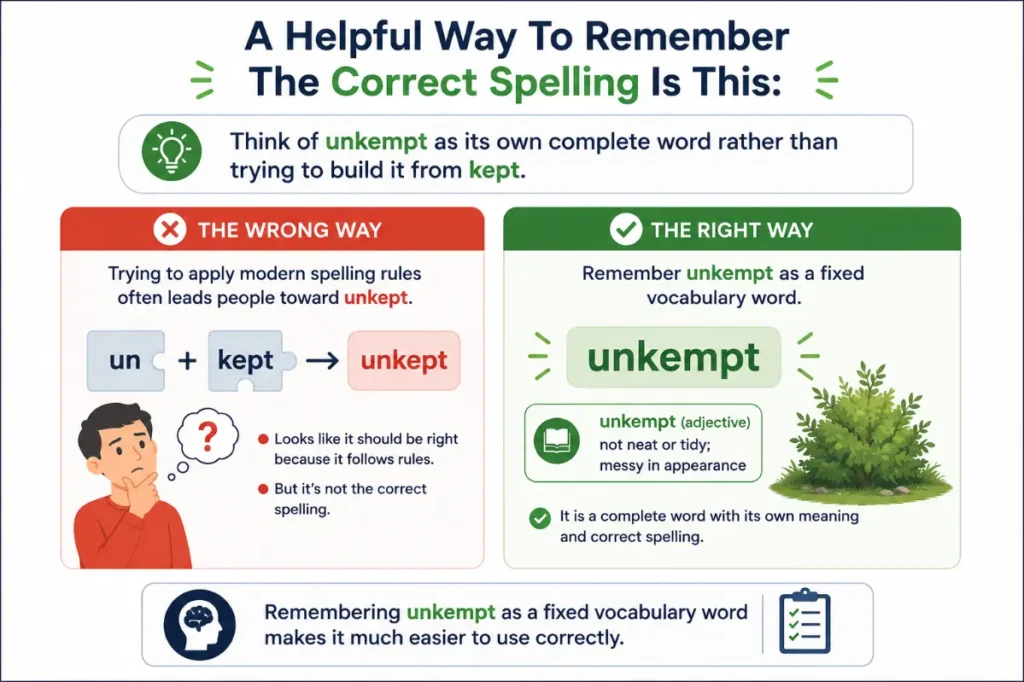
A helpful way to remember the correct spelling is this: Think of unkempt as its own complete word rather than trying to build it from kept. Trying to apply modern spelling rules often leads people toward unkept, but remembering unkempt as a fixed vocabulary word makes it much easier to use correctly. If you’re writing for school, work, publishing, blogging, journalism, or professional communication, unkempt is the spelling you should use every time.In Part 2, we’ll explore the key differences in greater depth, including detailed sentence examples for both terms, common spelling mistakes, pronunciation, grammar rules, and the fascinating history behind unkempt.
Key Differences Between Unkept and Unkempt
Although unkept and unkempt appear similar, they differ in acceptance, usage, and how native English speakers perceive them. Understanding these differences helps you choose the right word with confidence.
| Feature | Unkept | Unkempt |
|---|---|---|
| Standard English | No | Yes |
| Dictionary acceptance | Limited or labeled nonstandard | Fully accepted |
| Common in modern writing | Rare | Very common |
| Preferred by editors | No | Yes |
| Natural to native speakers | Usually no | Yes |
| Best for formal writing | No | Yes |
| Best for everyday writing | No | Yes |
The biggest difference is not the meaning but the level of acceptance. Both words may suggest neglect or disorder, but unkempt is the word that educated writers and speakers naturally use.
Examples Using Unkept
Although unkept is generally discouraged, seeing it in sentences helps explain why people use it and why editors usually replace it.
- The old farmhouse looked unkept after years of abandonment.
- His garden appeared unkept throughout the winter.
- The fence remained unkept for several seasons.
- She worried that her yard looked unkept.
- The playground seemed unkept after the storm.
- Visitors noticed the unkept pathway leading to the house.
- The building had an unkept appearance.
- The park looked unkept because no one maintained it.
- They complained about the unkept landscaping.
- The property looked unkept from the street.
Each sentence is understandable, but most professional editors would replace unkept with unkempt, neglected, poorly maintained, or another more natural adjective.
Examples Using Unkempt
These examples reflect standard English and sound natural in everyday communication.
- His unkempt hair covered his forehead.
- She arrived with an unkempt appearance after the long flight.
- The abandoned house had an unkempt yard.
- The dog’s unkempt fur needed brushing.
- He wore an unkempt beard throughout the winter.
- The neglected garden looked unkempt by spring.
- Her unkempt clothes suggested she had been traveling for days.
- The vacant lot had an unkempt appearance.
- Reporters described the actor as tired and slightly unkempt.
- The trail ended near an unkempt cabin hidden among the trees.
These sentences sound natural because unkempt has long been the accepted adjective for describing a messy or neglected appearance.
For another common grammar confusion, see to bad or too bad which is correct.
Common Mistakes People Make
Many writers choose unkept simply because it looks logical. English contains many adjectives formed by adding un to a past participle.
Examples include:
- Unfinished.
- Unlocked.
- Unopened.
- Unwashed.
- Unwritten.
It seems reasonable to expect:
Kept → Unkept.
That pattern would make sense if English were completely regular. However, languages preserve older words that do not always follow modern rules. Unkempt is one of those exceptions.
Other common mistakes include:
- Assuming unkept and unkempt are equally accepted.
- Using unkept in academic essays.
- Writing unkept hair instead of unkempt hair.
- Believing spell check will always catch the error.
- Thinking unkempt is an old-fashioned word.
The last point surprises many learners. Although unkempt has an old origin, it remains the standard word in modern English.
Pronunciation Guide
Correct pronunciation makes your speech sound more natural and confident.
Unkept
IPA:
/ʌnˈkɛpt/
Syllable breakdown:
un kept
Because this word is uncommon, pronunciation is rarely discussed. Most speakers would naturally pronounce it according to its spelling.
Unkempt
IPA:
/ʌnˈkɛmpt/
Syllable breakdown:
un kempt
The final pt cluster is pronounced clearly, although the p may sound subtle in rapid speech.
Common Pronunciation Mistakes
- Saying un kem ped by adding an extra syllable.
- Dropping the final t completely.
- Stressing the first syllable instead of the second.
- Confusing kempt with kept.
A useful way to remember the pronunciation is to divide the word into two parts:
un + kempt
The stress falls on kempt.
Etymology and Word Origin
The history of unkempt explains why it looks unusual today. The adjective comes from the older English word kempt, which meant well groomed, combed, or neatly arranged. In turn, kempt developed from the verb kemb, an Old English word meaning to comb. Over time, English speakers gradually stopped using kempt in everyday conversation. As the positive form faded, the negative form unkempt remained popular because people continued to need a word describing someone whose appearance was untidy. This created an interesting situation. Today, many people regularly use unkempt without realizing that kempt also exists, although it is much less common. This phenomenon is known in linguistics as an unpaired word or a surviving negative form, where the negative version becomes far more common than the original positive one.
Examples include:
- Ruthless.
- Disgruntled.
- Inept.
- Uncouth.
Their historical counterparts either disappeared from everyday use or became extremely rare.
Why Unkept Never Became Standard
From a historical perspective, unkept developed naturally as speakers tried to apply modern word-building patterns. Since English contains many adjectives like:
- Uncovered.
- Unpaid.
- Unfinished.
- Unwashed.
People occasionally created unkept by analogy.
However, by the time this happened, unkempt had already been established for centuries. There was little reason for the newer form to replace the traditional one. As a result, dictionaries continued listing unkempt as the standard spelling while treating unkept as uncommon or nonstandard.
Regional Usage
One question many learners ask is if unkept is accepted in one English-speaking country but not another. The answer is surprisingly consistent.
American English
American English strongly prefers unkempt. Editors, journalists, teachers, and publishers almost always use unkempt.
British English
British English also uses unkempt as the standard spelling. Major British dictionaries and style references recognize unkempt rather than unkept.
Canadian English
Canadian English follows the same convention. Professional writing overwhelmingly favors unkempt.
Australian English
Australian English also treats unkempt as the standard adjective. Whether you are writing for readers in New York, London, Toronto, or Sydney, unkempt remains the safest and most natural choice.
Grammar Rules
Understanding the grammar behind unkempt helps you use it correctly.
Part of Speech
Unkempt functions primarily as an adjective.
Examples:
- An unkempt beard.
- An unkempt lawn.
- An unkempt office.
- An unkempt appearance.
Position in a Sentence
It commonly appears before a noun.
Examples:
- Unkempt hair.
- Unkempt clothing.
- Unkempt garden.
It can also appear after a linking verb.
Examples:
- His hair looked unkempt.
- The yard seemed unkempt.
- The building appeared unkempt.
Comparative and Superlative Forms
Although possible, comparative forms are less common.
Examples:
- More unkempt.
- Most unkempt.
Writers often prefer clearer alternatives.
Examples:
- Even messier.
- Far more neglected.
- Considerably more untidy.
Plural Forms
Because unkempt is an adjective, it has no plural form.
Correct:
- Unkempt gardens.
- Unkempt children.
- Unkempt rooms.
Incorrect:
- Unkempts.
Adjectives do not become plural in English.
Choosing Better Alternatives
Sometimes unkempt is accurate, but another adjective communicates your meaning more precisely. If discussing personal appearance, consider:
- Disheveled.
- Untidy.
- Scruffy.
- Sloppy.
- Messy.
If discussing buildings or property, consider:
- Neglected.
- Overgrown.
- Run-down.
- Poorly maintained.
- Dilapidated.
Selecting the most precise word makes your writing stronger and more vivid.
Editorial Insight
Experienced editors do more than correct spelling. They choose the word that readers expect. Although unkept may seem logical, readers often pause when they encounter it because it looks unfamiliar. Even a brief moment of hesitation can interrupt the flow of reading. Professional editing favors words that communicate instantly. Unkempt succeeds because readers recognize it immediately without stopping to question the spelling. That is one reason newspapers, publishers, universities, and professional organizations consistently use unkempt instead of unkept. In Part 3, we’ll cover real-life usage examples across different contexts, related and commonly , expert language insights, eight detailed FAQs, a practical conclusion, and an SEO-optimized meta description.
Real Life Usage Examples
Understanding how native speakers use unkempt in different situations is one of the best ways to remember the correct word. The adjective appears in everyday conversations, journalism, literature, business writing, and academic texts because it quickly paints a picture of someone or something that lacks care or neatness.
Daily Conversation
In casual speech, unkempt often describes a person’s appearance or a place that looks untidy.
Examples:
- His hair looked unkempt after the camping trip.
- The backyard has become unkempt since they moved away.
- She apologized for the unkempt living room because guests arrived unexpectedly.
- After working all weekend, he looked tired and unkempt.
- The abandoned playground appeared unkempt and unsafe.
Academic Writing
In formal writing, unkempt is usually used objectively rather than emotionally.
Examples:
- Researchers described the vacant property as unkempt due to years of neglect.
- Historical records mention unkempt streets during periods of rapid urban growth.
- The report compared well maintained parks with unkempt public spaces.
- The novel contrasts elegant homes with unkempt neighborhoods.
- The survey found that residents associated unkempt surroundings with lower property values.
Professional Communication
Businesses and organizations generally use polite language, but unkempt may appear in inspection reports, maintenance notes, or property evaluations.
Examples:
- The inspector noted several unkempt areas around the building.
- The landscaping should be improved because the entrance appears unkempt.
- The rental agreement requires tenants to avoid leaving the yard unkempt.
- The property manager requested regular maintenance to prevent an unkempt appearance.
- The community association addressed complaints about unkempt lots.
Literature
Authors often use unkempt to create vivid descriptions.
Examples:
- His unkempt beard hinted at months spent alone.
- She stepped into an unkempt cottage hidden among ancient trees.
- The detective noticed the suspect’s unkempt clothes before asking any questions.
- An unkempt garden surrounded the forgotten mansion.
- The traveler appeared weary, dusty, and unkempt after crossing the desert.
News and Media
Journalists typically use unkempt in a neutral descriptive way.
Examples:
- Neighbors expressed concern about the unkempt property.
- The article described the historic building as unkempt but structurally sound.
- Officials ordered cleanup of several unkempt vacant lots.
- Volunteers transformed an unkempt park into a welcoming community space.
- Reporters described the actor as intentionally unkempt for the role.
Related Words and Commonly Confused Terms
People searching for unkept or unkempt often look for similar words. Choosing the most accurate one depends on what you want to describe.
| Word | Meaning | Best Used For |
|---|---|---|
| Untidy | Not neat or orderly | General appearance |
| Messy | Disorganized | Everyday conversation |
| Disheveled | Untidy, especially hair or clothing | Personal appearance |
| Scruffy | Untidy and slightly shabby | Casual descriptions |
| Sloppy | Careless or untidy | Appearance or work |
| Neglected | Not properly cared for | Property or maintenance |
| Overgrown | Covered with excessive vegetation | Gardens and lawns |
| Run down | Poorly maintained | Buildings and neighborhoods |
| Dilapidated | In poor condition due to age or neglect | Structures |
| Disorderly | Lacking organization | Rooms, spaces, behavior |
These words are not exact synonyms, but each fits specific contexts better than simply repeating unkempt.
Words That Are Frequently Confused
Several English words create confusion because they look or sound similar to unkempt.
Kempt
Kempt means neat, tidy, or well groomed.
Examples:
- She always looks perfectly kempt.
- The garden remained neat and kempt throughout the year.
Although correct, kempt is much less common than unkempt.
Kept
Kept is the past tense and past participle of the verb keep.
Examples:
- She kept every promise.
- They kept the house clean.
- He kept the receipt.
This verb should not be confused with the adjective unkempt.
Neglected
People sometimes use neglected instead of unkempt.
Examples:
- A neglected building may also appear unkempt.
- A neglected lawn often becomes unkempt.
The meanings overlap, but they are not identical. Neglected emphasizes a lack of care, while unkempt emphasizes the visible result.
Expert Language Insight
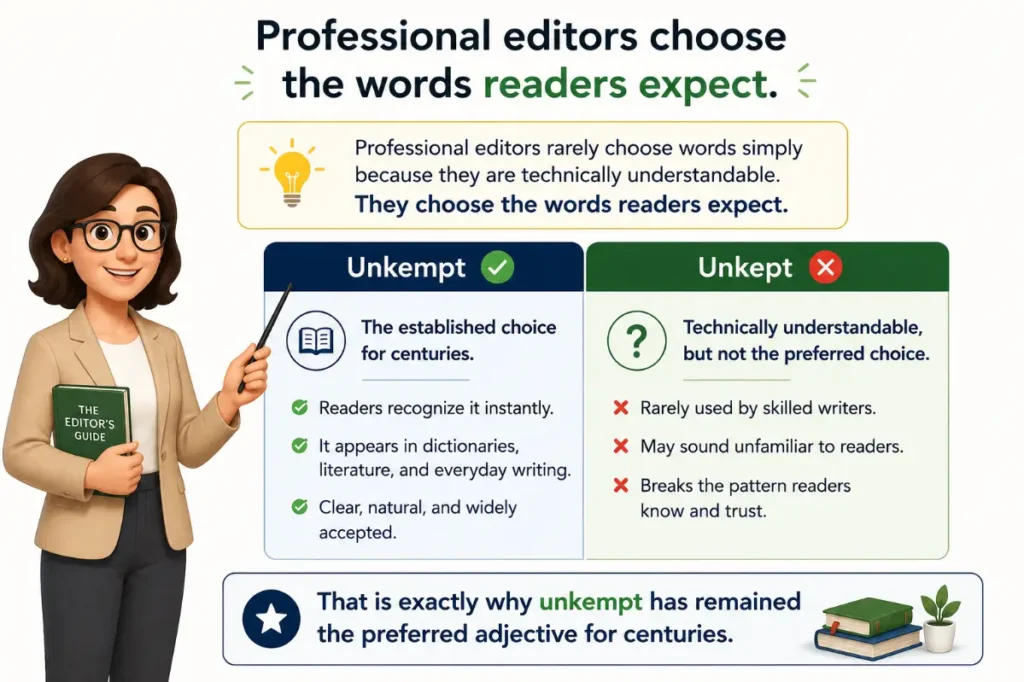
Professional editors rarely choose words simply because they are technically understandable. They choose the words readers expect. That is exactly why unkempt has remained the preferred adjective for centuries.
Imagine reading these two sentences.
The professor arrived with unkept hair. The professor arrived with unkempt hair. The first sentence causes many readers to pause because unkept feels unfamiliar. The second sentence flows naturally because unkempt is firmly established in modern English. Native speakers rarely stop to analyze grammar while reading. Instead, they recognize familiar patterns. Editors understand this and select vocabulary that communicates instantly. Another important point is precision. If you mean someone has not taken care of their appearance, unkempt is usually the strongest choice. If you mean something has not been maintained, another adjective may communicate your idea more clearly.
Examples include:
- Neglected.
- Overgrown.
- Poorly maintained.
- Dilapidated.
- Run down.
Choosing the most precise word always improves readability.
You may also want to read Elfs or Elves Correct Spelling Meaning and Usage Guide.
Quick Memory Trick
A simple memory trick can help you remember the correct spelling. Think of this sentence: Messy hair is unkempt. Every time you picture untidy hair, connect it with unkempt, not unkept. Another helpful reminder is this: Professional editors write unkempt. If you remember that single rule, you’ll almost never make this spelling mistake again. Conclusion If you’re deciding between unkept or unkempt, the correct choice is clear.
Unkempt is the standard English adjective and the one recognized by dictionaries, teachers, editors, and professional writers. It naturally describes hair, clothing, gardens, buildings, and other things that appear untidy, messy, or poorly maintained. Although unkept may seem logical because it follows common English word patterns, it has never become the accepted form in modern standard English.
Using it in formal or professional writing may distract readers and reduce the credibility of your work. When in doubt, choose unkempt. It is widely understood, grammatically accepted, and appropriate across American, British, Canadian, and Australian English. Remember this simple rule: if you want writing that sounds natural and polished, unkempt is almost always the right answer.
Frequently Asked Questions
Is unkept a real word?
Unkept occasionally appears in writing, but it is generally considered nonstandard in modern English. Most dictionaries, editors, and style guides recommend using unkempt instead because it is the accepted adjective for describing someone or something that looks untidy or neglected.
Is unkempt the correct spelling?
Yes. Unkempt is the standard spelling in modern English. It is recognized by major dictionaries and is the preferred form in academic, professional, journalistic, and everyday writing.
Why do people write unkept?
Many writers assume English follows a regular pattern like unfinished, unopened, and unwritten, so they naturally form unkept from kept. Although this seems logical, English preserved unkempt as the accepted historical form.
Can I use unkept in formal writing?
It is best not to. Most editors will replace unkept with unkempt or another more suitable adjective. Using unkempt helps your writing appear polished and professional.
What does unkempt mean?
Unkempt describes someone or something that looks untidy, messy, disheveled, or poorly maintained. It often refers to hair, clothing, gardens, buildings, or general appearance.
Is there a difference between neglected and unkempt?
Yes. Neglected focuses on the lack of care or attention, while unkempt describes the visible condition that results. A neglected garden may become unkempt, but the two words are not exact synonyms.
Is unkempt used in American and British English?
Yes. Unkempt is the standard spelling in American English, British English, Canadian English, and Australian English. There are no significant regional differences in its acceptance.
How can I remember the correct spelling?
Associate unkempt with messy hair or an untidy appearance. Instead of trying to build the word from kept, memorize unkempt as a complete vocabulary word. This simple habit makes the correct spelling much easier to remember.