
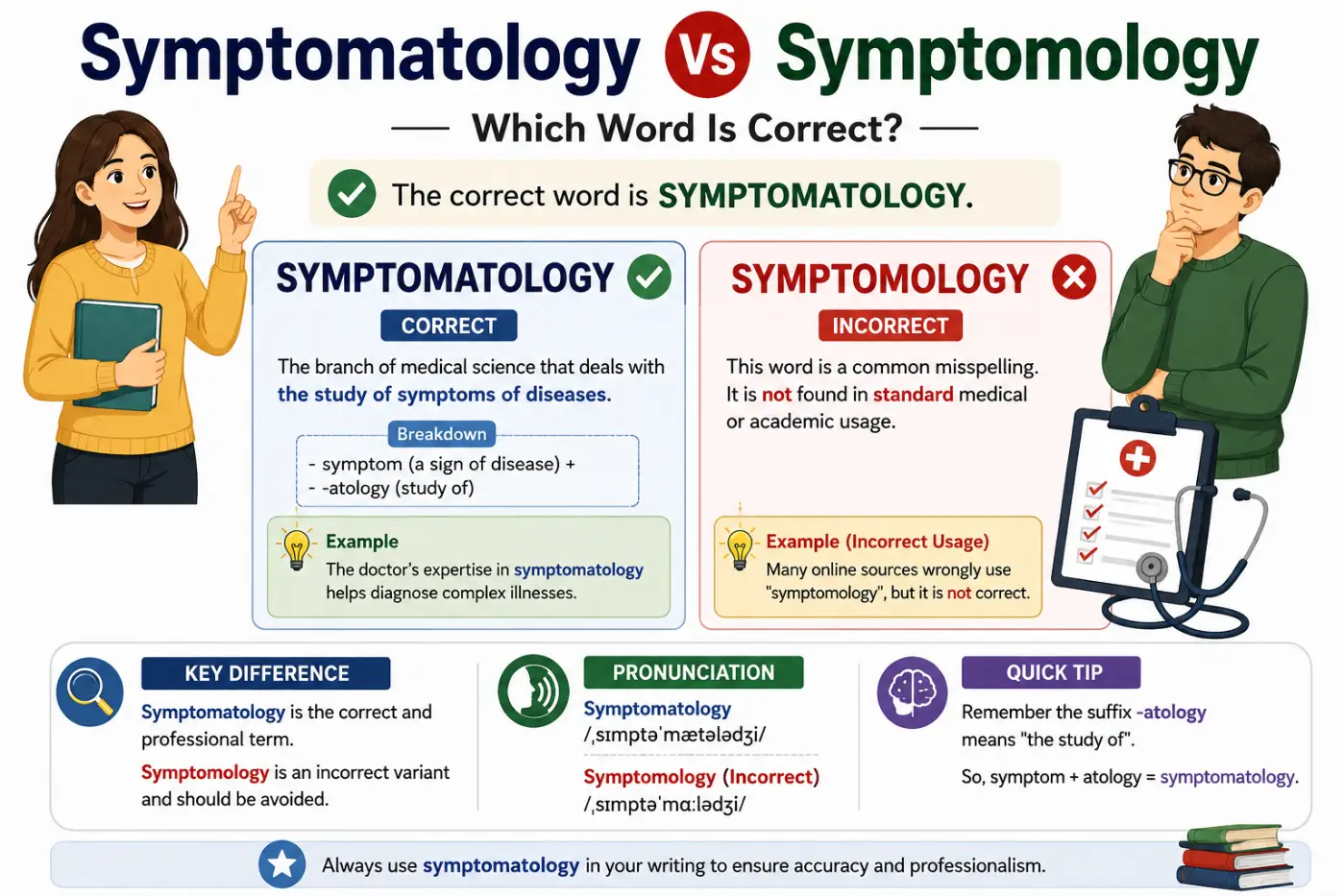
If you’ve searched for symptomatology vs symptomology, you’re probably trying to figure out which word is correct and if they mean the same thing. The confusion is understandable because both words look almost identical, both relate to symptoms, and both appear online in medical articles, blogs, and dictionaries. Yet only one is widely recognized as the standard term in formal English.
The short answer is simple. Symptomatology is the established and preferred word in medicine, healthcare, psychology, and academic writing. Symptomology exists and is occasionally used, but many dictionaries either omit it or label it as a less common variant. In professional writing, medical journals, textbooks, and research papers, symptomatology is overwhelmingly preferred.
Understanding this difference matters because precise language builds credibility. Using the accepted medical term makes your writing sound more accurate and professional, especially in healthcare, education, and scientific communication.

A related grammar guide is Tie vs Tye Correct Spelling and Usage.
Quick Definition
Symptomatology is the standard medical term for the collection, study, and description of symptoms associated with a disease or condition. Symptomology is an uncommon variant that appears in some informal sources but is rarely preferred in professional medical or academic writing. If accuracy matters, choose symptomatology.
Quick Answer
If you are deciding between symptomatology vs symptomology, use symptomatology.
It is the accepted and widely recognized term in medicine, psychology, nursing, and scientific research. Although symptomology occasionally appears in informal writing and some dictionaries list it as a variant, it is far less common and is generally avoided in professional communication.
| Feature | Symptomatology | Symptomology |
|---|---|---|
| Standard English | Yes | Rare variant |
| Meaning | Study or collection of symptoms | Same intended meaning |
| Part of Speech | Noun | Noun |
| Origin | Greek roots through medical Latin | Shortened variant of symptomatology |
| Usage Frequency | Very high | Very low |
| Formality | Highly formal | Less formal |
| Common Contexts | Medicine, psychology, research, healthcare | Informal writing, occasional online usage |
| Dictionary Acceptance | Widely recognized | Limited recognition |
| Recommended Choice | Yes | Usually no |
| Example | The physician reviewed the patient’s symptomatology before making a diagnosis. | The article discussed the symptomology of the illness. |
Symptomatology Vs Symptomology Meaning
Although these words point to the same general idea, they are not equal in acceptance or frequency.
What Does Symptomatology Mean
Symptomatology is a noun that refers to the collection, description, or scientific study of symptoms associated with a disease, disorder, or medical condition. Medical professionals use it to discuss the complete pattern of symptoms rather than a single symptom. For example, instead of talking about one sign of influenza, a doctor may refer to the symptomatology of influenza, meaning the entire range of symptoms patients commonly experience.
The word is common in:
- Medical textbooks.
- Clinical research.
- Psychology.
- Psychiatry.
- Nursing.
- Public health.
- Medical education.
Etymology of Symptomatology
The word comes from several Greek elements.
- Symptoma meaning occurrence or symptom.
- Logia meaning study or branch of knowledge.
- The suffix ology developed through Latin and later English to describe scientific fields.
Over time, symptomatology came to describe the systematic study or complete description of symptoms associated with diseases.
What Does Symptomology Mean
Symptomology is also used as a noun and generally carries the same intended meaning as symptomatology. However, it is usually considered a shortened variant rather than the preferred standard form. Many healthcare professionals avoid it because symptomatology has long been established in medical literature and academic publishing.
Today, symptomology appears most often in:
- Informal websites.
- Personal blogs.
- Online discussions.
- Occasionally in healthcare conversations.
It is much less common in peer reviewed journals or university textbooks.
Symptomatology Vs Symptomology Key Differences
Although their meanings overlap, several important differences separate these two words.
1. Standard Usage
Symptomatology is the recognized medical term.
Symptomology is a less common alternative.
2. Professional Acceptance
Medical schools, hospitals, universities, and scientific journals overwhelmingly use symptomatology. Professional editors usually replace symptomology with symptomatology during editing.
3. Dictionary Recognition
Most major dictionaries include symptomatology as the primary entry. Some dictionaries list symptomology as a variant, while others do not include it at all.
4. Frequency
Academic databases, medical journals, and healthcare publications contain far more examples of symptomatology than symptomology.
5. Writing Style
Using symptomatology gives your writing a more precise and authoritative tone. Using symptomology may cause readers to question your word choice, especially in academic or medical settings.
Symptomatology Vs Symptomology Which One Is Correct
The correct choice in nearly every professional situation is symptomatology. It is the accepted medical and academic term used to describe the collection or study of symptoms associated with a disease or disorder.
You should choose symptomatology when writing:
- Medical reports.
- Academic essays.
- Research papers.
- Healthcare documentation.
- Psychology assignments.
- Scientific articles.
- Clinical case studies.
You might encounter symptomology in less formal writing, but it is rarely the preferred option. As a general rule, if you want your writing to match professional standards, use symptomatology.
Examples of Symptomatology in Sentences
- The doctor carefully reviewed the patient’s symptomatology before ordering additional tests.
- Researchers compared the symptomatology of several respiratory illnesses.
- The nurse documented the changing symptomatology throughout the patient’s recovery.
- Early symptomatology often helps physicians identify rare diseases.
- The study examined the neurological symptomatology associated with the disorder.
- Understanding the symptomatology improved diagnostic accuracy.
- Pediatric specialists recognized a unique symptomatology among young patients.
- The professor explained the symptomatology of autoimmune diseases during the lecture.
- Doctors analyzed the patient’s symptomatology alongside laboratory findings.
- The textbook provides a detailed overview of the symptomatology of common infectious diseases.
Examples of Symptomology in Sentences
Although symptomology appears occasionally, these examples show how people use it in everyday writing. In formal medical or academic contexts, symptomatology would usually be the better choice.
- The article described the symptomology of seasonal allergies.
- She searched online for information about the symptomology of migraines.
- The website explained the symptomology of Lyme disease in simple language.
- He discussed the symptomology of anxiety during the support group meeting.
- The blog focused on the symptomology of long term fatigue.
- Some patients use symptomology when describing their health concerns online.
- The health forum included posts about the symptomology of viral infections.
- The writer summarized the symptomology of several digestive disorders.
- An older handbook referred to the symptomology of the condition.
- The report used symptomology, although most editors would recommend symptomatology instead.
Common Mistakes With Symptomatology Vs Symptomology
Many writers confuse these terms because they look nearly identical and describe the same general concept. Most mistakes come from assuming both words are equally accepted.
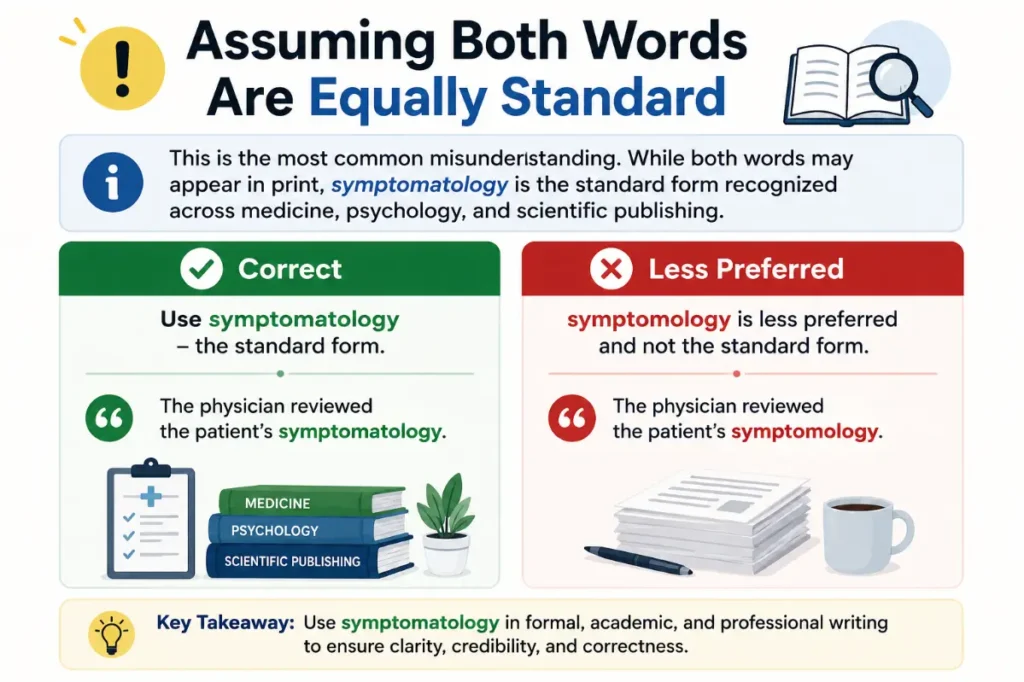
1. Assuming Both Words Are Equally Standard
This is the most common misunderstanding. While both words may appear in print, symptomatology is the standard form recognized across medicine, psychology, and scientific publishing.
Correct
- The physician reviewed the patient’s symptomatology.
Less Preferred
- The physician reviewed the patient’s symptomology.
2. Using Symptomology in Academic Writing
Students sometimes shorten the word without realizing that many instructors and editors expect the established medical term. If you are writing for school, research, or publication, choose symptomatology.
3. Confusing Symptoms With Diagnosis
Neither word means a diagnosis. Symptomatology refers to the symptoms themselves or the study of those symptoms. A diagnosis identifies the disease or condition causing them.
4. Using the Terms for a Single Symptom
These words usually describe a group or pattern of symptoms rather than one isolated symptom.
Natural
- The patient’s symptomatology suggested a viral infection.
Less Natural
- The patient’s headache was the symptomatology.
5. Believing Shorter Always Means Better
English often has shorter alternatives, but shorter is not always more accurate. In this case, the longer form remains the accepted professional choice.
For another common grammar confusion, see In Route vs En Route Which Is Correct.
Pronunciation Guide
Symptomatology
IPA (American English)
/ˌsɪmp.tə.məˈtɑː.lə.dʒi/
Syllable Breakdown
symp • to • ma • tol • o • gy
Symptomology
IPA (American English)
/ˌsɪmp.təˈmɑː.lə.dʒi/
Syllable Breakdown
symp • to • mol • o • gy
Common Pronunciation Mistakes
- Dropping an entire syllable from symptomatology.
- Stressing the first syllable instead of the main stressed syllable.
- Confusing symptomatology with symptomology during fast speech.
- Mispronouncing the ending ology as oh log ee instead of ol uh jee.
Speaking slowly and dividing the word into syllables makes pronunciation much easier.
Etymology and Word Origin
Understanding where these words came from explains why one became the accepted standard. The root symptom comes from the Greek word symptoma, meaning an occurrence, event, or sign of illness. The ending ology comes from the Greek logia, meaning the study of a subject or a field of knowledge. The word symptomatology developed by combining these elements into a term that means the study, description, or collection of symptoms associated with disease.
Regional Usage of Symptomatology Vs Symptomology
The preference for symptomatology is consistent across major English speaking countries.
| Region | Preferred Term | Notes |
|---|---|---|
| United States | Symptomatology | Standard in healthcare, universities, and research |
| United Kingdom | Symptomatology | Used in medical education and clinical practice |
| Canada | Symptomatology | Preferred in academic and healthcare writing |
| Australia | Symptomatology | Standard medical terminology |
| New Zealand | Symptomatology | Common in professional healthcare communication |
American English
American medical schools, hospitals, and research journals overwhelmingly use symptomatology.
British English
British healthcare professionals also prefer symptomatology, especially in clinical documentation and academic publications.
Canadian English
Canadian universities and medical organizations follow the same convention.
Australian English
Australian healthcare literature consistently favors symptomatology. Across all major English varieties, symptomology remains uncommon and is generally viewed as a nonstandard alternative.
Grammar Rules for Symptomatology Vs Symptomology
Understanding the grammar behind these words helps you use them naturally and correctly.
Part of Speech
Both symptomatology and symptomology are nouns. They name a concept rather than an action.
Example
- The physician studied the patient’s symptomatology.
Countable or Uncountable
Both words are generally treated as uncountable nouns because they describe a body or pattern of symptoms.
Natural
- The patient’s symptomatology was unusual.
Less commonly, writers may use a plural form when discussing different sets of symptoms across multiple diseases.
Example
- The symptomatologies of these disorders differ significantly.
This usage is uncommon outside specialized medical writing.
Articles
These nouns often appear with articles such as the when referring to a specific condition.
Examples
- The symptomatology of influenza is well documented.
- The symptomatology changed over several weeks.
Common Sentence Patterns
The words frequently appear after verbs such as:
- Analyze.
- Examine.
- Describe.
- Compare.
- Review.
- Evaluate.
- Document.
- Recognize.
- Observe.
- Study.
Examples include:
- Doctors analyzed the symptomatology carefully.
- Researchers compared the symptomatology of two diseases.
- Specialists documented the symptomatology over time.
Real Life Usage Examples
Daily Conversation
Although the average person usually says symptoms, healthcare workers sometimes use symptomatology during discussions.
Example “The patient’s overall symptomatology has improved since starting treatment.”
Academic Writing
Medical students and researchers frequently use symptomatology when discussing diseases and disorders.
Example “The study investigated the neurological symptomatology associated with early Parkinson’s disease.”
Professional Communication
Doctors, nurses, psychologists, and therapists rely on the term in reports and case notes.
Example “The documented symptomatology supports additional neurological testing.”
Medical Literature
Journal articles often summarize a disease by describing its characteristic symptomatology.
Example “The symptomatology observed in this patient group differed from previous studies.”
News and Health Media
Health journalists sometimes simplify the language for general readers by saying symptoms, but specialist articles still use symptomatology when discussing medical research.
Example “Researchers continue to study the symptomatology of emerging infectious diseases.”
Related Words and Confused Terms
When researching symptomatology vs symptomology, you may also encounter several related medical and linguistic terms. Understanding how they differ helps you choose the most accurate word.
| Term | Meaning | How It Differs |
|---|---|---|
| Symptom | A sign experienced by the patient, such as pain or fatigue | Refers to one indication of illness |
| Symptoms | More than one symptom | Everyday plural form |
| Sign | An objective finding observed by a healthcare professional | Not necessarily felt by the patient |
| Syndrome | A group of symptoms and signs that occur together | Refers to a recognized condition |
| Diagnosis | Identification of a disease or disorder | Determines the cause, not the symptoms themselves |
| Pathology | Study of disease and its causes | Broader than symptomatology |
| Etiology | Study of the causes of disease | Focuses on why a disease develops |
| Prognosis | Expected course or outcome of a disease | Predicts future health outcomes |
| Clinical Presentation | The combination of symptoms and signs shown by a patient | Often overlaps with symptomatology but is broader |
| Manifestation | A visible expression or feature of a disease | May include symptoms and physical signs |
Symptom Vs Sign
These words are often confused. A symptom is something the patient experiences, such as nausea, dizziness, or pain. A sign is something another person can observe or measure, such as a fever, rash, or high blood pressure. Together, symptoms and signs form the patient’s overall clinical presentation.
Symptomatology Vs Clinical Presentation
Although these expressions are closely related, they are not identical. Symptomatology focuses primarily on symptoms associated with a disease. Clinical presentation includes symptoms, physical signs, medical history, examination findings, and other observations.
Symptomatology Vs Pathology
These terms describe different aspects of medicine.
- Symptomatology examines what patients experience.
- Pathology studies the disease process itself, including tissue and cellular changes.
Symptomatology Vs Etiology
These words answer different questions.
- Symptomatology asks, “What symptoms does this disease produce?”
- Etiology asks, “What causes this disease?”
Understanding this distinction is important in medical education and scientific writing.
Expert Language Insight
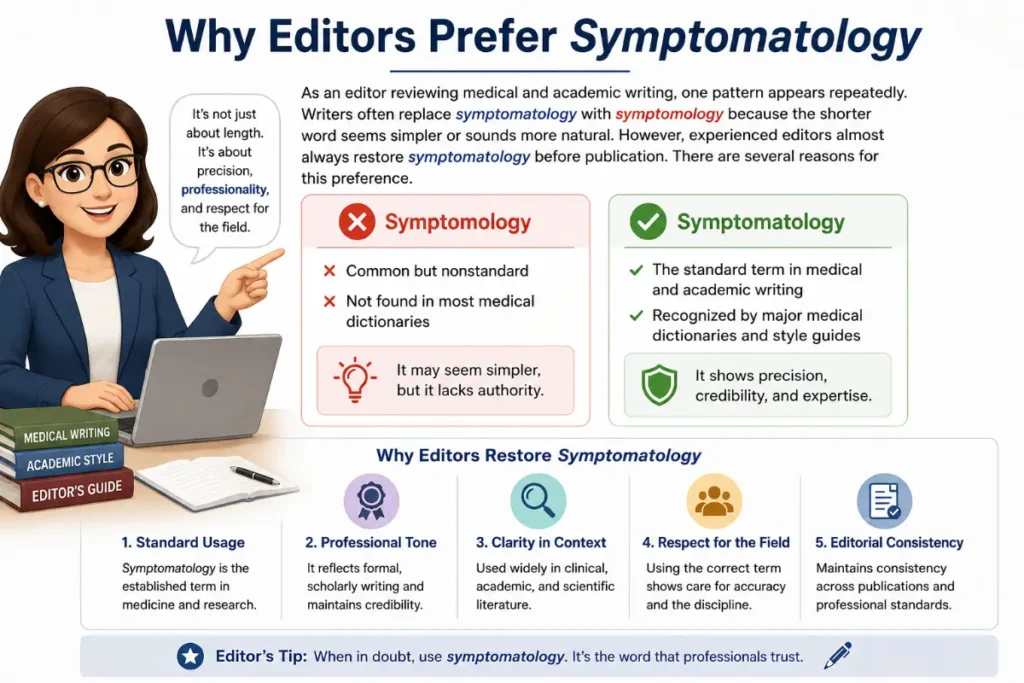
As an editor reviewing medical and academic writing, one pattern appears repeatedly. Writers often replace symptomatology with symptomology because the shorter word seems simpler or sounds more natural. However, experienced editors almost always restore symptomatology before publication. There are several reasons for this preference.
It Matches Medical Convention
Medical terminology values consistency. Healthcare professionals around the world have used symptomatology for generations, making it the established standard.
It Improves Credibility
Precise terminology signals expertise. Using the accepted term helps readers trust your writing, especially in scientific, academic, or healthcare contexts.
It Reduces Reader Distraction
Many knowledgeable readers immediately notice symptomology because it is uncommon. Even if they understand your meaning, the unexpected wording may interrupt the flow of reading.
Native Speaker Usage
Native English speakers outside healthcare usually avoid both terms in everyday conversation. Instead, they say:
- symptoms
- signs and symptoms
- symptom pattern
- medical symptoms
- health symptoms
Doctors, researchers, psychologists, and professors are much more likely to use symptomatology, particularly in formal communication.
Editorial Recommendation
If your audience includes healthcare professionals, students, educators, researchers, or academic readers, always choose symptomatology. If you are writing for the general public, the simplest choice is often just symptoms, unless the discussion specifically concerns the overall pattern or study of symptoms.
Conclusion
When comparing symptomatology vs symptomology, the evidence points clearly in one direction.
Both words refer to the collection or study of symptoms associated with a disease or medical condition. However, symptomatology is the established and widely accepted term in medicine, psychology, nursing, scientific research, and academic writing. It appears consistently in medical textbooks, peer reviewed journals, clinical reports, and professional healthcare communication.
Symptomology, while recognized by some dictionaries and occasionally used in informal contexts, has never achieved the same level of acceptance. Its limited use means it may appear unfamiliar or less precise to healthcare professionals, editors, and academic readers.
You may also want to read Immerse Vs Emerse Which Word Should You Use in 2026.
Frequently Asked Questions
Is symptomology a real word?
Yes. Symptomology is a real word and appears in some dictionaries and publications. However, it is much less common than symptomatology and is generally not the preferred choice in professional medical or academic writing.
Which is correct symptomatology or symptomology?
Symptomatology is the accepted standard in medicine, psychology, nursing, and scientific research. While symptomology is sometimes used, most editors and healthcare professionals recommend symptomatology.
Do symptomatology and symptomology have different meanings?
No. Both words refer to the collection, description, or study of symptoms associated with a disease or condition. The main difference lies in usage and acceptance rather than meaning.
Why do people confuse symptomatology and symptomology?
The confusion comes from their nearly identical spelling and pronunciation. Because many English words end in ology, some writers naturally shorten symptomatology to symptomology, even though the longer form remains the standard.
Is symptomology incorrect?
It is not completely incorrect because it has documented usage. However, it is considered a less common variant and is generally avoided in formal medical, academic, and scientific writing.
Which term should students use in assignments?
Students should use symptomatology, especially in healthcare, biology, psychology, nursing, and medical courses. It aligns with academic expectations and professional terminology.
Do doctors use symptomology?
Most doctors, researchers, and medical educators use symptomatology. Although some individuals may occasionally say symptomology, it is uncommon in professional documentation and published research.
Can I use symptomology in everyday writing?
Yes, readers will usually understand your meaning. However, if accuracy and professionalism matter, symptomatology remains the safer and more widely accepted choice.