
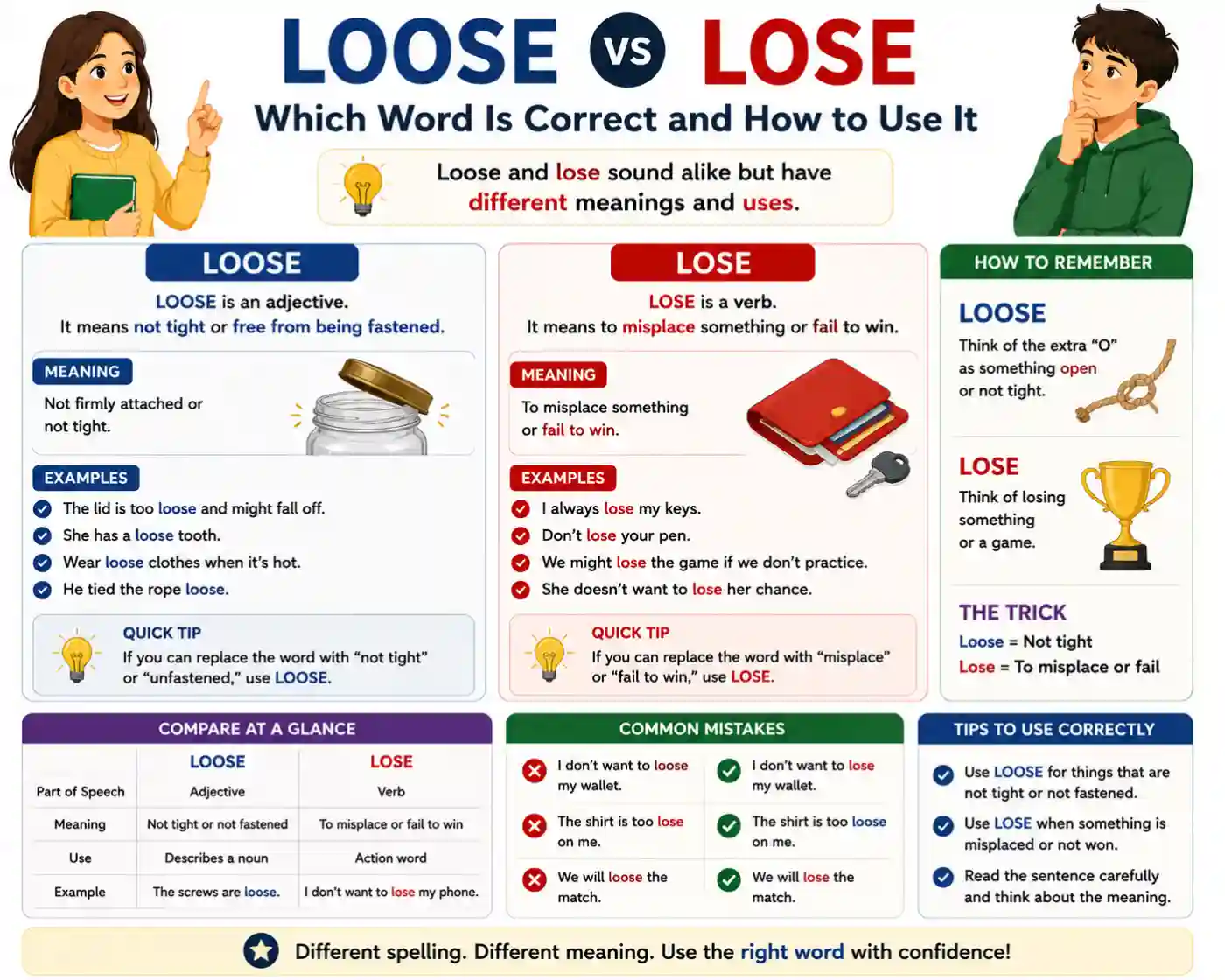
Have you ever paused while writing because you couldn’t decide between loose and lose? These two words look and sound similar, but they have very different meanings. The difference between loose vs lose is simple once you understand how each word works in a sentence.
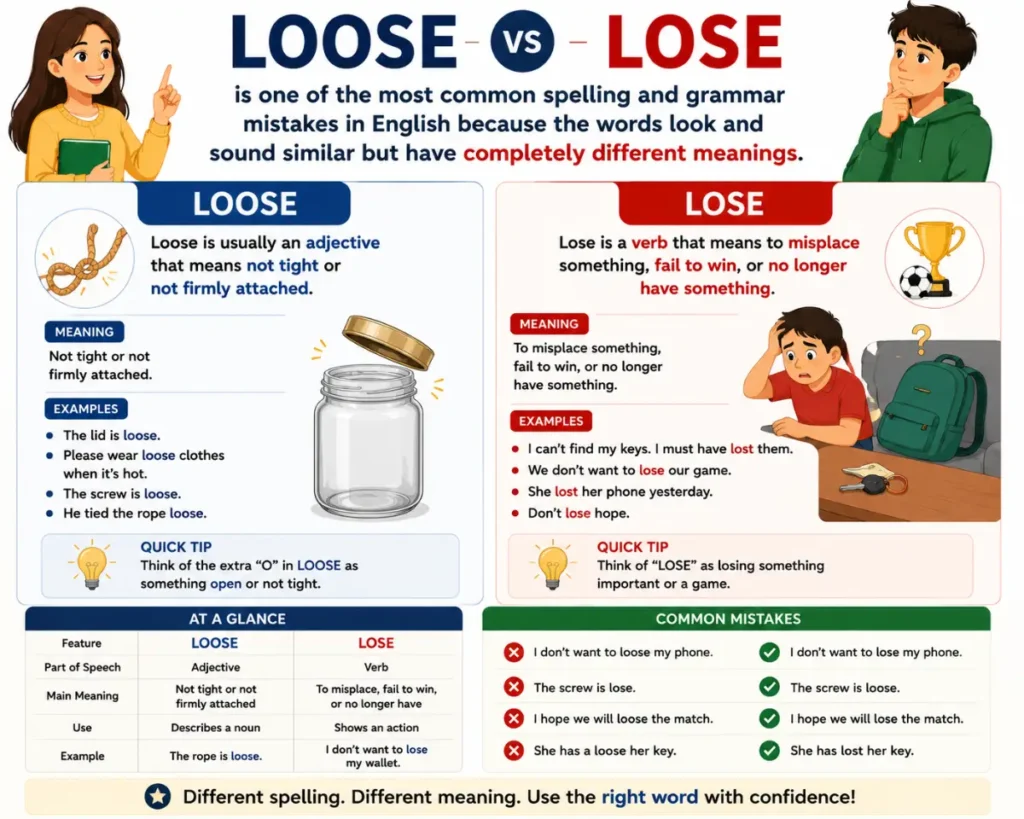
Loose usually describes something that is not tight, firmly attached, or securely held. Lose is a verb that means to misplace something, fail to keep it, or no longer have it. Both spellings are correct, so neither should be treated as a misspelling. The confusion happens because they share most of their letters and have similar pronunciations, especially for people who are learning English.
However, using one in place of the other can change the meaning of an entire sentence. For example, a loose shirt is too big or not tight, while losing a shirt means you can no longer find it or keep it. Understanding their meanings, grammatical roles, and common sentence patterns will help you choose the right word every time.
Need another quick comparison? Read Fewer Meaning And How To Use It Correctly.
Quick Answer
Loose is an adjective that describes something not tight, firmly fixed, or securely attached. Lose is a verb that means to misplace something, fail to win, or stop having something. Both are correct English words, but they cannot be used interchangeably. Remember that loose describes a condition, while lose expresses an action or change.
Comparison Table: Loose vs Lose
The easiest way to understand these words is to compare their meanings, parts of speech, and everyday uses.
| Feature | Loose | Lose |
|---|---|---|
| Correct spelling | Loose | Lose |
| Part of speech | Mainly adjective; also a verb | Verb |
| Main meaning | Not tight or firmly attached | Misplace or fail to keep something |
| Pronunciation | /luːs/ | /luːz/ |
| Syllables | One | One |
| Final sound | S | Z |
| Word function | Describes a person, object, or condition | Describes an action or result |
| Formality | Standard in all types of writing | Standard in all types of writing |
| Common contexts | Clothing, objects, rules, hair, connections | Games, belongings, money, opportunities, weight |
| Example | My shoes feel loose. | I don’t want to lose my shoes. |
The most noticeable difference is the final consonant sound. The first word ends with an unvoiced S sound, while the second ends with a voiced Z sound. Their meanings also differ because one mainly describes a condition and the other expresses an action.
Meaning and Definition
Although these words share four letters, they perform different jobs in English. Understanding their definitions is the first step toward using them correctly.
What Does Loose Mean?
Loose is primarily an adjective that describes something that is not tight, secure, firmly attached, or held in place. It can refer to physical objects, clothing, body parts, rules, connections, or even behavior.
For example, if your shirt is too big around the waist, you can describe it as loose. If a screw is not firmly attached, it is also loose.
Common meanings of loose include:
- Not tight: Something has extra space or does not fit closely.
- Not securely attached: An object can move, fall, or come away easily.
- Not firmly controlled: Rules or restrictions are relaxed.
- Not closely connected: People or ideas have a weak relationship.
- Free or unrestricted: Something is no longer tied, held, or confined.
Consider these examples:
- My jacket is too loose around the shoulders.
- The dog escaped because its leash was loose.
- The school has loose rules about clothing.
- A loose connection caused the computer to stop working.
- She prefers wearing her hair loose.
In each example, the word describes a state or quality rather than an action of misplacing something.
Can Loose Be a Verb?
Yes. Although it is mainly used as an adjective, loose can also function as a verb. As a verb, it means to release, free, or set something loose.
For example:
- The hunter loosed an arrow.
- They loosed the animals from their cages.
This verb usage is less common in everyday American English than the adjective form. You are more likely to encounter it in literature, historical writing, or formal descriptions.
Its verb forms include:
| Verb Form | Example |
|---|---|
| Base form | Loose the animals. |
| Third person | She looses the birds. |
| Past tense | He loosed the arrow. |
| Present participle | They are loosing the animals. |
Do not confuse this less common verb with lose. They still have different meanings.
What Does Lose Mean?
Lose is a verb that describes the action of no longer having something, failing to keep something, or being unable to find something.
It has several common meanings depending on the context.
Common meanings of lose include:
- Misplace something: You cannot find an item you previously had.
- Fail to win: You do not win a game, competition, or contest.
- Stop having something: You no longer possess something.
- Experience a reduction: Something becomes smaller or decreases.
- Waste or miss something: You fail to use an opportunity, amount of time, or resource.
- Become separated: You cannot maintain contact with someone or something.
Consider these examples:
- I don’t want to lose my phone.
- Our team might lose the championship.
- He hopes to lose weight this year.
- Don’t lose your confidence after one mistake.
- We could lose valuable time if we wait.
Unlike its similar-looking counterpart, this word describes an action, process, or result.
Key Differences Explained
Understanding the spelling alone is not enough. You should also recognize how these words behave in sentences.
1. Spelling Difference
The two words differ by one letter:
- Loose has two letter O’s followed by S and E.
- Lose has one letter O followed by S and E.
The extra O in the first word is a common reason people mix them up. However, their spelling patterns are connected to different pronunciations and meanings.
2. Meaning Difference
Loose describes something that is not tight, secure, or firmly attached.
Lose means to misplace something, fail to win, or stop having something.
For example:
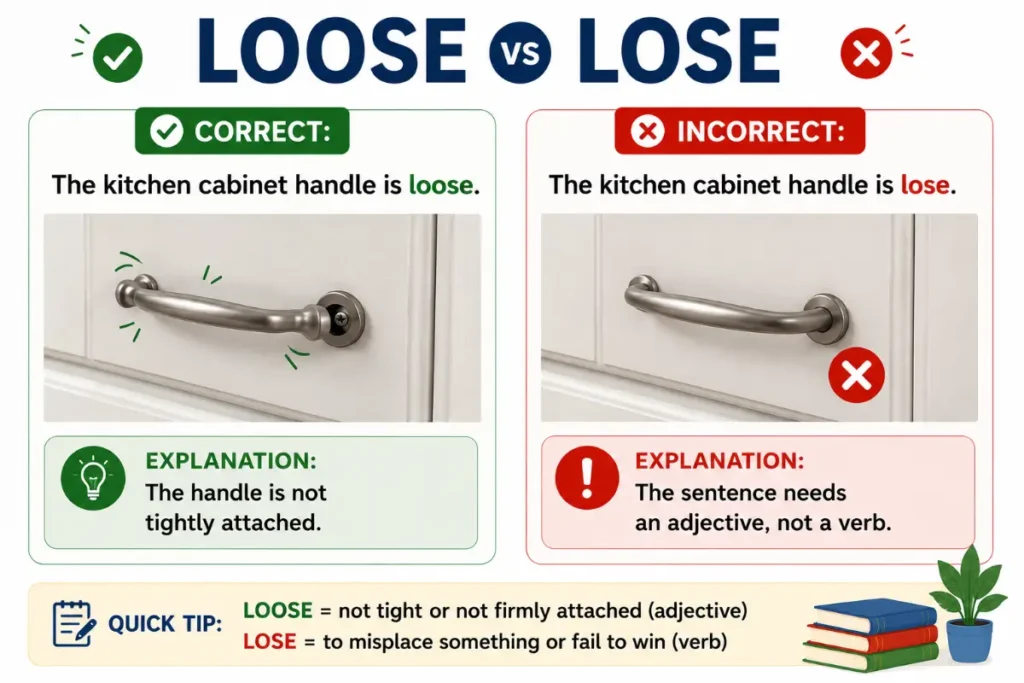
- The door handle is loose.
- I might lose my door key.
The first sentence describes the condition of the handle. The second describes the possibility of misplacing a key.
3. Grammar Difference
Loose is mainly an adjective. It modifies nouns and gives information about their condition or appearance.
Lose is a verb. It expresses an action and changes according to tense and subject.
Compare:
- She wears loose clothing.
- She doesn’t want to lose her clothing.
In the first sentence, the adjective describes the clothing. In the second, the verb describes something the person wants to avoid doing.
4. Pronunciation Difference
Both words contain the same long vowel sound, /uː/, as in blue and food. The difference appears at the end.
- Loose ends with an unvoiced /s/ sound.
- Lose ends with a voiced /z/ sound.
This small difference is useful when speaking, listening, and checking your spelling.
5. Formality and Context
Both words are accepted in standard American English, British English, Australian English, and Canadian English.
Neither is more formal than the other. Their suitability depends on the meaning you want to express.
For example, loose clothing is perfectly appropriate in professional writing. Similarly, lose an opportunity is acceptable in academic, business, and everyday communication.
Which Form Is Correct?
Both forms are correct, but they are used in different situations.
Use loose when you want to describe something that is not tight, firmly attached, or controlled. Use lose when you are talking about misplacing something, failing to win, or no longer having something.
The easiest way to identify the right choice is to examine the function of the word in your sentence.
Use loose when describing:
- Loose clothing.
- A loose screw.
- Loose hair.
- Loose connections.
- Loose restrictions.
Use lose when describing:
- Losing a game.
- Losing money.
- Losing your keys.
- Losing confidence.
- Losing an opportunity.
For example, consider these two sentences:
- I don’t want to lose my loose bracelet.
- My bracelet is loose, so I might lose it.
Both sentences are grammatically correct. The first word in the second sentence describes the bracelet’s condition, while the second word describes what might happen to it.
This distinction follows standard English grammar. An adjective describes a noun, while a verb expresses an action or state.
10 Natural Sentence Examples
The following examples show how these words appear in everyday conversations, professional communication, schoolwork, and other situations.
Examples Using Loose
- My new jeans are too loose around the waist, so I need a smaller size.
- The dog ran away because its collar was loose.
- She likes wearing her hair loose during the summer.
- There is a loose screw under the kitchen table that needs fixing.
- The company has introduced loose guidelines for its remote workers.
Examples Using Lose
- Be careful not to lose your wallet while traveling.
- Our basketball team cannot afford to lose another important game.
- You should never lose confidence just because you make a mistake.
- Students can lose valuable marks if they ignore the instructions.
- I want to lose a little weight by eating healthier meals and exercising regularly.
These examples demonstrate an important point: both spellings are correct, but each has its own grammatical purpose.
Common Mistakes and Misspellings
People often confuse these words because they look similar and share the same long vowel sound. Here are five common mistakes and ways to correct them.
1. Using Lose Instead of Loose
Incorrect: My shirt is lose around the waist.
Correct: My shirt is loose around the waist.
The sentence describes how the shirt fits. Since you need an adjective to describe its condition, loose is the correct choice.
2. Using Loose Instead of Lose
Incorrect: I don’t want to loose my phone.
Correct: I don’t want to lose my phone.
The sentence describes the possibility of misplacing a phone. Since this is an action, you need the verb lose.
3. Confusing Loose With Lost
Incorrect: I loose my keys yesterday.
Correct: I lost my keys yesterday.
Lose is the base form of the verb, while lost is its past tense and past participle. When describing something that happened in the past, use lost.
4. Writing Loosing Instead of Losing
Incorrect: She is loosing her patience.
Correct: She is losing her patience.
The present participle of lose is losing. You remove the final E before adding ING. Loosing is also a legitimate verb form of loose, but it means releasing or setting something free.
5. Adding an Extra Letter to the Verb
Incorrect: He is loosing the game.
Correct: He is losing the game.
When someone is not winning a game, the correct verb is losing. Loosing has a different meaning and does not describe failing to win.
Pronunciation Guide
Pronunciation is another helpful way to understand the difference between these words.
Both have one syllable and share the same long U vowel sound. However, their final consonants are different.
| Word | IPA | Easy Pronunciation | Final Sound |
|---|---|---|---|
| Loose | /luːs/ | Looss | S |
| Lose | /luːz/ | Looz | Z |
How to Pronounce Loose
The word loose is pronounced /luːs/.
To say it correctly:
- Start with the L sound.
- Make a long OO sound, like the one in moon.
- Finish with an unvoiced S sound, like the end of the word bus.
The final sound should be clear and sharp.
How to Pronounce Lose
The word lose is pronounced /luːz/.
To pronounce it:
- Start with the L sound.
- Make the same long OO sound.
- Finish with a voiced Z sound, like the end of the word buzz.
You should feel a slight vibration in your throat when making the Z sound.
Common Pronunciation Mistakes
A common mistake is pronouncing both words with the same final consonant. Some speakers also confuse the spelling because the long OO sound is identical in both.
Practice saying these pairs aloud:
- Loose and lose.
- Loose shoes and lose shoes.
- Loose change and lose change.
- Loose control and lose control.
Pay attention to the final sound. This small difference can help you recognize the words more easily.
For another common grammar confusion, see all-time vs all time Meaning and Correct Usage.
Etymology and Word Origin
The historical development of these words helps explain why they have different spellings and meanings.
Origin of Loose
Loose comes from Old Norse and Old English word forms associated with being free, unrestrained, or not bound. Its historical development reflects the idea of something being released or not held firmly in place.
Over time, its meaning expanded to describe objects that are not tight, relationships that are not close, and rules that are not strict.
Today, the adjective is commonly used in everyday English.
Origin of Lose
Lose comes from Old English losian, a verb associated with being lost or perishing. Its historical forms developed through Middle English before becoming the modern verb lose.
Its meaning gradually covered several related ideas, including misplacing possessions, failing to retain something, and experiencing defeat.
Although the two words have different historical backgrounds, their similar modern appearance contributes to spelling confusion.
Regional Usage
There is no major regional spelling difference between these words. Both are standard in the main varieties of English.
American English
In American English, loose and lose have their usual meanings and spellings.
Examples:
- These pants are too loose.
- I don’t want to lose my job.
Both are common in casual conversations, workplace communication, education, and formal writing.
British English
British English follows the same distinction.
For example:
- The handle is loose.
- Our team could lose the match.
There is no alternative British spelling that changes the distinction.
Australian English
Australian English also uses both words in the same way.
Loose describes something that is not tight or secure, while lose refers to misplacing something or failing to win.
Canadian English
Canadian English follows the same standard spelling and grammatical rules.
For example, a Canadian speaker would write:
- My shoes feel loose.
- I don’t want to lose my ticket.
The difference is based on meaning and grammar, not geography.
Grammar Rules and Part of Speech
Understanding the grammatical role of each word makes it easier to choose the correct spelling without memorizing dozens of examples.
Loose as an Adjective
An adjective describes a noun or gives more information about it.
Loose commonly appears before a noun or after a linking verb.
Before a noun:
- She bought a loose sweater.
- The mechanic found a loose bolt.
- He prefers loose clothing.
After a linking verb:
- The handle feels loose.
- My shoes are loose.
- The connection became loose.
In each example, the adjective tells you something about the condition of a person or object.
Loose as a Verb
Loose can also function as a verb, although this use is less common.
It means to release or set free.
Examples:
- The soldier loosed an arrow.
- The farmer loosed the horses into the field.
This usage is grammatically correct, but in everyday conversation, people often choose release or let go instead.
Lose as a Verb
Lose is an irregular verb. It changes its form depending on the tense and grammatical structure.
Here are its main forms:
| Verb Form | Word | Example |
|---|---|---|
| Base form | Lose | I don’t want to lose. |
| Third person singular | Loses | She loses her keys often. |
| Past tense | Lost | He lost his wallet. |
| Past participle | Lost | They have lost the game. |
| Present participle | Losing | We are losing time. |
Notice that the past tense and past participle are both lost, not loosed.
Common Grammatical Patterns
The verb lose appears in several common sentence structures.
1. Lose + object
Use this pattern when something is misplaced or no longer available.
Example: I don’t want to lose my passport.
2. Lose + game or competition
Use it to describe failing to win.
Example: Our team could lose the final match.
3. Lose + abstract noun
Use it to describe a reduction or loss of something that is not a physical object.
Example: He started to lose confidence.
4. Lose weight
This is a common expression referring to a reduction in body weight.
Example: She wants to lose weight through regular exercise.
5. Be losing + object or quality
Use the present continuous form to describe an ongoing process.
Example: The company is losing customers.
Common Grammar Errors
- Using an adjective where a verb is required.
- Using a verb where an adjective is needed.
- Writing loosed instead of lost when describing past loss.
- Using loosing instead of losing when describing an ongoing action.
- Forgetting that lose is an irregular verb.
Learning these patterns will help you use both words naturally.
Real Life Usage Examples
These words appear in many areas of everyday communication. Their meanings remain the same, but the surrounding context helps explain their function.
Daily Conversation
In ordinary conversations, loose often describes clothing, objects, and physical conditions.
Examples:
- Your shoelaces are loose. You should tie them.
- This chair feels loose. I think one of its screws is missing.
Lose is common when discussing belongings, games, or personal experiences.
Examples:
- Don’t lose your keys again.
- I hope we don’t lose the match tonight.
Email and Workplace Communication
Professional writing often uses these words to describe equipment, responsibilities, performance, and business results.
Examples:
- Please check the loose connection before using the equipment.
- We cannot afford to lose another important client.
In workplace communication, choosing the correct word keeps instructions and reports clear.
Academic Writing
In academic writing, loose can describe a weak connection between ideas or an arrangement that lacks a strict structure.
Examples:
- The researcher identified a loose connection between the two arguments.
- The study used a relatively loose framework for organizing the observations.
Lose can describe a reduction or failure to retain something.
Examples:
- Students may lose marks if they fail to explain their reasoning.
- The experiment could lose accuracy if the equipment is not calibrated.
News and Journalism
Journalists use these words in reports about sports, politics, business, and public events.
Examples:
- The team could lose its place in the tournament after another defeat.
- Several roads remain closed because of loose rocks near the highway.
The context makes the intended meaning clear without extra explanation.
Literature and Storytelling
Writers use loose to describe movement, appearance, and freedom. They use lose to describe emotional experiences, conflict, and change.
Examples:
- Her loose hair moved gently in the evening breeze.
- He feared he would lose the only person who understood him.
These uses show how both words can add clear details to descriptive and emotional writing.
Related and Confused Terms
Several other English words are connected to these two forms. Learning their meanings can help you avoid additional spelling and grammar mistakes.
1. Lost
Lost is the past tense and past participle of lose.
Example: I lost my favorite jacket yesterday.
It describes something that was misplaced, no longer available, or not won.
2. Losing
Losing is the present participle and gerund form of lose.
Example: The team is losing the competition.
It describes an ongoing action or process.
3. Loosing
Loosing is the present participle of the less common verb loose. It means releasing or setting something free.
Example: The soldiers were loosing the animals from their enclosure.
It is not the correct form when talking about losing a game or misplacing something.
4. Release
Release means to allow someone or something to go free or become available.
Example: The company plans to release its new product next month.
It can sometimes replace the verb loose, depending on the sentence.
5. Tight
Tight is an adjective that describes something firmly fitted, closely attached, or difficult to move.
Example: My shoes feel too tight.
It is often the opposite of loose when describing clothing or physical objects.
6. Secure
Secure describes something that is safely fixed, protected, or firmly attached.
Example: Make sure the ladder is secure before climbing it.
It can be the opposite of loose in situations involving safety and attachment.
7. Misplace
Misplace means to put something somewhere and then forget where it is.
Example: I sometimes misplace my glasses.
It is a useful synonym for one meaning of lose, although it does not cover every meaning of the verb.
8. Mislay
Mislay means to put something somewhere and temporarily forget its location.
Example: She managed to mislay her office keys.
It is similar to misplace and is often used in British English, though it is understood elsewhere.
Expert Editor Insight
Professional editors pay close attention to the grammatical function of these words rather than relying only on their appearance. Loose usually describes a noun, while lose expresses an action or change. The confusion is common because both words share the same long vowel sound and differ mainly in their final consonant. Spelling and grammar tools may flag an incorrect choice when the sentence makes the intended meaning clear, but they cannot always identify every context error. A useful editing tip is to check the sentence’s meaning first: if you are describing something that is not tight, choose loose; if you mean misplace, fail to win, or no longer have something, choose lose.
Key Takeaways
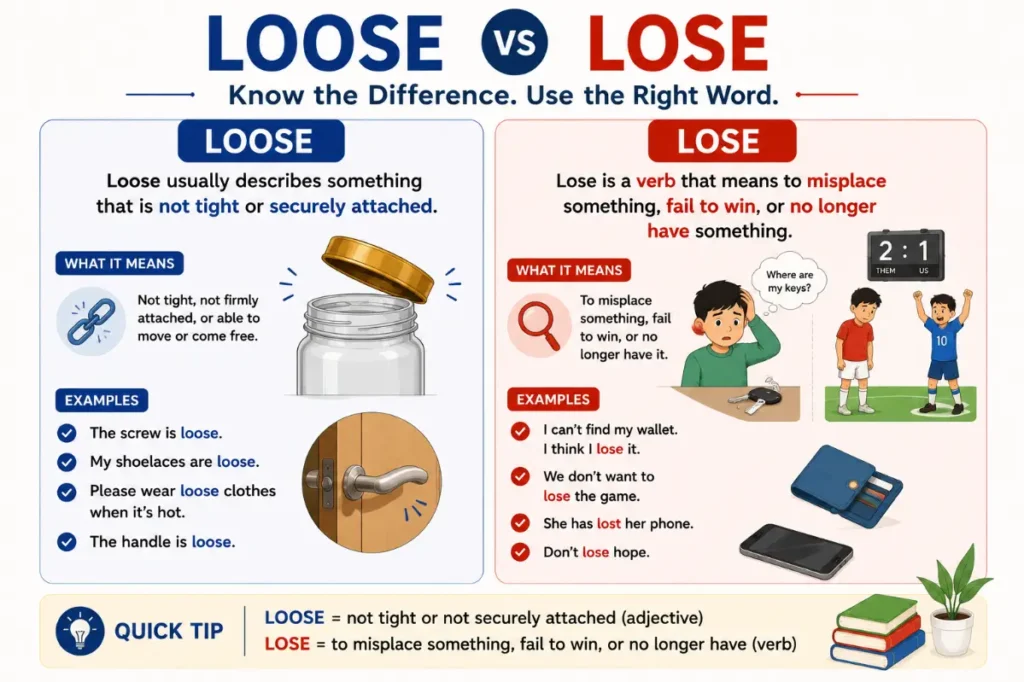
- Loose usually describes something that is not tight or securely attached.
- Lose is a verb that means to misplace something, fail to win, or no longer have something.
- Loose is commonly used with clothing, ropes, screws, and other physical objects.
- Lose is commonly used with games, money, keys, confidence, weight, and opportunities.
- Loose ends with an s sound, while lose ends with a z sound.
- The two words have different meanings, different grammatical roles, and different origins.
- Remember that lose has one O, while loose has two O’s.
Many readers also check Fact Or Fiction Meaning Difference And Correct Usage 2026.
Conclusion
Understanding loose vs lose becomes much easier when you focus on meaning and grammar. Loose is mainly an adjective that describes something not tight, secure, or firmly attached. Lose is a verb that means to misplace something, fail to win, or stop having something. Both are correct English words, but they serve different purposes.
The simplest way to remember the distinction is to associate the extra O in loose with extra room, as in loose clothing. For lose, remember the action of losing something you once had. Check the meaning of your sentence before choosing the spelling, and you will avoid this common mistake.
FAQs
Is Loose a Real Word?
Yes, loose is a standard English word. It is mainly an adjective that describes something not tight, securely attached, or firmly controlled. It can also function as a less common verb meaning to release or set free. For example, a loose shirt is not tightly fitted, while a loose screw is not firmly attached.
Is Lose a Real Word?
Yes, lose is a standard English verb. It means to misplace something, fail to win, or stop having something. You can use it in everyday conversation, academic writing, and professional communication. For example, you might lose your wallet, lose a competition, or lose confidence after a difficult experience.
What Is the Main Difference Between Loose and Lose?
The main difference is their meaning and grammatical function. Loose is primarily an adjective that describes something not tight or secure. Lose is a verb that describes an action, such as misplacing an item or failing to win. For example, a loose button can fall off, and you might lose that button.
How Do You Remember the Difference?
Remember that loose has an extra O and describes something that has extra room or is not tight. Lose has one O and means to misplace something or fail to keep it. You can also remember their final sounds: loose ends with S, while lose ends with Z. Practicing these differences makes the spelling easier.
Is It Losing or Loosing?
Losing is the correct form when you mean misplacing something, failing to win, or no longer having something. For example, you are losing the game. Loosing is a real but less common form of the verb loose, meaning releasing something. For example, loosing an animal means setting it free.
Is It Loose Weight or Lose Weight?
The correct expression is lose weight. Lose is the verb used to describe reducing body weight. Loose is an adjective that describes something not tight. For example, you might lose weight and then notice that your clothes feel loose. The two words have different grammatical roles, so they cannot be exchanged.
Why Do People Confuse These Two Words?
People confuse them because they share almost the same spelling and have the same long OO vowel sound. The main difference is the final consonant sound, S or Z. Typing quickly, learning English pronunciation, and remembering the wrong spelling pattern can also contribute to the mistake.
Can Both Words Be Used in Formal Writing?
Yes, both words are appropriate in formal writing when used correctly. Loose can describe a weak connection, relaxed rules, or an object that is not firmly attached. Lose can describe a reduction, defeat, or failure to retain something. Neither word is informal or incorrect by itself.