
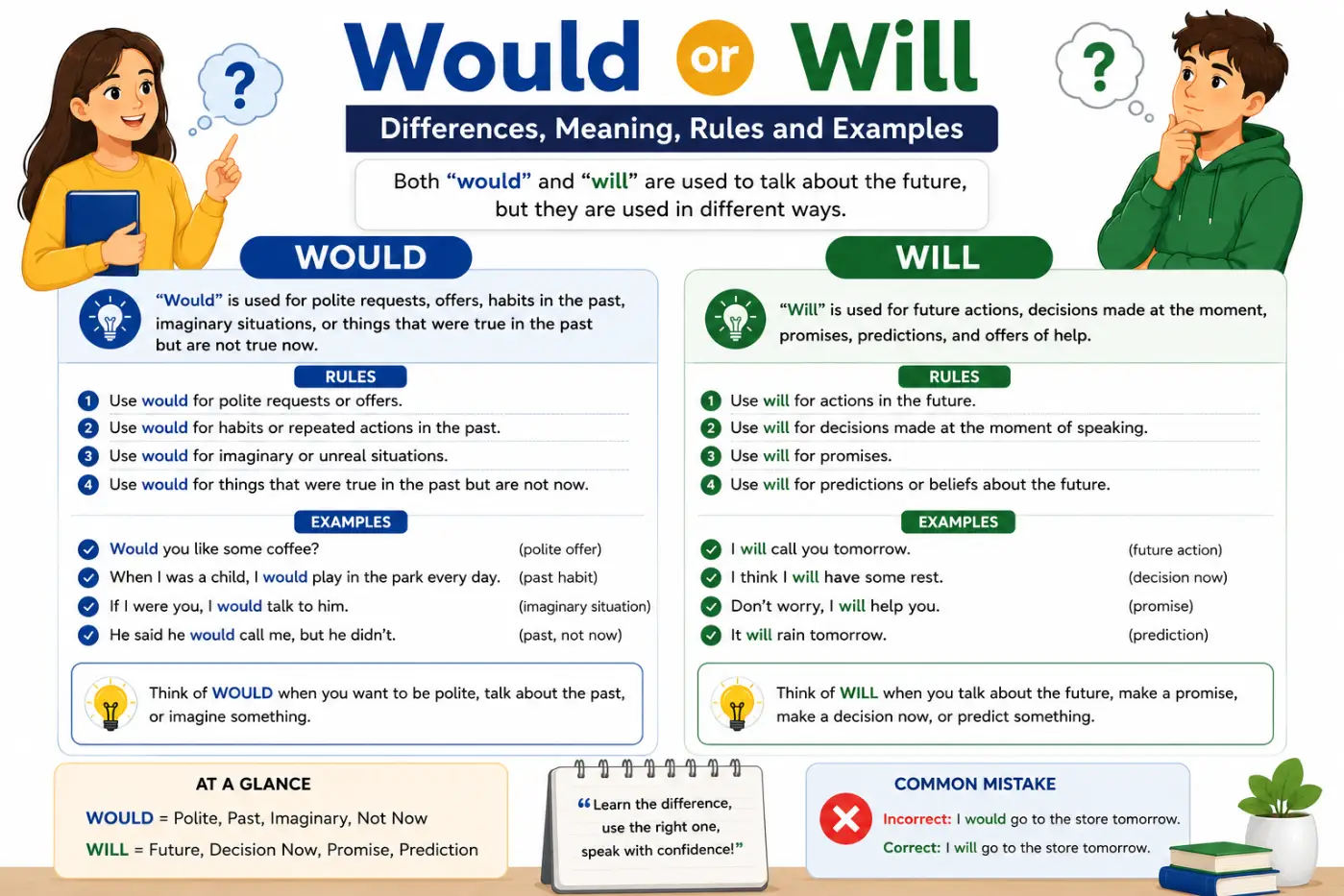
Choosing between would and will can be confusing, especially when you are talking about the future, making a promise, asking someone to do something, or describing an imaginary situation. Both words are correct, but they do not always communicate the same idea.
The main difference is that will usually expresses a future action, intention, decision, or prediction, while would often expresses a hypothetical situation, a polite request, a past habit, or a future action viewed from the past. Understanding this distinction helps you choose the right word without second-guessing your grammar.
It also makes your speaking and writing clearer. In this guide, you will learn what each word means, how to use it in different situations, and why native English speakers sometimes choose one instead of the other. You will also find practical examples, pronunciation guidance, common mistakes, and simple rules that make the difference easier to remember.
Still confused? Compare Patience vs Patients: Meaning and Correct Usage.
Quick Answer: What Is the Difference?
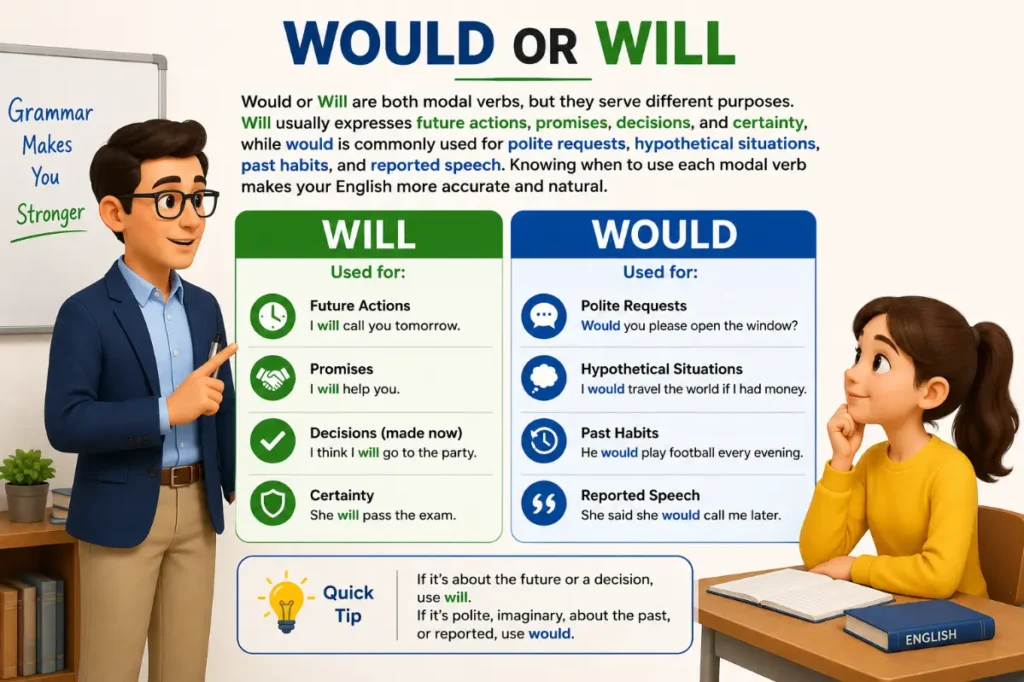
Will generally expresses a future action, intention, promise, prediction, or willingness. Would is commonly used for hypothetical situations, polite requests, repeated past actions, and future events viewed from a past point in time. Both are correct modal verbs, but the right choice depends on the meaning and context of your sentence.
Would vs. Will: Comparison Table
| Feature | Will | Would |
|---|---|---|
| Part of speech | Modal auxiliary verb | Modal auxiliary verb |
| Main meaning | Future action, intention, or prediction | Hypothetical action, politeness, or past perspective |
| Time reference | Usually future | Past, present, or hypothetical future |
| Certainty | Often expresses a stronger expectation or intention | Often expresses a conditional or less direct possibility |
| Conditional use | Common in the main clause of first conditional sentences | Common in second and third conditional sentences |
| Formality | Neutral | Often more polite or indirect |
| Requests | Can sound direct | Often sounds more courteous |
| Past habits | Not normally used for this meaning | Can describe repeated past actions |
| Example | I will call you tomorrow. | I would call you if I had your number. |
Meaning and Definition
Understanding the individual meanings is the easiest way to choose between these two words. Although they are related, their grammatical functions allow speakers to express different attitudes toward an action or event.
What Does Will Mean?
Will is a modal auxiliary verb used to express future actions, predictions, intentions, promises, decisions, and willingness. It helps describe something that is expected, planned, or intended to happen after the present moment.
For example:
- I will finish the report tonight.
- She will arrive at the airport tomorrow.
- We will help you with the project.
In each sentence, the speaker communicates an expected or intended future event.
The word can also express a spontaneous decision. For example, if someone asks whether you want coffee, you might answer, “I will have a cup, please.” The decision is made while speaking rather than being presented as a long-standing plan.
It can also show determination or willingness:
- I will never give up.
- He will do whatever it takes to succeed.
In these examples, the word communicates a strong intention rather than simply describing future time.
What Does Would Mean?
Would is a modal auxiliary verb that expresses hypothetical actions, conditional results, polite requests, preferences, and repeated past behavior. It is also commonly used to describe a future event from a past point of view.
For example:
- I would travel more if I had enough money.
- Would you please close the door?
- When we were children, we would play outside every evening.
The first sentence describes an imagined situation. The second makes a polite request, while the third describes a repeated activity in the past.
It is also used to express an unreal or imagined result:
“If I were taller, I would play basketball.”
The speaker is not saying that the situation is real. Instead, the sentence describes what might happen under a different condition.
This word can also make opinions and preferences sound less forceful:
“I would prefer to discuss this tomorrow.”
The speaker communicates a preference in a softer, more indirect way.
Key Differences Explained
The difference becomes clearer when you examine the purpose of each word rather than memorizing a single definition.
1. Future Actions vs. Hypothetical Situations
The most familiar use of will is to describe something expected to happen in the future.
Example:
“I will visit my grandparents next weekend.”
The speaker presents the visit as an intention or expected event.
Would often describes an action that depends on an imagined condition.
Example:
“I would visit my grandparents more often if I lived closer.”
Here, the speaker is describing a possible action that depends on living nearby.
The important distinction is that the first sentence communicates an actual intention, while the second describes a conditional possibility.
2. Certainty and Possibility
Will often communicates a stronger expectation, prediction, or commitment.
For example:
“The weather will improve tomorrow.”
The speaker presents improvement as an expected future event.
Would can make a statement conditional or less definite:
“The weather would improve if the storm moved away.”
The improvement depends on another event.
However, these words do not represent fixed levels of certainty in every situation. A person can use would to make a confident prediction based on a condition, and will can express an uncertain prediction.
Always consider the meaning of the whole sentence.
3. Direct Statements vs. Polite Requests
Both words can appear in requests, but they create different tones.
Compare:
- Will you help me with this assignment?
- Would you help me with this assignment?
The first is a straightforward request. The second generally sounds more polite and less demanding.
This difference is especially useful in professional communication, customer service, and formal conversations.
4. Real Future Events vs. Future in the Past
Would can describe an event that was still in the future from a past point of view.
For example:
“She said she would call me.”
The calling was in the future when she made the statement, but the reporting takes place later.
Compare:
“She says she will call me.”
The reporting happens in the present, so the future action is expressed using will.
This is an important rule in reported speech.
5. Conditional Grammar
These words play different roles in conditional sentences.
Consider these examples:
First conditional:
“If I have time, I will visit you.”
This describes a realistic future possibility.
Second conditional:
“If I had time, I would visit you.”
This describes an imagined or less likely situation.
Third conditional:
“If I had studied harder, I would have passed the exam.”
This describes an imagined past result that did not happen.
The conditional structure often determines which modal verb is appropriate.
6. Past Habits and Repeated Actions
Would can describe actions that happened repeatedly in the past.
For example:
“When I was young, my father would read stories to me.”
The sentence describes a repeated past activity.
Will does not normally perform this function. However, it can describe habitual behavior in the present or general willingness, depending on context.
Example:
“She will often spend hours reading.”
Here, will describes a characteristic or repeated behavior, not a straightforward future event.
Which Form Is Correct?
Both forms are grammatically correct. Neither is a misspelling or an incorrect version of the other. The correct choice depends on what you want to communicate.
Use will when expressing:
- A future action or event.
- A promise or commitment.
- A spontaneous decision.
- A prediction.
- A willingness to do something.
Use would when expressing:
- An imaginary or hypothetical situation.
- A conditional result.
- A polite request.
- A preference or softer opinion.
- A repeated past action.
- A future action viewed from a past perspective.
A useful grammatical rule is that would commonly appears in the result clause of hypothetical conditional sentences, while will commonly appears in the result clause of realistic future conditional sentences.
For example:
“If she studies, she will pass.”
“If she studied, she would pass.”
The difference is not spelling. It is the relationship between the condition and the expected result.
Sentence Examples: How to Use Each Word
The following examples demonstrate natural usage in everyday communication, professional writing, education, and social situations.
10 Examples Using Will and Would
- Everyday conversation: “I will meet you outside the restaurant at seven.” The speaker communicates a future plan.
- Text messages: “I would love to join you for dinner, but I have to work.” The speaker expresses interest while explaining a limitation.
- Workplace communication: “We will send the updated documents before the end of the day.” This communicates a professional commitment.
- Polite request: “Would you mind checking this email before I send it?” The question makes the request sound courteous.
- School: “If I study consistently, I will improve my grades.” The sentence describes a realistic future result.
- Academic writing: “The proposed method would produce different results under controlled conditions.” The statement describes a conditional outcome.
- Social situations: “I would rather stay home tonight than go to a crowded event.” This expresses a personal preference.
- Formal communication: “The company will announce its decision after reviewing the applications.” This describes an expected future action.
- Reported speech: “My teacher said she would explain the topic again.” The sentence describes a future action from a past perspective.
- Past storytelling: “Every summer, we would visit our cousins and spend the afternoon playing in the garden.” The word describes a repeated past activity.
Notice how the surrounding words help determine the appropriate choice. Understanding the intended meaning is more useful than trying to replace one word with the other.
Common Mistakes and How to Avoid Them
Even fluent English speakers sometimes confuse these modal verbs. Most errors happen because learners focus on the time of an action without considering its grammatical relationship to the rest of the sentence.
1. Using Would for Every Future Action
Incorrect: “I would call you tomorrow.”
Correct: “I will call you tomorrow.”
Why: If you are making a straightforward future commitment, the usual choice is will. The alternative may be appropriate if the sentence has an implied condition or a special conversational meaning.
2. Using Will in a Hypothetical Result
Incorrect: “If I had more money, I will buy a new car.”
Correct: “If I had more money, I would buy a new car.”
Why: The second conditional uses a past-form verb in the condition clause and a hypothetical modal construction in the result clause.
3. Using Will Instead of Would in a Polite Request
Less polite: “Will you please explain this again?”
More polite: “Would you please explain this again?”
Why: Both sentences are grammatical, but the second is generally more indirect and courteous.
4. Confusing Reported Speech
Incorrect: “He said he will arrive at noon.”
Correct in a typical backshifted report: “He said he would arrive at noon.”
Why: When reporting a statement from the past, English commonly changes will to would to maintain the past reporting perspective. However, will can remain appropriate when the future event is still relevant or the speaker wants to preserve the original viewpoint.
5. Using Would Without a Clear Conditional Meaning
Unclear: “I would go to the store yesterday.”
Better: “I went to the store yesterday.”
Or: “I would have gone to the store yesterday if I had had enough time.”
Why: Would normally needs a suitable grammatical or contextual function. It does not simply replace the past tense.
Pronunciation Guide
Both words are common in spoken English, and their pronunciation is generally straightforward.
Pronunciation of Will
- IPA: /wɪl/
- Syllables: One
- Easy pronunciation: wil
- Stress: The entire one-syllable word carries the stress when emphasized.
The vowel sound is similar to the short vowel in “sit.”
Example: “I will finish the work.”
In fast conversation, will is often reduced or blended with the preceding word. For example, “I’ll” is a common contraction of “I will.”
Pronunciation of Would
- IPA: /wʊd/
- Syllables: One
- Easy pronunciation: wood
- Stress: The entire one-syllable word carries the stress when emphasized.
The vowel sound is similar to the vowel in “book.”
Example: “I would like some water.”
In natural speech, would is often contracted:
- I would = I’d
- You would = You’d
- He would = He’d
- They would = They’d
The pronunciation of would can also change slightly in connected speech, especially when speakers talk quickly.
Common Pronunciation Mistakes
Some learners pronounce the letter L in would because they expect every written letter to be spoken. However, the L is silent.
The correct pronunciation is /wʊd/, not /wʊld/.
Another common difficulty is confusing the vowel sounds. Remember that will has the short vowel sound heard in “sit,” while would has the vowel sound heard in “book.”
Learn the difference in catchup or catch up Which Form Is Correct.
Etymology and Word Origin
Understanding the historical development of these words provides useful background, although their modern grammatical functions are more important for everyday writing.
Origin of Will
Will developed from Old English forms of the verb willan, meaning to wish, desire, or intend. Over time, the word developed an important grammatical role in expressing intention and future events.
Its modern use reflects this historical connection. When someone says, “I will help you,” the statement can express a decision or willingness as well as a future action.
Origin of Would
Would developed from the Old English past form wolde of willan. Its historical connection to the idea of wishing or intending helps explain why it is now used in hypothetical situations, polite requests, and conditional expressions.
As English grammar developed, would became an important modal auxiliary with several functions beyond its original past-related meaning.
Both words therefore share a historical relationship, but modern English gives them distinct grammatical roles.
Regional Usage: American, British, Australian, and Canadian English
There is no major spelling difference between American and British English for these words. Both are standard in the major varieties of English.
American English
In American English, both forms are widely used in everyday speech, professional communication, education, and formal writing.
Americans commonly use will for future plans and predictions.
Examples:
- “I will pick you up after work.”
- “Would you like something to drink?”
The second form is also frequently used to soften requests and express preferences.
British English
British English follows the same basic grammatical rules. Both words are standard and have the same main functions as in American English.
Examples:
- “I will see you tomorrow.”
- “I would prefer to wait until Monday.”
There may be differences in conversational habits, tone, and preferred expressions, but there is no fundamental difference in the meaning or spelling of these modal verbs.
Australian English
Australian English also uses both forms in the same general way.
Examples:
- “I’ll give you a call later.”
- “Would you like to come along?”
Contractions and informal expressions are common in everyday Australian conversation, but the underlying grammar remains the same.
Canadian English
Canadian English follows the same standard grammatical patterns.
Examples:
- “We will meet after the meeting.”
- “I would appreciate your feedback.”
Neither word has a special Canadian spelling or a separate regional meaning that changes the basic distinction.
Grammar Rules and Part of Speech
Both words belong to the category of modal auxiliary verbs. They help the main verb express ideas such as possibility, intention, willingness, hypothetical situations, and future time.
Understanding their sentence structure will help you use them correctly.
1. Basic Sentence Structure
Both words are followed by the base form of the main verb.
Structure:
Subject + modal verb + base verb + remaining sentence.
Examples:
- She will travel tomorrow.
- He would accept the offer.
- They will complete the project.
- We would enjoy the experience.
Do not add “to” or an -s ending to the main verb after either modal.
Incorrect: “She will goes home.”
Correct: “She will go home.”
Incorrect: “He would likes the idea.”
Correct: “He would like the idea.”
2. Negative Sentences
To make a negative statement, add not after the modal verb.
For will:
- I will not attend the meeting.
- She will not forget your kindness.
For would:
- I would not recommend that option.
- They would not agree with the decision.
Common contractions include:
- Will not = won’t
- Would not = wouldn’t
These contractions are common in everyday conversation and informal writing. In more formal documents, the full forms may be preferred depending on the style and tone.
3. Questions
To form a question, place the modal verb before the subject.
Examples:
- Will you come tomorrow?
- Would you help me?
- Will they attend the conference?
- Would she accept the invitation?
Unlike ordinary verbs, modal auxiliaries do not need the auxiliary “do” to form questions.
Incorrect: “Do you will come?”
Correct: “Will you come?”
4. Conditional Sentences
Conditional sentences are among the most important areas where these words differ.
The first conditional describes a realistic future possibility.
Structure:
If + present simple, subject + will + base verb.
Example: “If it rains, we will stay home.”
The second conditional describes an imaginary, unlikely, or unreal situation.
Structure:
If + past simple, subject + would + base verb.
Example: “If I owned a beach house, I would spend every summer there.”
The third conditional describes an imagined past result.
Structure:
If + past perfect, subject + would have + past participle.
Example: “If she had left earlier, she would have caught the train.”
These patterns are useful because they show how the speaker views the likelihood and timing of an event.
5. Reported Speech
Reported speech is another common situation in which the two words are connected.
Direct speech: “I will call you tomorrow,” she said.
Reported speech: She said she would call me the following day.
The change from will to would is called backshift. It commonly occurs when a present-tense statement is reported using a past-tense reporting verb.
However, backshift is not always compulsory. If the original statement remains true or the future action is still relevant, a speaker may retain the original tense.
6. Modal Verbs and Other Auxiliary Rules
Neither word takes an -s ending with third-person singular subjects.
Correct:
- He will work.
- She would agree.
- It will happen.
Incorrect:
- He wills work.
- She woulds agree.
Both also combine with other grammatical structures.
For example:
- She will be waiting for us.
- They would have finished earlier.
- He will have completed the course by June.
- I would be grateful for your assistance.
These combinations allow speakers to communicate future progress, completed actions, imagined outcomes, and polite attitudes.
Real-Life Usage Examples
The following situations show how these words work in natural communication.
Daily Conversation
People frequently use will to talk about plans and decisions.
- “I will bring some snacks for everyone.”
- “We will leave as soon as everyone is ready.”
Would often appears in friendly questions and expressions of preference.
- “Would you like to watch a movie?”
- “I would rather take a walk.”
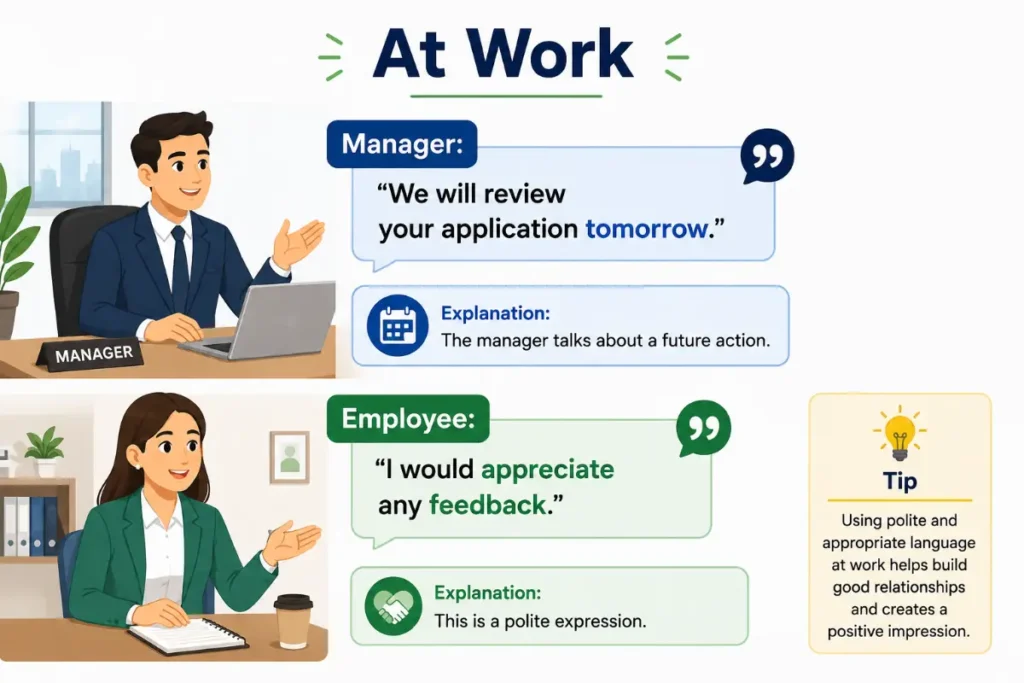
Email and Workplace Communication
Professional communication often uses both forms to balance clarity and courtesy.
- “I will send the revised proposal by Friday.”
- “We will contact you once the review is complete.”
For requests and suggestions, the alternative is often more diplomatic.
- “Would you please review the attached document?”
- “I would appreciate your comments before the meeting.”
Academic Writing
In academic writing, both words are useful for discussing predictions, conditions, and theoretical outcomes.
- “The intervention will improve the consistency of the results.”
- “The model would produce different outcomes if the input values changed.”
The choice depends on whether the writer is presenting an expected result or a conditional possibility.
News and Journalism
News reports use will to communicate expected developments and official plans.
- “The committee will announce its findings next week.”
- “The new policy will take effect in January.”
Would can appear when reporting statements or describing possible consequences.
- “The minister said the changes would take several months.”
- “The proposal would affect thousands of local residents.”
Literature and Storytelling
Writers use these modal verbs to establish future expectations, imagined events, and past routines.
- “She knew that one day she would return to the little village.”
- “He promised that he would never forget their friendship.”
Will can communicate determination or a character’s immediate intention.
- “I will find the truth,” he whispered.
- “We will survive this journey together.”
Related and Confused Terms
Several English expressions have meanings connected to these modal verbs. Understanding their differences helps you choose more precise language.
1. Shall
Shall is another modal auxiliary used to express future meaning, offers, suggestions, or formal obligations.
Example: “Shall we begin the meeting?”
In modern American English, will is much more common for ordinary future statements. Shall remains useful in certain formal and conversational situations.
2. Should
Should commonly expresses advice, recommendations, expectations, or obligations.
Example: “You should get some rest.”
Unlike would, it is not primarily used to describe hypothetical results. Unlike will, it does not normally express a straightforward future commitment.
3. Could
Could expresses ability, possibility, or a polite request.
Example: “Could you help me carry these boxes?”
It is often more tentative than will and can describe a possible action rather than a definite intention.
4. Can
Can expresses present ability, permission, or possibility.
Example: “I can finish the assignment today.”
Would and could can make certain requests sound more polite, but they have different grammatical and semantic functions.
5. Might
Might expresses possibility or uncertainty.
Example: “It might rain this evening.”
It generally communicates a less definite possibility than a straightforward statement using will.
6. May
May is used to express possibility or permission.
Example: “You may leave early today.”
It is common in formal communication and polite requests, although its exact function depends on the sentence.
7. Going To
Going to is a common future construction used for plans, intentions, and predictions based on present evidence.
Example: “I am going to start a new course next month.”
It can overlap with will, but the two expressions are not interchangeable in every context.
8. Used To
Used to describes past habits or situations that are no longer true.
Example: “I used to play tennis every weekend.”
Would can also describe repeated past actions, but used to is generally more suitable for describing both past habits and past states.
Expert Editor Insight
An experienced English editor looks beyond the individual word and examines the purpose of the sentence. The most common confusion occurs when writers assume that one form always means future time and the other always means past time. That is too simple. A professional editor checks whether the sentence expresses a real intention, a hypothetical result, a polite request, a past routine, or reported speech. Grammar tools may flag a sentence because its conditional structure appears inconsistent, but they cannot always understand the intended meaning. The best editing habit is to read the entire sentence and ask what relationship the speaker wants to communicate.
Key Takeaways
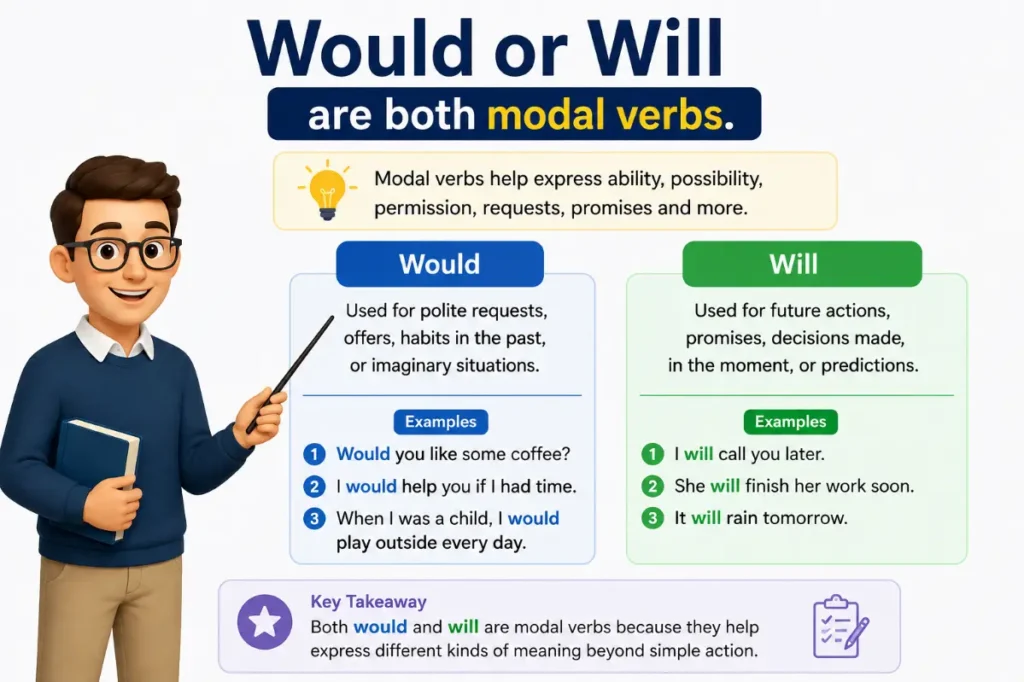
- Would or Will are both modal verbs.
- Will expresses future actions, predictions, promises, and instant decisions.
- Would expresses polite requests, hypothetical situations, reported speech, preferences, and past habits.
- Use will when talking about real future events.
- Use would in second and third conditional sentences.
- Would is more polite than will when making requests.
- Both modal verbs are followed by the base form of the main verb.
- Never use to after will or would.
- Context is the key to choosing the correct modal verb.
Many readers also check Writen Or Written: Correct Spelling and Differences (2026).
Conclusion
Understanding Would or Will becomes much easier when you focus on the meaning of the sentence instead of treating the words as interchangeable. Will generally communicates future actions, decisions, promises, and predictions, while would expresses hypothetical situations, polite requests, past habits, and future events viewed from the past. Both are standard English modal verbs, and neither is incorrect.
The best way to remember the difference is to ask whether you are describing an expected action or an imagined, conditional, or less direct one. Before choosing, read the complete sentence and check its grammatical structure. This simple editing habit can make your English clearer and more natural.
FAQs
1. Which Is Correct: Would or Will?
Both are correct English words. The appropriate choice depends on the meaning of your sentence. Use will for ordinary future actions, intentions, promises, and predictions. Use would for hypothetical situations, polite requests, conditional results, past habits, and future events viewed from a past perspective. Neither word is inherently more grammatically correct than the other.
2. Is Would the Past Tense of Will?
Would is historically the past form associated with will, but modern English uses it for several purposes beyond ordinary past tense. It appears in reported speech, hypothetical statements, polite requests, and repeated past actions. Therefore, it is better understood as a modal verb with several grammatical functions rather than simply the past tense of its related form.
3. Can You Use Would and Will in the Same Sentence?
Yes. Both can appear in the same sentence when they serve different grammatical purposes. For example, “I know she will succeed, and I would support her if she needed help.” The first expresses a future expectation, while the second describes a hypothetical offer of support. Their use depends on the meaning of each clause.
4. Why Is Would More Polite Than Will?
Would often sounds more polite because it makes a request less direct and more conditional. For example, “Will you open the window?” is a straightforward question, while “Would you open the window?” generally sounds softer. This does not mean that will is rude. The difference is mainly one of conversational tone and indirectness.
5. Can Would Be Used for Future Actions?
Yes. Would can describe a future action when viewed from a past point in time or when the action depends on an imagined condition. For example, “She said she would visit us next week” describes a future event from a past reporting perspective. It can also express an imagined future outcome in a conditional sentence.
6. Can You Start a Sentence With Would?
Yes. A sentence can begin with would when forming a question or using an inverted conditional structure. For example, “Would you like some coffee?” is a normal question. Another example is “Would I have known the truth, I might have acted differently,” although this inverted structure is more formal and less common in everyday American English.
7. What Is the Difference Between Would Have and Will Have?
Would have generally describes an imagined or conditional result, often involving the past. For example, “I would have attended if I had known.” Will have commonly describes an action expected to be completed by a particular future time. For example, “I will have finished the report by Friday.” The surrounding grammatical structure determines the intended meaning.
8. How Can I Remember When to Use Each Word?
A simple way to remember the distinction is to associate will with an intended or expected future action and would with an imagined, conditional, polite, or past-related situation. Ask yourself whether you are describing something you expect to happen or something that depends on a condition. This quick check will help you make the correct grammatical choice in most everyday situations.