
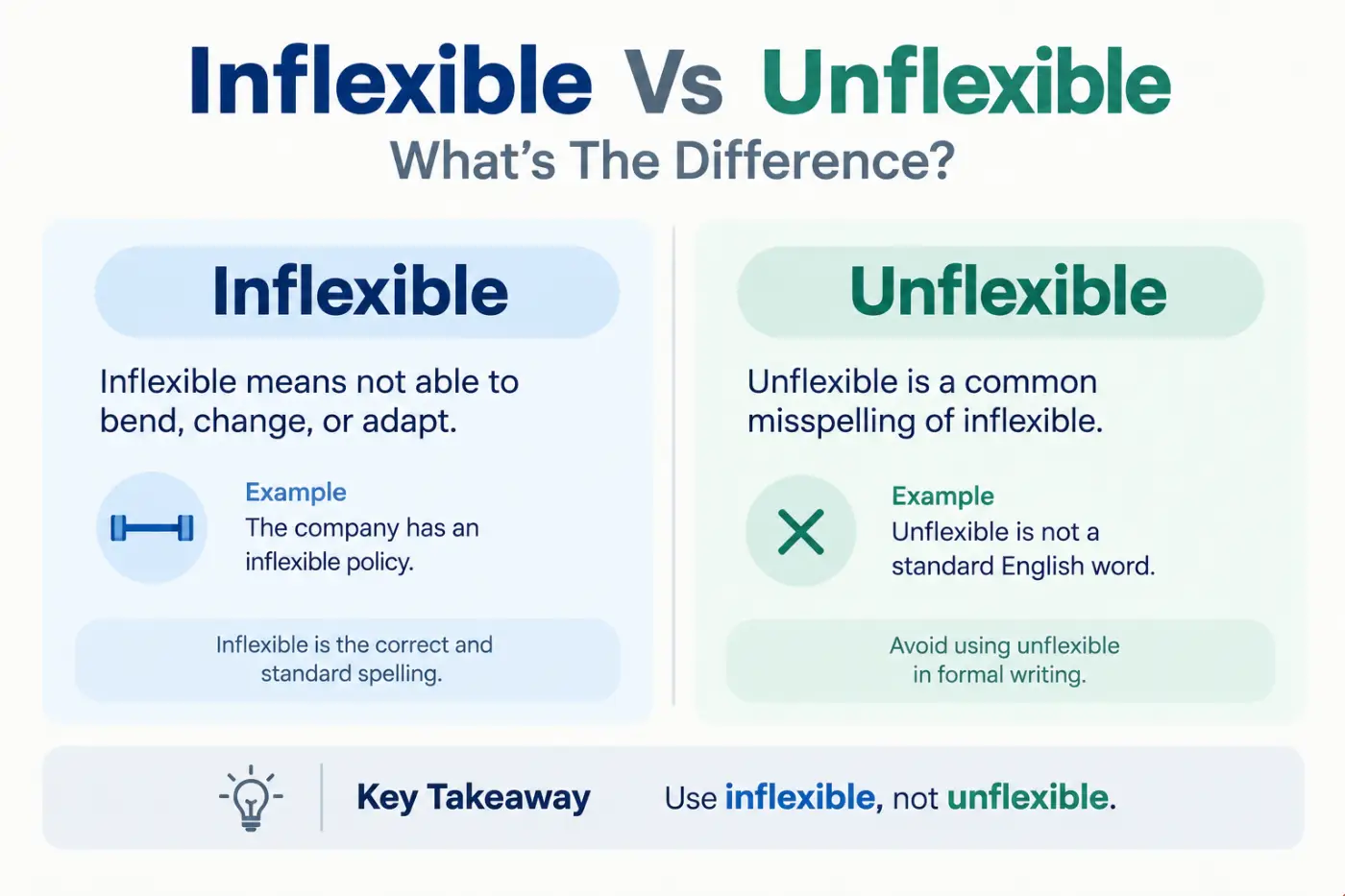
Have you ever wondered whether to write inflexible or unflexible? Both forms may look reasonable because English often uses the prefix un- to create the opposite of an adjective. However, only one is the normal choice in modern standard English. Inflexible is the established spelling used to describe someone or something that cannot bend, change, or adapt easily. The alternative, unflexible, is rare and is generally unsuitable for ordinary modern writing.
The confusion comes from a common word-building pattern. Since words such as unhappy, unfair, and unclear use un-, it may seem logical to apply the same prefix to flexible. English, however, does not always form opposites by adding the same prefix. Some adjectives have established forms that must be learned through regular usage. Understanding this difference will help you avoid an awkward spelling choice, write more clearly, and select the right expression for your intended meaning.
Still confused? Compare Seal or Seel: Which Spelling Is Correct?.
Quick Answer
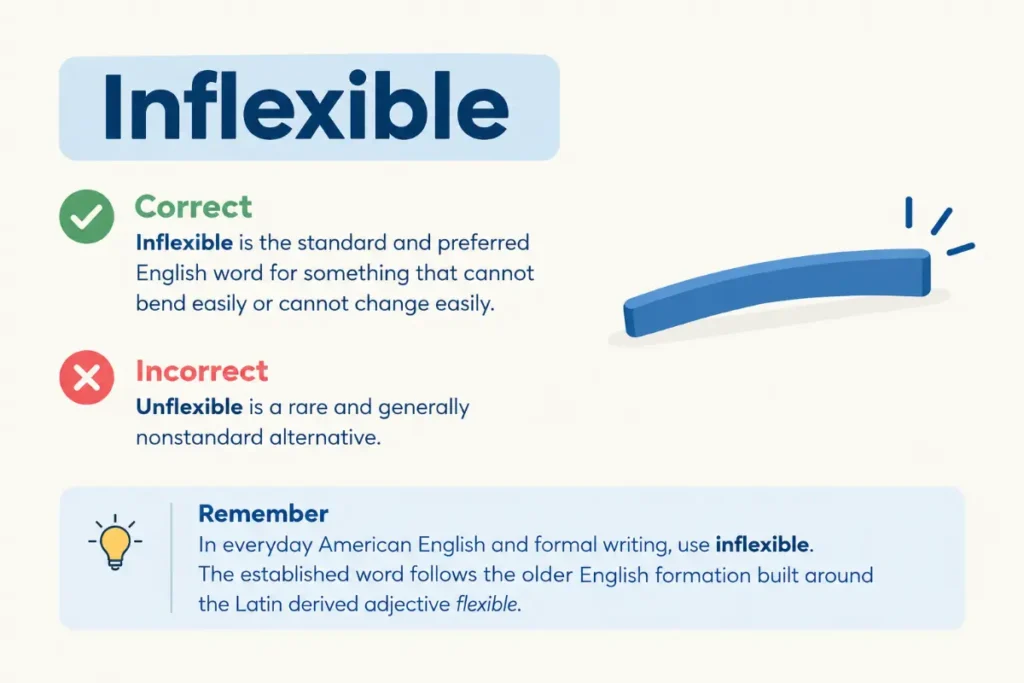
Inflexible is the correct and preferred form in modern standard English. It means unable to bend, change, or adapt easily. Unflexible is a rare, nonstandard alternative that most readers will regard as an error or an unusual word choice. Use inflexible in everyday writing, academic work, business communication, and formal documents.
Comparison Table: Inflexible vs Unflexible
The two spellings are related in meaning, but they are not equally suitable for modern English writing.
| Feature | Inflexible | Unflexible |
|---|---|---|
| Preferred spelling | Yes | No |
| Word status | Established standard English word | Rare, nonstandard alternative |
| Part of speech | Adjective | Adjective |
| Meaning | Not flexible; rigid or unwilling to change | Not flexible |
| Word formation | Latin-derived form | Formed with un- + flexible |
| Pronunciation | /ɪnˈflɛksəbəl/ | Varies; uncommon |
| Formality | Suitable for formal and informal writing | Generally unsuitable for standard writing |
| Common contexts | Rules, attitudes, materials, schedules | Occasional informal or historical usage |
| Usage frequency | Common and widely recognized | Uncommon |
| Recommended usage | Use this form | Replace with inflexible |
The main distinction is established usage. The preferred spelling has a long history in English and is recognized by major dictionaries, including Oxford and Cambridge. The alternative can be understood because its parts make sense, but that does not make it the normal choice. Oxford Learner’s Dictionaries+2
Meaning and Definition
What Does Inflexible Mean?
Inflexible is an adjective that describes something that cannot bend, change, or adapt easily. It can refer to physical objects, personal behavior, opinions, rules, plans, and systems.
The word has three main areas of meaning:
1. Physically stiff or difficult to bend
This meaning describes an object or material that does not bend easily.
Examples:
- The metal frame is inflexible and difficult to reshape.
- The protective material becomes inflexible in cold weather.
- The old plastic pipe is too inflexible for the repair.
2. Unwilling to change opinions or decisions
When used to describe a person, the adjective often suggests that someone refuses to reconsider an opinion, decision, or position.
Examples:
- The manager was inflexible during the salary discussion.
- My father can be inflexible about household rules.
- She remained inflexible despite several reasonable suggestions.
3. Fixed and unable to adapt
This meaning applies to plans, schedules, policies, deadlines, and procedures that allow little or no adjustment.
Examples:
- The company has an inflexible attendance policy.
- Our work schedule is inflexible this month.
- The deadline is inflexible because the application closes Friday.
These meanings share one central idea: a lack of flexibility. Something may be physically rigid, mentally unwilling to change, or practically unable to adjust.
Meaning of Unflexible
Unflexible is a recognizable word formation created by combining the prefix un- with flexible. Its intended meaning is simply not flexible.
It appears in some historical and modern English material, and specialist or less comprehensive dictionaries may record it. Therefore, calling it an impossible combination of letters would be inaccurate.
However, there is a difference between a word being understandable or recorded somewhere and being the accepted choice in standard contemporary writing. The alternative is uncommon, and major learner dictionaries generally present inflexible as the established adjective.
For example:
- Less appropriate: The company has an unflexible policy.
- Preferred: The company has an inflexible policy.
The second sentence sounds natural and follows established English usage.
You may occasionally encounter the unusual form in informal online discussions, older texts, or writing influenced by another language. In those cases, its meaning is usually clear from the context. Nevertheless, readers may interpret it as a spelling mistake.
Practical advice: If you are writing an email, school assignment, business report, article, or professional document, choose inflexible.
Key Differences Explained
Although both forms communicate a lack of flexibility, several linguistic and practical differences explain why one is preferred.
1. Spelling
The standard spelling begins with the letters i-n:
- Correct and preferred: inflexible
- Rare alternative: unflexible
The difference comes from the prefix used to express the negative meaning. English uses several negative prefixes, and their selection is not always predictable from the base adjective.
2. Meaning
Both formations suggest an absence of flexibility. However, inflexible has a well-established meaning in modern English.
It can describe physical stiffness, resistance to change, or an inability to adapt to circumstances. The alternative generally attempts to express the same ideas but lacks comparable acceptance in everyday standard writing.
3. Grammar
Both forms function as adjectives when they appear in a sentence.
For example:
- The material is inflexible.
- The material is unflexible.
The first is the standard construction. The second is understandable but not recommended.
Both can theoretically modify nouns or follow linking verbs, but grammatical possibility does not determine whether a word is the preferred vocabulary choice.
4. Part of Speech
The established form is an adjective. It modifies nouns and describes their qualities.
Examples:
- An inflexible manager.
- An inflexible schedule.
- An inflexible material.
It can also appear after linking verbs such as is, seems, becomes, and remains.
5. Pronunciation
The standard word is pronounced approximately:
in-FLEK-suh-buhl
The main stress falls on the second syllable. The initial sound is a short vowel, followed by the n sound.
The uncommon alternative begins with an un- sound, which may make it appear to be a natural opposite of flexible. However, spelling should follow accepted word usage rather than an assumed pronunciation pattern.
6. Formality
Inflexible is suitable for both everyday and professional communication.
It appears naturally in discussions about workplace rules, business arrangements, government policies, academic arguments, and personal behavior.
The alternative is better avoided in formal writing because readers may see it as an error or an unfamiliar construction.
7. Context
The preferred form works in several contexts:
- Physical: an inflexible plastic sheet.
- Personal: an inflexible attitude.
- Professional: an inflexible work schedule.
- Legal or administrative: inflexible regulations.
- Academic: an inflexible theoretical framework.
The less common form does not offer a meaningful advantage in any of these contexts.
8. Regional Usage
There is no important American-versus-British spelling distinction here. Both varieties use the same standard spelling.
The difference is not a regional preference. It is a matter of established vocabulary and conventional usage.
Which Form Is Correct?
The correct choice for standard contemporary English is inflexible.
There is a clear linguistic reason for this preference: the adjective comes from the established Latin-derived word inflexibilis, which entered English through French and Latin-influenced vocabulary.
Its negative prefix in- already expresses the meaning of not or the opposite of something. The complete word developed its own history and meaning rather than being formed recently by adding a negative prefix to the modern English adjective flexible.
Oxford identifies the word as an adjective and traces it to late Middle English and Latin. Cambridge also recognizes it as the standard adjective for something fixed, stiff, or unwilling to change. Oxford Learner’s Dictionaries+2
This is why adding un- is unnecessary when the established negative form already exists.
Consider these similar examples:
- Incorrect or nonstandard choice: unpossible.
- Standard choice: impossible.
- Incorrect or nonstandard choice: unresponsible.
- Standard choice: irresponsible.
- Less appropriate choice: unflexible.
- Standard choice: inflexible.
These examples demonstrate that English negative prefixes follow established vocabulary patterns, not one universal formula.
Remember: The existence of a negative prefix does not mean it can be added freely to every adjective. Established word forms should take priority over logical-looking inventions.
Sentence Examples
Here are 10 natural examples showing how to use the preferred adjective in different situations.
1. Everyday conversation: My boss is friendly, but he can be inflexible when it comes to changing office rules.
2. Text messages: I would love to join you, but my work schedule is pretty inflexible this week.
3. Workplace communication: Our current attendance policy is too inflexible to accommodate employees with different commuting needs.
4. School: The teacher was not inflexible about the assignment deadline and allowed students to request an extension.
5. Academic writing: An inflexible theoretical framework may limit the researcher’s ability to consider alternative explanations.
6. Formal writing: The proposed regulations create an inflexible system that may prevent reasonable exceptions.
7. Social situations: He has an inflexible attitude toward meeting new people, which sometimes makes group activities difficult.
8. Online communication: A platform with inflexible privacy settings may not meet the needs of every user.
9. Business communication: The supplier’s inflexible payment terms prevented the small company from completing the agreement.
10. Physical description: The inflexible plastic covering cracked when the technician tried to bend it around the corner.
Notice how the adjective works in each sentence. It can describe a person, an object, a rule, or an arrangement without changing its grammatical form.
The meaning depends on the noun it modifies and the surrounding context.
Common Mistakes and Misspellings
Spelling mistakes often happen because English has several ways to express negative meanings. Learning the correct form and its related words makes these errors easier to avoid.
Here are five common mistakes connected with this vocabulary.
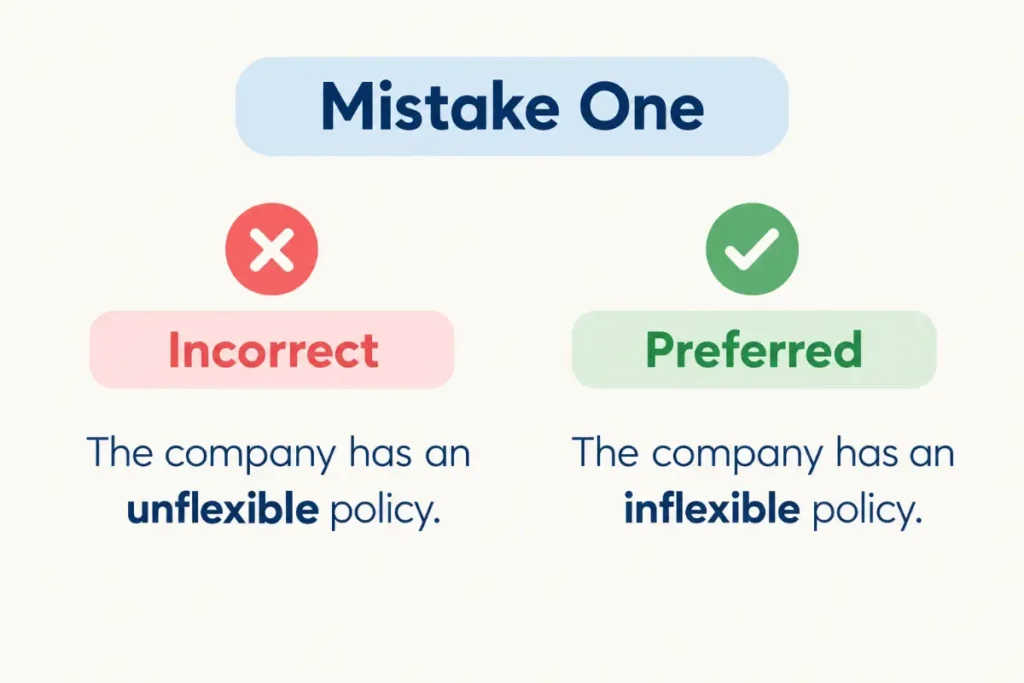
1. Writing Unflexible Instead of Inflexible
- Incorrect or nonstandard: The manager is unflexible.
- Correct: The manager is inflexible.
The mistake comes from applying the familiar un- prefix to an adjective that already has an established negative form.
Tip: Remember the complete word rather than trying to create its opposite from flexible.
2. Writing Inflexable Instead of Inflexible
- Incorrect: The rules are inflexable.
- Correct: The rules are inflexible.
This error happens because the endings -able and -ible sound similar in many English words. However, the established spelling uses -ible.
Tip: Associate the spelling with flexible and flexibility.
3. Confusing Inflexible With Inflexibility
- Incorrect: His inflexible made negotiations difficult.
- Correct: His inflexibility made negotiations difficult.
The two words belong to the same word family but have different grammatical functions.
Inflexible is an adjective, while inflexibility is a noun.
Tip: Use the adjective to describe something and the noun to name the quality.
4. Using Inflexibly When an Adjective Is Needed
- Incorrect: She has an inflexibly attitude.
- Correct: She has an inflexible attitude.
Inflexibly is an adverb. It describes how an action is performed rather than directly modifying a noun.
Tip: Use inflexible before nouns and inflexibly when describing verbs.
5. Confusing Inflexible With Unwilling
These words are related in some contexts, but they are not always interchangeable.
- Original: The manager is inflexible about the policy.
- Alternative: The manager is unwilling to change the policy.
Inflexible describes a general lack of adaptability. Unwilling describes a person’s lack of desire or readiness to do something.
Tip: Choose the word that communicates the exact reason for the behavior.
Pronunciation Guide
Correct spelling becomes easier to remember when you know how the word sounds.
IPA Pronunciation
The standard pronunciation is:
/ɪnˈflɛksəbəl/
International Phonetic Alphabet · General American
Simple pronunciation: in-FLEK-suh-buhl
Syllable breakdown: in · flex · i · ble
Stress pattern: Second syllable — FLEX
Cambridge gives the same central pronunciation pattern for American and British English, although individual speakers may vary slightly in their vowel sounds. English meaning – Cambridge Dictionary+1
How to Pronounce It Correctly
Break the word into four easy parts:
- In: Start with a short vowel sound, as in the word in.
- Flex: Pronounce this part like the beginning of flexible.
- I: Use a short, reduced vowel sound.
- Ble: Finish with a soft ending that sounds like buhl.
Say the complete word slowly: in-FLEX-i-ble.
Then repeat it at a normal speaking speed.
Common Pronunciation Mistakes
Some speakers place too much stress on the first syllable. Others pronounce every vowel as a full, separate sound, making the word unnecessarily long.
The most useful approach is to emphasize FLEX and reduce the unstressed syllables.
Do not confuse pronunciation with spelling. Even if the initial sound makes another negative prefix seem possible, the accepted written form remains inflexible.
Need another quick comparison? Read Shinning or Shining Which Is Correct in 2026?.
Etymology and Word Origin
The history of the word helps explain why its spelling is different from what some people expect.
The adjective comes from the Latin word inflexibilis, meaning something that cannot be bent. It is formed from two meaningful elements:
- In-: A negative prefix meaning not or the opposite of.
- Flexibilis: An expression associated with being bendable, pliant, or yielding.
The second element is connected to the Latin verb flectere, meaning to bend.
The word entered English through the influence of French and Latin. Historical references place its development in late Middle English, around the late 14th century. Oxford Learner’s Dictionaries+2
How the Meaning Developed
The original physical meaning focused on something that could not be bent easily.
Over time, the meaning expanded to describe people who would not change their minds or abandon their decisions. It also developed a practical sense involving fixed rules, arrangements, and conditions.
Today, the word is commonly used in three connected ways:
- Physical rigidity: A material that cannot bend easily.
- Mental rigidity: A person who refuses to reconsider an opinion.
- Practical rigidity: A rule, plan, or system that cannot be adjusted.
The development is logical. A person who refuses to change can be described metaphorically as someone who does not bend.
This connection between physical and figurative meaning is also found in related words such as rigid, stiff, and unyielding.
Regional Usage
The spelling does not change between major English varieties. American, British, Australian, and Canadian English all use inflexible as the established form.
There is no recognized regional rule that makes the alternative preferable in one country.
American English
In American English, inflexible is the normal spelling. It is commonly used in workplace communication, education, business writing, and everyday speech.
Examples:
- The company introduced an inflexible vacation policy.
- His inflexible position made the discussion more difficult.
American dictionaries recognize both physical and figurative meanings. The word can describe a stiff material or a person who refuses to consider other opinions. Oxford Learner’s Dictionaries+1
British English
British English uses the same spelling and meaning.
Examples:
- The school has an inflexible attendance policy.
- Her inflexible approach to the problem frustrated the team.
There is no meaningful spelling difference between British and American usage. Both use the established adjective.
Australian English
Australian English also follows the same spelling convention. The word is suitable for formal documents, workplace communication, educational writing, and ordinary conversation.
For example:
- The new working arrangements are too inflexible.
- The coach was inflexible about the training schedule.
Canadian English
Canadian English follows the same standard spelling.
Examples:
- The regulations are inflexible and need further review.
- An inflexible timetable can make family responsibilities harder to manage.
Regional takeaway: You do not need to change the spelling when writing for readers in the United States, United Kingdom, Australia, or Canada.
Grammar Rules and Part of Speech
Understanding how the word functions in a sentence will help you use it naturally.
Part of Speech: Adjective
Inflexible is an adjective. Its primary function is to describe a noun or provide information about the subject of a sentence.
Examples:
- The inflexible manager rejected the proposal.
- The schedule is inflexible.
- We need to replace the inflexible material.
The adjective does not change its spelling according to whether the noun is singular or plural.
For example:
- An inflexible rule.
- Several inflexible rules.
Position Before a Noun
The word can appear directly before a noun to describe its quality.
Common combinations include:
- Inflexible rules.
- Inflexible policies.
- Inflexible schedules.
- Inflexible deadlines.
- Inflexible attitudes.
- Inflexible materials.
- Inflexible systems.
- Inflexible requirements.
These combinations are useful in professional and everyday English because they describe situations where adjustment is difficult or impossible.
Position After a Linking Verb
The adjective can also appear after linking verbs.
Common linking verbs include:
- Be.
- Seem.
- Become.
- Remain.
- Appear.
Examples:
- The deadline is inflexible.
- The company seems inflexible.
- Her position became inflexible.
- The material remains inflexible at room temperature.
In these examples, the adjective describes the subject rather than an action.
Using Adverbs With the Word
You can modify the adjective with adverbs to show the degree of rigidity.
Examples include:
- Very inflexible.
- Extremely inflexible.
- Fairly inflexible.
- Increasingly inflexible.
- Completely inflexible.
- Somewhat inflexible.
Consider these sentences:
- The rules are extremely inflexible.
- Our manager is fairly inflexible about deadlines.
- The old system has become increasingly inflexible.
The adverb adds detail without changing the adjective’s grammatical role.
Comparative and Superlative Forms
The adjective can form comparisons using more and most.
| Form | Example |
|---|---|
| Base form | The system is inflexible. |
| Comparative | This system is more inflexible than the previous one. |
| Superlative | This is the most inflexible policy we have encountered. |
Less and least can also be used to express a lower degree of rigidity.
Examples:
- This approach is less inflexible than the old method.
- That is the least inflexible option available.
In everyday writing, more flexible is often a simpler and more positive way to express the opposite idea.
Related Noun and Adverb Forms
The word belongs to a small family of related vocabulary.
| Word | Part of Speech | Meaning |
|---|---|---|
| Flexible | Adjective | Able to bend or adapt |
| Inflexible | Adjective | Not easily bent or changed |
| Flexibility | Noun | Ability to bend or adapt |
| Inflexibility | Noun | Lack of flexibility |
| Flexibly | Adverb | In a flexible manner |
| Inflexibly | Adverb | In a rigid or unchanging manner |
Examples:
- Flexibility is important in modern workplaces.
- His inflexibility caused unnecessary conflict.
- The company responded flexibly to customer needs.
- The rules were applied inflexibly.
Common Grammatical Errors
Avoid these common sentence construction problems:
Incorrect: Her inflexible about the meeting time.
Correct: Her position on the meeting time is inflexible.
The adjective needs a suitable grammatical structure.
Incorrect: His inflexibility attitude caused problems.
Correct: His inflexible attitude caused problems.
Use the adjective before the noun, not its noun form.
Incorrect: The company responded inflexible.
Correct: The company responded inflexibly.
Use the adverb to describe the verb responded.
Incorrect: The rules are more inflexibler than before.
Correct: The rules are more inflexible than before.
Do not combine more with an additional comparative ending.
Real-Life Usage Examples
The best way to understand a word is to see how it works in real situations. The following examples demonstrate common uses in different types of communication.
1. Daily Conversation
In everyday speech, the adjective often describes a person’s behavior, personal preferences, or a situation that cannot easily be changed.
Examples:
- My brother is inflexible about what time we should leave for dinner.
- The restaurant has an inflexible booking policy, so we cannot change our reservation.
The first sentence describes someone’s unwillingness to adjust a preference. The second describes a business rule that does not allow changes.
2. Email and Workplace Communication
Professional communication often uses the word to describe working arrangements, deadlines, procedures, and management decisions.
Examples:
- The current work schedule is inflexible, so we would appreciate discussing alternative arrangements.
- Our existing payment policy is inflexible and does not allow extensions beyond the agreed date.
In workplace writing, the word can communicate a problem clearly. However, if you want to maintain a polite tone, consider explaining why the lack of flexibility creates difficulties.
3. Academic Writing
Academic writing uses the word when discussing theories, research methods, systems, and approaches.
Examples:
- An inflexible research framework may prevent scholars from exploring unexpected findings.
- The study examines how inflexible institutional structures affect educational outcomes.
In these examples, the adjective describes limitations rather than simply criticizing a person.
4. News and Journalism
Journalists may use the word when reporting on public policies, government decisions, negotiations, or institutional behavior.
Examples:
- Critics described the government’s position as inflexible following the latest negotiations.
- The proposed regulations could create an inflexible system for small businesses.
The word is useful in reporting because it summarizes resistance to change in a concise way.
5. Literature and Storytelling
In storytelling, the adjective can help describe a character’s personality or create tension between characters.
Examples:
- His inflexible nature made it difficult for him to accept advice from his closest friends.
- The old king remained inflexible, even as his kingdom faced a serious crisis.
Writers can use it to suggest stubbornness, emotional rigidity, or an unwillingness to compromise.
The word can also describe physical objects in descriptive passages, such as an inflexible metal gate or a rigid wooden structure.
Related and Confused Terms
Several English words share a similar meaning with the established adjective. However, they are not always interchangeable.
Understanding their differences helps you select more precise vocabulary.
1. Flexible
Flexible is the direct opposite.
It describes something that can bend, change, or adapt easily.
Example: Our manager is flexible about working hours.
Use it when you want to communicate openness to adjustment.
2. Rigid
Rigid describes something that is stiff, fixed, or resistant to change.
Example: The organization follows a rigid set of procedures.
It is particularly useful when describing strict systems, structures, and rules.
3. Stiff
Stiff usually describes something that is physically difficult to bend or move.
It can also describe someone’s behavior.
Example: The plastic covering is too stiff to fold.
Compared with the preferred adjective, stiff is often more directly physical.
4. Unyielding
Unyielding describes someone or something that refuses to give way, change, or compromise.
Example: The negotiator maintained an unyielding position.
It often suggests strong resistance rather than simply an inability to adapt.
5. Stubborn
Stubborn commonly describes a person who refuses to change an opinion or behavior.
Example: He is too stubborn to admit that his decision was wrong.
It is generally more personal and conversational than inflexible.
6. Uncompromising
Uncompromising describes a person or position that does not accept concessions.
Example: The director took an uncompromising position during negotiations.
It can suggest determination, which may be positive or negative depending on the situation.
7. Inflexibility
Inflexibility is the noun form of the adjective.
It refers to the condition or quality of being unable or unwilling to change.
Example: The inflexibility of the policy created problems for employees.
Use this form when discussing the quality itself rather than describing a person or object.
8. Inflexibly
Inflexibly is the adverb form.
It explains how someone acts or how something is applied.
Example: The rules were applied inflexibly, without considering individual circumstances.
It modifies a verb and should not be used directly to describe a noun.
Choosing the Best Alternative
The right synonym depends on the message you want to communicate.
| Intended Meaning | Best Word |
|---|---|
| Not easily changed | Inflexible |
| Physically hard to bend | Rigid or stiff |
| Refusing to compromise | Unyielding |
| Refusing to admit a mistake | Stubborn |
| Firmly refusing concessions | Uncompromising |
| Able to adjust easily | Flexible |
| Lack of adaptability as a quality | Inflexibility |
Choosing the right word improves clarity and makes your writing sound more natural.
Expert Editor Insight
An experienced English editor would normally retain inflexible without hesitation in a sentence where the intended meaning is a lack of flexibility. The confusion arises because un- is a productive English prefix, so readers naturally assume it can be attached to any adjective. However, established vocabulary does not always follow a predictable word-building pattern. Professional editors check whether a proposed spelling is recognized and conventional, not merely whether its construction seems logical. Grammar and spelling tools may flag the rare alternative, although their dictionaries and settings can vary. A useful editing habit is to check the complete word in a reputable dictionary rather than relying entirely on automatic suggestions.
Key Takeaways
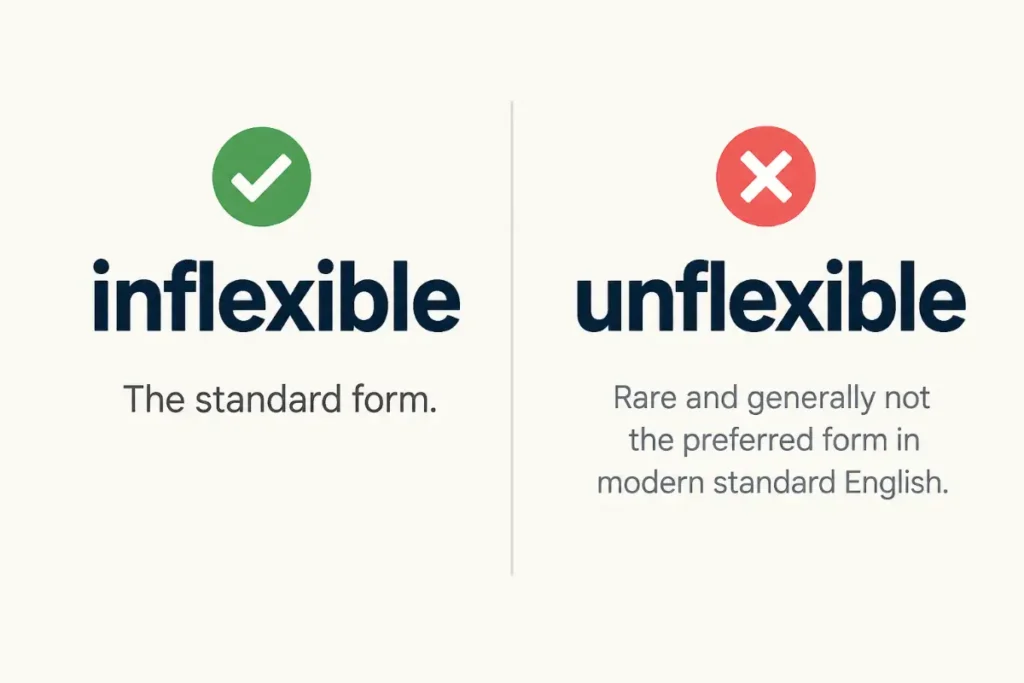
- Inflexible is the standard form.
- Unflexible is rare and generally not the preferred form in modern standard English.
- Inflexible means unable or unwilling to bend change or adapt.
- Inflexible is an adjective.
- Flexible and inflexible form the standard opposite pair.
- The word can describe physical objects rules schedules policies attitudes and people.
- The spelling comes from an established Latin based word formation rather than a simple modern addition of un.
- American British Canadian and Australian English all use inflexible as the standard form.
- If you are writing professionally, choose inflexible.
- When proofreading, replace unflexible with inflexible unless you have a specific reason to preserve unusual or historical wording.
For another common grammar confusion, see Too Many or To Many Which Is Correct?.
Conclusion
The difference between inflexible vs unflexible comes down to established English usage. Inflexible is the standard spelling and the natural choice for describing something that cannot bend, change, or adapt easily. Although unflexible is an understandable formation and appears in some word references, it is uncommon and generally unsuitable for standard writing. Both American and British English follow the same spelling convention, so there is no regional distinction to remember.
The easiest way to avoid mistakes is to associate flexible with inflexible as a familiar word pair. Whenever you write about rigid rules, fixed schedules, or unwilling attitudes, choose inflexible for clear, professional English.
FAQs
1. Is Unflexible a Real Word?
Unflexible is a recognizable English formation created by adding un- to flexible. Some dictionaries and historical word collections record it with the meaning not flexible. However, it is rare and is not the preferred form in standard modern English. For everyday communication, academic assignments, and professional documents, use inflexible instead.
2. What Does Inflexible Mean?
Inflexible means unable or unwilling to bend, change, or adapt easily. It can describe physical objects, such as stiff materials, or abstract things, such as strict rules and fixed schedules. When describing a person, it often suggests an unwillingness to reconsider opinions, decisions, or personal preferences.
3. Which Is Correct: Inflexible or Unflexible?
Inflexible is the correct and established choice for standard contemporary English. The alternative is understandable but uncommon. The distinction comes from English word history: the established adjective developed from Latin inflexibilis. Therefore, adding another negative prefix is unnecessary when the conventional word already communicates the intended meaning.
4. How Do You Pronounce Inflexible?
The standard American pronunciation is /ɪnˈflɛksəbəl/. You can remember it as in-FLEK-suh-buhl. The word has four syllables, with the strongest stress on the second syllable. Pronouncing it slowly at first can help you remember the spelling and avoid placing too much emphasis on the opening sound.
5. Can Inflexible Start a Sentence?
Yes. An adjective can begin a sentence when it introduces a noun phrase or appears in an appropriate descriptive construction. For example: “Inflexible workplace policies can make it difficult for employees to manage unexpected responsibilities.” The word follows ordinary adjective grammar and does not need a special sentence position.
6. What Is a Synonym for Inflexible?
Common synonyms include rigid, stiff, stubborn, unyielding, and uncompromising. The best choice depends on the context. Rigid often describes fixed systems or physical objects, while stubborn usually describes a person’s behavior. Unyielding suggests resistance to pressure, and uncompromising emphasizes a refusal to make concessions.
7. Why Do People Confuse These Two Spellings?
People confuse the forms because English frequently uses un- to create negative adjectives, as in unhappy, unfair, and unclear. Applying that familiar pattern to flexible seems logical. However, English has several negative prefixes, and established words do not always follow a single predictable formation rule. Historical usage explains the preferred spelling.
8. Is Inflexible Appropriate in Formal Writing?
Yes. Inflexible is appropriate in academic papers, business reports, professional emails, legal discussions, and formal documents. It communicates that something is rigid, fixed, or resistant to change. However, consider the tone when describing a person, since the word can sound critical. More neutral alternatives may be appropriate in sensitive professional communication.