
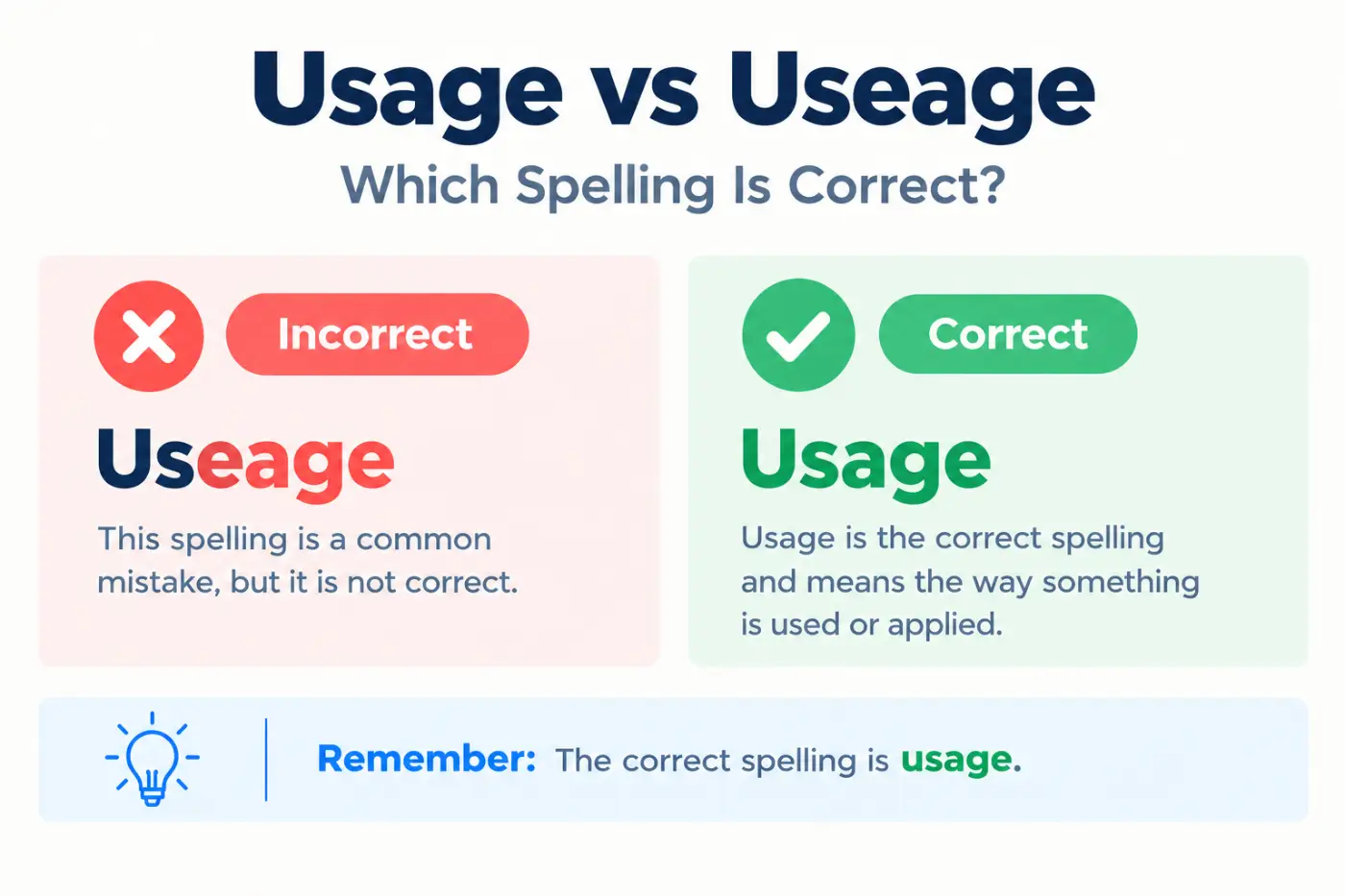
If you have ever paused while typing this word, you are not alone. The choice between usage vs useage is a spelling question, and the correct form in standard English is usage. The spelling “useage” is a common error, not an accepted alternative for ordinary writing.
The confusion makes sense. The word is related to “use,” and adding the ending can make it tempting to keep the letter “e.” However, English spelling does not always preserve every letter from a root word when a suffix is added. In this case, the correct form drops the extra “e.”
You will see “usage” in dictionaries, grammar guides, style manuals, and professional writing. It describes the way a word, phrase, object, or system is used. This article explains its meaning, spelling rule, pronunciation, history, and grammatical role. You will also find natural examples, common errors, regional notes, and practical editing advice to help you spell it correctly every time.
Many readers also check Retract vs Redact Meaning and Usage.
Quick Answer
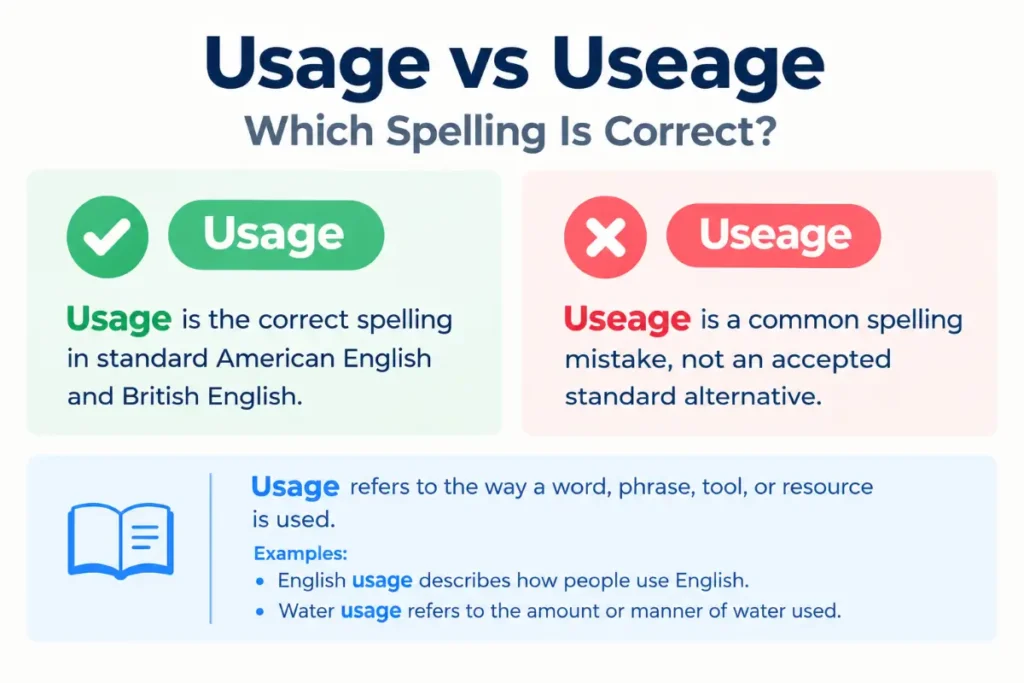
Usage is the correct spelling in standard English. It is a noun meaning the way something is used or the customary way a word or expression is used. Useage is a common misspelling caused by keeping the final “e” from “use” before adding the noun ending.
Comparison Table
| Feature | Usage | Useage |
|---|---|---|
| Standard spelling | Yes | No |
| Meaning | The way something is used; customary practice | No standard meaning as an ordinary English word |
| Part of speech | Noun | Usually an accidental misspelling |
| Word formation | Use + age, with the final e dropped | Incorrectly keeps the final e |
| Pronunciation | /ˈjuːsɪdʒ/ | Usually intended to sound like usage |
| Formality | Standard in formal and informal writing | Not suitable for standard writing |
| Common contexts | Grammar, language, technology, habits, rules | Typing errors and spelling mistakes |
| Example | The usage of this phrase has changed. | The usage of this phrase has changed. |
Meaning and Definition
What Does Usage Mean?
“Usage” is a noun that describes the way something is used. It can refer to how people use language, how often an object or service is used, or the accepted way to do something. The exact meaning depends on the subject and the sentence.
For example, language usage describes how speakers and writers use words, phrases, grammar, and expressions. In technology, data usage refers to the amount of data consumed by a device or service. In everyday life, household water usage describes how much water people use at home.
The word has two especially common meanings:
- The act or manner of using something. This meaning focuses on how a person uses an object, service, resource, or system.
- A customary or accepted way of doing something. This meaning often applies to language, grammar, social habits, and established practices.
Consider these examples:
- The new app makes phone usage easier to track.
- The teacher explained the correct usage of the verb.
- Water usage increased during the summer.
- The phrase is common in everyday American English.
In each sentence, the noun points to a way of using something or a pattern of use.
What Does Useage Mean?
“Useage” is generally a misspelling of “usage.” It is not the standard spelling of the noun, and you should not use it in ordinary emails, essays, reports, articles, or professional documents.
The mistake usually happens because writers see the base word “use” and assume the noun should keep its final “e” when the ending is added. That seems reasonable at first, especially because many English words preserve letters from their base forms. However, the established spelling of this noun is “usage,” without the extra letter.
A spelling checker may flag the incorrect form, but automated tools do not catch every mistake. If you are proofreading an important document, it is worth checking the word yourself.
Is Useage Ever a Real Word?
In ordinary modern English, “useage” is not an accepted alternative spelling of “usage.” You may find it in old documents, informal online posts, usernames, business names, or other special contexts. Those appearances do not make it the standard spelling.
A name or brand can use unusual spelling intentionally. For example, a company could choose “Useage” as a product name. In that case, it functions as a proper name, not as the standard English noun. For normal writing, use “usage.”
What Is the Difference Between Use and Usage?
“Use” can function as both a verb and a noun. As a verb, it means to do something with an object, tool, service, or resource. As a noun, it can mean the act or purpose of using something.
“Usage” is a noun that often refers to the manner, pattern, or customary practice of using something. It is especially common when discussing language and established habits.
Compare these sentences:
- I use this dictionary every day.
- The usage of this word has changed over time.
- The library has many uses for its meeting room.
- The library tracks room usage throughout the week.
The verb “use” describes an action. The noun “usage” often describes a pattern or manner of use.
Key Differences Explained
1. Spelling
The main difference is the extra letter “e.” The standard form is “usage,” not “useage.” The correct spelling has six letters: u, s, a, g, e, and the final letter is not an extra “e” after the “s.”
The incorrect version has seven letters because it keeps the final “e” from “use” before adding the ending. Although the mistake follows a pattern that may look logical, established English spelling uses the shorter form.
2. Meaning
“Usage” has a clear meaning in modern English. It describes how something is used or the customary way something is done. The misspelled form does not have a separate standard meaning.
If a writer uses the incorrect form, readers will usually understand the intended word from the sentence. Still, understanding the meaning does not make the spelling correct.
3. Grammar
The correct word is a noun. It can act as the subject or object of a sentence, and it often appears after adjectives or in phrases introduced by prepositions.
Examples include:
- Proper usage matters in formal writing.
- The company monitors energy usage.
- We discussed the usage of the new software.
- Her usage of technical terms was clear.
The incorrect spelling does not have a separate grammatical role. It is simply an error in a sentence where the writer intended the noun.
4. Pronunciation
The standard pronunciation of “usage” is /ˈjuːsɪdʒ/. It has two syllables: “yoo” and “sij.” The first syllable carries the main stress.
The incorrect spelling is usually intended to represent the same spoken word. That is one reason the mistake can survive proofreading: the two forms do not normally sound different when a writer reads the sentence aloud.
5. Formality
“Usage” is suitable for casual conversation, academic writing, business documents, journalism, and technical explanations. It is a standard noun, not an unusually formal or specialized term.
The misspelled form is not appropriate in edited writing. You should correct it even in informal messages if you want your writing to look polished and clear.
6. Context
The correct noun appears in many fields. Language teachers discuss grammar and word usage. Technology companies track data usage. Environmental reports examine energy and water usage. Researchers may study the usage patterns of a product or service.
The spelling remains the same in all these contexts. There is no special version for grammar, technology, business, or everyday speech.
7. Standard and Nonstandard Usage
Standard English dictionaries recognize “usage.” The extra letter in “useage” does not form a recognized alternative spelling for the ordinary noun.
A writer may intentionally use the unusual form in a name, title, or creative project. That is a separate choice and should not be confused with standard spelling. In ordinary sentences, the correct form is always “usage.”
8. Word Formation
The noun is related to the verb “use,” but its spelling does not simply preserve the full base word and attach an ending. The established form is “usage.”
English contains many words whose spelling changes when endings are added. Some retain a final letter, while others drop or alter it. The safest approach is to learn the accepted spelling of the complete word rather than building every form by guessing.
Which Form Is Correct?
The correct spelling is usage. It is the established English noun used to describe the way something is used or the customary way a word or expression is used. The spelling “useage” is not a standard alternative.
The reason for the mistake is easy to understand. The noun is connected to the verb “use,” so writers may assume that the final “e” should remain when the ending is added. However, English word formation does not always work by attaching an ending to an unchanged base word. The accepted spelling has no extra “e” between the “s” and “a.”
You can confirm the standard form by checking a reputable English dictionary. Look for the entry “usage,” which identifies it as a noun and explains its meanings. General dictionaries do not treat “useage” as an equal spelling option.
For clear writing, follow these practical rules:
- Write “usage” when you mean the way something is used.
- Write “word usage” when discussing how people use a word or expression.
- Write “data usage” when referring to the amount of data consumed.
- Write “usage rules” when referring to accepted or recommended practices.
- Correct “useage” whenever it appears as an accidental spelling error.
The distinction is not a matter of personal style. It is a standard spelling choice, so use the established form in both formal and informal writing.
Sentence Examples
The examples below show how the correct noun works in everyday communication, education, business, technology, and formal writing.
Ten Natural Examples
- Everyday conversation: The teacher explained the proper usage of the word during class.
- Text message: I checked my phone usage because my battery keeps running out.
- Workplace communication: Please review the usage guidelines before sharing the software with clients.
- School assignment: Our English lesson focused on the usage of commas in complex sentences.
- Academic writing: The researchers examined changes in language usage among younger speakers.
- Formal writing: The policy explains the acceptable usage of company equipment.
- Social situations: His usage of slang made the conversation feel relaxed and friendly.
- Online communication: The website provides examples of common grammar usage.
- Technology: You can check your monthly data usage in the account settings.
- Environmental discussion: Reducing household water usage can help conserve local resources.
These examples show that the noun can describe a specific action, a repeated habit, or a recognized pattern. The subject changes, but the spelling stays the same.
Five Examples of the Misspelling
The following sentences show how the incorrect form might appear in a draft. Each sentence should be corrected before publication or submission.
1. Incorrect: The useage of this phrase is common in casual speech.
Correct: The usage of this phrase is common in casual speech.
2. Incorrect: Please check your monthly data useage.
Correct: Please check your monthly data usage.
3. Incorrect: The report explains the useage of company resources.
Correct: The report explains the usage of company resources.
4. Incorrect: Students should learn the correct useage of punctuation marks.
Correct: Students should learn the correct usage of punctuation marks.
5. Incorrect: The app tracks daily screen useage.
Correct: The app tracks daily screen usage.
The error does not change the intended meaning in these examples. It does, however, make the writing look less polished and may affect a reader’s confidence in the document.
Common Mistakes and Misspellings
The most common problem is adding an extra letter to the standard noun. Other errors happen when writers confuse the noun with the verb or use a related expression in the wrong grammatical form.
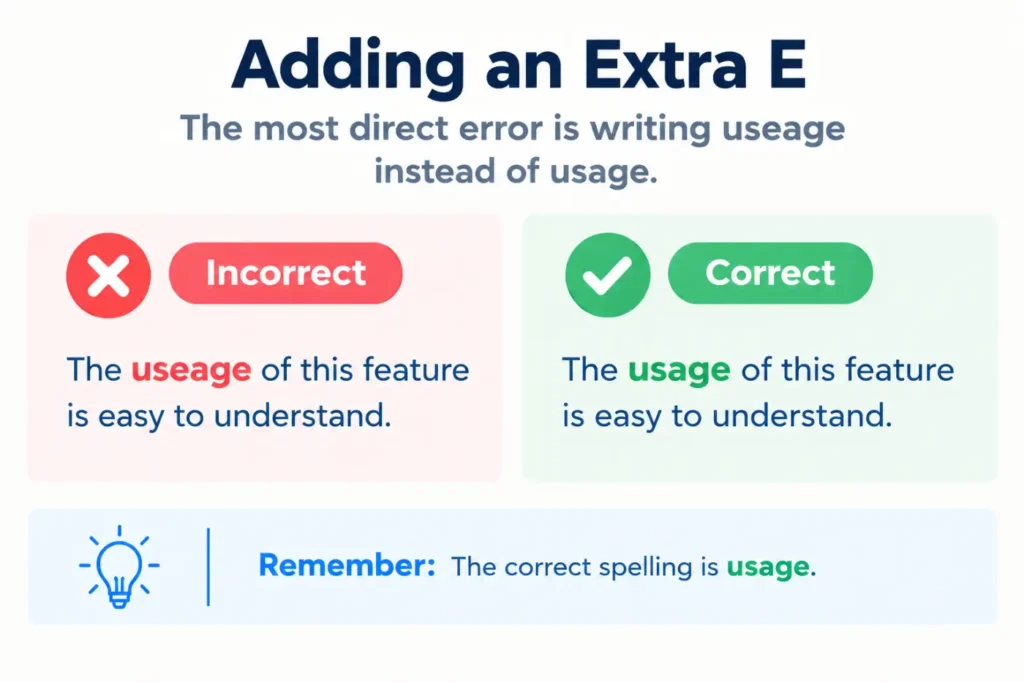
1. Adding an Extra E
Incorrect: Useage.
Correct: Usage.
This is the central spelling mistake. Writers often keep the final “e” from “use” because they assume the noun ending can be added without changing the base. Remember the established spelling as one complete word: u s a g e.
2. Confusing the Noun With the Verb
Incorrect: I usage this tool every morning.
Correct: I use this tool every morning.
“Use” is the verb that describes an action. “Usage” is a noun that describes a manner, pattern, or amount of use. A sentence needs the verb form when it tells the reader what someone does.
3. Using Usage Where Use Is More Natural
Awkward: I need to usage the new printer.
Correct: I need to use the new printer.
The noun does not replace the verb. Although the two forms are related, they perform different jobs in a sentence. Use the verb for an action and the noun for a concept or pattern.
4. Confusing Usage With Usability
Incorrect meaning: The usage of the website is poor because it is hard to navigate.
Clearer: The usability of the website is poor because it is hard to navigate.
“Usage” describes how something is used. “Usability” describes how easy or practical it is to use. A website may have high usage because many people visit it, but poor usability because visitors struggle to find information.
5. Treating Usage and Use as Identical in Every Context
Awkward: The use of the word has changed across generations, so its usage is incorrect.
Clearer: The usage of the word has changed across generations, so its current use differs from its earlier use.
The two nouns overlap, but they do not always carry the same emphasis. “Use” can refer to an act or purpose. “Usage” often points to a customary pattern or established way of using something.
A Quick Proofreading Method
When you finish a document, search for the spelling “useage.” If your editor has a search feature, enter the incorrect form and review every match. Replace it with “usage” when you intend the standard noun.
Then check the grammar of the full sentence. A spelling correction alone will not fix a sentence that needs the verb “use” or the noun “usability.” Look at the role the word plays before making the final edit.
Pronunciation Guide
How Do You Pronounce Usage?
The standard American English pronunciation is /ˈjuːsɪdʒ/. The word has two syllables, and the stress falls on the first one.
A simple guide is:
- First syllable: “yoo.”
- Second syllable: “sij.”
- Full pronunciation: “YOO sij.”
The first part sounds like the word “you.” The second part begins with an /s/ sound and ends with the sound heard at the end of “message.”
Syllable Breakdown and Stress
The word divides into two spoken parts: “u” and “sage.” The first syllable receives the strongest emphasis, while the second is shorter and lighter.
You do not need to pronounce every letter separately. The final “e” is not spoken as an independent sound. It helps form the conventional spelling, but the word is pronounced as two syllables.
Common Pronunciation Confusion
Some speakers may pronounce the final sound too strongly or give the second syllable extra stress. In standard American speech, the main stress belongs at the beginning.
The misspelled version usually represents the same intended pronunciation. That means reading a sentence aloud may not help you spot the spelling error. Visual proofreading and spell checking are more useful for this particular mistake.
Does the Pronunciation Change in British English?
The broad pronunciation is similar in British English, although the exact vowel quality may vary by accent. The word remains two syllables, with the main stress at the beginning. Regional accents do not create a different standard spelling.
Need another quick comparison? Read Up to Date vs Up-to-Date Which Form Is Correct?.
Etymology and Word Origin
The noun developed from the verb “use,” with the ending “age.” Its history is connected to the idea of employing, handling, or making use of something. The modern word carries meanings linked to the act, manner, and customary practice of using.
The verb “use” entered English through Anglo French and Old French forms connected with Latin “uti,” meaning to use or employ. The related noun developed as English adopted and adapted forms associated with the act or manner of using something.
The ending “age” appears in many English nouns, often describing an action, result, condition, or collective idea. It came into English through French, with deeper roots in Latin. Its role varies across words, so it is best not to assume that it always creates exactly the same meaning.
In modern English, the noun has developed two broad areas of meaning:
- The act or manner of using an object, resource, service, or system.
- The customary way a word, phrase, or expression is used within a language community.
The second meaning is especially useful in grammar and language study. Linguists and editors may examine actual usage to understand how people speak and write, rather than relying only on rules about how they are expected to communicate.
The word’s history also helps explain the spelling confusion. Its connection to “use” makes the incorrect extra letter seem plausible. However, historical roots do not give writers permission to change an established modern spelling. The standard form remains “usage.”
Regional Usage
American English
In American English, “usage” is the standard spelling. It appears in school textbooks, dictionaries, workplace policies, technology settings, and everyday writing.
Common American expressions include:
- English usage.
- Grammar and usage.
- Data usage.
- Water usage.
- Phone usage.
- Usage guidelines.
The spelling does not change based on the subject. A writer in California and a writer in New York use the same form.
British English
British English also uses “usage.” There is no standard British spelling that adds an extra “e.” The word appears in the same general contexts, including language study, public services, technology, and reports.
British writers may have different preferences for certain vocabulary or punctuation conventions, but this noun is not one of the words that changes spelling between the two varieties.
Australian English
Australian English follows the same spelling. Writers use the noun to describe language patterns, resource consumption, and the way equipment or services are used. “Useage” remains a spelling error in ordinary edited text.
Canadian English
Canadian English also uses “usage.” The word is standard in educational, professional, and everyday settings. There is no meaningful regional spelling distinction between Canadian and American English for this term.
Does the Spelling Change Across English Speaking Countries?
No. The standard spelling is consistent across major English varieties. You do not need to switch forms for a US audience, a British audience, an Australian audience, or a Canadian audience.
This makes the correction simple. If you are writing in standard English, choose “usage” regardless of the country or publication style.
Grammar Rules and Part of Speech
Usage Is a Noun
The word functions as a noun. It names a pattern, manner, or amount of use rather than describing an action directly.
For example:
- Correct usage improves clarity.
- The system records daily usage.
- Language usage changes over time.
In each sentence, the noun identifies a subject or concept. It does not act as the main action verb.
Use It as a Subject
A noun can act as the subject of a sentence. In this position, the word tells the reader what the sentence is about.
Examples:
- Usage varies between different professional fields.
- Phone usage often increases during long trips.
- Formal usage may differ from casual speech.
The noun can stand alone or appear with a describing word. In “proper usage,” the adjective “proper” gives more information about the type of usage.
Use It as an Object
The noun can also receive the action of a verb or follow a preposition.
Examples:
- The teacher explained the usage of the phrase.
- The company monitors energy usage.
- We talked about the usage of the new platform.
- The report compares water usage across several towns.
These structures are common in both formal and informal writing. The word can be followed by “of” to identify the thing being used or the language feature being discussed.
Singular and Plural Forms
“Usage” is usually an uncountable noun when it refers to a general manner or pattern of use. For example, “English usage changes over time” treats the concept as a whole.
In some contexts, writers use the plural “usages” to refer to separate meanings or distinct ways a word is used. For example, “The dictionary explains several usages of the expression” points to multiple recognized applications.
Do not add a plural ending automatically. Choose the singular form for a general concept and use the plural only when you are discussing distinct types or instances.
Common Grammar Patterns
These patterns are useful in everyday writing:
- Usage of something: The usage of this phrase is common.
- Proper usage: The guide explains proper usage.
- Common usage: The expression appears in common usage.
- Language usage: The class studies language usage.
- Data usage: The plan includes a monthly data limit.
- Usage patterns: The report identifies changes in customer usage.
- Usage rules: The handbook lists the accepted usage rules.
The phrase “usage of” is especially common, but it is not always necessary. You can write “proper usage” or “daily usage” without adding another noun after it if the context is already clear.
Usage in Formal and Informal Writing
The noun works in both styles. In a casual message, you might write, “My phone usage has gone up this month.” In a formal report, you might write, “The analysis examines changes in mobile data usage.”
The difference lies in the subject and sentence style, not in the spelling. You do not need a different form for professional communication.
Punctuation
The word itself does not require special punctuation. Use ordinary sentence punctuation based on the structure of your writing.
For example:
- Correct usage matters.
- The guide explains usage, meaning, and grammar.
- The report examines the usage of water in local homes.
A comma may separate items in a list, but it does not belong inside the word. Avoid inserting spaces or punctuation into the spelling.
Real Life Usage Examples
The noun appears in many fields because people use it to describe habits, language patterns, resources, and technology. The examples below show how it fits naturally into different types of communication.
Daily Conversation
In casual speech, people often use the word when talking about habits or the way something works.
- My phone usage is higher on weekends because I spend more time watching videos.
- The teacher said my usage of that expression sounded natural.
The first example describes a personal habit. The second refers to the way someone uses a phrase. Both sound natural in everyday conversation.
Email and Workplace Communication
In professional messages, the noun can describe company rules, software activity, or the use of shared resources.
- Please read the equipment usage policy before borrowing any devices.
- Our monthly report includes figures for customer account usage.
These sentences are direct and suitable for workplace communication. The first refers to rules about using equipment, while the second describes recorded activity.
Academic Writing
In education and research, the word often refers to language patterns, study habits, or the use of research tools.
- The paper examines the usage of modal verbs in student writing.
- The researchers compared internet usage among students from different age groups.
The first example focuses on grammar. The second describes a research topic involving technology and behavior.
News and Journalism
Journalists may use the noun when reporting on public resources, technology trends, language, or changes in consumer habits.
- The city released a report showing a rise in household water usage.
- The survey found changes in social media usage among adults.
These examples show how the term can communicate a measurable pattern. It is especially useful in reports that compare activity across groups, places, or time periods.
Literature and Storytelling
In storytelling, the word can describe a character’s speech habits or the way a person handles an object or resource.
- The editor noticed the character’s unusual usage of local expressions.
- Years of careful water usage had helped the family manage during dry seasons.
The first sentence describes a language feature that helps create a character’s voice. The second uses the noun to describe a practical habit.
Related and Confused Terms
These eight related words and expressions can help you choose a more precise term. Some are close in meaning, while others describe a different part of the same idea.
1. Use
“Use” can be a verb or a noun. As a verb, it means to employ something for a purpose. As a noun, it can refer to the act or purpose of using something.
Example: “I use this app every day.”
The related noun often emphasizes a pattern or customary way of using something, while “use” can refer to one action or purpose.
2. Usability
“Usability” describes how easy or practical something is to use. It is common in product design, software development, website reviews, and user experience discussions.
Example: “The redesign improved the usability of the website.”
A product can have high usage but poor usability. Many people may use a tool because they need it, even if they find it difficult to operate.
3. Utilization
“Utilization” means the act or degree of using something. It often appears in technical, business, medical, and administrative writing.
Example: “The company reviewed its office space utilization.”
It can sound more formal or technical than the everyday noun. In simple writing, “use” or “usage” may be easier for readers to understand.
4. Application
“Application” can mean the practical use of an idea, method, or tool. It can also refer to a formal request or a software program.
Example: “The practical application of this rule is easy to understand.”
The meaning depends on context. In a discussion of grammar, it may describe how a rule works in real sentences. In technology, it may refer to a program.
5. Practice
“Practice” can mean a repeated habit, a customary way of doing something, or the act of improving a skill.
Example: “It is common practice to review a report before sending it.”
The word overlaps with the idea of customary usage, but it often emphasizes repeated behavior or an accepted procedure.
6. Convention
A “convention” is an accepted way of doing something within a group or community. In language, conventions include shared spelling, punctuation, and writing patterns.
Example: “Standard writing conventions favor clear and consistent spelling.”
A convention may guide usage, but the two terms are not identical. One refers to a shared rule or practice, while the other can describe the way that practice is followed.
7. Usage Pattern
A “usage pattern” is a repeated or recognizable way in which something is used. It is common in research, business analysis, and technology.
Example: “The company studied customer usage patterns before changing its service.”
This expression is more specific than the general noun because it focuses on repeated behavior over time.
8. Customary Usage
“Customary usage” refers to a way of using a word, phrase, object, or system that has become accepted through regular practice.
Example: “The editor followed customary usage in the publication.”
This phrase is useful in language discussions because it highlights what people commonly say or write, rather than what a rule book might recommend in every situation.
Expert Editor Insight
An experienced editor treats “usage” as the standard spelling and corrects the extra “e” without hesitation. The error is easy to make because the noun is related to “use,” and the spelling may look logical to someone adding an ending by instinct. In a professional edit, check both spelling and grammatical role: a sentence may need the verb “use,” the noun “usage,” or the related term “usability.” Spell checkers often catch the misspelling, but they may not identify a wrong word choice that is spelled correctly. Reading the full sentence helps catch both problems.
Key Takeaways
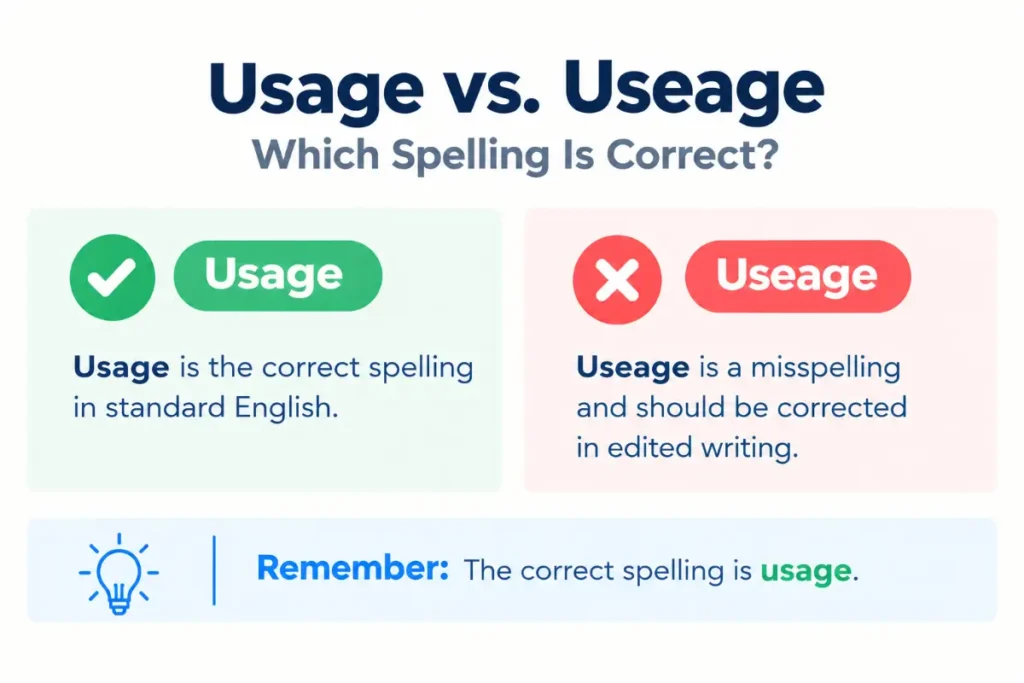
- Usage is the correct spelling in standard English.
- Useage is a misspelling and should be corrected in edited writing.
- Both American and British English use usage.
- Usage is a noun that describes a way of using something, a pattern of activity, or an accepted language practice.
- Use can function as a noun or a verb, while usage is a noun.
- The final e in use doesn’t appear in the standard spelling of usage.
- Choose usage for discussions of language conventions, resource consumption, and patterns of use.
- Prefer a direct verb such as use when it makes a sentence clearer.
- Proofreading and spellcheck tools can help you catch spelling mistakes before publishing.
- Remember the correct spelling and use it consistently in academic, professional, and everyday writing.
Still confused? Compare Hoping or Hopeing Which Spelling Is Correct..
Conclusion
The spelling choice in usage vs useage is simple: “usage” is the standard English form, and “useage” is a misspelling. The correct noun describes the way something is used, a pattern of use, or the customary way a word or expression appears in language. It works in everyday conversation, academic writing, business reports, and technical discussions. Remember that “use” is the verb, while “usage” is the noun.
A helpful editing habit is to search for the extra “e” before submitting a document. That quick check can prevent a common spelling error and keep your writing clear and professional.
FAQs
Is Usage or Useage the Correct Spelling?
“Usage” is the correct spelling in standard English. “Useage” is a common misspelling caused by keeping the final “e” from the word “use.” The correct noun describes the way something is used or the customary way a word or expression is used. Use the shorter spelling in schoolwork, business writing, emails, and published content.
Is Useage a Real English Word?
“Useage” is not a standard alternative spelling of the noun “usage.” It may appear in informal writing, old records, or as an intentional name, but those appearances do not make it correct in ordinary English. If you mean the way something is used, write “usage.” A spelling checker may also flag the extra letter.
What Does Usage Mean?
“Usage” is a noun that describes the way something is used or a customary way of doing something. It can refer to language, technology, resources, or daily habits. For example, “word usage” describes how people use words, while “data usage” describes the amount of data consumed by a device or service.
Why Do People Spell Usage With an Extra E?
People often add the extra “e” because they connect the noun to the verb “use.” They assume the final letter should remain before the noun ending. That guess seems reasonable, but the accepted spelling drops the extra letter. Learning the complete word as “usage” is more reliable than trying to build it from the base form.
How Do You Pronounce Usage?
In American English, the word is pronounced /ˈjuːsɪdʒ/. It has two syllables, with stress on the first: “YOO sij.” The opening sounds like “you,” and the ending sounds similar to the final part of “message.” The incorrect spelling is usually pronounced the same way, so pronunciation alone will not reveal the spelling error.
Is Usage a Noun or a Verb?
“Usage” is a noun, not a verb. It names a manner, pattern, or amount of use. The verb is “use,” as in “I use this computer every day.” You can say “computer usage has increased,” but you cannot replace the verb in that sentence with the noun. The two forms have related meanings but different grammatical roles.
Is Usage the Same as Use?
The words are related, but they are not identical in every sentence. “Use” can describe an action, purpose, or instance of employing something. “Usage” often describes a pattern, manner, or customary way of using it. For example, “I use the app” describes an action, while “app usage is increasing” describes a broader pattern.
Is Usage Appropriate in Formal Writing?
Yes. “Usage” is a standard noun and is suitable for academic papers, professional reports, business emails, journalism, and formal documents. It is also common in everyday conversation. The key is to use it in the right grammatical position and spell it correctly. Avoid the extra “e,” and choose “use” instead when your sentence needs a verb.