
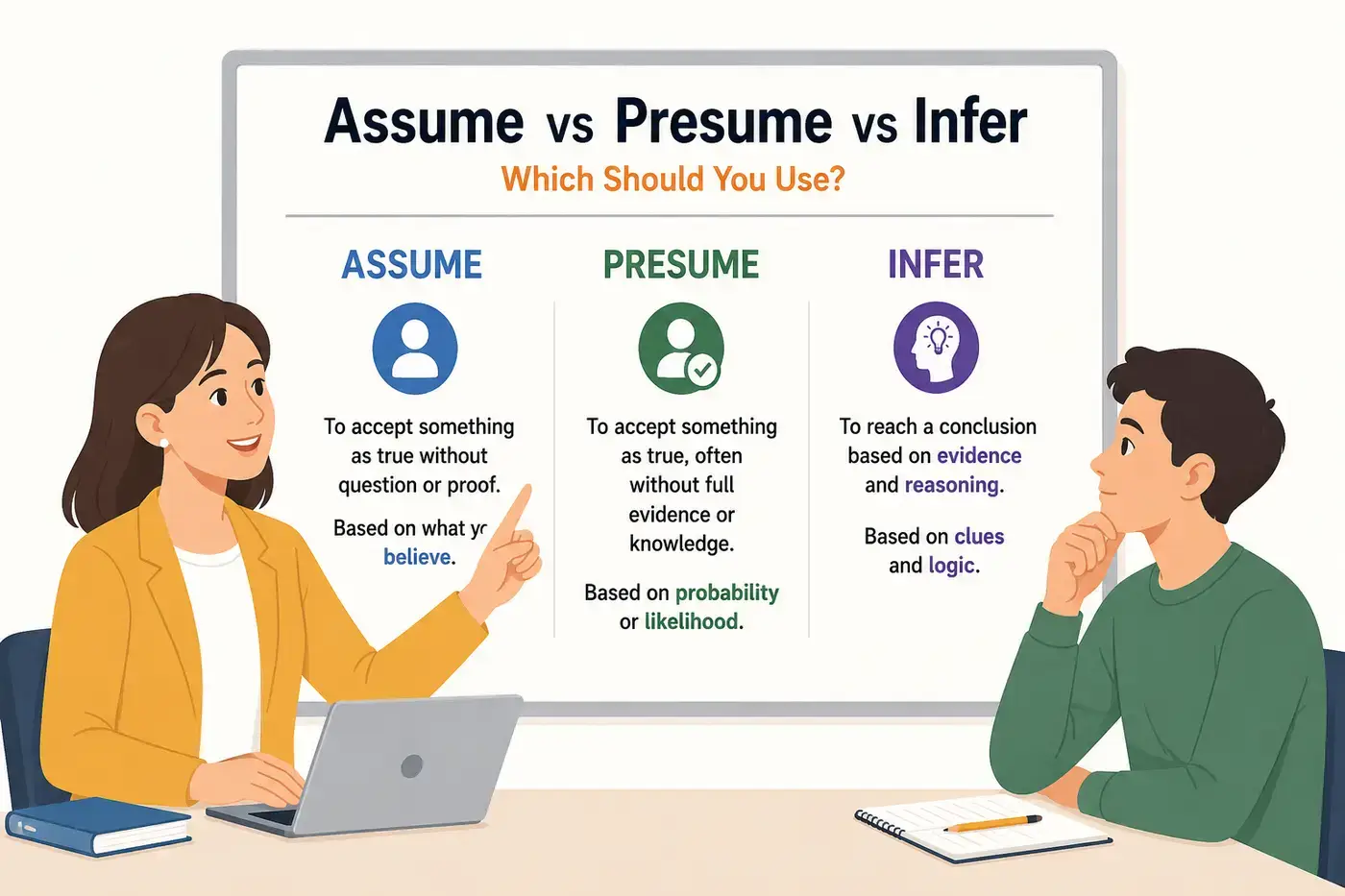
People often use assume vs presume vs infer as if they mean the same thing. However, these verbs describe different ways of thinking and reaching conclusions. To assume is to accept something as true without having enough proof. To presume is to accept something as likely based on probability, experience, or available reasons and To infer is to reach a conclusion from evidence or clues.
The difference becomes clear when you look at how people use information. You might assume a friend is busy because they have not replied to your message. You might presume they are at work because they usually work at that time. If you notice their office lights are on and their car is outside, you might infer that they are probably inside.
These distinctions matter in everyday conversations, research, business reports, and academic writing. Using the wrong verb can make your statement sound careless or change the meaning of your argument. This guide explains each word, compares its grammar and pronunciation, and provides practical examples to help you choose the right one.
Learn the difference in Gases or Gasses Which Spelling Is Correct.
Quick Answer
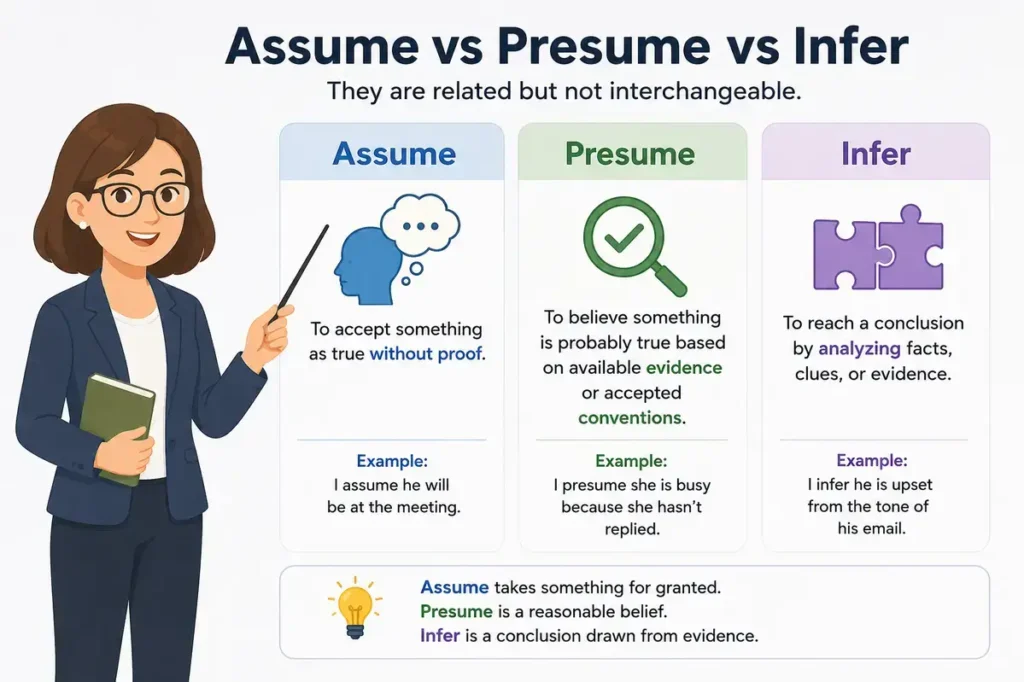
To assume means to accept something as true without proof. To presume means to believe something is likely based on reasonable grounds or prior knowledge and To infer means to reach a conclusion from evidence, facts, or clues. The main distinction is that assumptions lack sufficient support, presumptions have some basis, and inferences follow from available information.
Comparison Table
| Feature | Assume | Presume | Infer |
|---|---|---|---|
| Main meaning | Accept something as true without proof | Believe something is likely based on grounds or probability | Reach a conclusion from evidence |
| Part of speech | Verb | Verb | Verb |
| Pronunciation | /əˈsuːm/ | /prɪˈzuːm/ | /ɪnˈfɜːr/ |
| Main focus | Belief without confirmation | Reasonable expectation | Evidence based conclusion |
| Typical confidence | Can be low or high | Often suggests some basis for belief | Depends on the strength of the evidence |
| Common phrases | Assume responsibility, assume that | Presume innocence, presume that | Infer from evidence, infer that |
| Everyday use | Very common | More formal in some contexts | Common in reasoning and analysis |
| Academic use | Identifying untested beliefs | Describing a justified expectation | Drawing conclusions from findings |
| Example | I assumed the store was closed. | I presumed the store would be closed on the holiday. | I inferred that the store was closed from the dark windows. |
Meaning and Definition
What Does Assume Mean?
Assume is a verb that means to accept something as true without checking or having enough evidence to prove it. You may make an assumption because something seems likely, because you have previous experience, or simply because you have not considered another possibility.
For example, you might assume your friend is upset because they have not spoken to you all day. However, you do not know the reason for their silence. They could be busy, tired, distracted, or dealing with a personal matter.
The word often appears when a person treats an idea as true before confirming it. This does not always mean the belief is unreasonable. Sometimes assumptions are practical starting points, but they can also lead to mistakes.
Common expressions include:
- Assume that something is true.
- Assume responsibility.
- Assume control.
- Assume a role.
- Make an assumption.
- Take something for granted.
The verb also has meanings beyond forming a belief. A person can assume responsibility for a project, assume a leadership role, or assume control of a business. In these expressions, it means taking on a duty, position, or form of control.
What Does Presume Mean?
Presume is a verb that means to believe something is likely or accept it as true based on reasonable grounds, probability, or what is already known. It often suggests that the belief has some support, even if it has not been fully confirmed.
For example, you might presume that a colleague will attend a meeting because they accepted the invitation. You have a reason for expecting their attendance, but you do not know for certain that they will arrive.
The word can also describe treating something as true until evidence shows otherwise. A well known example is the legal principle that a person is presumed innocent until proven guilty. This means the person must be treated as innocent under the relevant legal standard unless guilt is established through the proper process.
Common expressions include:
- Presume that something is true.
- Presume innocence.
- Presume good faith.
- Presume someone is responsible.
- Presume permission.
- Make a presumption.
Presume can also describe behavior that seems too confident or inappropriate. For example, if someone enters another person’s office without permission, they may be said to presume too much. In this use, the word suggests taking a liberty or acting beyond what is considered acceptable.
What Does Infer Mean?
Infer is a verb that means to reach a conclusion from evidence, facts, observations, or clues. Instead of simply accepting an idea, you use available information to work out what is likely to be true.
For example, imagine you arrive at a house and notice that the lights are on, a car is parked outside, and music is playing. You might infer that someone is home. You do not have direct confirmation, but the clues support your conclusion.
Inference is an important part of reading, science, research, problem solving, and daily communication. Readers infer a character’s feelings from their actions. Scientists infer patterns from observations. A manager may infer that a project is falling behind after reviewing missed deadlines.
Common expressions include:
- Infer that something is true.
- Infer something from evidence.
- Infer meaning from context.
- Infer a conclusion.
- Draw an inference.
- Make an inference.
The word focuses on the reasoning process that connects information to a conclusion. A good inference should be supported by relevant evidence, although it can still turn out to be wrong if the evidence is incomplete or misleading.
What Is the Difference Between an Assumption and an Inference?
An assumption is an idea accepted as true without enough confirmation. An inference is a conclusion reached by examining available evidence. The difference is the role of evidence in the thinking process.
Imagine that your friend does not answer your phone call. You assume they are ignoring you if you accept that explanation without checking. If you know they are in a meeting because you saw their schedule, you may infer that they cannot answer at that moment.
An inference is not automatically correct, but it has a reason behind it. An assumption may also be based on experience or clues, yet the speaker often treats the idea as true without clearly examining the support.
What Is the Difference Between Presumption and Inference?
A presumption is a belief accepted as likely or true based on a starting point, accepted rule, or reasonable expectation. An inference is a conclusion drawn from specific evidence or information.
For example, you may presume that a scheduled class will take place because the school has not announced a cancellation. That expectation is based on the normal schedule. If you see students entering the classroom and hear the teacher speaking, you can infer that the class is taking place.
The difference is not always absolute. In everyday reasoning, people may use both processes together. However, the distinction helps explain the emphasis of each word: presumption concerns what you accept as likely, while inference concerns what you conclude from evidence.
Key Differences Explained
1. The Role of Evidence
The clearest distinction is how each verb relates to evidence.
- Assume: You accept an idea without confirming it. The evidence may be weak, missing, or not considered.
- Presume: You accept an idea as likely because there is some reason, rule, or expectation supporting it.
- Infer: You examine available information and reach a conclusion from it.
Consider a simple example involving a closed office.
You assume the office is closed because nobody is answering the phone. You presume it is closed because the company normally shuts down on public holidays and You infer it is closed after seeing the lights off, the doors locked, and a notice announcing the holiday closure.
These are useful differences, but real life is not always so neat. A presumption can be based on evidence, and an inference can be uncertain. The important point is the kind of thinking each word highlights.
2. Meaning and Purpose
Each verb describes a different mental action.
Assume focuses on accepting an idea. Presume focuses on expecting something to be true based on a reasonable starting point. Infer focuses on working out a conclusion from information.
For example, a teacher might assume a student understands a lesson because the student is quiet. The teacher might presume the student has completed the homework because they usually submit it on time. After reviewing the student’s answers, the teacher might infer that the student understands most of the topic but needs help with one part.
The three words can appear in the same situation, but they do not describe the same process.
3. Confidence and Certainty
None of these verbs guarantees that a belief is correct. An assumption may be right or wrong. A presumption may be reasonable but still unconfirmed. An inference may be strongly supported but remain open to revision.
Presume often suggests more justification than assume, but it does not always mean greater certainty. In legal writing, a presumption can be a formal rule that determines how something must be treated unless the required evidence changes that position.
Infer does not mean guess. It means draw a conclusion from available information. However, the strength of an inference depends on the quality and amount of evidence.
4. Grammar and Sentence Structure
All three words are verbs, and each can introduce a clause beginning with that.
Examples:
- I assume that the meeting starts at nine.
- I presume that the meeting starts at nine.
- I infer that the meeting starts at nine from the calendar.
The sentences are grammatically correct, but the meaning changes. The first describes an unconfirmed belief. The second suggests an expectation based on some reason. The third explains that the conclusion comes from information in the calendar.
With infer, the source of the conclusion is often introduced by from. For example, “She inferred his mood from his expression.” With assume and presume, writers often use that clauses to state the belief.
5. Formality and Tone
Assume is common in everyday conversation and formal writing. It can sound neutral, but it may suggest careless thinking if a person accepts something without checking.
Presume is sometimes more formal. It appears in legal writing, official communication, professional discussions, and polite expressions such as “I presume you have already met.”
Infer is common in academic, scientific, and analytical writing. It is also used in ordinary conversation when someone works out an answer from clues.
Do not choose a word only because it sounds more sophisticated. Choose the word that accurately describes the reasoning.
6. Who Is Doing the Thinking?
A useful way to understand infer is to notice the direction of the reasoning. A person who infers something uses information to reach a conclusion.
For example:
- The writer implies that the plan may fail.
- The reader infers that the writer has doubts.
The writer is the source of the implied message. The reader is the person who works out its meaning. This distinction is especially useful because infer is often confused with imply.
7. Regional Usage
These three verbs have the same basic meanings in American, British, Canadian, and Australian English. There are no major regional spelling differences.
The words may vary in frequency depending on the setting. Assume is common in everyday speech, presume often appears in formal or careful statements, and infer is especially useful in reasoning and academic contexts. These are broad tendencies rather than strict regional rules.
Which Word Is Correct?
All three words are correct. They are not alternative spellings of the same word, and none should be treated as a mistake simply because another one might fit a sentence better.
Use assume when you accept something as true without confirmation. Use presume when you have a reason or accepted basis for expecting something to be true and Use infer when you reach a conclusion from evidence or clues.
Compare these examples:
- Correct: I assumed that the package had arrived.
- Correct: I presumed that the package would arrive today because the delivery service confirmed the date.
- Correct: I inferred that the package had arrived after seeing it beside the front door.
Each sentence is grammatically correct. The difference comes from the speaker’s reason for believing the package has arrived.
A useful editing question is: What exactly happened in the person’s mind? Did they accept an idea without checking, expect something based on a reason, or work out a conclusion from evidence? Your answer will usually point to the right verb.
Sentence Examples
The following examples show how the three words work in realistic situations.
Ten Natural Examples
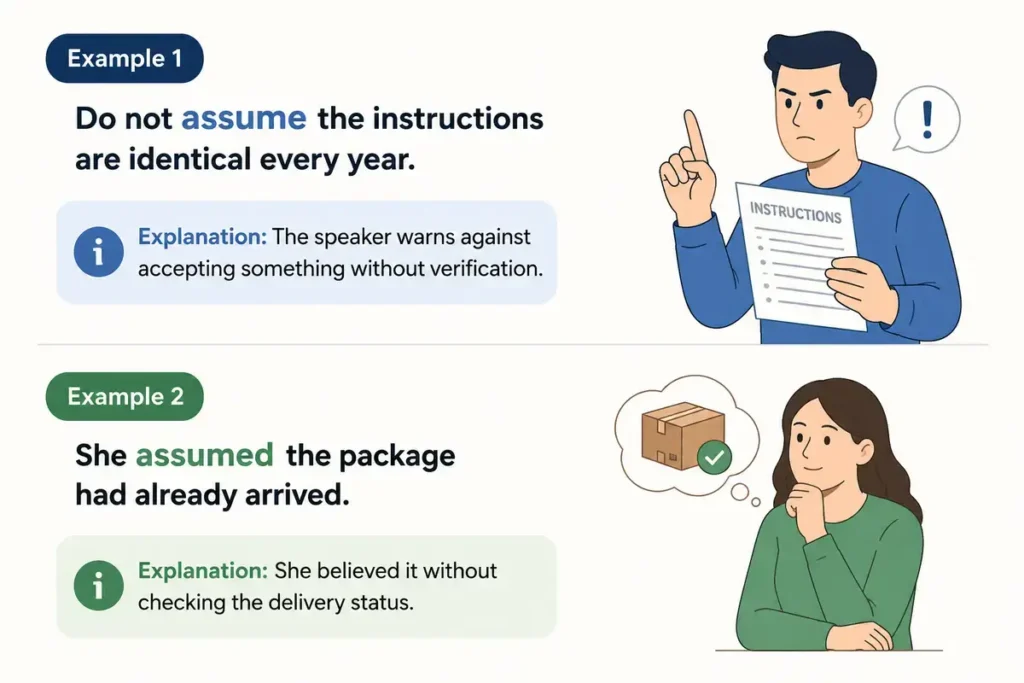
- Everyday conversation: I assumed you were already home because your car was outside.
- Text message: I presume you’re still coming to dinner tonight.
- Workplace communication: We should not assume that the customer has read the updated instructions.
- School: Students can infer the meaning of an unfamiliar word by looking at the surrounding sentence.
- Academic writing: The researcher inferred a possible connection between sleep quality and memory from the study results.
- Formal writing: The company presumes that all applicants have reviewed the job requirements.
- Social situations: She assumed he was upset because he left the party early.
- Online communication: I inferred from your comment that you disagree with the proposal.
- Customer service: We cannot assume that a delayed order has been canceled.
- Family conversation: I presumed Dad would bring the groceries because he usually shops on Fridays.
These examples show that each verb can fit naturally into daily life. The best choice depends on the reason behind the belief or conclusion.
More Examples of Assume
- The manager assumed that everyone had received the email.
- I assumed the restaurant was open because its website listed normal hours.
- Never assume that silence means agreement.
- The new director will assume responsibility for the department next month.
- We should not assume the results will remain the same under different conditions.
Notice that assume has more than one meaning. In the fourth example, it means taking responsibility, not forming a belief. This is a common and standard use of the verb.
More Examples of Presume
- I presume the guests will arrive around seven.
- The court may presume certain facts under the applicable legal rules.
- We should not presume that every customer has the same needs.
- I presume you have already spoken with the project manager.
- The policy presumes that users have access to a valid email address.
These examples show how the verb expresses an expectation, a starting belief, or a rule based on an accepted condition.
More Examples of Infer
- We can infer the author’s opinion from the final paragraph.
- The detective inferred that someone had entered through the back door.
- Researchers inferred a pattern from the collected data.
- From her expression, I inferred that she was surprised.
- You cannot infer a person’s intentions from one short message alone.
In each sentence, the conclusion comes from information or clues. The conclusion may still need confirmation, but it is not presented as a belief without any basis.
Common Mistakes and Usage Problems
The most common errors involve treating the verbs as interchangeable or confusing inference with implication. The following examples show how to avoid these problems.
1. Using Assume When the Conclusion Comes From Evidence
Less precise: I assumed the road was closed because the police had blocked both lanes.
Better: I inferred that the road was closed because the police had blocked both lanes.
The second sentence makes the reasoning clear. The speaker uses visible evidence to reach a conclusion. The first sentence is not always grammatically wrong, but it does not highlight the evidence based reasoning as clearly.
2. Using Presume Without a Reasonable Basis
Less precise: I presumed the package was missing because I had not checked the mailbox.
Better: I assumed the package was missing because I had not checked the mailbox.
If the speaker has no meaningful reason for expecting the package to be missing, assume is usually more suitable. Presume often suggests some grounds for the belief, although the strength of those grounds depends on context.
3. Using Infer to Mean Guess
Incorrect or misleading: I inferred that he was angry, but I had no information about his mood or behavior.
Clearer: I guessed that he was angry.
Inference involves drawing a conclusion from information. If there are no clues or supporting facts, guess is usually the more accurate verb. An inference can be uncertain, but it still needs some basis.
4. Confusing Infer With Imply
Incorrect: The manager inferred that the deadline was unrealistic when she said the project needed more time.
More precise: The manager implied that the deadline was unrealistic when she said the project needed more time.
The speaker or writer implies something by communicating it directly or indirectly. The listener or reader infers the intended meaning. Remember the direction: people imply messages, and other people infer them.
5. Treating Presume as a Guarantee
Incorrect: I presumed the event would happen, so it was guaranteed to take place.
Correct: I presumed the event would happen, but I still needed confirmation.
Presume expresses a belief or expectation, not absolute certainty. A presumption can be reasonable and still turn out to be wrong. Avoid presenting an expectation as a confirmed fact unless you have reliable confirmation.
A Simple Way to Avoid These Mistakes
Before choosing a verb, identify the thinking process.
- Accepting an idea without checking: assume.
- Expecting something based on a reason or accepted rule: presume.
- Reaching a conclusion from evidence: infer.
If the sentence describes a guess without supporting clues, consider using guess instead. If it describes a message that someone communicates indirectly, consider imply. These small checks can make your writing much more accurate.
Pronunciation Guide
How Do You Pronounce Assume?
In American English, assume is pronounced /əˈsuːm/. It has two syllables: uh and SOOM. The stress falls on the second syllable, which contains the long oo sound.
Say it as uh-SOOM. Avoid stressing the first syllable or shortening the long vowel too much. The final sound is /m/, so the word ends with the lips together.
How Do You Pronounce Presume?
Presume is pronounced /prɪˈzuːm/ in American English. It has two syllables: pri and ZOOM. The main stress falls on the second syllable.
Say it as prih-ZOOM. The first vowel is short, and the second syllable has the long oo sound. The middle consonant is a voiced /z/ sound, not an /s/.
How Do You Pronounce Infer?
In American English, infer is pronounced /ɪnˈfɜːr/. It has two syllables: in and FER. The second syllable receives the main stress.
Say it as in-FER. The final sound is an r colored vowel in most American accents. Avoid placing the main stress on the first syllable.
Pronunciation Differences
The words have different opening sounds and stress patterns:
| Word | IPA | Syllables | Stress |
|---|---|---|---|
| Assume | /əˈsuːm/ | uh-SOOM | Second syllable |
| Presume | /prɪˈzuːm/ | prih-ZOOM | Second syllable |
| Infer | /ɪnˈfɜːr/ | in-FER | Second syllable |
All three words have two syllables and stress the second syllable in standard American pronunciation. Listening for the first sound and the final sound will help you tell them apart.
Need another quick comparison? Read Conscience vs Conscious Which Word Is Correct.
Etymology and Word Origin
The Origin of Assume
Assume entered English through French and Latin. It comes from Latin assumere, meaning to take up or take upon oneself. This history connects with modern expressions such as assume responsibility, assume control, and assume a role.
The meaning developed to include accepting something as true or taking an idea as a starting point. Today, the verb can describe both forming a belief and taking on a duty or position.
The Origin of Presume
Presume entered English through French and Latin. Its Latin root, praesumere, combines a prefix meaning before with a verb meaning to take or anticipate. The historical sense is connected with taking something in advance or expecting something before it is fully established.
This background helps explain the modern meaning. To presume is often to accept something as likely before receiving complete confirmation. The word also developed a sense of acting too boldly or taking liberties, as in the expression presume too much.
The Origin of Infer
Infer comes from Latin inferre, meaning to bring in, carry in, or bring about. It entered English through French and Latin learning traditions. Over time, its meaning developed toward drawing a conclusion from facts or evidence.
This sense is central to modern reasoning. When you infer something, you use information to arrive at a conclusion rather than simply accepting an idea without examination.
How the Word Origins Help
The histories offer a useful memory aid. Assume is connected with taking something as a starting point. Presume carries the idea of expecting or taking something in advance. Infer is connected with bringing information together to reach a conclusion.
These roots are helpful, but modern usage matters most. The sentence and its intended meaning should guide your choice.
Regional Usage
American English
All three verbs are standard in American English. Assume is common in everyday conversation and professional writing. Presume appears in formal statements, legal contexts, and situations involving reasonable expectations. Infer is common in academic writing, reading comprehension, research, and discussions about evidence.
American speakers use the same basic distinctions explained throughout this guide. There is no special American spelling rule that changes the meaning of any of the three words.
British English
British English uses the same three verbs with the same general meanings. Speakers may assume something without checking, presume something based on a reasonable expectation, and infer a conclusion from evidence.
The pronunciation of infer and some vowel sounds may differ slightly by accent. However, the basic word choice remains the same. There is no major British spelling difference for these verbs.
Australian English
Australian English follows the same general usage. Assume is common in daily speech, presume often appears in formal or careful statements, and infer is used when discussing conclusions drawn from evidence.
These are differences in context and frequency, not separate regional definitions.
Canadian English
Canadian English also uses all three verbs in the same standard ways. Writers can use assume in everyday and professional communication, presume for an expectation or accepted starting point, and infer for conclusions based on information.
For readers across these English varieties, the central distinction remains consistent.
Grammar Rules and Part of Speech
Assume, presume, and infer are transitive verbs in many of their common uses. This means they can take an object, such as a noun or a clause. Each can also appear in different tenses and sentence structures.
Common Patterns With Assume
The verb assume often appears in these patterns:
- Assume that + clause. Example: I assume that the office is open.
- Assume something. Example: She assumed the answer was correct.
- Assume responsibility for something. Example: He assumed responsibility for the project.
- Assume a role. Example: She assumed a leadership role.
- Assume control of something. Example: The new company assumed control of the site.
When assume introduces a belief, a that clause often follows it. In everyday English, the word that can be left out when the meaning remains clear. For example, “I assume you’re ready” and “I assume that you’re ready” are both correct.
Common Patterns With Presume
Presume often follows similar patterns:
- Presume that + clause. Example: I presume that the meeting is still scheduled.
- Presume something. Example: The law may presume certain conditions.
- Presume innocence. Example: The system presumes innocence until guilt is established under the law.
- Presume on someone’s kindness. Example: Do not presume on your friend’s generosity.
- Presume to do something. Example: I would not presume to tell you how to manage your team.
The expression presume to do something can suggest that a person is taking an action that may be too bold or beyond their position. This is different from the ordinary meaning of expecting something to be true.
Common Patterns With Infer
Infer commonly appears in these structures:
- Infer that + clause. Example: We inferred that the road was closed.
- Infer something from evidence. Example: She inferred his mood from his expression.
- Infer meaning from context. Example: Readers can infer the meaning of the word from the sentence.
- Infer something about someone. Example: You should not infer too much about a person from one conversation.
- Infer that something is likely. Example: The results suggest that we can infer a possible pattern.
The preposition from is especially useful with this verb because it identifies the evidence used to reach the conclusion.
Verb Forms and Tenses
| Form | Assume | Presume | Infer |
|---|---|---|---|
| Present | assume or assumes | presume or presumes | infer or infers |
| Past | assumed | presumed | inferred |
| Present participle | assuming | presuming | inferring |
| Past participle | assumed | presumed | inferred |
Examples:
- I assume the report is ready.
- She presumed the meeting had ended.
- They are inferring a pattern from the results.
Notice the spelling of inferring. The final r is doubled when adding ing. The other two verbs simply add ing after removing the final e.
Common Grammar Errors
One common error is using the wrong verb pattern. For example, “I inferred him to be angry” is possible in some formal constructions, but “I inferred that he was angry” is clearer for most readers.
Another error is confusing the subject of the reasoning. In a sentence such as “The reader inferred the author’s meaning,” the reader makes the inference. The author may imply the meaning, but the reader infers it.
Punctuation
These verbs do not require special punctuation. Use a comma only when the sentence structure calls for one.
Correct: “I assumed that the office was closed.”
Correct: “Based on the available evidence, the researcher inferred that the treatment had an effect.”
Acceptable: “I presume you have received the invitation.”
The punctuation follows normal English sentence rules.
Real Life Usage Examples
Daily Conversation
People use these verbs to explain their beliefs and conclusions in ordinary situations.
- “I assumed you were taking the bus because your car was not outside.”
- “I presume the store closes at six, but we should check.”
The first describes an unconfirmed belief. The second expresses an expectation that has some basis but still needs confirmation.
Email and Workplace Communication
In professional communication, choosing the right verb can prevent confusion and help explain the basis for a decision.
- “I assume the team has reviewed the updated schedule.”
- “From the delivery records, I infer that the shipment was delayed at the warehouse.”
The first statement describes an expectation that may need checking. The second explains a conclusion drawn from specific records. In important business messages, it is often helpful to state the evidence behind an inference.
Academic Writing
These verbs have useful roles in research and education. Writers use assume to identify starting beliefs, presume to describe accepted expectations, and infer to explain conclusions drawn from data.
- “The analysis assumes that all participants received the same instructions.”
- “The researchers inferred a relationship between the two variables from the observed results.”
The first sentence identifies a condition taken as a starting point. The second reports a conclusion based on findings. In academic work, it is important to distinguish an assumption from a result supported by evidence.
News and Journalism
Journalists may use these words when reporting what people believe or what evidence suggests.
- “Officials presumed the road would reopen after the repairs were completed.”
- “Investigators inferred from the security footage that the vehicle had entered the area before midnight.”
The first describes an expectation. The second describes a conclusion drawn from recorded evidence. Careful word choice helps readers understand what is known and what remains uncertain.
Literature and Storytelling
Writers use these verbs to show how characters think, judge situations, and respond to clues.
- “Mara assumed the stranger had left, but she heard footsteps behind the door.”
- “From the muddy footprints, Daniel inferred that someone had entered through the garden.”
The first sentence shows a belief that may be mistaken. The second shows a character using clues to work out what happened. These verbs can reveal a character’s reasoning without explaining every detail.
Related and Confused Terms
These eight related words are useful because they describe different ways people form, communicate, or evaluate beliefs.
1. Imply
Imply means to communicate an idea indirectly rather than state it openly. A speaker or writer implies something, and a listener or reader may infer it. For example, a manager might imply that a report needs improvement without directly saying it.
The easiest memory rule is that the speaker implies and the listener infers.
2. Guess
Guess means to give an answer or form an opinion without enough information to know for certain. It can involve little or no evidence. An inference, by contrast, uses available clues to reach a conclusion.
For example, choosing an answer at random is a guess. Choosing an answer after reviewing several clues is an inference.
3. Speculate
Speculate means to form ideas or theories without having enough evidence to confirm them. It often appears when people discuss possible explanations for an event.
For example, reporters may speculate about the reason for a sudden resignation before officials release an explanation. Speculation may be reasonable, but it should not be presented as established fact.
4. Deduce
Deduce means to reach a conclusion by using facts, rules, or logical reasoning. It is close to infer, but it often suggests a more systematic process.
For example, if all members of a group must register before entering and a person has not registered, you can deduce that the person cannot enter under that rule.
5. Conclude
Conclude means to reach a final judgment or decision after considering information. It is a broad word that can describe the result of reasoning.
For example, after reviewing the sales figures, the manager concluded that the new campaign had not met its goal. The conclusion may be based on inference, analysis, or other forms of reasoning.
6. Presumption
A presumption is a belief or starting point accepted as likely or true until further information changes it. It can be used in everyday reasoning and in formal legal or professional contexts.
For example, a policy may operate on the presumption that users have read the instructions. This does not mean every user has actually read them.
7. Assumption
An assumption is something accepted as true without complete proof or confirmation. Assumptions can help people make plans, but untested assumptions can lead to errors.
For example, a business may make an assumption about customer demand when planning its stock. The company should test that belief against real sales information.
8. Evidence
Evidence is information, facts, or observations that support or challenge a claim. It is not a synonym for any of the three verbs, but it is closely connected to inference and presumption.
For example, a witness statement may provide evidence about an event. A person can use that evidence to infer what happened, while an unsupported assumption may ignore it.
Expert Editor Insight
A careful editor looks at the reasoning behind a statement, not just the verb itself. Native speakers commonly use assume in everyday conversation, while presume can sound more formal or suggest a reasonable expectation. Infer is the best choice when a conclusion comes from clues or evidence. Grammar tools may accept all three words because each is correctly spelled, so a spelling check alone cannot confirm that the meaning is right. An effective editing tip is to underline the reason for the belief in each sentence. If there is no clear evidence, assume may fit. If there is a reasonable expectation, consider presume and If the sentence explains a conclusion drawn from clues, use infer.
Key Takeaways
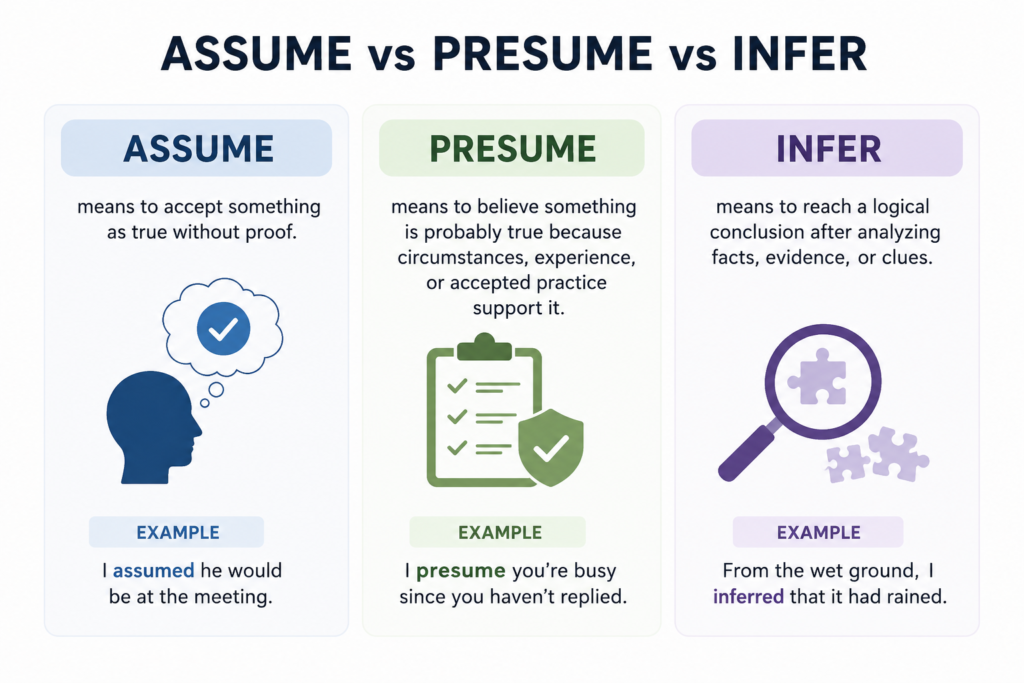
- Assume means to accept something as true without proof.
- Presume means to believe something is probably true because circumstances, experience, or accepted practice support it.
- Infer means to reach a logical conclusion after analyzing facts, evidence, or clues.
- Assume requires little or no evidence.
- Presume requires some supporting evidence or a reasonable expectation.
- Infer requires logical reasoning based on evidence.
- These three verbs are related but are not interchangeable.
- Infer is often confused with imply, but they describe opposite actions.
- Choosing the correct word makes your writing more precise and professional.
- A simple way to remember the difference is guess, reasonable belief, logical conclusion.
Still confused? Compare Than vs Then: Learn the Difference and Use Each Correctly.
Conclusion
The difference between Assume vs Presume vs Infer lies in how a person forms a belief or reaches a conclusion. Assume means accepting something without full confirmation. Presume suggests an expectation based on reasonable grounds or an accepted starting point. Infer means drawing a conclusion from evidence or clues.
All three verbs are correct, but they are not interchangeable. To choose the right one, identify the thinking process behind your sentence. A simple memory tip is to connect assume with accepting, presume with expecting, and infer with evidence. This small distinction will make your speaking and writing clearer and more accurate.
FAQs
What Is the Main Difference Between Assume and Presume?
Assume means accepting something as true without confirmation or enough proof. Presume means believing something is likely based on a reason, expectation, or accepted starting point. For example, you might assume a friend is busy because they have not replied, but presume they are at work because you know their usual schedule.
What Is the Difference Between Infer and Assume?
To infer is to reach a conclusion from evidence or clues. To assume is to accept an idea as true without checking it fully. If you see wet streets and dark clouds, you may infer that it has rained. If you simply believe it rained without looking for clues, you are making an assumption.
Is Presume Stronger Than Assume?
Presume often suggests that a belief has more support than an assumption, but it does not guarantee greater certainty. A presumption may come from a rule, prior experience, or reasonable expectation. An assumption may have a basis too, but the word often emphasizes accepting something without confirming it. Both beliefs can turn out to be wrong.
Can Infer and Presume Be Used Interchangeably?
Not in every sentence. Presume focuses on accepting something as likely based on a starting point or reasonable grounds. Infer focuses on reaching a conclusion from evidence. You may presume a meeting will happen because it is on the calendar, then infer that it has started after hearing people speaking inside the room.
What Is the Difference Between Imply and Infer?
Imply means to communicate an idea indirectly. Infer means to work out that idea from what someone says, writes, or does. A manager may imply that a report needs revision by pointing out several problems. The employee infers that changes are expected. The speaker implies, and the listener infers.
How Do You Use Assume, Presume, and Infer in a Sentence?
Use assume for an unconfirmed belief, presume for an expectation based on a reason, and infer for a conclusion drawn from evidence. For example, I assumed the office was closed, I presumed it was closed because of the holiday, and I inferred it was closed after seeing the locked doors and a closure notice.
Are Assume, Presume, and Infer Formal Words?
All three are standard English verbs and can appear in formal writing. Assume is common in both casual and professional communication. Presume often appears in legal, official, and careful statements. Infer is especially useful in academic writing, research, and analytical discussions because it describes conclusions drawn from information.
What Is Another Word for Infer?
Depending on the context, alternatives include conclude, deduce, reason, determine, and work out. These words are not exact replacements in every sentence. Deduce often suggests a logical process, while conclude can describe the final judgment. Infer is especially suitable when you want to show that a conclusion comes from clues or evidence.