
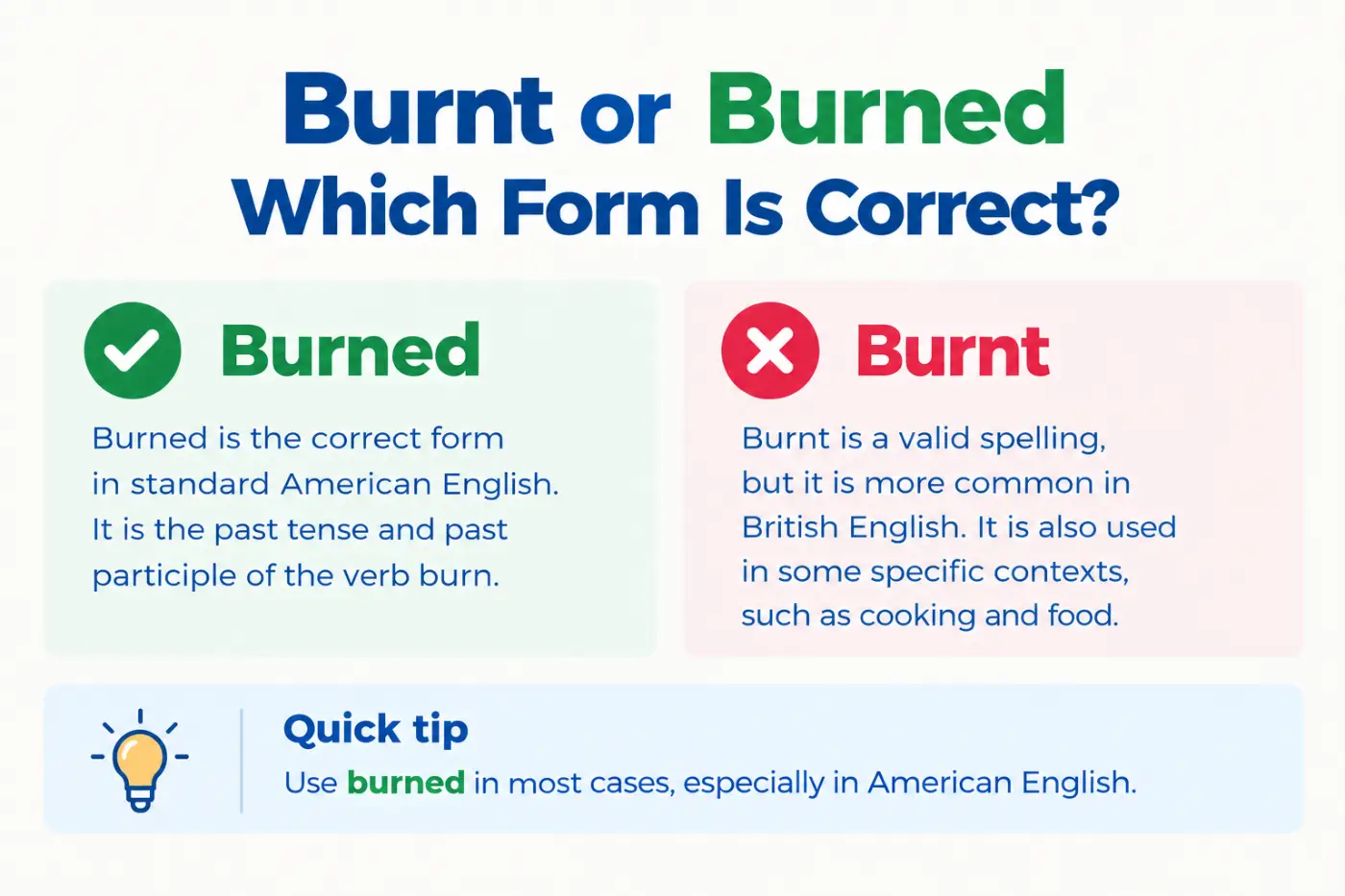
If you have ever paused while writing a sentence about toast, a campfire, or a damaged building, you may have wondered about burnt or burned. The good news is that both spellings are correct. They are forms of the verb burn, which means to be damaged by fire or heat, or to produce heat and flames.
The main difference comes down to usage. In American English, burned is generally the more common choice for the past tense and past participle, while burnt often appears as an adjective or in familiar expressions such as burnt toast. British English uses both forms, too, although preferences can vary by context.
Neither spelling is automatically wrong, and you do not need to memorize two different meanings. Instead, you need to understand how each form works in a sentence and which one sounds most natural for your audience. The following guide explains the grammar, pronunciation, regional preferences, common expressions, and practical examples so you can make the right choice with confidence.
quick-answer
A related grammar guide is former vs latter Explained With Clear Examples.
Quick Answer
Both burnt and burned are correct past forms of the verb burn. In American English, burned is the usual choice for actions in the past, such as “She burned the toast.” Burnt is also accepted, especially in phrases such as “burnt toast” and “burnt sugar.” In most cases, the two forms have the same basic meaning.
Comparison Table for Burnt and Burned
| Feature | Burned | Burnt |
|---|---|---|
| Correct spelling | Yes | Yes |
| Part of speech | Past tense, past participle, adjective | Past tense, past participle, adjective |
| Basic meaning | Damaged or affected by fire or heat | Damaged or affected by fire or heat |
| American English | Common and widely preferred | Correct, often used in certain expressions |
| British English | Correct | Correct and common |
| Australian English | Correct | Correct |
| Formal writing | A safe general choice | Appropriate when natural in context |
| Common example | The candle burned all night. | The toast smells burnt. |
| Typical use | General statements about past actions | Descriptions and established expressions |
Meaning and Definition
What Does Burned Mean?
Burned is the past tense and past participle of the verb burn. It describes an action that happened in the past or a condition that results from exposure to fire, heat, friction, or another source of damage.
For example, “He burned the letter” describes a completed action. The sentence “The field has burned” uses the past participle with the helping verb has to describe an event that has happened.
The word can also describe injury, damage, or intense sensation. Someone might have burned a finger on a hot pan, burned calories during exercise, or burned through their savings too quickly. In each case, context tells you which meaning applies.
What Does Burnt Mean?
Burnt carries the same core meaning as burned. It can describe something damaged by fire or excessive heat, an injury caused by heat, or a past action involving burning.
You may hear someone say, “The bread is burnt,” or “I burnt my hand on the oven rack.” Both sentences are grammatically acceptable. The first uses burnt as a description of the bread, while the second uses it as the past tense of the verb.
The spelling is especially familiar in expressions such as burnt toast, burnt sugar, and burnt offerings. These phrases do not make the form more correct than burned. They simply reflect common patterns of English usage.
Is Burnt a Real Word?
Yes. Burnt is a standard English word, not a spelling mistake or an informal invention. Major English dictionaries recognize it as a past form of burn and as an adjective.
The confusion arises because American English often favors burned in ordinary past tense sentences. That preference does not make burnt incorrect. Both forms belong to standard English, and the best choice depends on the sentence, the expression, and the style you want to follow.
Key Differences Explained
Spelling and Grammar
The most useful distinction is grammatical rather than semantic. Burned and burnt can both function as the simple past tense and the past participle.
Consider these examples.
- Simple past: Maya burned the old papers.
- Simple past: Maya burnt the old papers.
- Present perfect: Maya has burned the old papers.
- Present perfect: Maya has burnt the old papers.
- Adjective: The burned wood was removed.
- Adjective: The burnt wood was removed.
All six sentences can be correct. The choice does not normally change the underlying meaning.
Meaning and Context
In most situations, the two forms mean the same thing. Both can describe something catching fire, becoming damaged by heat, or experiencing a burning sensation.
However, certain expressions strongly favor one form in everyday use. Burnt toast, burnt sugar, and burnt ends are familiar phrases. Burned remains common in descriptions such as burned buildings, burned fields, and burned documents, especially in American writing.
These are preferences rather than absolute rules. You can encounter either form in many of the same contexts.
Past Tense and Past Participle
The simple past tense describes a completed event. The past participle appears in perfect tenses and passive constructions.
For example, “The chef burned the vegetables” uses the simple past. “The chef has burned the vegetables” uses the past participle with has. “The vegetables were burned during cooking” uses it in a passive construction.
You can substitute burnt in these examples without changing the basic meaning. The important point is to use the correct sentence structure. The spelling choice does not replace the need for an appropriate helping verb.
Pronunciation
Both forms are usually pronounced the same way in standard American English. The pronunciation is /bɝːnd/ for burned and /bɝːnt/ for burnt, so the final consonant differs slightly.
The past form ending in ed does not receive an extra syllable in burned. It is pronounced as one syllable, not burn ed. Burnt is also one syllable.
Formality and Tone
Neither form is inherently more formal or more informal than the other. Burned is a versatile choice for reports, essays, news writing, and professional communication in the United States. Burnt is also suitable for formal writing when it fits the sentence or the publication’s preferred style.
An editor may choose burned for consistency across a document while retaining a familiar phrase such as burnt toast. The goal is clear, natural writing rather than forcing one spelling into every situation.
Regional Usage
American, British, Canadian, and Australian English all recognize both forms. American usage tends to favor burned in general past tense sentences, while burnt remains common in familiar expressions and descriptive language.
British English often uses burnt comfortably as both a verb form and an adjective. However, burned is also standard in Britain. The same broad flexibility appears in Australian and Canadian English, although local preferences and individual style guides can differ.
Which Form Is Correct?
Both forms are correct, but burned is usually the safest default in American English when you are describing a past action. Use burnt when it sounds natural in a familiar expression or when it matches the style of the writing.
The reason is that burn has two accepted past forms. English contains many verbs with more than one recognized form, and their use can depend on regional habits, historical development, or the words surrounding them.
You do not need to treat burnt as a British only spelling. Nor should you assume that burned is exclusively American. Both forms cross regional boundaries, and neither belongs to only one variety of English.
For practical writing, follow these guidelines.
- Use burned for a straightforward statement about a past action in American English.
- Use burned or burnt in a past participle construction, depending on your preferred style.
- Choose the form that sounds natural in established expressions such as burnt toast.
- Keep your spelling consistent within the same document unless a fixed phrase or quotation calls for a different form.
- Follow your organization’s style guide if it specifies one form.
Sentence Examples
The following sentences show how the two spellings work in everyday and professional contexts. The first ten use burned as a broadly useful choice for American readers.
- Everyday conversation: I burned the garlic because I left the pan on the stove for too long.
- Cooking: The edges of the pizza burned before the cheese melted.
- Text message: Sorry, I burned dinner, so we may need to order takeout.
- Workplace communication: The technician reported that a small electrical component had burned out.
- School assignment: The wildfire burned thousands of acres before firefighters contained it.
- Academic writing: The researchers examined how burned plant material affected the soil.
- Formal report: The inspection found that the fire had burned through part of the roof.
- Social situation: He burned his tongue on the hot coffee and waited for it to cool.
- Online communication: I burned through my phone battery during the long video call.
- Personal finance: She burned through her savings after several unexpected expenses.
Here are five additional examples that use burnt naturally.
- The burnt toast set off the smoke alarm.
- A burnt smell lingered in the kitchen after breakfast.
- The recipe calls for a little burnt sugar to deepen the flavor.
- He noticed a burnt patch on the lawn after the outdoor fire.
- The burnt ends were tender, smoky, and full of flavor.
Notice that the examples do not divide neatly into correct and incorrect forms. Both spellings are accepted. The first set demonstrates a convenient general choice, while the second shows common contexts where the shorter form feels especially familiar.
Common Mistakes and Misspellings
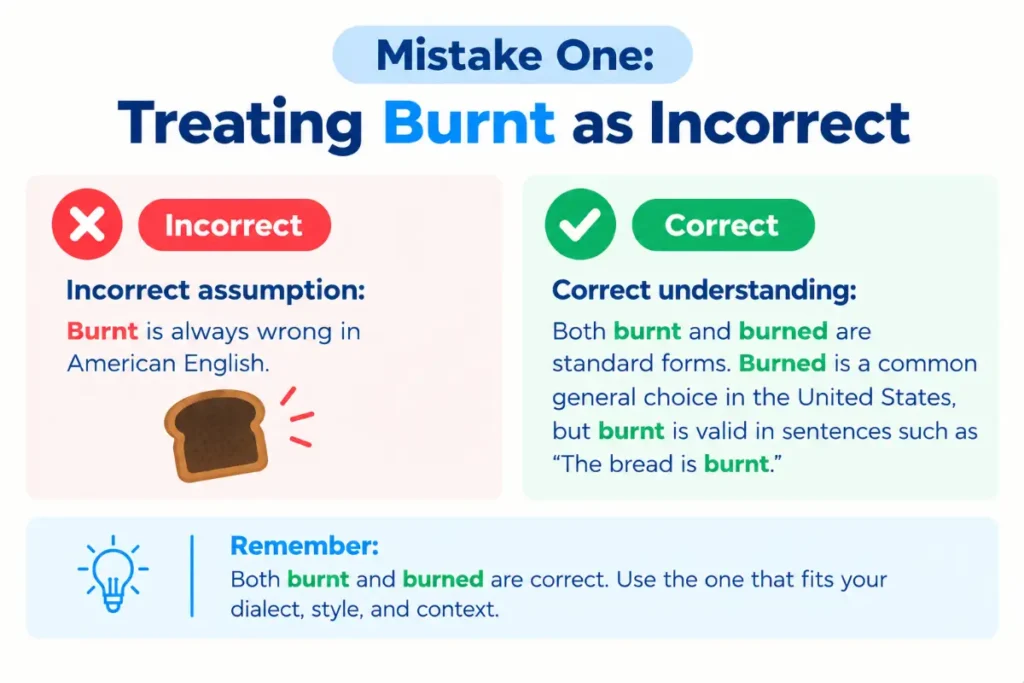
Mistake One: Treating Burnt as Incorrect
Incorrect assumption: Burnt is always wrong in American English.
Correct understanding: Both burnt and burned are standard forms. Burned is a common general choice in the United States, but burnt is valid in sentences such as “The bread is burnt.”
The mistake comes from confusing a regional preference with a strict grammar rule. If a sentence uses burnt correctly, there is usually no reason to change it simply because burned is more common elsewhere.
Mistake Two: Adding an Extra Syllable to Burned
Incorrect pronunciation: burn ed, spoken as two separate syllables.
Correct pronunciation: burned, spoken as one syllable.
The ed ending does not always create a new syllable in English. After many verbs ending in a voiced or voiceless consonant, the ending changes sound rather than adding a separate beat. In burned, the ending sounds like a d.
Mistake Three: Using an Incorrect Verb Form
Incorrect: I have burn the bread.
Correct: I have burned the bread. Alternatively, I have burnt the bread.
The present perfect tense needs a past participle after have or has. The base form burn does not work in that position. This is a grammar error, not a disagreement about spelling.
Mistake Four: Mixing Forms Without a Reason
Potentially inconsistent: The fire burned the fence, and the heat burnt the nearby shed.
More consistent: The fire burned the fence, and the heat burned the nearby shed.
The original sentence is not automatically ungrammatical, but switching forms can distract readers when no difference in meaning is intended. In edited writing, consistency usually improves readability.
Mistake Five: Assuming Burned and Burnt Always Sound Different
Incorrect assumption: Burnt must describe a more damaged object than burned.
Correct understanding: The words usually carry the same meaning. A sentence may suggest a particular degree of damage, but that meaning comes from the surrounding context, not from a fixed difference between these spellings.
For example, “The bread is burnt” does not automatically mean it is more damaged than bread described as burned.
A related grammar guide is Smoothe vs Smooth Which Spelling Is Correct.
Pronunciation Guide
Both forms are short words, but their final sounds are different.
| Form | IPA | Syllables | Easy guide |
|---|---|---|---|
| Burned | /bɝːnd/ in General American English | One | BURND |
| Burnt | /bɝːnt/ in General American English | One | BURNT |
How to Pronounce Burned
Start with the same vowel sound used in the American pronunciation of bird. Then pronounce the ending as a d sound. The complete word has one syllable, with stress naturally falling on that single syllable.
You do not say burn ed as two separate parts. The letters ed represent a final consonant sound here.
How to Pronounce Burnt
Begin with the same vowel sound. Finish with a t sound instead of a d sound. The word remains one syllable.
In connected speech, the difference can be subtle, especially when the word appears before another consonant. Listening to the final sound helps distinguish the forms.
Common Pronunciation Errors
The most common error is adding an extra syllable to burned. Another is pronouncing the final t in burnt too strongly in a sentence, making speech sound unnatural. Practice both words in complete sentences rather than saying them repeatedly in isolation.
Etymology and Word Origin
The verb burn has a long history in English and belongs to an older family of Germanic words connected with burning or producing heat. Its earlier forms developed over time into the modern English verb.
Burned and burnt emerged as alternative past forms. English verbs have not all followed one uniform pattern of change, and some retain competing forms that developed through different historical endings. This helps explain why both spellings survive today.
The ending in burned reflects the regular pattern used with many English verbs. The shorter form burnt reflects an older type of verb formation that remains in use with certain verbs and varieties of English.
English preserves similar alternatives elsewhere. Learners may encounter dreamed and dreamt, learned and learnt, or leaped and leapt. These pairs do not always have identical regional preferences, but they show that English can accept more than one past form for a verb.
The existence of two forms does not mean one is a mistake. Their continued use reflects the history and flexibility of the language.
Regional Usage
American English
In the United States, burned is the usual choice in many general statements about past events. It appears naturally in journalism, school writing, business communication, and everyday conversation.
Burnt is also accepted. Americans regularly use it in phrases such as burnt toast and burnt sugar, and some speakers use it more broadly as a past tense or past participle. For a neutral American style, burned is a reliable default when no particular expression suggests otherwise.
British English
British English uses both forms. Burnt is well established in everyday speech and writing, including descriptions of food, fire damage, and injuries. Burned is also standard and appears in many contexts.
There is no strict rule that requires British writers to use burnt or American writers to use burned. The difference is better understood as a broad tendency than as a firm boundary between national varieties.
Australian English
Australian English accepts both spellings. Burnt is familiar in descriptions such as burnt toast, while burned works well in statements about past actions and fire damage.
Local preferences can vary by speaker, publication, and context. A writer producing Australian material should follow the relevant house style instead of assuming that one form is universally required.
Canadian English
Canadian English also recognizes both forms. Since Canadian writing often shares conventions with both American and British English, the preferred form can depend on the publication and the type of text.
For everyday Canadian writing, either form can be correct. If you are preparing a formal document, check the organization’s style guide and apply the same convention throughout.
Grammar Rules and Part of Speech
Burned and Burnt as Verbs
Both forms can function as the simple past tense of burn. This form describes an action or event that occurred in the past.
Examples include “The candle burned for hours” and “The candle burnt for hours.” Both sentences describe the same basic event.
The subject can be a person, an object, or a natural force. A person might burn a letter, a candle might burn all night, or a wildfire might burn across a hillside.
Using the Past Participle
A past participle works with a helping verb in perfect tenses and passive constructions.
- Present perfect: The fire has burned for three hours.
- Present perfect: The fire has burnt for three hours.
- Past perfect: The leaves had burned before the rain arrived.
- Passive voice: The old fence was burned during the fire.
- Passive voice: The old fence was burnt during the fire.
Each construction is grammatical. Choose the spelling that fits your usual style and the surrounding language.
Using Burnt as an Adjective
Burnt frequently appears before a noun or after a linking verb to describe a condition.
Examples include burnt toast, burnt wood, burnt sugar, and a burnt smell. You can also say, “The bread smells burnt,” or “The edges look burnt.”
Burned can also act as an adjective, as in burned wood or burned skin. The choice may depend on common usage in a phrase, regional preference, or the writer’s style.
Transitive and Intransitive Uses
Burn can be transitive or intransitive. A transitive verb takes a direct object, as in “She burned the letter.” The letter receives the action.
An intransitive use does not take a direct object. In “The candle burned all night,” the candle is the subject, and no object receives the action. Both past forms can appear in these patterns.
Common Grammar Patterns
These sentence patterns help you choose the right verb structure.
- Subject plus past tense: The chef burned the bread.
- Subject plus has or have plus past participle: The chef has burned the bread.
- Subject plus had plus past participle: The chef had burned the bread before the guests arrived.
- Subject plus be verb plus past participle: The bread was burned in the oven.
- Linking verb plus adjective: The bread smells burnt.
The last pattern describes a condition rather than emphasizing an action. However, the exact grammatical role can depend on how the sentence is constructed.
Punctuation and Formal Style
Neither spelling requires special punctuation. Use ordinary sentence punctuation and capitalize the word only when it begins a sentence or appears in a title that follows title case conventions.
For professional writing, the main concern is consistency. If your company prefers burned, use that form throughout the document unless you are preserving a quotation or a fixed expression. If the style guide permits both, make choices based on context and clarity.
Real Life Usage Examples
Daily Conversation
In everyday speech, both forms are natural. Speakers often choose a familiar expression without thinking about its grammatical history.
- “I burned the pancakes while answering the phone.”
- “This toast tastes burnt. Do you have another slice?”
The first sentence describes a completed action. The second describes the condition of the toast. These are common patterns, but they do not establish an absolute rule that burned must be a verb and burnt must be an adjective.
Email and Workplace Communication
In a workplace setting, burned often works well because it is a familiar and neutral choice in American English.
- “The maintenance team found that the motor had burned out overnight.”
- “Please document the equipment that was burned during the incident.”
The first example uses a common phrasal verb. The second communicates damage in a straightforward way. For reports, consistency matters more than choosing one form as universally correct.
Academic Writing
Academic writing benefits from precise descriptions and consistent terminology. Both forms can appear in scholarly work, depending on the subject and the style guide.
- “The researchers measured the amount of carbon in burned plant material.”
- “The experiment examined the effects of burnt organic matter on soil conditions.”
The most important part is to define the process accurately and avoid switching terminology without a reason. If the study uses a technical term, follow the terminology established in the research field.
News and Journalism
Journalists often use burned in reports about fires, accidents, and property damage. The form is direct and widely understood by American readers.
- “The wildfire burned several acres before crews contained it.”
- “Investigators examined the burnt remains of the structure.”
Both examples are clear. A newsroom may choose one form as its default, but the other is not automatically incorrect.
Literature and Storytelling
Writers may select either form to fit a character’s voice, the rhythm of a sentence, or the tone of a scene. The spelling itself usually does not change the meaning, but it can affect how familiar an expression sounds.
- “The last candle burned beside the open window.”
- “A burnt scent hung in the air after the fire died.”
Both sentences create a clear image. The first emphasizes an ongoing past event, while the second describes a lingering smell.
Related and Confused Terms
These eight related terms can help you describe heat, fire, damage, and recovery more precisely.
Burn
Burn is the base form of the verb. It appears in present tense sentences such as “I burn the old papers every winter,” as well as commands such as “Do not burn the leaves.”
It can also function as a noun, as in “The burn on his arm was small.” Its meaning depends on the sentence.
Burning
Burning can function as a verb form, an adjective, or a noun. In “The house is burning,” it forms part of the present progressive tense. In “a burning sensation,” it describes a feeling.
The word can also refer to the act or process of combustion.
Burnt Out
Burnt out or burned out can describe something that has stopped working after being used or damaged. A burned out bulb no longer works, while a burnt out engine may be damaged beyond normal operation.
The expression can also describe severe emotional exhaustion. In that sense, it is often written as burned out or burnt out, depending on regional preference.
Scorched
Scorched means slightly burned or damaged by heat, often on the surface. A pan might scorch the bottom of a sauce without completely destroying it.
This word can suggest limited or surface level damage, although the exact meaning depends on context. It is useful when burned sounds too broad.
Charred
Charred describes something blackened by intense heat or fire. Wood, meat, and the remains of a building can all be charred.
The word often suggests a darkened outer surface. It does not always mean an object has been completely consumed by fire.
Singed
Singed means lightly burned, often at the edges or on the surface. A person’s hair might be singed by a flame, or a sleeve might be singed by a spark.
Unlike charred, which often suggests blackening, singed usually points to limited heat damage.
Smoldering
Smoldering describes something that burns slowly with smoke and little or no visible flame. A smoldering log may continue to produce heat after the main fire has faded.
The word can also describe anger or tension that has not yet become openly expressed.
Ablaze
Ablaze means burning strongly or being filled with flames. A building ablaze is actively on fire.
The term is more vivid than burned because it generally emphasizes visible flames or intense burning rather than the condition left behind after a fire.
Expert Editor Insight
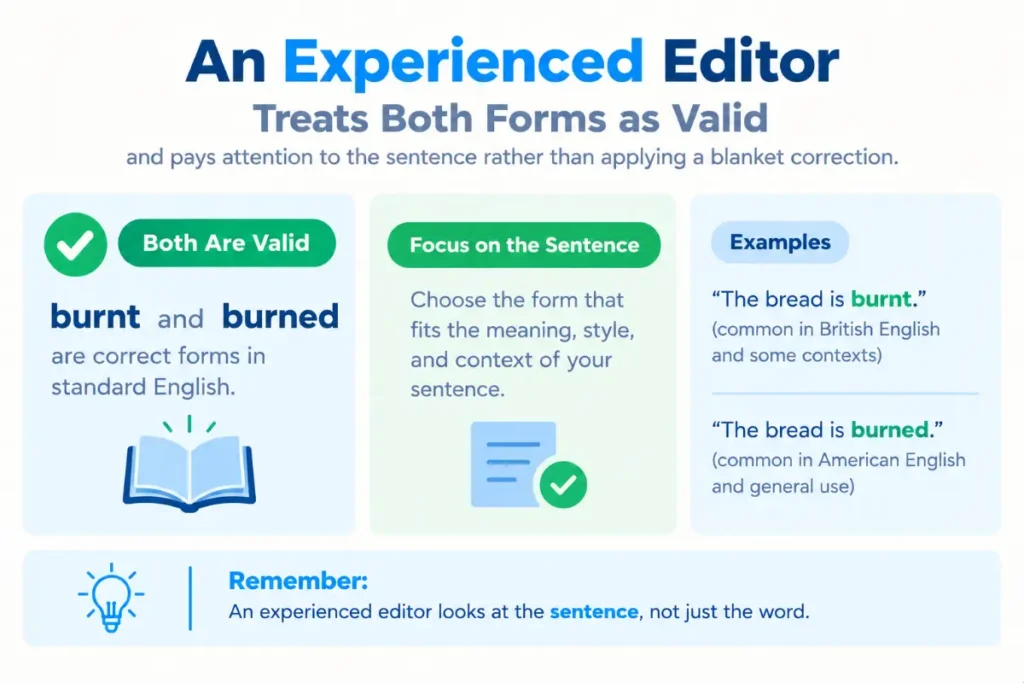
An experienced editor treats both forms as valid and pays attention to the sentence rather than applying a blanket correction. In American writing, burned is a useful default for past actions, while burnt often feels natural in familiar descriptions such as burnt toast. Grammar tools may flag one form based on their regional settings or preferred dictionary, but that does not prove the other form is wrong. The best editing tip is to check the word’s role in the sentence, follow your publication’s style guide, and stay consistent without changing established expressions unnecessarily.
A related grammar guide is fair vs good Meaning and Usage Explained.
Conclusion
The choice between burnt or burned is simpler than it first appears because both forms are correct. Burned is a dependable default for general American English, especially when describing past actions, while burnt is common in familiar phrases and descriptive language.
Neither form has a separate fixed meaning, and both can work as a past tense, past participle, or adjective. To make your writing clear, pay attention to grammar, consider your audience, and follow a consistent style. A useful editing tip is to read the entire sentence aloud before changing the spelling. If the form is grammatical and fits the context, you usually do not need to replace it.
FAQs
Is Burnt a Real Word in American English?
Yes, burnt is a standard English word in the United States. It is an accepted past form of burn and can also function as an adjective. Americans often use burned in general statements about past events, but phrases such as burnt toast and burnt sugar remain familiar. The shorter spelling is not automatically a mistake.
What Is the Difference Between Burnt and Burned?
The two forms usually have the same meaning. Both can describe a past action, a completed event, or damage caused by heat or fire. Burned is often the more common general choice in American English, while burnt is familiar in certain expressions and descriptive phrases. Grammar and context matter more than any fixed difference in meaning.
Which Form Should I Use in Formal Writing?
For general American professional or academic writing, burned is a reliable default. However, burnt is also correct and may be the more natural choice in a familiar phrase. Check your organization’s style guide if one exists. Once you select a convention, use it consistently, but do not alter a standard expression just to make every instance match.
Is Burnt Toast Correct or Should I Write Burned Toast?
Both phrases are grammatically correct, but burnt toast is a very familiar expression in everyday English. Burned toast is also understandable and acceptable, particularly in American usage. If you are writing a recipe, a casual message, or a description of breakfast, burnt toast will usually sound natural. There is no need to treat the alternative as a spelling error.
How Do You Pronounce Burned and Burnt?
In standard American English, burned is pronounced /bɝːnd/ and burnt is pronounced /bɝːnt/. Each word has one syllable. The main difference is the final consonant sound, d in burned and t in burnt. Do not pronounce burned as two syllables. In ordinary conversation, both forms are easy to recognize from context.
Can Burnt Be Used as a Verb?
Yes. Burnt can function as the simple past tense and the past participle of burn. You can write “I burnt the bread” or “I have burnt the bread.” Both constructions are grammatically acceptable. Burned is also correct in those sentences and is often the preferred general form in American English. The choice is mainly a matter of usage and style.
Is Burned More American Than British?
Burned is common in American English, but it is not exclusive to the United States. British English recognizes both burned and burnt, and burnt is particularly familiar in everyday descriptions. Australian and Canadian English also accept both forms. Regional preferences can influence which spelling sounds more natural, but no strict national rule makes either form incorrect.
Why Do English Speakers Use Two Past Forms?
English preserves different patterns for forming the past tense and past participle. Burned follows the regular ed pattern, while burnt reflects an older type of verb form. Both have remained in use, so modern English accepts both. Similar alternatives appear in words such as dreamed and dreamt. These pairs show how English can preserve more than one standard form.