
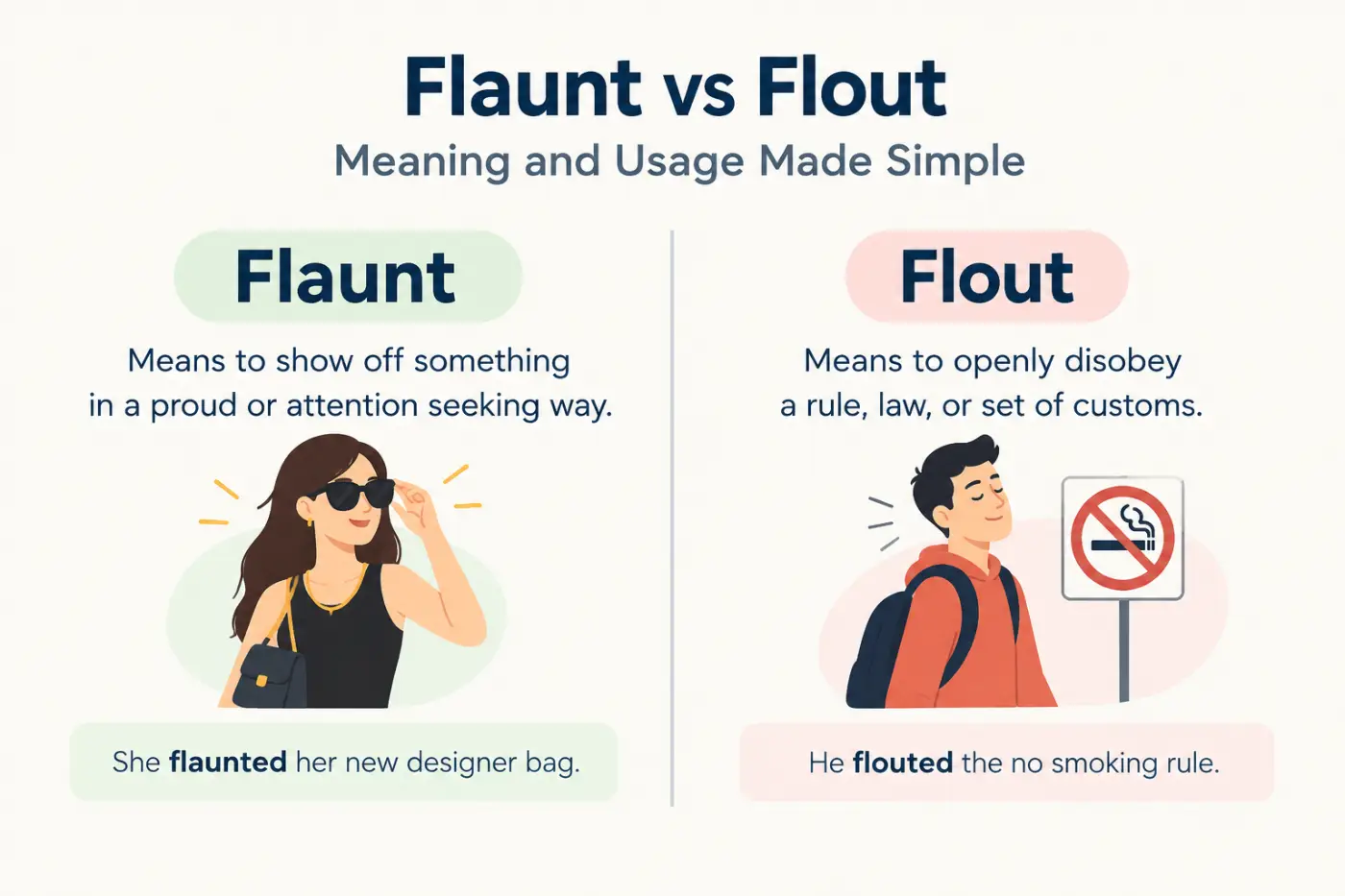
The difference between flaunt and flout comes down to one simple idea. Flaunt means to show something off, while flout means to openly ignore a rule or show disrespect for it. Both words are spelled correctly, but they don’t mean the same thing.
The confusion makes sense because the words look and sound almost identical. They also appear in similar situations, especially when people describe someone’s behavior. However, choosing the wrong word can change the meaning of a sentence. Someone might flaunt an expensive watch to attract attention, but they might flout a workplace policy by refusing to follow it.
Understanding this distinction will help you write more clearly and avoid a common vocabulary mistake. You’ll learn the definitions, grammatical patterns, pronunciation, word origins, and differences in American and British English. You’ll also see practical examples from everyday conversations, workplace emails, academic writing, and journalism.
The easiest rule to remember is this. Flaunt means show off. Flout means disregard. Once you connect each word with its main action, choosing the right one becomes much easier.
Still confused? Compare Camisole Meaning Slang: What Does It Really Mean?(2026).
Quick Answer
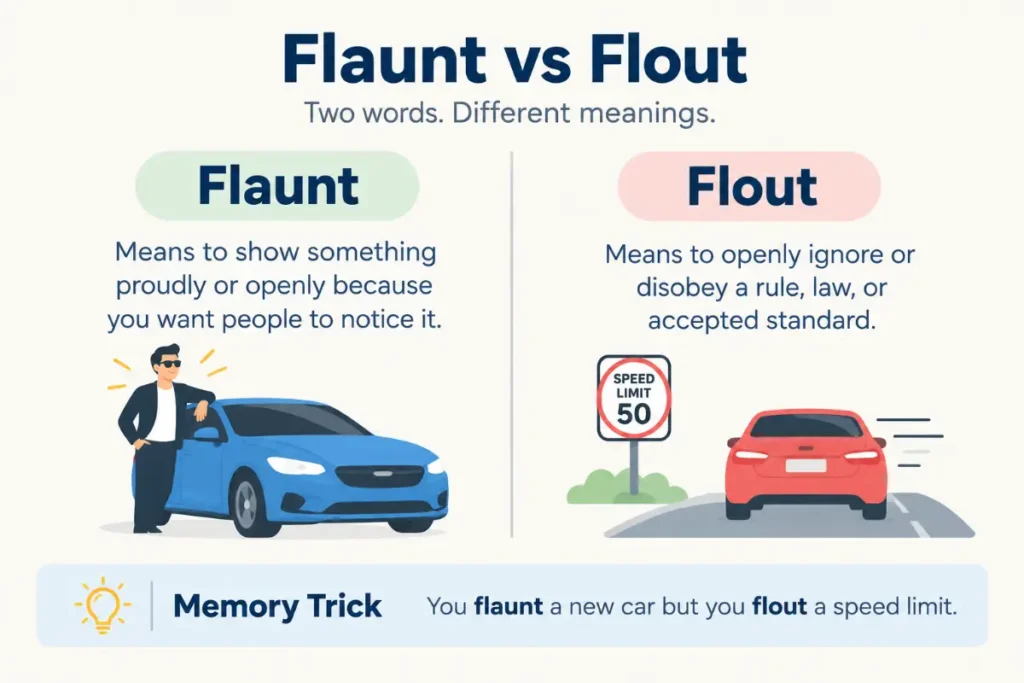
Flaunt means to display something proudly or show it off to attract attention. Flout means to openly disregard a rule, law, custom, or authority. Both are standard English verbs, but they serve different purposes. Use flaunt when someone wants others to notice something and flout when someone deliberately refuses to respect a rule or expectation.
Quick Comparison of the Two Words
| Feature | Flaunt | Flout |
|---|---|---|
| Meaning | To show off or display openly. | To openly disregard or defy. |
| Part of speech | Verb. | Verb. |
| Main purpose | To attract attention. | To show disregard. |
| Pronunciation | /flɔnt/ in common American pronunciation. | /flaʊt/ in American English. |
| Formality | Standard in casual and formal writing. | Standard in casual and formal writing. |
| Common contexts | Wealth, success, beauty, achievements, possessions. | Laws, rules, traditions, instructions, social norms. |
| Common pattern | Flaunt something. | Flout a rule or convention. |
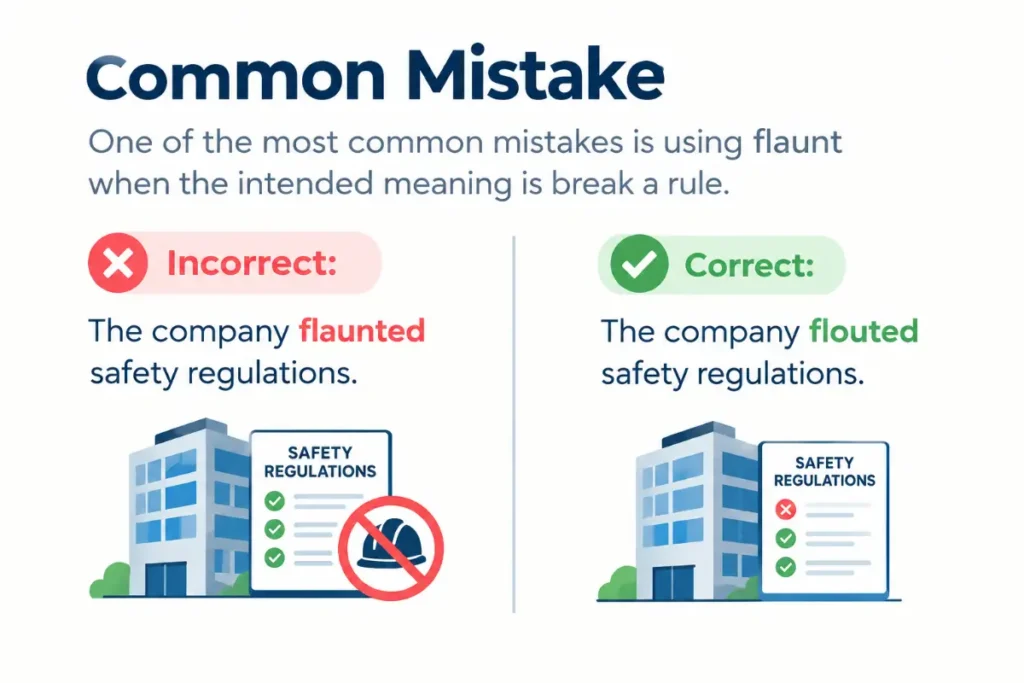
| Example | She flaunted her new designer bag. | The company flouted safety regulations. |
What Flaunt Means
Flaunt is a verb that means to display something openly or conspicuously, often to attract attention, admiration, or envy. It can describe the way people present their possessions, achievements, appearance, status, or abilities to others.
The word often suggests showing off. For example, someone who wears an expensive watch where everyone can see it might be flaunting their wealth. A student who proudly displays a perfect test score might be flaunting an achievement.
The tone depends on the situation. Sometimes the word describes confidence or pride. In other cases, it suggests vanity, boastfulness, or a lack of consideration for other people’s feelings.
Consider these examples.
- Marcus flaunted his new sports car at the neighborhood gathering.
- She flaunted her award because she was proud of her hard work.
- The influencer flaunted an expensive lifestyle on social media.
Each sentence describes something being displayed for others to notice. None of these examples involves breaking a rule.
How to Use Flaunt in a Sentence
This verb usually takes a direct object. That means the sentence tells readers what someone is showing off.
For example, you can flaunt your success, flaunt your wealth, flaunt your skills, or flaunt your new clothes. You can also use the word with a noun phrase that describes an achievement or quality.
The common grammatical pattern is:
Subject + flaunt + object.
For example, the sentence “He flaunted his promotion” follows this pattern. The subject is he, the verb is flaunted, and the object is his promotion.
You can also use the passive voice, as in “Her achievements were flaunted during the ceremony.” However, active sentences usually sound clearer and more natural.
Does Flaunt Always Have a Negative Meaning?
No. The word often carries a negative tone, but it doesn’t always criticize the person doing the showing off.
If a person flaunts their wealth, readers may picture someone who wants to impress others or make them feel less successful. By contrast, someone who flaunts a hard earned award might simply feel proud of an accomplishment.
Context makes the difference. Writers sometimes choose a more neutral verb such as display, show, present, or demonstrate when they don’t want to suggest that someone is seeking attention.
For example, “She displayed her artwork at the gallery” sounds more neutral than “She flaunted her artwork at the gallery.” The second version suggests a stronger desire to attract attention.
What Flout Means
Flout is a verb that means to openly disregard, defy, or show contempt for a rule, law, instruction, custom, or accepted standard. It describes behavior that goes against something people are expected to respect.
For example, a driver who deliberately ignores a clearly posted traffic restriction flouts the rules. A business that knowingly ignores required safety standards flouts regulations.
The word often suggests a deliberate act rather than an innocent mistake. Someone who forgets a meeting time hasn’t necessarily flouted a rule. Someone who openly refuses to follow a clear instruction may have.
Consider these examples.
- The restaurant flouted health regulations by ignoring required safety procedures.
- He flouted his parents’ rules by returning home hours after curfew.
- The politician was accused of flouting established democratic norms.
Each sentence describes a person or organization disregarding an expectation or requirement.
How to Use Flout in a Sentence
Flout commonly takes a direct object that names the rule, standard, or convention being ignored.
Common combinations include flout the law, flout regulations, flout the rules, flout convention, and flout authority.
The usual grammatical pattern is:
Subject + flout + object.
For example, “The company flouted the safety rules” follows this pattern. The company is the subject, flouted is the verb, and the safety rules are the object.
The word also appears in passive constructions. For instance, “The rules were openly flouted” emphasizes the rules rather than the person who ignored them.
Is Flouting Always Illegal?
No. Flouting a law or regulation can involve illegal conduct, but the word also applies to social expectations, traditions, and unwritten rules.
A guest who deliberately ignores a formal dress code may flout convention. An artist who challenges traditional artistic standards may flout accepted practices. A manager who openly disregards a company policy may flout workplace rules.
The word describes defiance or disregard. The seriousness of the behavior depends on the rule involved and the surrounding circumstances.
Key Differences Explained
The central distinction is the action each verb describes. One focuses on displaying something for attention. The other focuses on disregarding a rule or expectation.
Meaning and Intent
Flaunt usually involves making something visible so other people notice it. The object might be a possession, an achievement, a personal quality, or a sign of success.
Flout involves treating a rule or convention as something to ignore or defy. The object is usually an expectation, standard, instruction, or authority.
Compare these sentences.
- The employee flaunted his new promotion during lunch.
- The employee flouted company policy by sharing confidential records.
The first sentence describes showing off a promotion. The second describes disregarding a workplace rule.
Spelling and Pronunciation
Both words begin with the same four letters and end with the same final consonant sound. However, their vowel sounds differ in American English.
Flaunt commonly rhymes with haunt in accents that pronounce that vowel similarly. Flout rhymes with out. This difference can help you distinguish them when speaking.
The spelling also offers a useful clue. Flaunt contains the letter sequence associated with the vowel in words such as haunt in many American accents. Flout contains the same vowel sequence found in about.
Because regional accents vary, pronunciation can differ slightly. The meaning and grammatical context remain the most reliable guides.
Grammar and Part of Speech
Both words are verbs. They can appear in the present tense, past tense, continuous forms, and perfect constructions.
For flaunt, common forms include flaunts, flaunted, and flaunting.
For flout, common forms include flouts, flouted, and flouting.
Both verbs usually take direct objects, but those objects differ in meaning. A person flaunts a possession or achievement. A person flouts a rule or convention.
For example, “She is flaunting her success” describes a display. “She is flouting the rules” describes defiance.
Tone and Formality
Both words work in everyday speech, journalism, business writing, and academic discussion. Neither is an incorrect or informal spelling of the other.
Flaunt often carries an emotional tone. It can suggest pride, vanity, extravagance, or a desire to impress.
Flout often sounds more critical, especially in reports about laws, regulations, public behavior, or institutional responsibility. It suggests that a person or organization has failed to respect an established standard.
A writer should choose the word that fits the intended meaning rather than the one that sounds more formal.
Standard and Nonstandard Usage
Both forms belong to standard English. Neither is a misspelling, and neither is limited to a particular region.
The mistake happens when writers use one in place of the other. Writing “flout your success” when you mean showing it off changes the intended meaning. Writing “flaunt the rules” when you mean openly disregard them creates the same problem.
A grammar checker may not catch this error because both words are spelled correctly. Writers need to check meaning and context rather than relying on spelling tools alone.
Which Word Is Correct?
Both words are correct. The right choice depends on what you want to say.
Use flaunt when a person displays something to attract attention. Use flout when a person openly disregards a rule, law, custom, or standard.
A dictionary treats these as separate verbs with different meanings, not alternative spellings of the same word. That distinction matters because spell checkers may accept both words even when a writer uses the wrong one.
Here is a simple editing test. Ask yourself what the person is doing.
- If the person is showing off a possession, skill, achievement, or quality, choose flaunt.
- If the person is ignoring or defying a rule, instruction, law, or social expectation, choose flout.
For example, a celebrity might flaunt expensive jewelry at a public event. The same celebrity might flout a venue’s rules by entering a restricted area.
The context makes the correct choice clear.
Sentence Examples
These examples show how the two verbs work in realistic situations.
- Everyday conversation. “He loves to flaunt his new gaming setup whenever his friends visit.”
- Text messages. “She’s flaunting her vacation photos while we’re all stuck at work.”
- Workplace communication. “The manager warned the team not to flout the company’s privacy policy.”
- School. “The student flaunted his science fair trophy after winning first place.”
- Academic writing. “The study examines how public figures flaunt social status through clothing and luxury goods.”
- Formal writing. “The investigation found that the contractor had flouted several safety requirements.”
- Social situations. “She didn’t want to flaunt her success in front of friends who were struggling.”
- Online communication. “The streamer was criticized for flaunting expensive gifts during a charity event.”
- News reporting. “Officials accused the factory of flouting environmental regulations.”
- Storytelling. “The young prince flaunted his riches while the villagers struggled to afford food.”
Notice how the objects guide the meaning. People flaunt things they want others to see. They flout rules and standards they choose to disregard.
Common Mistakes and Confusing Forms
The most common mistake is treating these verbs as interchangeable. Other errors involve choosing a word based on how a sentence sounds instead of what it means.
Using Flaunt for Rule Breaking
Incorrect usage. “The driver flaunted the speed limit.”
Correct usage. “The driver flouted the speed limit.”
The intended meaning is that the driver disregarded the limit. The sentence needs flout, not flaunt.
Using Flout for Showing Off
Incorrect usage. “She flouted her expensive handbag at the party.”
Correct usage. “She flaunted her expensive handbag at the party.”
The handbag is being displayed to attract attention. No rule is being ignored.
Assuming One Word Is a Misspelling
Both verbs are standard English words. Treating one as an incorrect spelling of the other leads to unnecessary corrections and new errors.
Instead, identify the intended action before editing the sentence.
Confusing Flout With Flaw
Flaw is a noun that means a defect or weakness. Flout is a verb that means to disregard a rule or convention.
For example, “The plan has a serious flaw” is correct when describing a weakness. “The company flouted the regulations” is correct when describing disregard for rules.
Choosing a Word Based Only on Context
A sentence about a rebellious person doesn’t automatically call for flout. A person might flaunt an unusual outfit to attract attention without breaking any rule. Likewise, a person might flout a dress code without trying to show off.
Focus on the actual action rather than the personality or setting.
Pronunciation Guide
The two words look similar, but their vowel sounds distinguish them in American English.
You may also want to read Natzi or Nazi Meaning, Usage, and Correct Form 2026.
Flaunt
IPA: /flɔnt/ in a common American pronunciation.
Pronunciation guide: FLONT, rhyming with haunt in accents that share that vowel sound.
Syllables: One. Stress: The entire word.
Flout
IPA: /flaʊt/.
Pronunciation guide: FLOWT, rhyming with out and shout.
Syllables: One. Stress: The entire word.
The vowel in flaunt is commonly represented by the sound in caught or dawn for many American speakers, although accents differ. The vowel in flout is a diphthong, which means the sound moves from one vowel position to another.
A useful practice is to say these pairs aloud.
- Flaunt and haunt.
- Flout and shout.
- Flaunt your success.
- Flout the rules.
Keep the vowel sounds distinct. Pronunciation can help you recognize the words, but always consider the sentence meaning too.
Etymology and Word Origin
The two verbs developed separately, which helps explain why they have different meanings despite their similar spellings.
The History of Flaunt
Flaunt entered English in the 16th century. Its early history is not fully certain, and the precise origin of the word remains unclear.
Over time, it developed the familiar sense of displaying something openly or conspicuously. Modern usage often connects it with wealth, possessions, appearance, status, and achievements.
The idea of making something noticeable remains central to its meaning. The word can suggest pride or a desire to impress, but the degree of criticism depends on context.
The History of Flout
Flout also dates to the 16th century. Its early origin is uncertain, although historical dictionaries trace its development separately from the verb meaning to show off.
Its modern meaning centers on treating a rule, custom, or authority with disregard. It can describe defiance of written laws as well as resistance to accepted social expectations.
The important point for modern writers is that the words have distinct histories and meanings. Their similar appearance doesn’t make them interchangeable.
Regional Usage
Neither verb has a major spelling difference across the main varieties of English. American, British, Australian, and Canadian writers use both words with the same basic distinction.
American English
Both verbs are standard in the United States.
Flaunt often appears in conversations about wealth, celebrity culture, clothing, personal achievements, and social media. Flout frequently appears in news reports, workplace discussions, legal contexts, and criticism of public behavior.
For example, an American journalist might write that a celebrity flaunted a luxury lifestyle or that a company flouted federal regulations.
British English
British English uses the same meanings. A British newspaper might describe someone as flaunting expensive possessions or flouting local rules.
Pronunciation may differ by accent, particularly the vowel sound in flaunt. However, this does not change the meaning or spelling.
Australian English
Australian English follows the same standard distinction. Writers use flaunt for displaying something conspicuously and flout for disregarding rules or conventions.
No special Australian spelling is needed.
Canadian English
Canadian English also follows the same distinction. Both forms are accepted in formal and informal writing, and neither word has a unique Canadian meaning.
Across these varieties, context determines the correct choice.
Grammar Rules and Common Patterns
Both verbs follow regular English verb patterns. You can use them in the present, past, and future, as well as in continuous and perfect forms.
Present and Past Tense
Use flaunt with a singular subject in the present tense by adding s. Use flout in the same way.
- She flaunts her achievements.
- He flouts the rules.
- They flaunted their new home.
- The company flouted the regulations.
The past tense of each verb ends in ed. The same pattern applies to the participles used with helping verbs.
Continuous and Perfect Forms
Use flaunting and flouting with forms of be to describe ongoing actions. Use flaunted and flouted with have to form the perfect tenses.
- She is flaunting her new watch.
- They are flouting the safety rules.
- He has flaunted his wealth for years.
- The business has flouted local regulations.
These patterns work in formal and informal writing.
Sentence Position and Punctuation
Both verbs can appear in the middle of a sentence or at the end of a clause. They can also begin a sentence when used in an introductory phrase.
For example, “Flaunting his success, he thanked the team” begins with a participial phrase. “Flouting the rules, the company risked a serious penalty” uses the same structure.
Neither verb requires special punctuation. Follow the normal rules for commas, clauses, and sentence structure.
Real Life Usage Examples
The best word often becomes obvious when you consider the setting and the intended meaning.
Daily Conversation
- “He keeps flaunting his new phone every time we meet.”
- “The neighbors flouted the community rules by blocking the shared driveway.”
The first example focuses on showing off. The second focuses on ignoring an expectation.
Email and Workplace Communication
- “Please avoid flaunting personal achievements during client meetings when the discussion should focus on the team.”
- “The audit found that the department had flouted its own purchasing procedures.”
In workplace writing, the first sentence gives advice about behavior. The second describes a possible compliance problem.
Academic Writing
- “The author argues that luxury brands allow consumers to flaunt wealth and social status.”
- “The researchers examined how some organizations flout established ethical standards.”
Both verbs can appear in academic work when they accurately describe the behavior under discussion.
News and Journalism
- “The actor flaunted a collection of rare watches at the charity gala.”
- “Regulators said the company had flouted environmental requirements for several years.”
News writers often use flaunt to describe conspicuous displays and flout to describe alleged disregard for rules. In reports about accusations, careful wording helps distinguish an allegation from a proven finding.
Literature and Storytelling
- “The merchant flaunted his riches while the struggling villagers watched in silence.”
- “The rebel flouted the king’s orders and led his followers beyond the city walls.”
In storytelling, flaunt can help portray vanity or pride. Flout can establish defiance, rebellion, or conflict with authority.
Related Words and Expressions
Several nearby terms can help you express the same ideas with more precision.
- Show off. This informal expression is close to flaunt. It often suggests that someone wants attention or admiration.
- Display. This neutral verb means to present something so others can see it. It doesn’t necessarily imply pride or vanity.
- Boast. This means talking proudly about achievements or possessions. Flaunt often involves showing something rather than talking about it.
- Exhibit. This means to show or present something. It can describe behavior, qualities, or objects without suggesting a desire to impress.
- Defy. This means openly resisting or refusing to obey authority. It overlaps with flout but can suggest a stronger act of resistance.
- Disregard. This means paying little or no attention to something. It can describe accidental neglect as well as deliberate refusal, depending on context.
- Violate. This means breaking a law, rule, agreement, or right. It often emphasizes the breach itself rather than an openly defiant attitude.
- Ignore. This means paying no attention to something. It is broader than flout and doesn’t always imply deliberate disrespect.
These words aren’t perfect substitutes for one another. Choose the one that communicates the exact action you mean.
Expert Editor Insight
An experienced editor checks the object of the verb before changing anything. If a sentence describes possessions, success, or status, flaunt may fit. If it describes laws, rules, or accepted standards, flout is usually the better choice. Spelling tools can miss this error because both words are valid. A quick meaning check often catches what automated proofreading cannot.
Key Takeaways
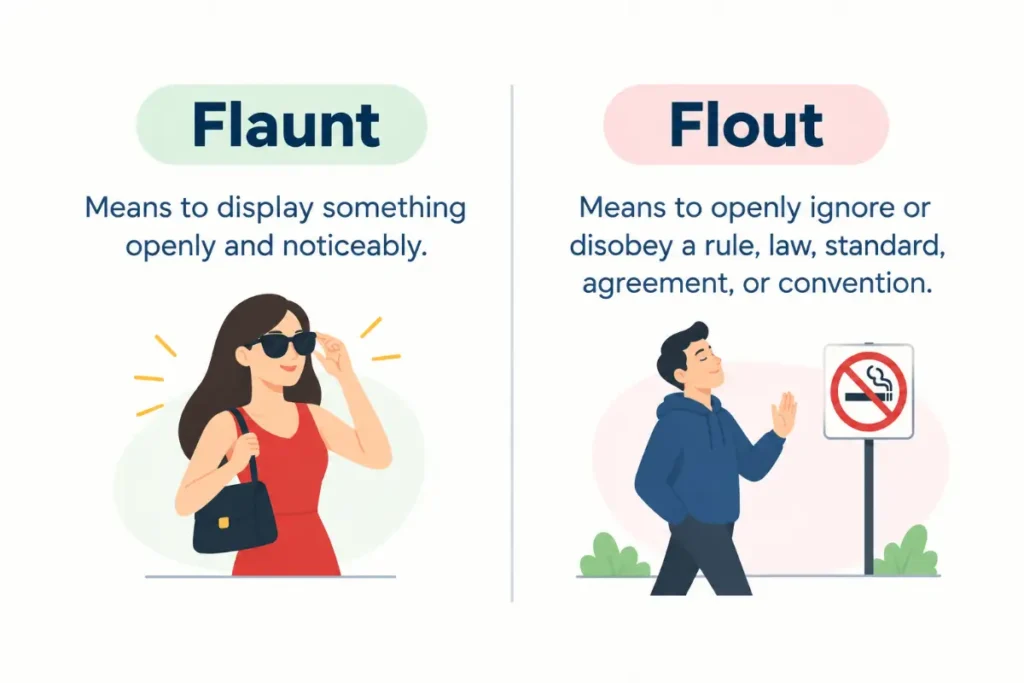
- Flaunt means to display something openly and noticeably.
- Flout means to openly ignore or disobey a rule law standard agreement or convention.
- You can flaunt possessions achievements qualities or advantages.
- You can flout laws regulations rules standards and expectations.
- Flaunt often suggests showing off but its tone depends on context.
- Flout usually suggests deliberate disregard.
- The simplest memory trick is show versus ignore.
- You flaunt a new car.
- You flout a speed limit.
- Both words are standard in American and British English.
A related grammar guide is Well Deserved Meaning Spelling And Usage.
Conclusion
The difference between flaunt vs flout comes down to the action you’re describing. Flaunt means to show off something such as wealth, success, or possessions. Flout means to openly disregard a rule, law, custom, or accepted standard. Both words are correct, and neither is a misspelling of the other. The easiest way to remember them is to connect flaunt with showing off and flout with defying rules.
Before you finish a sentence, check the word’s object and intended meaning. That small habit will help you avoid confusion and make your writing clearer, more accurate, and more professional.
FAQs
Is Flaunt a Real Word?
Yes. Flaunt is a standard English verb that means to display something conspicuously, often to attract attention or admiration. You can flaunt wealth, possessions, achievements, or personal style. The word can suggest vanity, but it can also describe someone proudly displaying an accomplishment. Its tone depends on the sentence and the surrounding context.
Is Flout a Real Word?
Yes. Flout is a standard English verb meaning to openly disregard or defy a rule, law, custom, or accepted standard. For example, a business may flout safety regulations, or a person may flout a dress code. The word often suggests deliberate disregard rather than an innocent mistake or simple lack of awareness.
Which Word Should I Use for Breaking Rules?
Use flout when someone deliberately disregards a rule or expectation. For example, “The driver flouted the parking restrictions” means the driver ignored them. Flaunt is not the right choice for that meaning. It describes showing something off, such as wealth, an award, or a new possession, rather than disregarding a requirement.
How Do You Pronounce Flaunt and Flout?
Flaunt is commonly pronounced /flɔnt/ in American English, with a vowel similar to the one in haunt for many speakers. Flout is pronounced /flaʊt/, rhyming with out. Both words have one syllable. Pay attention to the vowel sound when speaking, and use the sentence meaning to confirm that you’ve chosen the correct word.
Can Flaunt or Flout Start a Sentence?
Yes. Both words can begin a sentence in their base form when the subject follows. For example, “Flaunt your skills with confidence” is an instruction, while “Flout the rules at your own risk” warns against disregarding rules. You can also begin a sentence with a participial phrase, as in “Flouting the rules, he risked a penalty.”
What Is a Good Synonym for Flaunt?
Show off is often the closest everyday synonym for flaunt. Display and exhibit are more neutral alternatives, while boast usually emphasizes talking proudly about an achievement or possession. The best choice depends on the tone you want. Use show off for casual conversation and display when you want to describe something without suggesting vanity or a desire for attention.
What Is a Good Synonym for Flout?
Disregard, defy, and violate can work as alternatives, but their meanings differ slightly. Disregard emphasizes a lack of attention or respect. Defy suggests open resistance to authority. Violate emphasizes breaking a rule, law, or agreement. Flout is especially useful when you want to convey that someone openly disregards an established standard or convention.
Is This Distinction Important in Formal Writing?
Yes. Using the wrong verb can change the meaning of a sentence and weaken your credibility. A report about a company that flaunts regulations may sound as if the company is displaying them rather than ignoring them. In professional, academic, and journalistic writing, choose the word that matches the action and review the surrounding context before submitting your work.