

If you’ve ever paused while typing accross vs across and wondered which spelling is correct, you’re not alone. Across is the correct spelling in standard English, while accross is a common misspelling. You should always use the correct form in school assignments, emails, professional documents, and everyday writing.
The confusion is understandable. English has many words with doubled consonants, so it’s easy to add an extra letter by mistake. However, across contains only one c followed by two s’s. Learning this simple spelling pattern will help you avoid the error and write with confidence.
The word appears in many everyday situations. You might walk across a street, send a message across the country, or describe an idea that comes across as friendly. No matter how you use it, the spelling stays the same.
Still confused? Compare former vs latter Explained With Clear Examples.
Quick Answer
Across is the correct spelling. It means from one side to the other, on the opposite side, or throughout an area or group. Accross is a common spelling mistake rather than a standard English variant. Use one c and two s’s whenever you write this word.
Is across or accross correct?
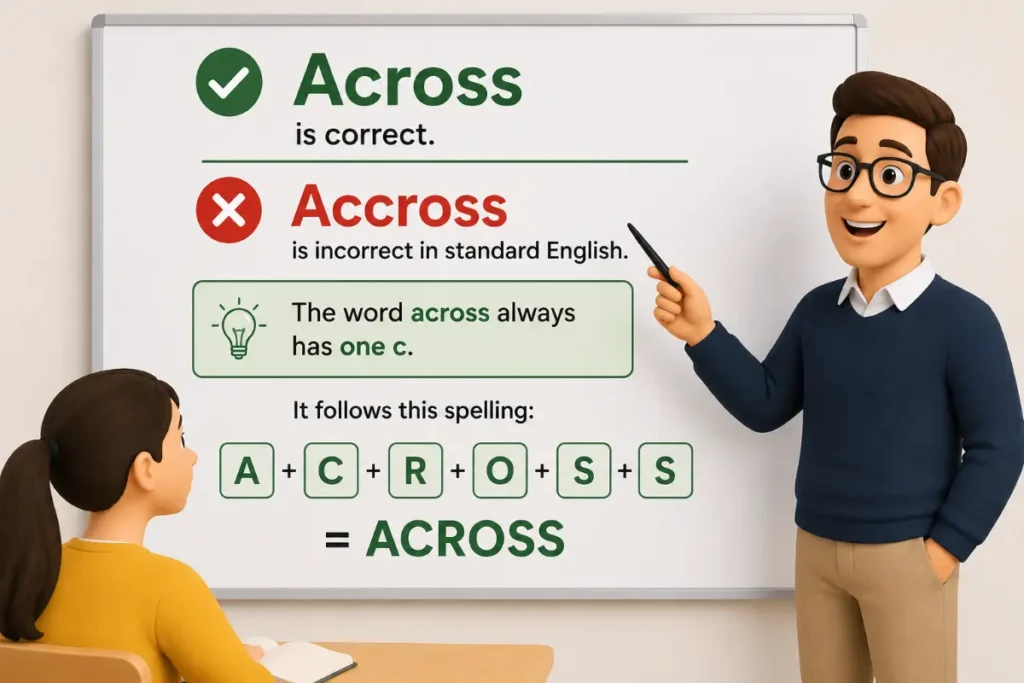
Across is correct. Accross is incorrect in standard English.
The word across always has one c. It follows this spelling:
A + C + R + O + S + S = ACROSS
The incorrect form adds an extra c:
A + C + C + R + O + S + S = ACCROSS
That extra c doesn’t belong there.
A useful way to remember this is to focus on the beginning of the word. Think a cross rather than ac cross. The phrase “a cross” isn’t the historical source of the modern spelling, but it can work as a simple memory trick.
Comparison Table
| Feature | Across | Accross |
|---|---|---|
| Spelling status | Correct standard spelling | Common misspelling |
| Meaning | From one side to another or on the opposite side | No separate standard meaning |
| Part of speech | Preposition and adverb | Not a standard form |
| Pronunciation | Uh cross | Usually intended to mean across |
| Formal writing | Appropriate | Should be corrected |
| American English | Standard | Nonstandard spelling |
| British English | Standard | Nonstandard spelling |
| Common contexts | Travel, direction, communication, reading, and description | Accidental typing and spelling errors |
| Example | We walked across the bridge. | We walked accross the bridge. |
Meaning and Definition
What Across Means
Across is a standard English word that describes movement from one side to another, a position on the opposite side, or something that extends through an area. It can also describe the spread of information, feelings, or activity among people and places.
The word has two main grammatical roles. It works as a preposition when it connects a noun or pronoun to another part of the sentence. It works as an adverb when it describes movement or position without taking an object directly.
Consider these examples.
- We drove across the state to visit our grandparents.
- The pharmacy is across the street.
- News of the award spread across the school.
- She glanced across and smiled at her friend.
In the first example, the word describes movement through an area. In the second, it identifies a location on the opposite side.
These uses share a central idea of crossing, spanning, or reaching from one point to another.
What Accross Means
Accross is not the standard spelling of an ordinary English word. In most cases, it appears when someone accidentally adds an extra c to the correct form.
For example, writing I ran accross the field creates a spelling error. The corrected sentence is I ran across the field. The meaning stays the same, but the corrected version follows standard English spelling.
You may occasionally encounter the unusual spelling in a username, a business name, a fictional name, or a deliberately misspelled message. Such uses depend on the name or context. They don’t establish accross as a standard alternative in ordinary writing.
If a spelling checker marks this form as an error, it is usually identifying the extra c. Unless you are reproducing an exact name or quotation for a specific reason, use the established spelling.
Key Differences Explained
Spelling
The main difference is the number and placement of the letters c and s.
The correct spelling contains one c followed by two s’s. The incorrect form contains two c’s followed by two s’s.
- Correct: across.
- Incorrect: accross.
A helpful way to remember the pattern is to look at the middle of the word. Write one c and then two s’s. You don’t need to double the c to make the word sound right.
Meaning
Across has several related meanings, but the extra c doesn’t create a different standard meaning. Both spellings are often intended to communicate the same idea, yet only one is accepted in ordinary standard English.
For instance, The cat ran across the yard describes movement from one part of the yard to another. The misspelled version would not change the intended meaning, but it would still need correction in polished writing.
Grammar and Part of Speech
Across functions as a preposition or an adverb. Its grammatical role depends on how it appears in a sentence.
As a preposition, it commonly comes before a noun phrase.
- The children walked across the playground.
- A narrow path runs across the garden.
Here, the playground and the garden complete the phrases that follow the preposition.
As an adverb, it can describe movement or position without a directly following object.
- The ball rolled across.
- She looked across and waved.
The sentence structure determines the function. In neither role is the extra c appropriate.
Pronunciation
In standard American English, across is commonly pronounced /əˈkrɔːs/, with some variation in the vowel sound across accents. The first syllable is unstressed, and the second syllable carries the main stress.
Adding another c in writing doesn’t normally change the intended pronunciation. That’s one reason the spelling error can survive a quick proofread. Your ears may recognize the word correctly even when your fingers type it incorrectly.
Formality
Across is suitable for casual conversation, academic writing, business communication, journalism, and formal reports. It is a normal part of everyday English rather than a word limited to a particular style.
The misspelled form is unsuitable for standard professional writing. A reader will generally understand what you mean, but the error can distract from your message and make the document appear less carefully edited.
Regional Usage
American, British, Canadian, and Australian English all use across as the standard spelling. There is no established regional spelling rule that makes the additional c correct in any of these varieties.
The vowel in the spoken word can vary by accent, but the spelling remains the same. This is a spelling issue rather than a difference between national varieties of English.
Which Form Is Correct
Across is correct because it is the established spelling recognized in standard English. Accross is a misspelling caused by adding a c that the word does not contain.
English spelling often preserves patterns that cannot be predicted from sound alone. The best approach is to learn the accepted written form instead of trying to create a spelling based on how the word feels when spoken.
Established dictionaries list across as the standard word and explain its uses in relation to movement, position, and extension. A spelling error does not become an accepted variant simply because many people make it.
When editing a document, correct the extra c unless the form appears intentionally in a proper name or in material that must be reproduced exactly.
Sentence Examples
The following examples show how the correct spelling works in different situations.
1. Everyday conversation. I walked across the street to buy a cup of coffee.
2. Text messages. I’ll meet you across from the movie theater.
3. Workplace communication. Please share the updated report across all departments.
4. School assignments. The students compared weather patterns across several regions.
5. Academic writing. The researchers observed similar trends across the three study groups.
6. Formal writing. The new policy will apply across the entire organization.
7. Social situations. I spotted an old friend across the room.
8. Online communication. The announcement reached readers across the country within hours.
9. Travel. We drove across the desert before stopping for the night.
10. Storytelling. A soft light shone across the empty hallway.
Each sentence uses the same spelling. The surrounding words change the meaning slightly, but the spelling remains consistent.
Examples of the Common Misspelling
These examples show errors that you may encounter when proofreading. The incorrect form is included only to demonstrate what needs fixing.
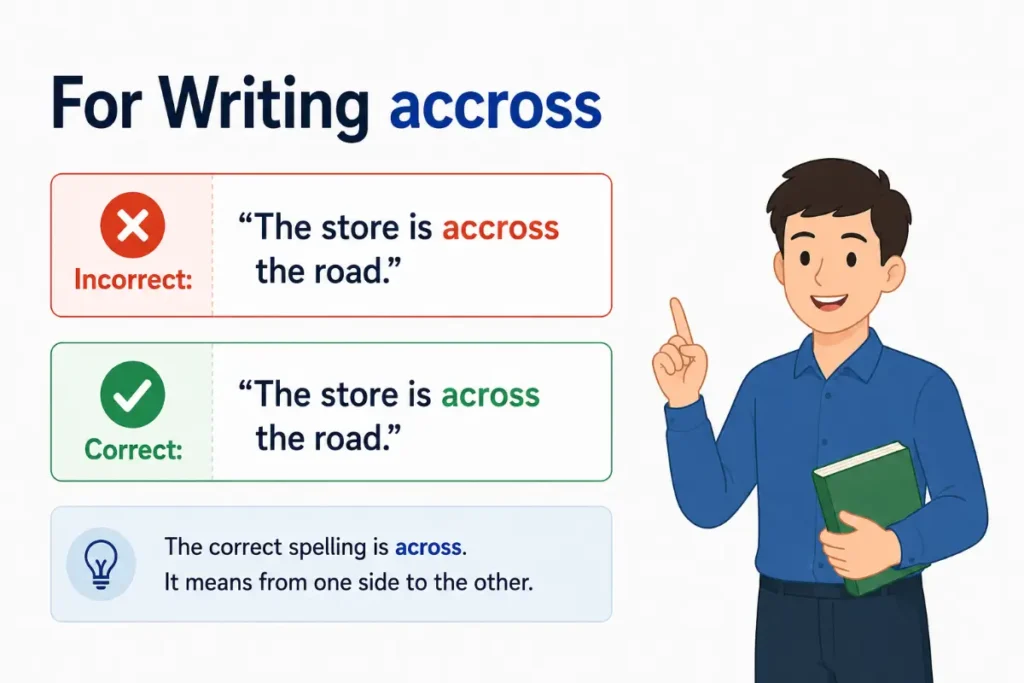
1. Incorrect: We walked accross the bridge. Correct: We walked across the bridge.
2. Incorrect: The news spread accross the town. Correct: The news spread across the town.
3. Incorrect: She looked accross the room. Correct: She looked across the room.
4. Incorrect: The road runs accross the valley. Correct: The road runs across the valley.
5. Incorrect: Please send this file accross the team. Correct: Please send this file across the team.
In the last example, the wording may also need revision depending on the intended meaning. You might say send this file to the team or share this file across the team. Correct spelling is essential, but good editing also checks that the sentence expresses the intended idea clearly.
Common Mistakes and Misspellings
The extra c is the main spelling problem, but a few related habits can make the error more likely. Recognizing these patterns can help you catch mistakes before they reach a finished document.
Adding an Extra C
This is the most direct error. Writers may type accross because they remember the sound but not the exact letter sequence. The fix is simple: write one c followed by two s’s.
Incorrect: The river flows accross the plain.
Correct: The river flows across the plain.
Confusing Spelling With Pronunciation
The spoken word doesn’t clearly announce how many letters belong in its written form. Since the incorrect and correct spellings usually represent the same intended word, listening carefully won’t reliably reveal the mistake.
Instead, learn the spelling as a visual pattern. If you notice the word in a book or a trusted dictionary, take a moment to remember its single c.
Typing Too Quickly
Fast typing can lead to repeated letters, skipped letters, and accidental substitutions. The extra c may appear when you’re writing quickly and your attention is focused on the meaning rather than the spelling.
A quick proofreading pass often catches this kind of error. Spellcheck can also help, especially when the misspelled form appears in a document containing many similar words.
Assuming a Familiar Error Is Acceptable
Seeing a spelling mistake repeatedly online can make it look normal. However, frequent use does not automatically make a spelling standard. Writers should distinguish between a recognized variant and a form that appears because people make the same error.
For ordinary English writing, across remains the accepted form.
Mixing Up Across and Cross
The words across and cross are related in meaning, but they serve different grammatical roles. Cross can function as a verb meaning to move from one side to another. Across commonly expresses the direction or extent of that movement.
For example, Cross the road carefully gives an instruction. Walk across the road carefully uses a different sentence structure to express a similar idea.
Neither word requires the extra c found in the common misspelling.
Learn the difference in Adapter vs Adaptor Which Spelling Is Correct.
Pronunciation Guide
Across has two syllables. Its first syllable is weak, while the second receives the main stress.
Standard American English
Across
IPA: /əˈkrɔːs/
Easy guide: uh KRAWS.
Stress pattern: The second syllable is stressed.
The vowel in the second syllable may sound slightly different depending on the speaker’s accent. Some American speakers use a vowel closer to the sound in thought, while other accents may differ. These variations do not change the accepted spelling.
How to Say It Clearly
Start with a short, relaxed first syllable. Then pronounce the second syllable with a stronger beat, ending with the s sound. Avoid giving both syllables equal stress, as that can make the word sound less natural.
The common spelling mistake doesn’t normally indicate a different pronunciation. Most people who write the incorrect form intend to say the same word. This makes spelling memory and proofreading more useful than trying to identify the error by sound alone.
Etymology and Word Origin
Across developed from earlier forms of English that expressed movement or position from one side to another. Its history is connected to the older word cross, which refers to a crossing, an intersection, or the act of moving from one side to another.
The word cross entered English through Old French, with roots in Latin crux, meaning a cross. Over time, English developed expressions that combined the idea of crossing with the sense of moving from one side to the other.
The modern word now covers more than physical movement. People use it to describe communication across a country, differences across generations, and patterns across a group of people. These meanings grew from the central idea of spanning or reaching from one point to another.
The spelling accross does not represent a separate historical stage that modern writers should use. In ordinary contemporary English, the accepted spelling is across.
Regional Usage
American English
Across is the standard form in the United States. It appears in everyday speech, schoolwork, news reports, business documents, and academic writing.
American English does not add a second c. If you are writing for a US audience, use the same spelling in both casual and formal contexts.
British English
British English also uses across as the standard spelling. There is no general British spelling rule that accepts the extra c.
Some differences between American and British spelling involve words such as color and colour. This word is not one of those cases. Its standard spelling remains the same in both varieties.
Australian English
Australian English follows the same standard spelling. Writers use across in education, government communication, news reporting, and everyday conversation.
An additional c is still a spelling error in ordinary Australian English.
Canadian English
Canadian English also uses across. Although Canadian spelling includes some conventions that differ from American usage, this word is not a regional exception.
The practical rule is simple. Use across in standard English regardless of the intended audience.
Grammar Rules and Part of Speech
Understanding how the word functions in a sentence makes it easier to use correctly. Across usually appears in expressions involving location, direction, distance, distribution, or communication.
Using Across as a Preposition
A preposition connects a noun or pronoun to another part of a sentence. Across often comes before a noun phrase that identifies the place, area, or group involved.
Examples include:
- The children ran across the field.
- A bridge stretches across the river.
- The company operates across several states.
- We could hear music from across the street.
In each example, the phrase after across completes the meaning. The word explains the direction of movement, the area covered, or the location from which something can be heard.
Using Across as an Adverb
An adverb can describe an action or provide information about position without taking a direct object after it. Across can work this way in sentences where the destination or reference point is already clear.
For example, She moved across may be appropriate if the surrounding conversation makes the direction clear. Similarly, He looked across and nodded describes the direction of his gaze without naming the place he looked over.
The surrounding context helps readers understand the intended meaning.
Common Grammatical Patterns
Across appears in several familiar sentence patterns.
- Movement across a place. They ran across the park.
- Position on the opposite side. The library is across the road.
- Distribution throughout an area. The service is available across the state.
- Communication among groups. The message was shared across departments.
- An impression created by behavior. Her response came across as sincere.
These patterns show why the word is useful. It can describe physical space, the reach of an activity, or the impression created by a person’s words and actions.
Punctuation and Sentence Position
Across does not need special punctuation. It can appear at the beginning, middle, or end of a sentence when the structure and meaning support that position.
For example, Across the street, a small bakery opened early places the location at the beginning for emphasis. The comma separates the opening phrase from the main clause. The comma is used because of the sentence structure, not because across itself requires punctuation.
At the end of a sentence, the word can also appear naturally when its meaning is clear from context. Always choose punctuation based on the full sentence rather than the word alone.
Formal and Informal Usage
Across is appropriate in both formal and informal writing. You can use it in a casual message such as I’ll be across the street or in a report such as The policy applies across all regional offices.
The key is clarity. Some sentences may call for a more specific preposition. For example, send the document to all departments may sound clearer than send the document across all departments if you mean to distribute a file to each department.
Correct spelling is only one part of good writing. The word should also match the intended relationship between the people, places, or ideas in your sentence.
Real Life Usage Examples
The word appears in many kinds of writing because it connects ideas about space, movement, reach, and perception. The examples below show how its meaning shifts with the situation.
Daily Conversation
In everyday speech, across often describes a location or a simple action. The meaning is usually clear from the surrounding words.
- Can you see the grocery store across the road?
- I waved to my neighbor from across the yard.
Both sentences use the word to help the listener picture a place. The first identifies a location on the opposite side of a road. The second describes the position from which someone waves.
Email and Workplace Communication
At work, the word often describes communication, coverage, or activity that reaches several teams or locations.
- The updated schedule has been shared across all regional offices.
- We need better communication across the sales and support teams.
These examples refer to the spread of information and cooperation between groups. In professional writing, check that the sentence names the intended relationship clearly.
Academic Writing
Academic writing often uses across to describe patterns that appear in multiple groups, regions, periods, or studies.
- The survey found similar responses across all age groups.
- The researchers compared reading habits across several school districts.
The word helps writers describe the scope of an observation without repeating longer phrases such as in every group included in the study.
News and Journalism
Journalists use across to describe events that affect broad areas or reach many communities.
- Heavy rain caused delays across the region.
- The campaign attracted support across the country.
In the first sentence, the word describes the geographic reach of the delays. In the second, it shows that support came from different parts of the country.
Literature and Storytelling
Writers often use the word to establish a scene or guide the reader’s attention.
- Moonlight fell across the wooden floor.
- A distant voice echoed across the valley.
These sentences show how a single preposition can help readers picture light, sound, and distance. The word works well in descriptive writing because it connects an action or image to the space around it.
Related and Confused Terms
Several English words share meanings or contexts with across. Learning the differences helps you choose the clearest expression for your sentence.
Cross
Cross can be a verb meaning to move from one side to another. It can also be a noun referring to a shape or structure.
Example: Cross the bridge before sunset.
Across often describes the path or direction of movement.
Example: Walk across the bridge before sunset.
Through
Through commonly describes movement from one side or end of a space to the other by passing within it.
Example: We drove through the tunnel.
Across generally emphasizes movement from one side to another or the span of an area. Through emphasizes passing inside or within something.
Over
Over can describe movement above something or from one side to another.
Example: The plane flew over the mountains.
Across usually emphasizes the span from one side to another. Over can emphasize height or movement above a surface, though the meanings sometimes overlap.
Beyond
Beyond means farther than a particular point or outside a defined limit.
Example: The village lies beyond the hills.
Across focuses on a span or opposite position. Beyond focuses on distance past a point or boundary.
Opposite
Opposite describes something located facing or directly across from another thing.
Example: The bank is opposite the post office.
Across can express a similar location when used in a phrase such as across from the post office. The choice depends on sentence structure and emphasis.
Throughout
Throughout means in every part of an area or during the whole of a period.
Example: The announcement spread throughout the organization.
Across can also describe broad distribution, as in the announcement spread across the organization. Throughout places stronger emphasis on the whole area or group.
Around
Around often describes movement in a surrounding area, a route that avoids an obstacle, or a position near something.
Example: We walked around the building.
Across suggests movement from one side to another. Around suggests movement along the outside or within the surrounding area.
Across From
Across from is a common phrase used to describe a location on the opposite side of a space.
Example: The café is across from the library.
The phrase is especially useful when giving directions. It tells the reader or listener how two locations relate to one another.
Is accross ever correct?
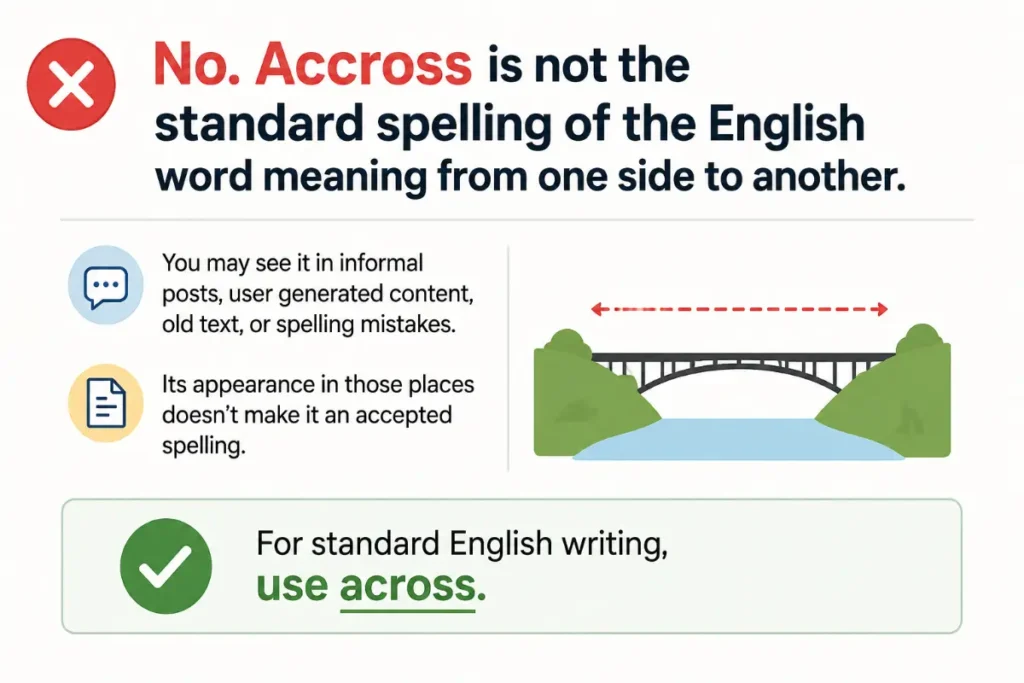
No. Accross is not the standard spelling of the English word meaning from one side to another.
You may see it in informal posts, user generated content, old text, or spelling mistakes. Its appearance in those places doesn’t make it an accepted spelling.
For standard English writing, use across.
Expert Editor Insight
An experienced editor treats across as a straightforward standard spelling and corrects the extra c in ordinary writing. The error often slips through because it doesn’t change the intended pronunciation, so a writer may overlook it while rereading a sentence. Spellcheck can catch many instances, but proper names and unusual terms may need human review. A useful editing habit is to check spelling and meaning separately. First confirm that each word is written correctly. Then read the full sentence to make sure the word expresses the intended direction, location, or relationship.
Many readers also check fair vs good Meaning and Usage Explained.
Conclusion
The spelling question accross vs across has a simple answer. Across is the correct form in standard English, while accross is a common misspelling caused by adding an extra c. The correct word describes movement from one side to another, a position on the opposite side, or something that extends through an area or group.
Its spelling stays the same in American, British, Canadian, and Australian English. To remember it, focus on the letter pattern: one c followed by two s’s. Before submitting an email, assignment, or report, check for the extra c. This small habit will help you write with greater accuracy and confidence.
FAQs
Is Accross a Real Word?
Accross is not a standard spelling of an ordinary English word. It usually appears as a misspelling of across, with an extra c added by mistake. You might see it in a business name, username, or deliberately altered text, but those special uses don’t make it a standard spelling. In everyday writing, use across.
What Does Across Mean?
Across generally means from one side to another, on the opposite side, or extending through an area or group. You might walk across a street, live across from a store, or see a policy applied across several departments. The exact meaning depends on the sentence, but the central idea involves a span, direction, or relationship between points.
Which Is Correct Accross or Across?
Across is correct in standard American English and other major English varieties. Accross contains an extra c and is considered a spelling error in ordinary writing. The two forms usually represent the same intended word when someone makes the mistake, so the difference is spelling rather than meaning. Use the single c form in emails, essays, reports, and everyday messages.
How Do You Pronounce Across?
Across has two syllables, with the main stress on the second syllable. In standard American English, it is commonly represented by the IPA transcription /əˈkrɔːs/, though vowel quality varies by accent. A simple pronunciation guide is uh KRAWS. The extra c in the misspelling usually doesn’t change how people say the intended word, so pronunciation alone may not reveal the error.
Can Across Start a Sentence?
Yes. Across can begin a sentence when it introduces a location or direction. For example, Across the street, a new restaurant opened last week. The opening phrase sets the scene before the main clause gives more information. A comma often follows an introductory phrase of this kind, depending on its length and the sentence structure.
What Is a Synonym for Across?
The best alternative depends on the meaning. Cross may work for movement, through may describe passing inside a space, and throughout may describe something present in every part of an area. Opposite can describe a location facing another place. These words are not interchangeable in every sentence, so choose the one that matches the intended relationship.
Why Do People Misspell Across?
People often write accross because they remember the sound but accidentally add an extra c. Fast typing and repeated exposure to the same mistake can also contribute. Since the incorrect spelling usually sounds like the intended word, pronunciation offers little help. Learning the letter pattern and proofreading the written form are reliable ways to reduce this error.
Is Across Appropriate in Formal Writing?
Yes. Across is a standard word used in professional reports, academic papers, news articles, and formal communication. It can describe movement, geographic reach, distribution, or relationships between groups. The main concern is choosing the right phrase for the intended meaning. The spelling accross should be corrected in formal writing unless it is part of a name that must remain unchanged.