
Have you ever paused while writing about a delicious chocolate cake or a long trip across a dry landscape because you couldn’t remember which spelling to use? The difference between desert vs dessert comes down to meaning, spelling, and pronunciation. Both are correct English words, but they describe very different things.
A dessert is a sweet food you enjoy after a meal. A desert is a dry region that receives little rainfall. Mixing them up can turn an ordinary sentence into an amusing mistake. For example, saying you crossed a dessert to reach a small town suggests you traveled across a giant piece of cake instead of a dry landscape.
The good news is that you don’t need to memorize a long grammar rule to get these words right. A simple spelling trick, a little attention to pronunciation, and a few everyday examples can make the distinction easy to remember. You’ll also learn how each word works in a sentence, where the words came from, and which mistakes to avoid in American English.
Learn the difference in Elicit vs Illicit Meaning and Usage Explained.
Short Answer
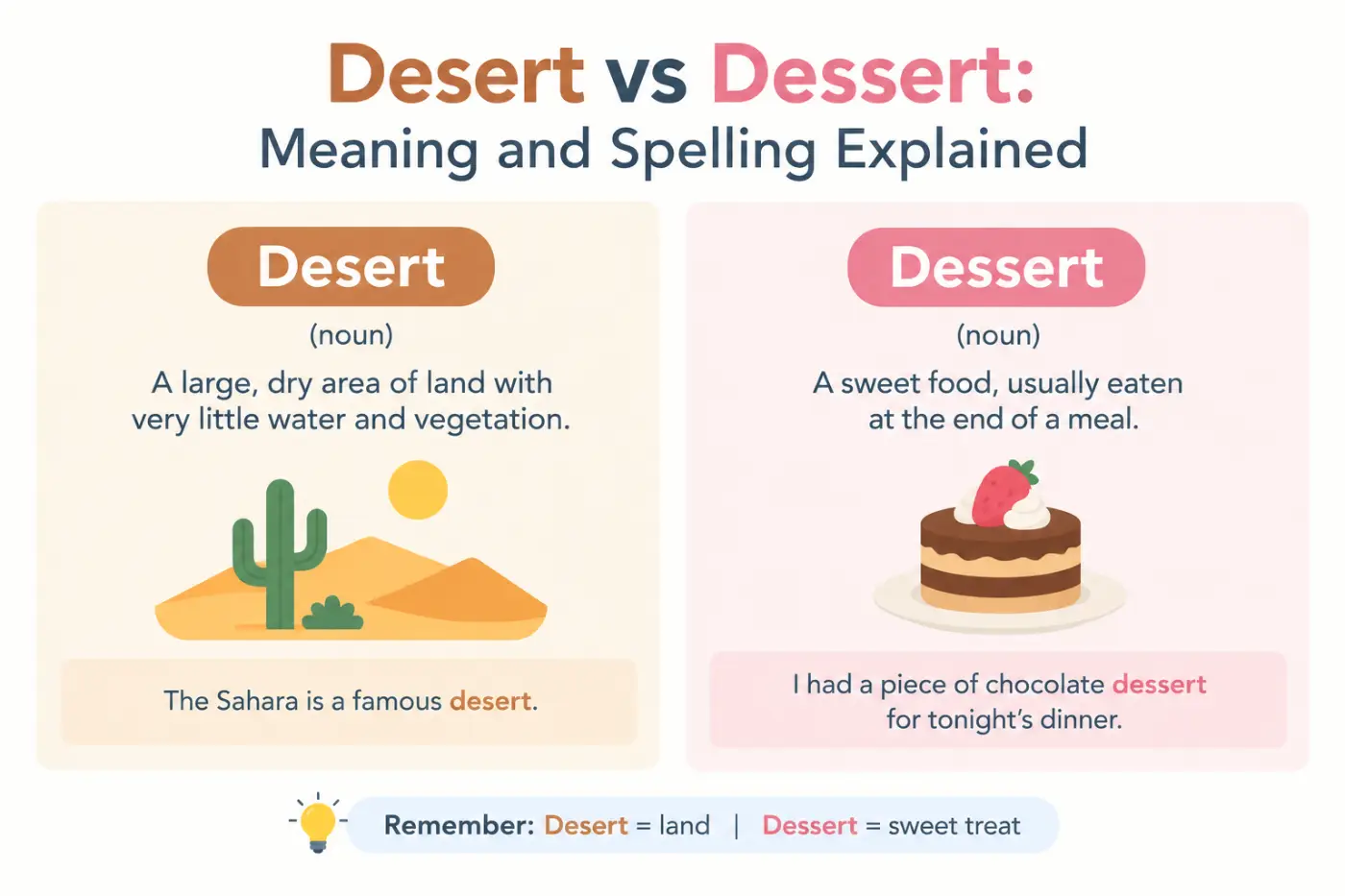
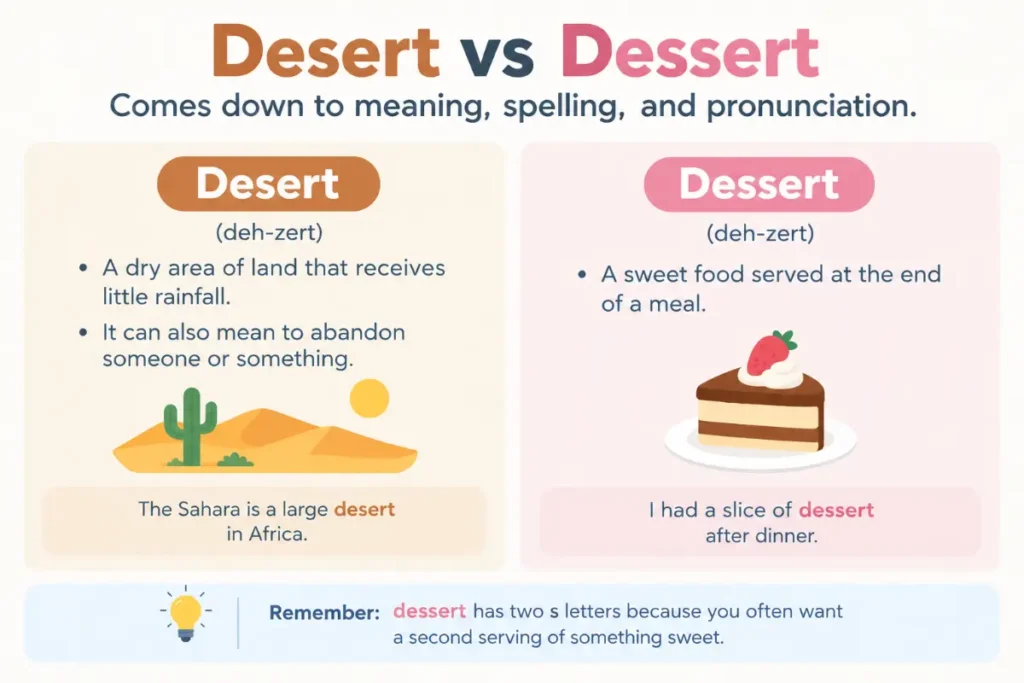
Dessert means a sweet food served at the end of a meal, such as cake, ice cream, or pie. Desert usually means a dry area of land with very little rainfall. Both words are spelled correctly, but dessert has two letters s in the middle, while desert has one.
The Main Difference Between the Two Words
The easiest way to tell these words apart is to picture what each one describes. One belongs on a plate after dinner. The other describes a landscape that may stretch for miles under a hot sun.
Dessert is a noun that refers to a sweet dish served after a meal. Common examples include brownies, cookies, pudding, cheesecake, and fruit pie. In the United States, people often use the word when talking about restaurant menus, birthday celebrations, and family dinners.
Desert is most often a noun that describes a dry region with little rainfall. The Sahara in Africa and the Mojave in the southwestern United States are familiar examples. Some deserts are extremely hot, while others are cold and can receive snow.
The words also differ in pronunciation. In its usual noun form, dessert has stress on the second syllable. The noun desert has stress on the first syllable. This sound difference can help you choose the correct spelling when speaking or writing.
Comparison Table
| Feature | Dessert | Desert |
|---|---|---|
| Main meaning | A sweet dish served after a meal | A dry region with little rainfall |
| Part of speech | Noun | Noun and verb |
| Spelling | Two s letters | One s letter |
| Pronunciation | dih ZURT | DEH zurt |
| Syllables | Two | Two |
| Main stress | Second syllable | First syllable as a noun |
| Common contexts | Meals restaurants recipes | Geography travel nature |
| Example | We ordered dessert after dinner. | The desert receives little rain. |
| Formality | Standard English | Standard English |
| Common association | Cake and ice cream | Sand and dry land |
The table shows the main distinction, but desert has another meaning that deserves attention. As a verb, desert means to abandon someone or something, often when support or loyalty is expected. For example, a soldier may desert a post, or a person may desert a friend in a difficult situation.
Meaning and Definition
What Does Dessert Mean
Dessert is a noun for a sweet food or dish served at the end of a meal. It can be simple, such as a bowl of fresh berries, or elaborate, such as a layered chocolate cake with frosting.
The word often appears in restaurants and recipes, but people also use it in casual conversation. You might ask a friend what they want for dessert or tell a family member that you’ve saved room for something sweet.
Here are three common ways to use the word.
- As a general food category. Ice cream is my favorite dessert.
- As the final course of a meal. The restaurant serves dessert after the main course.
- As part of a social occasion. We brought a homemade dessert to the holiday party.
Dessert doesn’t have to contain chocolate or added sugar. Fresh fruit, sweet cheese dishes, and other sweet preparations can also count as desserts, depending on the meal and local customs.
The word can be singular or plural. You might say that a restaurant offers one dessert special or several desserts. In normal American writing, the spelling stays the same apart from the final s used for the plural.
What Does Desert Mean
As a noun, desert refers to a region that receives very little precipitation compared with the amount of water that could evaporate from it. Deserts often have limited plant growth, but they aren’t all empty stretches of sand.
Some contain rocky ground, gravel plains, mountains, shrubs, and specialized plant life. The Antarctic region is also classified as a desert because it receives very little precipitation. This makes one thing clear: a desert is defined mainly by its dryness, not by its temperature.
Examples of desert regions include the following.
- The Sahara Desert. A vast dry region in northern Africa.
- The Mojave Desert. A desert in the southwestern United States.
- The Antarctic Desert. A cold desert that covers much of Antarctica.
The word also appears in phrases such as desert climate, desert wildlife, and desert landscape. In each phrase, it relates to a dry environment.
The Verb Form of Desert
Desert can also function as a verb. It means to leave a person, place, duty, or responsibility behind, often at a time when continued support is expected.
For example, a writer might say, “He refused to desert his teammates during the crisis.” Here, the word has nothing to do with a dry landscape. It describes abandoning other people.
The verb also appears in the phrase deserted island. In this expression, deserted means that people have left the island or that nobody lives there. The spelling contains one s in the middle, just like the noun for a dry region.
This extra meaning explains why context matters. If you read that a village was deserted, the sentence means people had left it. It doesn’t mean the village had become a desert.
Why the Spellings Are Different
The extra s in dessert is the most useful visual clue. It separates the two words on the page and helps readers recognize the intended meaning.
Think of dessert as the word with an extra serving of s. You get two s letters in the middle because the word has a double s spelling. Desert has only one s in the middle, and its noun form usually refers to dry land.
This trick works well in everyday writing because you can check the spelling quickly before sending a text or finishing an assignment. However, it helps to connect the spelling with the meaning instead of relying on the letters alone.
Try this simple memory aid.
- Dessert has two s letters. Think of wanting seconds of a sweet treat.
- Desert has one s letter. Think of a dry stretch of land with very little water.
- Read the whole sentence. If it describes food, use dessert. If it describes a dry region, use desert.
The memory trick won’t explain every use of the verb desert, but it handles the most common confusion. When the word means abandon, look at the action described in the sentence.
Which Spelling Is Correct
Both spellings are correct in standard English. The correct choice depends on the meaning you want to express, not on a rule that makes one spelling acceptable and the other wrong.
Use dessert when you mean a sweet dish. Use desert when you mean a dry region or the act of abandoning someone or something.
For example, “We ate dessert after dinner” is correct because the sentence describes food. “We drove across the desert” is correct because the sentence describes travel through a dry region.
A spelling checker may not catch the mistake if you use the wrong word in a grammatically valid sentence. Both words appear in standard dictionaries, so a program might accept a sentence even when the meaning is wrong. Proofreading for meaning is just as important as checking spelling.
If you write “The children enjoyed the desert after lunch,” the spelling tool may not flag anything. Yet readers may imagine that the children ate a dry landscape instead of a sweet dish. A quick reread can catch the problem.
Sentence Examples
These examples show how the words fit naturally into everyday American English. Notice the context in each sentence and how it points to the intended meaning.
Examples Using Dessert
- We ordered chocolate cake for dessert after dinner.
- My sister made a strawberry dessert for the family barbecue.
- The restaurant offers three desserts on its evening menu.
- I usually prefer fruit for dessert when I’ve had a big meal.
- The kids helped decorate cupcakes for the school celebration.
- Would you like dessert, or are you too full?
- I brought a homemade dessert to the office potluck.
- The recipe makes enough pudding for six dessert servings.
- We skipped dessert because we wanted to get home early.
- The chef created a new dessert with fresh peaches and vanilla cream.
Examples Using Desert
- The family drove across the desert during their summer vacation.
- Temperatures in the desert can change sharply after sunset.
- The cactus can survive in parts of the desert with very little water.
- Our science class studied how desert plants conserve moisture.
- The travelers packed extra water before entering the desert.
- A rare rainstorm brought new life to the desert landscape.
- The Mojave Desert covers parts of several southwestern states.
- Scientists study how animals adapt to desert conditions.
- The road crossed a rocky desert before reaching the mountains.
- The desert looked endless from the top of the hill.
Using Desert as a Verb
- The captain warned the soldiers not to desert their posts.
- She promised she wouldn’t desert her friend during a hard time.
- Several residents began to desert the town after the factory closed.
- He felt that his teammates had deserted him when the project failed.
- The soldiers faced serious consequences for choosing to desert the army.
These examples also show why the sentence matters. A word can be spelled correctly but still be the wrong choice for the meaning you intend.
Common Mistakes and Misspellings
People often confuse these words because they share nearly all their letters. The main difference is a single extra s, but that small detail changes the meaning.
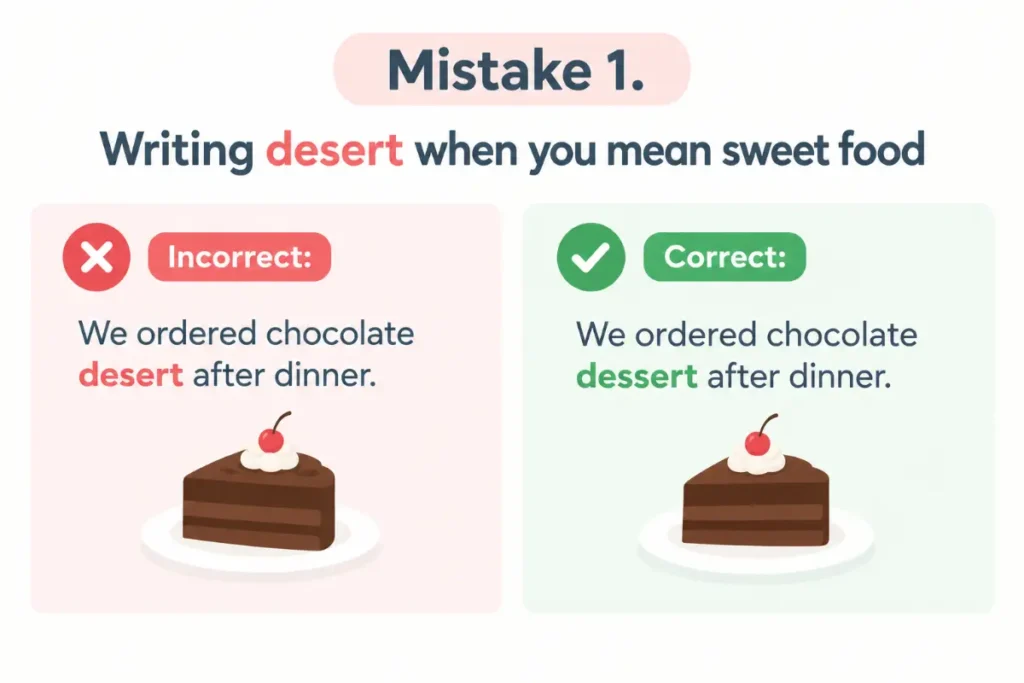
Using Desert When You Mean Dessert
Incorrect: We had ice cream for desert.
Correct: We had ice cream for dessert.
The sentence describes food served after a meal, so the spelling needs two s letters. The single s spelling points to dry land or the verb meaning abandon.
Using Dessert When You Mean Desert
Incorrect: The travelers crossed the dessert.
Correct: The travelers crossed the desert.
The sentence describes a journey across a dry region. The extra s changes the word into the name for a sweet dish.
Mixing Up the Verb Desert
Incorrect: He would never dessert his family.
Correct: He would never desert his family.
The sentence describes abandoning family members, not serving them food. The verb uses one s in the middle.
Assuming Every Desert Is Hot
This is a meaning mistake rather than a spelling mistake. Many people picture sand dunes and intense heat when they hear the word, but some deserts are cold.
A desert receives very little precipitation. Temperature alone doesn’t determine the classification, so a cold polar region can qualify as a desert.
Relying Only on Spell Check
A spelling tool may accept both words because both are valid. If you type the wrong one into a sentence, the program may not recognize the meaning problem.
For example, “I ordered a desert” is grammatically possible but probably incorrect if you mean a sweet course after dinner. Read the sentence for meaning before trusting the software.
Pronunciation Guide
The two words have different stress patterns in standard American English. Learning to hear that difference can make the spelling easier to remember.
Learn the difference in Adapter vs Adaptor Which Spelling Is Correct.
Dessert
IPA: /dɪˈzɝt/
Pronounced dih ZURT. Stress the second syllable. The ending sounds like the word hurt in many American accents.
Desert as a noun
IPA: /ˈdɛzɚt/
Pronounced DEH zert. Stress the first syllable. The first vowel sounds like the vowel in bed for many American speakers.
Both words have two syllables, but the stressed syllable changes. In casual American speech, the difference may sound subtle to learners, especially when people speak quickly. Listen for the stronger beat and the vowel in the first syllable.
The verb desert, meaning to abandon, is pronounced differently from the noun for a dry region. Its IPA is /dɪˈzɝt/, so it shares the usual pronunciation of the food word. The sentence helps you identify the intended meaning.
For example, compare “The desert is beautiful” with “Don’t desert your friends.” In the first sentence, the emphasis falls on the first syllable. In the second, it falls on the second.
Etymology and Word Origin
The two words have different histories, even though their modern spellings look almost alike. Their origins help explain why English uses distinct forms for food and dry land.
Where Dessert Comes From
The English word dessert comes from French desservir, a verb associated with clearing the table after a meal. The French term combines elements related to removing or clearing and serving. Over time, the word became associated with the final course served after the main meal.
English adopted the word from French, and its spelling retained the double s. The meaning gradually settled into the familiar modern sense of a sweet course at the end of a meal.
This history offers a useful connection between the word and the dining table. Dessert belongs to the end of a meal, after the main dishes have been served.
Where Desert Comes From
The noun desert comes through Old French from Latin desertum, meaning an abandoned or deserted place. The Latin term relates to the idea of leaving something behind. Its historical sense connects naturally with the modern idea of a place that is empty or uninhabited, although today’s geographical definition focuses on low precipitation.
The verb desert shares this historical family and keeps the meaning of abandoning or leaving behind. That connection is useful when you see expressions such as deserted village or deserted road.
The words therefore developed through different paths. Their similar appearance in modern English doesn’t mean they share the same meaning or spelling history.
Regional Usage
There is no major regional spelling difference between these words in standard American, British, Canadian, or Australian English. Both spellings are widely recognized, and the basic distinction remains the same.
American English
In the United States, dessert usually refers to the sweet course at the end of a meal. Desert commonly describes a dry region, while the verb refers to abandoning a person, place, or responsibility.
American pronunciation makes the stress distinction especially useful. Speakers generally stress the second syllable in dessert and the first syllable in the geographical noun desert.
British English
British English uses the same spellings and basic meanings. A British speaker may use pudding to refer to a sweet course after a meal, but dessert remains a standard word. The geographical term follows the same spelling rule.
Pronunciation varies by accent, so vowel quality may differ from American English. The stress pattern still helps distinguish the common noun forms.
Australian English
Australian English also uses both words in their standard senses. Dessert refers to a sweet dish, and desert refers to a dry region. The climate and geography of Australia make the second word especially familiar in discussions of the country’s arid interior.
Canadian English
Canadian English follows the same spelling distinction. People use dessert for sweet dishes and desert for dry regions. Local pronunciation can vary, but the meanings do not change.
For writers in any of these regions, the safest rule is simple: choose the spelling based on the meaning rather than trying to apply a regional spelling preference.
Grammar Rules and Part of Speech
Understanding how each word functions in a sentence makes the distinction easier to apply. Dessert is a noun. Desert can be a noun or a verb, so its grammatical role depends on the sentence.
How to Use Dessert in a Sentence
Dessert commonly appears as a subject, a direct object, or the object of a preposition.
- As a subject. Dessert was the highlight of the meal.
- As a direct object. We shared a dessert at the restaurant.
- After a preposition. She saved some room for dessert.
You can also use dessert to modify another noun. For example, dessert menu, dessert plate, and dessert recipe all describe things related to sweet food.
The plural form is desserts. The word is countable when you refer to individual dishes or types, as in “The bakery sells several desserts.” In other contexts, dessert can refer to the course more generally.
How to Use Desert as a Noun
The geographical noun can appear in the same sentence positions as other nouns.
- As a subject. The desert stretches across the region.
- As a direct object. They explored the desert during the trip.
- After a preposition. Several animals live in the desert.
It can also act as a modifier in phrases such as desert plants, desert climate, and desert road. These expressions describe things linked to dry environments.
How to Use Desert as a Verb
The verb usually takes a person, place, duty, or responsibility as its object.
For example, “The driver deserted the damaged vehicle” uses the past tense of the verb. The form changes to deserts for a singular third person subject in the present tense, deserted in the past, and deserting for the ongoing action.
The spelling remains based on desert with one s in the middle. Don’t add the extra s just because the sentence describes a person leaving someone behind.
Do These Words Need Special Punctuation
Neither word needs special punctuation. Use the normal punctuation rules for the sentence. Capitalize Desert when it forms part of a proper name, such as Sahara Desert, but use lowercase when referring to deserts in general.
For instance, “The Sahara Desert is in Africa” uses a capital letter because the name identifies a specific place. “The region contains several deserts” uses lowercase because the word is general.
Real Life Usage Examples
Context can help you recognize the correct spelling quickly. These examples show how the words appear in different kinds of writing.
Daily Conversation
- “Do you want dessert after dinner, or should we head home?”
- “The desert gets much cooler after the sun goes down.”
In casual conversation, the topic usually makes the intended word clear. Food and meals point to dessert, while weather, travel, and landforms point to the geographical noun.
Email and Workplace Communication
- “Please bring a dessert to share at Friday’s team lunch.”
- “The field team will study water use in the desert region.”
The first sentence is suitable for a workplace invitation. The second fits a project email or report about environmental research.
Academic Writing
- “Researchers examined how desert plants survive long periods without rainfall.”
- “The students compared traditional desserts from several cultures.”
Academic writing benefits from precise word choice because a spelling error can make a sentence confusing. Use the geographical term for a landform and the food term for a sweet dish.
News and Journalism
- “A rare storm brought rainfall to parts of the desert.”
- “Local bakeries introduced new desserts for the holiday season.”
News writing often uses the geographical noun in weather reports and environmental stories. The food word commonly appears in lifestyle coverage, restaurant reviews, and seasonal features.
Literature and Storytelling
- “The traveler watched the last light fade across the desert.”
- “After the feast, the family gathered around the table for dessert.”
In storytelling, both words can help create a clear scene. One evokes a landscape, while the other can signal comfort, celebration, or the end of a meal.
Related and Confused Terms
Several related words can help you understand the meanings more precisely. Some describe sweet foods, while others refer to dry landscapes or the act of leaving.
- Sweets. A broad term for candy and other sweet foods. In the United States, sweets is less common than candy for many products, but it can refer to sweet treats generally.
- Pudding. A term for a sweet dish in American English and for a wider range of desserts in British English. The exact meaning depends on the dish and region.
- Confection. A sweet food, often made with sugar or chocolate. The word can sound more formal than dessert.
- Pastry. A baked food made from dough, often used for pies, tarts, and other sweet dishes. Not every pastry is a complete dessert.
- Arid. An adjective describing a place with very little moisture or rainfall. It often appears in scientific and geographical writing.
- Drought. A long period with unusually low rainfall or water supply. A drought is a weather or climate condition, not a type of landscape.
- Wilderness. A natural area with little human development. A wilderness may be dry, forested, mountainous, or cold.
- Abandon. A verb meaning to leave someone or something behind. It is a useful synonym for the verb desert, though the precise meaning depends on the situation.
These terms aren’t interchangeable in every sentence. For example, a drought can affect a desert, but the words describe different things. Similarly, a pastry may be served as dessert, but not every dessert is a pastry.
Expert Editor Insight
An experienced editor looks at meaning before correcting spelling. Since both words are valid, a spell checker may miss the mistake entirely. The best approach is to read the full sentence and ask what the writer intends to describe. If the sentence mentions a meal, cake, or ice cream, the food spelling is likely correct. If it describes dry land, rainfall, or abandoning someone, the single s form may be right. This context first approach catches errors that automatic correction often misses.
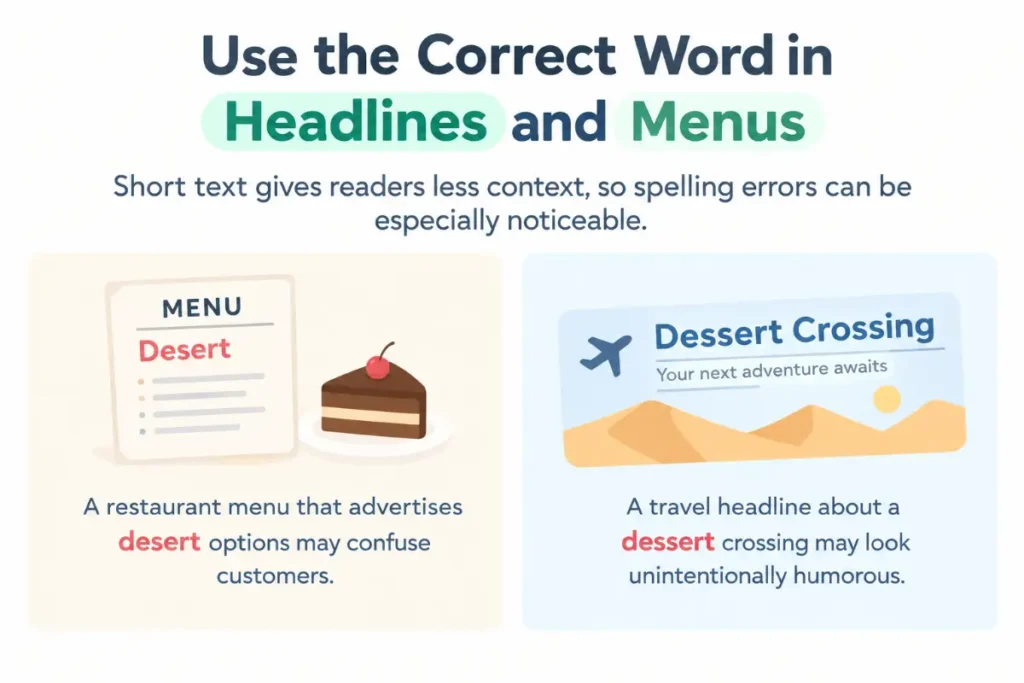
Use the correct word in headlines and menus
Short text gives readers less context, so spelling errors can be especially noticeable. A restaurant menu that advertises desert options may confuse customers, while a travel headline about a dessert crossing may look unintentionally humorous.
A related grammar guide is loan vs lend The Difference Explained With Examples.
Conclusion
The difference between desert vs dessert becomes simple once you connect each spelling to its meaning. Dessert is the sweet dish served after a meal. Desert is a dry region with little rainfall, and the same spelling can also describe the act of abandoning someone or something.
Remember the extra s in dessert by thinking about seconds of your favorite sweet treat. Then pay attention to pronunciation and sentence context when you write. A spelling checker can help with typos, but it may not catch a correctly spelled word used in the wrong place. Read your sentence once before submitting an assignment, publishing an article, or sending a message. That small habit can prevent a confusing mistake.
FAQs
Is Dessert or Desert the Correct Spelling?
Both spellings are correct English words. Dessert refers to a sweet dish served after a meal, while desert usually refers to a dry region with little rainfall. Desert can also function as a verb meaning to abandon someone or something. Choose the spelling that matches the meaning of your sentence.
What Does Dessert Mean?
Dessert is a sweet dish commonly served at the end of a meal. Examples include cake, ice cream, cookies, fruit pie, and pudding. The word can refer to one dish or to the final sweet course in general. In American English, people commonly use it when discussing restaurant menus, recipes, and family meals.
What Does Desert Mean?
As a noun, desert describes a region that receives very little precipitation. Deserts can be hot or cold, and they may contain sand, rocks, mountains, or sparse vegetation. As a verb, desert means to abandon someone, a place, or a responsibility. The sentence tells you which meaning applies.
How Do You Pronounce the Two Words?
In standard American English, dessert sounds like dih ZURT, with stress on the second syllable. The geographical noun desert sounds like DEH zert, with stress on the first syllable. The verb desert, meaning abandon, takes the second syllable stress. Listening for the stressed syllable can help you tell the words apart.
Why Does Dessert Have Two S Letters?
The spelling comes from the word’s history in French. English adopted dessert from French, where the related verb desservir referred to clearing the table after a meal. The double s became part of the standard English spelling. A simple memory trick is to associate the extra s with wanting a second helping of something sweet.
Can Desert Be Used as a Verb?
Yes. Desert can mean to leave or abandon someone, a place, or a duty. For example, “He refused to desert his teammates” means he refused to abandon them. The verb is pronounced with stress on the second syllable, unlike the geographical noun. Its past tense is deserted, as in “They deserted the old building.”
Are the Spellings Different in British and American English?
No. Standard American and British English use the same spellings for both words. Dessert refers to a sweet course, and desert refers to a dry region or the act of abandoning someone. Pronunciation can vary across accents, but the main spelling and meaning distinction remains the same.
What Is an Easy Way to Remember the Difference?
Remember that dessert has two s letters and is the sweet food you may want seconds of. Desert has one s in the middle and usually describes dry land. Then check the sentence for context. If you’re talking about a meal, choose the food spelling. If you’re describing a dry landscape, choose the geographical spelling.