
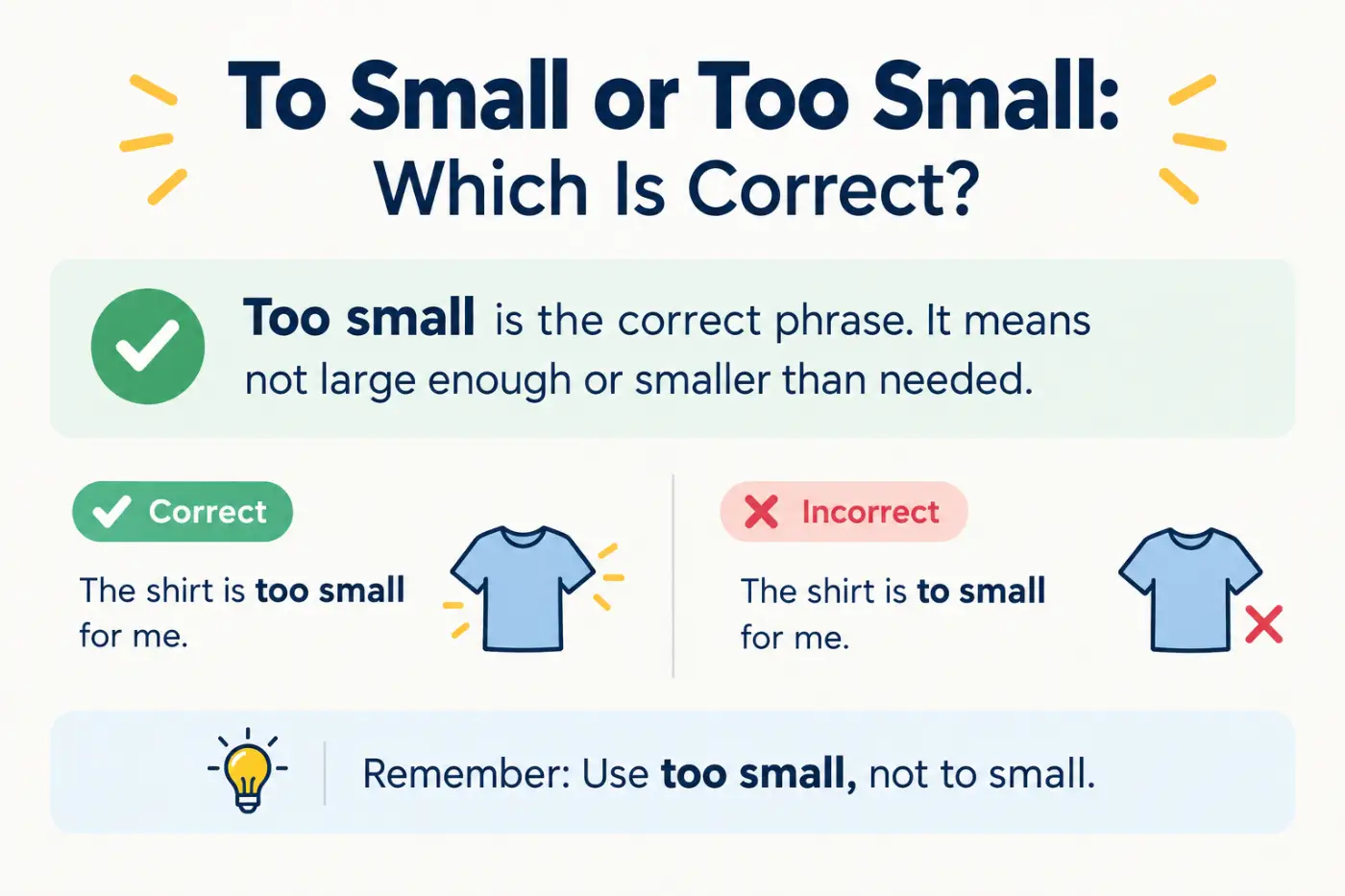
To small or too small is a common English spelling confusion because the words to and too sound alike in everyday speech. However, they have different meanings and grammatical functions. When you want to say that something does not have enough size, too small is the correct expression. For example, you should write, The shoes are too small, not The shoes are to small.
The confusion often happens because English has many words that sound the same but have different spellings and meanings. To can show direction, a destination, or a relationship between words. It also comes before a verb in its basic form, as in to read or to learn. In contrast, too means also or more than is needed. Before an adjective like small, it shows that something is smaller than a person needs or expects.
Learning the difference between to and too helps you write clearly in emails, school assignments, online messages, reports, and everyday conversations. You’ll also learn how to use too with other adjectives, when to use to before a verb, how to avoid similar spelling mistakes, and how to remember the correct form without second guessing yourself.
You may also want to read Sentence Or Sentance 2026 Which Spelling Is Correct?.
Quick Answer
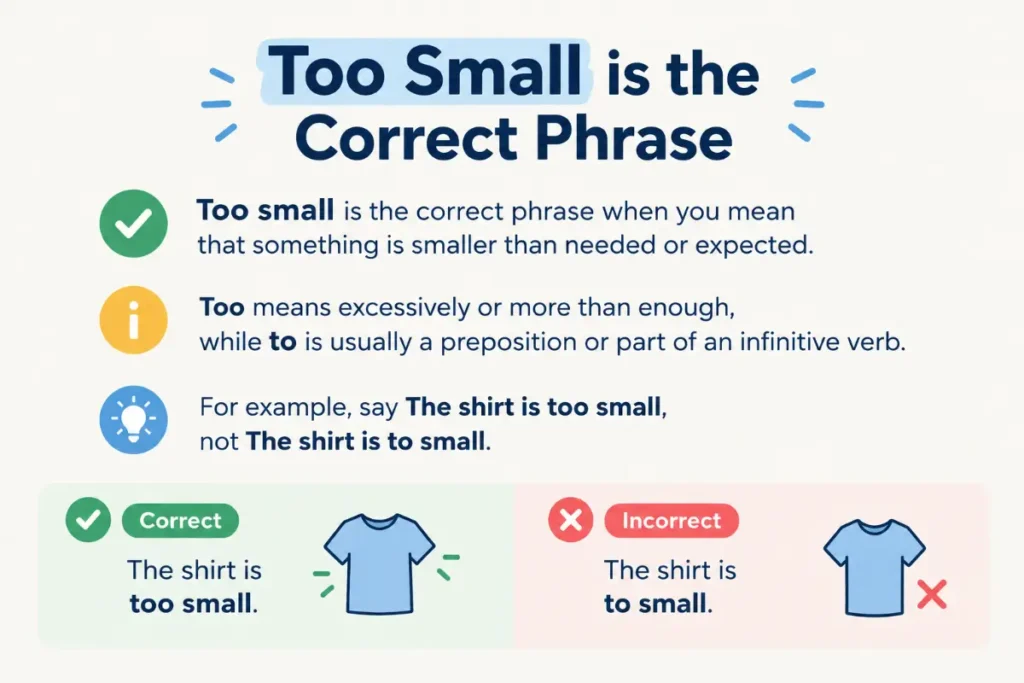
Too small is the correct phrase when you mean that something is smaller than needed or expected. Too means excessively or more than enough, while to is usually a preposition or part of an infinitive verb. For example, say The shirt is too small, not The shirt is to small.
Meaning and Definition
The phrase too small describes something that does not have enough size for a particular purpose. It can refer to clothing, rooms, containers, furniture, text, spaces, or other things. For example, if your shoes hurt because they don’t fit, you can say that they are too small.
The phrase to small is generally incorrect when used to express insufficient size. In that sentence, the writer needs the adverb too rather than the preposition to. The word small is an adjective, and too modifies that adjective to show an excessive degree or an amount below what is needed.
What Does Too Small Mean
Too small means smaller than necessary, suitable, comfortable, or expected in a given situation. The exact meaning depends on the context. A room can be too small for a family, a box can be too small for a package, and a font can be too small for someone to read comfortably.
Consider these examples.
- This jacket is too small for me.
The jacket does not fit the speaker properly because it lacks the needed size.
- The kitchen is too small for a large dining table.
The kitchen does not have enough space for the table.
- The text on the screen is too small to read.
The letters are not large enough for comfortable reading.
- That container is too small to hold all the ingredients.
The container lacks the capacity required for the ingredients.
In each sentence, too adds the idea of a degree that creates a problem or fails to meet a need.
What Does To Small Mean
To small is not the standard phrase for describing something that lacks enough size. In ordinary English, it is a spelling or word choice error when the intended meaning is smaller than needed.
For example, this sentence is incorrect.
The bedroom is to small for two beds.
The correct version is:
The bedroom is too small for two beds.
The correction changes only one letter, but that letter changes the meaning of the word. Too expresses degree, while to does not serve that purpose.
However, the words to and small can appear near each other in a grammatically correct sentence if they perform separate jobs.
For example:
I want to paint the small bedroom.
Here, to belongs to the infinitive verb phrase to paint. Small describes bedroom. The sentence does not use the incorrect phrase to small.
This distinction matters because the words are not wrong in every sentence where they appear together. The problem occurs when to is used in place of too.
Key Differences Explained
The main difference involves meaning and grammar. Too is an adverb in this phrase. To is usually a preposition or an infinitive marker.
| Feature | Too Small | To Small |
|---|---|---|
| Standard usage | Correct | Incorrect for this meaning |
| Meaning | Smaller than needed or expected | No standard meaning as a phrase |
| Grammar | Adverb plus adjective | To does not correctly modify small |
| Function | Describes an excessive degree or insufficient size | Usually a spelling or word choice error |
| Example | The shoes are too small. | The shoes are to small. |
| Best use | Describing something that lacks enough size | Use only when to belongs to a separate grammatical construction |
Spelling
The spelling difference is one extra letter o. Too has two o’s, while to has one. Although the difference looks small, the words serve different purposes.
Remember that English spelling depends on meaning rather than sound alone. Many words share a pronunciation but have different spellings. To, too, and two are a familiar example.
Meaning
Too can mean more than necessary or also. When it modifies an adjective such as small, it usually describes a degree that causes a problem or fails to meet a need.
For example, The box is too small means the box does not have enough space for the intended object.
To does not express this degree. It commonly indicates movement toward a destination, a relationship, or the basic form of a verb.
For example, She walked to school shows direction. I want to sleep uses to before a verb.
Grammar
Too small follows a common English pattern.
Too + adjective
Examples include too small, too large, too expensive, too cold, and too difficult.
The adverb too modifies the adjective that follows it. This pattern is used to describe a degree that exceeds an acceptable limit or falls outside what is suitable.
By contrast, to can appear before a verb.
Examples include to study, to work, to travel, and to understand.
The grammar of the sentence determines the correct choice.
Pronunciation
In standard American English, to and too are generally pronounced the same way when spoken with their full vowel sound. Both can sound like /tuː/. In natural conversation, to is often reduced to a weaker sound such as /tə/, especially before another word.
Because the pronunciation overlaps, you usually cannot identify the correct spelling by sound alone. You need to consider the sentence’s meaning and grammatical structure.
Formality
Too small is appropriate in casual conversation, academic writing, business communication, and formal reports. The phrase is standard English and does not sound informal or careless.
To small is not an alternative formal spelling. If it appears in a sentence where the intended meaning is insufficient size, it should be corrected.
Context
The phrase appears in many situations.
- Shopping. These shoes are too small.
- Housing. The apartment is too small for our family.
- Technology. The icons are too small on my phone.
- Education. The writing is too small to read from the back.
- Business. The current workspace is too small for the new team.
The setting may change, but the grammatical rule remains the same.
Which Form Is Correct
Use too small when you want to say that something is not large enough for a purpose. The word too modifies small and indicates that the size falls short of what is needed.
For example:
The table is too small for six people.
This sentence means the table does not provide enough room for six people to sit comfortably.
Do not write:
The table is to small for six people.
The word to cannot express the required meaning in this construction.
A simple editing test can help. Replace too with more than necessary or not enough for the purpose. If the sentence keeps its intended meaning, too is probably the right choice.
For example:
The bag is too small.
The bag is not large enough.
The meanings are compatible, so too is correct.
This test works with many other adjectives, including too short, too weak, too narrow, too expensive, and too difficult.
How to Use Too With Adjectives
Too often appears before adjectives to show that something has reached an unsuitable degree. It can describe a quality that creates a problem or prevents something from meeting a need.
Too Small
Use this phrase when an object or space lacks enough size.
- My gloves are too small.
- The office is too small for another desk.
- The print is too small to read easily.
Too Large
Use too large when something exceeds the suitable size.
- This suitcase is too large for the overhead compartment.
- The logo is too large for the design.
- That room is too large to heat efficiently.
Too Expensive
Use too expensive when the price exceeds what someone can afford or considers reasonable.
- That laptop is too expensive for my budget.
- The hotel was too expensive for a one night stay.
- The repair may be too expensive to justify.
Too Difficult
Use too difficult when a task exceeds someone’s current ability or the available level of effort.
- The question was too difficult for the class.
- This software is too difficult for new users.
- The instructions are too difficult to follow.
Too Cold
Use too cold when the temperature is below a comfortable or suitable level.
- The water is too cold for swimming.
- It is too cold to sit outside.
- The room feels too cold for a baby.
These examples follow the same grammatical pattern. Too comes before the adjective and changes the degree of the quality being described.
Ten Correct Sentence Examples
The following examples show how to use the correct phrase in different everyday situations.
- These jeans are too small for me.
The jeans do not fit the speaker because they lack enough room.
- The apartment is too small for our growing family.
The available living space does not meet the family’s needs.
- The letters on this form are too small to read.
The text is not large enough for comfortable reading.
- My backpack is too small to hold all my books.
The backpack does not have enough capacity for everything.
- This table is too small for the meeting.
The table does not provide enough space for the meeting’s needs.
- The screen looks too small from across the room.
The screen’s size makes it difficult to view from a distance.
- The company needs a larger office because the current one is too small.
The workplace no longer has enough space for the company’s needs.
- Your handwriting is too small for me to read clearly.
The letters are not large enough for the reader to recognize easily.
- The box was too small, so we used a larger one.
The first box could not accommodate the intended contents.
- This font is too small for a printed instruction manual.
The font size makes the instructions difficult for readers to use.
Each sentence describes a size problem. The adjective small gives the quality, and too explains that the degree is unsuitable.
Five Incorrect Examples and Their Corrections
These examples show common ways writers use the wrong word.
- Incorrect. This shirt is to small.Correct. This shirt is too small.Too is needed because the sentence describes a shirt that lacks enough size.
- Incorrect. The room was to small for the guests.Correct. The room was too small for the guests.The room does not have enough space for the intended number of people.
- Incorrect. My phone screen is to small to read.Correct. My phone screen is too small to read.Too modifies small to show that the screen’s size creates a problem.
- Incorrect. The container is to small for the cake.Correct. The container is too small for the cake.The container lacks the necessary capacity.
- Incorrect. These shoes are to small, so I need another pair.Correct. These shoes are too small, so I need another pair.The correct spelling shows that the shoes are smaller than the wearer needs.
Common Mistakes and Misspellings
The confusion between to and too is part of a larger group of common English errors. These mistakes often occur because several words sound alike or because writers type quickly without checking the sentence.
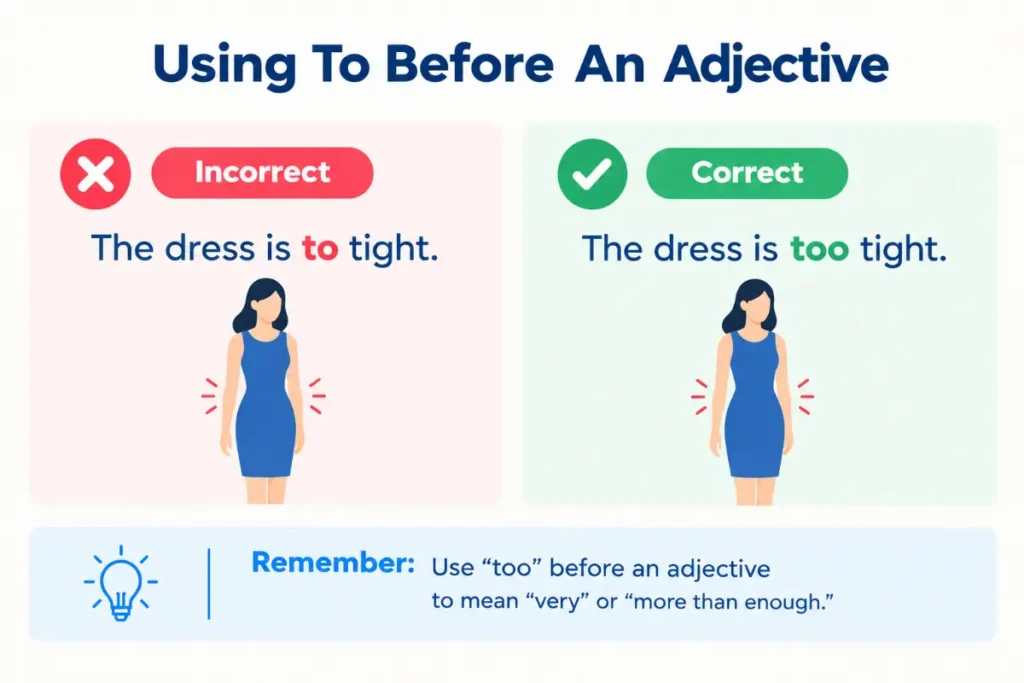
Using To Before An Adjective
Incorrect. The dress is to tight.
Correct. The dress is too tight.
To does not modify tight to show an excessive degree. Too does.
Using Too Before A Verb
Incorrect. I want too leave early.
Correct. I want to leave early.
Here, to introduces the infinitive verb leave. The sentence expresses what the speaker wants to do.
Confusing Too With Two
Incorrect. I bought too apples.
Correct. I bought two apples.
Two is the number 2. Too does not name a quantity in this sentence.
Confusing Too With Also
Incorrect. I want to come to.
Correct. I want to come too.
When too means also, it often appears at the end of a sentence. The correct choice depends on the intended meaning.
Missing The Extra Letter In A Quick Message
Incorrect. These shoes r to small.
Correct. These shoes are too small.
Text messages often contain shortened words and typing errors. Still, the standard spelling is too small, and using it makes the meaning clear.
A related grammar guide is Fewer Meaning And How To Use It Correctly.
Pronunciation Guide
Too and to are homophones in many common forms of American English. Homophones are words that sound the same but have different meanings or spellings.
How To Pronounce Too Small
The IPA pronunciation of too is /tuː/. The word small is commonly pronounced /smɔːl/ in American English, though the vowel varies by accent.
A simple guide is to say too like the word two, then say small.
The phrase has two spoken words and usually carries emphasis on too when the speaker wants to stress that the size is unsuitable.
For example:
The shirt is too small.
The stress on too helps communicate that the shirt does not fit.
How To Pronounce To
To can have a full pronunciation similar to too, but speakers often reduce it in connected speech. In a sentence such as I want to go, the word may sound like /tə/ rather than /tuː/.
This reduction is normal in conversational English. It does not change the spelling rule.
Why Pronunciation Cannot Solve The Problem
You cannot always hear the difference between the two spellings. The meaning and grammar provide the answer.
If the sentence describes an excessive degree, use too.
If the sentence shows direction or introduces a verb, use to.
That is why reading the whole sentence is more reliable than trying to spell the word based on sound.
Etymology And Word Origin
The words to and too have different histories and developed different roles in English.
To comes from Old English tō. It has long been used to show direction, relationships, and other grammatical connections. Its modern uses include phrases such as go to school, give it to her, and want to leave.
Too developed from an older English form associated with the idea of addition or excess. In modern English, it commonly means also or more than is needed. The extra o helps distinguish its written form from to, even though their pronunciation can be the same.
The spelling difference is useful because it lets readers identify the intended meaning without hearing the sentence aloud. Although both words have changed over time, modern standard English keeps their roles distinct.
You do not need to memorize the history to use them correctly. Knowing the present day grammar rule is enough for most writing tasks.
Regional Usage
The basic distinction is consistent across major varieties of English. American, British, Canadian, and Australian English all use too when describing something that is smaller than needed.
American English
In the United States, too small is the standard phrase. It is common in everyday conversation, product reviews, schoolwork, professional emails, and formal writing.
For example:
The parking space is too small for my truck.
The sentence follows standard American grammar.
British English
British English follows the same rule. Writers use too small to describe insufficient size.
For example:
The room is too small for the furniture.
There is no meaningful spelling difference between American and British English in this expression.
Canadian English
Canadian English also uses too small. The same distinction between too and to applies.
Australian English
Australian English follows the same standard usage. Too small is correct when the intended meaning is that something lacks enough size.
Regional accents may affect pronunciation, but they do not change the spelling rule.
Grammar Rules And Part Of Speech
Understanding the parts of speech makes this word choice easier.
Too As An Adverb
In too small, too is an adverb. It modifies the adjective small by expressing degree.
The pattern is:
Too + adjective
Examples include too small, too wide, too heavy, too loud, and too slow.
The adverb may also modify another adverb.
For example:
She spoke too quietly for us to hear.
Here, too modifies quietly rather than an adjective.
Too can also mean also.
For example:
I want to join the team too.
In this sentence, too means also. Its meaning depends on its position and context.
To As A Preposition
To can function as a preposition.
Examples include:
- We drove to the airport.
- She gave the book to her brother.
- The store is open from nine to five.
In these sentences, to connects words and expresses relationships such as direction, recipient, or range.
To As An Infinitive Marker
To also appears before the basic form of a verb.
Examples include:
- I want to sleep.
- They decided to leave.
- She hopes to win.
In each sentence, to comes before a verb rather than modifying an adjective.
Can Too Small Start A Sentence
Yes. The phrase can begin a sentence when the grammar and context support it.
For example:
Too small to fit the equipment, the box was returned.
The opening phrase describes the box and explains why it was returned.
A more conversational version is:
The box was too small to fit the equipment, so we returned it.
Both sentences are grammatical. The second is more direct for everyday writing.
Can To Small Ever Be Correct
The words can appear next to each other in a sentence if they have separate grammatical functions, but to small is not the correct phrase for insufficient size.
For example:
I decided to paint the small room.
To belongs to the verb phrase to paint. Small describes room. There is no error.
The important point is to examine the complete sentence rather than judge the two words in isolation.
Real Life Usage Examples
The following examples show how the phrase fits naturally into different types of communication.
Daily Conversation
- These shoes are too small, so I need a bigger size.
- The kitchen is too small for a family dinner.
Both sentences describe a practical size problem in everyday life.
Workplace Communication
- Our current meeting room is too small for the entire team.
- The font in the report is too small to read comfortably.
The first sentence concerns space, while the second concerns readability.
Academic Writing
- The sample size was too small to support a strong conclusion.
- The labels on the chart were too small to read from the back of the classroom.
In academic writing, the phrase can describe a lack of quantity or physical size. In the first example, sample size means the number of observations rather than the dimensions of an object.
News And Reporting
- The temporary shelter was too small to accommodate everyone who needed assistance.
- The narrow passage was too small for emergency vehicles to enter.
These examples show how the phrase can describe limits in public spaces and emergency settings.
Literature And Storytelling
- The little cottage was too small for all the travelers.
- The key was too small to turn the heavy lock.
In storytelling, the phrase can help readers picture a physical limit that affects what happens next.
Related And Confused Terms
Several words and expressions are useful to learn alongside this phrase.
To
To commonly expresses direction, a relationship, or an infinitive verb form.
Example: We walked to the park.
Too
Too means more than necessary or also.
Example: The coat is too small.
Two
Two is the number 2.
Example: I bought two tickets.
Small Enough
Small enough means that something has a suitable or sufficient degree of smallness for a particular purpose.
Example: The box is small enough to fit in the drawer.
This phrase does not necessarily suggest a problem. It describes a suitable size for the task.
Not Large Enough
Not large enough directly states that something lacks the required size.
Example: The table is not large enough for eight people.
This expression is a clear alternative when you want to avoid the word too.
Undersized
Undersized is an adjective that means smaller than the usual or required size.
Example: The undersized uniform did not fit the player.
It is often used in technical, sports, and professional contexts.
Too Tiny
Too tiny means excessively tiny or smaller than needed. Tiny already means very small, so adding too can strengthen the idea that the size is unsuitable.
Example: The labels are too tiny to read.
Too Narrow
Too narrow means not wide enough for the intended purpose.
Example: The doorway is too narrow for the sofa.
This phrase follows the same grammar pattern as the main expression.
Expert Editor Insight
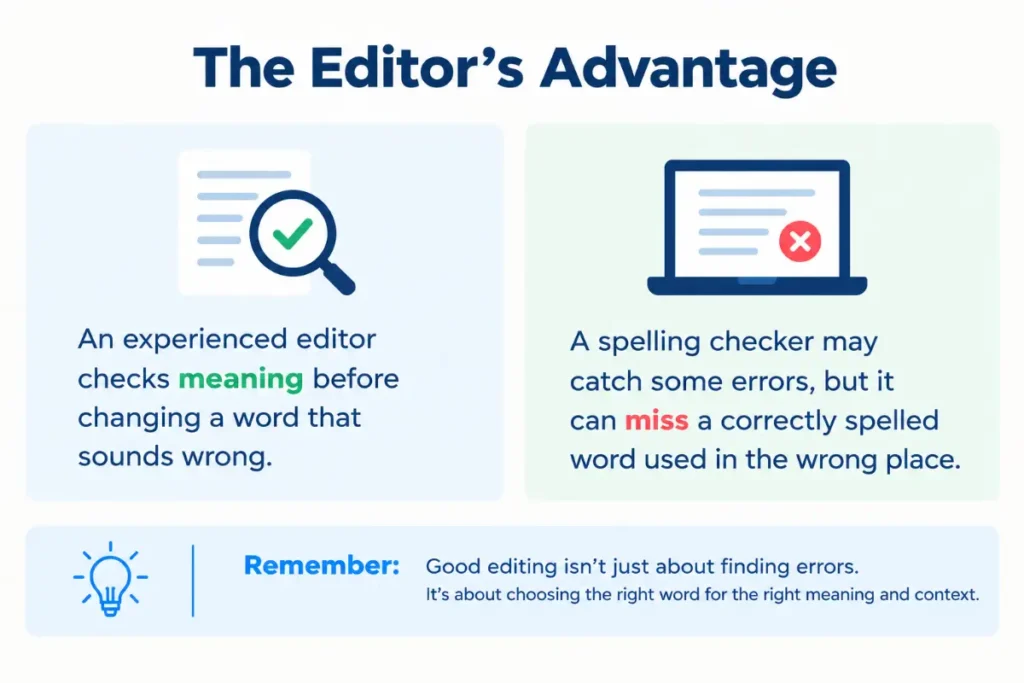
An experienced editor checks meaning before changing a word that sounds wrong. A spelling checker may catch some errors, but it can miss a correctly spelled word used in the wrong place. Since to and too are both standard English words, software may accept either one even when the sentence requires only one. Read the full sentence and ask what the writer means. If the sentence describes a degree that creates a problem, too is the correct choice. This simple meaning based check is more reliable than spelling alone.
Practical Memory Tips
A good memory trick should be easy to recall while writing.
Remember The Extra O
Too has an extra o. Think of that extra letter as adding something to the meaning. When something is too small, its size creates an extra problem because it does not meet the need.
This is only a memory aid, not a formal grammar rule, but it can help you recall the spelling quickly.
Use The Also Test
Too can mean also.
For example:
I want to go too.
You can replace too with also:
I also want to go.
The meaning remains similar.
This test does not work in every sentence, especially when too expresses excess, but it helps you remember that too has meanings beyond the preposition to.
Use The Direction Test
To often expresses movement or direction.
For example:
We went to school.
The word points toward a destination. You would not replace it with too.
Use The Degree Test
If the word comes before an adjective and means more than suitable or needed, use too.
Examples include:
- Too small.
- Too large.
- Too cold.
- Too expensive.
- Too difficult.
This is one of the quickest checks for everyday writing.
Read The Sentence Aloud
Reading aloud can help you understand the sentence’s meaning, even though it may not reveal the spelling difference. Ask yourself if you mean direction, an action, addition, or excess. Then choose the spelling that matches that meaning.
For another common grammar confusion, see less then or less than Correct Usage Explained.
Conclusion
The correct phrase is too small when you mean that something lacks enough size for a particular purpose. Too is an adverb that modifies the adjective small, while to usually expresses direction, a relationship, or an infinitive verb form. The two words can sound alike, but their meanings are different.
Remember the extra o in too when describing something that is smaller than needed. You can apply the same rule to too large, too narrow, too expensive, and too difficult. Before submitting an email, assignment, report, or message, check the meaning of the sentence instead of relying only on a spelling checker. That quick habit will help you avoid this common mistake and write with greater confidence.
Frequently Asked Questions
Is to small ever correct?
To small is incorrect when you mean that something lacks enough size. The standard phrase is too small. However, the words to and small may appear in the same sentence when they have separate functions, as in I want to paint the small room. In that example, to belongs to the verb paint, while small describes room.
What does too small mean?
Too small means smaller than needed, suitable, or expected for a particular purpose. For example, a shirt can be too small to fit comfortably, or a room can be too small to hold a large group. The phrase describes a size problem, and too modifies the adjective small to express that degree.
Which is correct to small or too small?
Too small is correct when describing something that is not large enough. To usually expresses direction, a relationship, or an infinitive verb form. It cannot replace too when you want to describe an unsuitable degree. Write The shoes are too small rather than The shoes are to small.
How do you pronounce too small?
In American English, too is generally pronounced /tuː/, and small is commonly pronounced /smɔːl/, with some regional vowel differences. The phrase has two words. Speakers often stress too to emphasize that an object is smaller than needed. To and too may sound identical, so grammar and meaning determine the spelling.
Can too small begin a sentence?
Yes. You can begin a sentence with a phrase such as Too small to hold the equipment, the box was returned. This structure is grammatical because the opening phrase describes the box. For everyday writing, The box was too small to hold the equipment, so we returned it may sound more direct.
What is a synonym for too small?
Useful alternatives include undersized, not large enough, insufficient in size, and too tiny. The best choice depends on the context. Undersized often sounds more technical, while not large enough is clear and conversational. Too tiny emphasizes a very small size that does not meet the need.
Why do people confuse to and too?
People confuse these words because they often sound alike in speech. Fast typing also makes it easy to leave out the extra letter o. Since both spellings are real English words, a spelling checker may not flag the mistake. Checking the meaning of the full sentence helps you choose correctly.
Is too small appropriate in formal writing?
Yes. Too small is standard English and works in formal reports, academic papers, business emails, and professional documents. For example, The sample was too small to support a reliable conclusion is appropriate in research writing. The phrase is not slang or an informal expression, so there is no need to replace it simply to sound professional.