
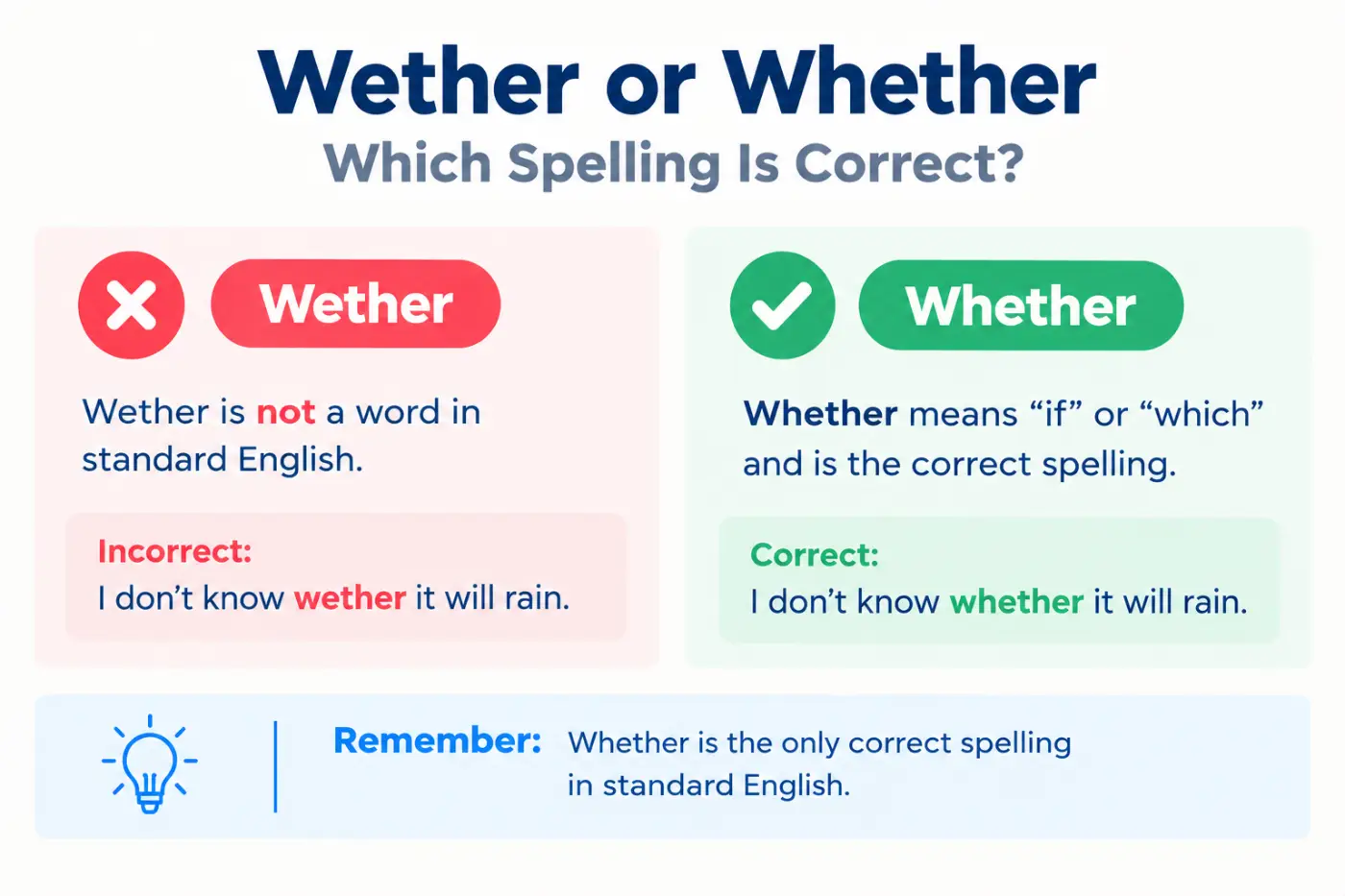
Wether or whether can be confusing because the two words look almost identical and sound alike in many English accents. However, they have very different meanings. Whether is a conjunction that introduces alternatives or expresses uncertainty, while wether is a specialized noun used mainly in farming and animal husbandry.
The good news is that you can avoid this spelling mistake with one simple rule. If your sentence discusses a choice, asks about two possibilities, or expresses doubt, the correct spelling is whether. If you are describing a castrated male sheep, wether is the appropriate word. The surrounding sentence usually makes the intended meaning clear.
This distinction matters because spelling checkers may recognize both words as valid English. A typing mistake can therefore slip into an otherwise well written sentence. In this guide, you will learn the definitions, pronunciation, grammar rules, common expressions, and practical examples that help you choose the right form confidently.
For another common grammar confusion, see Home Made Or Homemade Which One Is Correct?(2026).
Quick Answer
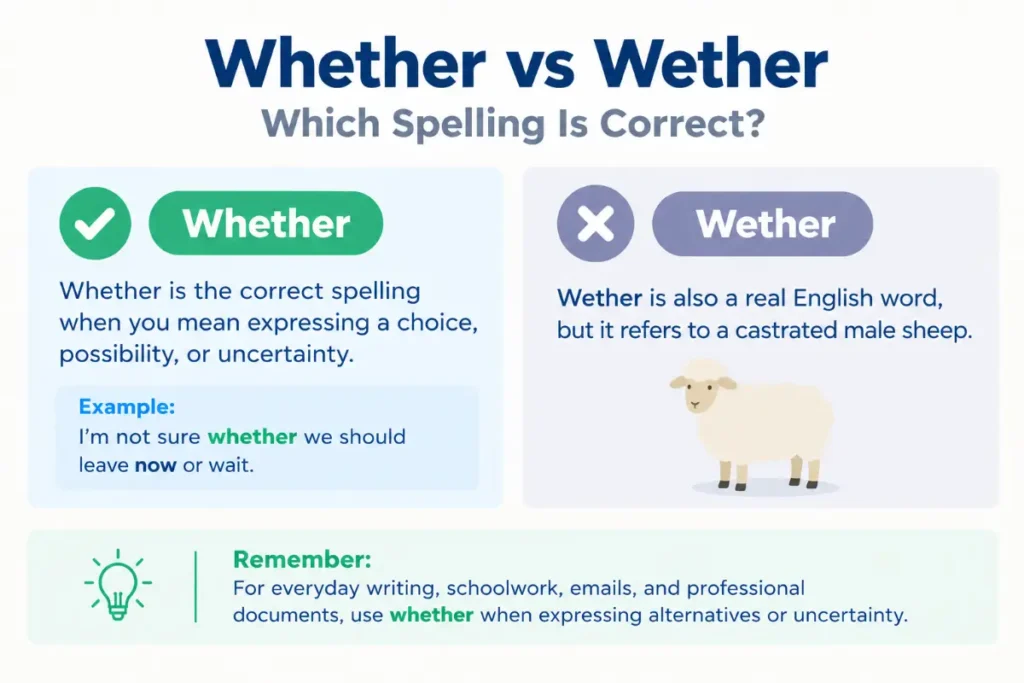
Whether is the correct spelling when you mean expressing a choice, possibility, or uncertainty. Wether is also a real English word, but it refers to a castrated male sheep. For everyday writing, schoolwork, emails, and professional documents, use whether when expressing alternatives or uncertainty.
What Is the Difference Between the Two Words
The main difference is meaning and grammatical function. One word helps connect ideas in a sentence, while the other names a particular animal.
| Feature | Whether | Wether |
|---|---|---|
| Correct spelling | Standard conjunction | Standard noun with a specialized meaning |
| Meaning | Expresses alternatives or uncertainty | A castrated male sheep |
| Part of speech | Conjunction | Noun |
| Pronunciation | Usually sounds like weather | Usually sounds like weather |
| Common context | Conversation, writing, questions, decisions | Farming, livestock, animal care |
| Everyday use | Very common | Uncommon outside agricultural contexts |
| Example | I wonder whether he will attend. | The farmer inspected the wether. |
The important point is that neither spelling is universally wrong. Both are legitimate English words, but they serve different purposes. The correct choice depends on what you want to say.
Meaning and Definition
What Whether Means
Whether is a conjunction used to introduce alternatives, express uncertainty, or present two or more possibilities. It helps show that a person is considering different outcomes or does not know which situation is true.
For example, consider this sentence.
I do not know whether the store is open.
The speaker is unsure about the store’s opening status. The word introduces that uncertainty and connects the main statement with the information being considered.
Here are more examples.
- She asked whether I needed help.
- We must decide whether to stay or leave.
- He could not tell whether the door was locked.
- I wonder whether the package has arrived.
- The teacher asked whether everyone understood the lesson.
In each example, the word connects an idea with a question, uncertainty, or alternative.
It also appears in the familiar construction whether or not. This expression means that something remains true or will happen regardless of the outcome.
For example, I will attend the meeting whether or not my friend comes.
The speaker plans to attend in both situations. The friend’s decision does not change that plan.
What Wether Means
Wether is a noun that refers to a castrated male sheep. The term belongs mainly to farming, livestock management, and animal husbandry.
Farmers may use the word when describing sheep according to their sex and reproductive status. It is a legitimate technical term, not simply a misspelling of the more familiar conjunction.
For example.
The farmer separated the wether from the breeding rams.
The sentence uses wether to identify a particular kind of male sheep.
Here are other examples.
- The wether grazed with the rest of the flock.
- The farmer checked the wether for signs of illness.
- A wether stood near the feeding area.
- The livestock records identified the animal as a wether.
- The shepherd moved the wether into another pen.
These sentences make sense in an agricultural setting. In ordinary conversations about plans, decisions, and possibilities, this specialized animal term is rarely needed.
Is Wether a Misspelling
No. Wether is a real English word with its own definition. However, it is the wrong choice when a sentence needs the conjunction that expresses alternatives or uncertainty.
For example, this sentence is incorrect.
I am not sure wether the bus has arrived.
The correct sentence is I am not sure whether the bus has arrived.
The problem is not that wether is always misspelled. The problem is that it does not express the meaning intended in the sentence.
This distinction is useful when editing because the two forms can pass a basic spell check. You need to check the meaning as well as the spelling.
Which Spelling Should You Use
Use whether when discussing choices, possibilities, questions, or uncertainty. Use wether only when referring to a castrated male sheep.
In everyday American English, the conjunction appears in many common expressions.
- I cannot decide whether to buy the blue shirt.
- Please tell me whether you received my email.
- She wondered whether the train would be late.
- We need to determine whether the information is correct.
- He asked whether the office would close early.
Each sentence involves a decision, a question, or a point that needs confirmation.
The animal term belongs in a different context.
The rancher counted each wether before moving the flock.
Here, the word identifies an animal rather than introducing an alternative.
A reliable editing habit is to replace the word mentally with its intended meaning. If you can replace it with a phrase such as if a particular situation is true, the conjunction may fit. If the sentence identifies a sheep, the specialized noun is appropriate.
Grammar Rules for Whether
Understanding the grammar of the conjunction makes spelling easier because you can recognize the role it plays in a sentence.
Using It Before a Clause
A clause contains a subject and a verb. The conjunction can introduce a clause that describes something unknown or uncertain.
For example, I asked whether the office was open.
The clause the office was open contains a subject and a verb. The conjunction introduces the information the speaker wanted to confirm.
Other examples include the following.
- She knows whether the report is ready.
- We checked whether the lights were working.
- He wondered whether his application had been accepted.
- They discussed whether the project needed more funding.
These constructions are common in both spoken and written English.
Using It With Two Alternatives
The conjunction often introduces a choice between two actions or conditions.
For example, I cannot decide whether to walk or take a taxi.
The sentence presents two options. The speaker has not yet chosen one.
Other natural examples include these.
- You must choose whether to call or send a message.
- She could not decide whether to study at home or visit the library.
- We discussed whether to postpone the event or continue with the plan.
- He is considering whether to accept the offer or look for another job.
The alternatives do not always need to be connected by the word or. Sometimes the surrounding sentence makes the choices clear.
Using Whether or Not
The expression whether or not is common in American English. It can mean regardless of the situation or introduce two possible outcomes.
For example, I will finish the assignment whether or not I receive extra time.
The sentence means the speaker plans to finish the assignment in either case.
Consider these additional examples.
- We will leave whether or not it rains.
- She plans to apply whether or not her friends join her.
- The event will continue whether or not the guest arrives.
- He will speak honestly whether or not everyone agrees.
In these examples, the main action does not depend on the outcome mentioned in the subordinate clause.
Whether at the Beginning of a Sentence
The word can appear at the beginning of a sentence, particularly when it introduces alternatives or uncertainty.
For example, whether we succeed depends on how carefully we prepare.
Here, the opening clause acts as the subject of the main statement.
Another example is whether the store opens today remains unclear.
This construction is grammatical, although a more natural version in everyday conversation might be it remains unclear whether the store opens today.
The position depends on the sentence structure and the emphasis you want to create.
Whether in Indirect Questions
An indirect question reports a question rather than asking it directly.
For example, the direct question is Is the manager available.
An indirect version is I asked whether the manager was available.
The indirect form fits naturally into a larger sentence and does not need a question mark unless the entire sentence is itself a direct question.
For example, I wonder whether the manager is available.
This is a statement, so it normally ends with a period.
By contrast, do you know whether the manager is available is a direct question and takes a question mark.
Sentence Examples
The following examples show how the conjunction works in everyday and professional situations.
Everyday Conversation
- I wonder whether the restaurant is still open.
The speaker is unsure about the restaurant’s current status.
- Tell me whether you want tea or coffee.
The sentence presents two choices.
- She asked whether I could pick her up after work.
The conjunction introduces the question that the speaker reported.
- We need to decide whether to leave now.
The sentence describes a decision that has not yet been made.
Text Messages and Online Communication
- Let me know whether you can join us tonight.
The writer asks for confirmation about someone’s plans.
- I cannot tell whether this message is genuine.
The sentence expresses uncertainty about the message’s authenticity.
Workplace Communication
- Please confirm whether the client approved the proposal.
The writer requests a clear answer about the client’s decision.
- The supervisor will determine whether additional staff are needed.
The sentence describes a decision that depends on an assessment.
School and Academic Writing
- The experiment examined whether temperature affected the results.
The conjunction introduces the possibility that the experiment investigated.
- Researchers wanted to establish whether the new method improved accuracy.
The sentence describes the question the researchers aimed to answer.
These examples show that the word works across informal conversation, professional communication, and academic writing.
Common Spelling Mistakes
The most common error is using the wrong spelling because the words sound alike. Several other English words can also create confusion.
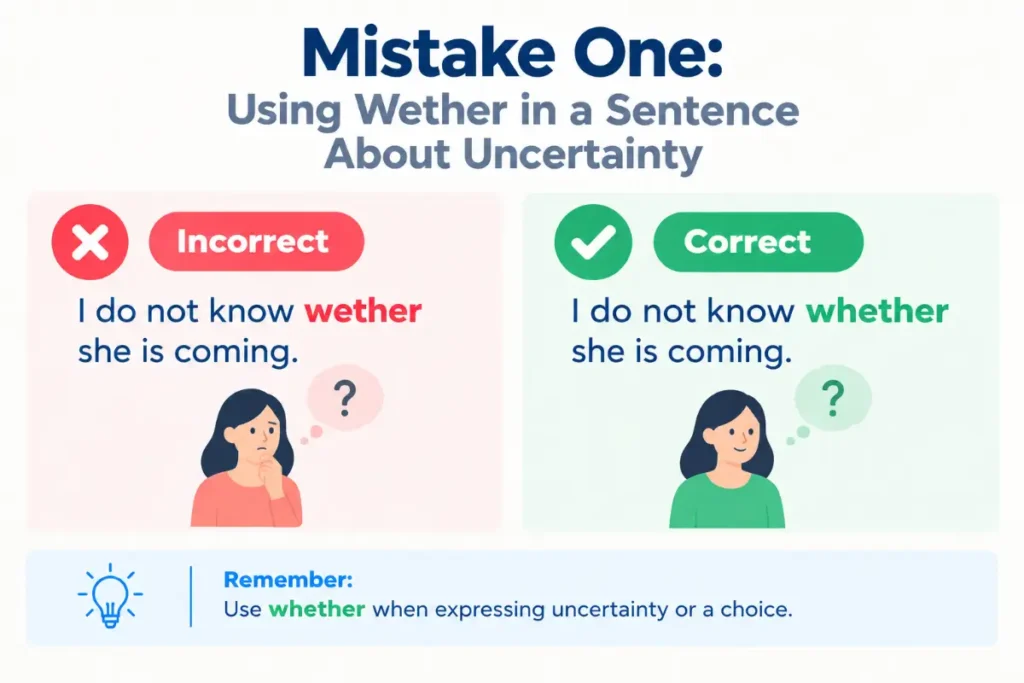
Mistake One Using Wether in a Sentence About Uncertainty
Incorrect: I do not know wether she is coming.
Correct: I do not know whether she is coming.
The incorrect version uses the name of a sheep when the sentence needs a conjunction. Check the intended meaning rather than relying only on sound.
Mistake Two Confusing Whether With Weather
Incorrect: I wonder weather he will call.
Correct: I wonder whether he will call.
Weather refers to conditions in the atmosphere, such as rain, wind, and temperature. The conjunction introduces uncertainty or alternatives.
Mistake Three Confusing Whether With Wether in Formal Writing
Incorrect: Please confirm wether the payment was received.
Correct: Please confirm whether the payment was received.
In a business email, the sentence asks for confirmation. The conjunction is therefore required.
Mistake Four Leaving Out a Letter
Incorrect: I am unsure wheter the door is locked.
Correct: I am unsure whether the door is locked.
Wheter is a typing or spelling error. The standard spelling contains the letters in the order w, h, e, t, h, e, r.
Mistake Five Using Whether Without a Clear Connection
Awkward: I whether the office is open.
Better: I wonder whether the office is open.
The conjunction usually connects a clause to a main clause or appears in a construction that functions as part of a larger sentence. It cannot normally replace a main verb.
A sentence needs a complete grammatical structure, not simply the correct spelling.
For another common grammar confusion, see Unkept or Unkempt Which Is Correct? 2026.
Pronunciation Guide
In many American accents, whether, wether, and weather sound the same or nearly the same. That similarity explains why spelling errors can occur even among fluent English speakers.
How to Pronounce Whether
The common American pronunciation is /ˈwɛðər/.
An easy guide is WETH er, with the stress on the first syllable. The first sound resembles the beginning of the word when, while the middle consonant is the voiced th sound heard in this.
The word has two syllables in ordinary American pronunciation.
How to Pronounce Wether
Wether is generally pronounced /ˈwɛðər/ as well. It has the same basic sound pattern in standard dictionary pronunciation.
Because the spoken forms overlap, listening alone may not help you select the spelling. The meaning of the sentence provides the strongest clue.
The Difference Between the Th Sounds
English has two common th sounds. One is unvoiced, as in think. The other is voiced, as in this.
The standard pronunciation of the words discussed here uses the voiced sound. Place your tongue lightly between your teeth and let your voice vibrate as air passes.
You do not need to master phonetic symbols to spell the words correctly. Knowing that their pronunciation is similar is enough to explain why context matters.
Etymology and Word Origin
The two words have different histories and developed different meanings in English.
The Origin of Whether
Whether comes from Old English hwæther, a form associated with alternatives and questions about which of two possibilities applies. Over time, its spelling and use developed into the modern conjunction.
Its connection with alternatives remains clear in modern expressions such as whether to stay or leave and whether the answer is correct.
The word is part of a long established English pattern used to present choices and uncertainty.
The Origin of Wether
Wether comes from Old English weder, a word used for a castrated ram or male sheep. The modern spelling identifies a specialized term that remains in use in livestock terminology.
Its meaning has stayed connected to sheep and animal husbandry. It is not a modern invention or a casual alternative spelling of the conjunction.
The shared sound does not mean that the words have the same definition. Their histories and grammatical roles explain why they are separate entries in English dictionaries.
Regional Usage
The main spelling distinction stays the same across major varieties of English. American, British, Canadian, and Australian English use the conjunction for alternatives and uncertainty and the noun for the sheep.
American English
In the United States, the conjunction is common in speech, emails, academic writing, and everyday conversation. The livestock term appears mainly in farming and agricultural settings.
American writers should choose the conjunction when expressing uncertainty or alternatives.
British English
British English uses the same standard spelling and basic grammatical patterns. The sheep term is also recognized, particularly in agricultural contexts.
There is no general British spelling rule that makes the two words interchangeable.
Canadian English
Canadian English follows the same distinction. Writers use the conjunction for questions and alternatives and the livestock noun for its specific animal meaning.
Australian English
Australian English also maintains this distinction. Because sheep farming is a significant part of Australian agriculture, the specialized noun may appear in livestock contexts, but it does not replace the conjunction in ordinary writing.
Regional pronunciation can vary, but the spelling rule remains stable.
Related and Confused Terms
Several words are worth learning alongside this pair because they sound alike or appear in similar sentences.
Weather
Weather is a noun that describes atmospheric conditions. It can also function as a verb meaning to endure or withstand something.
Example: The weather will improve tomorrow.
Example: The building managed to weather the storm.
If
If is a conjunction that introduces a condition. It often works as a substitute for the conjunction in indirect questions, though the two words do not fit every sentence in exactly the same way.
Example: I do not know if she is ready.
Choice
Choice is a noun that refers to selecting one option from available alternatives.
Example: You have a choice between two courses.
Alternative
Alternative refers to another available option.
Example: We need an alternative plan.
Uncertainty
Uncertainty is a noun describing a lack of knowledge or confidence about a situation.
Example: There is uncertainty about the delivery date.
Question
A question asks for information or expresses doubt that needs an answer.
Example: She asked a question about the schedule.
Ram
A ram is an adult male sheep. Unlike a wether, a ram used in breeding has not been castrated.
Example: The ram stayed near the flock.
Ewe
A ewe is an adult female sheep.
Example: The ewe stayed close to her lamb.
These terms help clarify the agricultural meaning of the less common noun and the everyday role of the conjunction.
Real Life Usage Examples
Daily Conversation
I cannot remember whether I locked the front door.
This sentence expresses uncertainty about an action in the past.
Do you know whether the movie starts at seven.
The speaker asks for information about the starting time. Because the sentence is a direct question, it should end with a question mark.
Email and Workplace Communication
Please let me know whether you can attend the meeting.
This is a polite request for confirmation.
The team will review the results to determine whether the changes were effective.
The sentence explains how the team plans to evaluate the outcome.
Academic Writing
The study investigated whether regular exercise improved sleep quality.
The conjunction introduces the question the research examined.
The results remain inconclusive, so further testing is needed to determine whether the pattern is consistent.
The sentence expresses uncertainty about the findings.
News and Journalism
Officials are investigating whether the outage affected nearby neighborhoods.
The sentence reports an investigation into a possible effect.
The company has not confirmed whether the service will return today.
The sentence communicates that information is still unavailable.
Literature and Storytelling
Mara paused at the gate, unsure whether someone was waiting inside.
The word expresses her uncertainty and adds tension to the scene.
He wondered whether the letter would change everything.
The sentence introduces a possibility that matters to the character.
Farming and Animal Care
The farmer moved the wether into a separate enclosure.
The noun identifies a castrated male sheep.
The veterinarian examined the wether before the flock returned to pasture.
The animal term fits the agricultural setting and identifies the type of sheep being examined.
Expert Editor Insight
An experienced editor checks the meaning of a sentence rather than trusting a spelling checker alone. Both forms are valid words, so software may accept the wrong one when the writer intends to express uncertainty. The best approach is to read the full sentence, identify the intended meaning, and confirm that the word performs the correct grammatical job. In ordinary writing, the conjunction is the form most readers need. The livestock term should remain in place when the subject is actually a sheep.
Key Takeaways
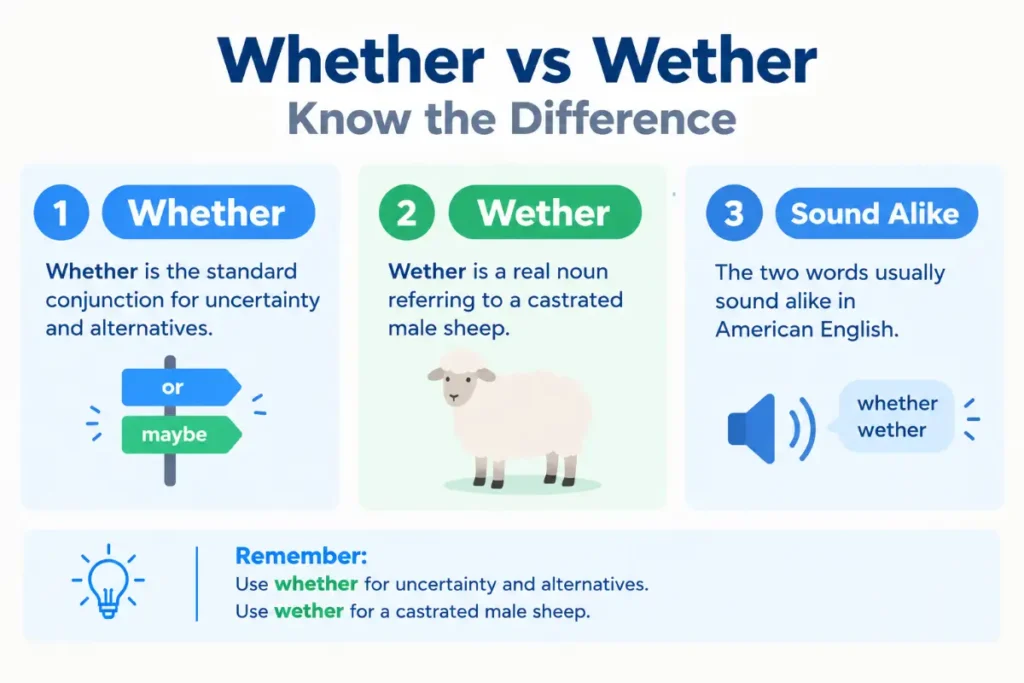
- Whether is the standard conjunction for uncertainty and alternatives.
- Wether is a real noun referring to a castrated male sheep.
- The two words usually sound alike in American English.
- Context determines the correct spelling.
- Spell checkers may not catch the mistake because both forms are valid.
- The conjunction appears in indirect questions and expressions such as whether or not.
- American, British, Canadian, and Australian English follow the same basic distinction.
- Reading a sentence for meaning is more reliable than relying on pronunciation alone.
Learn the difference in Momment or Moment Which Spelling Is Correct.
Conclusion
The spelling difference is simple once you connect each word with its meaning. Whether introduces alternatives, questions, and uncertainty, while wether names a castrated male sheep. Both are correct English words, but they cannot replace each other in ordinary sentences.
For schoolwork, emails, reports, and everyday conversation, choose the conjunction when you are discussing a possibility or asking for confirmation. Save the livestock term for agricultural contexts. The easiest editing tip is to pause when a spelling checker accepts a word that looks unusual. Read the sentence again and check its meaning. That small habit can prevent an easy mistake and make your writing clearer
FAQs
Is wether a real English word?
Yes. Wether is a standard English noun for a castrated male sheep. It is used mainly in farming, livestock management, and animal husbandry. It is not the correct spelling for sentences about uncertainty or alternatives. The intended meaning determines the appropriate spelling.
What does whether mean?
Whether is a conjunction used to introduce alternatives or express uncertainty. For example, I do not know whether the store is open. The sentence shows that the speaker is unsure about the store’s status. The word also appears in constructions such as whether or not.
Which spelling is correct for everyday writing?
Use whether when discussing choices, possibilities, indirect questions, or uncertainty. Wether is correct only when you mean a castrated male sheep. Since the two words sound alike in many accents, check the meaning of the sentence before choosing the spelling.
How do you pronounce these words?
In standard American English, the words usually share the pronunciation /ˈwɛðər/. Both have two syllables, with stress on the first syllable. Their similar sounds explain why writers can confuse them. Context and meaning provide the most reliable way to choose the correct spelling.
Can whether begin a sentence?
Yes. For example, Whether we succeed depends on our preparation. The opening clause acts as the subject of the main statement. This construction is grammatical, although writers often place the conjunction later in a sentence when that sounds more natural.
Is weather the same as whether?
No. Weather usually refers to atmospheric conditions such as rain, wind, and temperature. Whether introduces alternatives or uncertainty. For example, The weather is cold describes conditions outside. I wonder whether it will snow expresses uncertainty about a possible event.
Why do people confuse the spellings?
People confuse the words because their pronunciation is usually the same or very similar. They also share several letters. Spell checkers may accept both because each is a legitimate word. Reading the sentence for meaning is the best way to catch this type of error.
Is the conjunction appropriate in formal writing?
Yes. It is standard in professional emails, reports, academic papers, and formal documents. It helps writers express uncertainty, introduce indirect questions, and present alternatives clearly. Use the standard spelling and make sure the surrounding sentence has a complete grammatical structure.