
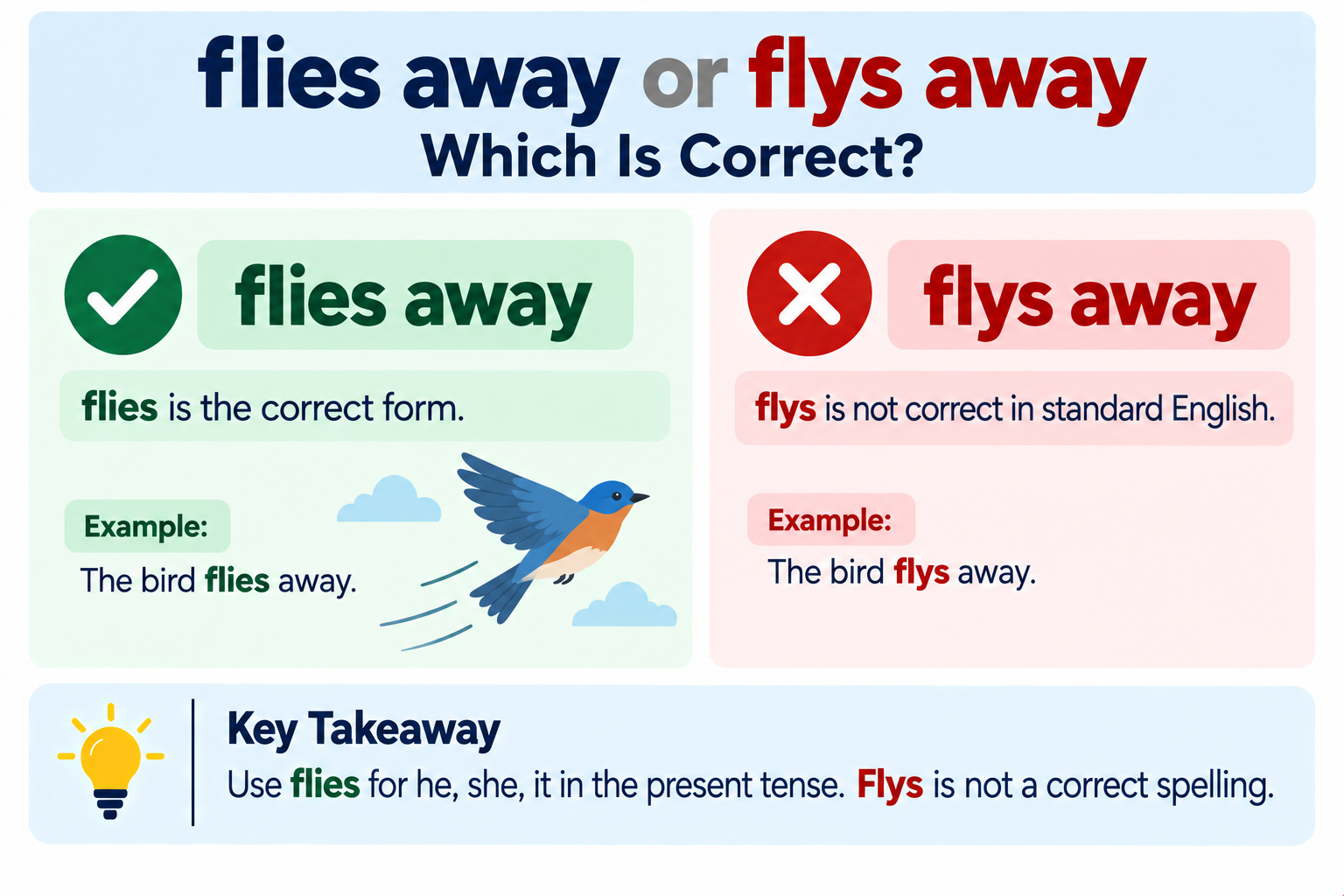
Flies away or flys away can look like a small spelling question, but the difference comes from an important English grammar rule. The correct form is flies away. The spelling flys away is not the standard form used in normal English writing.
The confusion happens because the base verb is fly, and many English verbs form their third person singular by adding s. For example, runs, walks, and jumps follow that pattern. However, verbs ending in a consonant followed by y usually change the y to i before adding es. That gives us flies rather than flys.
This guide explains the spelling rule in clear terms and shows how the phrase works in real sentences. You will also learn how to pronounce flies, why the spelling changes, how the phrase differs from fly away, and how to avoid similar mistakes with words such as tries, cries, and carries.
For another common grammar confusion, see In Route vs En Route Which Is Correct.
Quick Answer
Flies away is the correct standard form. It uses flies, the third person singular present tense of the verb fly, followed by the adverb away. Flys away is a common spelling mistake because writers may simply add s to fly instead of applying the consonant plus y spelling rule.
What the phrase means
The phrase describes a person, animal, bird, insect, object, or other thing moving through the air and getting farther from a particular place or person.
For example:
The bird flies away when it hears the noise.
Here, flies tells us what the bird does, while away shows movement farther from the current location.
The phrase can also have a figurative meaning. A person can say that an opportunity, thought, memory, or chance seems to fly away when it disappears quickly or becomes impossible to keep.
For example:
The opportunity seemed to fly away before I could make a decision.
The exact meaning depends on context, but the spelling of flies follows the same grammar rule in both literal and figurative uses.
Why flies is spelled with ies
The key rule is simple.
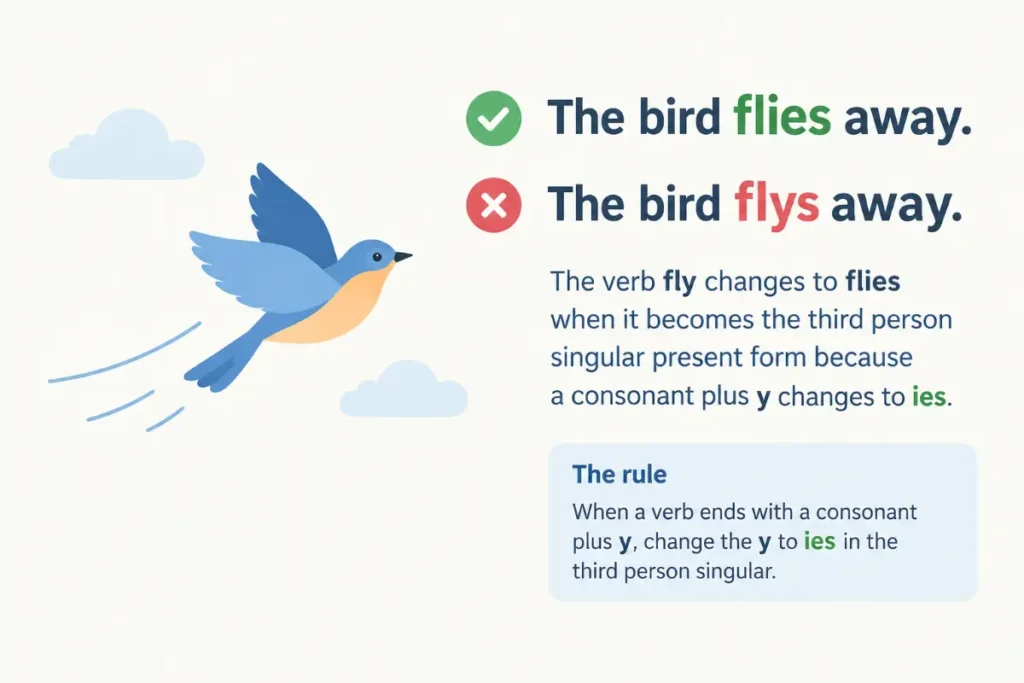
When a verb ends in a consonant followed by y, the y usually changes to i before es is added to form the third person singular present tense.
The verb fly follows this rule:
fly → flies
The same pattern appears in several common verbs:
- try → tries
- cry → cries
- carry → carries
- study → studies
- hurry → hurries
- worry → worries
- reply → replies
- deny → denies
So the correct grammatical form is flies, not flys.
This rule applies because the letter before the final y in fly is l, a consonant. The spelling changes from y to i and then adds es.
The rule becomes easier to remember when you compare it with verbs ending in a vowel plus y. For example, play becomes plays, not plaies. The same applies to enjoy, which becomes enjoys.
Compare these patterns:
| Base verb | Correct third person form |
|---|---|
| fly | flies |
| try | tries |
| cry | cries |
| study | studies |
| play | plays |
| enjoy | enjoys |
| stay | stays |
The important point is that the spelling depends on the letter immediately before the final y.
Comparison table
| Form | Meaning | Part of speech | Standard usage | Formality | Common context | Example |
|---|---|---|---|---|---|---|
| flies away | Moves away through the air | Verb phrase | Standard | Neutral | Birds animals insects objects | The bird flies away. |
| fly away | Move away through the air | Verb phrase | Standard | Neutral | Commands plural subjects and base verb constructions | The birds fly away. |
| flys away | Intended to mean moves away through the air | Misspelled verb phrase | Nonstandard | Not appropriate in edited writing | Typing and spelling mistakes | Incorrect: The bird flys away. |
The most important difference is grammatical. Flies away is used with a singular third person subject in the present tense, such as he, she, it, or a singular noun.
Fly away is used with plural subjects, the pronouns I and you, and as the base form after certain auxiliary verbs.
For example:
The eagle flies away.
But:
The eagles fly away.
And:
I fly away tomorrow.
The verb changes because the subject and grammatical structure change.
Meaning of the incorrect form
Flys is not the standard present tense spelling of fly. In ordinary English, it is best treated as a spelling error.
The mistake is understandable because many verbs simply take s in the third person singular:
walk → walks
run → runs
jump → jumps
read → reads
A writer who applies that basic pattern to fly may produce flys. However, English spelling has several rules for verbs ending in y, and this is one of them.
The correct pattern is:
fly → flies
So this sentence is incorrect:
The butterfly flys away.
The corrected version is:
The butterfly flies away.
The same issue appears with many other verbs. A writer might type tryed instead of tried or crys instead of cries. These errors come from applying a simpler spelling pattern to a word that follows a different rule.
Meaning of the correct form
Flies is the third person singular present tense form of fly.
The verb fly can mean to move through the air, travel by aircraft, or move quickly through space. It can also be used figuratively.
When flies is followed by away, the phrase normally means that one person, animal, or thing moves away through the air.
Examples include:
The sparrow flies away from the window.
A butterfly flies away when I get too close.
The paper flies away in the wind.
The phrase can also describe fast movement in a figurative sense:
The afternoon flies away when I am busy.
In that sentence, time is not literally moving through the air. The phrase creates the idea that time passes very quickly.
The grammar behind the phrase
The grammar becomes much clearer if you look at the subject.
With a singular third person subject, use flies:
The bird flies away.
My dog flies away from the water on the kite.
The airplane flies away from the airport.
With a plural subject, use fly:
The birds fly away.
The airplanes fly away.
With I and you, use fly:
I fly away tomorrow.
You fly away every summer.
With we and they, use fly:
We fly away early in the morning.
They fly away before sunset.
This gives you a useful pattern:
| Subject | Correct form |
|---|---|
| I | fly away |
| You | fly away |
| He | flies away |
| She | flies away |
| It | flies away |
| We | fly away |
| They | fly away |
A singular noun also takes flies:
The plane flies away.
A plural noun takes fly:
The planes fly away.
This is one reason the subject matters so much when choosing between fly and flies.
Flies away versus fly away
The difference between these forms is grammatical rather than a difference in meaning.
Flies away is used when the subject is third person singular in the simple present.
Fly away is used with I, you, we, they, plural nouns, and certain other grammatical structures.
Consider these examples:
The bird flies away every morning.
The birds fly away every morning.
The meaning is almost the same, but the subject changes from singular to plural.
You can also use fly away after modal verbs:
The bird may fly away.
The bird might fly away.
The bird could fly away.
You do not say:
The bird may flies away.
After a modal such as may, might, or could, the verb stays in its base form.
The same principle applies after does:
Does the bird fly away?
Not:
Does the bird flies away?
The auxiliary verb does carries the third person singular marking, so the main verb returns to its base form.
Which form is correct
The standard spelling is flies away when you need the third person singular present form.
The spelling flys does not follow the standard English spelling pattern for verbs ending in a consonant plus y.
The reason is the consonant plus y rule:
consonant + y → change y to i and add es
So:
fly → flies
And:
try → tries
cry → cries
carry → carries
study → studies
There is no need to memorize flies as an isolated spelling. Learning the pattern gives you a much more useful tool because you can apply it to many other verbs.
Sentence examples
Here are natural examples showing the correct form in different contexts.
- The bird flies away whenever someone opens the door.
- My cat watches the butterfly before it flies away.
- The paper flies away when the window is left open.
- The small plane flies away just before sunset.
- She watches the kite as it flies away into the distance.
- The story begins with a bird that flies away from its nest.
- The manager jokes that the workday flies away when the team is busy.
- The child becomes upset when her balloon flies away.
- In the story, the magical creature flies away before anyone can catch it.
- Time seems to fly away when I am working on something interesting.
These examples show that the phrase can describe literal movement as well as figurative ideas.
Common mistakes with this spelling
Writing flys instead of flies
This is the main spelling mistake.
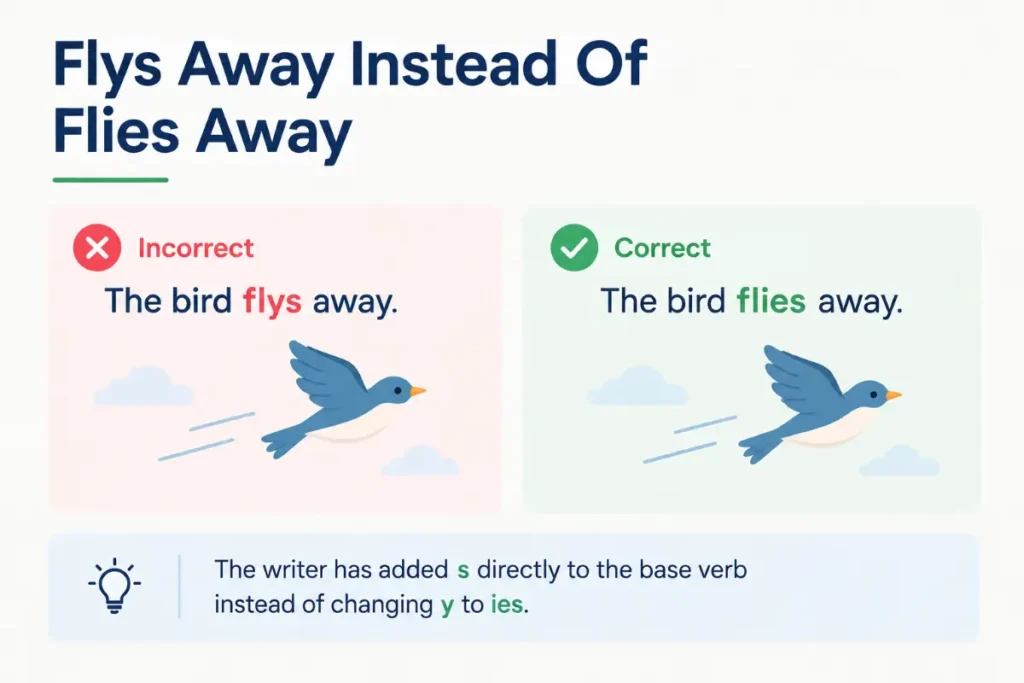
Incorrect:
The bird flys away.
Correct:
The bird flies away.
The error happens because the writer adds s directly to the base form fly. The spelling rule requires y to change to i before es.
Using flies with a plural subject
Incorrect:
The birds flies away.
Correct:
The birds fly away.
The subject birds is plural, so the base verb fly is required.
Using flies after a modal verb
Incorrect:
The bird might flies away.
Correct:
The bird might fly away.
Modal verbs such as might, could, should, would, and may are followed by the base form of the verb.
Using flies after does
Incorrect:
Does the bird flies away every morning?
Correct:
Does the bird fly away every morning?
The word does already carries the third person singular form. The main verb therefore stays as fly.
Confusing fly with flies in general
Some writers learn that flies is the correct spelling and then use it everywhere. That creates a grammar problem.
For example:
I flies to New York every year.
This is incorrect because I takes the base form:
I fly to New York every year.
The spelling rule and subject agreement must work together.
Pronunciation guide
The word flies is pronounced like the plural noun flies, meaning insects. It has one syllable.
IPA:
/flaɪz/
An easy pronunciation guide is:
flyz
The vowel sound is the same as the sound in my, sky, and high.
The final sound is z, not s. This is common in English because the ending can be voiced depending on the sound before it.
The word flies does not have two syllables. You should not pronounce it as something like fly iz. It is one smooth syllable.
Compare:
fly — /flaɪ/
flies — /flaɪz/
The spelling adds letters, but the word remains one syllable.
The phrase is pronounced approximately:
flies away → flyz uh way
The exact pronunciation varies slightly with natural speech, but the main point is that flies has one syllable and rhymes with words such as skies and cries.
Why the spelling mistake is common
The mistake is easy to make because English uses more than one pattern for forming third person singular verbs.
For many verbs, you simply add s:
run → runs
walk → walks
sing → sings
open → opens
That pattern is so common that it can become the first rule people reach for when spelling a new form.
Words ending in consonant plus y use a different pattern:
fly → flies
try → tries
cry → cries
carry → carries
There is also another pattern for words ending in vowel plus y:
play → plays
stay → stays
enjoy → enjoys
That means you cannot simply look at the final letter and assume that every word ending in y changes in the same way. You need to check the letter immediately before the y.
You may also want to read Transferred or Transfered Which Spelling Is Correct in 2026.
A simple spelling rule to remember
Use this three step method.
- Find the base verb.
- Look at the letter immediately before the final y.
- If the word ends in a consonant plus y, change y to i and add es.
For fly:
fly
The letter before y is l, which is a consonant.
So:
fly → flies
For play:
play
The letter before y is a, which is a vowel.
So:
play → plays
This contrast makes the rule much easier to remember.
More examples of the same grammar pattern
Learning related examples can help you recognize the pattern quickly.
Try and tries
He tries to open the door.
Not:
He trys to open the door.
Cry and cries
The baby cries when she is tired.
Not:
The baby crys when she is tired.
Study and studies
She studies English every evening.
Not:
She studys English every evening.
Carry and carries
The truck carries fresh produce.
Not:
The truck carrys fresh produce.
Hurry and hurries
He hurries home before dark.
Not:
He hurrys home before dark.
These words follow the same basic spelling pattern as fly.
Regional usage
American English
In American English, flies is the standard spelling for the third person singular present form of fly. The same spelling rule applies in everyday conversation, school writing, workplace communication, journalism, and formal documents.
There is no special American spelling variation that changes flies to flys.
British English
British English also uses flies. The spelling does not change simply because the writer is using British English.
A British writer would normally write:
The bird flies away.
The same rule applies to related verbs such as tries, cries, and studies.
Canadian English
Canadian English also uses flies in this grammatical context. There is no standard Canadian spelling variant that replaces it with flys.
Australian English
Australian English follows the same spelling pattern. Flies is the normal form in standard written English.
This is useful because some English spelling differences are regional, but this one is not. The distinction here comes from grammar and spelling rules rather than American versus British usage.
Grammar patterns you should know
The phrase becomes easier to use once you understand a few common sentence patterns.
Simple present
Use flies away for a singular third person subject.
The bird flies away every afternoon.
This can describe a habit, repeated action, or general behavior.
Present negative
Use does not or doesn’t followed by the base verb.
The bird does not fly away.
The bird doesn’t fly away.
Do not write:
The bird doesn’t flies away.
The auxiliary does changes the grammar of the sentence, so the main verb stays in its base form.
Questions
Use does with a singular third person subject.
Does the bird fly away?
Again, the main verb is fly, not flies.
Modal verbs
After a modal verb, use fly.
The bird may fly away.
The bird could fly away.
The bird might fly away.
The bird should fly away.
The same rule applies to other base verbs after modal verbs.
Simple present statement
Use flies when the subject is singular third person.
The eagle flies away at sunset.
This is the core pattern behind the spelling question.
Real life usage
Daily conversation
In everyday speech, the phrase often describes animals, birds, balloons, or objects moving away.
Look at that bird. It flies away every time I get close.
Hold the balloon tightly, or it might fly away.
These sentences sound natural because the phrase fits common situations.
Workplace communication
The phrase can also appear in workplace speech or writing, especially in figurative expressions about time.
The afternoon flies away when we have a busy schedule.
A workplace email could also use the literal meaning in a discussion about aviation or outdoor events.
The aircraft flies away shortly after the final inspection.
Academic writing
Academic writing may use the phrase when discussing animal behavior, physics, literature, or another subject involving movement.
The bird flies away after detecting movement near the nest.
The phrase itself is not informal. Its suitability depends on the subject and sentence around it.
News and journalism
News writing can use the phrase in reports about wildlife, aviation, weather, or unusual events.
The bird flies away before rescuers can reach it.
A journalist may also use flew away when describing an event that already happened.
The bird flew away before the team arrived.
This shows another important point: tense changes the form of the verb.
Literature and storytelling
Writers often use movement through the air as an image of freedom, escape, loss, or change.
The final bird flies away as the village falls silent.
In storytelling, the phrase can be literal or symbolic. The spelling remains the same when the verb is in the simple present.
Tense changes the verb
A common source of confusion is mixing up flies, fly, and flew.
In the simple present:
The bird flies away.
For a past action:
The bird flew away.
For a plural subject in the present:
The birds fly away.
For a future action:
The bird will fly away.
These forms are not interchangeable.
The spelling flies specifically belongs to the present tense form used with a third person singular subject.
You should not use flies simply because the action involves one bird. The verb form depends on the grammatical structure and tense.
For example:
The bird flew away yesterday.
Not:
The bird flies away yesterday.
The time expression yesterday requires a past tense form in this context.
Related and confused terms
Several words and phrases are closely connected to this spelling issue.
Fly
Fly is the base form of the verb.
Birds fly through the sky.
Flies
Flies is the third person singular present form of fly. It is also the plural of the noun fly, the insect.
The bird flies over the lake.
There are flies in the kitchen.
The pronunciation and meaning depend on the context.
Flew
Flew is the simple past form of fly.
The bird flew away yesterday.
Flown
Flown is the past participle.
The bird has flown away.
It normally appears with an auxiliary verb such as has, have, or had.
Fly away
This is the base form of the phrase.
The birds fly away at sunset.
Flew away
This is the past tense phrase.
The birds flew away before the storm.
Flying away
This is the present participle form.
The birds are flying away.
Take off
Take off can describe an aircraft leaving the ground. It is related to flying but is not always interchangeable with fly away.
The plane takes off at six.
The phrase focuses on leaving the ground rather than simply moving away.
An editor’s way to check the spelling
An experienced editor would not rely on how the word sounds alone. The best quick check is to identify the subject and then identify the base verb.
Ask:
- Is the base verb fly?
- Is the subject singular and third person?
- Is the sentence in the simple present?
If the answer to all three questions is yes, use flies.
For example:
The bird flies away.
The subject is the bird, which is singular and third person. The sentence describes a present habit or general action. Therefore, flies is correct.
If the subject changes to the birds, use fly:
The birds fly away.
This simple editing check catches both spelling and grammar errors at the same time.
How spelling tools may flag the mistake
Modern spelling and grammar checkers often recognize flys as an error in ordinary English text. However, automatic tools should not replace basic grammar knowledge.
A spell checker may tell you that a form looks wrong, but it may not always explain why. Understanding the consonant plus y rule helps you apply the same knowledge to words that a tool does not immediately flag.
This is especially useful when writing quickly, editing a document, or working in an environment where automated corrections are turned off.
Can the word start a sentence
Yes. The verb form can appear at the beginning of a sentence when the sentence structure calls for it.
For example:
Flies away the bird.
However, that sentence is not natural standard English because the normal subject and verb order has been reversed.
A natural sentence would be:
The bird flies away.
The phrase can appear at the start of a sentence in a different structure, especially in literary writing:
Flies away the last bird as the sun sets.
This is an unusual literary construction, not the normal word order for everyday English.
In ordinary writing, keep the subject before the verb:
The bird flies away.
Is the phrase formal or informal
The phrase itself is neutral. It is not slang, and it is not restricted to casual speech.
You can use it in:
- Everyday conversation.
- School assignments.
- Workplace writing.
- News writing.
- Academic discussions.
- Fiction and storytelling.
The surrounding sentence determines the level of formality. For example, The bird flies away is perfectly suitable for a basic science explanation, while a more technical document might use a more precise description of the animal’s movement.
A useful memory trick
Think of fly as a word that changes its final y when it needs the third person singular ending.
Remember this small group:
fly → flies
try → tries
cry → cries
study → studies
The repeated pattern makes the spelling easier to recall.
A second memory trick is to compare fly with play:
fly → flies
play → plays
Why the difference? The letter before y is different.
In fly, the letter before y is l, a consonant.
In play, the letter before y is a, a vowel.
That one comparison can prevent many spelling mistakes.
Expert Editor Insight
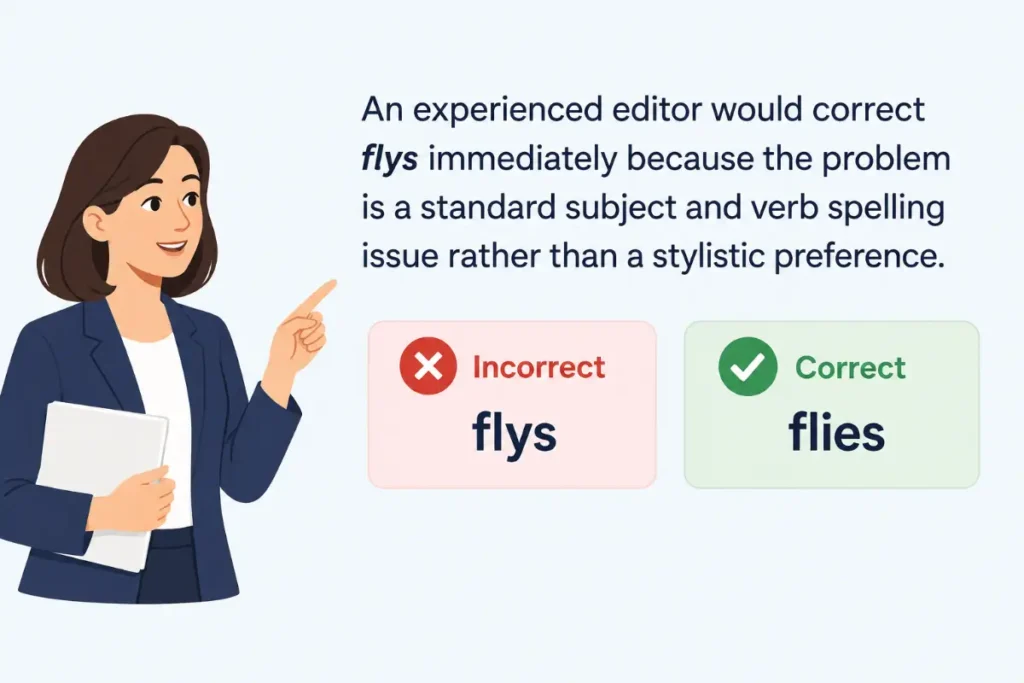
An experienced editor would correct flys immediately because the problem is a standard subject and verb spelling issue rather than a stylistic preference. The easiest way to catch it is to identify the subject first and then check the verb form. If the subject is he she it or a singular noun and the sentence uses the simple present tense you need flies. Spellcheckers may catch flys but grammar tools can also miss context based errors, so knowing the rule yourself remains the safest editing method.
For another common grammar confusion, see Leary or Leery Which Word Is Correct in 2026.
Conclusion
Flies away or flys away has a clear answer: flies away is the standard spelling. The form flys away is a common spelling mistake caused by adding s directly to fly without applying the consonant plus y rule.
The key grammar pattern is easy to remember. A singular third person subject takes flies, while plural subjects and pronouns such as I, you, we, and they use fly. The same spelling pattern appears in tries, cries, studies, and carries.
For a quick editing check, look at the subject and the tense before choosing the verb. If the sentence uses a singular third person subject in the simple present, choose flies. That small check will help you avoid the spelling mistake and keep your writing clear and correct.
FAQs
Is flys away a real word?
In ordinary standard English, flys is not the correct third person singular form of fly. It is normally treated as a misspelling. The standard form is flies. A writer who wants to describe one bird, insect, or object moving away in the present tense should write, “The bird flies away.”
What does flies away mean?
It normally means that a person, animal, bird, insect, or object moves through the air and gets farther from a particular place. It can also be figurative. For example, “The bird flies away” describes literal movement, while “Time flies away” can suggest that time passes very quickly.
Which is correct: flies away or flys away?
Flies away is correct in standard English. The word flies follows the spelling rule for verbs ending in a consonant plus y. The final y changes to i, and es is added. Therefore, fly becomes flies, not flys.
How do you pronounce flies?
Flies has one syllable and is pronounced /flaɪz/. It sounds like flyz. The vowel sound is the same sound heard in sky and high. The ending has a voiced z sound, so the word does not sound like two separate parts such as “fly iz.”
Can flies start a sentence?
Yes, but its position depends on the sentence structure. In normal English, you would usually write, “The bird flies away,” with the subject before the verb. Starting a sentence with flies can occur in unusual literary word order, but it is not the normal choice for everyday writing.
Why do people spell flies as flys?
The mistake usually comes from applying the common rule of adding s to a verb. Many verbs do work that way, such as run becoming runs. However, fly ends in a consonant plus y, so its spelling changes to flies. Similar examples include try and tries.
What is the past tense of flies away?
The simple past form is flew away. For example, “The bird flew away before I could take a picture.” The form flies away is present tense for a third person singular subject. The past participle is flown, as in “The bird has flown away.”
Is flies away appropriate in formal writing?
Yes. Flies away is a standard English verb phrase and can be used in formal writing when the meaning fits the subject. It can appear in academic, workplace, journalistic, educational, and literary contexts. The phrase is neutral in tone, so there is no general formality problem with using it.