
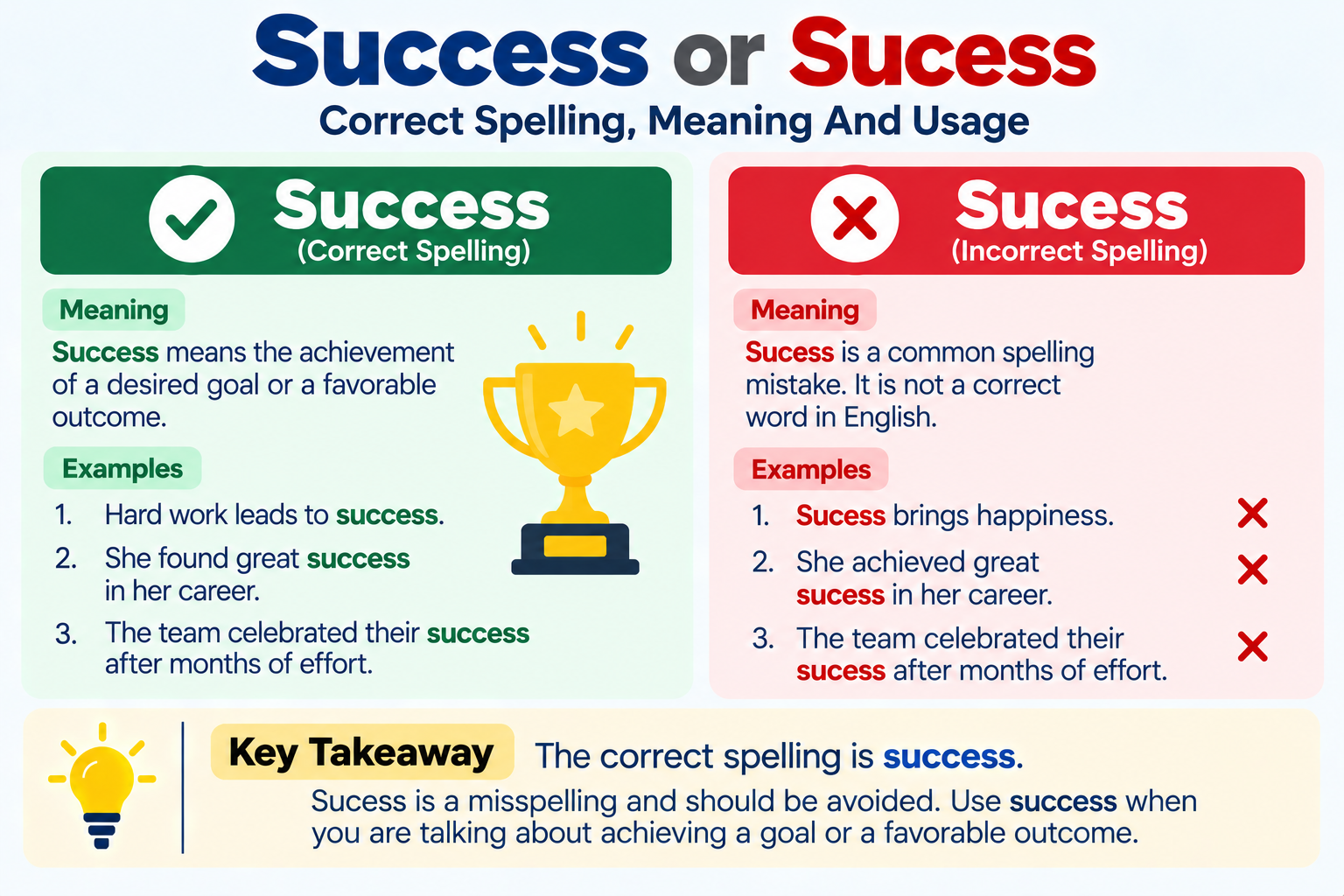
success or sucess can be confusing because the two forms look almost identical. The correct spelling is success with two c letters. Sucess is a common misspelling and is not the standard spelling used in English dictionaries.
The mistake usually happens because the word contains a repeated consonant sound that can be easy to overlook while writing. When you say the word aloud you do not clearly hear two separate c letters. Fast typing can make the problem even more common. Once you connect the spelling with the word’s structure and pronunciation the correct form becomes much easier to remember.
Success is a common noun used to describe achieving a desired result or reaching a goal. It can refer to personal achievement, business results, academic performance, public approval, or a favorable outcome. In this guide you’ll learn the correct spelling, meaning, pronunciation, grammar, word origin, common mistakes, related terms, and natural examples. You’ll also get a simple memory trick that can help you avoid this spelling error in the future.
Many readers also check Touchbase or Touch base: A Complete Usage Guide in 2026.
Quick Definition
Success is the correct spelling. It is a noun meaning the achievement of a desired goal or a favorable result. Sucess is a common spelling mistake caused by leaving out one c. The correct form contains two c letters before the final e and s.
Quick Answer
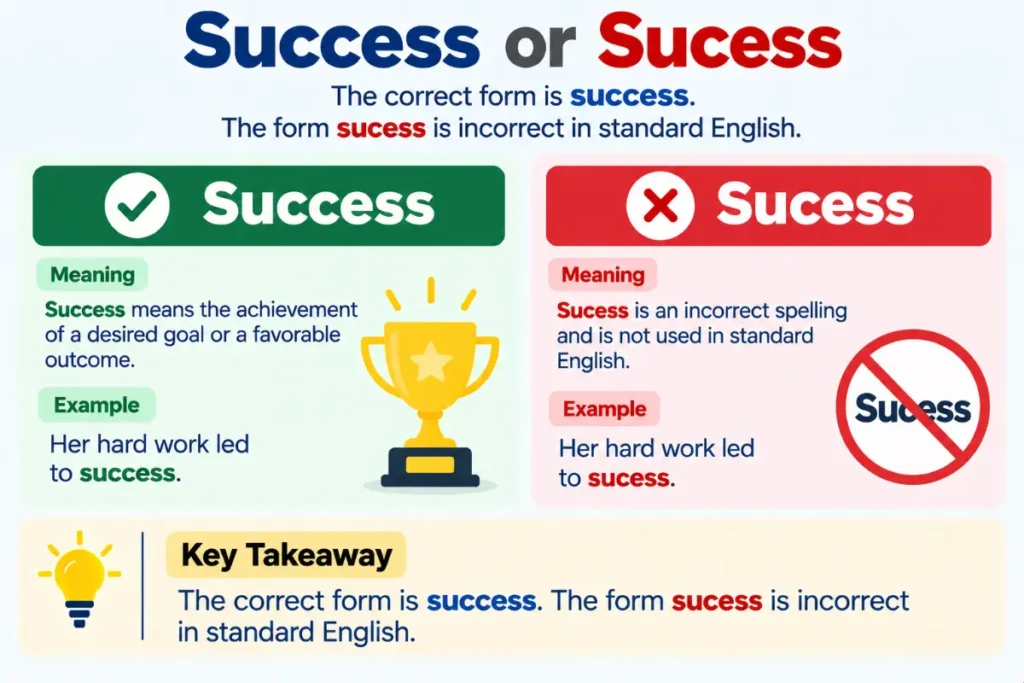
The correct form is success. The form sucess is incorrect in standard English.
Success is a noun that describes a positive result or the achievement of something you wanted to accomplish.
For example:
Her hard work led to success.
The easiest spelling reminder is to remember that success contains cc in the middle.
Comparison Table For Success And Sucess
| Form | Meaning | Part of Speech | Origin | Usage Frequency | Formality | Common Contexts | Example |
|---|---|---|---|---|---|---|---|
| Success | Achievement of a desired goal or favorable result | Noun | Latin successus through French and Middle English | Very common | Neutral and formal | School, work, business, personal goals, general writing | Her success came from years of practice. |
| Sucess | No standard English meaning | Misspelling of success | Spelling error | Uncommon as a correct form | Nonstandard | Typing mistakes and informal errors | Sucess is an incorrect spelling. |
The distinction is simple. Success is the standard English word. Sucess is missing one c.
Meaning And Definition
Meaning Of Sucess
Sucess is not the standard spelling of the English noun. It is generally a spelling mistake for success.
You may see it in online comments, quick messages, school work, search queries, social media posts, or drafts. Its appearance does not give it a separate standard meaning.
The most common reason for this mistake is that writers remember the general shape of the word but forget the repeated c. This is a familiar spelling pattern problem. English contains many words where repeated letters are not strongly reflected in pronunciation.
If you see sucess in your own writing, simply change it to success.
Meaning Of Success
Success is a noun that describes the achievement of a desired goal or a favorable result.
For example:
The project was a success.
Here success describes the positive result of the project.
The word can describe many kinds of achievement.
A student can experience academic success.
A business can achieve financial success.
An athlete can achieve success in competition.
A person can find success in a career.
A plan can succeed and produce a successful result.
Success does not always mean wealth or fame. Its meaning depends on the goal being discussed.
For one person, success might mean earning a promotion. For another, it might mean completing a degree, starting a business, improving a skill, helping a family, or reaching a personal milestone.
This broad meaning is one reason the word appears so often in everyday English.
Key Differences Explained
- Spelling. Success contains two c letters. Sucess contains only one c and is incorrect in standard English.
- Meaning. Success has a clear dictionary meaning related to achievement or a favorable result. Sucess does not have a separate standard meaning.
- Grammar. Success is a noun. It can act as the subject or object of a sentence and can follow linking verbs.
- Pronunciation. The two spellings are not normally pronounced differently because sucess is simply a misspelling of success.
- Formality. Success works naturally in casual, professional, academic, and formal writing.
- Context. You can use success when discussing school, careers, business, sports, personal goals, projects, relationships, or general outcomes.
- Standard usage. Success is the accepted spelling in standard English. Sucess should be corrected during proofreading.
- Regional usage. The spelling success is standard across major varieties of English, including American, British, Canadian, and Australian English.
Which Spelling Is Correct?
Success is the correct spelling.
The word contains two c letters in the middle:
s u c c e s s
The incorrect form leaves out the second c:
s u c e s s
That single missing letter changes a standard English word into a misspelling.
The spelling makes more sense when you look at the word’s history. Success came into English through Anglo French and Middle English from Latin successus. The word is related to the Latin verb succedere, meaning to come after or follow and later to succeed or turn out well.
The double c therefore belongs to the established spelling of the word. It is not optional and it does not change based on American or British English.
A dictionary based spelling check will recognize success as the standard noun. Sucess is normally treated as an error.
How To Remember The Spelling
The easiest memory trick is to remember the middle of the word.
Success has double c.
You can think of it as:
suc + cess
Another useful trick is to connect success with succeed and successful.
Success.
Succeed.
Successful.
The related words help reinforce the c pattern.
You can also remember this short sentence:
Success needs two c letters.
That small reminder can prevent the most common spelling error.
Sentence Examples
Here are natural examples using the correct form.
- Her success came after years of hard work.
- The project was a major success for the company.
- Academic success requires patience and consistent effort.
- He measured success by how much he learned.
- The team celebrated its success after the final game.
- Her small business became a surprising success.
- Good planning played a major role in the event’s success.
- The students worked together to achieve success.
- Success does not always happen quickly.
- The company considers customer satisfaction an important part of success.
These examples show how flexible the noun can be. It can describe an outcome, achievement, result, or broader state of doing well.
Common Mistakes And Misspellings
Sucess
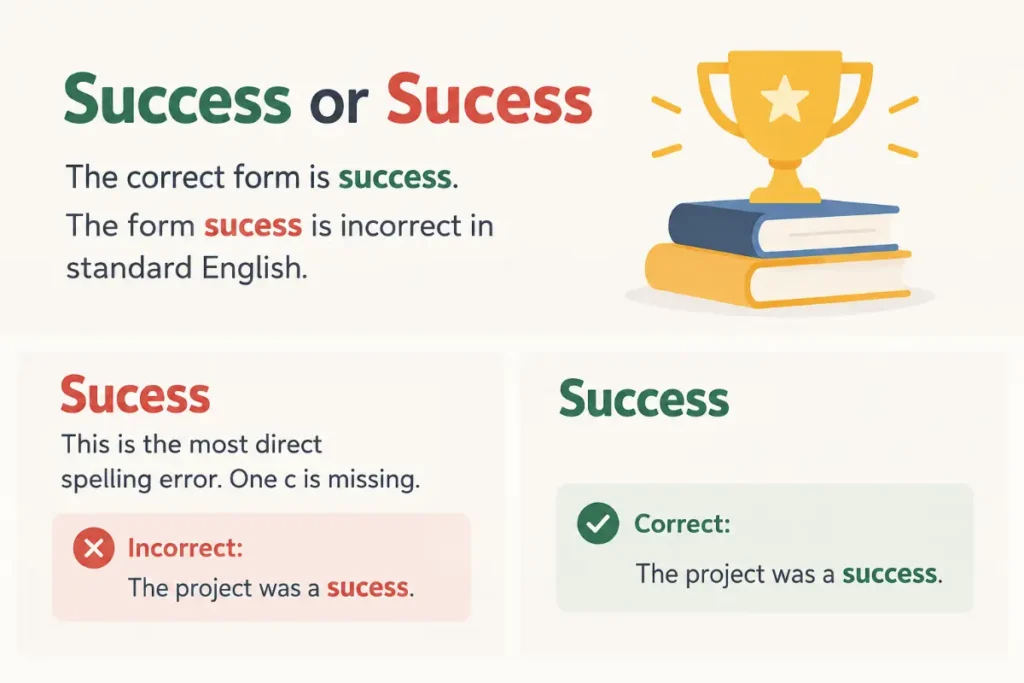
This is the most direct spelling error. One c is missing.
Incorrect:
The project was a sucess.
Correct:
The project was a success.
The error usually happens because the repeated c is easy to overlook.
Succes
Some writers may also drop one of the final s letters.
Incorrect:
She achieved great succes.
Correct:
She achieved great success.
The word ends with ss, not a single s.
Sucessful
This combines the missing c mistake with the adjective ending.
Incorrect:
She became sucessful.
Correct:
She became successful.
The adjective successful also contains the double c pattern.
Suceed
This spelling leaves out one c and changes the structure of the related verb.
Incorrect:
I hope you suceed.
Correct:
I hope you succeed.
The correct verb is succeed with double c.
Sucessfully
This form combines the same spelling problem with the ly ending.
Incorrect:
The project was completed sucessfully.
Correct:
The project was completed successfully.
Learning the entire word family can help because the same spelling pattern appears across several related forms.
Why People Misspell Success
The most common reason is visual and phonological confusion.
When you pronounce success, you hear the sound sequence rather than the individual letters. English spelling often contains letters that are not obvious from speech. That makes it easy to write the word from memory incorrectly.
Fast typing adds another layer. When someone types quickly, repeated letters are easy to skip.
There is also a pattern recognition issue. Readers become familiar with the overall shape of a word rather than consciously processing every letter. If the second c disappears, the brain may still recognize what the writer intended.
That is why a person can read sucess and understand the intended word immediately while still having written the spelling incorrectly.
This is not a failure of meaning. It is a spelling pattern problem.
Pronunciation Guide
Success is commonly pronounced /səkˈses/ in American English.
A simple pronunciation guide is:
suk SESS
The word has two syllables:
suc cess
The main stress falls on the second syllable.
The first syllable has a relaxed vowel sound. The second syllable sounds like sess.
Say it naturally:
suk SESS
The pronunciation does not clearly announce that the spelling contains two c letters. That is one reason the written form can cause trouble.
The double c represents the spelling structure rather than two separately pronounced consonants.
A useful learner strategy is to connect the sound to the written pattern. Say success aloud while looking at the spelling. Then write the word from memory several times.
Grammar Rules And Part Of Speech
Success is a noun.
It can appear as the subject of a sentence.
Success requires patience.
Here success is the subject.
It can also appear as the object.
She achieved success through hard work.
Here success is the object of achieved.
Success can follow a linking verb.
The event was a success.
In this construction the word describes the outcome of the event.
The noun is usually uncountable when referring to success in a general sense.
Success takes time.
But it can be countable when referring to a particular successful person, event, or thing.
The new product was a success.
You can also use the plural form successes when referring to multiple achievements.
The company has enjoyed several successes this year.
This distinction is useful because learners sometimes assume that success always behaves the same way grammatically.
Learn the difference in Definately or Definitely Which Spelling Is Correct (2026).
Success With Articles
It can appear with no article when you are discussing the idea generally.
Success takes effort.
It can also appear with the definite article when a specific kind of success is being discussed.
The success of the project surprised everyone.
The article the points to a particular result.
You can use a when referring to a specific successful event or outcome.
The fundraiser was a success.
The difference comes from meaning and context rather than from the word itself.
Success And Successful
Success is a noun.
Successful is an adjective.
Compare these sentences.
Her success impressed the team.
She was successful in her new role.
The first sentence uses success to name the achievement or favorable outcome.
The second uses successful to describe the person.
This distinction is useful because learners sometimes use the noun where an adjective is needed.
Incorrect:
She is a success person.
Better:
She is a successful person.
Or:
She is a successful business owner.
Likewise, you should not use successful when you need a noun.
Incorrect:
Her successful was unexpected.
Correct:
Her success was unexpected.
Success And Succeed
Succeed is the verb.
Success is the noun.
Successful is the adjective.
Successfully is the adverb.
These forms belong to the same word family.
Verb: succeed.
Noun: success.
Adjective: successful.
Adverb: successfully.
You can remember them as a small family rather than four unrelated words.
For example:
She wants to succeed.
Her success came after years of effort.
She became successful.
She completed the project successfully.
Learning the family together makes spelling and grammar easier.
Etymology And Word Origin
Success has roots in Latin.
The English word developed from Latin successus, which was related to succedere. The Latin verb carried the idea of coming after, following, or advancing. Over time the word developed into meanings associated with a favorable result or achievement.
The word entered English through French influence before becoming established in Middle English.
This history helps explain the double c in the modern spelling. The spelling has been shaped by the word’s historical structure rather than by modern pronunciation alone.
The related verb succeed comes from the same historical family. Successful and successfully were later formed from the same word family in English.
Understanding this connection gives you a useful spelling advantage. When you know that success, succeed, successful, and successfully belong together, the double c pattern becomes easier to remember.
Regional Usage
American English
Success is the standard spelling in American English. It is used in everyday speech, education, business, journalism, professional communication, and academic writing.
There is no American spelling variation that removes one of the c letters.
British English
British English also uses success as the standard spelling. The meaning and grammatical use are essentially the same as in American English.
British writers do not normally use sucess as an alternative spelling.
Australian English
Australian English uses success as the standard form. The spelling does not change based on Australian usage.
Canadian English
Canadian English also uses success. There is no standard Canadian variation that changes the double c spelling.
The word is therefore consistent across major varieties of English.
Formal And Informal Usage
Success is suitable for almost any type of English writing.
You can use it in a text message:
I hope your exam is a success.
You can use it in a business report:
The launch was a significant success.
You can use it in academic writing:
The study examines factors associated with academic success.
You can use it in formal communication:
We appreciate your contribution to the success of the project.
Unlike many casual words, success does not need to be replaced in formal writing. It is a standard neutral English noun.
The only concern is precision. In formal writing, it can help to explain what kind of success you mean.
Instead of:
The program was successful.
You might write:
The program increased graduation rates.
The second sentence gives the reader measurable information rather than relying on a broad positive term.
Real Life Usage Examples
Daily Conversation
I hope you have success with your new business.
Her hard work finally brought success.
These examples sound natural in everyday speech.
Workplace Communication
The success of the project depended on clear communication.
The team celebrated the successful launch after months of preparation.
Workplace writing often uses success to describe goals, projects, launches, sales, or customer outcomes.
Academic Writing
Academic success often depends on consistent study habits.
The researchers examined factors linked to student success.
Academic writing often combines success with terms such as academic, educational, professional, or long term.
News Writing
The event was considered a success by organizers.
The company reported strong sales following the successful product launch.
News writing uses the word when discussing outcomes, public events, campaigns, business results, and other developments.
Literature And Storytelling
After years of struggle, her success changed the direction of her life.
He discovered that success meant something different from what he had imagined.
In storytelling, the word can describe both an external achievement and a character’s personal idea of achievement.
Related And Confused Terms
Succeed
Succeed is the verb form. It means to achieve a desired result or accomplish something.
She worked hard to succeed.
Successful
Successful is the adjective.
She became a successful writer.
Successfully
Successfully is the adverb.
She successfully completed the course.
Achievement
Achievement refers to something accomplished successfully. It often emphasizes the result itself.
Accomplishment
Accomplishment is similar to achievement and often highlights something completed through effort.
Victory
Victory usually refers to winning a contest, competition, conflict, or struggle. It is narrower than success.
Progress
Progress means movement toward a goal. A person can make progress without reaching complete success.
Failure
Failure is commonly treated as the opposite of success, but the relationship is not always absolute. A failed attempt can still provide useful experience and lead to later achievement.
These terms help clarify meaning. Success is broad while the other words often describe particular parts of achieving a goal.
Success In Different Contexts
The meaning of success changes slightly depending on the subject.
Academic Success
Academic success usually refers to achieving educational goals. Grades, completed courses, skills, and learning outcomes may all contribute to it.
Career Success
Career success can refer to professional growth, meaningful work, responsibility, income, recognition, or personal satisfaction.
Business Success
Business success may involve profitability, growth, customer satisfaction, sustainability, or achieving a specific business goal.
Personal Success
Personal success is highly individual. One person may define it through financial independence while another may define it through family life, health, learning, creativity, or personal freedom.
This is why the word should not automatically be treated as a synonym for money or fame.
Common Phrases With Success
Several common expressions use the noun naturally.
Achieve success.
This means to reach a desired level of achievement.
Find success.
This often describes eventually becoming successful in a particular field.
Enjoy success.
This describes experiencing positive results or achievements.
Success rate.
This refers to the percentage or proportion of attempts that produce a desired outcome.
Key to success.
This describes something believed to contribute strongly to achieving a goal.
Recipe for success.
This is a figurative expression for a combination of factors likely to produce a good result.
Road to success.
This describes the process or journey toward achievement.
Measure of success.
This refers to a standard used to determine how successful something has been.
These phrases appear across everyday, professional, academic, and media writing.
Expert Editor Insight
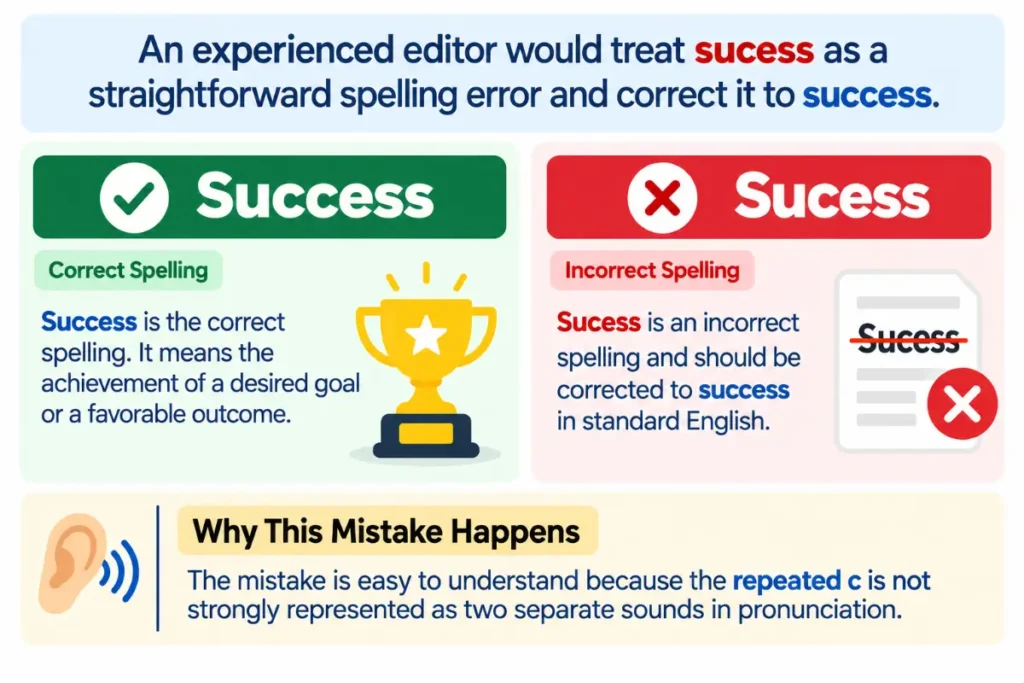
An experienced editor would treat sucess as a straightforward spelling error and correct it to success. The mistake is easy to understand because the repeated c is not strongly represented as two separate sounds in pronunciation. Professional proofreading also checks the related forms succeed, successful, and successfully because writers who miss one c in success may repeat the same pattern elsewhere. A useful editing habit is to visually check the middle of the word and remember that success contains cc. That quick check catches the most common error without slowing down your writing.
Still confused? Compare Tweek vs Tweak Which Spelling Is Correct?.
Conclusion
success or sucess has a clear answer. Success is the correct standard English spelling, while sucess is a common misspelling caused by leaving out one c. The word is a noun that describes achievement, a favorable result, or the accomplishment of a desired goal.
The spelling is consistent across American, British, Australian, and Canadian English. It also connects with the related forms succeed, successful, and successfully, which makes the word family useful for remembering the correct pattern. Success works naturally in casual conversation, academic writing, business communication, and formal documents.
The easiest editing trick is simple. Stop for a second when you reach the middle of the word and check for cc. Remember that success needs two c letters and two s letters at the end. That small visual check can save you from one of the most common spelling mistakes.
FAQs
Is sucess a real English word?
Sucess is not the standard spelling of an English word meaning achievement or a favorable result. It is normally a misspelling of success. The correct form contains two c letters in the middle. If you see sucess in school work, professional writing, an email, or a published draft, it should normally be corrected to success.
What does success mean?
Success means achieving a desired goal or producing a favorable result. The word can describe academic achievement, career progress, business performance, personal goals, or the outcome of a particular event. Its meaning depends on context. Success does not always mean money or fame. A person can define success through learning, relationships, service, creativity, or reaching a personal goal.
Which is correct, success or sucess?
Success is correct. Sucess is a common spelling mistake caused by leaving out one c. The correct spelling is s u c c e s s. A useful memory trick is to remember the double c in the middle and the double s at the end. The same spelling pattern appears in related words such as successful and successfully.
How do you pronounce success?
Success is commonly pronounced /səkˈses/ in American English. It has two syllables, with the main stress on the second syllable. A simple guide is suk SESS. The pronunciation does not clearly reveal the double c in the spelling, which helps explain why writers sometimes leave one c out when spelling the word from memory.
Is success a noun or adjective?
Success is a noun. It names an achievement, favorable result, or state of doing well. The related adjective is successful. For example, success is used in The project was a success, while successful appears in The project was successful. The related adverb is successfully, as in She completed the project successfully.
What is the adjective form of success?
The adjective form is successful. It describes a person, thing, action, or event that achieves a desired result. For example, She is a successful writer uses successful as an adjective. The noun is success, the verb is succeed, and the adverb is successfully. Learning these forms together can make both grammar and spelling easier.
Why do people misspell success?
People often misspell success because the double c is easy to overlook. The pronunciation does not make the two c letters obvious, and fast typing can cause repeated letters to disappear. Some writers also remember the general shape of the word instead of each letter. Connecting success with successful and remembering the double c can help prevent the mistake.
Is success appropriate in formal writing?
Yes. Success is a standard neutral English noun and works well in formal writing. You can use it in academic papers, business reports, professional emails, news writing, and official communication. For greater precision, explain what the success involves. Instead of simply calling a project successful, you can describe the specific result, such as increased sales, improved grades, or higher participation.