
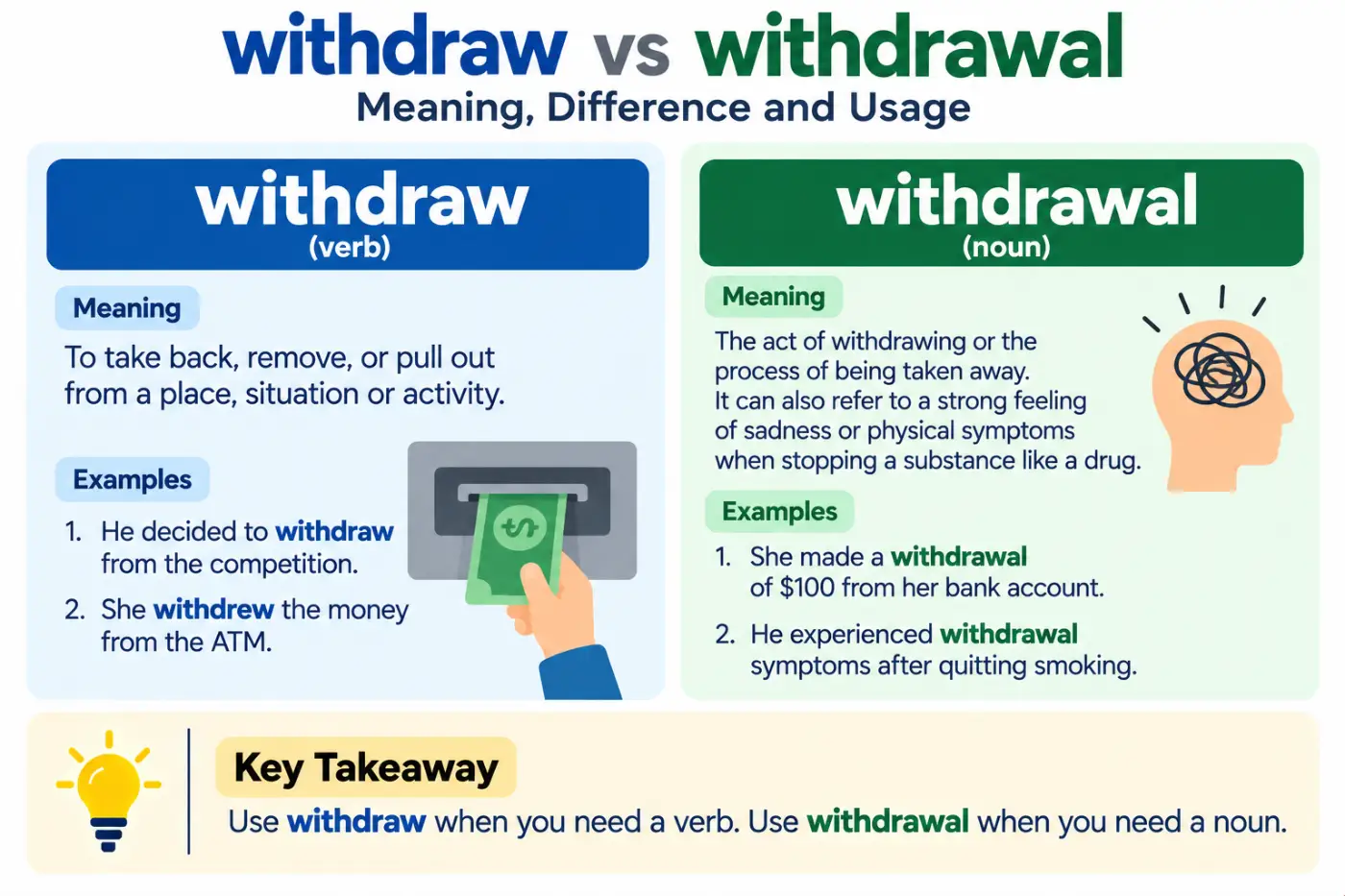
withdraw or withdrawal often causes confusion because the two words share the same core meaning but work differently in a sentence. Withdraw is the verb while withdrawal is the noun. If you say I want to withdraw money you are describing an action. If you say the withdrawal was successful you are naming that action or event.
The confusion becomes easier to understand once you look at what the sentence needs. A verb tells us what someone does or what happens. A noun names a person place thing idea action or event. Withdraw describes the act of taking something away or moving back. Withdrawal refers to that act or the result of it.
This distinction appears in banking medical writing military discussions social situations academic work and everyday conversation. You will learn how each word works how to pronounce them how they developed and how native speakers use them naturally. You will also see common mistakes and simple memory tricks that make the difference easier to remember.
Still confused? Compare In Route vs En Route Which Is Correct.
Quick Definition
Withdraw is a verb meaning to take something away to remove yourself from a situation or to take money from an account. Withdrawal is a noun that refers to the act process or result of withdrawing. Use withdraw when describing an action and withdrawal when naming that action or event.
Quick Answer
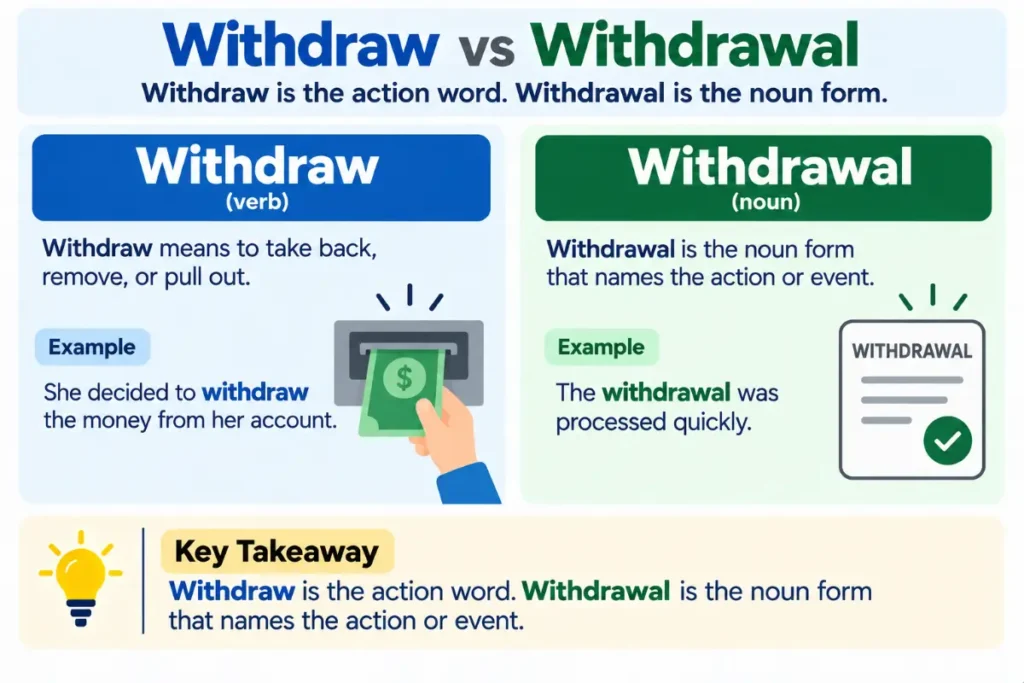
Withdraw is the action word. Withdrawal is the noun form that names the action or event.
For example you can say I need to withdraw $100 from my account. You can also say The withdrawal appeared on my statement. The first sentence describes an action. The second sentence names the transaction.
Both forms are standard English. The choice depends on the grammatical role the sentence requires.
Comparison Table Withdraw Or Withdrawal
| Form | Meaning | Part of Speech | Origin | Usage Frequency | Formality | Common Contexts | Example |
|---|---|---|---|---|---|---|---|
| Withdraw | To take away remove leave or take money from an account | Verb | Middle English from Anglo French and related Germanic influences | Very common | Neutral and formal | Banking conversations decisions groups military situations | I need to withdraw some cash. |
| Withdrawal | The act process or result of withdrawing | Noun | Formed from withdraw with the noun ending al | Common | Neutral and formal | Banking medicine finance social situations formal writing | The withdrawal appeared on my statement. |
The most useful distinction is grammatical. Withdraw performs the action while withdrawal names the action.
Meaning And Definition
Meaning Of Withdraw
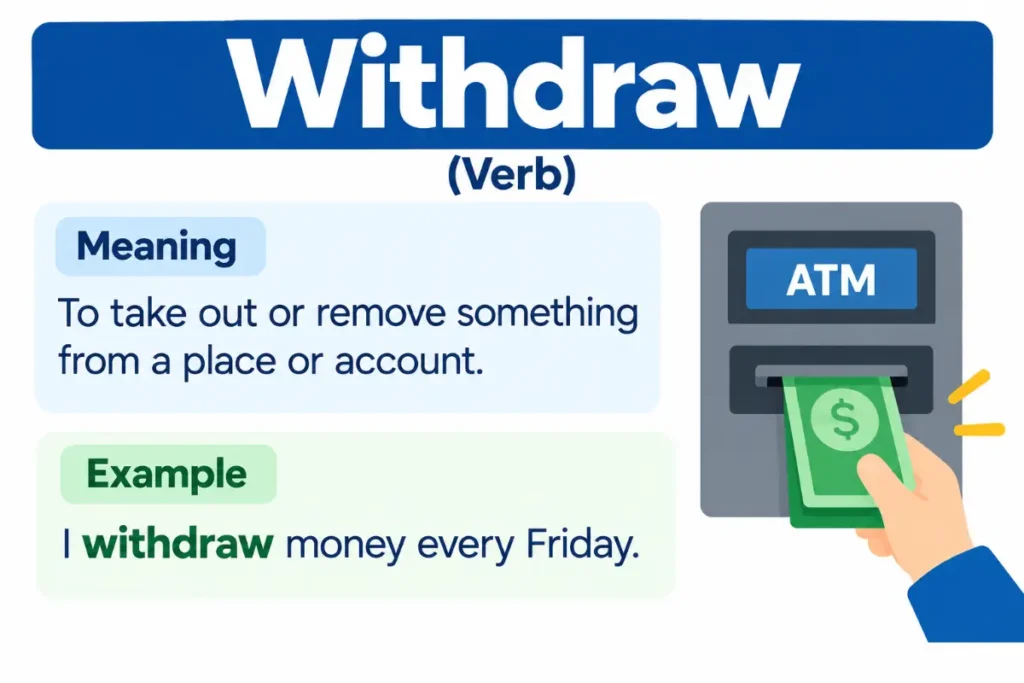
Withdraw is a verb. It describes an action in which someone takes something away removes something from a place or leaves a situation.
One of the most familiar uses involves money.
I need to withdraw cash from the ATM.
Here withdraw describes what the person does with the money.
The word also works in many other contexts.
The student decided to withdraw from the course.
The company withdrew its offer.
The player withdrew from the competition.
The diplomat withdrew the statement.
The government withdrew its proposal.
These examples look different on the surface but share a basic idea. Something is being taken away or someone is moving away from a situation.
Withdraw can also describe physical movement.
The soldiers withdrew from the area.
In this sentence the people move away from a location.
It can also describe social behavior.
He withdrew from his friends after the argument.
Here the meaning is figurative. The person becomes less socially involved.
The word therefore has a broad range of meanings. The central idea remains removal or movement away.
Meaning Of Withdrawal
Withdrawal is a noun. It names the act process or result associated with withdrawing.
For example:
The bank approved the withdrawal.
Here withdrawal names the transaction.
You can also use it in other contexts.
Her withdrawal from the competition surprised everyone.
The withdrawal of the proposal changed the discussion.
The patient experienced withdrawal symptoms.
The troops began their withdrawal from the region.
In each sentence withdrawal functions as a noun.
The word can describe a financial transaction. It can describe leaving an activity. It can describe the removal of a statement or offer.
This broad meaning explains why the word appears across many fields.
The Core Difference
The simplest rule is this.
Withdraw describes doing. Withdrawal names the doing.
Compare these sentences.
I will withdraw my application.
My withdrawal from the program was unexpected.
In the first sentence withdraw is the verb. It tells us what I will do.
In the second sentence withdrawal is the noun. It names the event.
Another example makes the difference even clearer.
She withdrew $200 from her account.
The withdrawal was recorded at 10 a.m.
The first sentence focuses on the action. The second focuses on the transaction.
This verb and noun relationship is common in English.
Decide becomes decision.
Approve becomes approval.
Refuse becomes refusal.
Arrive becomes arrival.
Withdraw becomes withdrawal.
Recognizing these word families can make grammar much easier because you begin to see patterns instead of memorizing every word separately.
When To Use Withdraw
Use withdraw when the sentence needs a verb.
The word can appear in several common structures.
Withdraw Something
Use withdraw when someone removes something.
The company withdrew its advertisement.
The bank withdrew the offer.
She withdrew her complaint.
The organization withdrew its support.
In these sentences the object comes after the verb.
Withdraw From Something
Use withdraw from when someone leaves an activity group place or situation.
He withdrew from the course.
She withdrew from the competition.
The company withdrew from the market.
The team withdrew from the tournament.
The preposition from is important because it connects the action with the thing being left.
Withdraw Money
In financial English withdraw commonly means to take money from a bank account.
I need to withdraw some cash.
She withdrew $500 from her savings account.
He withdrew money before the trip.
This is one of the most common everyday uses.
Withdraw A Statement
Withdraw can also mean to officially take back something that was said or submitted.
The company withdrew its statement.
The speaker withdrew the accusation.
The author withdrew the claim after reviewing the evidence.
This use is common in formal communication.
When To Use Withdrawal
Use withdrawal when the sentence needs a noun.
The word often appears after articles such as a or the.
The withdrawal was processed yesterday.
A withdrawal from the account requires identification.
It can also follow possessive words.
His withdrawal from the competition surprised the team.
Their withdrawal from the agreement changed the situation.
Withdrawal can also appear after prepositions.
The bank charged a fee for the withdrawal.
She announced her withdrawal from the race.
These patterns help you recognize the noun form quickly.
A useful editing question is simple. Ask yourself whether you are describing an action or naming the action. If you are describing what someone does use the verb. If you are talking about the action as a thing or event use the noun.
Grammar And Part Of Speech
Withdraw is a verb. It can appear in different verb forms.
The base form is withdraw.
The third person singular present form is withdraws.
The past tense and past participle are withdrew and withdrawn.
For example:
I withdraw money every Friday.
She withdraws cash when necessary.
He withdrew the application yesterday.
The application was withdrawn yesterday.
Notice that withdrawn is not interchangeable with withdrawal. Withdrawn is a past participle or adjective while withdrawal is a noun.
This creates another useful word family.
Withdraw is the base verb.
Withdrew is the past tense.
Withdrawn is the past participle.
Withdrawal is the noun.
Each form has its own grammatical role.
A common mistake is to use withdrawal after an auxiliary verb that requires a verb.
Incorrect:
I need withdrawal my money.
Correct:
I need to withdraw my money.
Another common mistake is to use withdraw after an article.
Incorrect:
The withdraw was completed.
Correct:
The withdrawal was completed.
The article the normally introduces a noun. Withdrawal fits that role while withdraw does not.
Sentence Examples
Here are natural examples using the verb form in different settings.
- I need to withdraw some cash before I leave.
- She decided to withdraw from the class.
- The company withdrew its offer after reviewing the contract.
- He withdrew his application before the deadline.
- We may need to withdraw the proposal.
- She withdrew money from her savings account.
- The team withdrew from the tournament.
- The speaker withdrew the statement later that day.
- I want to withdraw my name from the list.
- The organization decided to withdraw its support.
Now look at the noun form.
- The withdrawal appeared on my bank statement.
- His withdrawal from the course surprised his classmates.
- The company announced the withdrawal of its product.
- The withdrawal took only a few minutes.
- Her withdrawal from the competition was unexpected.
- The bank charges a small fee for certain withdrawals.
- The withdrawal of the proposal changed the discussion.
- The patient was monitored for withdrawal symptoms.
- The military withdrawal began gradually.
- The withdrawal request was approved yesterday.
The difference becomes much easier when you compare matching pairs.
I withdrew my application.
My withdrawal was confirmed.
The company withdrew its offer.
The withdrawal of the offer caused confusion.
She withdrew from the race.
Her withdrawal from the race surprised the audience.
The verb describes the action. The noun names the action or event.
Common Mistakes
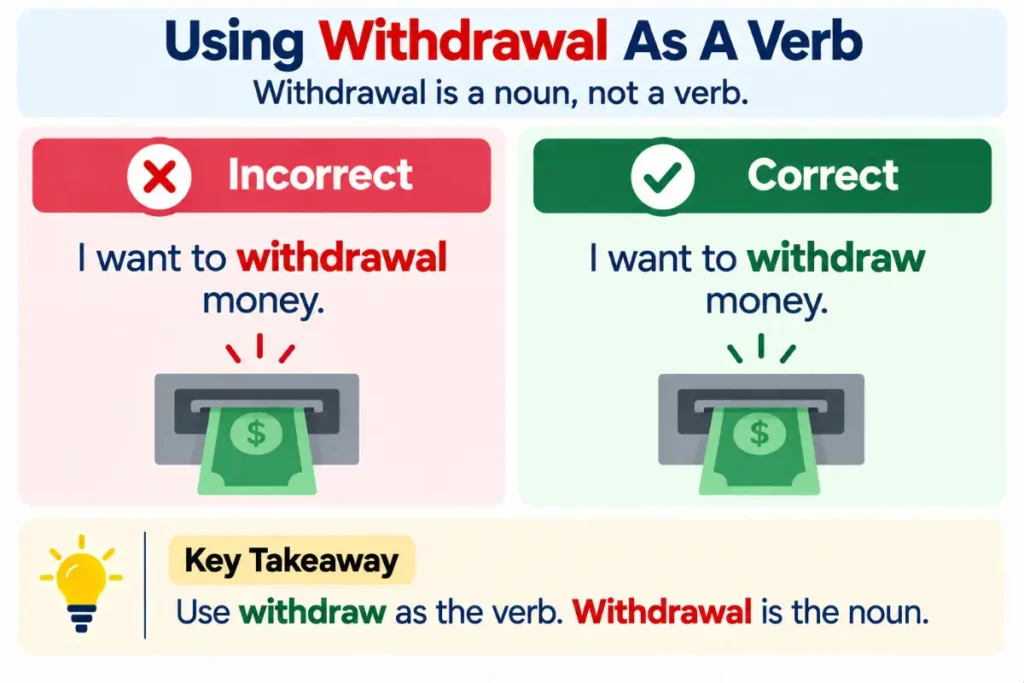
Using Withdrawal As A Verb
Incorrect:
I want to withdrawal money.
Correct:
I want to withdraw money.
The problem happens because withdrawal looks like a natural verb form. It is not. It is a noun.
Using Withdraw As A Noun
Incorrect:
The withdraw was processed.
Correct:
The withdrawal was processed.
The article the needs a noun after it in this construction.
Confusing Withdraw And Withdrew
Withdraw is the present or base form.
Withdrew is the simple past form.
I withdraw money every week.
I withdrew money yesterday.
You should not write I withdraw money yesterday because the time expression yesterday requires the past form.
Confusing Withdrawn And Withdrawal
Withdrawn is a verb form or adjective.
Withdrawal is a noun.
The money was withdrawn.
The withdrawal was recorded.
These sentences are both correct but perform different grammatical jobs.
Forgetting From
When withdraw means leaving an activity or situation the preposition from is often needed.
Correct:
She withdrew from the competition.
Not:
She withdrew the competition.
The second sentence changes the meaning and suggests that she removed the competition itself.
Why The Words Are Easy To Confuse
The two words belong to the same word family. That similarity is helpful for meaning but can create problems when you are choosing the correct grammatical form.
English often forms nouns from verbs by adding endings such as al.
Approve becomes approval.
Arrive becomes arrival.
Refuse becomes refusal.
Withdraw becomes withdrawal.
This pattern can help you understand why the noun has a longer form.
There is also a spelling issue involving the final consonant. Withdraw ends in aw while withdrawal keeps the base word and adds al. The spelling looks unusual because the pronunciation changes slightly across the word boundary.
Another source of confusion is context. Financial language uses both forms constantly.
I need to withdraw money.
The withdrawal was successful.
Because these sentences discuss the same event the two words can feel interchangeable. They are not. Their meanings are closely related but their grammatical functions differ.
Pronunciation Guide
Withdraw is commonly pronounced /wɪðˈdrɔː/ in American English.
A simple pronunciation guide is with DRAW.
The main stress falls on the second part.
Withdrawal is commonly pronounced /wɪðˈdrɔəl/.
A simple guide is with DRAW uhl.
The stress again falls on the part related to draw.
The pronunciation of the th sound can vary depending on the speaker and context. In common American speech the word may sound smooth and quick rather than strongly separated into individual parts.
A frequent learner mistake is to pronounce withdrawal as if every written letter receives equal emphasis. Natural English does not usually work that way. Focus on the stressed syllable and let the unstressed vowel sound remain light.
Another useful point is that withdraw and withdrawal should not be confused with withdrawed. The correct past tense is withdrew and the correct past participle is withdrawn.
Need another quick comparison? Read to bad or too bad which is correct.
Etymology And Word Origin
Withdraw has a long history in English. The word developed from the combination of with and draw. Historically the idea was connected with drawing away or pulling back.
Over time the meaning expanded beyond physical movement. The word came to describe removing something from a place or situation and later became common in financial contexts for taking money from an account.
Withdrawal developed from withdraw with the noun forming ending al. Its meaning naturally follows the verb. It names the act or process of withdrawing.
This history helps explain why the two words look so closely related. They are part of the same word family rather than unrelated vocabulary items.
The older physical idea of moving something away still appears in modern usage. You can withdraw from a room or situation. You can also withdraw money from an account. The specific meaning changes with context while the central idea of removal remains.
Regional Usage
American English
Both withdraw and withdrawal are standard American English. The words are widely used in banking employment education business writing journalism and everyday speech.
American speakers commonly use withdraw for actions involving money or leaving a situation.
I need to withdraw cash.
She withdrew from the program.
Withdrawal is used to name the transaction or process.
The withdrawal was completed.
There is no major American spelling difference between the two forms.
British English
British English uses the same basic distinction. Withdraw is the verb and withdrawal is the noun.
British speakers use both words in financial and general contexts. The spelling remains the same as American English.
The pronunciation may vary slightly because accents differ but the grammatical distinction remains consistent.
Australian English
Australian English also follows the standard distinction. Withdraw functions as the verb while withdrawal functions as the noun.
The terms appear in banking language formal writing education and ordinary conversation.
No major Australian spelling variation changes the basic relationship between the words.
Canadian English
Canadian English follows the same standard pattern. Writers and speakers use withdraw to describe the action and withdrawal to name the action or event.
Context determines the meaning just as it does in other major English varieties.
There is no major regional rule that changes the basic grammar.
Financial Usage
Banking is one of the areas where this distinction matters most.
A customer might say:
I want to withdraw $300.
A bank employee might say:
Your withdrawal has been processed.
Both sentences describe the same general event but from different grammatical angles.
Withdraw is also common in instructions.
You can withdraw cash from an ATM.
The machine allows customers to withdraw money.
Withdrawal appears in account records and financial documents.
The statement shows a withdrawal of $300.
There may be a withdrawal fee.
The maximum daily withdrawal is limited by the account terms.
In financial writing clarity matters because a small grammatical mistake can make an instruction sound unnatural or unclear.
Withdrawal In Medical And Health Contexts
Withdrawal has an additional meaning in medical language. It can describe physical or psychological effects that occur when someone stops using a substance on which the body has become dependent.
For example:
The patient experienced withdrawal symptoms.
Doctors monitored the patient during withdrawal.
This meaning is different from a bank transaction but still relates to the broader idea of stopping or removing something.
The word may refer to a group of symptoms or to the process itself.
Withdraw can also appear in health related contexts when someone leaves a treatment program or stops participating in an activity.
The patient withdrew from the study.
The participant withdrew from the trial.
In these sentences withdraw remains a verb.
The withdrawal of a participant from a study is the noun form.
Withdrawal In Social And Personal Contexts
The word can also describe a change in social behavior.
After the argument he began to withdraw from his friends.
This means he became less involved socially.
The noun form describes the same process.
His social withdrawal worried his family.
These uses show how the word has moved beyond its literal meaning of pulling away. English frequently extends physical ideas into emotional and social contexts.
The same pattern appears in many related expressions.
Withdraw from a conversation.
Withdraw an invitation.
Withdrawal from social activities.
Withdrawal of support.
The surrounding words tell you which sense is intended.
Formal Writing And Informal Writing
Withdraw and withdrawal work in both formal and informal English.
In everyday conversation you might say:
I need to withdraw some money.
She withdrew from the class.
In a formal report you might see:
The organization decided to withdraw its proposal following further review.
The withdrawal of the proposal was announced on Monday.
The words themselves are not restricted to formal writing. However some noun constructions with withdrawal can sound more formal because professional writing often uses nouns to describe processes.
This is called nominalization. It means turning an action into a noun.
Withdraw becomes withdrawal.
Decide becomes decision.
Approve becomes approval.
Nominalization can be useful in reports and formal documents but too much of it can make writing heavy.
Compare:
The company withdrew the product after testing.
The company announced the withdrawal of the product following additional testing.
Both are correct. The first is more direct. The second gives more emphasis to the event itself.
Real Life Usage Examples
Daily Conversation
I need to withdraw some cash before dinner.
She decided to withdraw from the class because her schedule changed.
These examples sound natural because the verb directly describes the person’s action.
Email And Workplace Communication
Please withdraw the previous request and submit the revised form.
The withdrawal of the request has been confirmed.
Workplace writing often uses both forms because employees may need to describe actions and formal records.
Academic Writing
Participants may withdraw from the study at any time.
The withdrawal of participants can affect the final sample size.
Academic writing often distinguishes carefully between the action and the event.
News Writing
The company withdrew the product after receiving customer complaints.
The withdrawal was announced in a public statement.
News writing uses the verb when focusing on what happened and the noun when discussing the event itself.
Literature And Storytelling
He withdrew from the crowd and stood quietly near the door.
Her sudden withdrawal changed the mood of the room.
These examples show how the words can describe physical movement and emotional distance.
Related And Confused Terms
Remove
Remove means to take something away from a place or situation. It can overlap with withdraw but does not always suggest pulling back or leaving.
Retire
Retire can mean to leave employment or to move away from an activity. It has a narrower meaning in many contexts.
Resign
Resign means to formally leave a job or position. It should not be used as a general replacement for withdraw.
Cancel
Cancel means to stop or call off something that was planned. It differs from withdraw because withdrawing often means removing oneself or taking back something already offered.
Recall
Recall can mean to ask someone to return or to take back a product or statement. Its meaning depends heavily on context.
Retreat
Retreat means to move back or away from a position. It often describes physical movement or a strategic decision.
Abandon
Abandon means to leave something completely or give it up. It is often stronger than withdraw.
Return
Return means to come or go back. It can be related to withdrawal in physical situations but describes movement toward a previous place rather than away from something.
These words overlap in meaning but are not interchangeable in every sentence. Good word choice depends on the exact action you want to describe.
Expert Editor Insight
An experienced editor looks first at the grammatical job of the word. If the sentence describes what someone does use withdraw. If it names the action or event use withdrawal. Editors also watch for awkward constructions such as I want to withdrawal money and the withdraw was processed because these mistakes confuse a verb with a noun. Spellcheckers may catch some errors but they cannot always identify a grammatically wrong word that is spelled correctly. The most reliable check is to ask what the sentence needs: an action or a name for that action.
A Simple Editing Test
If you are unsure which form to use pause and ask one question.
Am I describing an action or naming an action?
If you are describing an action use withdraw.
I will withdraw my application.
If you are naming an action use withdrawal.
My withdrawal was confirmed.
You can also replace the word mentally with another obvious verb or noun.
I will remove my application.
That sentence needs a verb. Therefore withdraw fits.
The removal of my application was confirmed.
That sentence needs a noun. Therefore withdrawal fits.
This test works because it focuses on grammar rather than appearance.
Common Word Forms
Understanding the full word family makes the distinction even easier.
Withdraw
This is the base verb.
I withdraw money every Friday.
Withdraws
This is the third person singular present form.
She withdraws money from her account regularly.
Withdrew
This is the simple past form.
He withdrew the application yesterday.
Withdrawn
This is the past participle.
The application has been withdrawn.
It can also work as an adjective.
The withdrawn offer caused confusion.
Withdrawal
This is the noun.
The withdrawal was processed quickly.
Learning all five forms gives you a clearer picture of how the word behaves in English.
You may also want to read Tear vs Tare: What is the Difference? (2026).
Conclusion
withdraw or withdrawal becomes simple once you identify the grammatical role each word plays. Withdraw is the verb used for an action such as taking money out of an account leaving a course or taking back an offer. Withdrawal is the noun that names the action event or process. Both forms are correct and belong to the same word family.
The easiest way to remember the difference is to ask what your sentence needs. If you are saying what someone does use withdraw. If you are naming what happened use withdrawal. This rule works across banking workplace writing academic contexts and everyday conversation.
For proofreading remember this quick pair: withdraw describes the action while withdrawal names the action. If you can replace the word with another verb such as remove then withdraw is likely the right choice. If you need a noun such as removal then withdrawal will usually fit.
FAQs
Is withdraw a verb or a noun?
Withdraw is a verb. It describes an action such as taking money from an account removing an offer or leaving a situation. The related noun is withdrawal. For example you can say I need to withdraw money but you would say The withdrawal was recorded. The two words share a meaning but perform different grammatical jobs.
Is withdrawal a verb?
No. Withdrawal is a noun. It names the act process or result of withdrawing. For example The withdrawal was approved uses withdrawal as a noun. If you need a verb you should use withdraw. A sentence such as I need to withdraw money is correct while I need to withdrawal money is not standard English.
Which is correct for taking money from a bank?
Use withdraw when describing the action. For example I need to withdraw $200 from my account. Use withdrawal when naming the transaction or process. For example The withdrawal appeared on my statement. Both forms are correct but they cannot simply replace each other because one is a verb and the other is a noun.
What is the past tense of withdraw?
The simple past tense is withdrew. For example I withdrew $100 yesterday. The past participle is withdrawn. For example I have withdrawn the money. Withdraw is the base form. Withdrawal is the noun and should not be confused with either withdrew or withdrawn.
What is the difference between withdraw and withdrawn?
Withdraw is the base verb while withdrawn is the past participle of the same verb. You can say I will withdraw my application and My application has been withdrawn. Withdrawn can also function as an adjective in some contexts. Withdrawal is different because it is a noun that names the action or process.
Do you say withdraw from or withdraw of?
Use withdraw from when someone leaves or removes themselves from a group activity place or situation. For example She withdrew from the course. Use withdraw something when someone takes something back such as an offer or statement. Withdrawal of is a noun construction such as the withdrawal of the proposal.
What does withdrawal mean in banking?
In banking withdrawal means the act or transaction of taking money out of an account. For example a cash withdrawal occurs when money is taken from an account through an ATM or another banking method. The word can refer to the transaction itself rather than the action performed by the customer.
Is withdrawal appropriate in formal writing?
Yes. Withdrawal is a standard noun and is widely used in professional academic financial medical and formal writing. It is especially useful when discussing a process or event. Still you should not use it simply because it sounds formal. If the sentence needs a direct action use withdraw. Clear grammar should guide the choice.