
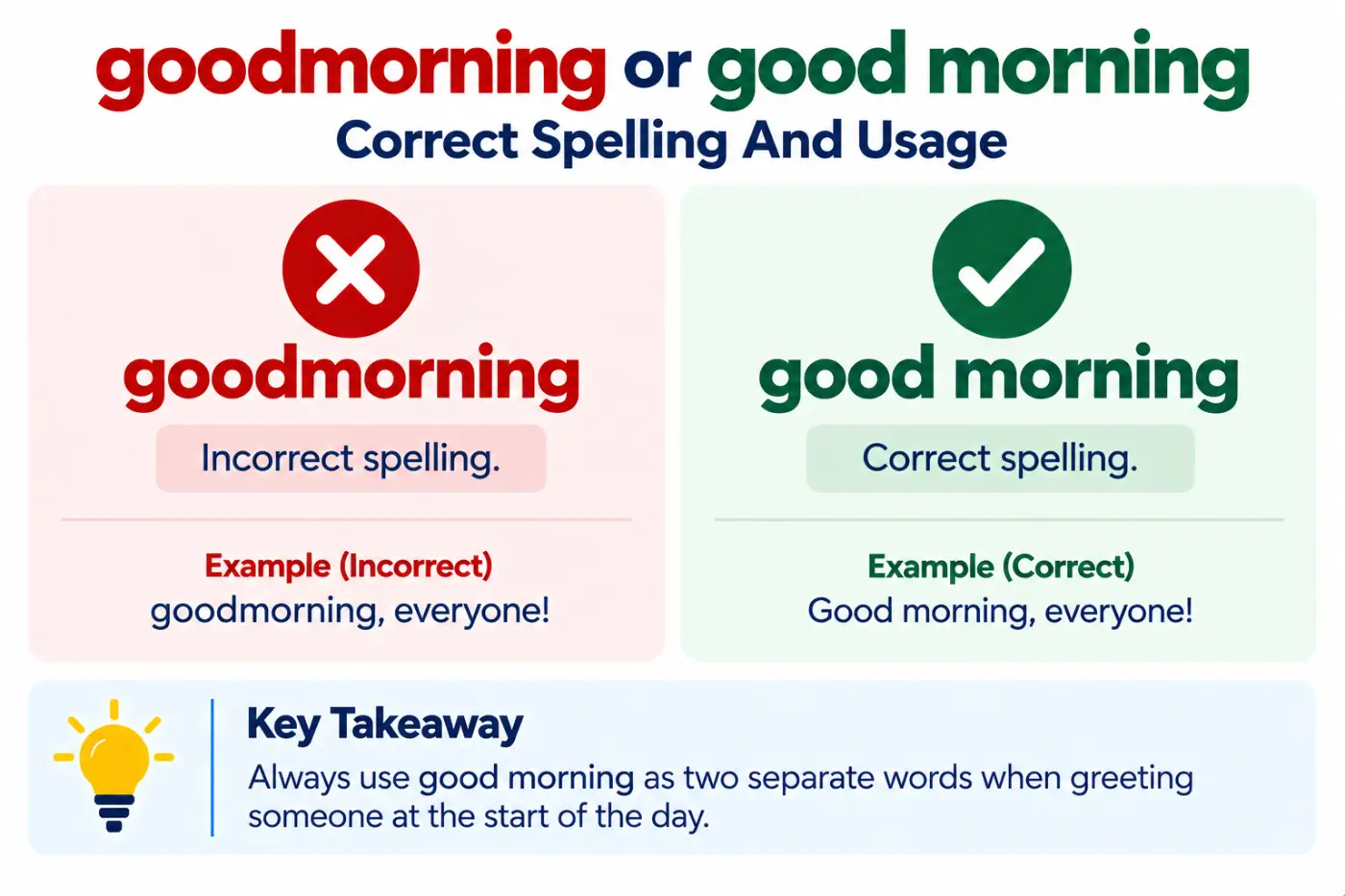
goodmorning or good morning is a common spelling question because the phrase sounds like one natural unit when people say it aloud. The standard English form is good morning with two separate words. The closed form is not the standard spelling for the everyday greeting.
The confusion is understandable. English contains many compounds that started as separate words and later developed into single words. Words such as goodbye and breakfast show how language can change over time. However this particular greeting remains conventionally written as two words in standard American English and other major forms of English.
The good news is that the rule is easy to remember. Use good morning when you greet someone or refer to the morning in a natural phrase. You’ll also learn how to capitalize it in texts and emails how punctuation works how it sounds in American English how it differs from similar greetings and how native speakers use it in casual and formal situations. The examples will help you write the phrase naturally without overthinking it.
Need another quick comparison? Read Suit vs Suite: Definitions, Meanings, and Examples 2026.
Quick Definition
Good morning is the standard two word English greeting used when speaking to someone during the morning. Good functions as an adjective and morning functions as a noun. The phrase can stand alone or appear inside a sentence. The closed form is not the standard spelling for this everyday greeting.
Quick Answer
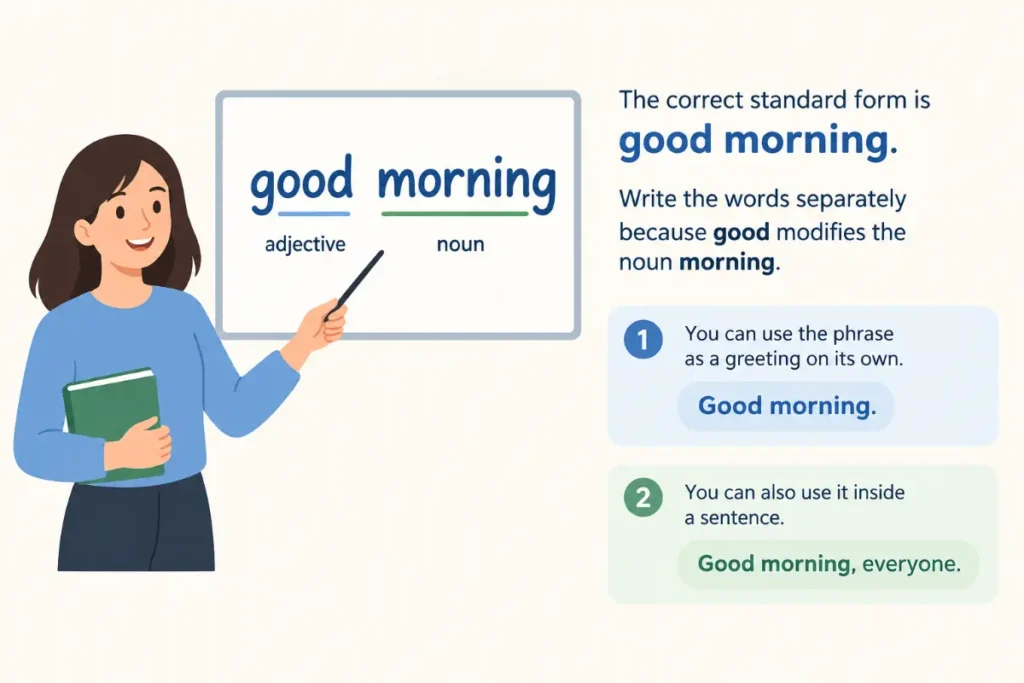
The correct standard form is good morning. Write the words separately because good modifies the noun morning.
You can use the phrase as a greeting on its own.
Good morning.
You can also use it inside a sentence.
I said good morning to my teacher.
The phrase is common in conversation messages emails classrooms workplaces and other everyday settings.
Comparison Table
| Form | Meaning | Part of Speech | Origin | Usage Frequency | Formality | Common Contexts | Example |
|---|---|---|---|---|---|---|---|
| Good morning | A greeting used during the morning | Adjective plus noun | Good comes from Old English while morning developed from the word morning | Very common | Neutral | Conversation messages emails school work | Good morning. How are you today? |
| Goodmorning | Not the standard spelling of the greeting | Nonstandard closed form | Not established as the standard everyday form | Uncommon in edited English | Informal or incorrect | Typing errors usernames stylized names | Goodmorning is normally corrected to good morning. |
The distinction is mainly about spacing. The meaning does not change into a different standard English greeting when the words are joined. The problem is that the closed form does not follow the conventional spelling used for this phrase.
Meaning And Definition
Meaning Of The Two Word Form
Good morning is a greeting used during the morning. It can express politeness friendliness respect or simple acknowledgment.
If you meet a coworker at 8 a.m. you can say:
Good morning.
If you send a message before noon you might write:
Good morning. I hope you’re doing well.
The phrase can also appear as part of a longer sentence.
She smiled and said good morning before taking her seat.
The word good describes the morning in the phrase. It does not mean that the speaker has scientifically judged the morning as good. The expression has become a conventional social greeting.
That point matters because greetings often have meanings that are more social than literal. When someone says good morning to you they are usually not making a detailed claim about the weather or quality of the morning. They are politely acknowledging you and beginning an interaction.
Meaning Of The Closed Form
The closed form is not the standard spelling of the ordinary English greeting.
You may occasionally see it in usernames brand names stylized designs social media handles or other creative contexts. A person or business can choose unusual spacing as part of a name. That does not make the closed form the standard spelling of the greeting.
In school work professional email published writing or carefully edited content use the two word form.
Why The Words Stay Separate
English has many compound expressions. Some are written as one word. Others use a space. Some use a hyphen. The spelling depends on established usage rather than a simple rule that applies to every phrase.
Good morning remains a two word phrase because good functions as an adjective and morning functions as a noun.
The same pattern appears in many ordinary expressions.
Good afternoon.
Good evening.
These expressions do not automatically become single words simply because people use them frequently.
Pronunciation can make the phrase feel like one unit. In natural speech the pause between good and morning may be very small. That does not change the written form.
This is a useful lesson in English spelling. Spoken language and written language do not always divide words in exactly the same way.
Key Differences Explained
- Spelling. The standard greeting is written as two words. The words are not normally joined.
- Meaning. The standard phrase is a polite morning greeting. Joining the words does not create a different standard English meaning.
- Grammar. Good works as an adjective while morning works as a noun.
- Pronunciation. The two words are spoken naturally as one greeting but they remain separate in writing.
- Formality. The standard two word form works in casual and formal settings.
- Context. You can use the greeting in conversation texts emails classrooms meetings and customer service.
- Capitalization. At the beginning of a sentence or greeting line the first word is normally capitalized.
- Regional usage. Major English varieties use the same basic two word spelling.
The biggest practical rule is simple. Write the greeting as two words.
Which Form Is Correct?
Good morning is the standard form.
The phrase follows ordinary English word spacing because good functions as an adjective that describes morning. Standard dictionaries and established English usage treat the phrase as two words rather than a single closed compound.
This also fits related greetings. English speakers write good afternoon and good evening as two words too.
A useful editing test is to ask what role each word plays. If the phrase contains good as the adjective and morning as the noun then keeping the words separate is the natural choice.
The closed spelling may appear in informal digital spaces or as part of a creative name. That use is different from standard sentence writing.
If you are writing a school assignment a professional email a greeting card a formal message or an article choose good morning.
Sentence Examples
Here are natural examples that show how the phrase works.
- Good morning. How are you today?
- I said good morning to my neighbor before leaving for work.
- Good morning everyone. Please take your seats.
- She smiled and wished me good morning as I entered the office.
- I sent my teacher a good morning message before class.
- Good morning. I hope you had a restful night.
- The receptionist greeted every visitor with a warm good morning.
- He walked into the kitchen and said good morning to his family.
- Good morning team. We’ll begin the meeting in a few minutes.
- The children learned how to say good morning politely.
Here are examples that demonstrate the nonstandard closed form without presenting it as standard.
- Goodmorning is usually corrected to good morning.
- The draft contained goodmorning instead of the standard two word form.
- My spelling checker marked goodmorning as an error.
- The student wrote goodmorning at the top of the page and corrected it later.
- If you see goodmorning in an edited sentence you will usually want to separate the two words.
Common Mistakes And Misspellings
Joining The Two Words
The most common problem is writing the entire greeting as one word.
Incorrect:
Goodmorning.
Standard:
Good morning.
The mistake often happens because the phrase sounds connected during fast speech.
Using A Hyphen
Some writers try to solve the spacing question by writing good morning with a hyphen.
That is not normally needed when you are using the phrase as a greeting.
Good morning is the standard form.
A hyphen may appear in unusual compound constructions where grammar requires it. That is a different issue from the ordinary greeting.
Capitalizing Every Letter
Another common mistake appears in messages such as:
GOOD MORNING EVERYONE.
All capital letters are not grammatically wrong in every context. However they can feel loud in ordinary digital communication. Standard sentence capitalization is usually more natural.
Good morning everyone.
Adding Too Much Punctuation
A greeting does not need several punctuation marks.
Good morning!!!
This may work in an enthusiastic personal message but it is not necessary in professional writing.
Good morning.
is cleaner and more neutral.
Treating The Phrase As One Noun
Good morning is a greeting phrase rather than a single noun.
You do not normally need to turn it into one closed word just because it functions as a complete social expression.
Understanding the grammar helps prevent the spelling mistake.
Pronunciation Guide
In American English good morning is commonly pronounced approximately as /ɡʊd ˈmɔrnɪŋ/.
You can divide it into two main parts.
good MOR ning
The strongest stress normally falls on morning.
The first word has the short vowel sound found in good. The second word contains the stressed vowel in morning followed by the ending sound in ing.
In natural American speech the phrase may sound very connected. The final consonant in good moves directly into the beginning of morning. That smooth transition can make learners feel as if the phrase should be written as one word.
It should still be written as two words.
Another point concerns the pronunciation of morning. American speakers commonly use a strong r sound in the middle of the word. The exact sound varies among English accents.
The greeting is easy to pronounce once you stop trying to give each word a separate dramatic pause. Say it naturally as one social expression while remembering that the written form contains two words.
Etymology And Word Origin
The phrase combines two ordinary English words with much older histories.
Good comes from Old English gōd and has been used for many centuries to describe something favorable desirable or morally positive.
Morning developed from older Germanic forms related to the beginning part of the day. It is connected historically with words describing the early part of daylight.
The greeting itself follows a familiar English pattern in which an adjective is placed before a noun. Good describes morning and the complete expression became a conventional way to greet someone during that part of the day.
English speakers also use similar time based greetings such as good afternoon and good evening.
Language changes constantly but not every frequently used phrase becomes a single word. The continued two word spelling reflects established modern English usage.
Regional Usage
American English
Good morning is completely standard in American English. People use it in homes schools offices stores customer service settings and public interactions.
It can sound warm and friendly in casual speech while remaining perfectly suitable for professional communication.
In American texting people may shorten or stylize greetings depending on the relationship. However standard edited writing still uses the two word form.
British English
British English also uses good morning as the standard spelling.
The phrase is common in everyday conversation professional settings schools and formal communication. There is no major British spelling difference that changes the basic form.
Australian English
Australian English follows the same standard spelling. Good morning is used as an ordinary greeting and can appear in both informal and professional settings.
Any unusual closed form you see in Australian digital content is more likely to be a personal styling choice or typing error than a standard regional spelling.
Canadian English
Canadian English also uses good morning as the standard form.
The spelling and basic meaning remain the same. Canadians may choose different greetings based on context and level of formality but the phrase itself does not have a special Canadian spelling.
A related grammar guide is Carrer or Career Which Spelling Is Correct? 2026.
Grammar Rules And Part Of Speech
Good morning is best understood as a greeting phrase.
Within the phrase good is an adjective and morning is a noun.
Good modifies morning.
You can see the same grammatical pattern in expressions such as good afternoon and good evening.
Starting A Sentence
When the phrase begins a sentence the first word is capitalized.
Good morning. I’m glad you’re here.
If you continue the same sentence after the greeting the punctuation depends on the structure.
Good morning everyone. The meeting will start soon.
You can also write:
Good morning everyone. How is everyone doing?
In formal edited writing some writers prefer a comma after the greeting when it directly addresses people.
Good morning, everyone.
The comma separates the greeting from the direct address.
Using A Person’s Name
When you greet someone directly you can write:
Good morning, Sarah.
Good morning, everyone.
The comma helps separate the greeting from the name or group being addressed.
Using It In A Sentence
The phrase can also appear as a noun like expression within a larger sentence.
She gave me a cheerful good morning before class.
The exact grammatical analysis can depend on the sentence structure. For everyday learners the practical point is simple. The phrase can function as a greeting or as a reference to that greeting.
Good Morning In Emails
Email greetings often use a simple opening.
Good morning, John.
Good morning team.
The exact punctuation and style can vary with the organization and relationship. A professional email usually benefits from simple clean formatting rather than excessive punctuation.
Formal And Informal Usage
Good morning works across a wide range of situations.
You can say it to a family member at breakfast. You can use it when entering a classroom.
The tone comes mostly from the surrounding language.
Compare these examples.
Good morning. Could you please send the updated report?
Good morning!!! Hope you’re having an awesome day!!!
The first sounds professional and calm. The second sounds much more casual and enthusiastic.
The phrase itself is neutral. Context determines the emotional tone.
When To Use Good Morning
Use the phrase when you want to greet someone during the morning.
It works well when:
- You meet someone early in the day.
- You start a conversation in the morning.
- You begin a meeting.
- You open an email.
- You enter a classroom.
- You greet customers.
- You acknowledge a group.
- You send a morning text.
The phrase is especially useful because it is polite without being overly formal.
When Good Morning May Not Fit
Time and context matter.
If it is late in the afternoon you would normally use good afternoon instead.
If it is evening you would usually say good evening.
Good night is different. People generally use it when saying goodbye at night or when someone is going to sleep. It is not simply the nighttime version of good morning.
For example:
Good morning. I’m happy to see you.
Good afternoon. How can I help you?
Good evening. Welcome to the event.
Good night. Sleep well.
These expressions are related but serve different social purposes.
Good Morning In Text Messages
Texting has made greetings more flexible. People may write:
Good morning.
Morning.
Morning 😊
Good morning! Hope you slept well.
All of these can work in the right relationship.
The standard spelling remains two words when you choose the full phrase.
In close relationships people may use shortened greetings because texting often favors speed. That does not change the standard written form.
If you are texting a teacher manager customer or someone you do not know well the full phrase is usually a safe choice.
Good Morning In Professional Emails
A professional email can begin with a simple greeting.
Good morning, Ms. Brown.
I’m writing to confirm our meeting for Thursday.
This style is clear and polite.
You can also address a group.
Good morning, team.
I’ve attached the updated schedule for review.
Avoid trying to make the greeting sound overly formal. Good morning is already polite. You usually do not need an elaborate opening before getting to the purpose of the email.
If you send the email later in the day you may choose good afternoon instead. Matching the greeting to the actual time helps the message sound natural.
Good Morning In School Writing
Students often use the phrase in dialogue writing stories speeches and classroom activities.
For example:
The teacher entered the room and said, Good morning, everyone.
The comma before everyone shows that everyone is being addressed directly.
Students should also remember that the phrase remains two words even when it appears inside a quotation or dialogue.
The same rule applies in essays and other school assignments.
Good Morning In Journalism And Storytelling
News reports may use the phrase when describing a morning interaction.
The mayor greeted residents with a good morning before the meeting began.
In storytelling the phrase can help establish time and mood.
She opened the door and heard her neighbor say good morning.
Because the greeting is familiar readers understand it immediately. Writers do not need to explain its basic meaning unless the story depends on a special context.
Related And Confused Terms
Good Afternoon
Good afternoon is the standard greeting used during the afternoon. It follows the same adjective plus noun pattern.
Good Evening
Good evening is normally used as a greeting during the evening. It can sound polite and formal depending on the setting.
Good Night
Good night usually works as a farewell or a way to wish someone a good night of sleep. It is different from a simple greeting.
Morning
Morning refers to the early part of the day. It can function as a noun.
Greetings
Greetings is a broader term for expressions used to acknowledge or welcome someone.
Hello
Hello is a general greeting that does not depend on a particular time of day.
Hi
Hi is a short informal greeting. It is common in casual speech and messages.
Good Day
Good day is grammatically valid but can sound more formal or less common in ordinary American conversation than good morning.
These related expressions help show why the phrase is a greeting rather than a single closed word.
Common Questions About Spacing
A useful way to think about the phrase is to ask if the two words still have separate grammatical jobs.
In good morning the answer is yes.
Good describes the morning.
Morning identifies the time of day.
Because the words retain these separate roles the normal spelling keeps them separate.
This pattern is also easy to see with good afternoon.
Good describes afternoon.
The same applies to good evening.
Good describes evening.
English does contain compound words that eventually become closed forms. But writers should follow established usage rather than creating a closed word simply because two words often appear together.
Capitalization Rules
Capitalization depends on where the phrase appears.
At the beginning of a sentence write:
Good morning.
In the middle of a sentence write:
She said good morning before sitting down.
In an email greeting write:
Good morning, David.
In a title or heading the capitalization style may depend on the publication or style guide.
You should not capitalize the second word simply because it is part of the greeting.
Good Morning.
This capitalization may appear in promotional material or decorative designs but standard sentence style normally uses lowercase morning unless another capitalization rule applies.
Expert Editor Insight
An experienced editor treats good morning as a familiar two word greeting and would normally correct the closed form in standard prose. The confusion usually comes from speech because the two words flow together so naturally that they can feel like one unit. Spelling tools may flag the closed form because it does not match the standard lexical pattern. A practical editing tip is to remember the related phrases good afternoon and good evening. Seeing the same structure across all three greetings makes the spacing rule easy to remember.
Many readers also check arial vs aerial Which Word Should You Use.
Conclusion
goodmorning or good morning has a straightforward answer. The standard English greeting is good morning written as two separate words. Good works as an adjective and morning works as a noun so the phrase keeps its normal word spacing. The closed form may appear in usernames creative designs or typing errors but it is not the standard form for edited English.
The phrase works naturally in conversations texts emails classrooms workplaces and formal communication. You can use it by itself or as part of a longer sentence. Capitalization and punctuation depend on its position but the basic spelling stays the same.
The easiest editing trick is to remember its close relatives good afternoon and good evening. All three follow the same two word pattern. If you remember that structure you’ll have an easy way to write the greeting correctly every time.
FAQs
Is goodmorning one word?
Goodmorning is not the standard spelling of the everyday English greeting. Standard English writes the phrase as two words. You may see the closed form in usernames creative designs brand names or casual typing but those special uses do not establish it as the normal spelling. In school work professional writing and edited content use good morning.
Is good morning correct English?
Yes. Good morning is standard English and is one of the most common greetings used during the morning. It works in casual conversation and formal settings. You can say it to a friend a teacher a coworker a customer or a group. Its meaning is straightforward and its spelling uses two separate words.
Why are good and morning written separately?
The words keep separate grammatical roles. Good works as an adjective and morning works as a noun. The adjective describes the noun. English does not automatically join frequently used word combinations into one word. Established usage determines the spelling. Good morning follows the same pattern as good afternoon and good evening.
Can I write good morning in an email?
Yes. Good morning is a natural and polite email greeting. You can write Good morning, Sarah or Good morning, team. The comma can separate the greeting from the person or group being addressed. After the greeting you can move directly to the purpose of your message. The phrase works well in professional and personal email.
Should I capitalize both words?
Usually you capitalize only the first word when the phrase begins a sentence or email greeting. Write Good morning rather than Good Morning in normal sentence style. If the phrase appears in the middle of a sentence then both words normally remain lowercase. A title may follow a different capitalization style depending on the publication.
Is good morning formal or informal?
Good morning is neutral and flexible. You can use it in casual conversations with friends and family or in formal situations with teachers clients coworkers and customers. The surrounding words determine the overall tone. A simple Good morning sounds polite and professional while an enthusiastic version with emojis or multiple exclamation marks can sound much more casual.
Is good morning the same as hello?
Both can function as greetings but they are not identical. Hello works at almost any time of day while good morning specifically identifies the morning. The time based phrase can sound warmer or more situational because it acknowledges the part of the day. You can also use hello in the morning when you want a general greeting.
What is the correct spelling in American English?
American English uses good morning as the standard two word form. The same spelling is also used in British English Canadian English and Australian English. There is no major regional spelling difference for the ordinary greeting. If you are writing a message essay email or professional document the safest standard form is good morning.