
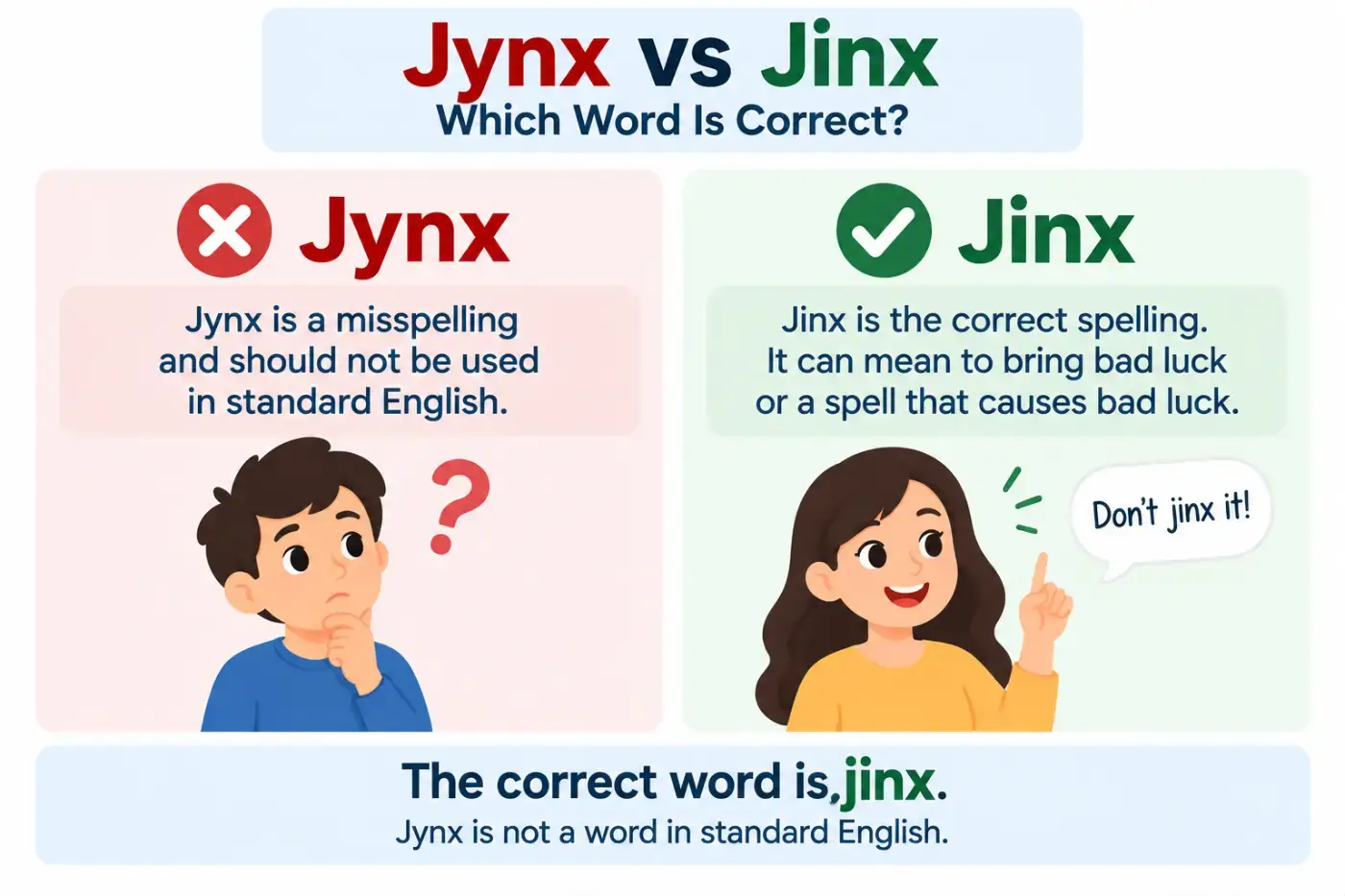
jynx vs jinx is a common spelling comparison because the two forms look almost identical and both can appear in searches and online writing. The correct word for the familiar idea of bad luck is jinx. If you mean an unlucky person thing situation or action that seems to cause trouble use jinx.
The confusion usually comes from the unusual spelling of jinx. English has several words where the letter combination looks less familiar than the sound suggests. People may also create alternate spellings based on how a word looks or appears in usernames names games and other online contexts. That can make an uncommon form seem like a legitimate English variant even when standard dictionaries use a different spelling.
This guide explains the meaning history pronunciation grammar and usage of jinx. You’ll also learn how the less common form differs from the standard word where it can appear and how to avoid the mistake in everyday and formal writing.
You may also want to read Forteen Vs Fourteen Which Spelling Is Correct.
Short Answer
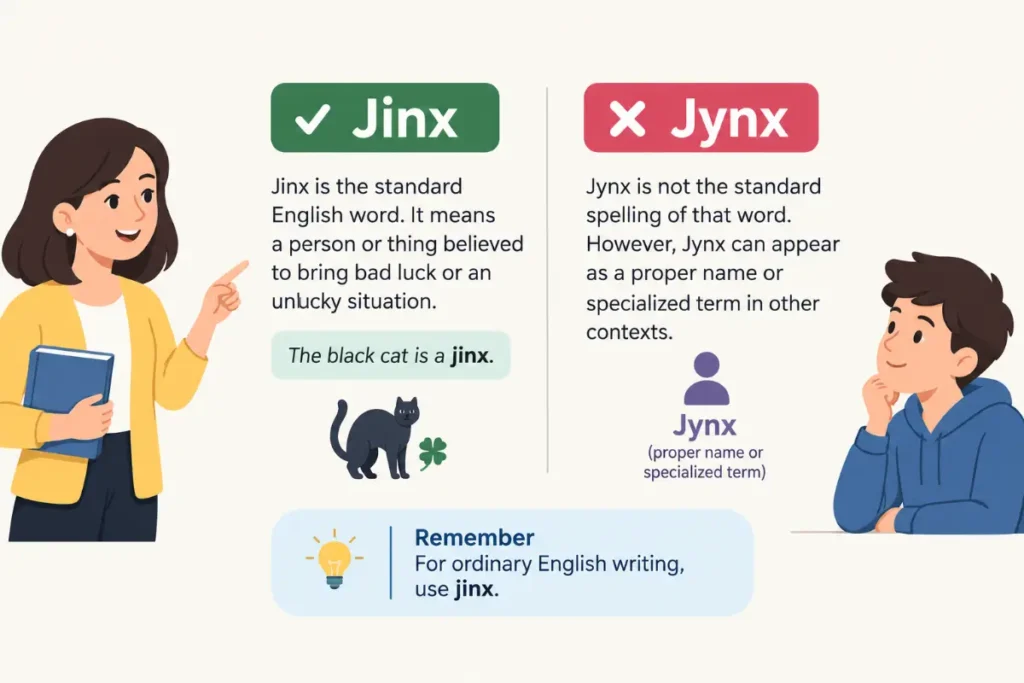
Jinx is the standard English word. It means a person or thing believed to bring bad luck or an unlucky situation. Jynx is not the standard spelling of that word. However Jynx can appear as a proper name or specialized term in other contexts. For ordinary English writing use jinx.
Table of Contents
- Quick Answer
- Meaning of Jinx
- Meaning of Jynx
- Key Differences
- Which Spelling Should You Use
- Comparison Table
- Examples in Everyday English
- Common Spelling Mistakes
- Pronunciation Guide
- Word Origin
- Grammar and Usage
- Regional English Usage
- Jinx as a Verb
- Jinx as a Noun
- Related Words and Expressions
- Memory Tips
- Professional Writing Advice
- Frequently Asked Questions
- Key Takeaways
- Conclusion
Meaning of Jinx
A jinx is a person thing or situation believed to cause bad luck. The word can also describe an unlucky spell or a run of bad events.
For example you might say that a particular shirt is a jinx because every time you wear it your team loses. The statement usually expresses a belief or joke rather than a proven fact.
The word is common in casual American English. You’ll hear it in conversations about sports games competitions relationships plans and everyday mishaps.
Consider this sentence:
I think this chair is a jinx.
The speaker doesn’t necessarily believe the chair has magical powers. They may simply have noticed that several unfortunate events happened while sitting in it.
The word also works as a verb.
Don’t jinx it.
This means don’t say or do something that people believe could cause a good situation to go wrong.
That expression is especially common in casual conversation.
A person can also jinx another person.
You jinxed us by saying we were definitely going to win.
Again the idea is usually playful. The speaker blames someone for tempting bad luck.
Meaning of Jynx
Jynx is not the standard English spelling for the common word associated with bad luck. If you write jynx in an ordinary sentence where you mean an unlucky influence readers will usually understand your intention from context. Still the spelling can look like an error because standard English uses jinx for this meaning. There are situations where Jynx can appear as a name or specialized label. Proper names and fictional names can use unusual spellings for creative or branding reasons. A specialized term can also have a spelling that differs from ordinary vocabulary.
That distinction matters.
A nonstandard spelling can still exist somewhere without becoming a standard English alternative. If you’re writing a normal sentence about bad luck the established form is jinx.
For example:
The team thinks the old stadium is a jinx.
That is standard English usage.
Writing the same sentence with jynx would normally be treated as a spelling mistake unless the writer intentionally refers to a specific name or title.
Key Differences
The difference is mostly about standard spelling and context rather than meaning.
- Standard spelling. Jinx is the established English spelling for the word associated with bad luck.
- Nonstandard form. Jynx is not normally used as an alternative spelling in standard English.
- Meaning. Jinx refers to bad luck an unlucky influence or something believed to cause misfortune.
- Grammar. Jinx can function as both a noun and a verb.
- Pronunciation. The standard word is pronounced with a sound that ends like links or sinks.
- Formality. Jinx is common in informal and conversational English. It can appear in journalism and general writing when the context is suitable.
- Names. Jynx may appear as a proper name or creative spelling. That doesn’t make it the standard spelling of the ordinary word.
- Regional usage. Major English varieties generally use jinx for the ordinary word.
The biggest point is simple. These forms should not be treated as two interchangeable spellings of the same standard English word.
Which Spelling Should You Use
Use jinx when you mean bad luck or an unlucky influence. The word can describe a person who supposedly brings bad luck. It can describe an object that seems unlucky. It can also describe a situation where unfortunate events seem to follow one another. If you’re writing an essay email article report school assignment or professional message choose the established spelling. If you encounter Jynx as a name then keep the spelling used by the person organization character or product being named. Proper names don’t have to follow ordinary vocabulary spelling patterns. This is a useful general rule in English. A spelling can be valid as a name without being a standard dictionary form of an ordinary word. For everyday vocabulary the safest choice is the established form recognized in standard English.
Comparison Table
| Form | Standard English Status | Meaning | Part of Speech | Pronunciation | Common Context | Formality | Example |
|---|---|---|---|---|---|---|---|
| Jinx | Standard word | Bad luck or an unlucky influence | Noun and verb | /dʒɪŋks/ | Conversation sports stories writing and everyday speech | Mostly informal | I hope I don’t jinx the game. |
| Jynx | Not the standard spelling for bad luck | No standard meaning as the ordinary bad luck word | Depends on the specific name or specialized use | Depends on the intended name or term | Names creative labels and specialized contexts | Context dependent | Jynx may be used as a proper name. |
Examples in Everyday English
The word is especially useful because it can fit many everyday situations.
- I think I jinxed the game.
The speaker believes something they said or did may have caused the game to go badly.
- Don’t say we’re definitely going to win. You’ll jinx us.
Here the verb means to bring supposed bad luck to a situation.
- That jacket has to be a jinx.
The speaker jokingly connects the jacket with repeated bad outcomes.
- Every time I make plans for Friday the weather gets worse. I must be a jinx.
The speaker humorously blames themselves for a pattern of bad luck.
- He thinks his lucky hat protects him from a jinx.
This sentence contrasts good luck and bad luck beliefs.
- We were winning until someone mentioned the final score. Now I’m worried they jinxed us.
The word fits naturally into sports conversation.
- I don’t want to jinx anything but the project is going really well.
This common conversational pattern shows caution about celebrating too early.
- She says talking about the promotion before it’s official could jinx it.
Here the verb describes the fear that speaking too confidently might cause the desired result to fail.
- The team broke its losing streak and finally shook the jinx.
Here the noun refers to a supposed source of repeated bad luck.
- Calling the victory too early was probably a jinx.
The word describes an action that supposedly brought bad luck.
These examples show something useful about the word. Native speakers often use it playfully. You don’t need to believe in supernatural forces to use the expression naturally.
Common Spelling Mistakes
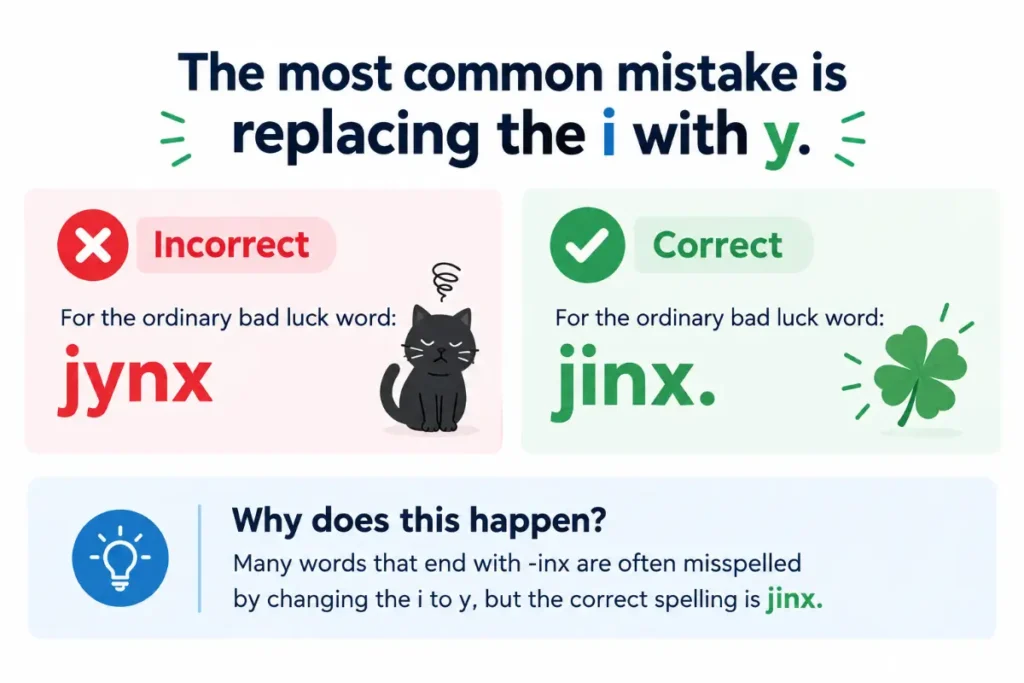
The most common mistake is replacing the i with y.
Incorrect for the ordinary bad luck word: jynx.
Correct: jinx.
Why does this happen?
The letter y appears in many English words and can sometimes feel natural in a short word. Writers may also encounter Jynx as a name online and assume it represents another accepted spelling.
Another mistake is treating the two forms as fully interchangeable. They aren’t.
A third problem is assuming that unusual spelling automatically signals a different pronunciation. In names and creative labels that may happen. In ordinary English vocabulary the established spelling should guide you.
A fourth mistake is using the noun and verb incorrectly.
For example:
I jinxed the team.
Here jinxed is a verb.
The team has a jinx.
Here jinx is a noun.
A fifth mistake is assuming that a spelling accepted in a username or fictional setting belongs in formal English. Names can be deliberately unconventional. Standard vocabulary follows different rules.
The larger lesson is useful beyond this particular word. Search results and online usage can expose you to many creative spellings. Familiarity with an unusual form doesn’t automatically make it standard English.
Pronunciation Guide
The standard word is pronounced /dʒɪŋks/. The first sound is the same sound you hear at the beginning of words such as job and jump. The middle vowel is the short i sound found in sit and win. The ending contains the ng sound followed by k and s. A simple pronunciation guide is:
JINKS
It rhymes closely with words such as links and sinks.
The spelling may look slightly unusual but the pronunciation is straightforward.
One common mistake is to pronounce the word as if the y spelling represented a different vowel. In ordinary English the standard word has the short i sound.
The past tense is pronounced naturally as jinxed. The final ed does not create an extra syllable.
For example:
She jinxed the game.
The verb remains compact in speech.
Word Origin
The history of jinx is more interesting than its spelling might suggest. The word entered English in the early twentieth century. Its precise origin has been discussed by etymologists and isn’t completely certain. It is often connected with older words associated with magical or unlucky influence. One important related word is jynx which was used in older zoological and classical contexts for a type of bird known in English as the wryneck. The Latin name for that bird was associated with magical practices in classical tradition. That historical connection helps explain why the spellings can sometimes seem related. Still modern English has established jinx as the ordinary word for an unlucky influence. The history also illustrates a broader point about English vocabulary. Words can move between specialized terminology and everyday speech. Their spelling and meaning can shift as speakers adopt them into new contexts. You don’t need the historical details to use the word correctly. Still they explain why this short word has a surprisingly complicated background.
Grammar and Usage
Jinx works as both a noun and a verb.
Jinx as a Noun
As a noun it can refer to a person thing or situation associated with bad luck.
Examples include:
That player is a jinx.
The old stadium is a jinx.
They believe the losing streak is a jinx.
The noun can also appear with articles.
He is a jinx.
It was a jinx.
That object is the jinx.
The exact wording depends on the intended meaning.
Jinx as a Verb
As a verb it means to cause or bring supposed bad luck.
For example:
Don’t jinx it.
You jinxed our chances.
I hope I didn’t jinx the plan.
The verb is especially common in casual speech.
Common Expressions
One of the best known expressions is:
Don’t jinx it.
People say this when something is going well and they don’t want someone to make a confident statement that might supposedly cause the situation to change.
For example:
We’re almost finished and nothing has gone wrong.
Don’t jinx it.
The phrase is usually playful rather than literal.
Another common pattern is:
I don’t want to jinx it.
For example:
I think we’re going to finish early but I don’t want to jinx it.
This expression is extremely natural in conversation.
For another common grammar confusion, see waring vs wearing Correct Spelling Meaning and Usage.
Formal and Informal Usage
Jinx is mainly associated with informal English. It sounds natural in conversation sports coverage entertainment writing personal stories and casual online communication. You might say: I don’t want to jinx our chances.m That sentence sounds completely normal in everyday speech. In formal academic writing the word may be less common because writers usually describe beliefs about causation more precisely.
For example instead of saying:
The policy was a jinx.
A formal writer might explain the actual sequence of events and avoid implying supernatural causation.
That doesn’t make jinx incorrect in formal writing. It simply means that register matters.
Journalists may use the word in headlines or articles when the tone allows a conversational expression. Sports writers especially use terms related to luck streaks curses and jinxes because those concepts are part of common sports language.
Professional writing requires context rather than a blanket rule that the word must never appear.
Regional English Usage
American English
Jinx is well established in American English. It’s common in everyday conversation and particularly familiar in sports contexts. Americans often use the phrase don’t jinx it when someone talks confidently about a positive outcome before it has happened. The standard spelling remains jinx.
British English
British English also uses jinx. The meaning is broadly the same and the spelling doesn’t change. Speakers can use the word as a noun or verb. The expression can refer to bad luck or a person or thing believed to bring it.
Australian English
Australian English uses the same standard spelling. The word can appear in casual conversation sports discussions and general writing. There is no established Australian spelling that replaces the i with y for the ordinary word.
Canadian English
Canadian English also uses jinx as the standard form. The meaning and spelling are consistent with other major varieties of English. The unusual form may appear as a name or creative spelling but that is different from ordinary vocabulary.
The Difference Between Jinx and Curse
Jinx and curse can overlap but they aren’t identical in every context. A jinx is often lighter and more playful. People commonly talk about jinxes in everyday situations where they don’t seriously believe magic is involved. A curse can sound much stronger. It often suggests deliberate supernatural harm or a powerful negative force.
Compare these ideas:
I think I jinxed the game.
The sentence sounds playful.
The village was under a curse.
That sentence sounds much more serious and supernatural.
The distinction depends heavily on context. Still jinx generally carries a lighter conversational tone.
The Difference Between Jinx and Bad Luck
Bad luck is the broader and more neutral expression. If something unlucky happens you can simply call it bad luck. A jinx suggests a specific person thing action or situation that supposedly causes repeated bad outcomes.
For example:
Missing the bus was bad luck.
That old shirt is a jinx.
The first sentence describes an unfortunate event. The second assigns a supposed source to the misfortune.
This difference matters because jinx often contains an implied belief about cause.
The Difference Between Jinx and Jinxy
Jinxy is sometimes used informally to describe something that seems likely to bring bad luck or someone who appears to attract bad luck. It is a playful formation built from jinx.
For example:
That prediction feels a little jinxy.
This is much less standard than the basic word and depends on informal context.
If you’re writing formal English it’s usually better to choose a clearer expression such as unlucky.
Why People Write Jynx
The spelling Jynx can look plausible because English contains many words where y represents a vowel. Words such as myth and symbol show that y can play different roles in English spelling. People may also encounter Jynx in names games fictional characters usernames or creative projects. Once you’ve seen a spelling in several places it can begin to feel like a normal vocabulary word. There is another reason the confusion can persist. Search engines are often good at interpreting misspellings. If you type an unusual form the search system may still return information about the standard word. That convenience can hide the spelling mistake. mFor polished writing you should still use the established form for the ordinary meaning.
Memory Tips
The easiest memory trick is to connect the word with the sound of links.
Think of:
jinx
links
sinks
All three share a similar ending sound.
Another trick is to remember that the ordinary bad luck word uses i rather than y.
Think:
Bad luck has a jinx.
The i in jinx is short and clear.
You can also remember the common phrase:
Don’t jinx it.
Because this expression is so common it can serve as a spelling anchor. If you’re unsure while proofreading ask yourself a simple question. Am I talking about bad luck or an unlucky influence? If yes use jinx. If you’re talking about a specific name or title spelled Jynx then preserve that official spelling.
Similar Words and Related Expressions
Several words and expressions sit close to jinx in meaning.
Bad Luck
This is the broadest and most neutral expression. It describes an unfortunate outcome without suggesting a specific cause.
Unlucky
This adjective describes someone or something that experiences bad fortune.
Misfortune
This is a more formal word for an unfortunate event or condition.
Curse
This can describe a supernatural force believed to cause harm or repeated misfortune. It usually sounds stronger than jinx.
Hex
Hex is an informal word for a magical spell intended to cause harm or bad luck. It has a stronger supernatural sense.
Charm
A charm can refer to an object believed to protect someone or bring good luck. It contrasts with the unlucky idea associated with jinx.
Superstition
A superstition is a belief that connects actions objects or events with luck or supernatural effects without a reliable factual basis.
Lucky Break
A lucky break is an unexpected event that produces a favorable result. It represents the opposite side of the luck spectrum. These related words help clarify the semantic field around jinx. The right choice depends on how strong literal or playful you want the statement to sound.
Real Life Usage
Daily Conversation
Jinx fits naturally into casual conversation. I don’t want to jinx it but everything is going perfectly.m That phrase sounds friendly and familiar.
Another example is:
You just jinxed us.
The speaker might say this after someone confidently predicts a positive result.
Workplace Communication
The word can appear in workplace conversation when the tone is relaxed. I think we’ll finish before lunch but I don’t want to jinx it. That sentence is natural in a friendly workplace setting. In a formal report the writer would usually describe the actual circumstances rather than blame a supposed jinx.
Academic Writing
Academic writing generally requires more precise language. The word can still appear when discussing beliefs superstition folklore popular culture or language.
For example:
The study examines how athletes describe a perceived jinx after repeated losses.
Here the term is appropriate because the subject itself involves the concept.
News Writing
News and sports journalism can use jinx naturally. The team finally broke its playoff jinx. That headline style is especially common in sports because readers understand the idea of a repeated unlucky pattern.
Literature and Storytelling
Storytelling can use jinx to create humor mystery or superstition. The villagers believed the abandoned house carried a jinx. This gives the story a sense of local belief without requiring the narrator to confirm that the supernatural explanation is real.
Professional Writing Tips
A good editor looks at more than spelling. Context matters. If you’re writing about an ordinary unlucky situation use the established word. If the text refers to a person character product or other named entity called Jynx then preserve the name exactly as intended. Editors also watch for unnecessary repetition. If a paragraph uses jinx several times you can often replace some instances with expressions such as bad luck unlucky streak or misfortune. The best writing doesn’t repeat the same word simply because it matches the topic. It uses the clearest term for each sentence. Another useful tip is to check the word’s grammatical role. If someone is supposedly causing bad luck you can use the verb. I think I jinxed it. If the unlucky influence itself is the subject you can use the noun. mThat team has a jinx. This simple distinction prevents many awkward sentences.
Expert Editor Insight
From an editing perspective the spelling issue is easy to resolve once you separate ordinary vocabulary from proper names. The standard English word for an unlucky influence is jinx and it works as both a noun and a verb. Jynx may appear in names or creative contexts but shouldn’t replace the standard spelling in ordinary prose. Spelling tools can catch many mistakes but they may not understand a specialized name without context. A human editor checks the intended meaning first and then decides which spelling belongs in the sentence.
Key Takeaways
- Jinx is the standard English word for an unlucky influence or supposed source of bad luck.
- Jynx isn’t the standard spelling for that ordinary meaning.
- Jinx can function as both a noun and a verb.
- The noun can describe a person object or situation associated with bad luck.
- The verb can mean to bring or supposedly bring bad luck.
- Don’t jinx it is a common conversational expression.
- Jinx is pronounced /dʒɪŋks/ and has one syllable.
- Jynx can appear as a proper name or creative spelling without becoming the standard English vocabulary form.
- The word is common across American British Canadian and Australian English.
- For ordinary writing choose jinx.
Learn the difference in Ninth vs Nineth: Origin, Meaning and Correct Usage (2026).
Conclusion
jynx vs jinx comes down to a simple spelling choice in ordinary English. Jinx is the standard word for a person thing situation or action associated with bad luck. It can also work as a verb when someone supposedly causes an unwanted outcome. The other form isn’t the standard spelling for this meaning.
The word is especially common in casual conversation and sports language. You’ll often hear people say don’t jinx it when they’re enjoying a good situation and don’t want to tempt bad luck. The word can also appear in news writing storytelling and discussions of superstition.
The easiest way to remember the spelling is to connect jinx with words such as links and sinks. If you mean bad luck use jinx. If you see the unusual spelling as part of a specific name then check the name itself ra
Frequently Asked Questions
Is jynx a correct spelling of jinx?
No. Jynx isn’t the standard spelling of the English word that means bad luck or an unlucky influence. The standard form is jinx. The unusual spelling can still appear as a proper name or creative label. If you’re writing an ordinary sentence about bad luck choose jinx.
What does jinx mean?
Jinx can mean a person thing or situation believed to cause bad luck. It can also function as a verb meaning to bring supposed bad luck to something. The word is common in casual English. Expressions such as don’t jinx it are especially familiar in conversations about games plans and expected outcomes.
jynx vs jinx which one should I use?
Use jinx when you mean bad luck an unlucky influence or the act of supposedly causing bad luck. Jynx isn’t the standard spelling for that meaning. You may encounter Jynx as a name or creative term. In that situation keep the spelling associated with the specific name instead of changing it.
How do you pronounce jinx?
Jinx is pronounced /dʒɪŋks/. It has one syllable and rhymes closely with words such as links and sinks. The beginning has the same sound found in jump. The middle contains the short i sound found in sit. The ending moves through the ng k and s sounds.
Can jinx be used as a verb?
Yes. Jinx works as a verb as well as a noun. As a verb it means to cause or supposedly cause bad luck. A common example is don’t jinx it. You can also say I hope I didn’t jinx our chances. This verb use is especially common in casual conversation.
Is jinx formal or informal?
Jinx is mainly conversational and informal. It works naturally in everyday speech sports writing storytelling and casual communication. It can also appear in journalism when the tone fits. In highly formal academic or technical writing a more precise term may be better if the writer is describing an actual cause rather than a belief about luck.
What is the difference between a jinx and a curse?
A jinx usually has a lighter and more conversational meaning. It often describes an unlucky pattern or something believed to bring bad luck. A curse generally suggests a stronger supernatural force or deliberate magical harm. The two ideas overlap but curse tends to sound more serious and dramatic.
Why do people confuse the spelling?
The unusual spelling of jinx can make the word easy to alter from memory. People may also encounter Jynx as a name online and assume it is an accepted vocabulary variant. Search engines can sometimes interpret the unusual form automatically which may reinforce the confusion. In ordinary English writing the established spelling remains jinx.
Is jinx used in American English?
Yes. Jinx is familiar in American English and appears often in casual conversation. Sports discussions are a particularly common setting because people frequently talk about losing streaks lucky objects and supposed bad luck. The standard spelling is jinx. The alternate looking form doesn’t represent a standard American spelling variant.
What is a synonym for jinx?
Depending on the sentence possible alternatives include bad luck unlucky influence curse hex or misfortune. These words aren’t exact replacements in every context. Jinx often has a playful tone while curse and hex can suggest stronger supernatural ideas. Bad luck is more neutral and simply describes an unfortunate outcome.