
If you’re looking for space words that start with i you’ll find a useful mix of astronomy terms spacecraft language and words connected to planets stars and the universe. Some are common words such as ice and impact. Others such as inflation and interstellar belong to more specialized areas of astronomy and cosmology.
These words can help you build a stronger space vocabulary for school projects science writing creative work and word games. They also show how much scientific language can begin with one simple letter.
This guide explains the most useful terms in clear language. You’ll learn what each word means how scientists use it and how to use it naturally in a sentence. You’ll also see the difference between everyday space vocabulary and more technical astronomy terms.
A related grammar guide is plural of loaf Is Loaves Correct.
Quick Answer
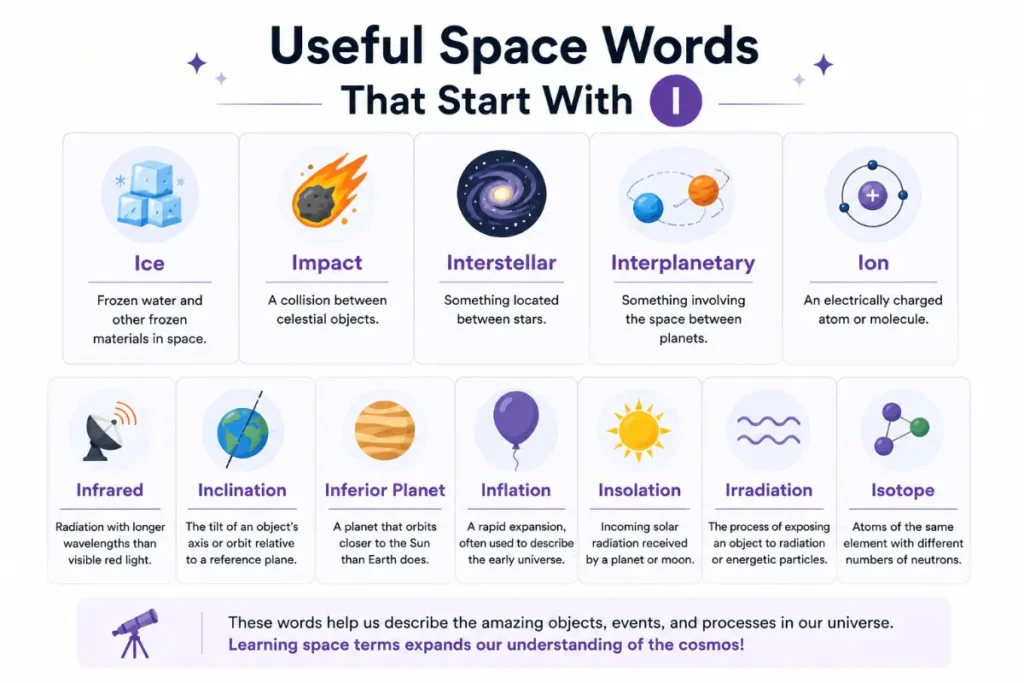
Useful space words that start with I include ice for frozen water and other frozen materials in space, impact for a collision between celestial objects, interstellar for something located between stars, interplanetary for something involving the space between planets, and ion for an electrically charged atom or molecule. Other useful terms include infrared, inclination, inferior planet, inflation, insolation, irradiation, and isotope.
Useful Space Vocabulary
Space science uses words from many branches of science. Astronomy describes objects and their locations. Physics explains forces and particles. Planetary science examines worlds and their surfaces. Cosmology explores the origin and development of the universe.
The letter I appears in vocabulary from all of these areas. Some words describe things you can observe. Others explain processes that happen on scales far beyond everyday experience.
Here are some of the most useful terms to know.
Ice
Ice is frozen water. In space science the word usually refers to water ice but it can also describe frozen substances such as methane ammonia carbon dioxide and other materials.
Ice is common throughout the solar system. Scientists have found evidence of water ice on moons planets dwarf planets comets and other small bodies. Some icy worlds may even contain oceans beneath their frozen surfaces.
Comets are especially famous for their ice. When a comet travels close to the Sun its surface can heat up. Frozen material can turn directly into gas and release dust and other particles. This process can help create the cloud and tail associated with an active comet.
Example: Scientists study the ice beneath the surface of several outer solar system moons.
Impact
An impact happens when one object strikes another. In astronomy the term often describes collisions involving asteroids comets planets moons or smaller pieces of rock.
Impacts have shaped the surfaces of many planets and moons. The Moon’s craters are one of the clearest examples. Earth also has impact craters although erosion volcanic activity oceans and geological movement have erased many ancient ones.
A large asteroid impact can release enormous amounts of energy. Scientists therefore study impact sites to understand planetary history and assess how collisions have affected worlds over time.
Example: The spacecraft photographed an ancient impact crater on the surface.
Inclination
Inclination describes the tilt of an orbit compared with a chosen reference plane. Astronomers use orbital inclination to describe how an object’s path is oriented in space.
For objects in our solar system the reference plane is often the plane of Earth’s orbit around the Sun. An object with an orbital inclination close to zero follows a path that is close to this plane. A larger inclination means its orbit is more tilted.
Inclination matters when scientists calculate the paths of planets asteroids comets and spacecraft.
Example: The asteroid has a high orbital inclination compared with Earth’s orbit.
Infrared
Infrared is a form of electromagnetic radiation. It has wavelengths longer than visible red light and shorter than microwaves.
Human eyes can’t see infrared radiation. However special instruments can detect it. Astronomers use infrared observations to study cool objects clouds of dust young stars planets and distant galaxies.
Infrared astronomy is especially valuable because some infrared wavelengths can pass through clouds of dust that block visible light. This allows scientists to observe regions of space that would otherwise remain hidden.
Example: The telescope used infrared observations to study a dusty region where stars were forming.
Interplanetary
Interplanetary means existing or occurring between planets. The term is commonly used when scientists discuss the space and material between planets in a planetary system.
For example interplanetary space contains very thin plasma particles magnetic fields dust and other material. Spacecraft traveling from Earth to Mars move through interplanetary space.
The word combines inter meaning between and planetary meaning related to planets. That structure makes the meaning fairly easy to remember.
Example: The spacecraft spent several months traveling through interplanetary space.
Interstellar
Interstellar means existing or occurring between stars. It’s one of the most useful words in astronomy because stars aren’t completely isolated from one another.
Interstellar space contains extremely thin gas dust cosmic rays magnetic fields and other material. The region between stars can look empty from Earth but it still contains matter and energy.
The word also appears in terms such as interstellar medium and interstellar cloud. The interstellar medium is the material spread through the space between stars.
Example: Scientists detected a cloud of gas drifting through interstellar space.
Interstellar Medium
The interstellar medium is the material found between stars in a galaxy. It includes gas dust and energetic particles.
Most of the interstellar medium is extremely thin compared with the air around Earth. Still its contents play an important role in the life cycle of stars.
Clouds within the interstellar medium can become dense enough to collapse under gravity. Some of these regions eventually form new stars and planetary systems.
Example: Dense regions of the interstellar medium can provide material for new stars.
Ion
An ion is an atom or molecule that has gained or lost one or more electrons. This gives it an electrical charge.
An atom that loses electrons becomes positively charged. An atom that gains electrons becomes negatively charged.
Ions are common in space. They can exist in stellar atmospheres planetary environments nebulae and interstellar gas. The behavior of charged particles also helps scientists understand magnetic fields and space weather.
Example: Solar radiation can turn atoms in a planet’s upper atmosphere into ions.
Ionization
Ionization is the process of creating an ion by adding or removing electrons from an atom or molecule.
High energy radiation can cause ionization. Stars produce large amounts of energetic radiation so regions around hot stars can contain significant amounts of ionized gas.
Ionization is important in many areas of astronomy. Scientists use the presence and behavior of ionized atoms to learn about the temperature density and radiation environment of distant objects.
Example: Strong ultraviolet radiation caused ionization in the surrounding gas.
Ionosphere
The ionosphere is a region of Earth’s upper atmosphere that contains many charged particles. It begins high above the lower atmosphere and extends upward into space.
Solar radiation plays a major role in creating the ionosphere. Its conditions can change with solar activity and other factors.
The ionosphere matters to space science because it interacts with solar particles and radiation. It also affects some forms of radio communication.
Example: Changes in the ionosphere can influence radio signals.
Inflation
Inflation is a theory describing an extremely rapid expansion of the very early universe.
According to inflationary models the universe underwent a brief period of exceptionally fast expansion shortly after the earliest stages of its history. The idea helps explain several important features of the universe including why large regions appear remarkably similar.
Inflation belongs mainly to cosmology rather than ordinary observational astronomy. It deals with the universe as a whole rather than a single star or planet.
Scientists continue to investigate the physical details behind inflation and look for observational evidence that can distinguish among different models.
Example: Cosmologists study inflation to understand conditions in the early universe.
Insolation
Insolation means incoming solar radiation received by a planet or another body. The word is especially useful in planetary science and climate studies.
The amount of solar energy reaching a surface depends on factors such as distance from the Sun and the angle at which sunlight arrives.
Earth receives different amounts of solar energy across its surface because of its curved shape and changing orientation. Insolation therefore plays an important role in planetary temperatures and atmospheric behavior.
Example: Seasonal changes are strongly connected to changes in solar insolation.
Irradiation
Irradiation refers to exposure to radiation. In space science the word can describe how radiation affects a surface object or material.
Space environments can expose materials to ultraviolet radiation X rays gamma rays energetic particles and other forms of radiation. Long exposure can change physical and chemical properties.
Scientists study irradiation when examining spacecraft materials planetary surfaces and biological risks associated with space travel.
Example: Long term irradiation can alter the surface of an airless moon.
Isotope
An isotope is a form of an element that has the same number of protons as other atoms of that element but a different number of neutrons.
For example carbon has several isotopes. The different isotopes have different masses while still belonging to the same chemical element.
Isotopes are extremely useful in space science. Scientists can study them in meteorites lunar samples planetary atmospheres and other materials to learn about the history and formation of the solar system.
Some isotopes are stable. Others are radioactive and gradually change into other forms through radioactive decay.
Example: Scientists measured isotopes in the meteorite to investigate its age and origin.
Inferior Planet
An inferior planet is a planet whose orbit lies inside Earth’s orbit around the Sun. In our solar system Mercury and Venus are inferior planets.
The term can sound as if it means less important or lower quality. It doesn’t. Inferior refers only to orbital position.
Because Mercury and Venus orbit closer to the Sun than Earth does they can appear at different positions relative to the Sun in Earth’s sky. They can show phases much like the Moon.
Example: Venus is an inferior planet because its orbit is inside Earth’s orbit.
Intergalactic
Intergalactic means existing or occurring between galaxies.
The space between galaxies is called intergalactic space. It isn’t completely empty. It can contain extremely thin gas magnetic fields radiation and other material.
Astronomers use the term when studying interactions between galaxies and the large scale structure of the universe.
Example: Scientists detected hot gas in the intergalactic medium.
Intergalactic Medium
The intergalactic medium is the material spread through the space between galaxies. It consists largely of extremely thin gas along with other forms of matter and energy.
This material can help scientists trace how matter is distributed across the universe. It also interacts with radiation traveling across enormous distances.
The term is closely related to interstellar medium. The key difference is the scale. Interstellar refers to space between stars within a galaxy. Intergalactic refers to space between galaxies.
Example: Light from a distant galaxy passed through the intergalactic medium before reaching Earth.
Interplanetary Dust
Interplanetary dust consists of tiny solid particles distributed throughout the solar system.
These particles can come from comets asteroids collisions and other sources. Although individual grains are tiny they can have important effects on observations and spacecraft.
Sunlight can scatter from interplanetary dust. This contributes to faint light known as zodiacal light which can be observed under suitable conditions.
Example: The spacecraft collected samples of interplanetary dust during its mission.
Many readers also check adjectives that start with r for clear writing.
Interstellar Dust
Interstellar dust consists of extremely small solid particles found between stars. These grains form part of the interstellar medium.
Dust can absorb and scatter visible light. As a result it can make distant stars appear dimmer or redder than they would without intervening dust.
Interstellar dust also provides material involved in chemical processes and the formation of new stars and planets.
Example: Interstellar dust blocked some of the visible light from the distant star.
Inner Planets
The inner planets are the four planets closest to the Sun in our solar system. They are Mercury Venus Earth and Mars.
These planets are also called terrestrial planets because they have solid rocky surfaces. They differ from the outer giant planets in size composition and atmospheric structure.
The inner planets are relatively close to the Sun and have shorter orbital periods than planets farther away.
Example: The inner planets have rocky surfaces and relatively high densities.
Inner Solar System
The inner solar system is the region closer to the Sun that includes the terrestrial planets and nearby smaller bodies.
Mercury Venus Earth and Mars are the major planets of this region. The asteroid belt lies beyond Mars and forms a useful boundary when people describe the inner solar system in a broad sense.
The term helps astronomers distinguish the Sun’s nearby planetary environment from the much more distant outer solar system.
Example: Several spacecraft have explored different regions of the inner solar system.
Irregular Galaxy
An irregular galaxy is a galaxy without a clear overall shape such as the spiral form of the Milky Way or the elliptical form of many other galaxies.
Some irregular galaxies have distorted shapes because of gravitational interactions with neighboring galaxies. Others may have more chaotic structures for different reasons.
Irregular galaxies can contain active regions of star formation and large amounts of gas and dust.
Example: The irregular galaxy contains bright regions where new stars are forming.
Irregular Satellite
An irregular satellite is a natural moon with an orbit that differs from the more orderly or regular satellite orbits found around many planets.
Irregular satellites often have more distant and highly inclined or eccentric orbits. Many are thought to have been captured rather than forming alongside their planets.
The term is particularly useful when discussing the moons of giant planets.
Example: The giant planet has several irregular satellites with unusual orbits.
Isotropic
Isotropic means having the same properties in all directions.
The term appears frequently in cosmology and astronomy. Scientists may describe radiation or a distribution as isotropic when its properties appear similar in different directions.
The cosmic microwave background is often discussed in terms of its remarkable large scale uniformity. Small variations exist and those variations contain valuable information about the early universe.
Example: Scientists measured how close the cosmic background radiation is to an isotropic distribution.
Inertial Frame
An inertial frame is a reference frame in which an object with no net force acting on it moves at constant velocity in a straight line.
This concept comes from physics rather than astronomy alone but it plays an important role in understanding the motion of spacecraft planets and other objects.
Spacecraft navigation relies on physical models of motion. Choosing an appropriate reference frame makes those calculations easier to describe and interpret.
Example: Engineers used an inertial reference frame to model the spacecraft trajectory.
Escape Velocity
Escape velocity is the minimum speed an object needs to move away from a massive body without additional propulsion under an idealized model.
The term doesn’t begin with I but it often appears beside I terms such as inertial frame and inclination in astronomy discussions. It’s useful to know because space vocabulary often overlaps across physics and planetary science.
A massive object has greater escape velocity than a smaller object with the same size. Earth’s escape velocity is much greater than that of the Moon.
Example: A spacecraft needs enough velocity to escape a planet’s gravitational influence.
How These Words Fit Together
The easiest way to remember space vocabulary is to connect related terms instead of memorizing isolated definitions.
Interplanetary and interstellar both describe locations between objects. The difference is simple. Interplanetary means between planets while interstellar means between stars.
Ion and ionization are also closely connected. An ion is a charged atom or molecule. Ionization is the process that creates an ion.
Ice, isotope, and irradiation describe very different ideas. Ice is a material. An isotope is a version of an element with a particular neutron count. Irradiation describes exposure to radiation.
Inclination describes the orientation of an orbit. Impact describes a collision. Inflation describes a proposed period of extremely rapid expansion in the early universe.
Once you see these relationships the vocabulary becomes much easier to retain.
Key Differences Between Similar Terms
Some astronomy words look similar because they share the same prefixes. Their meanings can still differ sharply.
- Interplanetary and interstellar. Interplanetary refers to space between planets. Interstellar refers to space between stars.
- Interstellar and intergalactic. Interstellar refers to the space between stars within a galaxy. Intergalactic refers to the space between galaxies.
- Ion and isotope. An ion has an electrical charge because it has gained or lost electrons. An isotope differs in neutron number from another form of the same element.
- Ionization and irradiation. Ionization is a physical process that changes an atom or molecule into an ion. Irradiation means exposure to radiation.
- Inclination and orbit. An orbit is the path followed by an object under gravity. Inclination describes the tilt of that orbit relative to a reference plane.
- Inner planets and inferior planets. Inner planets usually refers to Mercury Venus Earth and Mars. Inferior planets specifically refers to planets whose orbits are inside Earth’s orbit.
- Isotropic and uniform. Isotropic means similar in different directions. Uniform generally means similar across a region or throughout a distribution. The concepts can overlap but they aren’t identical.
- Impact and collision. Collision is a broad word for objects striking each other. Impact often emphasizes the event or its effects and is especially common in planetary science.
Grammar And Part Of Speech
Most of these space terms function as nouns or adjectives.
Words such as ice, impact, ion, inflation, insolation, irradiation, and isotope are nouns.
Words such as interplanetary, interstellar, intergalactic, inferior, inner, and isotropic usually function as adjectives.
The word ionization is a noun describing a process. You can use it in a sentence such as this: Ionization occurs when an atom gains or loses electrons.
You can use an adjective before a noun. For example you can write interstellar space, interplanetary dust, irregular galaxy, or inferior planet.
These terms work best when you match the grammar to the scientific idea. Don’t turn a noun into an adjective simply because the words look related.
Pronunciation Guide
Some of these words are easy to pronounce while others may be unfamiliar.
Ice is pronounced /aɪs/. It has one syllable.
Impact is pronounced /ˈɪm.pækt/. The stress falls on the first syllable.
Inclination is pronounced /ˌɪn.kləˈneɪ.ʃən/. The strongest stress falls near the end.
Infrared is commonly pronounced /ˌɪn.frəˈred/ in American English.
Interplanetary is pronounced with several syllables and usually has primary stress on the third syllable from the end.
Interstellar is pronounced /ˌɪn.tɚˈstel.ɚ/ in American English.
Ion is commonly pronounced /ˈaɪ.ɑːn/ in American English.
Ionization is pronounced /ˌaɪ.ə.nəˈzeɪ.ʃən/.
Isotope is pronounced /ˈaɪ.sə.toʊp/.
A useful pronunciation trick is to pay attention to the beginning i sound. Words such as ice ion and isotope begin with the long i sound. Words such as impact inclination and interstellar begin with a short i sound.
Word Origins And Meaning Patterns
Many scientific words become easier to understand when you recognize their roots.
The prefix inter comes from Latin and means between or among. That explains words such as interplanetary interstellar and intergalactic.
The prefix intra has a related but different meaning. It generally means within. Recognizing the difference can help you understand scientific vocabulary.
The word isotope comes from Greek roots connected with equal and place. The name reflects the fact that isotopes occupy the same position in the periodic table while having different masses.
The word ion has roots connected with the Greek word meaning going. The scientific term developed from the idea of a charged particle moving toward an electrode.
Infrared combines infra meaning below or beneath with red. The name refers to radiation beyond the red end of visible light.
These roots aren’t just trivia. They give you clues about meaning and can make unfamiliar science terms easier to decode.
American English Usage
American English uses these terms in the same general scientific sense found across modern English language science writing.
Students in the United States are likely to encounter words such as interstellar ion isotope infrared and impact in textbooks science classes and popular astronomy material.
Some terms are much more common in technical writing than everyday conversation. You might casually say space between stars rather than interstellar space when speaking to someone unfamiliar with astronomy. In a science report the technical term is usually clearer and more precise.
The spelling of these words generally doesn’t change between American and British English. The main differences you may notice involve pronunciation and broader scientific style rather than the core vocabulary itself.
Common Spelling Mistakes
Scientific vocabulary can be tricky because several terms contain similar sounds and long clusters of letters.
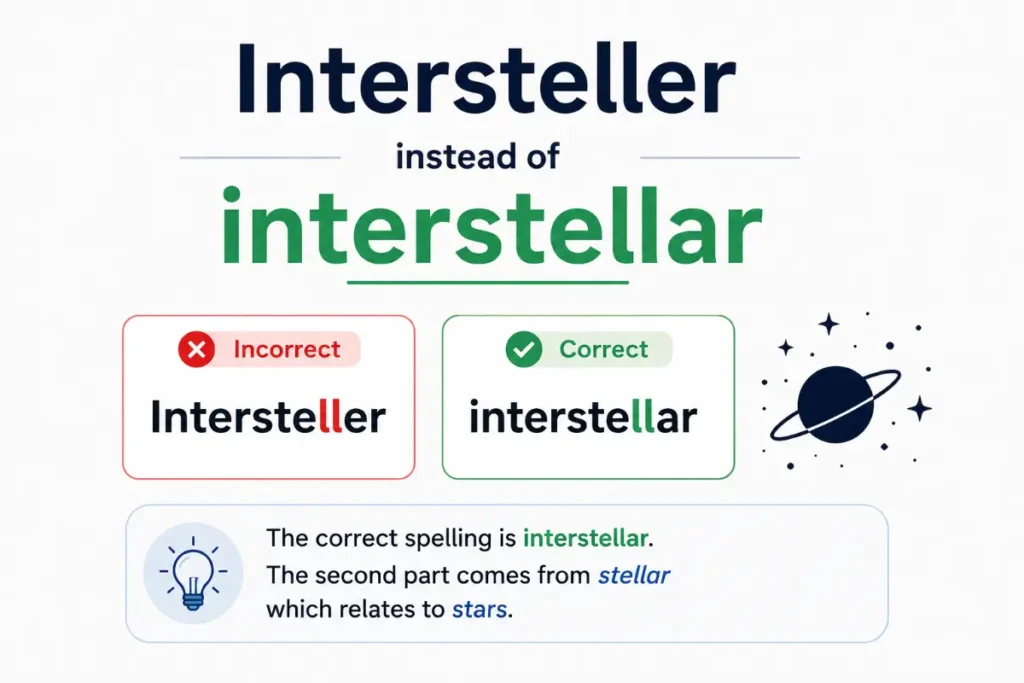
- Intersteller instead of interstellar. The correct spelling is interstellar. The second part comes from stellar which relates to stars.
- Interplanetery instead of interplanetary. The correct spelling is interplanetary. The ending is planetary not planetery.
- Isotop instead of isotope. The final e is part of the standard spelling.
- Ionisation in American writing. Ionisation is a standard British spelling. American English normally uses ionization with z.
- Infra red instead of infrared. Infrared is normally written as one word when it functions as the name of the type of radiation.
A good editing habit is to look at the word root instead of relying only on sound. Many scientific spelling errors happen because the pronunciation doesn’t clearly reveal every letter.
Real Life Usage
Daily Conversation
Space vocabulary can appear in ordinary conversation when people discuss astronomy news or science interests.
Scientists discovered water ice near the lunar surface.
The asteroid left a large impact crater.
Workplace Communication
Engineers researchers and science teams use technical terms when describing spacecraft missions and observations.
The spacecraft entered interplanetary space after leaving Earth orbit.
The team reviewed the satellite’s orbital inclination before the next maneuver.
Academic Writing
Students can use these words in reports essays and science projects.
The planet receives less solar insolation because of its greater distance from the Sun.
The researchers examined isotopes in the sample to investigate its origin.
News And Journalism
Science reporting often uses these terms when explaining discoveries.
Astronomers observed an unusual interstellar object moving through the solar system.
Researchers detected evidence of ice beneath the surface of the distant moon.
Literature And Storytelling
Writers can also use space vocabulary in fiction and creative nonfiction.
The crew crossed the silent interstellar void on its journey to another star.
A flash of infrared light appeared across the ship’s instruments.
Technical vocabulary can add realism when the context supports it. You don’t need to use complicated terms simply to make a story sound scientific.
Related Space Terms
Several words connect naturally with the vocabulary above.
- Astronomy is the scientific study of stars planets galaxies and other objects and phenomena beyond Earth.
- Asteroid is a rocky or metallic body that orbits the Sun. Many are found in the asteroid belt between Mars and Jupiter.
- Comet is a small solar system body that can develop a visible coma and tail when it becomes active near the Sun.
- Galaxy is a huge system containing stars gas dust dark matter and other components held together by gravity.
- Nebula is a large cloud of gas dust or both found in space.
- Orbit is the path an object follows around another object under the influence of gravity.
- Radiation is energy that travels through space or matter in the form of electromagnetic waves or particles.
- Solar wind is a stream of charged particles flowing outward from the Sun.
These terms often appear beside I words in astronomy writing. Learning them together gives you a stronger understanding of the subject rather than a disconnected list of definitions.
How To Remember The Vocabulary
A simple memory system can make these words much easier to learn.
Think of inter as meaning between. Then interplanetary means between planets. Interstellar means between stars. Intergalactic means between galaxies.
Think of ion as a charged particle. Then ionization is the process that creates ions and the ionosphere is a region of the atmosphere containing many charged particles.
Think of infrared as invisible light beyond red. This helps connect the word with the electromagnetic spectrum.
Think of inclination as tilt. An inclined orbit is an orbit that is tilted relative to a reference plane.
Think of impact as a strike. When a space rock hits a planetary surface it creates an impact.
Think of isotope as a different version of an element. The proton count stays the same while the neutron count changes.
These small mental links work like hooks. Once you attach a new term to an idea you already understand the word becomes easier to recall.
Expert Editor Insight
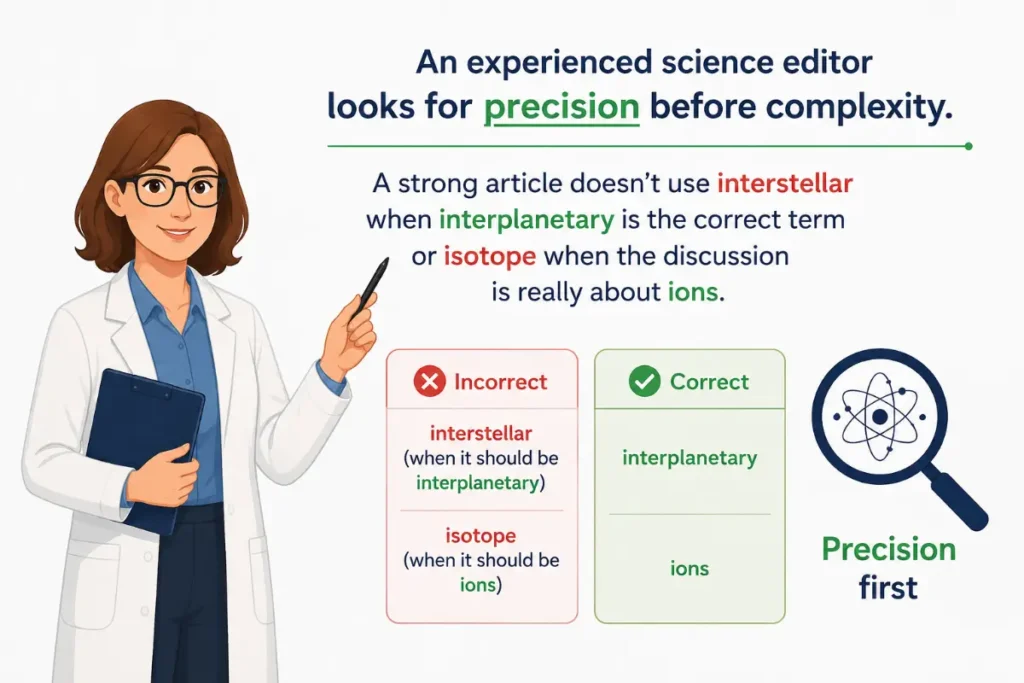
An experienced science editor looks for precision before complexity. A strong article doesn’t use interstellar when interplanetary is the correct term or isotope when the discussion is really about ions. The best approach is to understand the core meaning first and then choose the technical term that matches it. Spelling tools can catch obvious errors but they can’t always catch a correctly spelled scientific word used in the wrong context. Context remains the final check.
You may also want to read is timeframe one word Correct Spelling And Usage.
Conclusion
The most useful space words that start with i include ice impact inclination infrared interplanetary interstellar ion ionization inflation insolation irradiation and isotope. Each term describes a different part of astronomy or space science.
The easiest way to remember them is to connect related words. Interplanetary means between planets while interstellar means between stars. Ion describes a charged particle while ionization describes the process that creates it. Inclination describes orbital tilt while impact describes a collision.
When you use these terms in writing focus on accuracy before complexity. Pick the word that matches your meaning and check its spelling from the root when needed. That simple habit will help you build a stronger and more precise space vocabulary.
FAQs
What are some common space words that start with I?
Common examples include ice impact ion infrared interstellar interplanetary inclination isotope and inflation. Some are everyday science terms while others belong to specialized fields such as cosmology or planetary science. Interstellar and interplanetary are especially useful because their prefixes make their meanings easier to understand.
What does interstellar mean in space science?
Interstellar means located between stars. Interstellar space contains thin gas dust magnetic fields radiation and other material. The term is often used in phrases such as interstellar space interstellar medium and interstellar dust. It differs from interplanetary which describes the region between planets.
What does interplanetary mean?
Interplanetary means between planets. In our solar system the term commonly describes the space material or processes found between the planets. A spacecraft traveling from Earth to Mars travels through interplanetary space. The word is built from inter meaning between and planetary meaning related to planets.
What is an ion in astronomy?
An ion is an atom or molecule with an electrical charge because it has gained or lost electrons. Ions are common in stars planetary atmospheres nebulae and interstellar gas. Astronomers study them because their behavior can reveal information about temperature radiation magnetic fields and the physical conditions of distant environments.
What is the difference between an ion and an isotope?
An ion has an electrical charge caused by a change in its number of electrons. An isotope is a form of an element with a different number of neutrons. These are separate concepts. An atom can be both an ion and an isotope at the same time because charge and neutron number describe different properties.
What does infrared mean in astronomy?
Infrared refers to electromagnetic radiation with wavelengths longer than visible red light. Human eyes can’t normally detect it but specialized telescopes can. Infrared observations help astronomers study cool objects dust clouds young stars planets and distant galaxies. Infrared astronomy can also reveal regions hidden by dust at visible wavelengths.
What is an inferior planet?
An inferior planet is a planet whose orbit is closer to the Sun than Earth’s orbit. Mercury and Venus are the two inferior planets in our solar system. The word inferior describes orbital position rather than quality or importance. This is a technical astronomy term and shouldn’t be interpreted in its everyday sense.
Why are these astronomy terms useful to learn?
These words give you precise ways to describe objects processes and regions of space. They’re useful for science classes research projects astronomy discussions and writing. Learning related terms together also makes unfamiliar vocabulary easier to understand. Once you recognize roots such as inter and words such as ion the meanings become much easier to remember.