
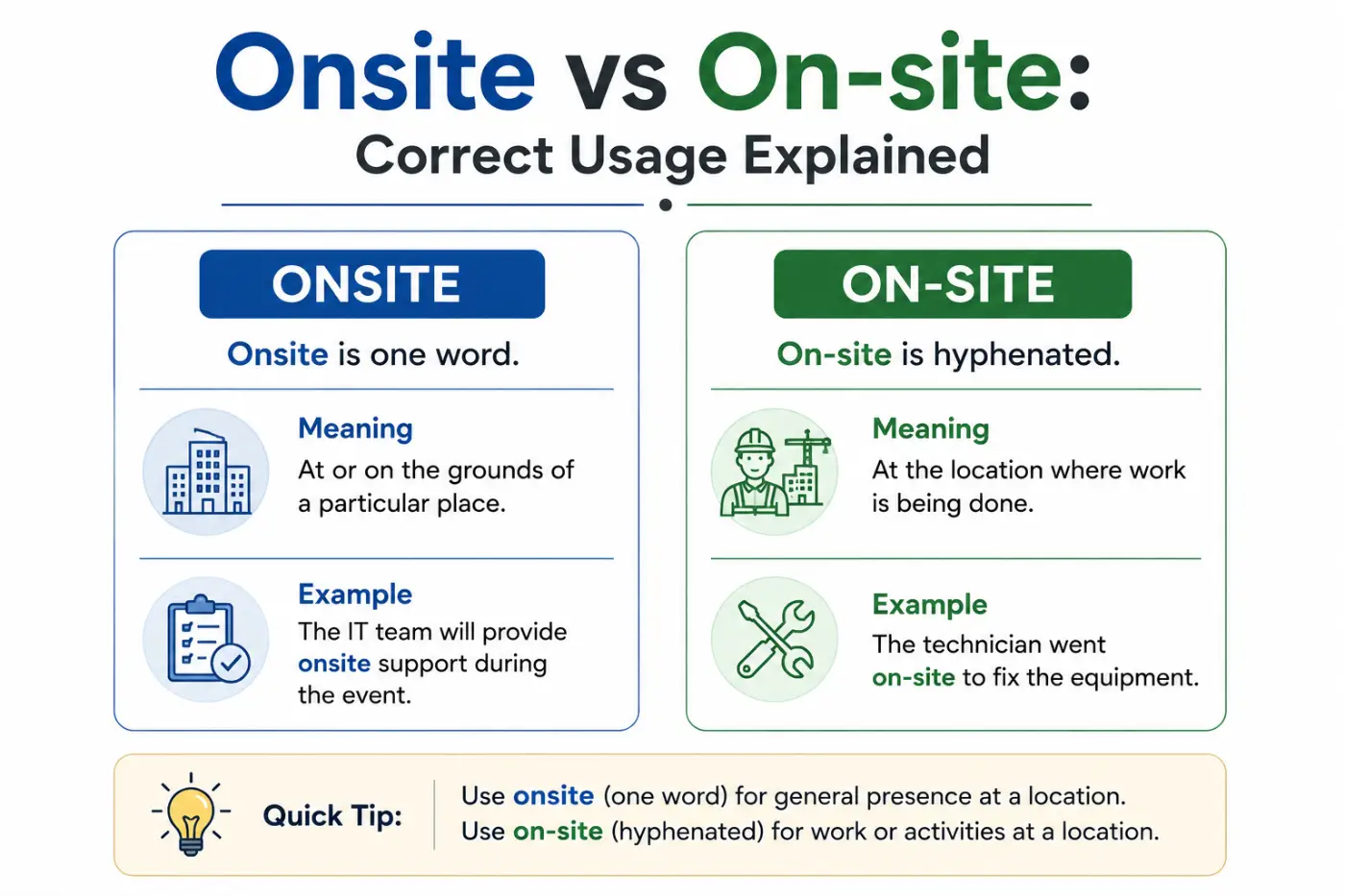
The confusion around onsite vs on-site is understandable because both forms appear in modern English. The good news is that you don’t have to treat one as a simple spelling mistake. Both forms are accepted in standard English and share the same basic meaning.
The real difference comes down to spelling style and grammatical context. Onsite is especially common in modern American workplace writing while on-site remains a well established form. The two word form on site is also correct when you are talking about a location.
This guide explains how each form works so you can choose the right one with confidence. You’ll learn the meanings grammar pronunciation usage rules common mistakes and practical examples for everyday and professional writing.
Need another quick comparison? Read In Route vs En Route Which Is Correct.
Quick Answer
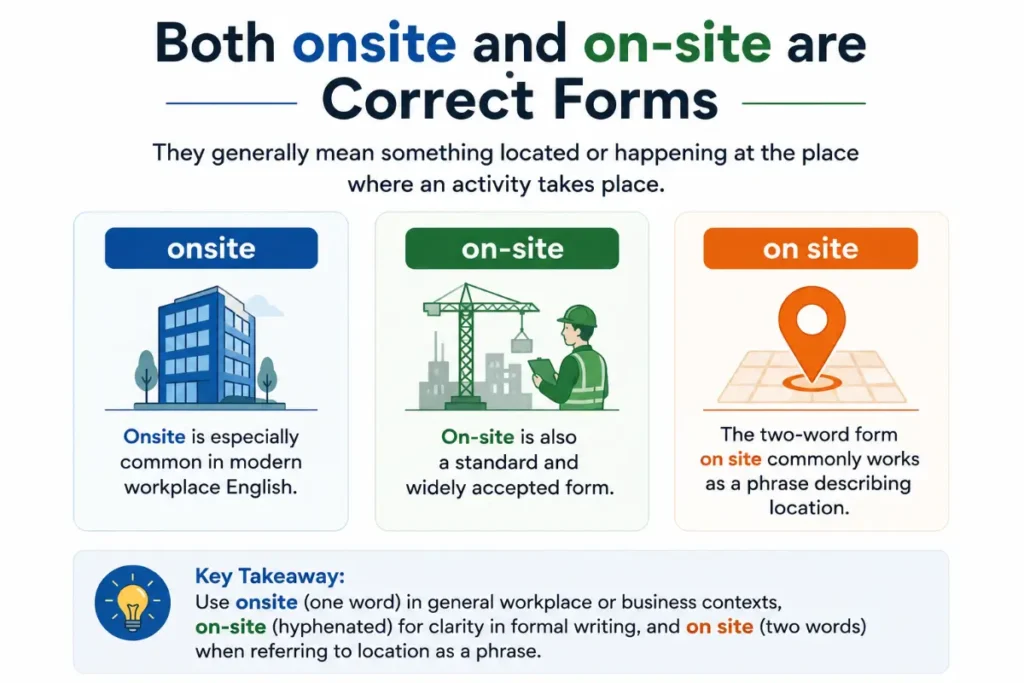
Both onsite and on-site are correct forms. They generally mean something located or happening at the place where an activity takes place. Onsite is especially common in modern workplace English while on-site is also standard. The two word form on site commonly works as a phrase describing location.
Quick Answer For Everyday Writing
If you’re writing for a general American audience either onsite or on-site can work when the sentence is clear. Many modern workplaces prefer onsite because the closed form looks simple and fits naturally with other workplace terms.
Still on-site isn’t wrong. It has a long history of use and remains familiar to many readers.
The form on site serves a slightly different grammatical purpose in many sentences.
For example:
Our company provides onsite training.
The company provides on-site training.
The manager is on site today.
All three sentences are natural. The first two use the expression to describe training. The third uses it to describe the manager’s location.
The safest approach is to look at how the expression functions in your sentence and follow the style used by your organization.
Comparison Table
| Form | Meaning | Part of Speech | Formality | Common Contexts | Example |
|---|---|---|---|---|---|
| onsite | Located or happening at a particular place | Adjective and adverb | Neutral | Workplace services training facilities | We provide onsite training. |
| on-site | Located or happening at a particular place | Adjective and adverb | Neutral | Business technical academic writing | The engineer completed an on-site inspection. |
| on site | At a particular location | Prepositional phrase | Neutral | Location based statements | The manager is on site today. |
The important point is that these forms aren’t simply three competing spellings. Their grammatical roles can differ depending on the sentence.
What Does Onsite Mean
Onsite means located happening or available at the place where an activity takes place.
The word often appears in workplace and service related language.
For example:
The company provides onsite training.
The hotel offers onsite parking.
The school has onsite counselors.
The hospital provides onsite services.
The technician offers onsite support.
In each example onsite describes something that exists or happens at a particular location.
An onsite training session happens at the workplace or another designated location. Onsite support means a technician or specialist provides help at the location rather than handling the issue remotely.
The word can also work as an adverb.
For example:
The technician works onsite.
The company manufactures the equipment onsite.
The team completed the repairs onsite.
In these sentences onsite tells the reader where an action happens.
What Does On Site Mean
On site has a closely related meaning. It usually refers to being at a particular location or doing something at that location.
For example:
The manager is on site today.
The workers arrived on site early.
The engineer stayed on site overnight.
The doctor treated the patient on site.
The crew completed the repairs on site.
Here on site functions as a phrase that describes location.
This form often sounds especially natural when you are talking about someone’s physical presence at a place.
Think of it as answering the question Where?
Where is the manager?
The manager is on site.
Where did the workers complete the repairs?
They completed the repairs on site.
That simple question can help you choose the open form in many sentences.
What Does On Site Mean In A Sentence
The phrase on site usually tells us that someone or something is physically present at a particular location.
Consider these examples.
The supervisor is on site.
The equipment was tested on site.
The crew remained on site.
The doctor provided treatment on site.
The phrase doesn’t necessarily describe a noun. Instead it often provides information about where an action happens or where someone is located.
That makes it different from an adjective such as onsite in a phrase like onsite training.
Compare these two sentences.
The company offers onsite training.
The trainer is on site.
In the first sentence onsite describes training.
In the second sentence on site describes where the trainer is.
What Does On Site Mean In Professional Writing
Professional writers use the phrase when discussing construction projects inspections technical services repairs workplace activities and field operations.
For example:
The engineer arrived on site at eight.
The team completed the inspection on site.
The workers remained on site until the project was finished.
The specialist will be on site tomorrow.
These sentences focus on physical location.
Professional writing also uses the closed and hyphenated forms before nouns.
For example:
The company offers onsite training.
We provide onsite technical support.
The project requires an on-site inspection.
The contractor arranged an on-site meeting.
The choice often depends on the organization’s preferred style.
What Is The Difference Between Onsite And On Site
The main difference is grammatical form.
Onsite is one word.
On site is two words.
On-site uses a hyphen.
All three can relate to the same general idea of something happening at a particular location.
The important distinction is how the expression works within a sentence.
Onsite As An Adjective
An adjective describes a noun.
For example:
onsite training
onsite facilities
In onsite training the word tells us what kind of training is being offered.
In onsite support it tells us what kind of support is available.
Onsite As An Adverb
An adverb can tell us where an action happens.
For example:
The technician works onsite.
The team repaired the equipment onsite.
The company manufactures the parts onsite.
Here the word describes the location of an action.
On Site As A Phrase
The two word form commonly works as a location phrase.
For example:
The technician is on site.
The crew arrived on site.
The manager will be on site.
The workers stayed on site.
This form often feels natural when the focus is physical presence.
On Site As Part Of A Longer Phrase
You may also see the phrase used with verbs.
For example:
The engineers inspected the equipment on site.
The workers assembled the structure on site.
The doctor examined the patient on site.
The team solved the problem on site.
In these sentences on site tells us where the activity happened.
Is Onsite Correct
Yes. Onsite is a correct English form.
Some people assume that the closed spelling is an informal shortcut. That’s not the case. It has become an established compound in modern English and is especially common in workplace communication.
You can use it in professional writing when it fits the sentence.
For example:
We offer onsite training.
The company provides onsite support.
Employees can use the onsite gym.
The building has onsite parking.
The school provides onsite services.
There is no need to change onsite to on-site simply because the closed spelling looks newer.
Is On Site Correct
Yes. On site is also correct.
It works particularly well when you are describing a person’s or object’s location.
For example:
The manager is on site.
The technician is already on site.
The workers arrived on site.
The equipment was repaired on site.
The team stayed on site overnight.
You shouldn’t replace this form automatically with onsite.
For example:
The manager is onsite.
is also possible.
However:
The manager is on site.
can make the location idea especially clear.
Is On Site Or Onsite Better
Neither form wins in every situation.
The better choice depends on the sentence.
Use onsite when it naturally works as a compact adjective or adverb.
For example:
We offer onsite training.
The company provides onsite support.
The team works onsite.
Use on site when you want a clear location phrase.
For example:
The manager is on site.
The crew arrived on site.
The engineers stayed on site.
Use on-site when that spelling fits your style guide or when you’re using the expression as a compound modifier.
For example:
The engineer completed an on-site inspection.
The project requires an on-site assessment.
The company scheduled an on-site visit.
The most important rule is consistency.
If your workplace consistently uses on-site then follow that convention. If your publication uses onsite then use that form throughout the document.
Good editing isn’t about forcing one spelling into every sentence. It’s about choosing the form that fits the context and maintaining a clear style.
Which Form Is Correct
Both onsite and on-site are correct.
The two word form on site is also correct when it functions as a location phrase.
So you shouldn’t think of this as a typical correct versus incorrect spelling question.
The distinction is more useful when you look at grammar.
Before a noun you can use either onsite or on-site depending on your preferred style.
For example:
onsite training
on-site training
When describing location you can use on site.
For example:
The instructor is on site.
The technician is on site.
This approach gives you a practical rule without turning English into a maze of exceptions.
Ten Natural Sentence Examples
- The company provides onsite training for new employees.
- Our technician offers onsite support for urgent problems.
- The manager will be on site tomorrow morning.
- The hotel has onsite parking for guests.
- The engineer completed an on-site inspection before approving the work.
- The school provides onsite counseling for students.
- The repair crew arrived on site within an hour.
- Employees can use the onsite fitness center during lunch.
- The equipment was tested on site before shipment.
- Our maintenance team handles most routine repairs onsite.
These examples show how the forms fit different sentence structures. The closed form works naturally before nouns and can also work as an adverb. The open phrase works naturally when the sentence focuses on location.
A related grammar guide is Conex Or Connex Differences, Meaning and Correct Usage(2026).
Five Common Mistakes
Treating Onsite As Wrong
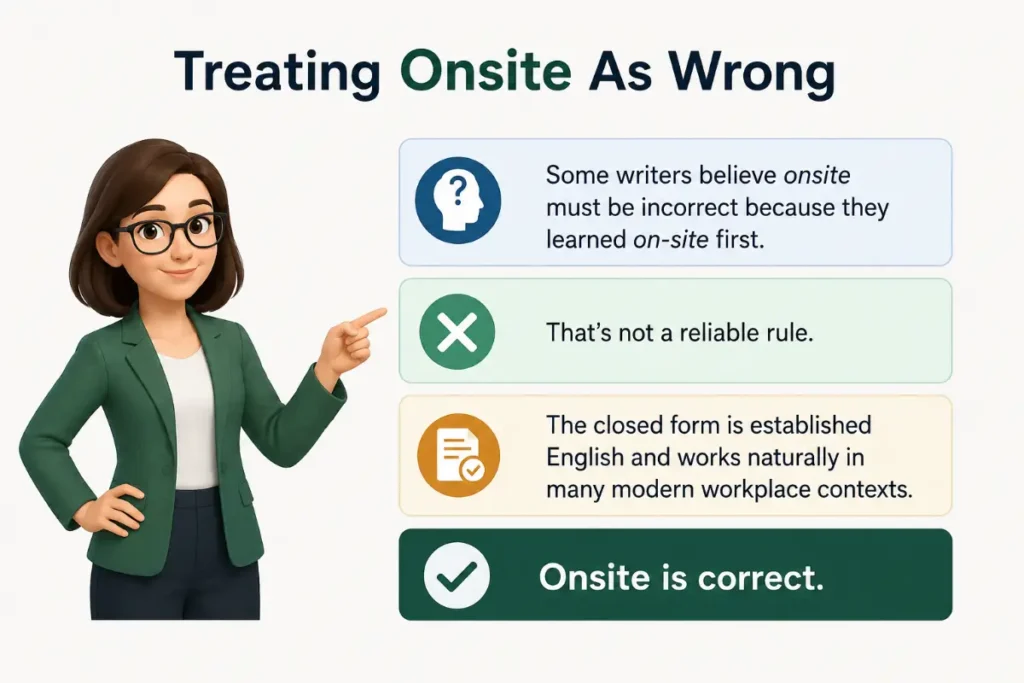
Some writers believe onsite must be incorrect because they learned on-site first.
That’s not a reliable rule.
The closed form is established English and works naturally in many modern workplace contexts.
Correct:
The company offers onsite training.
Using Onsite When Location Is The Main Point
This isn’t always grammatically wrong but it can make the sentence less natural.
For example:
The manager is onsite.
This works.
But:
The manager is on site.
may feel more natural when you are simply stating the manager’s location.
The choice is often one of style and rhythm rather than strict grammar.
Confusing Site And Sight
Site means a place or location.
Sight relates to seeing or something seen.
Correct:
The construction site is nearby.
Incorrect:
The construction sight is nearby.
You may hear both words pronounced similarly but their meanings are different.
Confusing Site And Cite
Cite means to refer to a source or example.
For example:
The student cited a research paper.
Site refers to a place.
For example:
The workers arrived at the site.
These words can cause mistakes because they sound the same.
Switching Forms Throughout One Document
A document that uses onsite in one paragraph and on-site in another may look inconsistent.
Neither spelling is automatically wrong. The problem is the lack of a clear style.
Choose one preferred form for your document when the grammatical context allows it.
Pronunciation Guide
The pronunciation of onsite and on-site is the same.
The American pronunciation can be represented as:
/ˌɑːnˈsaɪt/
An easy pronunciation guide is:
on SITE
The strongest stress falls on site.
You pronounce onsite and on-site the same way.
The phrase on site also normally has the same sound when the words are spoken naturally.
The pronunciation can create spelling confusion because listeners cannot hear the difference between the closed form the hyphenated form and the open form.
That means spelling must come from context rather than sound.
Etymology And Word Origin
The expression is made from two familiar English elements.
On is an old English preposition that has roots in the Germanic language family. It has long been used to describe position location contact and other relationships.
Site means a place or location. The word entered English through French and ultimately traces back to the Latin word situs which referred to position or location.
The modern expression developed naturally from the idea of something being at a particular site.
The spelling history follows a common pattern in English compounds. A combination can begin as separate words. Writers may later use a hyphen to connect the elements. Over time the combination can become a closed compound.
This helps explain why you can encounter on site on-site and onsite in modern English.
English compounds don’t always follow one fixed path. Different dictionaries style guides publishers and workplaces may favor different forms.
American English Usage
American English uses all three forms.
Onsite is especially common in modern workplace language.
You may see phrases such as:
onsite training
onsite facilities
The hyphenated on-site form also remains common.
For example:
on-site inspection
on-site assessment
The two word on site form is especially natural when describing location.
For example:
The engineer is on site.
The workers arrived on site.
The manager will be on site.
There is no simple rule that says American English must always use one form.
British English Usage
British English also uses these forms.
You may encounter onsite as well as on-site and on site.
The difference isn’t best explained as an American spelling versus a British spelling.
Instead the variation relates to compound spelling grammatical function and editorial preference.
British publications and organizations may follow their own style rules. The same applies to American publications.
If you’re writing for a specific publication then its style guide should take priority over personal preference.
Canadian English Usage
Canadian English can also use onsite on-site and on site.
There isn’t a major Canadian spelling rule that makes one form universally correct while the others are wrong.
As with American and British English professional context matters.
A Canadian company may choose one form for its internal style while another organization may use a different form.
The key is consistency.
Australian English Usage
Australian English also uses these expressions in workplace and general writing.
The same practical distinction applies.
Use onsite or on-site when the expression works as a modifier or adverb according to your chosen style.
Use on site when it works naturally as a location phrase.
There is no need to force a regional distinction where none exists.
Grammar Rules To Remember
You can make the choice easier by remembering a few practical rules.
- Onsite can function as an adjective.
The company offers onsite training.
- Onsite can function as an adverb.
The technician works onsite.
- On-site can also function as an adjective.
The engineer completed an on-site inspection.
- On-site can also function as an adverb in established usage.
The team worked on-site throughout the project.
- On site commonly works as a location phrase.
The manager is on site.
- Keep your chosen style consistent.
If you use onsite training in a document you don’t need to switch to on-site training later without a reason.
- Don’t confuse spelling with grammar.
A sentence can contain a correctly spelled form and still have a grammatical problem.
The surrounding sentence determines how the expression should work.
Real Life Usage Examples
Daily Conversation
People use the expression naturally when talking about work services repairs and locations.
The technician is on site now.
The company has onsite childcare.
The first example focuses on the technician’s location. The second describes a facility available at the workplace.
Workplace Email
The expression appears frequently in workplace messages.
Our team will provide onsite support during the installation.
The project manager will be on site during the inspection.
The first sentence describes a service. The second identifies someone’s location.
Academic Writing
Academic writers may use the expression when discussing research fieldwork testing or observation.
Researchers collected samples on site.
The study included onsite observation of workplace behavior.
The wording should match the style used throughout the paper.
News Writing
News reports may use the phrase when describing inspections emergencies construction projects and public events.
Officials conducted an on-site inspection.
Emergency workers treated several people on site.
The publication’s preferred style determines the spelling.
Storytelling
Narrative writing can use the expression to establish a physical location.
The crew remained on site until the storm passed.
The detective stayed onsite while investigators examined the building.
Both sentences communicate the same basic location idea while using slightly different structures.
Related And Confused Terms
Several words and phrases connect closely with this expression.
Offsite
Offsite usually means away from the main workplace or location.
Example:
The company held an offsite meeting.
It contrasts naturally with onsite.
Off Site
Off site can work as a location phrase.
Example:
The equipment is stored off site.
Remote
Remote describes work or activity performed away from a physical workplace.
Example:
The company offers remote support.
Remote and onsite aren’t always exact opposites because some work can happen partly at the workplace and partly elsewhere.
In Person
In person means physically present rather than communicating through a digital or remote method.
Example:
We can discuss the issue in person.
Workplace
A workplace is the place where someone works.
Example:
The company has several services available at the workplace.
Location
A location is a particular place or position.
Example:
The technician arrived at the location before noon.
Facility
A facility is a building or place designed for a particular purpose.
Example:
The facility offers onsite medical services.
Fieldwork
Fieldwork refers to practical work performed outside a controlled setting such as a laboratory or office.
Example:
Researchers conducted fieldwork on site.
These related terms can help you understand the larger meaning of location based language without treating every expression as interchangeable.
How Native Speakers Usually Use These Forms
Native speakers generally don’t stop to analyze the spelling when they hear the expression.
The difference becomes important mainly during writing.
In modern business English onsite feels natural in many compounds.
For example:
onsite training
onsite services
At the same time on site remains natural for location statements.
For example:
She is on site.
The workers are on site.
The manager will be on site.
The hyphenated form often appears because a writer or publication prefers that style.
For example:
on-site inspection
on-site visit
This variation is normal in English. The important skill is knowing how the expression functions in your sentence.
A Simple Memory Trick
Think about the role of the expression.
If it describes a thing then the closed or hyphenated form may fit.
onsite training
on-site training
If it describes where someone is then the open form often works naturally.
The trainer is on site.
You can remember it as:
What kind of service? Onsite.
Where is the person? On site.
This isn’t an absolute grammar rule because English allows variation. It is simply a useful editing shortcut.
Expert Editor Insight
An experienced editor won’t automatically change onsite to on-site because both forms are established. The editor first checks the grammatical role of the expression and then considers the publication’s preferred style. Consistency matters too. If a document uses onsite for workplace services then switching randomly to on-site can make the writing look poorly edited. Good editing focuses on clarity context and consistency rather than changing words just to make them look different.
Still confused? Compare Patience vs Patients: Meaning and Correct Usage.
Conclusion
The choice between onsite vs on-site isn’t a simple matter of correct English versus incorrect English. Both forms are established and share the same basic meaning. The two word form on site is also correct when you are describing a location or stating where an activity happens.
For modern American workplace writing onsite is a clean and natural choice. On-site remains perfectly acceptable when it matches your preferred style. Meanwhile on site often works best as a location phrase such as The manager is on site.
The easiest memory trick is to think about the sentence’s purpose. If the expression describes a service or thing then onsite often fits smoothly. If you’re answering the question where then on site is usually a natural choice.
FAQs
Is Onsite A Real Word
Yes. Onsite is a real and established English word. It functions as an adjective and an adverb. It commonly describes something located happening or available at a particular place and It appears frequently in workplace language such as onsite training onsite support onsite services and onsite facilities.
What Is The Meaning Of Onsite
Onsite means located or happening at the place where an activity takes place. For example onsite training means training provided at the relevant physical location. The word can also describe an action that happens at that location such as The technician works onsite.
Which Is Correct Onsite Or On Site
Both can be correct. Onsite is a closed form commonly used as an adjective or adverb. On site is a two word phrase that commonly describes location. For example We offer onsite training and The trainer is on site are both natural sentences.
Is On Site One Word Or Two Words
On site is two words. Onsite is one word. On-site is the hyphenated form. These forms can all occur in standard English. Your choice depends on grammatical function and style. Don’t assume that one form is automatically an error simply because another spelling is more familiar to you.
How Do You Pronounce Onsite
Onsite is pronounced approximately on SITE. The American IPA pronunciation is /ˌɑːnˈsaɪt/. The main stress falls on site. The closed and hyphenated forms have the same basic pronunciation. The two word phrase on site also sounds the same in normal speech.
Can Onsite Start A Sentence
Yes. Onsite can start a sentence when its grammatical role allows it. For example Onsite training begins Monday is grammatically sound. In this sentence onsite describes the type of training. Starting the sentence with the word doesn’t create a grammar problem.
Why Do People Confuse Onsite And On Site
People confuse these forms because they sound the same and have closely related meanings. English also allows different spellings for some compound expressions. Writers may encounter the closed form the hyphenated form and the open phrase in different documents. That can make the choice seem harder than it really is.
Is Onsite Appropriate In Formal Writing
Yes. Onsite can work well in formal and professional writing. It commonly appears in workplace documents reports policies and service descriptions. The hyphenated form on-site is also appropriate. For formal work the best choice is usually the form that matches your publication company or organizational style.