
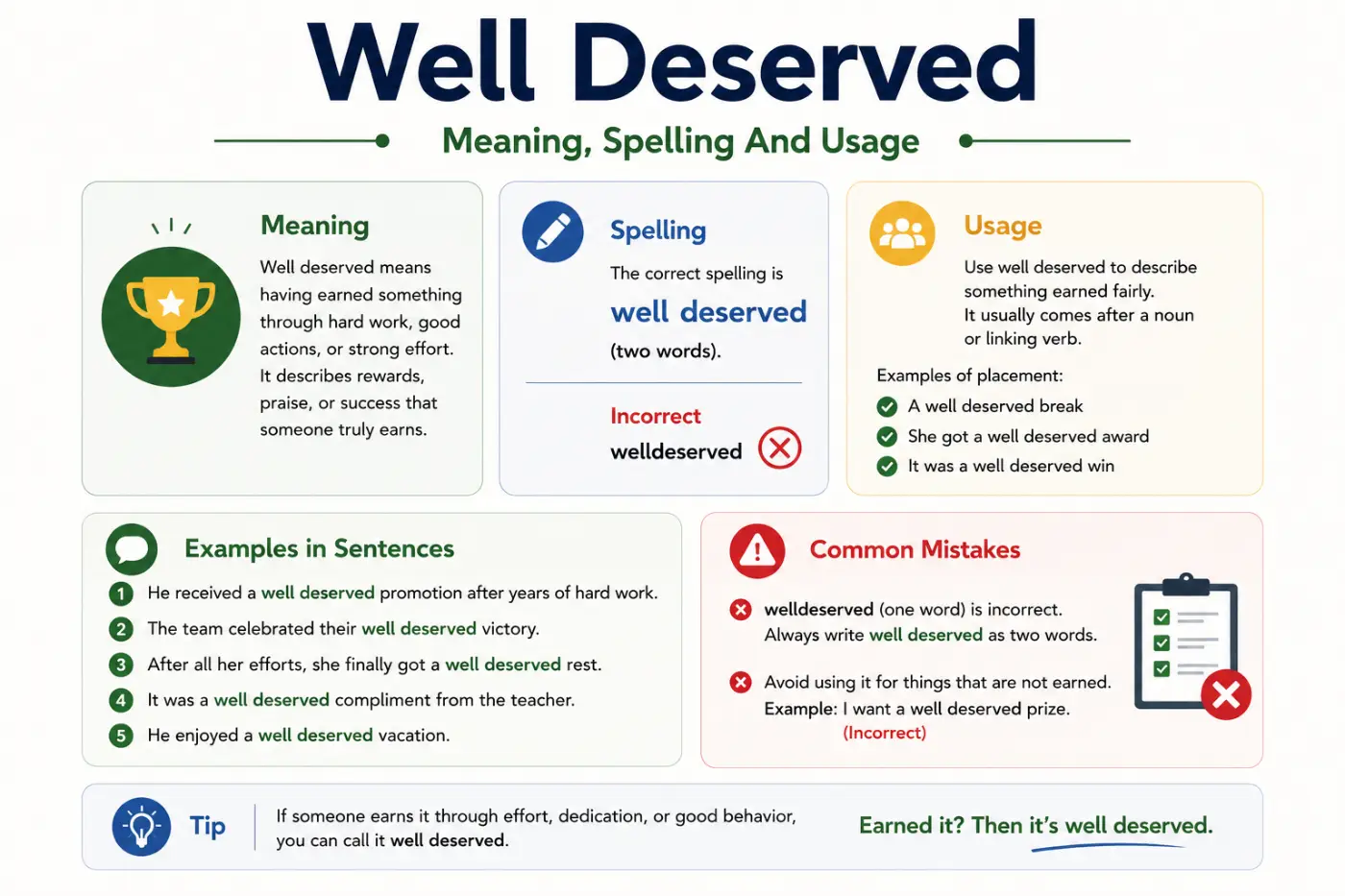
If you have ever written a sentence like She earned a well deserved promotion you may have paused over the spelling. Should the two words stay separate or should they be joined with a hyphen. The answer depends mainly on where the phrase appears in the sentence.
Well deserved is a correct English expression. It describes something a person has earned or received because of their effort behavior qualities or achievements. The phrase can appear after a linking verb as in Her success was well deserved. When it comes directly before a noun as a compound adjective many style guides and dictionaries use a hyphenated form.
That small punctuation difference can cause a surprising amount of confusion. The meaning stays almost the same but the grammatical position changes the way the phrase is written. Cambridge lists the open form as an adjective and also gives the hyphenated form before a noun. This guide explains the meaning the grammar pronunciation spelling pattern common mistakes and natural examples. By the end you will know exactly how to choose the right form without having to second guess yourself.
Many readers also check Shakey or Shaky Which Spelling Is Correct in 2026?.
Quick Answer
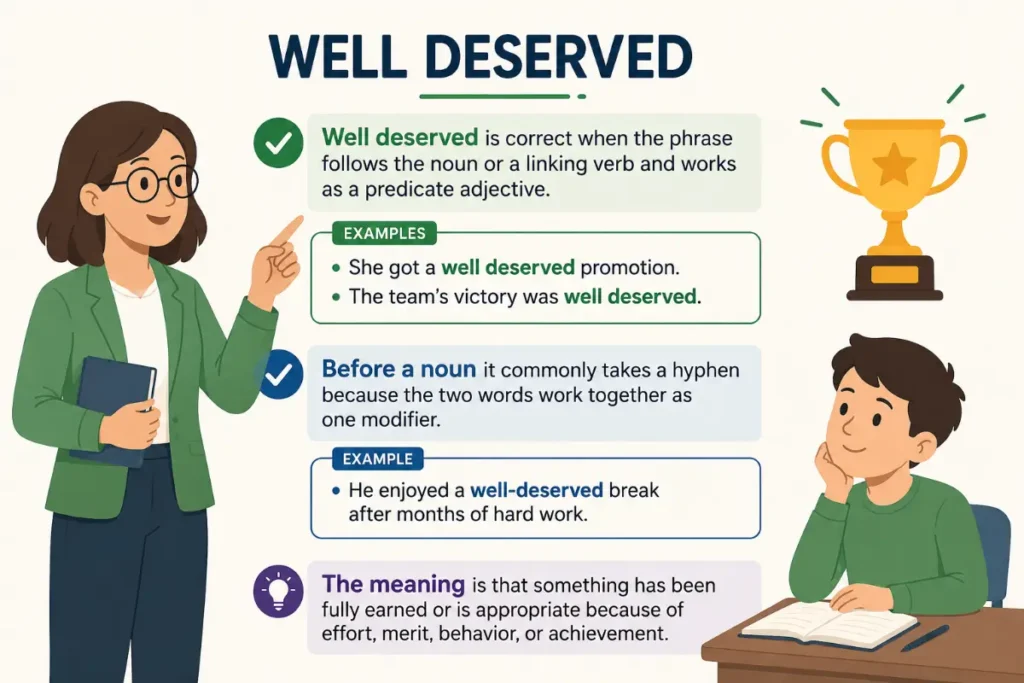
Well deserved is correct when the phrase follows the noun or a linking verb and works as a predicate adjective. Before a noun it commonly takes a hyphen because the two words work together as one modifier. The meaning is that something has been fully earned or is appropriate because of effort merit behavior or achievement.
The Basic Rule
The easiest way to remember the rule is to look at the position of the phrase.
When it comes after a linking verb the words normally remain separate.
Her promotion was well deserved.
The award was well deserved.
His success is well deserved.
In these sentences the phrase describes the subject after a linking verb. It acts as a predicate adjective.
When the phrase comes directly before a noun it commonly works as a compound modifier.
She received a well deserved award.
He took a well deserved break.
They celebrated a well deserved victory.
In standard edited English the compound modifier is commonly written with a hyphen in this position. Cambridge specifically distinguishes the open form from the hyphenated form used before a noun.
The punctuation does not change the basic meaning. It helps readers see that the words work together as a single descriptive unit.
What Does Well Deserved Mean
The phrase means fully earned or properly earned. It describes something that someone has a strong reason to receive because of their actions qualities effort or achievements.
If someone works hard for months and finally receives a promotion you can say the promotion was well deserved. If an athlete performs exceptionally and wins a major competition you can describe the victory as well deserved.
The phrase can express approval admiration or a sense of fairness.
Consider this sentence.
Her success was well deserved.
The speaker is saying that her success did not come from luck alone. Her work or ability gave her a genuine reason to receive that success.
The phrase can also describe negative outcomes.
The criticism was well deserved.
Here the speaker believes the criticism was justified because of what the person did.
That makes the expression more flexible than it may first appear. It can describe rewards praise recognition success rest criticism punishment or other outcomes.
Is Well Deserved Correct
Yes. The phrase is standard English.
The confusion usually comes from the hyphen. Many people assume that one version must always be correct and the other must always be wrong. English grammar does not work that way here.
The open form is common when the phrase appears after a linking verb.
The recognition was well deserved.
The result was well deserved.
Her rest was well deserved.
The hyphenated form is commonly used when the phrase comes immediately before a noun.
He received a well deserved reward.
She enjoyed a well deserved vacation.
They earned a well deserved victory.
Cambridge recognizes both patterns and gives examples that show the difference in position.
Oxford also uses the hyphenated form before a noun in its examples of deserved.
So the real issue is not correctness of the phrase itself. The real issue is grammatical position and compound modifier punctuation.
Well Deserved Compared With The Hyphenated Form
| Form | Meaning | Part of Speech | Typical Position | Formality | Common Contexts | Example |
|---|---|---|---|---|---|---|
| well deserved | Fully earned or justified | Adjective phrase | After a linking verb | Standard | Praise success recognition rewards | The award was well deserved. |
| Hyphenated compound form | Fully earned or justified | Compound adjective | Directly before a noun | Standard | Awards breaks victories promotions | She received a well deserved award. |
The important point is that these are not two different meanings. They are two written patterns for the same basic idea.
The first pattern describes a noun after a linking verb.
The second pattern modifies a noun directly.
This distinction appears in many English expressions. Writers often use hyphens to show that two or more words are acting together as one modifier before a noun. The goal is clarity rather than decoration.
Why The Hyphen Matters
A hyphen can help readers understand how words connect.
Compare these structures.
The reward was well deserved.
She received a well deserved reward.
In the first sentence the phrase comes after the linking verb was. The reader naturally understands that the phrase describes the reward.
In the second sentence the phrase comes before reward. The two words function together to describe the noun.
This is why edited English often uses a hyphen in the second pattern.
The same principle appears in expressions such as a well known author a highly respected teacher and a carefully planned event. The punctuation shows that the words belong together as a unit before the noun.
There is one important practical point. Not every writer or publication follows exactly the same house style for every compound modifier. Dictionary examples and established editorial practice can vary. Still the position based rule gives you a reliable starting point.
Meaning And Grammar
The phrase contains two parts.
Well is an adverb in this construction. It strengthens the meaning of deserved.
Deserved is an adjective derived from the verb deserve. It describes something that has been earned or is appropriate because of a person’s actions qualities or circumstances.
Oxford defines deserved in terms of something earned through what someone has done or how they have behaved. Its entry also connects deserved with the phrase well deserved.
The phrase therefore carries the idea of strong merit.
A deserved reward is a reward that is appropriate.
A well deserved reward goes a step further. It emphasizes that the reward is strongly justified.
The expression can also describe a result that someone has earned even when that result is not positive.
His punishment was well deserved.
The phrase does not automatically mean something pleasant. It means appropriate or justified according to the circumstances.
Part Of Speech
Well deserved functions as an adjective phrase.
The word deserved is the core adjective. Well modifies it by adding emphasis.
Look at this example.
The praise was well deserved.
The phrase describes the noun praise.
Now consider this structure.
She received a well deserved compliment.
Here the expression works as a compound adjective placed before the noun compliment.
This distinction helps explain the punctuation rule.
You do not need to memorize a complicated grammar formula. Simply ask yourself where the phrase sits in the sentence.
If it comes after a linking verb it is normally written as two separate words.
If it comes directly before a noun it commonly appears as a hyphenated compound modifier in edited English.
Sentence Examples
Here are natural examples that show how the expression works in everyday English.
- Your promotion was well deserved.
- The team earned a well deserved victory.
- After months of hard work she finally received the recognition she had earned.
- His performance received well deserved praise from the judges.
- That long weekend was well deserved after such a demanding project.
- The teacher said the student’s success was well deserved.
- The company gave its employees a well deserved break after the busy season.
- Her award was well deserved because she had spent years improving her craft.
- The applause was well deserved after such a strong presentation.
- He felt that the positive feedback was well deserved.
Notice how the grammar changes with position. Sentences one six and eight place the phrase after a linking verb. Other examples place it before a noun.
That change in position is the key lesson.
Common Mistakes
Using The Hyphen In Every Sentence
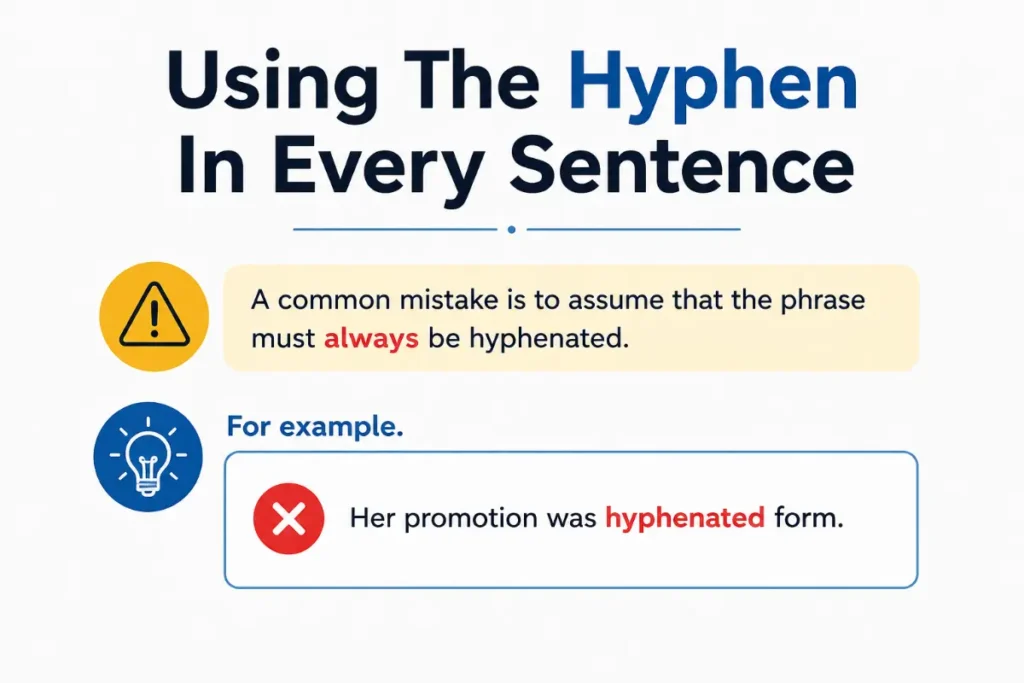
A common mistake is to assume that the phrase must always be hyphenated.
For example.
Her promotion was hyphenated form.
That pattern is unnecessary because the phrase comes after the linking verb was.
A cleaner version is.
Her promotion was well deserved.
Removing The Hyphen Before A Noun
The opposite problem also appears often.
Someone may write.
She received a well deserved promotion.
In careful edited writing the compound modifier before the noun is commonly written with a hyphen.
The important idea is not that the meaning changes. The punctuation simply helps identify the phrase as one modifier.
Treating The Phrase As A Verb
Deserved comes from the verb deserve but deserved itself is not acting as the main verb in a sentence such as The award was well deserved.
The main verb is was. Deserved functions as an adjective.
This distinction matters because it helps you understand why the phrase behaves like an adjective rather than a normal verb phrase.
Confusing Deserved With Deserving
Deserved and deserving are related but they are not interchangeable.
Deserved describes something that has been earned or is justified.
Deserving describes someone or something that merits a particular response.
She received the deserved recognition.
She is a deserving candidate.
The first focuses on the recognition. The second focuses on the candidate.
Assuming A Hyphen Changes The Meaning
It does not normally change the basic meaning here.
The main difference is grammatical position.
That is why it is better to learn the phrase through sentence structure rather than memorizing one spelling in isolation.
Pronunciation Guide
The phrase is pronounced with two clear parts.
Cambridge gives the American pronunciation as /ˌwel dɪˈzɝːvd/.
An easy pronunciation guide is.
wel dih ZURVD.
The strongest stress falls on the second part of deserved.
The first word sounds like the familiar word well. The second word begins with a short dih sound and ends with a sound similar to served.
The phrase does not require a special pronunciation when the words appear as a compound modifier. The punctuation affects writing rather than speech.
A common learner mistake is to pronounce deserved as if it had an extra syllable. In normal American English pronunciation the word is generally compact.
Need another quick comparison? Read Much Needed Meaning Explained With Examples.
Etymology And Word Origin
The key word deserved comes from the verb deserve.
Oxford traces deserve to Middle English and ultimately to Old French deservir and Latin deservire. The Latin root carried the sense of serving well or zealously.
Over time the English verb developed its modern sense of having earned something because of conduct qualities or actions.
The phrase then combines well with deserved to add emphasis.
That development explains why the expression naturally works with ideas such as reward praise recognition rest success and criticism. All of these can be viewed as outcomes that someone has earned or merits.
Understanding the history is interesting but you do not need etymology to use the phrase correctly. Sentence position remains the practical rule that matters most for modern writing.
American English Usage
The expression is standard in American English. American writers use it in casual conversation professional communication journalism academic writing and everyday messages.
You might say.
Your promotion was well deserved.
A manager might write.
Your team earned a well deserved break.
A friend might text.
That vacation was well deserved.
The expression sounds natural because it communicates approval without sounding overly formal.
It also works in emotional situations.
You worked hard for this. The recognition was well deserved.
That sentence sounds warm and direct. It gives praise without exaggerating.
British English Usage
British English uses the same basic distinction.
The phrase appears in both open and hyphenated patterns depending on grammatical position. Cambridge presents the open form as an adjective and specifically identifies the hyphenated pattern before a noun.
There is no major difference in meaning between American and British English here.
The pronunciation differs slightly in standard British and American speech. Cambridge gives both forms in its pronunciation information.
The spelling principle remains easy to follow in both varieties.
Canadian And Australian English
Canadian and Australian English also use the expression naturally.
There is no major regional difference that changes the basic meaning or grammatical function.
The same position based punctuation principle remains useful.
If the phrase follows a linking verb it normally appears as two separate words.
If it directly modifies a noun it commonly appears as a hyphenated compound adjective in edited prose.
You do not need to learn a separate Canadian or Australian rule for this expression.
Grammar Rules You Can Remember
A simple editing test can save you time.
First find the noun being described.
Then check the position of the phrase.
If the phrase follows a linking verb such as is was seems or feels it normally remains open.
The result was well deserved.
The praise is well deserved.
Her success seems well deserved.
If the phrase comes immediately before the noun it describes it commonly works as a compound modifier.
He received a well deserved award.
She took a well deserved rest.
They celebrated a well deserved win.
This approach works better than trying to memorize isolated spellings.
After A Linking Verb
The phrase commonly follows verbs such as is was seems feels appears and looks.
The result was well deserved.
Her promotion seems well deserved.
His success is well deserved.
The criticism was well deserved.
In these examples the phrase describes the subject.
Before A Noun
The compound expression can appear directly before a noun.
A well deserved award can bring recognition after years of work.
A well deserved victory can feel especially satisfying after a difficult season.
The punctuation tells the reader that the words work together as a single modifier.
Real Life Usage
Everyday Conversation
People often use this expression to congratulate someone.
You worked really hard for that. It was well deserved.
That kind of sentence sounds natural because it connects the result directly to the person’s effort.
Another common example is talking about rest.
After that long week you deserve a well deserved break.
In polished writing the compound modifier before break is normally hyphenated.
Workplace Communication
The phrase fits professional communication because it can sound positive without becoming overly formal.
Your promotion is well deserved.
The team earned well deserved recognition for completing the project.
A manager could also write a short congratulatory message using the expression.
Congratulations on the achievement. Your success is well deserved.
The wording is clear and professional while still sounding human.
Academic Writing
Academic writers may use the expression when evaluating a contribution or outcome.
The researcher received well deserved recognition for the study.
The award was well deserved given the quality of the work.
Academic writing generally benefits from precise wording. The phrase works best when the writer can explain the basis for the judgment.
News And Journalism
Journalists use the expression when describing awards victories recognition and public reactions.
The team received well deserved praise after the final performance.
The article itself does not need dramatic language. The phrase already communicates that the outcome was justified.
Storytelling
In personal writing and storytelling the phrase can add warmth.
After years of setbacks she finally reached the finish line. The celebration was well deserved.
The expression works especially well when the reader has already seen the effort behind the result.
Related Terms
Deserved
Deserved means earned or justified.
The result was deserved.
It is broader than the full expression because it does not add the same emphasis.
Deserving
Deserving describes someone or something that merits a particular outcome.
She is a deserving winner.
The word focuses on the person or thing that merits the result.
Earned
Earned emphasizes effort or action that leads to an outcome.
He earned the promotion.
This word can often replace deserved in practical contexts.
Merited
Merited means justified or deserved.
The decision merited careful consideration.
It tends to sound more formal than everyday expressions.
Justified
Justified means supported by good reasons or circumstances.
The criticism was justified.
This word is useful when the focus is on reasons rather than personal achievement.
Worthy
Worthy means deserving of respect attention praise or another response.
She was worthy of the honor.
It often focuses on the quality of a person or thing.
Deservedly
Deservedly is an adverb that means in a deserved or justified way.
She deservedly won the award.
This construction places the emphasis on how the action occurred.
Undeserved
Undeserved is the opposite idea.
He received undeserved criticism.
It means that the person or outcome did not properly merit what happened.
How To Choose The Right Expression
You can make the decision quickly by asking one question.
Is the phrase describing the subject after a linking verb or is it directly modifying a noun.
If it describes the subject after a linking verb use the open form.
The honor was well deserved.
If it modifies a noun directly use the hyphenated compound form in careful edited writing.
She received a well deserved honor.
That simple check handles most situations.
You do not need to rely on how the phrase sounds. The words sound the same in speech. The answer comes from grammar and sentence structure.
This is especially useful when proofreading your own work. Instead of staring at the phrase and wondering if it looks right simply identify its job in the sentence.
An Easy Memory Trick
Think of the hyphen as a small bridge between words that need to work together before a noun.
A well deserved reward has two words acting as one description of reward.
But in The reward was well deserved the phrase already follows the linking verb and clearly describes reward.
So remember this pattern.
After the verb use the open form.
Before the noun use the compound form.
This is not a perfect rule for every compound adjective in English but it is a highly useful practical guide for this phrase.
Expert Editor Insight
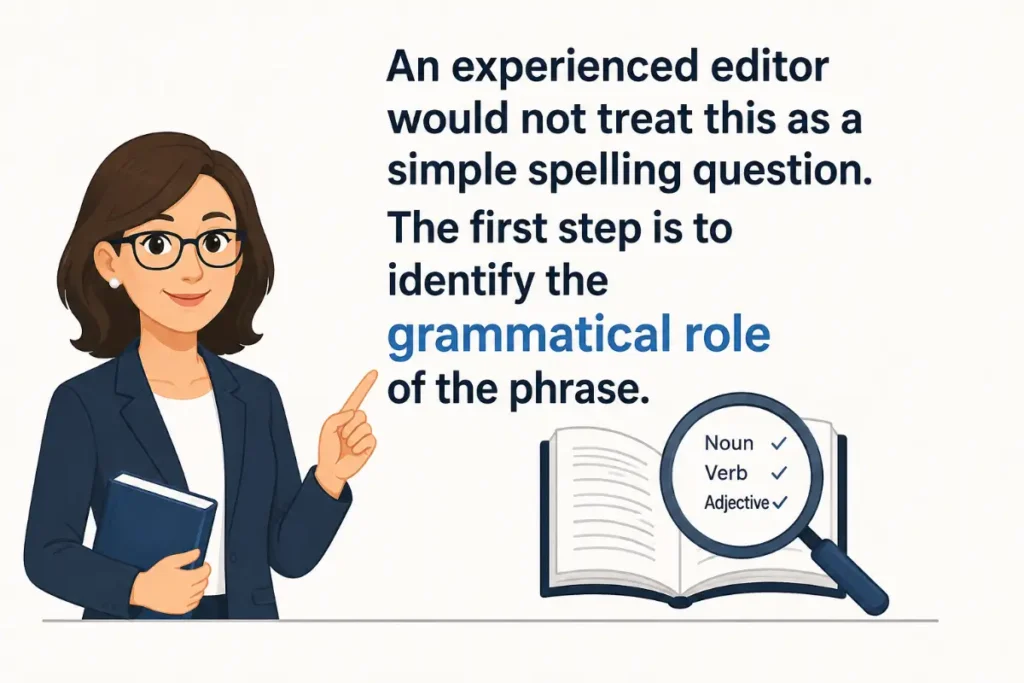
An experienced editor would not treat this as a simple spelling question. The first step is to identify the grammatical role of the phrase. If it follows a linking verb it normally stays open. If it comes directly before a noun it commonly becomes a hyphenated compound modifier. Grammar and spellcheck tools may flag the punctuation differently because style rules vary across systems. A human editor looks at the whole sentence before making the final decision.
Still confused? Compare Catalogue or Catalog: Which Spelling Is Correct?.
Final Takeaway
Well deserved is a correct and useful English expression that means fully earned or justified. The main writing issue is not the meaning but the position of the phrase in the sentence.
After a linking verb the words normally remain separate. Before a noun they commonly work as a compound adjective and take a hyphen in careful edited English.
The best editing trick is simple. Look at what the phrase is doing rather than memorizing one spelling. If it describes the subject after a linking verb keep it open. If it directly modifies a noun check the compound modifier rule. Once you see that pattern the confusion becomes much easier to handle.
FAQs
Is Well Deserved A Correct Expression?
Yes. It is a standard English adjective phrase meaning fully earned or justified. The open form commonly appears after a linking verb such as was or is. Before a noun the same idea commonly appears as a hyphenated compound modifier in edited writing. Cambridge recognizes both patterns.
Should The Phrase Have A Hyphen?
It depends on its position. After a linking verb you normally write the phrase as two separate words. Before a noun it commonly takes a hyphen because the words work together as one modifier. The hyphen therefore relates mainly to grammatical structure rather than a change in meaning.
What Does Well Deserved Mean?
It means fully earned or justified. You can use it for something positive such as praise a promotion or a reward. You can also use it for something negative such as criticism or punishment when you believe the outcome was appropriate because of someone’s actions.
How Do You Pronounce Well Deserved?
The American pronunciation is represented as /ˌwel dɪˈzɝːvd/. The first word sounds like well. The second word has the main stress near the end. In simple terms you can think of the phrase as wel dih ZURVD.
Can The Phrase Start A Sentence?
Yes. There is no grammar rule that prevents it from starting a sentence. For example you could write Well deserved recognition finally came after years of hard work. The exact punctuation depends on the sentence structure and the noun that follows.
What Is A Synonym For Well Deserved?
Useful alternatives include fully earned richly deserved justified merited appropriate and earned. The best choice depends on context. Fully earned sounds direct. Merited sounds more formal. Justified works especially well when you are explaining why a reaction or decision was appropriate.
Why Do People Confuse The Two Forms?
The confusion comes from the fact that the words sound identical in speech. Writers may also remember seeing both forms in books articles messages and online posts. The grammatical position determines the punctuation in careful writing so looking at the surrounding sentence is more reliable than relying on memory alone.
Is The Phrase Appropriate In Formal Writing?
Yes. The expression is suitable for professional and formal writing when the meaning fits the sentence. It can describe recognition awards achievements praise or other outcomes. In formal editing pay attention to its position because compound modifiers before nouns often require clearer punctuation.