
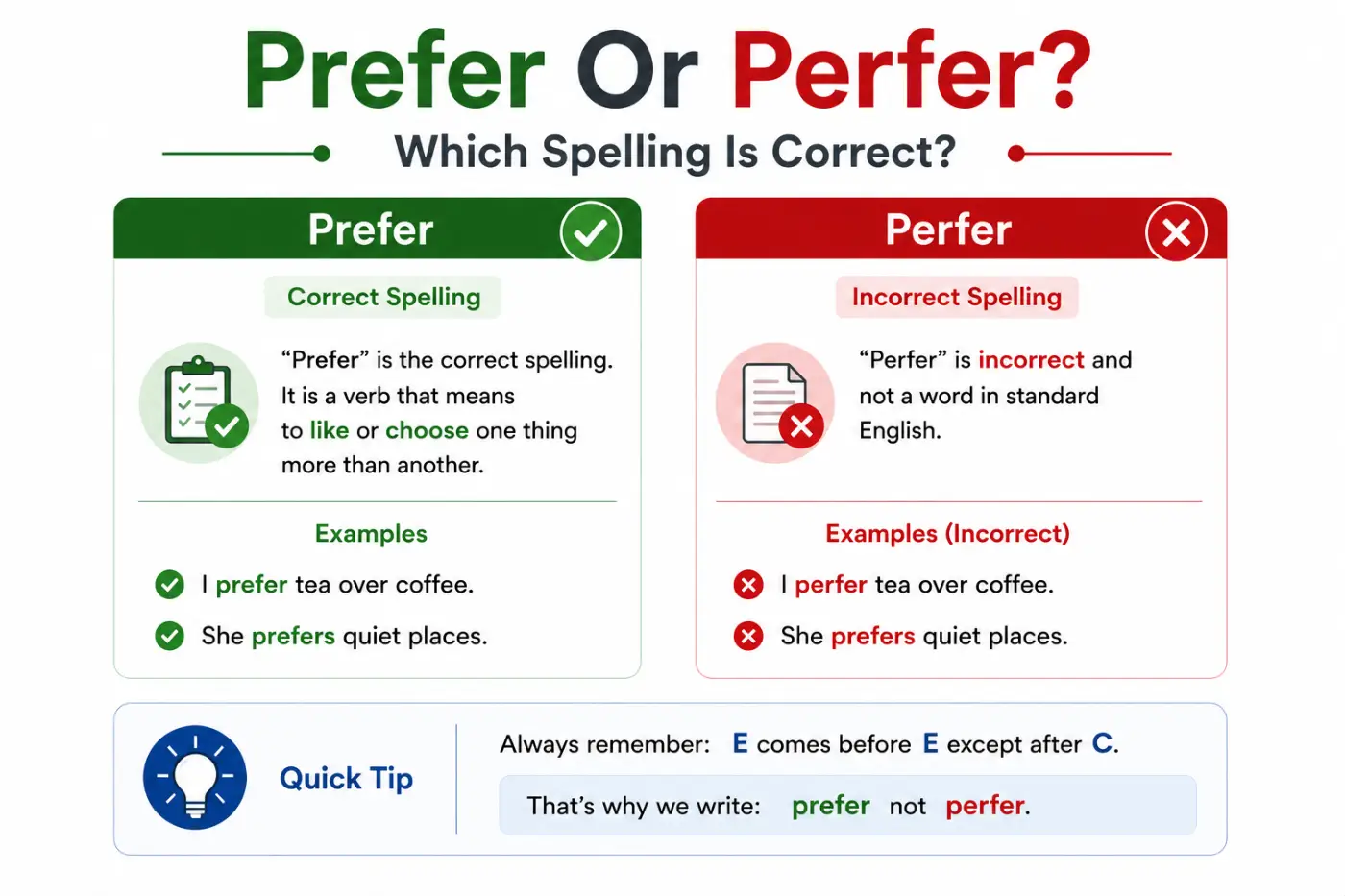
If you’re unsure about prefer or perfer the correct spelling is prefer. The word prefer is a standard English verb that means to like one thing more than another or to choose one option because you like it better. Perfer is a common misspelling and isn’t the standard spelling of the verb.
The confusion usually comes from pronunciation. When people say prefer quickly the first vowel can sound weak. That makes it easy to write the word as perfer. The problem becomes especially common because English spelling doesn’t always give you a clear clue from pronunciation alone.
This guide explains the spelling difference in plain English. You’ll learn the meaning of prefer the correct pronunciation the grammar rules the most common mistakes and how native speakers use the word in everyday and formal writing.
For another common grammar confusion, see flies or flys Which Spelling Is Correct.
Quick Answer
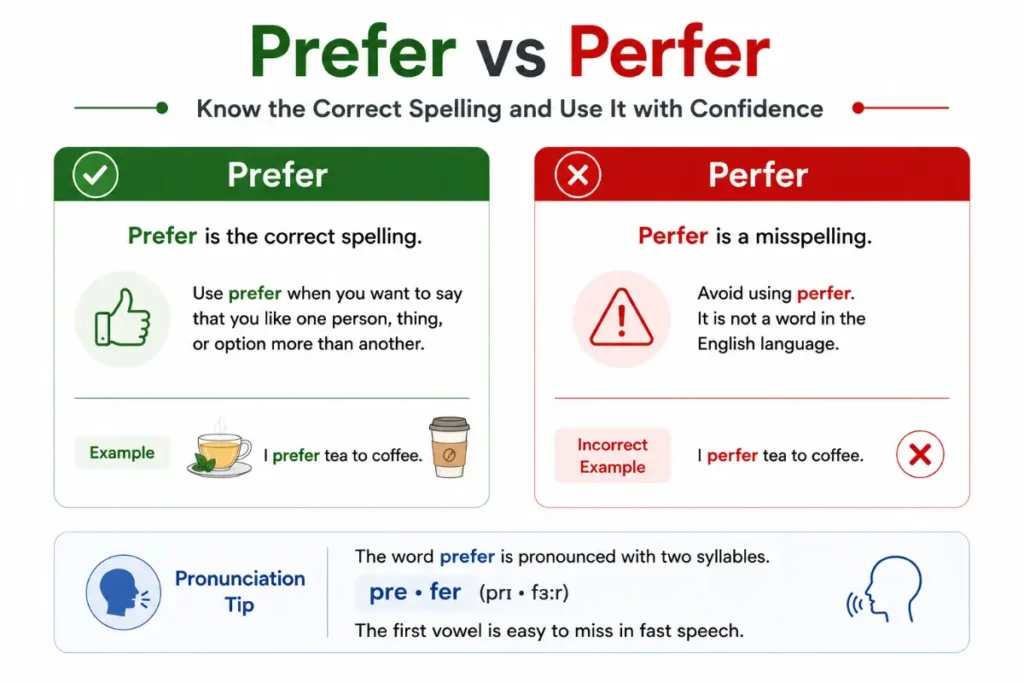
Prefer is the correct spelling. Perfer is a misspelling. Use prefer when you want to say that you like one person thing or option more than another. For example you can say I prefer tea to coffee. The word is pronounced with two syllables and the first vowel is easy to miss in fast speech.
Comparison Table
| Correct Form | Meaning | Part of Speech | Origin | Usage Frequency | Formality | Common Contexts | Example |
|---|---|---|---|---|---|---|---|
| Prefer | Like or choose one thing more than another | Verb | Latin through French | Common | Neutral | Conversation writing work school | I prefer tea to coffee. |
| Perfer | No standard meaning as the intended verb | Misspelling | Not a standard form of prefer | Uncommon in edited English | Nonstandard | Typing spelling mistakes informal messages | I perfer tea to coffee. |
The distinction is straightforward. Prefer belongs in standard English. Perfer usually appears because someone has misspelled the word.
Meaning And Definition
Meaning Of Prefer
Prefer is a verb that describes a stronger liking or choice.
If you prefer one thing to another you like or want the first option more. You might prefer coffee to tea. You might prefer working in the morning. You might prefer a quiet restaurant instead of a busy one.
The word can describe personal taste. It can also describe a practical choice.
For example:
- I prefer walking to driving.
- She prefers working alone.
- They prefer the smaller apartment.
- He prefers email for work communication.
The basic idea stays the same. You have more than one possible choice and one option appeals to you more.
Meaning Of Perfer
Perfer isn’t the standard spelling of the English verb prefer.
You may see it in online posts text messages school assignments or other informal writing. In most cases it’s simply a spelling mistake.
A reader will usually understand what the writer means from context. Still that doesn’t make the spelling correct.
For professional writing academic work applications reports and published content use prefer.
Key Differences Explained
The biggest difference between the two forms is spelling.
- Prefer is the standard English word.
- Perfer is a common misspelling.
- Prefer functions as a verb.
- Perfer doesn’t serve as the standard verb for expressing a choice or stronger liking.
- Prefer appears in both casual and formal English.
- Perfer should be corrected in edited writing.
The meaning itself isn’t difficult. The spelling causes the trouble.
A useful way to remember the difference is to connect the word with preference. The noun is preference. The verb is prefer. Both forms begin with pre.
Think of the spelling as a small family.
Prefer
Preference
Preferred
Preferable
Seeing these related forms together makes the spelling easier to remember.
Which Form Is Correct
Prefer is correct.
English uses prefer as the verb for expressing a stronger liking or choice. The word has a long history in English and follows established spelling patterns that appear in its related forms.
The spelling perfer often develops from the way the word sounds. The second syllable can receive more attention in normal speech while the first vowel becomes less prominent. A writer who relies heavily on sound may therefore insert the wrong vowel.
Professional editing relies on the established written form rather than spelling the word from its fast spoken pronunciation.
So if you’re writing an email or completing an assignment and you hesitate between the two forms choose prefer.
Sentence Examples
Here are natural examples showing how prefer works in real sentences.
- I prefer tea in the morning.
- She prefers reading before bed.
- We prefer to meet in person.
- He prefers working from home.
- They prefer a quiet table near the window.
- I prefer this version because it’s easier to understand.
- My teacher prefers clear and direct answers.
- Most students prefer examples that relate to real life.
- She prefers writing with a pen instead of typing.
- I prefer the first option for this project.
Notice that the verb can appear in several useful patterns.
You can say prefer something.
You can say prefer to do something.
You can say prefer something to something else.
You can also use prefer doing something to doing something else.
These patterns are common in everyday English.
Common Grammar Patterns
Prefer Something
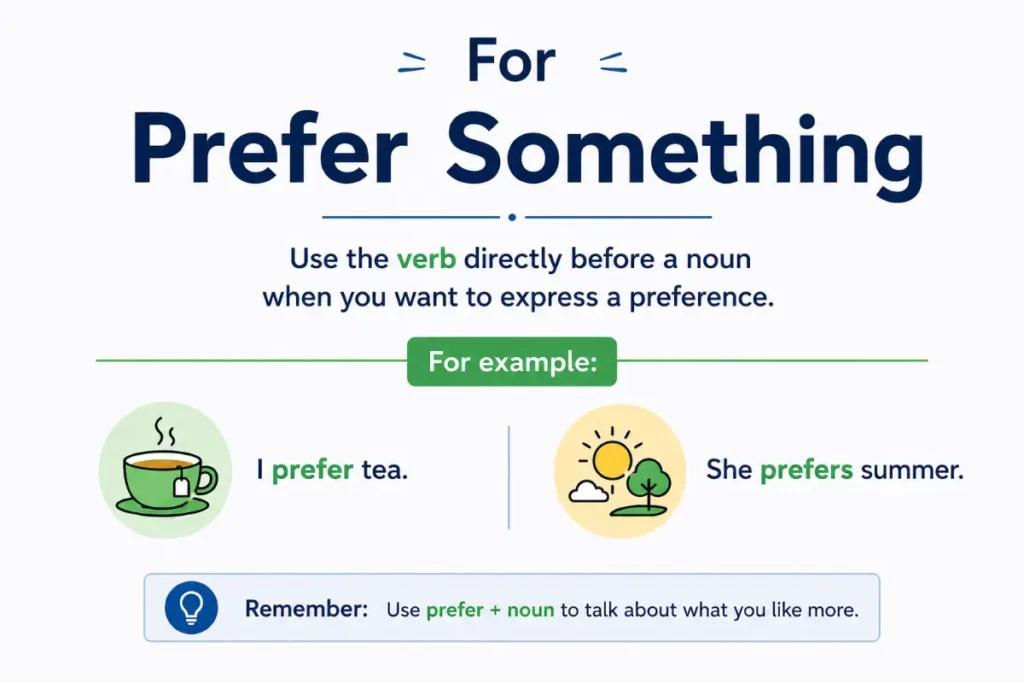
Use the verb directly before a noun when you want to express a preference.
For example:
I prefer tea.
She prefers summer.
They prefer quiet places.
This structure is short and natural.
Prefer To Do Something
Use prefer to before another verb when describing an action you like more.
For example:
I prefer to walk.
She prefers to study at home.
He prefers to arrive early.
This structure is especially common when discussing personal habits or choices.
Prefer Something To Something Else
This is one of the most important patterns to remember.
For example:
I prefer tea to coffee.
She prefers books to movies.
They prefer buses to trains.
The word to connects the two choices.
A common mistake is using than because people associate comparison with words such as better or rather. With prefer the standard pattern is prefer X to Y.
Prefer Doing Something To Doing Something Else
You can also compare two activities.
For example:
I prefer reading to watching television.
She prefers walking to taking the bus.
He prefers studying in the morning to studying at night.
This structure makes the comparison clear and natural.
Prefer To Something Else
Another common pattern uses prefer to followed by a verb.
For example:
I prefer to stay home.
We prefer to leave early.
She prefers to work alone.
The verb after to stays in its base form.
You wouldn’t normally write:
I prefer to stayed home.
The correct sentence is:
I prefer to stay home.
Pronunciation Guide
Prefer is commonly pronounced /prɪˈfɜːr/ in many British pronunciations and /prɪˈfɝː/ in General American English.
It has two syllables.
The basic sound pattern is:
pri FER
The stress falls on the second syllable.
The first part is short and unstressed. The second part receives the stronger stress.
This pronunciation helps explain the spelling confusion. When people speak naturally the first syllable can become less noticeable. Someone may hear the word and mentally reconstruct it as perfer.
That’s a useful example of why pronunciation alone isn’t always enough to determine English spelling.
Common Pronunciation Mistake
Some speakers may try to pronounce every letter with equal force. That can make the word sound unnatural.
A natural pronunciation gives more emphasis to the second syllable.
Think of the rhythm as:
pri FER
rather than:
PRE fer
The exact vowel quality can vary across English accents. The stress pattern remains the useful point for most learners.
Why People Spell Prefer As Perfer
The mistake has a simple explanation.
English spelling often preserves information that casual speech doesn’t make obvious. In prefer the first vowel occurs in an unstressed syllable. During natural speech that vowel can sound weaker than expected.
When someone hears the word quickly they may focus on the stronger second syllable. They may then spell the first part according to what they think they heard.
There’s another reason the mistake can stick. English contains many words where vowel patterns don’t match what learners expect. Writers may also rely on familiar patterns from other words.
The good news is that this mistake is easy to fix once you connect prefer with preference.
Common Mistakes And Misspellings
Perfer Instead Of Prefer
This is the main spelling error.
Incorrect:
I perfer tea.
Correct:
I prefer tea.
The mistake comes from changing the first vowel.
Preffer Instead Of Prefer
Some writers add an extra f.
Incorrect:
I preffer coffee.
Correct:
I prefer coffee.
The standard spelling has one f before the second syllable.
Prefered Instead Of Preferred
This error appears when writers add the past tense ending without applying the spelling rule.
The correct form is preferred.
For example:
She preferred the earlier version.
The final consonant doubles before the ending in this form.
Prefering Instead Of Preferring
The same spelling issue appears with the present participle.
The correct form is preferring.
For example:
He is preferring a quieter environment.
That sentence is grammatically possible though native speakers may choose a different structure depending on the context.
Prefer Than Instead Of Prefer To
This is a grammar mistake rather than a spelling mistake.
Incorrect:
I prefer tea than coffee.
Correct:
I prefer tea to coffee.
The standard comparison pattern uses to.
Grammar Rules And Part Of Speech
Prefer is a verb.
It expresses a choice or stronger liking. Because it’s a verb it can change according to tense and subject.
Consider these examples:
I prefer tea.
She prefers tea.
They preferred tea.
We have preferred tea.
The base form is prefer.
The third person singular present form is prefers.
The past form is preferred.
The present participle is preferring.
Prefer In The Present Tense
Use prefer with I you we and they.
For example:
I prefer simple explanations.
You prefer quiet places.
We prefer online meetings.
They prefer local restaurants.
Use prefers with he she and it.
For example:
He prefers tea.
She prefers early meetings.
The company prefers written applications.
Prefer In The Past
The past form is preferred.
For example:
I preferred the older design.
She preferred the first proposal.
They preferred the original plan.
The spelling contains two r letters in the middle.
That detail matters because writers sometimes create prefered by forgetting the doubled consonant.
Prefer In The Continuous Form
The present participle is preferring.
However the continuous form isn’t always the most natural choice because preferences often describe relatively stable states.
For example:
I prefer coffee.
That sounds more natural than:
I am preferring coffee.
The continuous form can still appear when the speaker wants to describe a temporary or developing preference.
For example:
I’m preferring the quieter room today because I need to concentrate.
The context determines the most natural structure.
Real Life Usage Examples
Daily Conversation
People use prefer constantly in everyday speech.
You might say:
I prefer this one.
I prefer to stay home tonight.
Do you prefer tea or coffee?
She prefers the window seat.
These sentences sound natural because the verb works well for ordinary choices.
Workplace Communication
The word also fits professional communication.
For example:
I prefer to receive the documents by email.
The manager prefers a shorter report.
We prefer to schedule the meeting in the morning.
The client prefers written confirmation.
The word itself isn’t especially formal. It works in professional writing because it expresses a clear choice without sounding overly complicated.
Academic Writing
Academic writers often use prefer when discussing choices or tendencies.
For example:
Some students prefer visual examples.
Researchers may prefer a larger sample for certain types of analysis.
Students often prefer clear instructions before beginning an assignment.
The word remains simple and direct.
News And Journalism
Journalists may use the verb when reporting personal choices or stated preferences.
For example:
The coach prefers a defensive strategy.
The candidate prefers to focus on local issues.
The company prefers a gradual expansion plan.
These examples show that the word works across many styles.
Storytelling
Writers can use prefer to reveal character.
For example:
Mara preferred quiet streets and small cafés.
Daniel preferred to listen before he spoke.
That kind of sentence tells the reader something about a person without explaining it directly.
Formal And Informal Usage
Prefer works in both formal and informal English.
In casual conversation you might say:
I prefer this one.
In professional writing you might say:
We prefer to receive all applications electronically.
Both are standard.
The difference comes from the surrounding language rather than from the verb itself.
You don’t need a more complicated word to replace prefer in formal writing. In many cases the simplest word is the strongest choice.
For another common grammar confusion, see Flatform Vs Platform Which Spelling Is Correct 2026.
American English And British English
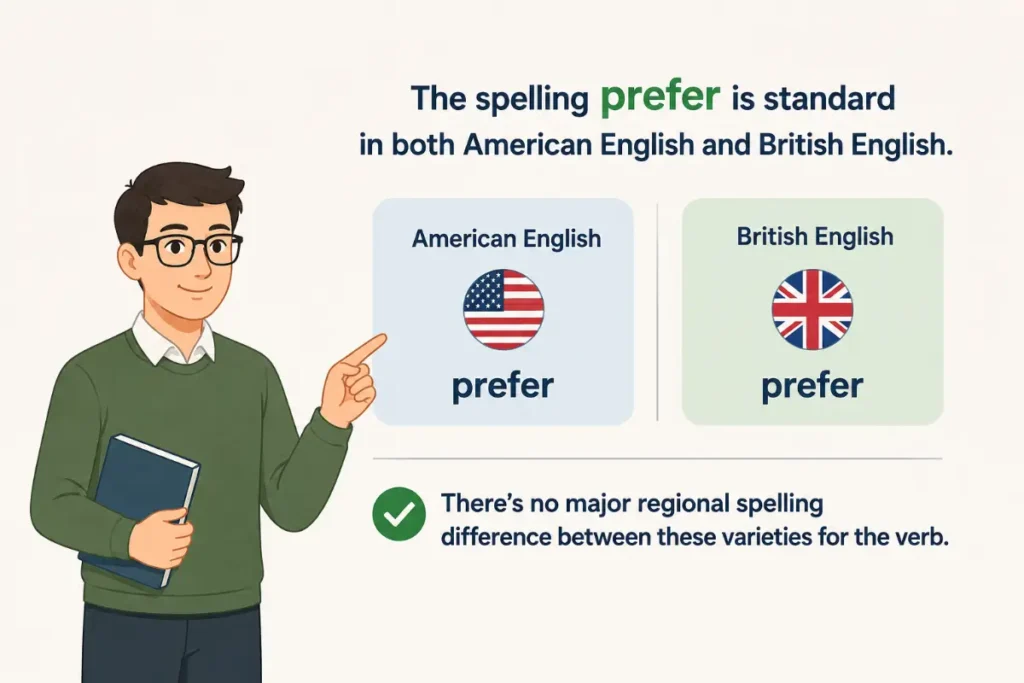
The spelling prefer is standard in both American English and British English.
There’s no major regional spelling difference between these varieties for the verb.
The same applies to its common forms:
prefer
prefers
preferred
preferring
Pronunciation can vary by accent. American and British speakers may produce different vowel sounds. That difference doesn’t change the spelling.
Canadian and Australian English also use prefer as the standard form.
So this isn’t a case where you need one spelling for the United States and another for Britain. The same standard spelling works across major English varieties.
Etymology And Word Origin
The history of prefer goes back to Latin.
The Latin verb praeferre carried the sense of carrying or placing something before another thing. It was formed from elements connected with the ideas of before and carrying.
The word moved through Old French before entering English.
Over time the meaning developed toward the modern idea of choosing one thing over another or regarding one option as more desirable.
That historical development fits the modern meaning well. When you prefer one option you effectively place it ahead of another in your choice.
The related noun preference comes from the same word family.
Knowing the family can help with spelling because several related words preserve the same opening pattern.
Related And Confused Terms
Preference
Preference is the noun related to prefer.
For example:
My preference is tea.
The noun describes the choice or liking itself.
Preferred
Preferred is the past form and past participle of prefer.
For example:
She preferred the smaller room.
It can also function as an adjective.
For example:
This is my preferred option.
Preferable
Preferable means more desirable or better suited.
For example:
The second option is preferable.
This word expresses a comparison but works differently from the verb.
Favorite
Favorite describes a person or thing that you like more than others.
For example:
Blue is my favorite color.
The two words are related in meaning but don’t always work in the same sentence.
Choose
Choose means to select something.
For example:
I chose the blue shirt.
You can choose something without expressing a preference between two options. Prefer focuses more directly on liking or favoring one option.
Favor
Favor can mean to support or show a preference for something.
For example:
The committee favored the first proposal.
It can overlap with prefer but often carries a slightly different context.
Rather
Rather can appear in expressions that describe preference.
For example:
I’d rather stay home.
This can communicate a choice without using prefer.
Like
Like is a broad word for enjoyment or positive feeling.
For example:
I like coffee.
Prefer usually creates a comparison or suggests that one option is favored over another.
Prefer And Choose
These words are easy to confuse because both can appear when someone makes a decision.
Prefer focuses on liking one option more.
Choose focuses on the act of selecting.
Compare these sentences:
I prefer tea to coffee.
I chose tea.
The first sentence tells us about my preference. The second tells us what I selected.
You can prefer something without choosing it.
For example:
I prefer traveling by train but I’m taking the bus today.
The speaker has a preference but makes a different choice because of circumstances.
That distinction is useful in everyday conversation.
Prefer And Rather
Prefer and rather can express similar ideas.
Compare:
I prefer to stay home.
I’d rather stay home.
Both can communicate a desire to stay home.
The structures differ.
With prefer you can use:
I prefer tea to coffee.
With rather you can use:
I’d rather drink tea than coffee.
This is a good example of why grammar patterns matter. Two words can have related meanings while following different sentence structures.
Prefer And Favorite
A favorite is usually the option you like most within a group.
For example:
Blue is my favorite color.
You can also say:
I prefer blue to green.
The first sentence identifies the top choice. The second compares two options.
This distinction may seem small but it helps make your writing more precise.
How To Remember The Correct Spelling
The easiest memory trick is to connect prefer with preference.
Both begin with pre.
Think:
prefer
preference
preferred
preferable
If you remember the word family you’re less likely to write perfer.
Another useful trick is to remember the basic structure prefer X to Y.
For example:
I prefer tea to coffee.
The first word in that pattern starts with pre.
A spelling memory works best when you connect the word to meaning and related words rather than trying to memorize isolated letters.
Why Spelling Tools May Flag Perfer
Modern spelling tools usually recognize standard English vocabulary. Since perfer isn’t the standard spelling of the intended verb the software may underline it.
That warning is useful but it shouldn’t replace human judgment.
A spell checker can tell you that a form looks unfamiliar. It may not explain why the mistake happened or how to avoid it next time.
That’s why understanding the word family is more valuable than simply correcting one typo.
If you repeatedly make the same mistake you’ll benefit from learning the pattern behind it.
Expert Editor Insight
An experienced editor would usually fix perfer immediately because the intended word is clear and the standard form is well established. The more useful question is why the error keeps appearing. In most cases the writer is spelling from the sound rather than recalling the written form. A good editing habit is to connect prefer with preference and preferred. That gives you a reliable visual pattern and helps prevent the same error from returning.
A Simple Editing Test
If you’re unsure about the spelling while writing quickly stop and test the word family.
Ask yourself:
Does the related noun begin with preference?
Does the past form look like preferred?
Does the sentence describe liking or choosing one option more than another?
If the answer is yes you almost certainly need prefer.
This kind of mental check takes only a second. It’s faster than repeatedly deleting and retyping the word.
When To Use Prefer In Formal Writing
You can safely use prefer in formal writing.
It works in:
Academic essays.
Business emails.
Reports.
Final Takeaway
The correct choice is prefer or perfer only if you’re asking which spelling belongs in standard English. The answer is prefer. It’s the standard verb for expressing a stronger liking or choosing one option over another. Perfer is a common misspelling.
Remember the word family prefer preference and preferred. They all help reinforce the correct opening pattern. Also remember the grammar pattern prefer X to Y. Once that spelling and structure become familiar you’ll be much less likely to type the incorrect form. When in doubt use the related word preference as your quick visual reminder.
Learn the difference in Blankie or Blanky (2026): Which Spelling Is Standard English?.
Common Questions About The Spelling
Is Perfer A Real Word
In standard modern English perfer isn’t the correct spelling of the verb that means to like or choose one thing more than another. Most appearances of perfer are spelling errors. Use prefer in school work professional writing edited content and formal communication.
What Does Prefer Mean
Prefer means to like one thing more than another or to favor one option over another. For example I prefer tea to coffee means the speaker likes tea more than coffee. The verb can also describe a favored action such as I prefer to walk.
Which Is Correct Prefer Or Perfer
Prefer is correct. Perfer is a common misspelling. The correct form begins with pre and contains one f before the second syllable. If you’re writing the verb that describes a stronger liking or choice use prefer.
How Do You Pronounce Prefer
Prefer has two syllables and the stress falls on the second syllable. A simple pronunciation guide is pri FER. The exact vowel sounds vary across English accents but the second syllable receives the main stress.
Can Prefer Start A Sentence
Yes. Prefer can start a sentence when the sentence structure supports it. For example Prefer tea to coffee if you want a lighter drink works as an imperative. More commonly the word appears after a subject such as I prefer or She prefers.
What Is A Synonym For Prefer
Useful alternatives include favor and choose in some contexts. Like better can also express a similar idea. The best choice depends on the sentence because these words don’t always have identical grammar or meaning.
Why Do People Misspell Prefer
People often misspell the word because the first syllable is unstressed in normal speech. The vowel can sound weak when the word is spoken quickly. Writers may then reproduce the sound they hear instead of recalling the established spelling.
Is Prefer Appropriate In Formal Writing
Yes. Prefer is completely appropriate in formal writing. It’s a standard English verb used in academic professional and general writing. You don’t need to replace it with a more complicated word to sound formal.